

Saved Bookmarks
This section includes 7 InterviewSolutions, each offering curated multiple-choice questions to sharpen your Current Affairs knowledge and support exam preparation. Choose a topic below to get started.
| 1. |
A bat is flitting a cave, navigating via ultrasonic beeps . Assume that the sound emission frequency of the bat is 40 kHz . During one faxtswoop directly towerd a flat wall surface, the bat is moving at 0.03 times the speed of sound in air . What frequency does the bat hear reflected off the wall? |
|
Answer» |
|
| 2. |
In cricket match, a bowler throws a ball of 0.5 kg with a speed of 20 m/s. When a batsman swings the bat the ball strikes with the bat normal to it, and returns in opposite direction with speed of 30 m/s. If the time of contact of the ball with the bat is 0.1s, then the force acting on the bat is......N. |
|
Answer» 50 `DELTAP=p_(2)-p_(1)` `=m(v_(2)-v_(1))` `=0.5(-3-20)` `=-0.5xx50` `=-25kgm//s` Momentum gained by BAT `Deltap=+25kgm//s` `therefore` The force acting on bat `F=(Deltap)/(Deltat)=(25)/(0.1)` `=250N` |
|
| 3. |
A mass of 3.9 kg suspended from a string of length 0.5 m is at rest. Another body of mass 0.1 kg moving horizontally with a velocity 200 ms^(-1) strikes and stricks to it. The maximum angle through which the system swings just before the tension in the string becomes zero is |
|
Answer» `60^(@)` |
|
| 4. |
If the linear momentum and angular momentum are zero, then the object is said to be in |
|
Answer» STABLE EQUILIBRIUM |
|
| 5. |
A chain consisting of 5 links each of mass 0.1 kg is lifted vertically up with a constant acceleration of 2.5m//s^(2). The force of interaction between 1st and 2nd links as shown |
|
Answer» 6.15 N |
|
| 6. |
A particle is tied to the end of a string of length 20 cm and makes 5 rps. How many revolutions will it make in one second when the string is shortened to 10 cm ? |
|
Answer» Solution :Using the law of conservation of ANGULAR momentum. `I_(1) omega_(1) = I_(2) omega_(2)` `I_(1) = mr_(1)^(2), I_(2) = mr_(2)^(2)` `omega_(1) = 2pi n_(1), omega_(2) = 2pi n_(2)` `mr_(1)^(2) xx 2pi n_(1) = mr_(2)^(2) xx 2pi n_(2), n_(2) = (r_(1)^(2)n_(1))/(r_(2)^(2)) = (20^(3) xx 5)/10^(2) = 2` rps |
|
| 7. |
A cornot engine has the same eficincy , when operated (i) between 100K and 500K (ii) between TK and 900K. Find the value of T. |
|
Answer» SOLUTION :(i) Here `T_(1)=500K, T_(2)=100K` `eta=1-(T_(2))/(T_(1))=1-(100)/(500)=1-0.2=0.8` (II)Now, `T_(1)=900K,T_(2)=T and eta=0.8` Again, `eta=1-(T_(2))/(T_(1))` `0.8=1-(T)/(900)(or)(T)/(900)=1-0.8=0.2` `thereforeT=180K` . |
|
| 8. |
Explain the process of change in state of matter by heating or cooling it. |
|
Answer» Solution :Take some CUBES of ice in a beaker. Note the temperature of ice `(0" "^(@)C)`. Start heating it slowly on a constant heat source. Note the temperature after everry minute. Continuously STIR the mixture of water and ice. Draw a graph between temperature and TIME.  You will observe no change in the temperature so long as there is ice in the beaker. In the above process, the temperature of the system does not change even though heat is being continuously suppied. The heat supplied is being UTILISED in changing the state from solid (ice) to liquid (water). |
|
| 9. |
A spring of young's modulus 2 xx 10^11pa is suspended vertically and subjected to a load of 5 kg and elongation is 2 mm. when the load is doubled - match the following (g = 9.8 m//s^2) |
|
Answer» |
|
| 10. |
Alcohol flows through two capillary tubes under a pressure lead. The diameter of the two tubes are in the ratio of 4:1 and the length are in the ratio of 1:4. Compare the rate of flow of alcohol through the two tubes. |
|
Answer» <P> Solution :` ""(d_1)/(d_2) = (4)/(1)i.e.,(r_1)/( r_2)= (4)/( 1) ,(t_1)/( t_2)= (1)/(4)`Ratio of rate of flow `= ( Q_1)/( Q_2) = ? ` ` "" Q = (pi P R^(4))/( 8 eta l ) . ` Here ` eta ` and P are constant. `" So " ""Q PROP (r^(4))/(l) ` ` therefore ""(Q_1)/(Q_2)= (r_1^(4))/( l_1) xx (l_2)/( r_2^(4))xx (l_2)/( l_1)` ` therefore ""(Q_1)/(Q_2)= ((4)/(1)) ^(4)xx ((4)/( 1)) ` ` "" = 1024: 1` |
|
| 11. |
The temperature of an idea gas is increased from 120 K to 480 K. If at 120 K the root mean square velocity of the gas molecules is nu, at 480 K it becomes |
|
Answer» `77^(@)C`<BR>`350^(@)` `(3RT)/28=(3R(273+127))/32=impliesT350K=77^(@)C` |
|
| 12. |
Which of the following statement is//are correct ? |
|
Answer» Average speed of a particle in a given time period is NEVER LESS than MAGNITUDE of average velocity |
|
| 13. |
Two blocks kept on a surface of inclination 30^(@) are connected by a weightless string. Each block is of mass 1 kg. Coefficients of friction of the lower and the upper block with the plane are (1)/(4) and (1)/(2) respectively. If the two blocks are released simultaneously, what will be the common acceleration along the inclined plane? What will be the tension in the string? |
|
Answer» |
|
| 14. |
The direction cosines of a vector vecA are cos alpha=(4)/(5sqrt(2)),cos beta =(1)/(sqrt(2)) and cos gamma=(3)/(5sqrt(2)) then the vector vecA is |
|
Answer» `4 HAT(i) + hat(J) + 3hat(K)` |
|
| 15. |
Calculate the velocity of sound in a gas in which two waves of wavelength 50 cm and 50.5 cm produce 6 beats per second. |
|
Answer» |
|
| 16. |
The work done in blowing a soap bubble of radius r of the solution of surface tension S will be |
|
Answer» `4pir^2S` |
|
| 17. |
The degree of freedom in the case of monatomic gas is |
|
Answer» 1 |
|
| 18. |
As far as mechanics is concerned all systems of units are having the same dimensions for a given physical quantity. But for thermodynamics, electricity, magnetism and electromagnetics this is not the case. Why? |
| Answer» Solution :This is because in SI we have GOT DIMENSIONS for TEMPERATURE and current also in ADDITION to LENGTH, mass and time . | |
| 19. |
To a man walking at the rate of 3 km/h the rain appears to fall vertically. When he increases his speed to 6km/h it appears to meet him at an angle of 450 with vertical. Find the angle made by the velocity of rain with the vertical and its value. |
Answer» Solution : From the diagram `TAN45^(0) = (3)/(y)………(1)` and `TANTHETA =(3)/(y)……………(2)` From (1) and (2) `theta=45^(@)` and `:. Sin45^(@)=(3)/(V_(R)),(1)/(sqrt(2))=(3)/(V_(R)) ""V_(R)=3sqrt(2) kmph` |
|
| 20. |
The pressure in a monoatomic gas increases linearly from 4 xx10^5Nm^(-2)to 8 xx 10^5Nm^(-2)when its volume increases from 0.2 m^3to 0.5 m^3. Calculate the following: work done by the gas, |
|
Answer» SOLUTION :Given that, `P_1= 4 xx 10^5N//m^2, P_2 = 8 xx 10^5 N//m^2 , V_1 = 0.2 m^2, V_2= 0.5 m^3` As PRESSURE increases linearly from `P_1` to `P_2, P-V` graph will be a straight line, as SHOWN in fig. Hence work done = AREA under P-V graph = Area of `Delta ABC + `Area `ACDE ` ` =[(V_2 -V_1)( 1/2P_2 P_1) +p_1] =1/2 (P_1 +P_2 )(V_2 -V_1)` 
|
|
| 21. |
If a hole were drilled through the centre of earth and ball dropped into the hole at one end, it will oscillate. The ball will comes out of other end if passed through centre hole in earth. |
|
Answer» Both 'A' and 'R' are TURE and 'R' is the correct EXPLANATION of 'A' |
|
| 22. |
A ladder of mass 30 kg and length 5 m is kept leaning against a vertical smooth wall. A man of mass 60 kg climbed up (3)/(4) th the length of the ladder. If the coefficient of friction between the floor and the ladder is 0.5, what should be the maximum distance of the foot of the ladder from the wall to avoid slipping? |
|
Answer» |
|
| 23. |
The escape velocity for a planet is v_(e). A particle is projected from its surface with a speed v. For this particle to move as a satellite around the planet |
|
Answer» `(v_(e))/(2) LT V lt v_(e)` |
|
| 24. |
Two particles of masses m_(1) and m_(2) (m_(1) gt m_(2)) are separated by a distance d. The shift in the centre of mass when the two particles are interchanged. |
|
Answer» `((m_(1)+m_(2))d)/(m_(1)-m_(2))` |
|
| 25. |
The pressure in a monoatomic gas increases linearly from 4 xx10^5Nm^(-2)to 8 xx 10^5Nm^(-2)when its volume increases from 0.2 m^3to 0.5 m^3. Calculate the following: molar heat capacity of the gas. |
|
Answer» Solution :Given that, `P_1= 4 xx 10^5N//m^2, P_2 = 8 xx 10^5 N//m^2 , V_1 = 0.2 m^2, V_2= 0.5 m^3` `C_("molar") = (Q )/(T_2 -T_1) =(QR)/(P_2 V_2 -P_1 V_1)= 17J // mol -K` |
|
| 26. |
What is the work done in taking an object of mass 1kg from the surface of the earth to a height equal to the radius of the earth? (G = 6.67 xx 10^(-11) Nm^2//kg^2, Radius of the earth =6400km, Mass of the earth = 6 xx 10^24kg.) |
|
Answer» Solution :The work done in TAKING an object to a HEIGHT `=(GMM)/(R(R+h))`, Here h=R `=(6.67xx10^(-11)xx6xx10^24xx1)/(2xx6.4xx10^6)=3.127xx10^7` J |
|
| 27. |
The pressure in a monoatomic gas increases linearly from 4 xx10^5Nm^(-2)to 8 xx 10^5Nm^(-2)when its volume increases from 0.2 m^3to 0.5 m^3. Calculate the following: amount of heat supplied, |
|
Answer» Solution :Given that, `P_1= 4 XX 10^5N//m^2, P_2 = 8 xx 10^5 N//m^2 , V_1 = 0.2 m^2, V_2= 0.5 m^3` `Q = DELTAU +W = 1.8 xx 10^5= 6.6 xx 10^5 J` |
|
| 28. |
A student measures the time period of 100 oscillations of a simple pendulum four times. The data set is 90 s, 91 s, 95 s and 92 s. If the minimum division in the measuring clock is Is, then the reported mean time should be : |
|
Answer» `92+-3 s` MEAN absolute ERROR `=(2+1+3+0)/(4)=(6)/(4)=1.5` Value `(92+-1.5)` SINCE `L.C=1s` `:.` Value `92+-2s` |
|
| 29. |
The pressure in a monoatomic gas increases linearly from 4 xx10^5Nm^(-2)to 8 xx 10^5Nm^(-2)when its volume increases from 0.2 m^3to 0.5 m^3. Calculate the following: increase in the internal energy, |
|
Answer» Solution :GIVEN that, `P_1= 4 xx 10^5N//m^2, P_2 = 8 xx 10^5 N//m^2 , V_1 = 0.2 m^2, V_2= 0.5 m^3` For monoatomic gas :`C_v =(R )/(gamma -1) = (3R)/(2)= ( 3 xx8.3 )/(2)J// "MOLE `-K `therefore `Increase in internal energy, `Delta U=nC_v(T_2-T_1) =(C_v )/(R )(P_2 V_2-P_1V_1)` `=( 12.5 )/( 8.3) [8 xx 10^5 xx 0.5- 4 xx 10^5 xx 0.2 ] = 4.8 xx 10^5 J` |
|
| 30. |
The position-time (x-1) graphs for two children A and B returning from their school 0 to their homes P and Q respectively are as shown in the figure. Choose the incorrect statement regarding these graphs. |
|
Answer» A LIVES closer to the school than R. |
|
| 31. |
(A) A red object appears dark in the yellow light. ( R) The red colour is scattered least. |
|
Answer» Both A and R are true and R is the CORRECT EXPLANATION of A |
|
| 32. |
To simulate car accidents, auto manufacturers study the collisions of moving cars with mounted springs of different spring constants. Consider a typical simulation with a car of mass 1000 kg moving with a speed 18 kmh^(1)on a smooth road and colliding with a horizontally mounted spring of spring constant 6.25 xx 10^(-3)Nm^(-1) What is the maximum compression of the spring? |
|
Answer» Solution :At MAXIMUM comprssion `x_(m)`, the K.E. of the car is converted ENTIRELY into the P.E. of the spring `therefore 1/2kx^(2)m=1/2mv^(2) " or " x_(m)=2m` |
|
| 33. |
A mass of 0.5 kg moving with a speed of 1.5 m/s on a horizontal smooth surface collideswith string of force constant 50 N/m . How much maximum compression on the spring will be ? |
|
Answer» `0.5`m ` :. K = PE` ` :. 1/2 mv^(2) =1/2 kx^(2)` ` :. x = sqrt((mv^(2))/k)` ` :. x = sqrt((0.5xx(1.5^(2)))/50)` `:. x = sqrt(((15)^(2))/((100)^(2)))` ` :. x = 0.15 m ` |
|
| 34. |
A marble block of mass 2 kg lying on ice when given a velocity of 6ms^(-1) is stopped by friction in 10 s. Then the coefficient of friction is (g = 10ms^(-2)) |
|
Answer» 0.02 |
|
| 35. |
Ganesh is a champion in cricket in his school. When he is in the ground (for practice) and he used to whirl his bat in different style. His coach was Mr. Gunalan. The coach asked Ganesh to hold the bat at its handle and roatate fastly. But Ganesh could not do as his coach said, Ganesh developed pain in his hands. Then his coach told him to rotate the bat by holding it at its mid point. When Ganesh rotated at this position, he was able to rotate the bat faster. Ganesh was surprised and asked his coach how. (i) What was coach's explanation to Ganesh ? (ii) What is Radius of Gyration ? Give an example. (iii) How moment of Inertia is related with Angular velocity ? |
|
Answer» Solution :(i) When any object of mass 'm' is rotated by holding at its edge, its mass due to rotation (i.e. Inertia due to turing effect) will be more. Due to this, if is not possible to rotate the bat with greater ANGULAR VELOCITY. But by holding the bat at its centre and rotated, the Moment of Inertia easier will be less. So you can rotate it with a greater angular velocity `(omega)` Moment of Inertia is also CALLED as Rotational Mass. (ii) Radius of Gyration : Consider a table fan, which rotates through its Axis or rotation. G be the centre of gravity of the fan at a point some where below the axis of rotation. The perpendicular DISTANCE between the Axis of rotation and the centre of gravity of the object (fan) is called Radius of Gyration (K). Example : Parctically it is used in air planes and other automobiles which need a balance but have irregular shape. (iii) Relation between Moment of Inertia (I) and Angular velocity `(omega)` `I prop (1)/(omega) , I omega =` a constant i.e. Angular momentum L = I `omega` |
|
| 36. |
(i) What is the change in the time period of simple pendulum if its length changes by 1%? (ii) When the length of a simple pendulum is increased by 21% what is the change in its time period? |
|
Answer» Solution :Expression of the time period of a simple PENDULUM is `T=2pisqrt(l/g)`………1 Differentiating w.r.t `l""(dT)/(dl)=((2pi)/(sqrt(g)))1/(2l^(1//2))` `dT=((2pi)/(sqrt(g)))1/2(dl)/(l^(1/2))`……….2 Dividing 2 with 1 `(dT)/T=(((2pi)/(sqrt(g)))(d/l)/(2l^(1//2)))/(((2pi)/(sqrt(g)))l^(1//2))=(dT)/T=1/2((dl)/l)` `((dT)/T)%=1/2((dl)/l)%` In this PROBLEM, % CHANGE in l=1% `:.` % change in `T=1/2(1)=0.5%` (ii) Expression for the time period of a simple pendulum `T=2pisqrt(l/g)` When length CHANGES from `l_(1)` to `l_(2)` time period changes from `T_(1)` to `T_(2)` KEEPING g constant `(T_(2))/(T_(1))=sqrt((l_(2))/(l_(1)))"" :. (T_(2))/(T_(1))=sqrt((121l)/(100l)0=11/10` `=((T_(2))/(T_(1))-1)=(11/10-1)=1/10implies(DeltaT)/T% =1/10xx100=10%` `:.` Increase in time period =10% |
|
| 37. |
Slope of displacement-time graph at any instant gives : |
|
Answer» SPEED |
|
| 38. |
Three equal masses of m kg each are fixed at the vertices of an equilateral triangle ABC a) What is the force acting on a mass 2m placed at the centroid G of the triangle. b) What is the force if the mass at the vertex A is doubled? Take AG = BH = 1m |
|
Answer» Solution :The individual FORCES in vector notation are `F_(GA) = (G(m)(2m))/1 hatj` `F_(GB)=(G(m)(2m))/1(-haticos 30^@-hatjsin30^@)` `F_(GC)=(G(m)(2m))/1(haticos 30^@-hatjsin30^@)` From the PRINCIPLE of superposition and law of vector addition the resultant GRAVITATIONAL force `F_R ` on (2m) is `F_(R) = F_(GA) + F_(GC)` `F_(R)= 2Gm^(2) hatj+2Gm^(2)(-haticos30^@-hatjsin30^@)` `+ 2GM^(2)(haticos 30^(@)-hatjsin30^@) = 0 ` b) By symmetry , the X - component of the force cancelsout . The Y - component survies . `:. F_(R) = 4Gm^(2) hatj-2Gm^(2)hatj=2Gm^(2)hatj` |
|
| 39. |
Work done by a body against friction always results in a loss of its kinetic/potential energy . |
| Answer» SOLUTION :KINETIC ENERGY | |
| 40. |
Obtain the dimensions of linear momentum and surface tension in terms of velocity (v), density (rho) and frequency(nu) as fundamental units. |
|
Answer» Surface tension `=MT^(-2)=[ML^(-3)][LT^(-1)]^(3)[T^(-1)]^(-1)=rhov^(3)v^(-1)` |
|
| 41. |
Figure (a) and (b) shows two different arrangements of a spool being pulled with a constant force F in each case. Identify the direction of motion of the centre of mass, and the direction of friction force in each case. a. The CM moves along……………….x-axis . b. The friction force acts along………………….x-axis. c. The CM moves along .....x-axis. d. The friction force acts along……………..x-axis. |
Answer» Solution :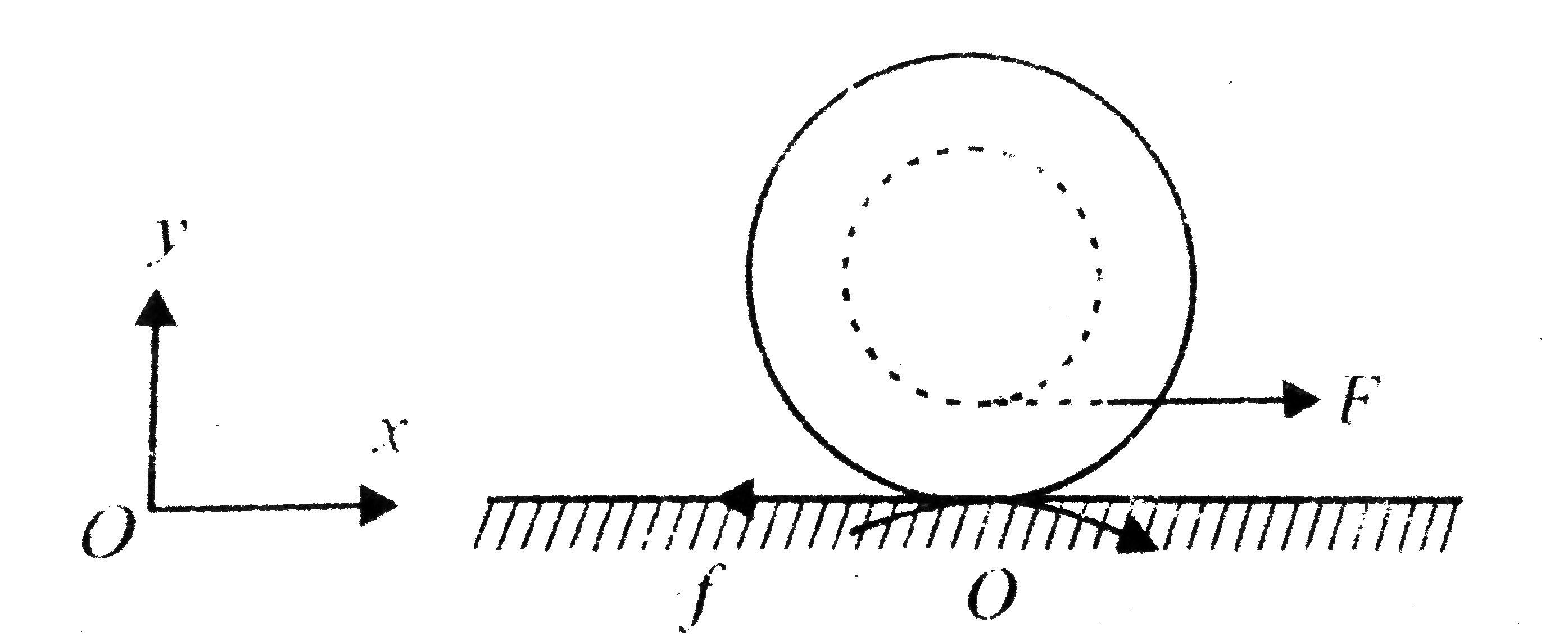 a. The `CM` moves ALONG the positive `X`-axis because the rest torque about the POINT of contactis clockwise. b. The friction force ACTS along the negative `x` axis. In the absence of friction force, point `O` has a tendency to MOVE along the positive `x`-axis. 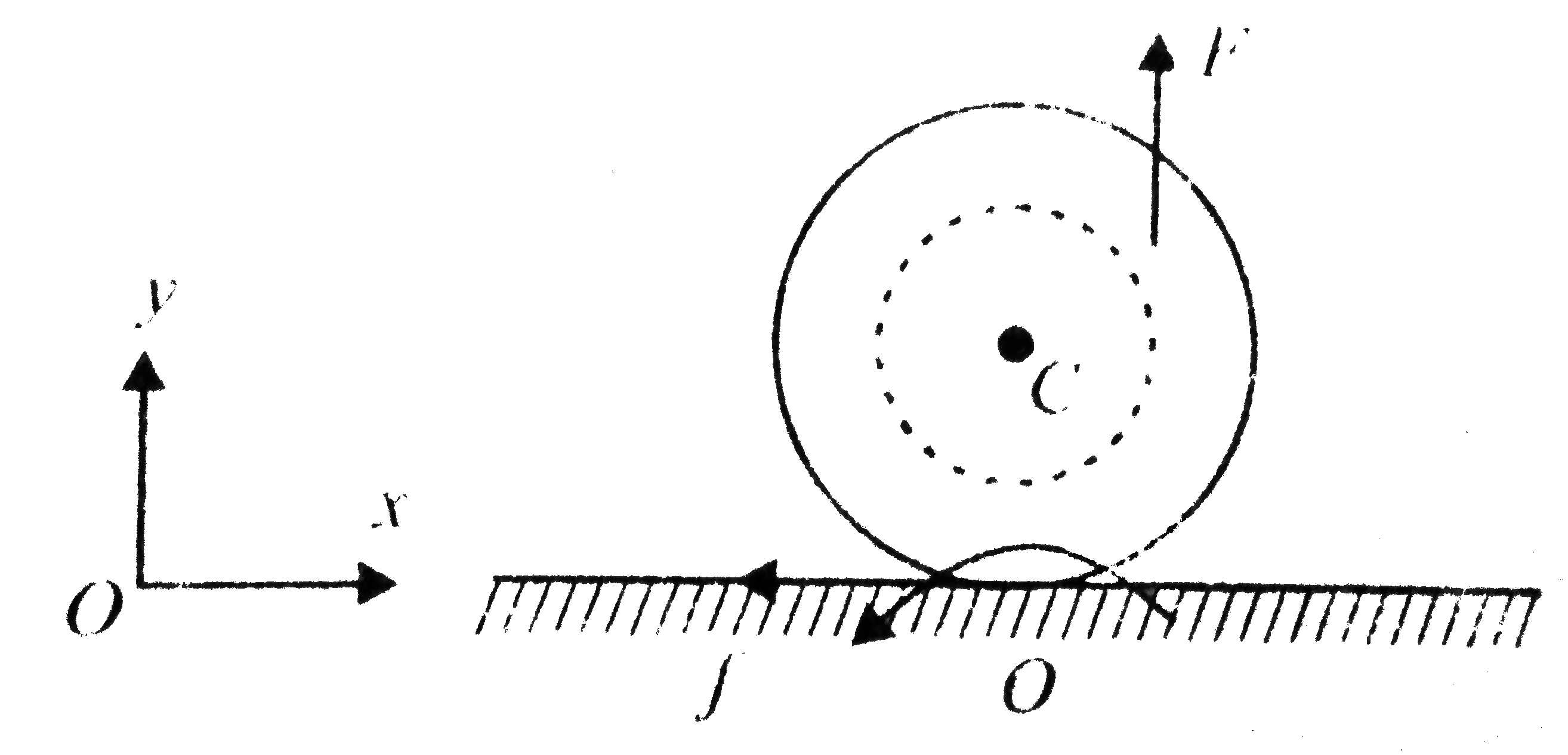 c. The `CM` moves along the negative `x` axis because the at torque about the point o contact is anticlockwise. d. The friction force acts along the negative `x`-axis. No other force is acting along the `x`-axis that can acceleration the centre of mass along the negative `x`-axis. |
|
| 42. |
Centre of mass of 3 particles 10 kg, 20 kg and 30 kg is at (0, 0, 0). Where should a particle of mass 40 kg be placed so that the combined centre of mass will be at (3, 3, 3)? |
|
Answer» (0,0,0) `therefore X_(CM) = sum_(m_(i) x_(i))/(sum m_(i)) or 3 = (10 xx 0 + 20 xx 0 + 30 xx 0 + 40 xx x)/(10 + 20 + 30 + 40)` `therefore x = (300)/(40) = 7.5` `Y_(CM) = (sum m_(i) y_(i))/(sum m_(i))` `3 = (10 xx 0 + 20 xx 0 + 30 xx 0+ 40 xx y)/(10 + 20 + 30 + 40) = y = (300)/(40) = 7.5` `Z_(CM) = (sum m_(i) z_(i))/(sum m_(i))` `3=(10 xx 0 + 20 xx 0 + 30 xx 0 + 40 xx z)/(10 + 20 + 30 + 40) implies z = (300)/(40) = 7.5` |
|
| 43. |
Which of the following quantities does not depend upon the orbital radius of a satellite ? |
|
Answer» `(T)/(R)` `:. (T^(2))/(R^(3))=` CONSTANT |
|
| 44. |
A concrete sphere of radius R has a cavity of radius r which is packed with saw-dust. The specific gravities of concrete and sawdust are 2.4 and 0.3 respectively. The sphere floats with its entire volume sub-merged under water. Calculate the ratio of mass of concrete and the mass of saw-dust |
|
Answer» 1 |
|
| 45. |
A ring rolls without slipping on a horizontal surface. At any instant, its position is as shown in the figure |
|
Answer» Section ABC has GREATER KINETIC energy than section ADC. |
|
| 46. |
When a person of mass 60 kg gets into a car, the centre of gravity of the car descends by 0.3 cm. If the mass of the car is 1000 kg, then determine the frequency of vibration of the empty car. |
|
Answer» |
|
| 47. |
A body is found to cool from 50^@C to 40^@C in 300s, and from 45^@Cto 41.5^@C in 5 minutes. Calculate the temperature of the surroundings. |
| Answer» SOLUTION :`33.3^(@)C` | |
| 48. |
Find the fundamental quantities in term of which density can be expressed. |
|
Answer» Solution :We KNOW density= `("mass")/("volume")` Also, volume = `("length")^(3)` `:. Density= ("mass")/("length")^(3)` Hence, density is a derived QUANTITY which depends on base quantities mass and length. |
|
| 49. |
Find the order of magnitude of the number of atom in 1cm^(3) of a solid. Given that the diameter of an atom is about 10^(-10)m |
|
Answer» Number of atoms in the SOLID `=1` atom `xx10^(-6)m^(3)//10^(-30)m^(3)=10^(24)` atoms |
|