

Saved Bookmarks
This section includes 7 InterviewSolutions, each offering curated multiple-choice questions to sharpen your Current Affairs knowledge and support exam preparation. Choose a topic below to get started.
| 1. |
Four particles of masses 1kg, 2kg, 3kg and 4kg are placed at the four vertices A,B,C and D of the square of side 1 m. Find the position of centre of mass of the particles. |
Answer» Solution :Assuming A as the origin , AB x-axis and AD as y-axis we have  Co-ordinates of their CM are `x_(CM)=(m_(1)x_(1)+m_(2)x_(2)+m_(3)x_(3)+m_(4)x_(4))/(m_(1)+m_(2)+m_(3)+m_(4))` `=((1)(0)+2(1)+3(1)+4(0))/(1+2+3+4)=0.5m` Similarly, `y_(CM)=(m_(1)y_(1)+m_(2)y_(2)+m_(3)_(3)+m_(4)y_(4))/(m_(1)+m_(2)+m_(3)+m_(4))` `=(1(0)+2(0)+3(1)+4(1))/(1+2+3+4)=0.7m` `:.` Co-ordinate of CENTRE of mass `(X_(CM),y_(CM))=(0.5m,0.7m)` |
|
| 2. |
See Fig. A mass of 4 kg rests on a horizontal plane. The plane is gradually inclined until at an angle theta=15^@with the horizontal, the mass just begins to slide. What is the coefficient of static friction between the block and the surface ? |
|
Answer» Solution :The forces ACTING on a block of mass m at rest on an inclined PLANE are (i) the weight mg acting vertically downwards (ii) the normal FORCE N of the plane on the block, and (iii) the static frictional force fs opposing the impending motion. In EQUILIBRIUM, the resultant of these forces must be zero.Resolving the weight mg along the two directions shown, we have `mg SIN theta = f_s , mg cos theta = N` As `theta `increases , the self - adjusting frictional force `f_s` increases unit at ` theta = theta_(max), f_s` achieves its maximum value `(f_s)_(max) = mu_s N` . Therefore ,`tan theta_(max) = mu_s "or" theta_(max) = tan^(-1) mu_s` When` theta`becomes just a little more than ` theta_( max)` , there is a small net force on the block and it begins to slide.Note that`theta_( max)`depends only on µs and isindependent of the mass of the block. for`theta_(max) = 15^@` `mu_s = tan 15^@` = 0.27 |
|
| 3. |
A rubber ball floats on the surface of water contained in a beaker, exposed to atmosphere certain volume immersed inside the water. If the whole arrangement is shifted to the ball remain immersed at the same depth? |
|
Answer» Solution :Gravity on the surface of moon is 1/6th of that on the earth surface. But the EFFECT of (a) weight of the ball (b) upthrust. So, the equilibrium of floating rubber ball will remain undisturbed. On earth, weight of the rubber ball will be balanced by upthrust from water and air. weight of the ball `=mg=V_(W) p_(w) +V_(a) p_(a) g` `V_(w)="volume of water displaced"` `p_(w)="density of water"` `V_(a)="volume of air displaced"` `p_(a)="density of air"` `m=V_(w)p_(w)+V_(a)p_(a)` Now, on the moon, there is not atomosphere, So, `mg=V_(w)^(.) p_(w) g` `m=V_(w)^(.) p_(w)` `V_(w)^(.)="Volume of water displaced on moon"` Comparing (i) and (ii), we get `V_(w) p_(w)=V_(a)p_(a)=V_(w)^(.)p_(w)` `rArr V_(w)^(.)=V_(w)+(V_(a) p_(a))/(p_(w))` `rArr V_(w)^(.) gt V_(w)` So, the volume of ball immersed INSIDE the water is greater on moon. So, the ball will likely to get a little more inside the water when taken on moon. |
|
| 4. |
A thick rope of density 1.5 xx 10 ^(3) kg m ^(-3)and Young's modulus 5 xx 10 ^(6) Nm ^(-2), 8 m in length when hung from the ceiling of room the increase in its length due to its own weight is .......... (g = 10 ms ^(-2)) |
|
Answer» `9.6 xx 10 ^(-5) m` 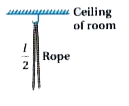 Now `Y = F/A xx ((l)/(2) )/( Delta L ) = (Wl )/( 2 A Delta l ) [ because F = W`weight] `THEREFORE Y = (mgl )/( 2 A Delta l ) = (A l rho gl )/( 2 A Delta l ) ""[because m = A l rho ]` `therefore Y = (rho g l ^(2))/( 2 Delta l )` `therefore DL = (rho g l ^(2))/( 2Y) =(1.5 xx10 ^(3) xx 10 xx (8) ^(2))/( 2 xx 5 xx 10 6^(6))` `therefore Delta l =9.6 xx 10 ^(-2) m` |
|
| 5. |
If v = (3i+4j+5k)ms^(-1) is the instan-taneous velocity of a body of mass 1.50 kg. calculate its kinetic energy. |
|
Answer» SOLUTION :`V=(3i+4j+5k)MS^(-1)M=1.5kg` KINETIC ENERGY K.E = `(1)/(2) mv^(2)` `=(1)/(2)1.5(3i+4j+5k).(3i+4j+5k,)=37.5` joules |
|
| 6. |
A particle moving with a velocity equal to 0.4ms^(-1) is subjected to an acceleration 0.15ms^(-2)of for 2 seconds in a direction at right angles to the direction of motion. The magnitude of the final velocity is |
|
Answer» `0.3ms^(-1)` |
|
| 7. |
Which physical quantities is / are conserved during elastic and inelastic collision? |
| Answer» SOLUTION :LINEAR MOMENTUM. | |
| 8. |
The variation of angular position theta, of a point on a rotating rigid body, with time t is shown in Fig. Is the body rotating clock wise or anti-clockwise ? |
| Answer» Solution : AStheslope of `THETA` -tgraphispossitiveandslope indicates , anti - CLOCK wiserotationwhichis traditionallytakenas POSITIVE . | |
| 9. |
The momenta of a body in two perpendicular directions at any time 't' are given by P_(X)=2t^(2)+6 and P_(Y)=(3t^(2))/(2)+3. The force acting on the body at t=2 sec is |
|
Answer» 5 UNITS |
|
| 10. |
Statement I: Centre of mass of a rigid body always lies inside the body. Statement II: Centre of mass and centre of gravity coincide if gravity is uniform. |
|
Answer» Statement I is TRUE, statement II is true, statement II is a CORRECT EXPLANATION for statement I. |
|
| 11. |
Find the value of (vec(a) + vec(b)) xx (vec(a) - vec(b))= |
|
Answer» `(VEC(a) XX vec(B))` |
|
| 12. |
A loaded spring vibrates with a period T. The spring is divided into four equal parts and the same load is suspended from one as these parts. The new time period is…………… |
|
Answer» `(T)/(4)` If the spring is divided into FOUR equal parts, then the force constant of each part will be 4k. Therefore, `T=2pisqrt((M)/(4k))=(T)/(2)` |
|
| 13. |
(A): The pressure of a gas depends upon kinetic energy of its molecules. (R) : Kinetic energy of gas molecules increases with increase in pressure. |
|
Answer» If both (A) and (R) are true and (R) is the CORRECT EXPLANATION of (A) |
|
| 14. |
A sphere of mass m and radius R_(2) has a concentric cavity of radius R_(1), The force exerted by the sphere on a particle of unit mass located at a distance r from the centre varies as (O le r le oo) |
|
Answer»
|
|
| 15. |
A particle executing SHM has a maximum speed of 30 cm"/"s and a maximum acceleration of 60 cm"/"s^(2). The period of oscillation is……….. |
|
Answer» `pi s` `therefore 30 = A omega """…….."(1)` and maximum acceleration, `a_("max")= A omega^(2)` `therefore 60 = A omega^(2)"""…….."(2)` Taking RATIO of equation (2) and (1) `(60)/(30)= omega` `therefore 2= (2pi)/(T)""therefore T= pi s`. |
|
| 16. |
A block of mass m moving with a velocity v_(0) on a smooth horizontal surface strikes and compresses a spring ofstiffuess k till mass coines to rest as shown in the figure. This phenomenon is observed by two observers : (a) Standing on the horizontal surface (b) standing on the block To an observer A, the net work done on the block is: |
|
Answer» `- mv_(0)^(2)` |
|
| 17. |
A block of mass m moving with a velocity v_(0) on a smooth horizontal surface strikes and compresses a spring ofstiffuess k till mass coines to rest as shown in the figure. This phenomenon is observed by two observers : (a) Standing on the horizontal surface (b) standing on the block To an observer A, the work done by the normal reaction N between the block and the spring on the block is : |
|
Answer» ZERO |
|
| 18. |
If Delta U and Delta W represent the increase in internal energy and work done by the system respectively in a thermodynamical process, which of the following is true ? |
|
Answer» `DELTA U = -Delta W`, in a ADIABATIC PROCESS |
|
| 19. |
''A black dot on as a porcelain cup apppears dark. But when heated to a high temperature it becomes brighter than the rest of the cup.'' Why ? |
| Answer» Solution :First it APPEARS dark because it absorbs, more HEAT radiation than the white porcelain. But when heated it appears white because good absorbs and good EMITTERS, in ACCORDANCE with Kirchhoff.s LAW. | |
| 20. |
Is it possible in increase the temperature of a gas without adding heat to it ? Explain. |
| Answer» SOLUTION :YET. By COMPRESSING the GAS adiabtically. | |
| 21. |
An electric heater is used in a room of total wall area 137m^(2) to maintain a temperature of +20^(@)C inside it, when the outside temperature is -10^(@)C. The walls have three different layers materials. The innermost layer of wood of thickness 2.5 cm, the middle layer is of cement of thickness 1.0 cm and the outermost layer is of brick of thickness 25.0 cm. Find the power of the electric heater. Assume that there is no heat loss through the floor and the ceiling. The thermal conductivities of wood, cement and brick are 0.125, 1.5 and 1.0W//m-""^(@)C respectively. |
|
Answer» Solution :Equivalent thermal CONDUCTIVITY of the wall `K=(l_(1)+l_(2)+l_(3))/(l_(1)/K_(1)+l_(2)/K_(2)+l_(3)/K_(3))` = `(0.025+0.01+0.25)/((0.025/0.125+0.01/1.5+0.25/1.0))` = `0.285/0.457=0.624W//m-""^(@)C` The rate of FLOW of heat is given by `H=KA(T_(1)-T_(2))/L` = `0.624xx137xx([20-(10)])/0.285=(0.624xx137xx30)/0.285=9000W` 
|
|
| 22. |
The interanal radius of one limb of a capillary U-tube is r_(1) = 1 mm and the internal radius of the second limb is r_(2) = 2 mm, the tube is filled with same mercury, and one of the limbs is connected to a vecuum pump. The surface tension & density of mercury are 480 "dyn"//"cm" & 13.6 gm//cm^(3) respectively (assume contact angle to be theta = 180^(@))(g = 9.8 m//s^(2)) What will be the difference in air pressure when the mercury levels in both limbs are at the same height ? |
|
Answer» `3.53 MM` of `HG` |
|
| 23. |
For a body in a uniformly accelerated motion, the distance of the body from a reference point at time 't' is given by x= a t + bt^(2) + c where a, b, c are constans. The dimensions of 'c' are the same as those of (A) x (B) at (C ) bt^(2)(D) a^(2)//b |
|
Answer» A |
|
| 24. |
A body attains a height equal to the radius of the earth. The velocity of the body with which it was projected is |
|
Answer» `SQRT((GM)/(R))` `(1)/(2)mv^(2)=(mgh)/(1+h//R)` Putting h = R, we get `v=sqrt(GR)=sqrt((GM)/(R))` |
|
| 25. |
The equation of a state of a gas is given by P(V-b)=nRT. If 1 mole of a gas is isothermally expanded from volume V and 2V, the work done during the process is |
|
Answer» `RT LN |(2V - B)/(V - b)| ` |
|
| 26. |
Two metal spheres each of radius 'r' and made of same material are seperated by a certain fixed distance or (d gt 2r) in a medium. The gravitational force between those spheres is proportional to |
|
Answer» `(1)/(R^2)` |
|
| 27. |
Same quantity of ice is filled in each of the two metal container P and Q having the same size, shape and will thickness but make of different materials. The containers are kept in identical surroundings, The ice in P melts completely in time t_(1), whereas in Q takes a time t_(2). The ratio of thermal conductivities of hte materials of P and Q is: |
|
Answer» `t_(2):t_(1)` `(dQ)/(dt) = -KA(d(theta))/(dx)=-KAxx(TG)` i.e., `TG alpha 1/K` `(dQ)/(dt)` = constant or `Kalpha1/t rArrK_(1)ALPHA1/(t_(1))`...........(i) `K_(2)alpha1/t_(2)`..............(II) From the Eqs. (i) and (ii), we get `K_(1)/K_(2)=(1//t_(1))/(1//t_(2)) rArrK_(1):K_(2)=t_(2):t_(1)` |
|
| 28. |
A body of mass 10 kg is acted upon by two perpendicular forces, 6N and 8N. The resultant acceleration of the body is |
|
Answer» 1 `MS^(-2)` at an angleof `tan^(-1)(4/3)` w.r.t 6n force  Mass= m= 10 kg `F_(1)=6N` `f_(2) = 8N` Resultantforce`=f= sqrt(F_(1)^(2) + F_(2)^(2)) = sqrt(36+ 64)` Let`THETA _(1)` be angleand `vec(QR )` tan `theta _(1) = (F_(2))/(F_(1))= (8)/( 6) = (4)/(3)` `theta _(1) = tan^(-1)(4)/(3) w.r.t F_(1) = 6N` `tan theta_(2)= (F_(1))/( F_(2))= (6)/(8)= (3)/(4)` `theta _(2) = tan^(-1) ((3)/(4)) w.r.tF_(2) = 8N` |
|
| 29. |
If the temperature of the sun becomes twice its present temperature, then |
|
Answer» Radiated ENERGY WOULD be predominantly in INFRARED |
|
| 30. |
The displacement y(t) of a particle depends on time according in equation y(t)=a_(1)t-a_(2)t^(2). What is the dimensions of a_(1) and a_(2)? |
|
Answer» SOLUTION :By the principle of homogeneity of dimensions, if the equation is CORRECT then `a_(1)t` and `a_(2)t^(2)` should have the same dimensions as that displacement `y(t)` i.e.[L]. i.e.`a_(1)t=[L],a_(1)=L/T=[LT^(-1)],a_(2)t^(2)=[L]=a_(2)=L/(T^(2))=[LT^(-2)]` So `[L]=[LT^(-1)]xx[T]-[LT^(-2)]XXT^(2)` or `[L]=[L]=[L]`. The EQUATIO is correct when the dimensions of `a_(1)` is `[LT^(-1)]` and that of `a_(2)` is `[LT^(-2)]` |
|
| 31. |
If the length and radius of a wire are doubled, how does its elongation change under a given load ? A. b 12. What is the Young.s modulus of the material of perfectly rigid body ? |
| Answer» SOLUTION :BECOMES HALF | |
| 32. |
Transverse waves pass through the strings A and B attached to an object of mass 'm' as shown. If mu is the linear density of each of the strings, the velocity of the transverse waves produced in the strings A and B is |
|
Answer» `sqrt((mg)/(mu))` `mg=2Tsintheta` from FIG `SIN theta=(sqrt(7))/(4)` |
|
| 33. |
A Carnot's reversible engine converts (1)/(6) of heat input into work. When the temperature of the sink is reduced by 62 K, the efficiency of Carnot's cycle becomes (1/3). The temperature of the source and the sink, in kelvin, are respectively |
|
Answer» 372, 310 |
|
| 34. |
Moment of inertia of a body does not depend upon |
|
Answer» mass |
|
| 35. |
From the given information ,select appropriatepair . |
|
Answer» `1-(a) ,(l), 2- (F),(m), 3 - (B),(j), 4 - (d) , (n)` |
|
| 36. |
A frequency generator with fixed frequency of 343 Hz is allowed to vibrate abovea 1.0 m high tube . A pump is switched on to fill the water slowly in the tube . In order to get resonance , what must be the minimum height of the water ? (Speed of sound in air is 343 ms^(-1) ) . |
|
Answer» Solution :The wavelength , `lambda = (c)/(F) implies lambda = (343 ms^(-1))/( 343 Hz) = 1.0` m Let the length of the resonant columns be `L_1 , L_2` and `L_3` . The first resonance occurs at length `L_1` `L_(1) = (lambda)/(4) = (1)/(4) = 0.25` m The second resonance occurs at length `L_(2) = (3lambda)/(4) = (3)/(4) = 0.75` m The third resonance occurs at length `L_(3) = (5 lambda)/(4) = (5)/(4) = 1.25` m Since TOTAL length of the tube is 1.0 m the third and other higher resonances do not occur . Therefore , the minimum height of weight `H_("min")` for resonance is , `H_("min") = 1.0 m - 0.75 = 0.25 m` |
|
| 37. |
A particle performs simple harmonic motion with amplitude A. Its speed is trebled at the instant that it is at a distance (2A)/3from equilibrium position. The new amplitude of the motion is: |
|
Answer» `(7A)/3` |
|
| 38. |
(A) : To unscrew a rusted nut, we need a wrench with longer arm.(R ) : Wrench with longer arm reduces the torque of the arm. |
|
Answer» Both (A) and (R ) are TRUE and (R ) is the correct explanation of (A) |
|
| 39. |
The measurement value of length of a simple pendulum is 20 cm known with 2 mm accuracy. The time for 50 oscillations was measured to be 40 s within 1s resolution. Calculate the percentage accuracy in the determination of acceleration due to gravity g from the above measurement. |
|
Answer» `= t/n = (40)/(50) s` `:. DeltaT = (Deltat)/(n)` So, `(DeltaT)/(T) = (Deltat//n)/(t//n) = (Deltat)/(t)` `Deltal, DeltaT` are LEAST COUNT errors `(Deltag)(g) = (Deltal)/(l) + 2 (DeltaT)/(T) = (0.2)/(20) +2 ((1)/(40)) = (1.2)/(20) = 0.06` Hence, the percentage error in g is `((Deltag)/(g)) xx 100 = ((Deltal)/(l) +2 (DeltaT)/(T)) xx 100% = 0.06 xx 100% = 6%` |
|
| 40. |
Is centre of mass a reality? |
| Answer» SOLUTION :No. The centre of MASS of a system is a HYPOTHETICAL point which acts as a single mass particle of the system for an EXTERNAL FORCE. | |
| 41. |
A stream of water flowing horizontally with a speed of 15 m s'1 gushes out of a tube of cross-sectional area 10-2 m_(2) and hits a vertical wall nearby. What is the force exerted on the wall by the impact of water assum ing it does not rebound ? |
|
Answer» Solution :Velocityof flowwaterv = 15`ms^(-1)` Areaof cross sectionof tube A = `10^(2)ms^(2)` Volumeof liquidflowingthroughtubeenerysecond `V=Av ` `10^(2)xx 15 ` `=15 xx 10^(2) m^(3) //s` DENSITY of WATERP = `10^(3) kgm^(-3) ` `m= pv ` `150kg//s` FORCEACTINGON walldueto impactof water = changein momentumeverysecond `= mv ` `=2250 N` |
|
| 42. |
During summers in India, one of the common practice to keep cool is to make ice balls of crushed ice, dip it in flavoured sugar syrup and sip it. For this a stick is inserted into crushed ice and is squeezed in the palm to make it into the ball. Equivalently in winter, in those areas where it snows, people make snow balls and throw around. Explain the formation of ball out of crushed ice or snow in the light of P - T diagram of water. |
Answer» SOLUTION :LOOK at graph of `ptoT` of water. At `0^(@)C` temperature increase in PRESSURE from 1 atm melts ice and decrease in pressure freezes ice.  When ice is deformed it melts paretically, pressure releases from small PORES. Hence, water freezes and by merging small ice particles a steady ball can be formed. |
|
| 43. |
A metal wire of diameter1 mm is held on two knife by a distance50 cm . The tension in the wire is 100 N. The wire vibrating with its fundamental frequency and a vibrationg tuning fork together produce5 beats//s. The tension in the wire is then reduced to 81 N. When the two excited , beats are heard at the same rate . Calculate i. the frequency of the fork and ii. the density of material of wire |
|
Answer» Solution :Let the FREQUENCY of the TUNING fork be `n` . When tension in the string is decreased , the number of beats remains unchanged. This means initially the frequency of metal wire is higher than that of fork . As number of beats ` = 5 per second` . Therefore initial frequency of wire ` n_(1) = n + 5 per second`. Therefore initial frequency of wire ` n_(1) = n + 5` So , `n_(1) = n + 5 (1)/(2 l) SQRT(((T_(1))/(m))) = (1)/( 2 xx 0.5 ) sqrt(((100)/(m)))`(i) [ Since `T = 100 N , l = 50 cm = 0.50 m`] When tension is reduced to `T_(2) = 81 N`, the frequency of wire becomes `n_(2) = n - 5` . Therefore , `n_(2) = n - 5 = (1)/(2 l) sqrt (((T_(2))/(m))) = (1)/( 2 xx 0.5 ) sqrt(((81)/(m)))`(ii) i. Dividing Eq. (i) by Eq. (ii), we GET `( n + 5)/( n - 5) = sqrt (((100)/(81))) = (10)/(9)` Solving frequency of fork , `n = 95 cycles//s.` ii. We have ` m = "mass per unit LENGTH" = Ad = pi r^(2) d`. Substituting this in Eq. (i) , we get ` n + 5 = (1)/( 2 xx 0.5) sqrt (((100)/( pi r^(2) d)))` here `n = 95 , r = ( 1mm)/( 2) = (1)/(2) xx 10^(-3) m = 5 xx 10^(-4) m` Putting all value s` 95 + 5 = (1)/( 1.0) xx(100)/([ sqrt (3.14 xx(5 xx 10^(-4))^(2) d)])` ` d = 12.7 xx 10^(3) kg// m^(3)` |
|
| 44. |
Ina car lift compressed air exerts a force F_(1) on a small piston having a radius of 5.0 cm . This pressure is transmitted to a second piston of radius 15 cm . (See figure).If the mass of the car to be lifted is 1350kg .Calculate F_(1) . What is the pressure necessary to accomplish this task ?(g=9.8ms^(-2)) |
| Answer» SOLUTION :`F_(1)=529.2N,` pressure `P=1.8726xx10^(5)Nm^(-2)` | |
| 45. |
A rod of mass 5 kg is connected to the string at point B. The span of rod is along horizontal. The other end of the rod is hinged at point A. If the string is massless, then the reaction of hinge at the instant when string is cut, is (Take, g=10 ms^(-2)) |
|
Answer» 10.1 N `tau_(A)="mg"(l)/(2)`….(i) Also from Newton's law, `tau_(A)=I alpha` where, `alpha=` angular acceleration of the rod and `I=` moment of inertia of rod, From EQS. (i) and (ii), we get `I alpha="mg"(l)/(2)rArr alpha="mg" (l)/(2)//I` As, `I=m (l^(2))/(3)` So, `alpha=(mg(l//2))/((ml^(2))/(3))=(3g)/(2l)` Now, acceleration of centre of mass of rod, `a_(CM) = alpha.r` Here, r = distance between hinge point A and centre of the rod `rArr a_(CM)=(3)/(2)(g)/(l)(l)/(2)=(3g)/(4)rArr mg-R_(A)=ma_(CM)` where, `R_(A)=` REACTION at A `rArr mg-R_(A)=mxx(3g)/(4)rArr R_(A)=(mg)/(4)=(5xx10)/(4)=12.5 N`. |
|
| 46. |
A body of mass 'm' and radius 'r' rolling on a horizontal floor with velocity 'v', rolls up an inclined plane up to vertical height (3V^(2))/(4g). Find the moment of inertia of body and comment on its shape. |
|
Answer» Solution :The total KE of the body `K=K_(T)+K_(R )=(1)/(2)mv^(2)[1+(I)/(mr^(2))]` When rolls up an inclined plane of HEIGHT `H=(3V^(2))/(4g)` its KE is converted into PE So `(1)/(2)mv^(2)[1+(I)/(mr^(2))]=mg((3v^(2))/(4g))` on simplification `I=(mr^(2))/(2)` HENCE the body is either a DISC or CYLINDER. |
|
| 47. |
Two small spheres of radii r and 2r fall through a viscous liquid with the same constant speed. The viscous forces experienced by them are in the ratio ………….. . |
|
Answer» `1 : 2` |
|
| 48. |
Weight of a body on the surfaces of two planets is the same. If their densities are d_(1) and d_(2), then the ratio of their radius |
|
Answer» `(d_(1))/(d_(2))` |
|
| 49. |
A balloon rises with uniform velocity of 10ms^(-1). When the balloon is at a height of 75 m if a stone is dropped from it the time taken by it to reach the ground is |
|
Answer» 3 sec |
|


