

Saved Bookmarks
This section includes 7 InterviewSolutions, each offering curated multiple-choice questions to sharpen your Current Affairs knowledge and support exam preparation. Choose a topic below to get started.
| 1. |
In which of the following cases the, potential energy is defined? |
|
Answer» both conservative and non-conservative forces Force, `F=-((del U)/(del x)hati+(del U)/(del y)hat j+(del U)/(del z)hat K)` where, F =Conservative force `((del U)/(del x)hati+(del U)/(dely)hatj+(delU)/(delz)HATK)="Partial derivative of potential energy"` w.r.t.x,y and respectively. |
|
| 2. |
what is law of conservation of energy? |
| Answer» Solution :it STATES that ,"energy can neither be CREATED nor destroyed but it can be transformed form ONE form to another " | |
| 3. |
A body is moving under the expense of a constant power. If .X. is the displacement in time. t_1, then .x. is proportional to |
|
Answer» `t^(2//3)` |
|
| 4. |
A man of mass 40kg in standing on a uniform plank of mass 60 kg lying on horizontal frictionless ice. The man walks from one end to the other end of the plank. The distance walked by the man relative to ice is (given length of plank = 5m) |
|
Answer» 2 m |
|
| 5. |
State Archlmedes principle. |
|
Answer» Solution :When a body is PARTIALLY or wholly IMMERSED in a fluid, it experiences an upward thrust equal to the WEIGHT of the fluid displaced by it and its upthrust acts through the centre of gravity of the liquid displaced. Upthrust or buoyant force = weight of liquid displaced. |
|
| 6. |
A planet moves around the sun of mass m in an ellipticcal orbit of eccentricity e. If a is the semi major axisof the elliptical orbit , the velocity of the planet at the apogee is given by |
|
Answer» `SQRT((GM)/(a)[(1+e)/(1-e)])` |
|
| 7. |
According to newton’s low of motion, the force depends on the rate of change of r momentum A man jumping out of a moving bus falls with his head forward. What should he do in order to long safety ? |
| Answer» Solution :He should RUN for some DISTANCE in the direction of MOTION of the BUS | |
| 8. |
A glass rod when measured with a zinc scale, both being at 30°C, appears to be of length 100cm. If the scale shows correct reading at 0°C, determine the true length of the glass rod at (a) 30°C and (b) 0°C. ( 'alpha' for glass = 8 xx 10^(-6)//°C and for zinc = 26 xx 10^(-6)//°C ) |
|
Answer» `100.078` CM |
|
| 9. |
Assume that a geosunchronous communications satellite is in ornit at the longitude of Kota. Your are at Kota and want to pick up its signals. In what direction should you point the axis of your parabolic antenna from vertical? The latitude of Kota is 30^(@)N. |
Answer» 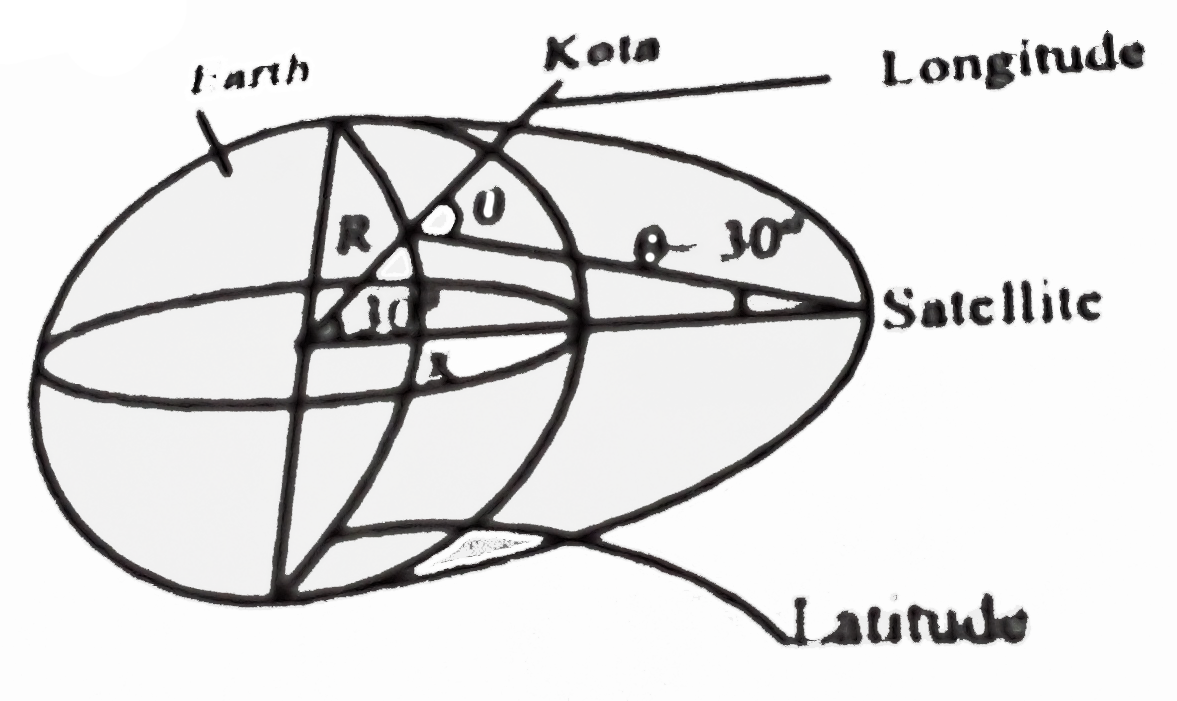 `(SIN theta)/v=(sin(theta-30^(@)))/R` `R/x=(sin thetacos30^(@)-cos thetasin30^(@))/(sin theta)` `6400/42000=cos30^(@)-cot thetasin30^(@)` `theta=cot^(-)[SQRT(3)-32/105]` |
|
| 10. |
An object is thrown vertically upward with some velocity. If gravity is turned off at the instant the object reaches the maximum height, what happens ? |
|
Answer» The object CONTINUES to move in a straight line |
|
| 11. |
In the Fig. 7.85 shown a constant force is applied on the lower block , just large sliding out from between the upper block and the table . Determine the acceleration of each block . |
Answer»  `f_(1) = 5 xx a_(1)` `a_(1) = 0.98 m// sec^(2)`  For LOWER block  `F - mu_(k)N_(1) - mu_(k) N_(2) = M xx a_(2)` `F - 0.1 xx 5 xx 9.8 - 0.4xx 20 xx 9.8 = 15 xx a_(2) "" ..... (i) ` [Valueof F = `(3)/(10) xx 5 xx 4.9 + (5)/(10) xx 20 xx 4.9`] Byputting this VALUE of F in EQUATION(i) , we get `a_(2)` |
|
| 12. |
Fire is extinguished more effectively by |
| Answer» Answer :a | |
| 13. |
The coefficient of friction between a hemispherical bowl and an insect is sqrt(0.44) and the radius of the bowl is 0.6m. The maximum height to which an insect can crawl in the bowl will be |
|
Answer» 0.4m |
|
| 14. |
When a diatomic gas expands at constantpressure, the percentage of heat supplied that increases temperature of the gas and in doing external work in expansion at const-ant pressure is |
|
Answer» `60%, 40%` |
|
| 15. |
Two discs have the same mass and thickness. Their materials are of densities d_(1) and d_(2). The ratio of their M.I. about their central axis is |
|
Answer» `d_(2):d_(1)` |
|
| 16. |
What is a rigid body ? Explain the differences between rigid body and solid body. |
| Answer» SOLUTION :A SOLID BODY can be DEFORMED while a RIGID body can not. | |
| 17. |
What is meant by Inertial frame of reference. |
|
Answer» Solution :(i) In this INERTIAL frames an object experiences no FORCE it moves with constant velocity or remains at rest. (ii) A frame of reference in which Newton's FIRST law of motion HOLDS GOOD is called an inertial frame of reference. |
|
| 18. |
(i) Determine the height h to which water rises when capillary tube of radius 0.2 mm is dipped vertically in a beaker containing water (Surface tension of water 7.0xx10^(-3)Nm^-1) and angle of contact =0^(@)) (ii) Discuss what will happen if the capillary tube is now pushed down till its height above thesurface of water is 4 cm. Assume that the density of water is 1000 kgm^(-3) and g is 10ms^(-2) |
|
Answer» Solution :(i) Formula `h=(2Scos THETA)/(r rho g)` Angle of contact `theta=0^(@):.cos 0^(@)=1` Surface tension `S=7xx10^(-2)Nm^(-1)` Density of water `d=1000kgm^(-3)` Acceleration due to gravity `g=10ms^(-2)` Radius of the tube `r=(0.2//1000)m` `:.` Height `h=(2xx(7xx10^(-2))xx1)/((0.2/1000)xx(1000)xx(10))=7xx10^(-2)m ` or 7 cm (i) However when the capillary tube is pushed down till its height above the surface of water is 4 cm, the water RISES up to 4 cm only and it will not over flow. In this sepcial CASE the angle of contact will CHANGE `(h_(2))/(h_(1))=(cos theta_(2))/(cos theta_(1))implies cos theta_(2)=(h_(2))/(h_(1))cos theta_(1)` here `h_(1)=7cm,h_(2)=4cm, theta_(1)=0^(@)` `cos theta_(2)=cos^(-1)(0.5714)=55^(@)` |
|
| 19. |
A solid cylinder of mass 20kg rotates about it axis with anguler speed 100s^(-1) the radius of the cylinder is 0.25m, Calculate moment of intertia of the solid cylinder. |
|
Answer» Solution :Given Data : R=0.25m,M=20KG, `omega=100s^(-1)` MOMENT of inertia of the solid cylinder=`(MR^(2))/(2)` `=(20xx(0.25)^(2))/(2)=0.625kgm^(2)` `therefore` K.E of rotation` =(1)/(2)IOMEGA^(2)` `(1)/(2)xx0.625xx(100^(2))=3125J` `therefore` Anguler momentum `L=Iomega=0.625xx100` `L=62.5Js` |
|
| 20. |
A drop of radius 1 mm is sprayed into 1000 droplets of same size. If surface tension of the liquid is 40 dyne (cm^(-1)), the amount of workdone in the process is |
|
Answer» 4.53 erg |
|
| 21. |
Find the velocity of image w.r.t ground shown in figure. |
|
Answer» Solution :For the velocity component along the principal axis `(V_(II))_(II)=+v^2/u^2 (V_(OL))_s`. Applying lens equation `1/v-1/u=1/f IMPLIES 1/v-1/(-20)=1/(+30) implies v=-60cm` `m=+ v/u=(-60)/(-20)=3, (V_(IM))_(II)=+((-60)/(-20))^2 (5)=+45m//s` `vecV_(RG)=vecV_(IL)+vecV_(LG)=+45+0=45m//s` Hence, IMAGE aproaches the lens with a velocity `45m//s` |
|
| 22. |
An open knife edge of mass M is dropped from a height .h. on a wooden floor. If the blade penetrates a distance .s. into the wood, the average resistance offered by the wood to the blade is : |
|
Answer» Mg |
|
| 23. |
A particle of mass m moving in the x - directionwith speed 2c is hit by another particleof mass2m moving in the y - direction with with speed v . If the collision is perfectly inelastic , the percentage loss in the enrgy during the collision is close to . |
|
Answer» 0.44 `vec(p_(2)) =m_(2)vec(v_(2)) =m(2v)hat(i) =2mv hat(j)` ` :. " Resultant momentum " | vec(p) | = sqrt(p_(1)^(2)+p_(2)^(2))` `(2m+m) v. = sqrt((2mv)^(2)+(2mv)^(2))` ` : 3v. , = sqrt(4m^(2)v^(2)+4m^(2)v^(2))` ` :. 3v. m = 2sqrt(2) MV ` ` :. v = = (2sqrt(2))/3 v ` Now , DECREASE in K.E= INTIAL K.E - K.E after collision `1/2 m(2v)^(2) +1/2 (2m) v^(2) - 1/2 [2m+m] (v)^(2)` ` = 2,v^(2) +mv^(2)-1/2 xx3m xx (8v^(2))/9` ` = 3mv ^(2) - (4v^(2)m)/3 ` `= (9mv^(2)-4v^(2)m)/3= (5mv^(2))/3` ` :. %" loss in K.E "=((5mv^(2))/3)/(2mv^(2)+mv^(2)) xx100 % ` `=(5mv^(2))/(3xx3mv^(2)) xx100 % ` ` = 500/9 % ` ` = 55.55 % ` ` = 56 % ` |
|
| 24. |
In an elastic collision of two bodies , the momentum and energy of each body is conserved . |
| Answer» SOLUTION :No , In THISCASE total kinetic energy is not conservedbecause when the bodies are in contact in ELASTICCOLLISION even the kineticenergy is converted into potential energy . | |
| 25. |
State and prove Bernoulli's theorem. Write any two limitations of Bernoulli's theorem. |
|
Answer» Solution :1st part: N/A 2nd part: Limitations: (i) VISCOUS DRAG is not taken into account. (ii) It is ASSUMED that there is no ENERGY LOSS. |
|
| 26. |
Determine whether the given points are collinear. P(1, 2) , Q(2, 8/5), R(3, 6/5) |
|
Answer» Solution :DIMENSIONAL formula for T = T Dimensional formula for r = L Dimensional formula for `G = M^(-1) L^3 T^(-2)` Dimensional formula for M = M. (a) `T^2M^)L^) = [L^3] [ML^(-3) T^2]` `T^2 M^0L^0 = L^0 MT^2` - not correct (b) ` T^2 = [L^3] [ML^(-3) T^2] [M^(-1) ]` `T^2 = T^2` = dimensionally correct |
|
| 27. |
CLASSICAL PHYSICS |
|
Answer» If both assertion and reason are true and reason is the correct EXPLANATION of assertion. |
|
| 28. |
Ten one rupee coins are put on stop of one another on a table Each coin has a mass m kg Give the magnitude and direction of (a)the force on the 7 th coin (counted from the botton ) due to all coins above it (b) the force on the 7 th coin by the eighth coin and (c) the reaction of the sixth coin on the seventh coin. |
|
Answer» SOLUTION : (a) The force on 7 th coin is due to weight of the three coins lying above it Therefore ` F = (3 m ) kg f = (3 mg ) N ` where g is acceleration due to GRAVITY . This force acts vertically downwards . (b) The eighthcoin is alredy under the weight of two coins above it and it has its own weight too . Hence force on 7 th coin due to 8 th coin is sum of the two forces i . e ` F = 2 m + m = (3 m ) kg f = (3 mg ) N ` The force acts vertically downwards. (c) The sixth coin is under the weight of four coins above it REACTION ` R = - F = - 4 m (kg f ) = - (4 mg ) N ` Minus sigh indicates that the reaction acts vertically upwards opposite to the weight . |
|
| 29. |
The rise of liquid into capillary tube is h_(1). If the apparatus is taken in a lift moving up with acceleration, the height is h_(2), then |
|
Answer» `h_(1)=h_(2)` |
|
| 30. |
Which type of strain is there, when a spiral spring is stretched by a force? |
| Answer» SOLUTION :LONGITUDINAL STRAIN and SHEAR strain. | |
| 31. |
A conical vessel without a bottom tightly stands on a table. A liquid is poured into the vessel and as soon as its level reaches a height h. The pressure the liquid raises the vessel. The radius of the bottom greater base of the vessel is R, the semi- vertex angel of the cone is, prop and the weight of the vessel is W. What is the density of the liquid ? |
|
Answer» `(W)/(pi GH^(2)TAN^(2) PROP (R+(1)/(3) H tan prop ))` |
|
| 32. |
A shell of mass 100 g moving with speed of 50 m s^(-1) along a straight line inclined at an angle tan^(-1) ((4)/(3)) to the horizontal bursts into two pieces. The piece of mass 60 g starts moving horizontally with a speed of 50 m s^(-1). The other piece moves with a speed of |
|
Answer» `50ms^(-1)` opposite to the first PIECE `= (100)/( 1000) xx 50kgms^(-1)=kgms^(-1)` Horizontalmomentum`= 3 kgms^(-1)` verticalmomentum`= 4 kgms^(-1)` thevelocityof otherpieceof mass40 g ` = (4 kgms^(-1))/( 0.04kg ) = 100MS^(-1)`  Toconservemomentum ,itshouldbe directedvertucallydownward . |
|
| 33. |
The displacement of an object attached to a spring & executing SAM is given by x=2xx10^(-2) |
|
Answer» `0.55mu` |
|
| 34. |
Which is the following measurement is more accurate? |
|
Answer» `7000m` |
|
| 35. |
Two parallel rail tracks run north south. Trains A moves north with a speed of 54km h^(-1), and train B moves south with a speed of 90km h^(-1). What is the (a) velocity of B with respect to A? (b) Velocity of ground with respect to B? and (c) velocity of a monkey running on the roof of the train A against its motion (with a velocity of 18kmh^(-1) with respect to the train A) as observed by a man standing on the ground? |
|
Answer» Solution :`v_(A)=+54km h^(-1)=15ms^(-1)` `v_(B)=-90kmh^(-1)=-25ms^(-1)` RELATIVE velocity of B with respect to A is `V_(BA)=V_(B)-V_(A)=-40ms^(-1)` i.e, the train B appears to A to move with a speed of 40 m s-1 from north to south. Relative velocity of ground with respect to B is `V_(GB)=0-V_(B)=25ms^(-1)` In (c), let the velocity of the monkey with respect to ground be `v_(M)`. Relative velocity of the monkey with respect to A. `v_(MA)=V_(M)-V_(A)=-18kmh^(-1)=-5MS^(-1)` THEREFORE `v_(M)=v_(MA)+V_(A)=(-5+15)ms^(-1)=10ms^(-1)`. |
|
| 36. |
What is the heat lost from the body of a person her hour whose body temperature is 37^(@)C and the surrounding temperature is 20^(@)C ? The emissivity of the skin is 0.92 and the surface area of skin is 1.6 m^(2) . (Asssume that the person is unclothed.) |
|
Answer» Solution :`T = 37div273 = 310K, T_(0) = 273+20=293 K` `e = 0.92,A = 1.6m^(2), t = 1 hour = 3600 s` Heat lost in t sec = `esigmaA(T^(4)-T_(0)^(4))t` Heat lost in ONE hour Q = `0.92xx5.67xx10^(-8)xx1.6xx(310^(4)-293^(4))xx3600` = `5.6xx10^(5)` J |
|
| 37. |
Water is heated by using an immersion heater. Can the process be reversed? |
| Answer» SOLUTION : No, it is an irrversible PROCESS. | |
| 38. |
Which of the two kilowatt hour or electron volt is a bigger unit of energy and by what factor ? |
|
Answer» `(1kwh)/(1EV)=(3.6xx10^(6)J)/(1.6xx10^(-19)J)` |
|
| 39. |
In the situation shown, all surfaces are frictionless and triangular wedge is free to move. In column-2, the direction of certain vectors are shown. Match the direction of quantities in column-1 with possible vector in column-2. |
|
Answer» |
|
| 40. |
A particle moves in a circle in such a way that, its tangential deceleration is numerically equal to its radial acceleration. If the initial velocity of the particle is V_(0), find the variation of its velocity with time |
|
Answer» `(V_(0))/(1+ (V_(0)t)/(R))` |
|
| 41. |
When air is blown In betweentwo balls suspended close to each other they are attracted towards each other why? |
| Answer» Solution :This is because when air is BLOWN, velocity is increased and the pressure is DECREASED. On the other side of the BALLS pressure is HIGH, so they are attracted towards each other. | |
| 42. |
Choose the correct answer from the brackets . Weakest force in nature is ……... |
|
Answer» Strong nuclear FORCE, |
|
| 43. |
A solid cylinder of mass M and radius R is resting on a horizontal platform (which is parallel to the x-y plane) with its axis fixed along y-axis and free to rotate about its axis. The platform is given a motion in the X direction given by x = A cos omega t. There is no slipping between the cylinder and the platform. the maximum torque acting on the cylinder during the motion is |
|
Answer» `(M OMEGA^(2)AR)/(3)` |
|
| 44. |
When the temperature is increased , the angle of contact of a liquid |
|
Answer» INCREASES |
|
| 45. |
{:("List - 1","List - 2"),("a)"m^(-1) ,"e) Surface tension"),("b)" Pa,"f) Thermal capacity"),("c)"JK^(-1),"g) Rydberg constant"),("d)"J "m"^(-2) ,"h) Energy density"):} |
|
Answer» a-h b-f C-e d-g |
|
| 46. |
A boy sits near the edge of revolving circular dise (i) What will be the change in the motion of a disc? (ii) If the boy starts moving from edge to the center of the disc, what will happen? |
|
Answer» Solution :As we know L=L omega`=constant if the boy sits on the edge of REVOLVING disc, its I will be increased in turn it reduces angular VELOCITY. (II) If the boy STARTS moving towards the CENTER of the disc, its I will decrease in turn that increases its angular velocity. |
|
| 47. |
The frequency of a particle performing SHM is 12Hz. Its amplitude is 4cm. Its initial displacement is 2cm towards positive extreme position. Write its equation for displacement. |
| Answer» SOLUTION :x=0.04 SIN`(24 PIT +pi/6)`m | |
| 48. |
A wire 3m long and diameter 0.3 mm is stretched by a load of 2kg. If the elongation is 2mm, find the Young.s modulus of the material of the wire and the potential energy stored in the wire. |
|
Answer» |
|
| 49. |
A uniform thin ring ABCD rolls without slipping on a rough horizontal surface, The line BD is horizontal and line AC is vertical. The kinetic energies of section AB, BC, CD and DA are respectively K_(1),K_(2),K_(3) and K_(4). Relation among KE's (K_(1))/(K_(4))=a(K_(2))/(K_(3))=b then ab is |
|
Answer» |
|
| 50. |
Distinguish between uniformly accelerated and non-uniformly accelerated motion. |
|
Answer» SOLUTION :In accelerated motion, if the change in velocity of an OBJECT per unit time is same (CONSTAT) then the object is said to be MOVING with UNIFORMLY accelerated motion. If the change in velocity per unit time is different at different times , then the object is said to move with non-uniform accelerated motion. |
|