

Saved Bookmarks
This section includes 7 InterviewSolutions, each offering curated multiple-choice questions to sharpen your Current Affairs knowledge and support exam preparation. Choose a topic below to get started.
| 1. |
What is meant by waves? |
| Answer» SOLUTION :The disturbance which carries energy and momentum from one point in space to another point in space WITHOUT the transfer of the MEDIUM is KNOWN as a wave. | |
| 2. |
In the arrangement shown in figure , the mass of ball 1 is (n=1.8) times larger than that of rod 2 . Thelength of rod is 1=1m . The ball is set on the same level as the lower end of the rod and then released , find the time taken by the ball to reache at the level of the upper end of the rod. The masses of pulleys , threads and the friction may be neglected . |
|
Answer» |
|
| 3. |
A force acting on a body depends on its displacement S given by Fprops^(-1//3). Then power delivered by force directly proportional to S^(x). Then the value of x is. |
|
Answer» |
|
| 4. |
Find the specific heat of a polyatomic gas at constant volume if the density of gas in standard conditions is 7.95 xx 10^(-4) g//cm^3 |
| Answer» SOLUTION :`0.334cal//g^(@) C` | |
| 5. |
A double star is a system of two stars rotating about their centre of mass only under their mutual gravitational attraction. Let the stars have masses m and 2m and let their separation be 1. Their time period of rotation about their centre of mass will be proportional to (a)1^(3//2), (b)a , (c) m ,(d)m^(-1//2) |
|
Answer» only a and C are TRUE |
|
| 6. |
What is the time period of revolution of a geo-stationary satellite ? Does it rotate from west to east or east to west |
| Answer» Solution :The time period of a geo-stationary satellite is 24 hrs. SATELLITES in geo-stationary orbit will REVOLVE round the earth in west to east direction in an equatorial PLANE. | |
| 7. |
A shot moving with a velocity 140 ms^(-1) collides a wooden block and comes to rest in it. If mass of the block is 13 times the mass of the shot, velocity of the block is |
| Answer» Answer :B | |
| 8. |
Two bodies A and B whose masses are in the ratio 1 : 2 are suspended from two separate massless springs of force constants k_(A) andk_(B) respectively . If the two bodies oscillate vertically such that their maximum velocities are in the ratio 1 :2 , the ratio of the amplitude A to that of B is |
|
Answer» `SQRT(k_(B)/(2k_(A)))` |
|
| 9. |
Four particle each of mass 1kg are at the four corners of a square of side 1m. The work done to move one of the particles to infinity |
|
Answer» `2sqrt(2)G` |
|
| 10. |
Thes orbital speed of satellite revolving very close to earth |
|
Answer» `sqrt((2GM)/R)` |
|
| 11. |
A body of mass 3 kg is moving along a straight line with a velocity of 24 ms^(-1)When it is at a point 'P' a force of 9 N acts on the body in a direction opposite to its motion. The time after which it will be at 'P' again is, |
| Answer» ANSWER :B | |
| 12. |
Inner and outer radii of a spool are r and R, respectively. A thread is wound over its inner surface and spool is placed over a rough horizontal surface.Thread is pulled by a force F as shown in Figure. In case of pure rolling, which of the following statements are possible to be correct |
|
Answer» Thread unwinds, SPOOL rotates anticlockwise and FRICTION acts left WARDS |
|
| 13. |
Is the direction of acceleration same as the direction of velocity ? |
| Answer» SOLUTION :Not necessarily . If velocity INCREASES, acceleration ACTS in the DIRECTION of velocity and if velocity decreases, then acceleration acts in the opposite direction of velocity . | |
| 14. |
Find the temperature at which the fundamental frequency of an organ pipe is independent of small variation in temperature in terms of the coefficient of linear expansion ( alpha) of the material of the tube. |
|
Answer» `1//3alpha` `f=(v)/(2l)` where `l` is length of the organ pipe at temperature `T` Also, `l=l_(0)[1+alpha(T-T_(0))]` VELOCITY of sound, `v=sqrt((gammaRT)/(M))` We have to find the temperatureat which `f(T')=f(T_(0))` for small `(T-T_(0))` `(sqrt((gammaRT)/(M)))/(2l_(0)[1+ alpha(T-T_(0))])=(sqrt ((gammaRT_(0))/(M)))/(2l_(0))rArrsqrt((T)/( T_(0)))=1+alpha(T-T_(0))` `" "[1+((T-T_(0))/(T_(0)))]^(1//2) =1+alpha(T -T_(0))` For small ` (T-T_(0))` we may use binomial APPROXIMATION, `1+(1)/(2)((T-T_(0))/(T_(0 )))= 1+alpha(T-T_(0))` `(1)/(2)((T-T_(0))/(T _(0)))=alpha( T-T_(0)),alpha=(1)/(2T _(0))orT_(0)=(1)/(2alpha)` |
|
| 15. |
A SONAR (sound navigation and ranging) uses ultrasonic waves to detect and locate objects under water. In a submarine equipped with a SONAR , the time delay between generation of a probe wave and the reception of its echo after reflection from an enemy submarine is found to be 77.0s. What is the distance of the enemy submarine ? (Speed of sound in water = 1450 ms^(-1)). |
|
Answer» SOLUTION :Time taken to hear echo T=77 s Time taken by wave to reach to ENEMY submarine `t=(T)/(2)=(77)/(2)=38.5s` Speed of SOUND in water `v=1450ms^(-1)` Distance of enemy submarine D=vt `=1450x38.5` =55825m =55.825 km |
|
| 16. |
'The earth without its atmosphere would be inhospitably cold'. Why? |
| Answer» Solution :Heat radiated outby earth is REFLECTED back by the atmosphere. In the absence at night all heat would escape from earth.s surface THEREBY surface would be inhospitality cold. Also atmosphere helps in maintaining the temperature through convection CURRENT. | |
| 17. |
Assuming the earth to be a uniform sphere of mass M and radius R. which of the following graphs represents the variation of accelerationdue to gravity with distance 'r' from the ventre of the earth. |
|
Answer»
|
|
| 18. |
What is a discovery ? |
| Answer» Solution :ACCORDING to Abbert SZENT = Gyorgyi (1893 - 1986), DISCOVERY cosists of SEEING that evetybody has seen, but thinking what nobody has thought. | |
| 19. |
If T be the period of revolution of a planet revolving around sun is an orbit of mean radius R, then identify the incorrect graph |
|
Answer»
|
|
| 20. |
Two particles of mass m_(1),m_(2) moving with initial velovity u_(1) and u_(2) collide head-on. Find minimum kinetic energy that system has during collision. Thus. Prove that maximum kinetic energy is lost in perfectly inelastic collision |
|
Answer» Solution :Particles moving with velocity `u_(1)` and `u_(2)` in the same direction. In C-frame initial KINETIC energy of system is `K_("sys")=K_(sys//c)+K_(c')` we get `K_(sys)=(muv_(rel)^(2))/(2)+(mv_c^(2))/(2)` `(1)/(2)mu(u_(2)-u_(1))^(2)+(mv_(c)^(2))/(2)` `mu=(m_(1)m_(2))/(m_(1)+m_(2))` ltbegt During collision, at the instant of maximum deformation. we get minimum kinetic energy in C-frame as particles attain same. velocity, thus relative velocity becomes zero. When an isolated system has minimum kinetic energy in C-frame, it will also have minimum kinetic energy in ground frame, as velocity of center of mass is constant. Thus minimum kinetic energy during collision is `(1)/(2)(m_(1)+m_(2))v_(c)^(2)` Where `v_(c)=((m_(1)u_(1)+m_(2)u_(2)))/(m_(1)+m_(2))` In perfectly inelastic collision, since both the particles move together, the relative velocity be- comes zero. Thus, final kinetic energy is `(1)/(2)(m_(1)+m_(2))v_(c)^(2)(m_(s)=m_(1)+m_(2))`, as velocity of center of mass is constant. This is the minimum possible kinetic energy that a system will have because in all other case there will be one more term adding in the kinetic energy of system because of particles having relative velocity. Two block of mass `m_(1)` and `m_(2)` connected by an ideal spring of spring constant `k` are kept on a SMOOTH horizontal surface. Find maximum extension of the spring when the block `m_(2)` is given an initial velocity of `v_(0)` towards right as shown in figure. 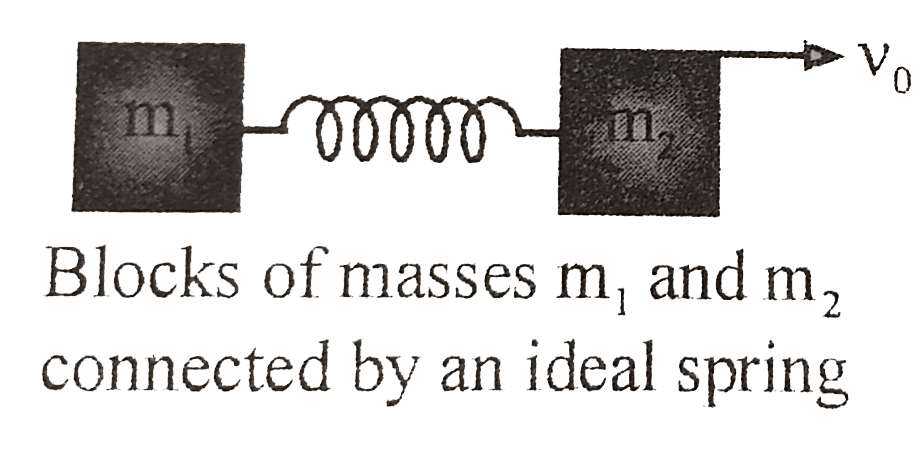 When a block of mass `m_(2)`is given an initial velocity of `v_(0)` towards right, the spring extends and pulls the block toward left and the same extended spring will pull the block `m1` towards right. Initially the force acting on `m_(2)` will reduce its speed and the force acting on `m_(1)` will increase its speed. Thus, we can see that initially the extension be increasing.If we consider the two blocks and spring as one system, then total mechanical energy must be CONSERVED as there is no dissipative force present. Also, momentum will be conserved as there is no external force present. Now there will be an instant when the block will have same velocity, that is, velocity of `m_(1)` has increased SUFFICIENTLY to become equal to the velocity of `m_(2)` which has been decreasing continuously. At this moment. The spring wil have the maximum extension`x_(xax')` as till this point distance between the blocks was continuously increasing because `m_(2)` had larger velocity. Now it will start decreasing as `m_(1)` will be moving faster than `m_(2)` and it will reduce the distance between the two blocks. Thus when `v_(1)=v_(2')` extension is maximum. This can also be understood alternatively by looking at `m_(1)` from reference frame attached to `m_(2)`. To an observer sitting on `m_(1)` the block `m_(2)` will be colsest or farthest when it is relative at rest. Since no external force is present, velocity of canter of mass is given as `v_("com")=((m_(2)v_(0)))/(m_(1)+m_(2))` From the reference frame of center of mass, the initial kinetic energy is given by `K=(1)/(2)mu(v_(2f)-v_(1f))^(2)=(1)/(2)(m_(1)m_(2))/(m_(1)+m_(2))(u)^(2)` From the reference frame of center of mass, the final kinetic energy is given by `K=(1)/(2)mu(v_(2f)-v_(1f))^(2)=0` Thus, equating initial and final energies in C-frame, we get `(1)/(2)(m_(1)m_(2))/(m_(1)+m_(2))(v_(0))^(2)=0+(1)/(2)kc_(max)^(2)` Thus, maximum extension `x_(max)=v_(0)sqrt((m_(1)m_(2))/(k(m_(1)+m_(2)))` This problem can be thought exactly as the opposite of the privious Illustration as here the maximum extension is occurrig the relative velocity is zero. |
|
| 21. |
Two clocks are being tsted against a standard clock located in the national laboratory. At 10: 00: 00 AM by the standard clock, the readings of the clocks are : If you are doing an experiment that requires prescision time interval measurements, whichof the two clock will you prefer ? (a)Clock A (b) Clock B (c) Either Clock A or B (d) Neithr A nor B |
| Answer» Solution :The AVERAGE reading of Clock A is much CLOSURE to the standard time than the average reading of clock B and the range of VIBRATION over the 5 days of observation is much smaller for clock B. As here clock's ZERO error is not significant for precision work, because a zero error can always be easily corrected. HENCE, clock B is to be preferred to clock A. | |
| 22. |
If the length of a body is measured m centimeters instead of meters the coefficient of linear expansion |
|
Answer» increasses |
|
| 23. |
A simple pendulum has a time period T_(1). When its point of suspension is moved vertically upwards according as y=kt^(2),where y is vertical covered and k=1 ms^(-2) , its time period becomes T_(2) then(T_(1)^(2))/(T_(2)^(2)) is (g=10 ms^(-2)) |
|
Answer» `(5)/(6)` `:.T_(1)^(2)= 4PI^(2)((l)/(g))` `y= kt^(2)` `K= 1 MS^(-1)` `:. Y= t^(2)` `:. (y_(1))/(y_(2))=(T_(1)^(2))/(T_(2)^(2))=(6)/(5)` |
|
| 24. |
Surface temperature of sun is 6000 K. Considering sun as a perfectly black body, calculate the energy given out by sun per second in radiation. Radius of sun= 6.9 xx 10^(8) m and sigma = 5.67 xx 10^(-8) J s^(-1)m^(-2) K^(-4) |
|
Answer» |
|
| 25. |
A vanis moving along x-axis . As shown in the figure , it moves from O to P in 18 s and returns from P to Q in 6s . What are the average velocity and average speed of the van in going from.From O to P and back to Q ? |
|
Answer» SOLUTION :Formula :From O to P AVERAGE velocity `= ("DISPLACEMENT")/("Time interval")` `= (+360)/(18s) = + 20 ms^(-1)` Average speed`= ("Path length ")/("Time interval") = (360)/(18s)` `= 20 ms^(-1)` |
|
| 26. |
When a mass m is connected individually to two springs S_(1)" and "S_(2) the oscillation frequencies are v_(1)" and "v_(2). If the same mass is attached to the two springs as shown in figure, the oscillation frequency would be |
|
Answer» `v_(1)+ v_(2)`  The block is considered with two springs considered as parallel. Hence equivalent SPRING constant `k= k_(1) +k_(2)` where `k_(1)" and "k_(2)` are spring constant of spring `S_(1)" and "S_(2)` respectively.  Time PERIOD of oscillation of the spring block system is `T= 2pi sqrt((m)/(k))= 2pi sqrt((m)/((k_1)+(k_2)))` where k = equivalent spring constant Frequency of the system, `v= (1)/(2pi) sqrt((k_(1)+k_(2))/(m))"""........"(1)` Frequency of oscillation of a BODY of MASS m with spring `S_(1)` is `v_(1)= (1)/(2pi) sqrt((k_1)/(m))"""........."(2)` and frequency of oscillation of this body with sprin `S_(2)` is `v_(2)= (1)/(2pi) sqrt((k_2)/(m))"""........."(3)` From equation (2), ` (k_1)/(m)= 4pi^(2) v_(1)"""........."(4)` and from equation (3), ` (k_2)/(m)= 4pi^(2) v_(2)"""........."(5)` From equation (1), ` v= (1)/(2pi) [(k_1)/(m)+(k_2)/(m)]^(1/2)` `v= (1)/(2pi) [4pi^(2) v_(1)^(2) + 4pi^(2)v^(2)]^(1/2)""[therefore ` From equations (4) and (5)] `therefore v= (2pi)/(2pi) [v_(1)^(2) +v_(2)^(2)]^(1/2)` `therefore v= sqrt(v_(1)^(2) + v_(2)^(2))`. |
|
| 27. |
A force of 200 dyn acts on a mass of 10 g for 5 s. initially the body was at rest. What will be the final velocity of the mass? |
|
Answer» |
|
| 28. |
Which one of the following observers is in an inertial frame? |
|
Answer» A cyclist negotiating a sharp turn |
|
| 29. |
A particle is executing SHM at midpoint of mean position and extremily.What is the PE in terms of total energy(E)? |
|
Answer» `E/4` |
|
| 30. |
Assertion: In an isolated system the entropy increases. Reason: The processes in an isolated system are adiabatic. |
|
Answer» If both ASSERTION and REASON are true and reason is the correct explanation of assertion |
|
| 31. |
The expression S= (a)/(b) (1-e^(-bt)) is dimensionally true. The dimensional formula of a and b are respectively, (if S is the dispacement at any instant t) |
|
Answer» LT and T |
|
| 32. |
A block of mass m is sliding on an inclined right angle through as shown in Fig. 7.46(a) and (b) If mu is the coefficient of kinetic friction, find the acceleration of the block . |
|
Answer» Solution :As here reactions are from two surfaces and the body is a cube so `R_(1) = R_(2) = R `. The resultant of these reactions will be perpendicular to LINE AB and will be given by `R' = 2 R "cos" 45^(@) = sqrt2 R"" ….. `(i)  Now for equilibrium in ADIRECTION perpendicular to AB , `R' = "MG cos" theta` which in the light of Eqn. (i) gives `R = (1 //sqrt2) "mg cos" theta "" .......... (ii)` And for the motion along the trough , mg sin `theta - muR_(1) - muR_(2) = ma` or `"" a = "G sin " theta - (2 muR//m) "" ["as" R_(1) = R_(2) = R]` Substituting R from Eqn . (ii) in the above , `a = g "sin" theta - (2mu)/(m) xx ("mg cos" theta )/(sqrt2)` i.e, `"" a = g["sin" theta - sqrt2 , mu "cos" theta ]` |
|
| 33. |
Molar heat capacity of a gas does not depend on a) Its temperature b) Its molecular weight c) Its atomicity |
|
Answer» a and B are TRUE |
|
| 34. |
A boy of mass 60 kg standing on a platform of mass 40 kg placed over a smooth horizontal surface. He throw, a stone of mass 1 kg with velocity u = 10 m/s at on angle of 45^(@) w.r.t the ground. The displacement of platform (with boy) on the horizontal surfaces when the stone lands on the ground is (g=10 m//s^(2)0 |
|
Answer» SOLUTION :`1.u cos 45^(@)=(60+40)v, v=(1)/(10sqrt(2))` TIME of light `= T_(f)=(2U sin theta)/(g)=SQRT(2)SEC`. `S = v xx T_(f)=0.1m`. |
|
| 35. |
Gravitational force between two point masses m and M separated by a distance r is F. Now if a point mass 3m is placed next to m, what will be the (a) Force on M due to m (b) total force on M ? |
|
Answer» Solution :The Gravitational force on m DUE to M `F = (GMm)/(r^(2))` (a) Since the gravitational force between two point masses is independent of the presence of other masses, So if a point mass 3 m is placed to m, the force doesn.t change. `therefore F = (GMm)/(r^(2))` (b) TOTAL force on BODY of mass M is `F_(1) = (GM(3m+m))/(r^(2)) = (4GMm)/(r^(2)) = 4F` |
|
| 36. |
Which of the following has largest M.I |
|
Answer» RING about its AXIS PERPENDICULAR to its PLANE |
|
| 37. |
Find the angle of projection for which the horizontal range and the maximum Height are equal. |
|
Answer» SOLUTION :`(mu^2sin2theta)/G=(mu^2sin^2theta)/(2G)sin2theta=sin^2theta/22sinthetacostheta=(sin^2theta)/2tantheta=4 0=75.58.` |
|
| 38. |
The adjacent graph shows the extension (DeltaI) of a wire of length 1 m suspended from the top of a roof at one end with a load W connected to the other end. If the cross-sectional area of the wire is 10^(-6) m ^(2),calculate The Young's modulus of the material of the wire is ........ |
|
Answer» ` 2 xx 10 ^(11) Nm^(-2)` `therefore` Young modulus `Y= (FL)/(A Delta L)` `= (100 xx 1 )/(10 ^(-6) xx 5 xx 10 ^(-4)) =2 xx 10 ^(11) Nm ^(-2)` |
|
| 39. |
Two identical piano wires kept under the same tension T have a fundamental frequency of 600 Hz. The fractional increase in the tension of one of the wires which will lead to occurrence of 6 beats/s when both the wires oscillate together would be ...... |
|
Answer» `0.02` (Where K = constant of proporationaly) `therefore ( DF )/( dT) =K (1)/( 2 sqrtT) = (f)/( sqrtT) xx (1)/( 2 sqrtT) = (f)/( 2T)` `therefore (dT)/(T) =2 ((df)/(f)) =2 xx (6)/( 600) =0.02` `implies ` Fractional increases in tension `=0.02` |
|
| 40. |
A particle (atom) has potential energy U= a/(r^6) - b/(r^12) relative to the interatomic distance r, the effective stiffness of the molecular spring is given by 6x(a/(2b))^(4/3) , then the value of x is …….. |
|
Answer» |
|
| 41. |
The steam point and the ice point of mercury thermometer are marked as 80^(@) and 20^(@). What will be the temperature in centigrade mercury scale when this thermometer reads 32^(@). |
|
Answer» `20^(@) C` |
|
| 42. |
The maximum tension a rope can withstand is 60 kg.wt. The ratio of maximum acceleration with which two boys of masses 20 kg and 30 kg can climb up the rope at the same time is |
|
Answer» `1:2` |
|
| 43. |
An object is projected with a velocity sqrt((8gR)/(3)) from earth. The valocity of the object, at the maximum height reached by it will be |
| Answer» Answer :A | |
| 44. |
A small toy car moves round a circular track of radius 4 m. The car makes one revolution in 10 s. Calculate (a) the speed of the car, (b) its centripetal acceleration, (c) the centripetal force exerted,by the track if the.mass of the car is 200 g, (d) the safe speed with which the car can move around without toppling, if the distance between the wheels is 4 cm and the height of the centre of gravity of the car from the horizontal is 2 cm. |
|
Answer» Solution :Radius = r = 4 m TIME taken for one revolution = T = 10 s (a) Speed = `v=(2pir)/T = (2 xx 3.14 xx 4)/10 = 2.51` m/s (b) Centripetal acceleration `=a=v^(2)/r = (2.51 xx 251)/4 = 1.57 m//s^(2)` ( c) Mass = m = 200 g = 0.2 kg Centripetal force `=F = (MV^(2))/r = ma = 0.2 xx 1.57 = 0.314 N` (d ) Safe speed `=v= sqrt((gsr)/H) = sqrt((9.1 xx 0.02 xx 4)/0.02) = 6.26` m/s |
|
| 45. |
A person can see clearly objects only whenthey lie between 50cm and 400cm from his eyes. In order to increase the maximum distance of distinct vision of infinity, the type and power of the correcting lens, the person has to use, will be |
|
Answer» CONVEX,+2.25 diopter |
|
| 46. |
A block of mass 'm' is kept on a horizontal ruler. The friction coefficient between the ruller and the block is 'mu'. The ruller is fixed at one end and the block is at a distance (L) from fixed end the ruler is rotated about the fixed end in the horizontal plane. If angular speed of the ruler is uniformly increased from zero at an angular acceleration alpha when the angular speed be omega= (mu^(2)g^(2)-L^(2)alpha^(2))^(2//n)the block will slip. Then n= .......... |
|
Answer» |
|
| 47. |
A bulletof mass m fired at 30^(@) to the horizontal leaves the barrel of the gun with a velocity v . The bullet hits a soft target at a height h above the ground whileit is moving downward andground while it is movingdownward andemerge outwith half the kinetic energyit had before hitting the target . Which of the following statements are correct in respect of bullet after it emergesout ofteh target ? |
|
Answer» The velocity of the bullet will be reduced to half its initial value  9B) From law of conservation of energy , `U_(i)+K_(i) =U_(f)+K_(f)` ` 0+1/2 mv^(2) =U_(f) +K_(f)` `((v)^(2))/2 = (v^(2))/2 = - gh` `(v)^(2)=v^(2)-2gh rArr v = sqrt(v^(2)-2gh) " "...(i)` where v is speed of the bullet just before hittingthe target . Let speed after emerging form the target is v . then , `1/2 (mv)^(2) = 1/2 [1/2m(v)^(2)]` (given) ` :. 1/2 m(v)^(2) = 1/4 m(v)^(2) ` ` :. 1/2 m(v)^(2) = 1/4 m[v^(2)-2gh]` ` (v")^(2) =1/4 m[v^(2)-2gh]` `(v")^(2) =(v^(2)-2gh)/2` `= (v^(2))/2 - gh` `v.. =sqrt((v^(2))/2-gh)" " ...(ii)` By taking ratio (1) to (2) `(v.)/(v..) =(sqrt(v^(2)-2gh))/((sqrt(v^(2)-2gh))/(sqrt(2)))=sqrt(2)` `v .. = (v.)/(sqrt(2))` ` = v^(2) (v/2)` `(v..)/(v/2)=sqrt(2)` ` = 1.414 GT 1 ` ` v.. gt (v.)/2 ` (D) As the velocity of the bullet CHANGES to v.. which is less than v HENCE , path followed will CHANGE andthe bullet reaches at point B insteadof A . as shown . (D) As the bulletis passing throughthe targetthe loss in energy of the bullet is transferred to particles of the target . Therefore , thier internal energy increases . |
|
| 48. |
State the laws of simple pendulum. |
|
Answer» SOLUTION :Law of length: For a given value of acceleration due to gravity, the time period of a simple pendulum is directly proportional to the square ROOT of length of the pendulum. `Tpropsqrt(l)` Law of acceleration: For a fixed length, the time period of a simple pendulum is inversely proportional to square root of acceleration due to gravity. `T=prop(1)/sqrt(G)` |
|
| 49. |
The maximum possible error in the sum of two quantities is equal to ........... |
|
Answer» Z = A+B |
|
| 50. |
The pressure of a gas filled in the bulb of a constant volume gas thermometer at 0^(0)C and 100^(0)C are 28.6 cm and 36.6 cm of mercury respectively. The temperature of bulb al which pressure will be 35.0 cm of mercury will be |
| Answer» Answer :A | |


