

Saved Bookmarks
This section includes 7 InterviewSolutions, each offering curated multiple-choice questions to sharpen your Current Affairs knowledge and support exam preparation. Choose a topic below to get started.
| 1. |
POR is a rigid equilateral triangular frame of side length .L.. Forces F_(p) F_(2) and F_(3) are acting along PQ, QR and PR. Find the relation between the forces if system is in equilibrium. |
Answer» Solution :If the system is in rotational equilibrium find the relation between the FORCES,  Perpendicular distance of any force shown in the figure from centroid .C. of triangle is `L//2SQRT3`. The forces `F_(1)` and `F_(2)` PRODUCE anti-clockwise turning effect where as `F_(3)` clockwise turning effect about .C.. Since the system is in rotational equilibrium the total TORQUE acting on the system about the centroid is zero. `:.F_(1)xx(L)/(2sqrt3)+F_(2)xx(L)/(2sqrt3)+F_(2)xx(L)/(2sqrt3)-F_(3)xx(L)/(2sqrt3)=0` Hence `F_(1)+F_(2)-F_(3)=0` `:.F_(3)+F_(1)-F_(2)`. |
|
| 2. |
An ideal gas is maintained at constant pressure. If the temperature of an ideal gas increases from 100K to 1000K then the rms speed of the gas molecules |
|
Answer» increases by 5 times `nu_(rms_(2))/nu_(rms_(1))=sqrt(T_(2)/T_(1))=sqrt(1000/100)=sqrt10/(sqrt1)` |
|
| 3. |
In the above problem car got a stopping distance of 80m on cement road then mu_(k) is(g = 10ms^(-2)) |
|
Answer» 0.2 |
|
| 4. |
A car is approaching a hill at a high speed . At that time, it the horm of the car is blown, that driver hears the echo sharper than the original sound . Explain the reason. |
| Answer» Solution :The original sound after being REFLECTED from the HILL approaches the CAR and the driver listens to the eacho . So , in this case, the listener is moving towerds the source of the each . So due to Doppler effect, the echo is of a higher APPARENT frequency . Thus, it APPEARS to be sharper than the original sound to the driver . | |
| 5. |
A cone of mass M, radius R and height H is hanging from its apex from the ceiling Its height is verticl in this position. Now two small beads of masses m each are noe stuck on the laterl surface of the cone. One at the rim of its base and other at the surface at its mid height on its opposite projector. In this situation find the angle made by the axis of the cone with the vertical. |
|
Answer» |
|
| 6. |
In vernier callipers, m divisions of main scale with (m + 1) divisions of vernier scale. If each division of main scale is d units, the least count of the instrument is |
|
Answer» `d//(m-1)` |
|
| 7. |
A point mass m connected to one end of inextensible string of length l and other end of string is fixed at peg. String is free to rotate in vertical plane. Find the minimum velocity given to the mass in horizontal direction so that it hits the peg in its subsequent motion. |
|
Answer» Solution :Tension in string is zero at point P in its subsequent motion, after this point its motion is projectile. Velocity at point P, `T=0`. `impliesmgcostheta=(mv^2)/(L) v=sqrt(glcostheta)` ASSUME its projectile motion start at point P and it passes through point C. So that EQUATION of TRAJECTORY satisfy the co-ordinate of `C(lsintheta, -lcostheta)` 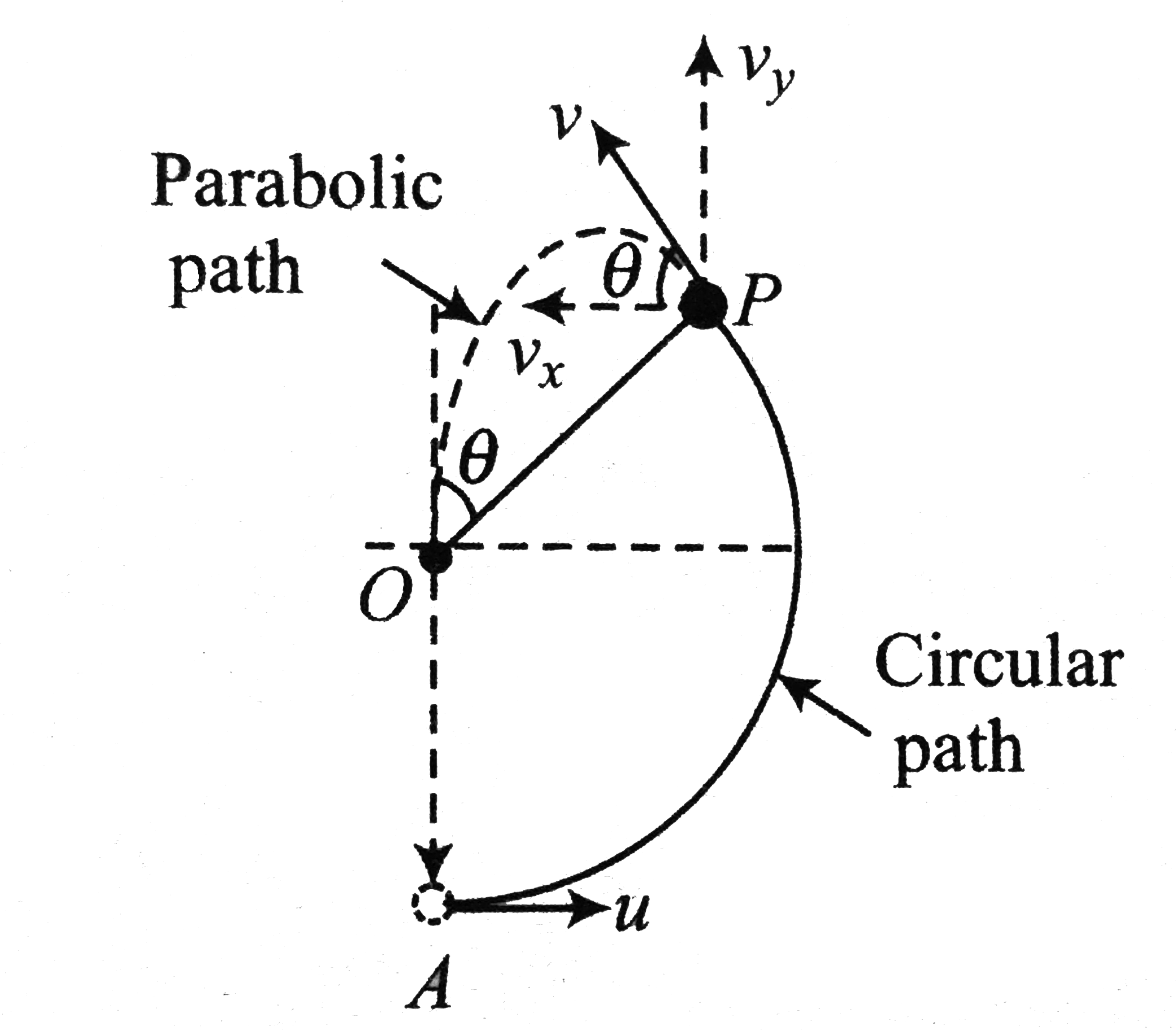 Equation of trajectory, `y=xtantheta-(gx^2)/(2v^2cos^2theta)` `=(lsintheta)tantheta-(g(lsintheta)^2)/(2(glcostheta)cos^2theta)` `=-costheta=(sin^2theta)/(costheta)-1/2(sin^2theta)/(2cos^3theta)` `implies-2cos^4theta=2sin^2thetacos^2theta-sin^2theta` `impliessin^2theta=2sin^2thetacos^2theta+2cos^4theta` `=2cos^2theta(sin^2theta+cos^2theta)` `impliestan^2theta=2` `impliestantheta=sqrt2` hence, `costheta=1/sqrt3`, `sintheta=sqrt(2/3)` From energy CONSERVATION between point P and A, `1/2m u^2=1/2mv^2+mg(1+costheta)` `impliesu^2=v^2+2gl(1+costheta)` `=2gl+3glcostheta=2gl+3gl(1)/(sqrt3)` `impliesu=[(2+sqrt3)gl]^(1//2)` |
|
| 8. |
Discuss the properties of scaiar and vector |
|
Answer» Solution :Properties of scalar product are: (i)The product quantity`vec(A), vec(B)`is always a sxalar. It is positive if the angle between the vectors is acule(i.e.,`theta lt 90^(@)`. It is negative if the angle between them is obtuse(i.e.,`90^(@) lt theta lt 180^(@) ` ) (ii)The scalar product obeys commutative law i.e.,`vec(A). vec(B) = vec(B). vec(A)` (iii)The vectors obeys distributive law i.e.,`vec(A) . (vec(B) + vec(C)) = vec(A) . vec(B) + vec(A) . vec(C)` (iv)The angle between the vectors , `theta = cos^(-1)[(vec(A).vec(B))/(AB)]` (v)The scalar product of two vectors will be maximum when`cos theta = 1, i.e. theta = 0^(@),"so"(vec(A) . vec(B))_("max") = AB` (vi)The scalar product of two vectors will be MINIMUM, when ` cos theta = - 1, i.e., theta = 180^(@)` .When the vectors are anti-parallel. `(vec(A). vec(B))_("min") = - AB` (vii)If two vectors`vec(A) and vec(B)`are perpendicular to each other then their scalar product`vec(A) . vec(B) = 0 ` , because`cos 90^(@) = 0`. Then the vectors `vec(A) and vec(B)`are said to be mutually orthogonal . (viii)The scalar product of a vector with itself is termed as self-dot product. ITIS given by`(vec(A))^(2) = vec(A) . vec(A) = A A cos theta = A^(2)` .Here angle`theta = 0^(@)` The magnitude of the vector is given by`vec(A) is|vec(A)| = A = sqrt(A) . vec(A)` (ix)In case of a unit vector , `hat (n)` ` hat (n) . hat(n) = 1 xx 1 xx cos 0 = 1 `. For example,` hat (i) . hat (i) = hat (j) . hat (j)= hat (k) . hat (k) = ` (x)In the case of orthogonal unit vectors`hat (i) . hat (j) and hta(k)` , `hat (i). hat(j) = hat(j) . hat (k) = hat(k) . hat (i) = 1.1 cos 90^(@) = 0 ` (xi)In terms of components the scalar product of ` vec(A) and vec(B)`can be written as `vec(A) . vec(B) = (A, hat (i) + A hat(j) + A, hat(k)).(B, hat(i) + B, hat(j) + B, hat(k))` ` = A_(x) B_(x) + A_(y) B_(y) + A_(z) B_(z)`,With all other terms zero. The magnitude of vector `|vec(A)|`is given by `|vec(A)| = A = sqrt(A_(x)^(z)+A_(y)^(2)+A_(z)^(2))` Properties of vector (cross)product are : (i)The vector product of any two vectors is always another vector whose direction is perpendicular to the piane CONTAINING these two vectors , i.e., orthogonal to both the vectors `vec(A) and vec(B)`. In this case. the vectors `vec(a)and vec(B)`may or may not be mutually othogonal . (ii)The vector of two vectors is not commutative,i.e.,`vec(A) xx vec(B) ne vec(B) xx vec(A) `But .,`vec(A)xx vec(B) = - [ vec(B) xx vec(A)]`. But, `|vec(A) xx vec(B)| = |vec( B) xx vec(A)| = AB sin theta i.e., `in the case of the product vectors`vec(A) xx vec(B) and vec(B) xx vec(A)`, the magnitudes are equal but directions are oppositeto each other . (iii)The vector product of two vectors will have maximum magnitude when sin `theta = 1, i.e., theta =90^(@)`i.e., when the vectors `vec(A) and vec(B)`are orthogonal to each other . `(vec(A) xx vec(B))_("max") = AB hat(n)` (iv)The vector product of two non-zero vectors will be minimum when`|sin theta| = 0,i.e., theta = 0^(@) or 180^(@)` `(vec(A) xx vec(B))_("min") = 0 ` If the vectors are either parallel or anti parallel i.e., then the vector product of twonon-zero vectors vanishes. (v)The self - cross product, i.e., product of a vector with itself is the null vector `vec(A) xx vec(A) = A A sin 0^(@) hat(n) = vec(0)` The null vector `vec(0)`is SIMPLE denoted as zero in physics. (vi)The self-vector products of unit vectors are thus zero . `hat(i) xx hat (i) = hat(j) xx hat (j) = hat (k) xx hat (k) = vec(0)` (vii)In the case of orthogonal unit vectors,`hat(i), hat(j), hat(k)`in accordance with the right hand screw rule `hat (i) xx hat(j) = hat (k), hat(j) xx hat (k) = hat(i) and hat (k) xx hat (i) = hat(j)` Also, since the cross product is not commutative, `hat(j) xx hat(i) = - hat(k), hat(k) xx hat(j) = - hat(i) and hat(i) xx hat(k) = - hat(j)` (viii)In terms of components the vector product of two vectors`vec(A) and vec(B)` is`vec(A) xx vec(B)=|{:(hat(i),hat(j),hat(k)),(A_(x),A_(y),A_(z)),(B_(x),B_(y),B_(z) ):}|` `{{:(hat(i)(A_(y)B_(z)-A_(z)B_(y))),(+hat(j)(A_(z)B_(x)-A_(x)B_(z))),(+hat(k)(A_(x)B_(y)-A_(y)B_(x))):}` Notethat in the `hat(j)^(th)`component the order of multiplicationis different than`hat(i)^(th)andhat(k)^(th)`components . (ix)Iftwo vectors `vec(A) and vec(B)` form adjacent sides in a parallelogram, then the magnitude of `|vec(A) xx vec(B)|`will give the area of the parallelogram as represented GRAPHICALLY in the figure. (x)Since a parallelogram is divided into twoequal triangles as shown in the figure, the area of a triangle with `vec(A) and vec(B)`as sides is`(1)/(2) |vec(A) xx vec(B)|`. 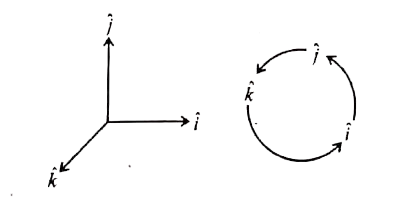 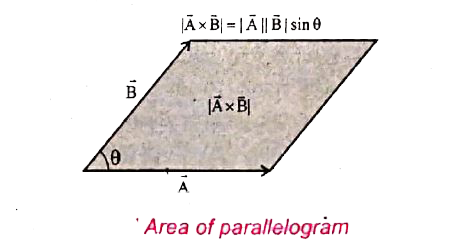 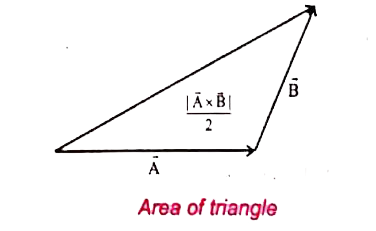
|
|
| 9. |
A particlefall freely from height s . At certain height its kineticenergyis three time to its potential energy ,them at any one instant its height and speed respectively ………….. |
|
Answer» `s/4,(3gs)/2` ` :. V^(2)-v_(0)^(2) =2g (s-X)` `v^(2)=2g(s-x)` Potential energy at B = mgx `…….` (2) ` :. ` Kinetic energy at PONT B . = 3x potential energy . `1/2 m SS 2g(s-x) = 3 mgx ` ` :. s - x = 3x ` ` :. s = 4x ` ` :. x = S/4` ` :. ` EQUATION (1) , `v^(2) =2g(s-s/4)` `= 2g xx (3s)/4 ` `=(3gs)/2 ` ` :. v = sqrt((3gs)/2)`. |
|
| 10. |
Column-II is related to Column-I. join them appropriately : |
| Answer» SOLUTION :`(a-iii), (b-i) ` | |
| 11. |
If v rarr t graph is parallel to time axis, then object is …... . |
|
Answer» |
|
| 12. |
A particle is performing simple harmonic motion of period T about a point O and it passes through a point P, where OP=y with velicity v in the direction vecOP. Show that the time which elapses before it returns to P again is (T//pi)tan^(-1)((vT)/(2piy)) |
|
Answer» Solution : let Q and R be the positions of particle of REFERENCE on the circleof reference, corresponding to vibrating point at P in SHM, in the FIRST instant and when it returns to p again. Here, `y=rsin omega t` VELOCITY, `v=(dy)/(dt)romegacosomegat` `:. (y)/(v)=(1)/(omega)tan omega t or tan omegat =(omegay)/(v)` or `omegat=tan^(1)((omegay)/(v))` Required time, `t=(/_QOP)/(omega)=(2(90^(@)-omegat))/(omega)` `=(2[90^(@)-tan^(-1)((omegay)/(v))])/(omega)=(2TAN^(-1)((v)/(omegay)))/(omega)` `=(2tan^(-1)((v)/(y)xx(T)/(2pi)))/(2pi//T)=(T)/(pi)tan^(-1)((VT)/(2piy))proved` 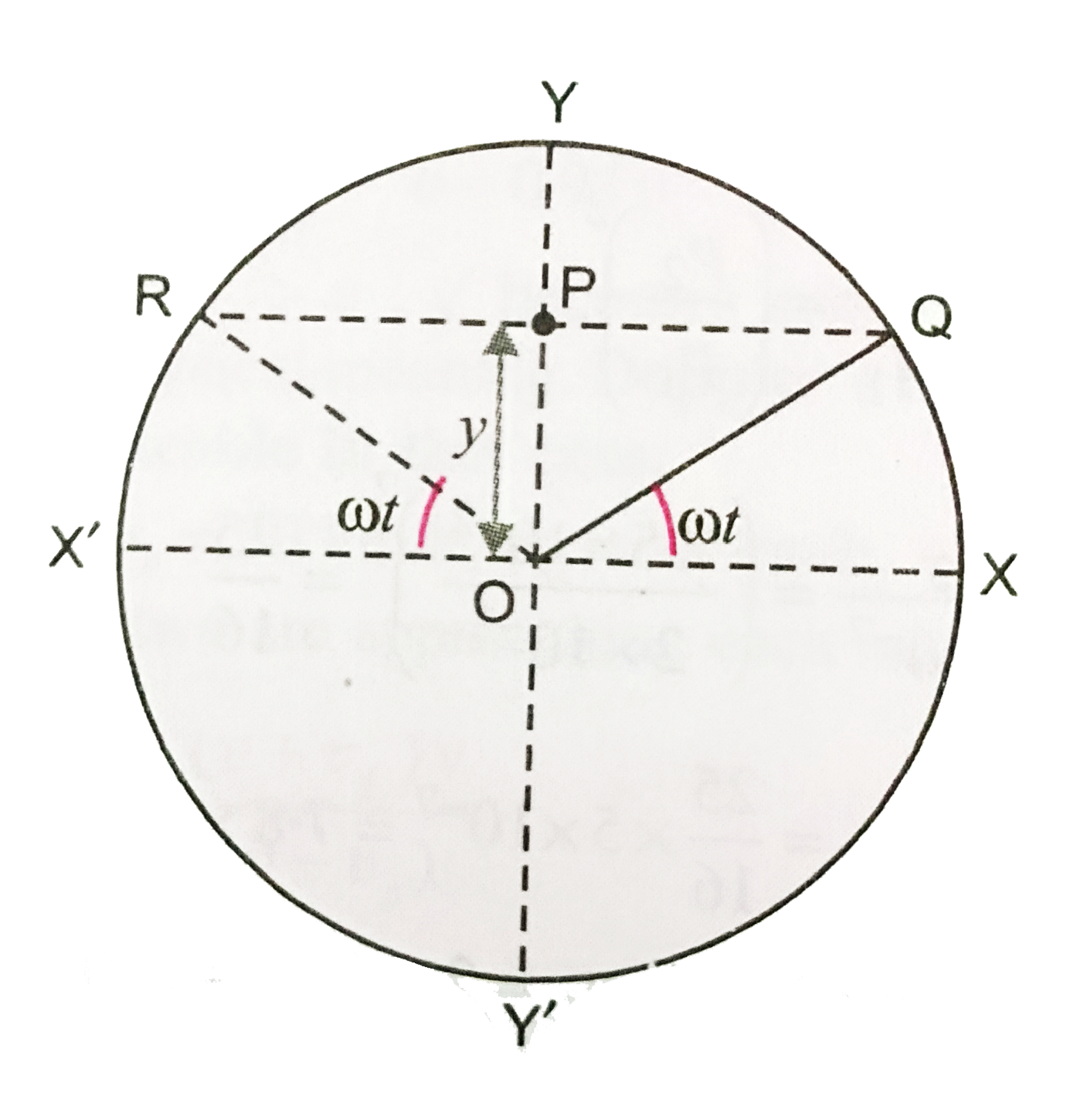
|
|
| 13. |
A satellite moves around the earth in a circular orbit with speed v. IF .m. is the mass of the satellite, its total energy is |
|
Answer» `-(1)/(2)MV^(2)` |
|
| 14. |
The mass of the earth is 6.00 xx 10^(24) kg and that of the moon is 7.40 xx 10^(22)kg. The constant of gravitational G = 6.67 xx 10^(-11) N-m^(2)kg^(-2). The potential energy of the system is -7.79 xx 10^(28)J. The mean distance between the earth and moon is |
|
Answer» `3.80 XX 10^(8)m` |
|
| 15. |
There are two identical small holes, each of area of cross-sections on the opposite sides of a tank containing a liquid of density rho. The difference in height between the holes is 'h'. Tunk is resting on a smooth horizontal surface. Find the horizontal force which will have to be applied on the tank to keep it in equilibrium. |
|
Answer» SOLUTION :`F=F_(1)-F_(2)=rhoav_(1)^(2)-rhoav_(2)^(2)` `rhoa(2gh_(1))-rhoa(2gh_(2))=2rhoag(h_(1)-h_(2))=2rhogh` 
|
|
| 16. |
a) The far point of a myopic person is 80 cm in front of the eye. What is the power of the lens required to enable him to see very distant objects clearly? B) In what way does the corrective lens help the above person? Does the lens magnify very distant objects? Explain carefully. (c ) The above person prefers to remove his spectacles while reading a book. Explain why? |
|
Answer» Solution :a) u=a,v=-80=.08m F=? `1/F=1/v-1/4` `implies 1/F=1/0.8 1/a F=-8/10` Power `P=1/F=-10/8=-5/4=-1.25D` (b) No the corrective lens is concave and in fact it reduces in size of the image. The eye is able to see distant objects not because the corrective lens magnifies the object, but because it brings the object (i.e., it produces VIRTUAL image of the object) at the FAR point of the eye which then can be focused by the eye lens on the RETINA. c) The myopic person may have a normal near point i.e., about 25 cm (or even less) In order to read s book with his spectacles (for distant vision), he must keep the book at a distance greater than 25 cm so that the image of the book by the concave lens is produced not closer than 25cm. As the angular size of the book at a distance `gt 25cm` is less than the angular size at 25cm, the person prefers to REMOVE his spectacles while reading. |
|
| 17. |
A bobof mass m is suspeded by a light stringof length L . It is imparted a horizontal velocity v_(0)at the lowest point A such that it completes a semicircular trajectroy in the vertical plane with the string becoming slack only on reaching the topmost point C . Thisis shown in figure .Obtain a expression for (i) v_(0) (ii) the ratio of the kinetic energies (K_(B)/(K_(C ))) at B and C . Comment on the nature of the trajectroy of the bob after it reaches the point C . |
|
Answer» Solution :Two forces acting on bob. (i)Gravity and (ii) the tension T in the string .the work is not done by tensionin the string.because dispalcement of bob is always normal to the string . The potential energy of the bob is thus associated with the gravitational force only and mechanical energy of the system is conserved . (i) LET potential energy of the system is conserved . L=0 ` :. mgL =0` Total mechanical energy point A, `E =1/2 mv_(0)^(2) [ :. "Newton.s Second law"] ` ` E =1/2 mv_(0^(2) ""....(1)` The velocity of bob at point A , is `v_(0)` Bob moving circular . ` :. ` Resultant force is string = centripetal force `T_(A)-mg =(mv_(0)^(2))/L [ :. "Newton.s Second law"] ` Where `T_(A)` is the tensionin the string at A. At the highest point C, the string = centripetal force `T_(A) -mg =(mv_(0)^(2))/L [ :. "Newton.s Second Law"]` Where `T_(A)` is the tension in the tring at A. At the highest [point C, the string slackens , as the tension in the string `T_(C)` become zero. Thus , at C `E=1/2 mv_(C )^(2) +2mgL ""....(2)` Where `T_(A)` is the tension in the string t A. At the highest point C, the string slackness, as the tension in the string `T_(C)`becomes zero. Thus at C ` E=1/2 mv_(C)^(2)+2mgL ""...(2)` `(mv_(C )^(2))/L = mg"" {:. "Newton.s second law "]` Where `v_(c)` is the speed at C ` :. v_(C)^(2) =mgL ""....(3)` And `v_(C)^(2) -gL ""...(4)` ` :. ` From EQUATION (2). , ` E = 1/2 m cc"gL"+2ML` ` :. E=(5mgL)/2 ""...(5)` `1/2 mv_(0)^(2) =(5mgL)/2 ""` [ From equation (1)] ` :. v_(0)=SQRT(5gL) ""...(6)` (ii) From equation (4), `v_(C )=sqrt(gL) ""...(7)` and at the Btotal mechanical energy . `E =1/2 mv_(B)^(2) +mgL "" [ :. h = L]` From equation (6) and (1), `1/2 mv_(0)^(2) =1/2 mv_(B)^(2) +mgL` `1/2 m cc 5gL =1/2 mv_(B)^(2)+mgL` ` [ :. "From equation (7)"]` ` :. 1/2mv_(B)^(2)=5/2 mgL-mgL` `1/2 mv_(B)^(2)=3/2 mgL` ` :. v_(B) =sqrt(3gL)` (iii)The ratio of the kinetic energies at B and C is : The ratio of the kinetic energies at B and C is : `(K_(B))/(K_(C))=(1/2mv_(B)^(2))/(1/2mv_(C)^(2))=(v_(b)^(2))/(v_(C )^(2))` ` :. (K_(B))/(K_(C ))=(3gL)/("gL")=3:1` At point C , the string becomes slack and the to the left . If the string is cut at this instant , the bob will execute a projectile to MOTION with horizontal and to the left . If the string is cit at this instant , the bob will execute a projectile to motion with horizontal projection akin to motion with horizontal projection akin to a rock kicked horizontally fromthe edge of a sliff. Otherwise the bob will continue on its circular pathand complete the revolution . |
|
| 18. |
A uniform rod of mass m and length l rests on a smooth horizontal surface. One of the ends of the rod is struck in a horizontal direction at right angles to the rod. As a result the rod obtains velocity v_(0). Find the force with which one-half of the rod will act ont he other in the process of motion. |
Answer» Solution : LET `J` be the linear impulse applied at B and `OMEGA` and angular speed of rod `J=mv_(0)`..(i) ,BRGT `J((l)/(2))=(ml^(2))/(12).omega`.(ii) solving these two equations `omega=(6v_(0))/(l)` Linear speed of D (mid-point of CB) relative C `v=omega((l)/(4))=(3)/(2)v_(0)` `therefore` force exerted by upper half on the LOWER half `F=(((m)/(2))v^(2))/(((l)/(4)))` substituting `v=(3)/(2)v_(0)`, we get `F=(9)/(2)(mv_(0)^(2))/(l)` |
|
| 19. |
A car is travelling at 36 kmph on a road. If mu=0.5 between the tyres and the road, the minimum turning radius if the car is (g=10 ms^(-2)) |
| Answer» ANSWER :A | |
| 20. |
1g=.... Amu |
|
Answer» `1.66xx10^(-24)` `:.1amu=1.66xx10^(-24)kg ( :. 1 kg=10^(3)G)` `:.1g=(?) amu` `=(1)/(1.66xx10^(-24))=0.6024xx10^(23)amu` |
|
| 21. |
A disc of radius R rolls on a horizontal surface with linear velocity v and angular velocity omega. There is a point P on the circumference of the disc at angle theta which has a vertical velocity, here theta=""^(xpi+cos^(-1))((v)/(Romega)). where 'x' is |
|
Answer» |
|
| 22. |
Glycerine flows steadily through a horizontal tube of length 1.5m and radius 1.0 cm. If the amount of glycerine collected per second at one end is 4. 0 xx 10^(-3) kg s^(-1)what is the pressure difference between the two ends of the tube? (Density of glycerine = 1.3 xx 10^(3)kg m^(-3)and coefficient of viscosity of glycerine = 0.83 Ns m^(-2) ) |
|
Answer» |
|
| 23. |
Time period of oscillations of a torsional pendulum is 5 times N where 'N' is an integer. If the torional constant of the wire is 10pi^2 in SI units and the moment inertia of the pendulum is 10 kg - m^2 about the axis of rotation, then N is equal to |
|
Answer» |
|
| 24. |
The parallelogram law of vector addition is equivalent to . . . . Method. |
|
Answer» polygon |
|
| 25. |
A rod AB of length 10cm, has its mass per unit length varying from 1 kg/m (at end A) to 2kg/m (at end B). Find the distance of the centre of mass of the rod from the end B. |
|
Answer» |
|
| 26. |
In the following what are the quantities which that are conserved? |
|
Answer» Linear momentum of planet |
|
| 27. |
If T_(1) , T_(2) and T_(3) are the time periods of a given simple pendulum on the surface of the earth , at a depth 'h ' in a mine and at an altitude 'h' above the earth's surface respectively, then |
|
Answer» `T_(1)=T_(2)=T_(3)` |
|
| 28. |
A boat which has a speed of 5kmph in still water crosses a river of width 1km along shortest path in 15 min. (river velocity is greater than 5kmph). In second coloumn velocities are in kmph and lengths are in Km, time is in hours {:("Column-I","Column-II"),("A) Velocity of river","P) " 4/3),("B) Shortest time taken to cross river","Q) "5/3),("C) Length of shortest path","R) "25/3),("D) Minimum drift","S) "1/5):} |
|
Answer» |
|
| 29. |
A vessel of volume 0.02m^(3) contains a mixture of hydrogen and helium, at 20^(@)C and 2 atm pressure. The mass of the mixture is equal to 5g. Find the ratio of the mass of hydrogen to that of helium in the given mixture. |
|
Answer» |
|
| 30. |
Ultrasonic waves are |
|
Answer» LONGITUDINAL |
|
| 31. |
If the lines of forces act in the same plane, they can be |
|
Answer» CONCURRENT FORCES |
|
| 32. |
An aeroplane is flying from city A to city B along path 1. The path 1 is a circular arc whose centre coincides with the centreof the earth. Another aeroplane is flying along path 2 from A to B. The path 2 is circular arc whose centre is at C. O is the centre of the earth. Then, |
|
Answer» The distance travelled by `1^(st)` aeroplane is greater than that of `2^(nd)`aeroplane. `I_2` = distance travelled by aeroplane 2 along path 2 Let `OC = R/2` Here, for path 1, `2 theta = l_1 /R` But `COSTHETA = R/2R = 1/2 therefore theta = pi/3` `implies 2 xx pi/3 = l_1/R therefore l_1 = 2piR/3 = 0.67 piR` But for path 2 `l_2 = pir = pi("AC") = pi RSIN pi/2 = sqrt 3/2 piR = 0.866 piR` `therefore l_1 lt l_2` 
|
|
| 33. |
A jar 'A' is filled with an ideal gas characterised by parameters P, V and T and another jar B is filled with an ideal gas with parameters 2P.(V )/(4). And 2T. Find the ratio of the number of molecules in jar A and B. |
|
Answer» Solution :`n_(A)=(PV)/(RT), n_(B)=(2P((V)/(4)))/(R(2T))=(1)/(4)n_(A), n_(B)=(1)/(4)n_(A)` `therefore""n_(A):n_(B)=4:1` |
|
| 34. |
A) Work and energy have the same units in any given system of measurement B) Work and power have the same ratio of SI unit to C.G.S unit |
|
Answer» STATEMENT A is true and B is FALSE |
|
| 35. |
A point object O is placed on the principal axis of a convex lens of focal length 10 cm at 12 cm from the lens. When object is displaced 1mm along the principal axis magnitude of displacement of image is x_(1). When the lens is displaced by 1mm perpendicular to the principal axis displacement of image is x_(2) in magnitude. find the value of (x_(1))/(x_(2)) |
|
Answer» |
|
| 36. |
A stone is thrown vertically upward with a speed of 10.0 ms^(-1) from the edge of a cliff 65m high. What will be its speed just before hitting the bottom ? |
|
Answer» 3.14 m/s |
|
| 37. |
This diagram depicts a block sliding along a, frictionless ramp in vertical plane. The eightl numbered arrows in the diagram represent directions, to be referred to when answeringthe questions. The direction of the acceleration of the block, when in position I, is best represented by which of the arrows in the diagram ? |
|
Answer» 2 |
|
| 38. |
5.6 litre of helium gas at STP is adiabaticallycompressed to 0.7 litre. If the initial temperature of the gas is TK, work done in the process is (R is universal gas constant in SI units) |
| Answer» Answer :B | |
| 39. |
A bomb travelling in a parabolic path under the effect of gravity, explodes in mid-air. The centre of mass of the fragments will |
|
Answer» g/2 |
|
| 40. |
A sample of 0.1 g of water at 100^@ C and normal pressure (1.013 xx 10^5 Nm^(-2)) requires 54 cal of heat energy to convert to steam at 100^@ C. If the volume of the steam produced is 167.1 cc, the change in internal energy of the sample is ____ |
|
Answer» Solution :`DeltaQ`=54 cal = `54xx4.18`J =225.72 J …(1) `DeltaW=PDeltaV` `=P(V_2-V_1)` `V_2`=volume of steam `V_1`=volume of water `=1.013xx10^5[167.1xx10^(-6)- 0.1xx10^(-6)]` [`because` 1CC=`10^(-6) m^3`] `=1.013xx10^5xx167xx10^(-6)` `DeltaW` = 16.917 ..(2) Now `DeltaU=DeltaQ-DeltaW` =225.72 - 16.917 [`because` From equ. (1) and (2)] =208.8 J `therefore DeltaU` = 208.7 J nearest value |
|
| 41. |
The earth (mass = 6 xx 10^(24)kg) revolves around the sun with an angular velocity of 2 xx 10^(-7)rad/s in a circular orbit of radius 1.5 xx 10^8km. The force exerted by the sun on the earth, in newton, is ......... |
|
Answer» `18 xx 10^(25)` `R = 1.5 xx 10^(11) m` Foce EXERTED by Sun on the EARTH `=F= momega^(2) R` `:. F = 6 xx 10^(24) xx (2 xx 10^(-7))^2 xx 1.5 xx 10^(11)` `= 36 xx 10^(21) N` |
|
| 42. |
Value of heat capacity is same at different condition for a matter. |
| Answer» SOLUTION :VALUES are not same. | |
| 43. |
A small body is kept at a distance of 7 cm from the centre of a gramophone disc. The disc starts rotating with gradually increasing speed and the body is just on the verge of being thrown off when the disc rotates at 60 times a minute. What will be the speed of the disc when the body, kept at a distance of 12 cm from the centre, is just thrown off? What will be the rotational speed, when a body of double the mass is kept at the previous position of 7 cm away from the centre? |
|
Answer» |
|
| 44. |
The pendulum of a certain clock has time period 2.04s . How fast or slow does the clock run during 12 hour? |
|
Answer» `11.4` MINUTES SLOW |
|
| 45. |
Give some analogy to differentiate between accuracy and precision. |
Answer» Solution :A good analogy to differentiate between accuracy and precision is the TARGET analogy. Fig. 1(e ).2. shows three targets on a chalkboard screen. The DOTS represent bullet holes in thetarget. Target (a) shows good accuracy and POOR precision. Target (b) shows good precision and poor accuracy. Target (C ) represents good accuracy and good precision. 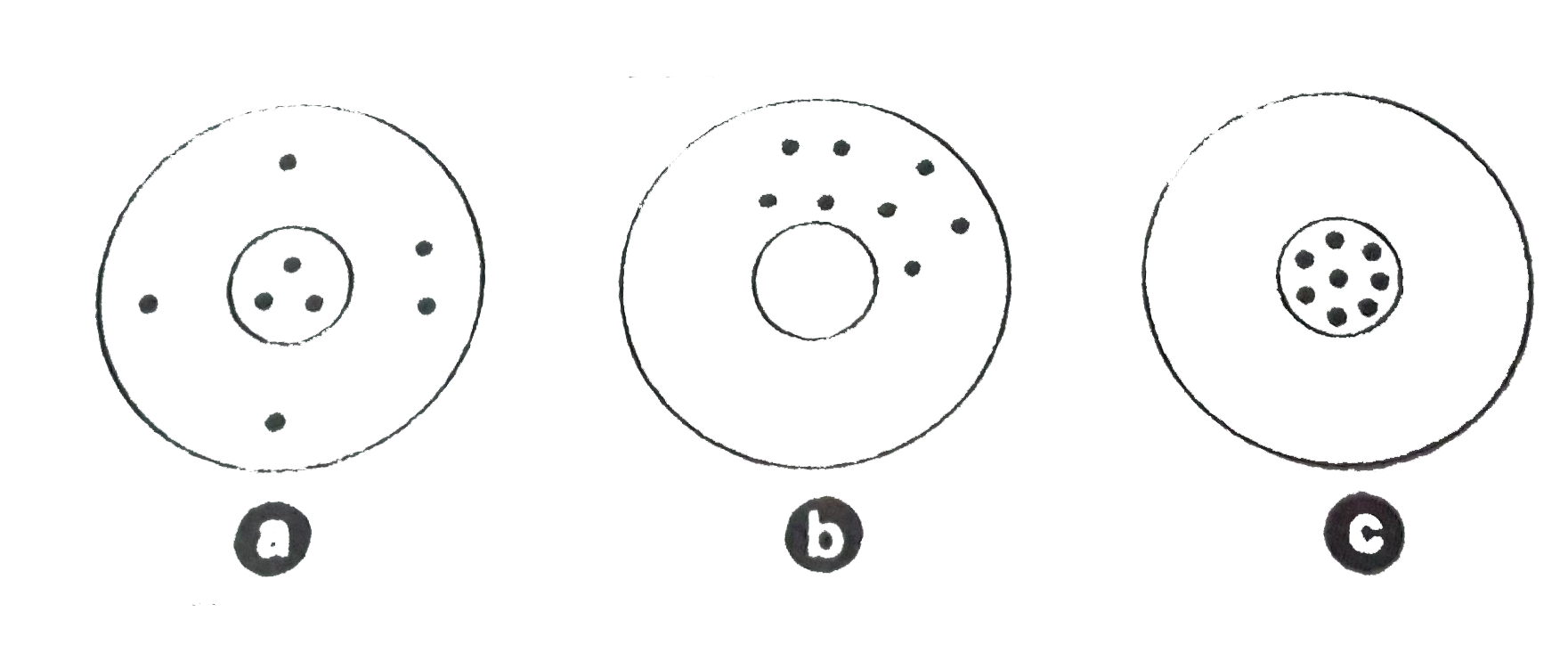
|
|
| 46. |
(A) : Two row boats moving parallel to each other and nearby, are attracted towards each other. (R ) : Increase of velocity of fluid decrease the pressure. |
|
Answer» Both (A) and (R ) are TRUE and (R ) is the CORRECT EXPLANATION of (A) |
|
| 47. |
One petametre related to centimetre as |
|
Answer» `10^15 CM` |
|
| 48. |
A stone is thrown vertically upward with a speed of 10.0 "ms"^(-1)from the edge of a cliff 65 m high. What will be its speed just before hitting the bottom ? |
|
Answer» 3.14m/s |
|
| 49. |
A uniform metre scale of mass 2kg is suspended from one end. If it is displaced through an angle 60^(@) from the vetical, th increase in its potential energy is, |
|
Answer» 4.9 J |
|