Saved Bookmarks
This section includes 7 InterviewSolutions, each offering curated multiple-choice questions to sharpen your Current Affairs knowledge and support exam preparation. Choose a topic below to get started.
| 1. |
Three spheres of different materials are in motion their radii, densities and speeds are as given{:("Sl.No","Radius","Density","Speed"),(1,r,d,upsilon),(2,r//2,d,V//2),(3,2r,d//2,upsilon):}If K_(1), K_(2), K_(3) are the kinetic energies of those three spheresrespectively, those values can be arranged in descending order as given below |
|
Answer» `K_(3),K_(2),K_(1)` |
|
| 2. |
For two vectors, the magnitude of their sum is equal to the magnitude of their difference. Find the angle between the two vectors. |
|
Answer» |
|
| 3. |
A rectangular frame of length 20 cm is dipped in a soap solution and then raised, forming a soup film on the frame. The pull required is 2.83 g wt more before the film breaks. Calculate the surface tension of the liquid. |
|
Answer» SOLUTION :The additional pull of 2.83 g wt is equal to the force of surface tension, `F= "2.83 g wt= 2.83 "XX "981 dyne"` As the solution touches the frame both on outside and inside along its length, so force the frame due to surface tension is `F=2 xx l xx sigma=2l sigma` `rArr 2.83 xx 981 =2 xx 10 xx sigma` `rArr sigma=(2.83 xx 981)/(20)="138.8 dyne/cm"` |
|
| 4. |
If the density of air ate NTP is 1.293kgm^(-3) and its sp. heat capacity at constant volume is 169 cal kg^(-1)K^(-1), calculate specific heat capacity at constant pressure. (Density of mercury =13.6xx10^(3)kgm^(-3) at 0^(@)C and J=4.2 joule cal^(-1)) |
|
Answer» |
|
| 5. |
A solid is completely immersed in a liquid the force exerted by the liquid on the solid will |
|
Answer» <P>INCREASE if it is P used deeper INSIDE the liquid |
|
| 6. |
Two bodies of masses m_(1) and m_(2) moving on the same direction with velocities u_(1) and u_(2) collide. The velocities after collision are V_(1) and V_(2). If each sphere loses the same amount of kinetic energy, then |
|
Answer» `u_(1)+u_(2)+V_(1)-V_(2)=0` |
|
| 7. |
Consider two springs whose force constants are 1Nm^(-1) and 2N m^(-1) which are connected in series. Calculate the effective spring constant (k_(s)) and comment on k_(s). |
|
Answer» Solution :`k_(1)=1NM^(-1),k_(2)=2Nm^(-1)` `k_(s)=(k_(1)k_(2))/(k_(1)+k_(2))Nm^(-1)` `k_(s)=(1xx2)/(1+2)=(2)/(3)Nm^(-1)` `k_(s)ltk_(1)andk_(s)ltk_(2)` Therefore, the EFFECTIVE spring constant is LESSER than both `k_(1) and k_(2)`. |
|
| 8. |
An electron starting from rest has a velocity that increases linearly with the time that is v = kt, where k = 2 m//sec^2 . The distance travelled in the first 3 seconds will be |
|
Answer» 9m |
|
| 9. |
A stone tied to an inextensible string of length l = 1 m is kept horizontal. If it is released, find the angular speed of the stone when the string makes an angle theta = 30^@ with horizontal. |
|
Answer» Solution :When the stone is released, it moves down executing a circular motion. At any INSTANT, the stone accelerates towards (w.r.t.) the center of its revolution `0`, that is, centripetal ACCELERATION `a_r` and simultaneously accelerates down with an acceleration, that is, gravitational acceleration `g , vec a_r = omega^2 r`. Resolving `vec a_r` and along the tangent, we obtain the tangential acceleration of the stone as `a_t = g COS theta`. Angular acceleration, `prop = (a_t)/( r)` `rArr prop = (g cos theta)/(l)` `(since r = 1)` PUTTING `prop = (omega d omega)/(d theta),` we obtain `(omega d omega)/(d theta) = (g cos theta)/( r)` `rArr omega d omega = (g//l) cos theta d theta`. Integrating both the sides, we obtain `int_0^(omega) omega d theta = (g)/(l) int_0^(theta)cos theta d theta` `rArr (omega^2)/(2) = (g)/(l) sin theta or omega = sqrt((2 g)/(l)) sin theta` Putting `l = 1 m and theta = 30^@`, we obtain `omega = sqrt((2(10) sin 30^@)/((1))) = sqrt(10) rArr omega ~= 3.1 rad s^-1`.  . |
|
| 10. |
A wire of diameter 14 cm is gently lowered on a liquid surface so that its plane is parallel to the surface and the pulled up.The extra force applied is 0.0616 N. The surface tension of the liquid is |
|
Answer» `7XX10^(-2)NM^(-1)` |
|
| 11. |
A brass boiler has a base area of 0.15 m^(2)and thickness 1.0 cm. It boils water at the rate of 6.0 kg/min when placed on a gas stove. Estimate the temperature of the part of the flame in contact with the boller. Thermal conductivity of brass= 109 J s^(-1) m^(-1) K^(-1), Heat of vaporisation of water = 2256 xx 10^(3) J kg^(-1). |
| Answer» SOLUTION :`238 ^(@)C` | |
| 12. |
The greater and least resultant of two forces are 7 N and 3 N respectively. If each of the force is increased by 3N and applied at 60^(@). The magnitude of the resultant is |
| Answer» ANSWER :D | |
| 13. |
If there is change of angular momentum from J to 4J in 4S, then the torque is |
|
Answer» `(3)/(4)J` |
|
| 14. |
Find a vector whose length is 7 and that is perpendicular to each of the vectorsvec(A) = 2 hat(i) - 3 hat(j) + 6 hat(k) and vec(B) = hat(i) + hat(j) - hat(k) |
|
Answer» Solution :Given :`vec(A) = 2 HAT(i) - 3 hat(j) + 6 hat(K)` `vec(B) = hat(i) + hat(j) - hat(k)` Here ` vec(A) xx vec(B) |{:(hat(i),hat(j), hat(j)),(2, -3, 6),(1 , 1, -1):}|` `= hat(i) (3 - 6) - hat(j) (-2 - 6) + hat(k) (2 + 3)` `= - 3 hat(i) + 8 hat(j) + 5 hat(k)` `|A^(2) xx vec(B)| = sqrt((-3)^(2) + 8 ^(2) + 5^(2))` `= sqrt(98) = 7 sqrt(2)` Unit vector PERPENDICULAR to `vec(A) and vec(B)` is `hat(n) = (vec(A) xx vec(B))/(|vec(A) xx vec(B)|)= (-3 hat(i) + 8 hat(j) + 5 hat(k))/(7 sqrt(2))` Required vector `= 7 hat(n) = 7 ((-3hat(i) + 8 hat(j) + 5 hat(k))/(7 sqrt(2)))` `= (1)/(sqrt(2)) ( - 3 hat(i) + 8 hat(j) + 5 hat(k))` |
|
| 15. |
A mass m=8kg is attached to a spring as shown in figure and held in position so that the spring remains unstretched. The spring constant is 200 N/m. The mass m is then released and begins to undergo small oscillations. Find themaximum velocity of the mass (g=10m//s^(2)) |
|
Answer» Solution :Mean position will be at K,X=MG or `x=(mg)/k=(8xx10)/200=2/5=0.4m` This is also the AMPLITUDE of oscillation i.e. A=0.4m Now `v_("max")=A omega=Asqrt(k/m)=(0.4)SQRT(200/8)=2m//s` 
|
|
| 16. |
On an average, a human heart is found to beat 75 times in a minute. Calculate its frequency and period. |
|
Answer» Solution :The BEAT FREQUENCY of HEART = 75/(1 MIN) = 75/(60 s) `=1.25s^(-1)` `=1.25Hz` The time period T `= 1//(1.25 s^(-1))` =0.8s |
|
| 17. |
Define Relative density or specific gravity. |
| Answer» Solution :The relative density of a substance is DEFINED as the ratio of the density of a substance to the density of WATER at `4^@C`. It is a dimensionless positive SCALAR quantity. | |
| 18. |
A particle of mass 2m is projected at an angle of 45^(@) with the horizontal with a velocity of 20sqrt(2)m//s, After 1s of explosion, the particle breaks into two equal pieces. As a result of this one part comes to rest. The maximum height from the ground attained by the other part is n xx 7m. Find n (g = 10ms^(-2)) |
|
Answer» |
|
| 19. |
Explain instantaneous velocity and discuss how it can be determined from x to tgraph. |
|
Answer» Solution :The average velocity tells us how fast an object has been moving over a GIVEN time interval but does not TELL us how fast it moves at different instants of time during that interval. For this, we define instantaneous velocity. The velocity at an instant is defined as the limit of the average velocity as the time interval At becomes infinitesimally small. In other words, `v = lim _(Delta t - to 0) (Delta x)/(Delta t )` `v = (dx)/(dt) =x` In the language of calculus it is the differential coefficient of x with respect to t and is denoted by `(dx)/(dt).` We can obtain the value of velocity at an instant either graphically or numerically.(1) Graphical Method : Suppose the below given x t graph is for non-uniform motion of the car and we want to obtain graphically the value of velocity at time t = 4 s. For this CASE, the variation of velocity with time is found to be as shown in figure.  Suppose, by keeping t = 4s in MIND, if we take different time intervals `Deltat _(1), Delta t_(2), Delta t _(3),......`then for these time intervals displacement will be `P_(1) P_(2), Q_(1) Q_(2), T_(1) T_(2),...`and corresponding displacement are `Delta x_(1), Delta x _(2) Delta x _(3),.....`. In all these time intervals the average velocity comes nearer to some exact value and when the time interval becomes zero it MEANS`(Delta t lim _(x to 0)` at that time average velocity gives instantaneous velocity at t = 4 s. It is difficult to use graphical method always. Slope of the graph is instantaneous velocity at that point (Slope `= tantheta`). For the motion in straight line the slope is construct. Hence, average and instantaneous velocities are same.(2) Numerical Method: For the graph shown in figure ` x = 0.08 t ^(3).` Table gives the value of Ax/At calculated for at equal to 2.0 s, 1.0 s, 0.5 s, 0.1 s and 0.01 s centred at t = 4.0 s. The second and third columns give the value of `t _(1) = (t - (Delta t)/(2)) and t _(2) = (t + (Delta t )/(2))` and the fourth and the fifth columns give the corresponding values of x. `i.e. x(t_(1)) = 0.08 t_(1) ^(3) and x(t_(2)) = 0.08 t_(2)_(3)` The sixth column lists the difference `Delta x = x(t_(2)) - x(t_(1))` and the last column gives the ratio of Ar and `Deltat,` i.e. the average velocity corresponding to the value of at listed in the first column. As the time interval becomes smaller, the velocity at t = 4s can be obtained. 
|
|
| 20. |
A simple pendulum has time period 3sec. The pendulum is completely immersed in a nonviscous liquid whose density is 1//10th of that of the material of the bob. Then time perod of that pendulum is |
|
Answer» `SQRT(3)`SEC |
|
| 21. |
In a molecule, the potential energy between two atoms is given by U(x)=(a)/(x^(12))-(b)/(x^(6)). Where a and b are positive constants and x is the distance between atoms. Find the value of x at which force is zero and minimum P.E. at that point. |
|
Answer» SOLUTION :Force is ZERO `rArr (dU)/(dx) = 0` i.e., `a (-12) x^(-13) - b(-6) x^(-7)= 0` `(-12a)/(x^(13))+(6b)/(x^(7))=0rArr(12a)/(x^(13))=(6b)/(x^(7))` `rArrx^(6)=(2A)/(b)thereforex=[(2a)/(b)]^(1//6)` `U_(min)=a((b)/(2a))^(12//6)-b((b)/(2a))^(6//6)` `rArr U_(min)=(AB^(2))/(4a^(2))-(b^(2))/(2a)rArrU_(min)=(-b^(2))/(4a)` |
|
| 22. |
If no external torque acts on a body will its angular velocity remain conserved? |
| Answer» SOLUTION :No. ANGULAR VELOCITY is not CONSERVED but angular MOMENTUM is conserved. | |
| 23. |
A shell of mass 0.01 kg fired by a gun of mass 10 kg. If the muzzle speed of the shell is 50 ms^(-1), what is the recoil speed of the gun ? |
|
Answer» 0.01 m/s |
|
| 24. |
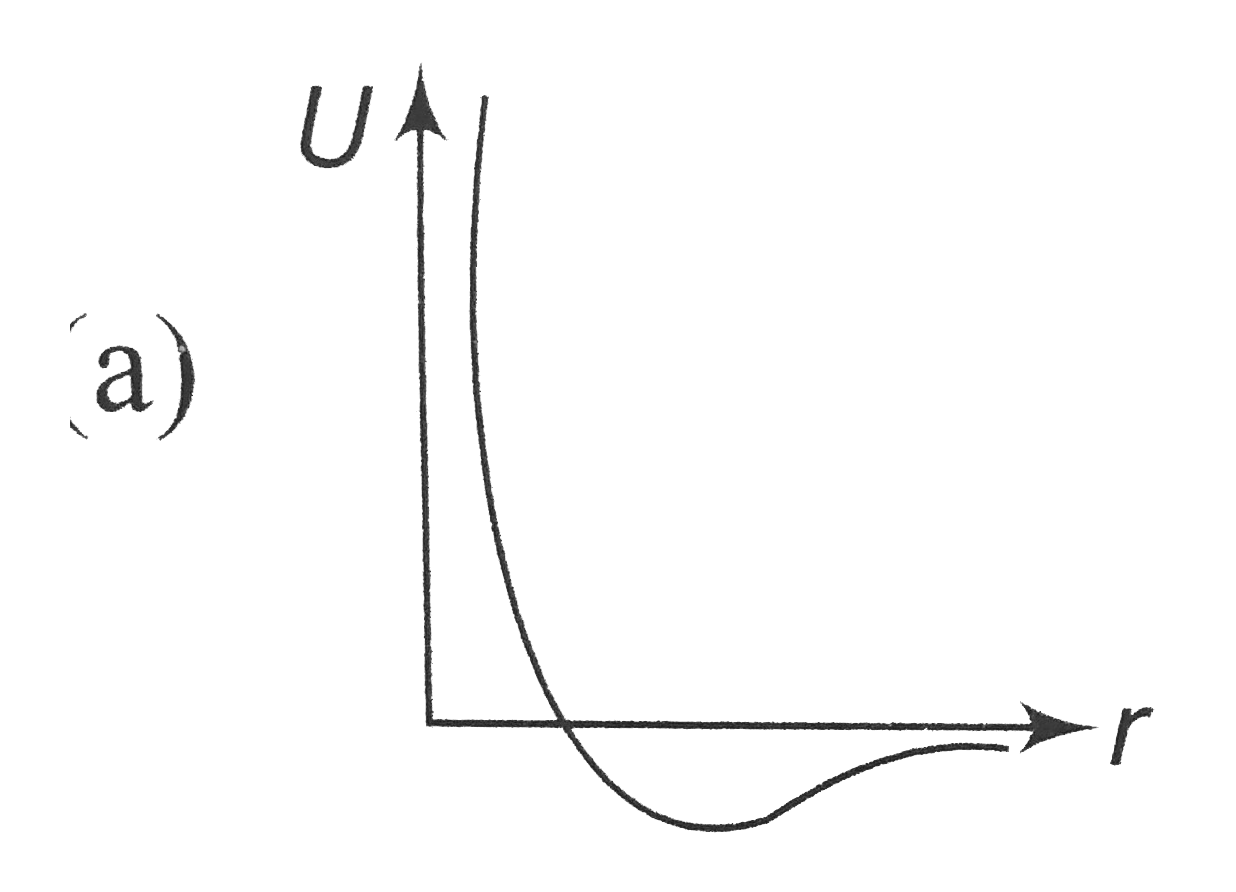
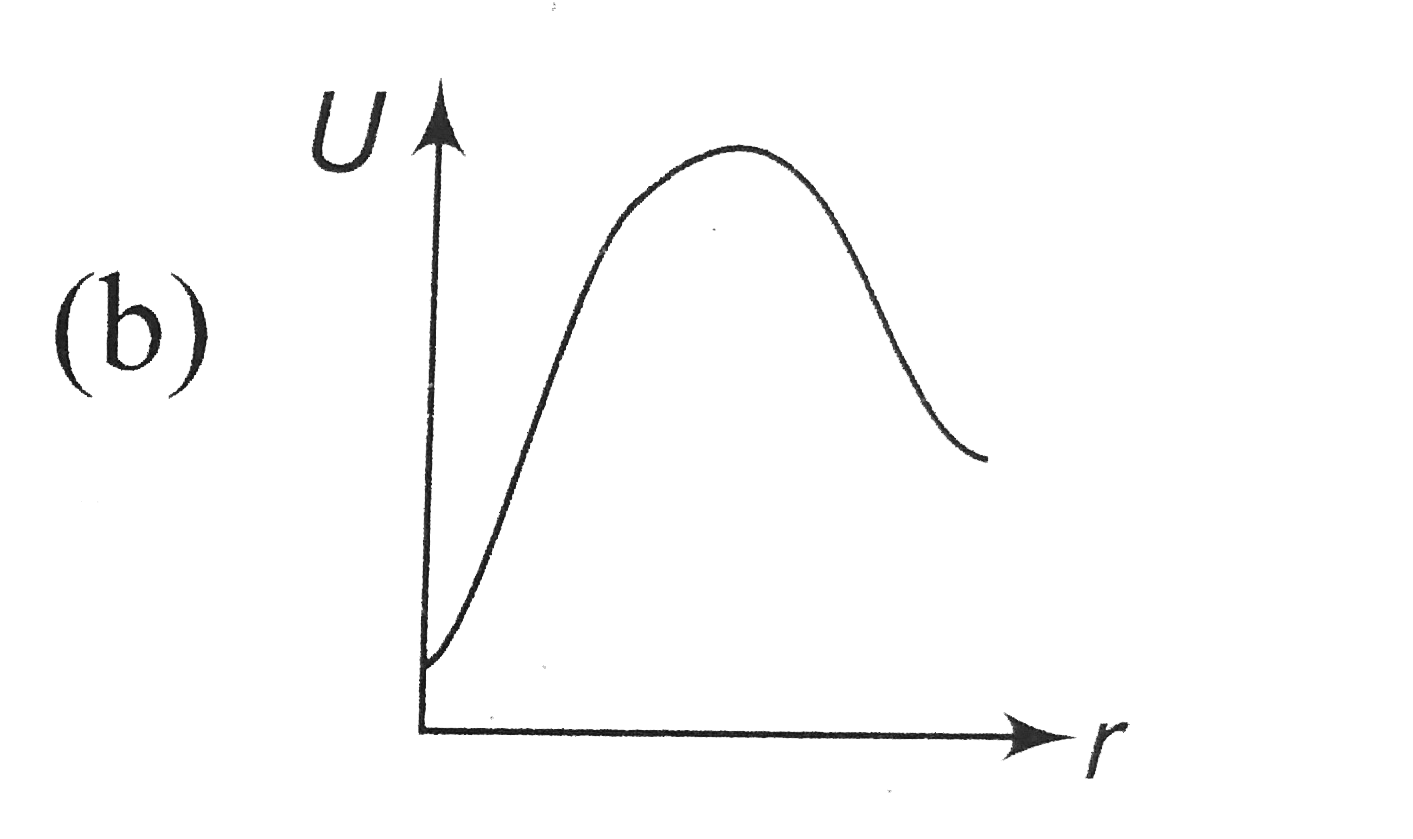
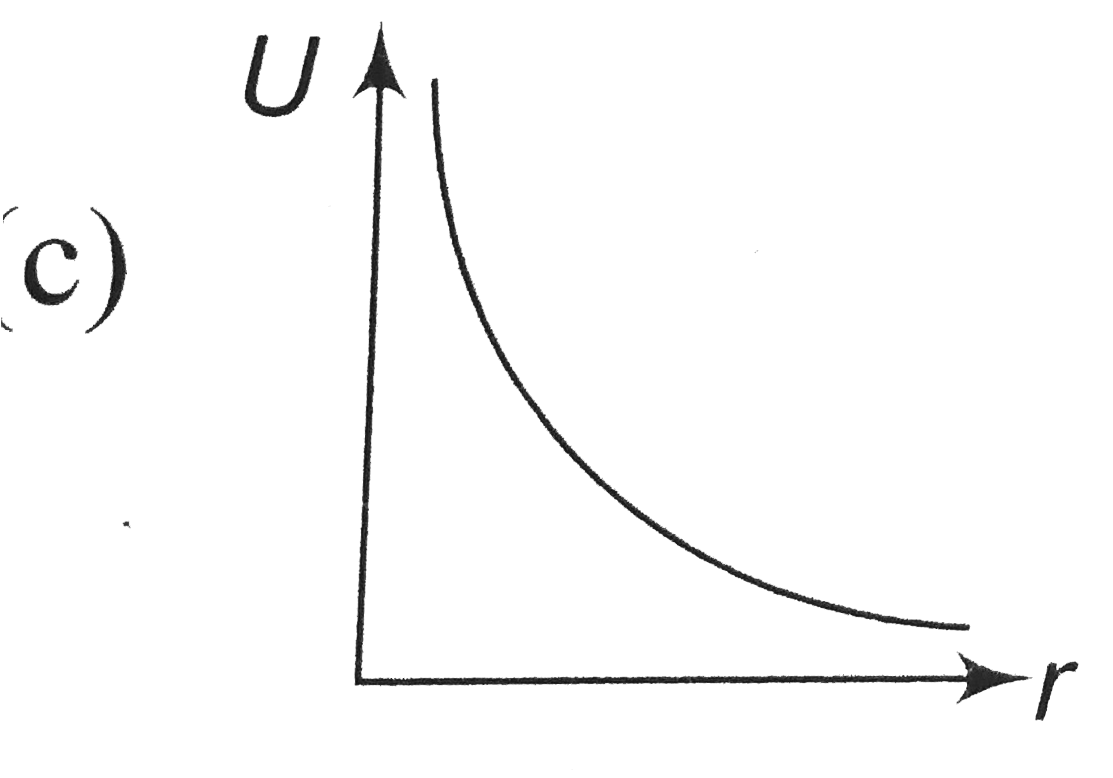
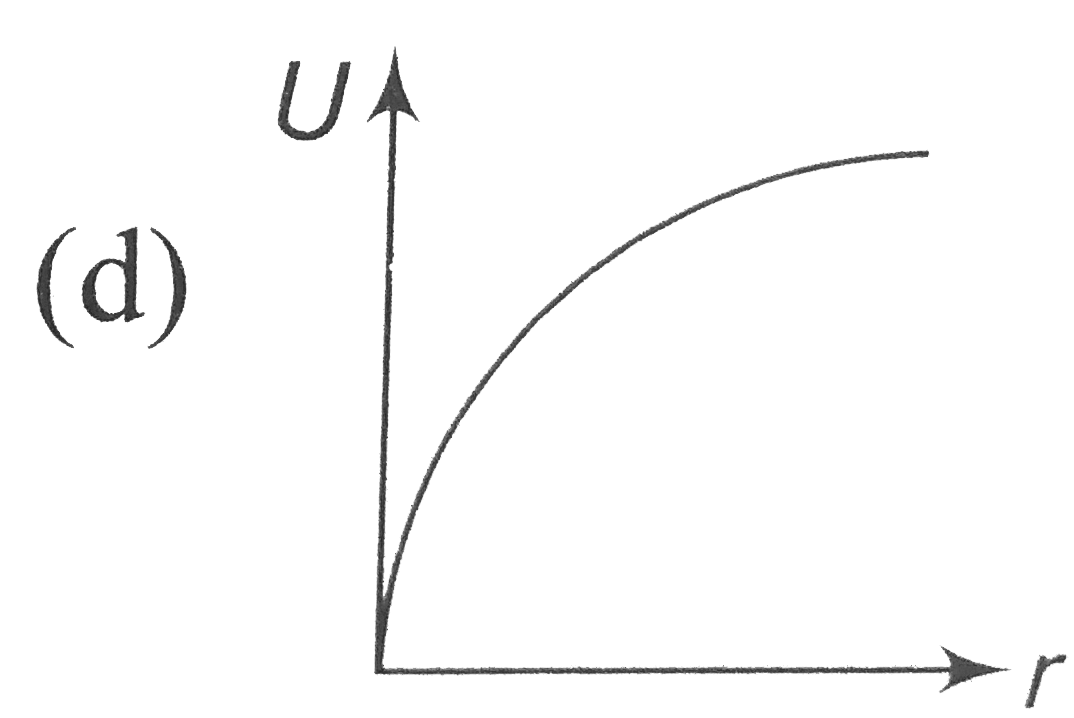
The diagram respresent the potential energy U of a function of the inter atomic distance r. Which diagram corresponding to slabe molecules found in nature? |
|
Answer»
This can explated by SLOPE of `U` CURVE shown in graph |
|
| 25. |
Obtain Eq. (7.38) omega= omega_0 + alphat from first principles. |
|
Answer» Solution :The ANGULAR acceleration is uniform, hence `(domega)/(dt)=alpha` = constant (i) INTEGRATING this equation, `omega=intalphadt+c` `=alphat+c` (as `alpha` is constant) At `t = 0,ω= ω_(0)` (given) From (i) we GET at `t=0,ω=c=omega_(0)` Thus, `ω = αt + ω_(0)` as required. With the definition of `ω= d θ //dt` we may integrate Eq. (7.38) to get .This derivation and the derivation of Eq. (7.40) is left as an exercise. |
|
| 26. |
The total energy of a particle vibrating in SHM is proportional to the square of its……….. |
|
Answer» velocity |
|
| 27. |
A particle traveling horizontally with speed u collides and sticks with a particle of equal mass hanging at rest at the end of a light inextensible string of length 21. If the string rotates through an angle of 60° before its velocity becomes zero, then u is |
|
Answer» `SQRT(4GL)` |
|
| 28. |
A body released from the top of a tower of height h takes T seconds to reach the ground . The position of the body at T/4 seconds is |
|
Answer» at `(H)/(16)` from the ground |
|
| 29. |
Match Column-I with Column-II : {:("Column-I","Column-II"),("(1) Perpendicular axis theorem",I=I_C+Md^2),("(2) Parallel axis theorem",I_z=I_x+I_y):} where d = distance between two prallel axes. |
|
Answer» |
|
| 30. |
A particle is projected horizontally with a speed "u" from the top of plane incline at an angle "theta" with the horizontal. How far from the point of projection will the particle strike the plane? |
Answer» Solution : `R=SQRT(X^(2)+y^(2)) ((y)/(x)=tantheta)` `=sqrt("x"^(2)+("x"tantheta)^(2))=xsqrt(1+tan^(2)theta)="x"sectheta` `x=ut, y = (1)/(2), (y)/("x")=(1)/(2)("gt"^(2))/(ut)` `tantheta=("gt")/(2u), t=(2u)/(G)tantheta` `"x"=ut=(2u^(2))/(g)tantheta"":. R=(2u^(2))/(g)tanthetasectheta` |
|
| 31. |
Consider an object of mass 2 kg moved by an external force 20 N in a surface having coefficient of kinetic friction 0.9 to a distance 10 m. What is the work done by the exteranl force and kinetic friction? Comment on the result. (Assume g = 10 m^(-2)) |
|
Answer» SOLUTION :`m=2kg, d=10mF_(ext)=20N=mu_(K)m h=0.9` (a) External force `F_(ext)=20N` (B) Kinetic friction `f_(k)=mu_(k)mg=0.9xx(2)xx10=18N` The work done by the external force `w_(ext)=Fd=20xx10=200J` The work done by the force of kinete friction`w_(k)=f_(k)d=(-18)xx10=-180j` here the negative sin IMPLIES that the force of kinetic friction is opwite to the of displacement The total work done on the object `w_(total)=w_(ext)+w_(k)=200J-180J=20J` Since the friction is a non-conservative force, out of 200J given by external force, the 180J is lost and it can not be recovered. |
|
| 32. |
Suppose two trains A and B are moving with uniform velocities along parallel tracks but in opposite directions. Let the velocity of train A be 40kmh^(-1) due east and that of train B be 40kmh^(-1) due west. Calculate the relative velocities of the trains. |
|
Answer» Solution :RELATIVE velocity of A with respect to B, `v_(AB)=80kmh^(-1)` due east. Thus to a passenger in train B, the train A will APPEAR to move east with a velocity of `80kmh^(-1)` The relative velocity of B with respect to A, `V_(BA)=80kmh^(-1)` due west. To a passenger in train A, the train B will appear to move westwards with a velocity of `80kmh^(-1)` |
|
| 33. |
(A) : A judo fighter in order to throw his opponent on to the mat tries to initially bend his opponent and then rotate him around his hip.(R ) : As the mass of the opponent is brough closer to the fighter.s hip, the force required to throw the opponent is reduced. |
|
Answer» Both (A) and (R ) are TRUE and (R ) is the correct explanation of (A) |
|
| 34. |
The Vernier scale of an instrument has 50 divisions which coincide with 49 main scale divisions. If each main scale division is 0.5 mm, then using this instrument the minimum inaccuracy in the measurement of distance, is |
|
Answer» 0.01mm |
|
| 35. |
Dimensional formula for thermal conductivity. |
|
Answer» `L^(2) T^(-2) K^(-1)` |
|
| 36. |
A body is moving up an inclined plane of angletheta with an initial kinetic energy E. The coefficient of friction between the plane and the body is mu. The work done against friction before the body comes to rest is |
|
Answer» `(MU cos THETA)/( E cos theta + sin theta)` |
|
| 37. |
The astronauts are floating ingravitational free space after having lost contact with their spaceship. The two will : |
|
Answer» Will BECOME stationary |
|
| 38. |
Give any two illustrations of surface tension. |
Answer» Solution :(i) NEEDLE floats on water surface:A greased needle of steel and a piece of blotting paper are take and gently placed over the water surface. Blotting paper soaks water and soon sinks down but the needle keeps floatinng. The floating needle CAUSES a litte depression, the forces F, due to the surface tension of the curved surface are inclined as shown in Figure. Thevertical components of these two forces support the weight of the needle. Now add liquid soap to the water and stir it. It is found that the needle sinks. (ii) Take a plastic sheet and cut out a piece in the shape of a boat. Atapering and smooth front with a notch at the back is suggested. A piece of camphor is put into the notch of the boat. Gently release the boat on the surface of the water and we find that the boat is propelled forward when the camphor dissolves. The surface tension is lowered, as the camphor dissolves and produces a difference in surface tension in the water nearby the notch. This causes the water to flow AWAY from the back of the boat, which MOVES the boat forward. |
|
| 39. |
The bob of a simple pendulum is made of brass and its time period is T. It is completely immersed in a liquid and is allowed to oscillate. If the density of the liquid is 1/8 th of the density of brass, what will be the time period of oscillation of the pendulum now? |
|
Answer» Solution :Initial time period of the simple pendulum, `T=2pisqrt(L/g)""`[L = EFFECTIVE length of the pendulum] If m is the mass, V is the volume of the bob and d is the density of BRASS, then the apparent weight of the bob inside the liquid, `W_(1)` = W - buoyancy (weight of the DISPLACED liquid) = `Vdg-Vd/8g=7/8Vdg` If `g_(1)` is the effective acceleration DUE to gravity in the immersed condition, then `W_(1)=mg_(1)=7/8Vdgor,g_(1)=7/8(MG)/m=7/8g` `therefore` Final time period, `T_(1)=2pisqrt(L/g_(1))=2pisqrt((8L)/(7g))=sqrt(8/7)T`. |
|
| 40. |
A motor is pumping water with a velocity of 20 ms^(-1) from a pump of area of cross section 10 cm^(2). Its average power is, |
| Answer» ANSWER :A | |
| 41. |
A billiard ball strikes perpendicularly on one side of a smooth billiard table and after rebounding it strikes the opposite side. As there is no friction the motion continues. Thus the ball makes a to and fro oscillation with repeated rebounds. Is the motion of the billiard ball simple harmonic? |
| Answer» Solution :In this case, if the COLLISION of the billiard ball with the edge of the table is elastic, then the motion of the billiard ball is periodic. But all periodic motions are not simple HARMONIC. If in a periodic motion, ACCELERATION of the particle is proportional to its displacement from the POSITION of equilibrium and is directed towards it, then that periodic motion of the particle is called simple harmonic. The billiard ball oscillates to and fro with repeated rebounds, but it does not fulfill the above conditions of SHM. The table is SMOOTH. So the ball has no acceleration on its path of motion except at the time of collision with the two edges of the table. Hence, the motion is not simple harmonic. | |
| 42. |
The amplitude of a SHM is halved. How does this affect Maximum velocity? |
| Answer» Solution :MAXIMUM velocity `(v_(RMS))= omegaA`. If AMPLITUDE is halfed then maximum velocity is also halfed. | |
| 43. |
Water is flowing in a pipe of radius 1.5 cm with an average velocity of 15 cm s^(-1) . What is the nature flow ? Given coefficient of viscosity of water is 10^(-3) kg m^(-1)s^(-1) and its density is 10^3 kg m^(-3). |
|
Answer» SOLUTION :`D = 2 xx 1.5 cm = 3 xx 10^(-2) m` `v = 15 cm s^(-1) = 0.15 MS^(-1)` `eta= 10^(-3) kg m^(-1)s^(-1)` `R_c = (RHO v D)/(eta) = (10^3 xx 0.15 xx 3 xx 10^(-2))/(10^(-3))` `R_c = 4500` As `R_c > 3000`, so the flow is turbulent. |
|
| 44. |
The dimension of coefficient of viscosity is |
|
Answer» `MLT^-2` |
|
| 45. |
A ray of light passes through four transparent media with refractive indices mu_1,mu_2,mu_3 and mu_4 as shown in the figure. The surfaces of all media are parallel. If the emergent ray CD in parallel to the incident ray AB we must have |
|
Answer» SOLUTION :APPLYING snell.s law at B and C `MU sin i`= constant or `mu_1 sin i_B= mu_4 sin i_C` But `AB||CD` `therefore i_B=i_C or mu_1=mu_4` 
|
|
| 46. |
When acceleration of object in motion is constant it will move in same direction. |
|
Answer» |
|
| 47. |
A comet orbits the sun in a height elliptical orbit. Does the comet have a constant (a) linear speed (b) angular speed (c ) angular momentum (d) kinetic energy (e) potential energy (f) total energy throughout its orbit ? Neglect any mass loss of the comet when it comes very close to the sun. |
| Answer» Solution :A comet while GOING on elliptical ORBIT around the SUN has constant angular momentum and total energy at all LOCATIONS but other quantities very with locations. | |
| 48. |
(A) : Electric current density is a vector ( R) : A physical quantity having magnitude and direction should be always a vector |
|
Answer» Both (A) and ( R) are ture and ( R) is the correct EXPLANATION of (A) |
|
| 49. |
The frequency of a vibrating body situated in air…………… |
|
Answer» is the same as its nautral FREQUENCY |
|
| 50. |
A planet is rotating around the sun with the orbital radius three times than that of earth. The time period of this planet will be (For earth, time period is 365 days ) |
|
Answer» 1,862 days `(T_(2)^(2))/(T_(1)^(2)) = (R_(2)^(3))/(R_(1)^(3))` `(T_(2)^(2))/(T_(1)^(2)) = ((3)/(1))^(3) = 27` `T_(2)^(2) = T_(1)^(2) xx 27` `T_(2) = T_(1) xx SQRT(27)` `= 365 xx sqrt(27) = 365 xx 5.1 = 1,862` days |
|