

Saved Bookmarks
This section includes 7 InterviewSolutions, each offering curated multiple-choice questions to sharpen your Current Affairs knowledge and support exam preparation. Choose a topic below to get started.
| 1. |
The K.E. of a body rotating at 300 rpm is 62.8 J. Its angular momentum is |
|
Answer» `1Js` |
|
| 2. |
The acceleration of a moving body can be found from |
|
Answer» AREA under velocity-time graph |
|
| 3. |
A U-tube whose ends are open and whose limbs are vertical contains oil of specific gravity 0.60 and surface tension 30 dyne/cm. If one limb has a diameter of 1mm and the other 2mm, what is the level difference of oil in the two limbs ? (Assume angle of contact to be zero). |
|
Answer» |
|
| 4. |
If g is the acceleration due to gravity on the surface of earth, its value at a height equal to double the radius of earth is: |
|
Answer» G |
|
| 5. |
A particle moves along the x-axis in such a way that its coordinates x varies with time 't' according to the equation x=2-5t+6t^(2). What is the initial velocity of the particle? |
|
Answer» SOLUTION :`X=2-5t+6t^(2)` VELOCITY, `v=(DX)/(dt)=(d)/(dt)(2-5t+6t^(2))orv=-5+12t` For initial velocity, t=0 `:.` Initial velocity `=-5ms^(-1)` The negative sign implies that at t=0 the velocity of the particle is along negative x direction. |
|
| 6. |
The kinetic energy is not conserved in |
| Answer» Answer :B | |
| 7. |
The length of a rod is 22.4 m out of it 2.543m is cut out. The remaining length of the pencil according to the idea of significant figures is |
|
Answer» 19.8 m |
|
| 8. |
Figure shows the volume versus temperature graph for the same mass of a gas (assumed ideal correspond to two different pressure P_1 and P_2. Then |
|
Answer» `P_1 GT P_2` |
|
| 9. |
Arrive at the expression for time period of oscillation of a mass attached to avertical spring. |
|
Answer» Solution :Consider a spring of force constant K. Let a MASS body .m. be at ONE end of the massless spring. Let the other end of the spring be supported vertically. Force `=-kx=ma` hence`""ma+kx =0` `"i.e."m(d^(2)x)/(dt^(2))+kx=0` `"or"(d^(2)x)/(dt^(2))+((k)/(m))x=0` Compaaring (1) with a standard diffential equation `(d^(2)x)/(dt^(2))+omega^(2)x=0`representing S.H.M we write angular frequency `omega^(2)=(k)/(m)` or `omega=sqrt((k)/(m)) or (2pi)/(T)=sqrt((k)/(m))` `therefore"period of OSCILLATION T"=2pisqrt((m)/(k))`. where, `k-`is the spring constant. 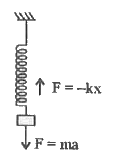
|
|
| 10. |
If there were a small alteration in gravitational force, then which of the following forces do you think would alter in some respect |
|
Answer» VISCOUS forces |
|
| 11. |
A wire of length l and mass m is first bent in a circle, then in a square and then in an equilateral triangle. The moment of inertia in these three cases about an axis perpendicular to their planes and passig through their centres of mass are I_(1),I_(2) & I_(3) respectively. Then maximum of them is: |
| Answer» Answer :A | |
| 12. |
A bar of mass m resting on a smooth horizontal plane starts moving due to the force F=mg/3 of constant magnitude. In the process of its rectilinear motion the angle alpha between the direction of this force and the horizontal varies as alpha=as, where a is a constant and s is the distance traversed by the bar from its initial position. Find the velocity of the bar as a function of the angle 'alpha' |
|
Answer» SOLUTION :`V=sqrt(2G SIN ALPHA)/(3A)` |
|
| 13. |
Explain translational motion by given illustration. |
|
Answer» SOLUTION :A rectangular block sliding down an inclined plane without any SIDEWISE movement as shown in figure. Its MOTION down the plane is such that all the PARTICLES of the body are moving together. Means they have the same velocity at any instant of time. Such motion of rigid body is in PURE translational motion. In pure translational motion at any instant of time all particles of the body have the same velocity at any instant of time. Such motion of rigid body is in pure translational motion. In pure translational motio at any instant of time all particles of the body have the same velocity. |
|
| 14. |
When force F_(1), F_(2), F_(3) are acting on a particle of mass m such that F_(2) and F_(3) are mutually perpendicular, then the particle remains stationary. If the force F_(1) is now removed then acceleration of the particle is |
|
Answer» `-(barF_3)/m("or")(barF_1+barF_2)/m` |
|
| 15. |
A body cools from 80^(@)C to 50^(@)C in 5 minutes Calculate the time it takes to cool from 60^(@)C to 30^(@)C. The temperature of the surroundings is 20^(@)C. |
|
Answer» Solution :According to Newton.s law of COOLING, `-(dT)/(dt)=K.(T-T_(s))` `-((50-80)/(5))=K.[(50+80)/(2)-20]` `6=K.(65-20)` `:.K.=(6)/(45)` Now, again, `-(dT)/(dt)=K.(T-T_(s))` `:.((30-60)/(t) )=(6)/(45)[(30+60)/(2)-20]` `:.(30)/(t)=(2)/(15)[45-20]` `:.(30)/(t)=(2)/(15)xx25` `:.(30)/(t)=(10)/(3)` `:.t=(90)/(10)` `:.t=9" min"` |
|
| 16. |
Due to the application of a force on a body of mass 100 kg that is initially at rest, the body moves with an acceleration of 20ms^(-2) in the direction of the force. Find the magnitude of the force. |
| Answer» ANSWER :B | |
| 17. |
Densities of a liquid at 30°C and 80°C are 0.6gm/c.c and 0.54 gm/c.c. The coefficient of real expansion of liquids is |
|
Answer» 0.0002/°C |
|
| 18. |
A ball of mass 'm' is thrown with a speed v_0towards a bat. It rebounds along the same speed 2v_0 . The variation of interaction force between the bat and ball is shown The speed of the ball at the instant the force acting on the ball is maximum is |
|
Answer» `v_0` |
|
| 19. |
A ball of mass 'm' is thrown with a speed v_0towards a bat. It rebounds along the same speed 2v_0 . The variation of interaction force between the bat and ball is shown Average force exerted by the bat on the ball is |
|
Answer» `(mv_0)/t_0` |
|
| 20. |
A ball of mass 'm' is thrown with a speed v_0towards a bat. It rebounds along the same speed 2v_0 . The variation of interaction force between the bat and ball is shown Maximum force exerted by the bat on the ball is |
|
Answer» `(mv_0)/t_0` |
|
| 21. |
The diameter of a soap bubble is 8mm and the surface tension of soap solution is 4xx10^(-2)Nm^(-1). Find the excess pressure inside the bubble. |
|
Answer» Solution :Diameter of the bubble = `8mm=8xx10^(-3)m` RADIUS of the bubble `(r )=4XX10^(-3)m` Surface tension `(S)=4xx10^(-2)Nm^(-1)` Excess pressure inside the bubble `=(4S)/(r )` `=(4xx4xx10^(-2))/(4xx10^(-3))=40Nm^(-2)` `therefore` Excess pressure inside the bubble = `40Nm^(-2)` |
|
| 22. |
The nature of a physical quantity is described by its dimensions.Besides the seven base units, there are two more units in SI. The unit ofsoild angle is |
|
Answer» RADIAN |
|
| 23. |
Abody is projected vertically up with velocity 98ms^(-1). After 2 s if the acceleration due to gravity of earth disappears, the velocity of the body at the end of next 3 s is |
|
Answer» `49ms^(-1)` |
|
| 24. |
The parallax method has been used for measuring ………… which are………… |
|
Answer» |
|
| 25. |
At time t=0, two bodies A and B are at the same point. A moves with constant velocity V and B starts from rest and moves with constant acceleration. Relative velocity of B with respect to A when the bodies meet each other is |
|
Answer» `(V)/(2)` |
|
| 26. |
What do you mean by capillary rise? What is the phenomenon responsible for it? |
| Answer» Solution :The PHENOMENON of rise of LIQUID in a capllary tube is CALLED capillary rise. Surface TENSION is the phenomenon responsible for it. | |
| 27. |
The speed of a motor increases from 1200 rpm to 1800 rpm in 20S. How many revolutions does it make in this period of time? |
|
Answer» 400 |
|
| 28. |
An artificial satellite of mass 'm' is revolving around the earth, in a circular orbit of radius 'r'. If the mass of the earth is 'm' angular momentum of the satellite with respect to the centre of earth is (G= universal gravitational constant) |
|
Answer» `sqrt(GMM^(2)r)` |
|
| 29. |
Define gravitational potential energy. Obtain the formula for the gravitational energy of body at distancer r (r gt R_c)fromthe centre of earth. |
|
Answer» Solution :`implies` Gravitational potential energy : "The work done in bringing a body of unit mass from infinite distance to the given point in gravitational field of other body is called the gravitational potential energy at that point".  `implies`Suppose, the mass of earth is Mp and radius RE: We have to determine the gravitational potential energy of mass m at point P from distancer from the centre of earth. `implies` Suppose, at any instant body of mass m lying at point A at a distance x from the centre of earth OP = x `implies`The gravitational force on the body at this point, `F = (GM_(E) m)/x^2 ""...(1)` `implies` The work done to MOVE the body to small displacement from the centre of earth dW = FDX `:.dW = (GM_Em)/x^2dx""...(2)` `implies` TOTAL work done to bring the body from infinite (D) distance to x distance `implies W = intdW=int_(oo)^(r)(GM_Em)/x^2dx` `implies W=GM_(E)"m"int_(oo)^(r) x^(-2) dx` `implies W = GM_Em[-1/x]_(oo)^(r)` `implies W=(GM_Em)[-1/r+1/oo]` `:. W=-(GM_Em)/r""...(3)` `implies ` ACCORDING to definition this work done is known as gravitational potential energy of a body of mass m at point P, `U =-(GM_Em)/r""...(4)` If a body bring to at the surface of earth r = Re, `U = - (GM_Em)/(R_E) ""....(5)` |
|
| 30. |
Explain Bulk Modulus. |
|
Answer» Solution :When a body is submerged in a fluid, it undergoes a hydraulic stress (equal in magnitude to the hydraulic pressure). This LEADS to the decrease in the voume of the body thus producing STRAIN called volume strain. The ratio of hydraulic stress to the corresponding hydraulic strain is called bulk modulus. It is denoted by symbol B. `therefore B = (-p)/((Delta V//V))` The negative sign indicates that with an INCREASES in pressure, a decrease in volume occurs. That is if p is positive, `Delta V` is negative. Thus, for a system in equilibrium, the vlaue of bulk modulus B is always positive. SI unit of bulk modulus is the same as that pressure. Means `Nm^(-2)` or Pa and dimensional formula is `[M^(1) L^(-1) T ^(-2)].` Stress, strain and various elastic moduli: Hence, compressibility of solid is very low, while gases have the most compressibility. Gases are ten lakh time more compressible compare to solids compressibility of gases are very large. It will be changes with temperature and pressure. Incompressibility of solid mainly is due to firm bonding of neighbour atoms. Atoms of liquid is also bonded to neighbour atoms but, it is less compare to in solid. Atoms of goposses weak bonding to their NEIGHBOURING atoms. Bulk moduli (B) of some common materials : 
|
|
| 31. |
The refractive index of a prism for amono-chromatic wave is sqrt2 and its refracting angle is 60^@ For minimum deviation the angle of incidence will be |
| Answer» Answer :B | |
| 32. |
For perfectly inelastic collision, coefficient of restitution is |
|
Answer» 0 |
|
| 33. |
(A) : The soldiers marching on a suspended bridge are advised to go out of steps. (R ) : Frequency of marching steps may match with the natural frequency of oscillation of bridge. |
|
Answer» Both 'A' and 'R' are TURE and 'R' is the correct explanation of 'A' |
|
| 34. |
When a damped harmonic oscillator completes 100 oscillations, its amplitude is reduced to (1)/(3) of its initial value. What will be its amplitude when it completes 200 oscillations ? |
|
Answer» `(1)/(5)` `a=a_(0)e^(-bt)` If, `t=100 T and a=(a_(0))/(3)` `THEREFORE (a_(0))/(3)=a_(0)e^(-100bT)` If, `t=200 T` `a=a_(0)e^(-bt)=a_(0)e^(-b(200T))` `=a_(0)(e^(-1006T))^(2)` `a=a_(0)((1)/(3))^(2)` `a=(a_(0))/(9)` |
|
| 35. |
One end of a thin uniform rod of length L and mass M_(1) is rivetted to the centre of a uniform circular disc of radius 'r' and mass M_(2) so that that both are coplanar. The centre of mass of the combination from the centre of the disc is (Assume that the point of attachment is at the origin). |
|
Answer» `(L(M_(1)+M_(2)))/(2M_(1))` |
|
| 36. |
A glass bulb of volume 250 c.c is completely filled with mercury at 20^(@)C. The temperature of the system is raised to 100^(@)C. If the coefficient of linear expansion of glass is 9xx10^(-6)//""^(@)C and coefficient of absolute expansion of mercury is 1.8xx10^(-4)//""^(@)C, the volume of mercury that overflows is nearly |
|
Answer» `3.06` c.c |
|
| 37. |
Which one of these is more elastic, steel or rubber ? Why ? |
| Answer» SOLUTION :STEEL is more ELASTIC than RUBBER. If an equal stress is applied to both steel and rubber, the steel produces less strain. So the Young.s MODULUS is higher for steel than rubber. The object which has higher young.s modulus is more elastic . | |
| 38. |
1 kg of ice at 0^(@)C is mixed 1.5 kg of water at 45^@C[latent of fusion = 80 cal/g] Then: |
|
Answer» The TEMPERATURE of the mixture is `0^@C` |
|
| 39. |
A steam at 100^@C is passed into 1 kg of water contained in a calorimeter of water equivalent 0.2 kg at 9^@C till the temperature of the calorimeter and water in it is increased to 90^@C. The mass of steam condensed in kg is nearly (specific heat of water =1 cal//g^@C,latent heat of vaporisation= 540 cal//g) |
|
Answer» `0.81` |
|
| 40. |
Consider an arrangement shown in the figure. The pulley P is frictionless and the threads are massless. The mass of the spools is m and moment of inertia of the spool is 1/2 mR^(2). The mass of the disc of radius R is also m. The surface below the spool is rough to ensure pure rolling of spool. the mass of the block is m and the surface below the block is smooth. find the initial acceleration of the block when the system is released from rest. |
|
Answer» `4/37 g`  Now `alpha=alpha_(1)(R-R/2)` `rArralpha=(alpha_(1)R)/2....(1), alpha_(1)=alpha_(1)R.....(2)` `alpha_(2)=alpha_(1)(2R)+alpha_(2)(R).......(3)` For the block `ma=T_(1)......(4)` For the spool `malpha_(1)=T_(2)-T_(1)-F.....(5)` `((mR^(2))/2)alpha_(1)=T_(2)R+T_(1)R+fR.....(6)` For the disc `ma_(2)=mg-T_(2)` .....(7) `(1/2mR^(2))alpha^(2)=T_(2)R......(8)` For these equations, we get `a=4/37 g` |
|
| 41. |
Assertion : A solid is floating in a liquid of density rho_(1). When the solid melts its density becomes rho_(2) in liquid state. If rho_(1) gt rho_(2) level of liquids will increase after melting. Reason : In liquid state volume always increases after a solid melts. |
|
Answer» If both ASSERTION and REASON are CORRECT and Reason is the correct EXPLANATION of Assertion. |
|
| 42. |
(A) : Two vectors are said to be equal vecors only if they have same direction but different magnitudes. ( R) : Vector quantities do not have specific direction. |
|
Answer» Both (A) and ( R) are ture and ( R) is the CORRECT EXPLANATION of (A) |
|
| 43. |
A large and small vehicle moving with the some kinetic energy on a straight road. Their engine are simultaneously OFF. Which one will stop at a longer distance ? |
|
Answer» Solution :The vehicle stops when k.E is spent in working against the FORCE of friction varies directly with the weight of the vehicle. k.E = workdone Workdone (W) = Force of friction `xx` distance Energy € `= f xx s` Displacement (S) = E/f For given k.E s will be smaller where F is LARGER such as in the SMALL vehicle, so the displacement of a larger vehicle is HIGH. |
|
| 44. |
Whichtype ofconvectionis involvedin coolingthe airin aircoolers ? |
| Answer» SOLUTION :FORCED CONVECTION. | |
| 45. |
Gravitational acceleration on the surfaceof a planet is (sqrt(6))/(11) g, where g is the gravitational acceleration on the surface of the earth. The average mass density of the planetis 2/3 times that of the earth.IF the escape speed on the surface of hte earth is taken tobe 11 kms^(-1), the escape speed on the surface of the planet in kms^(-1) will be. |
|
Answer» |
|
| 46. |
A road curve is banked so that there is no side thrust on the passengers in a car which negotiate the curve at 72 km/hr speed . Find the angle of banking for a circular curve making a 90^(@) turn in a distance of 157 m along the road. |
|
Answer» |
|
| 47. |
Hailstones fall from a certain height. If they melt completely on reaching the ground, find the height from which they fall. |
|
Answer» Solution :On reaching the ground, a hailstone of mass M loses potential ENERGY which is converted into a heat energy required to melt it. In SI, potential energy lost = heat energy required for melting the hailstone MGH `=ML rArr gh = L ` ` H = L/g , h = (80xx4.2 xx1000)/10` ` = 33.6 xx1000 m = 33.6 km ` |
|
| 48. |
If the density of oxygen at S.T.P is 1.429 gm "litre"^(-1). Calculate the gas constant. |
|
Answer» |
|
| 49. |
A particle of mass m is attached to an end of a uniform rod of mass M=2m and length 'l' which is suspended through its mid point by an inextensible string as shown. Initially the rod is in horizontal position and at rest. The system is released from this position. Just after the release. |
|
Answer» |
|
| 50. |
A train runs along an unbanked circular track of radius 30 m at a speed of 54 km/h. The mass of the train is 10^(6) kg What provides the centripetal force required for this purpose - the engine or the rails ? What is the angle of banking required to prevent wearing out of the rail ? |
|
Answer» Solution :The centripetal force is PROVIDED by the lateral thrust by the rail on the flanges of the wheels. By rhe third law, the train EXERTS an equal and opposite thrust on the rail causing its WEAR and tear. Angle of banking `theta = tan^(-1)((v^(2))/(Rg))=tan^(-1)((15xx15)/(30xx10))=37^(@)` |
|