

Saved Bookmarks
This section includes 7 InterviewSolutions, each offering curated multiple-choice questions to sharpen your Current Affairs knowledge and support exam preparation. Choose a topic below to get started.
| 1. |
As shown in figure, masses of 2 kg and 4kg are tied to two ends of a wire passed over a pulley. Cross-sectional area of wire is 2 cm^(2). Calculate longitudinal strain produced in wire. (g = 10 ms ^(-2) Y= 2 xx 10 ^(11) Pa |
Answer» Solution : Here, `M = 4kg` `m = 2 kg` `g = 10 ms ^(-2)` `y = 2 XX 10 ^(11) P_(a)` `a = ?` `A = 2 cm ^(2)` `= 2 xx 10 ^(-4) m ^(2)` `T = ?` `(Delta l)/(l) = ?` If common acceleration of both masses is a and tension in WIRE = T, using equation of MOTIONS, ` Mg -T = Ma ""...(1)` `T- mg = ma ""...(2)` `therefore` Adding eq. (1) and (2). `(M-m ) g = (M + m) a` `therefore ( 4-2) xx 10 = (4 +2) xx a ` `therefore (20)/(6) = a` `therefore a = (10)/(3) ms ^(-2)` Putting `a = (10)/(3) ms 6(-2)` in eq. (2) `T= mg + ma = 2 xx 10 + 2 xx (10)/(3)` `therefore T = (80)/(3) N` `therefore` Stress `SIGMA = (F)/(A) = T/A = (80)/( 3 xx 2 xx 10 ^(-4)) = 4/3 xx 10 ^(5) (N)/( m ^(2))` `therefore "Strain" epsi = ( "stress")/(Y)` `= 4/3 xx 10 ^(5) xx (1)/( 2 xx 10^(11))= 2.3 xx 10 ^(-6) ` `~~ 0.66 xx 10 ^(-6)` `~~ 6.6 xx 10 ^(-7)` |
|
| 2. |
The resistance R=V/I where V=(100 pm5)V and I=(10 pm 0.2)A. Find the percentage error in R. |
| Answer» SOLUTION :The percentage error in V is 5% and in I it is 2% .The total error in R would THEREFORE be 5%+2% = 7%. | |
| 3. |
The velocity of a cylindrical layer of liquid at a distance 0.4 cm from the axisof a tube of radius 0.5 cm is 3.6cm//s .Find the velocity of a layer lying at a distance of 0.3 cm from axis .[Hint : v=(P)/(4etal)(r^(2)-x^(2))] |
|
Answer» SOLUTION :`r=0.5cm ""v=(P)/(4etal)(r^(2)-x^(2))and` `x_(1)=0.4cm` `x_(2)=0.3cm "" v_(1)=(P)/(4etal)(r^(2)-x_(1)^(2))`….(1) `v_(1)=3.6cm//s "" v_(2)=(P)/(4etal)(r^(2)-x_(2)^(2))`…(2) `v_(2)=?` TAKING RATIO of EQUATION (1) and (2), `(v_(1))/(v_(2))=(r^(2)-x_(1)^(2))/(r^(2)-x_(2)^(2))` `thereforev_(2)=v_(1)[(r^(2)-x_(2)^(2))/(r^(2)-x_(1)^(2))]` `v_(2)=3.6[(0.25-0.09)/(0.25-0.16)]=(3.6xx0.16)/(0.09)` `v_(2)=6.4cm//s` |
|
| 4. |
A particle executes SHM represented by the equation =0.02sin (3.14t + (pi)/2) metre. Find (i) amplitude (ii) time period (iii) frequency (iv) epoch (v) maximum velocity and (vi) maximum acceleration. |
|
Answer» Solution :COMPARE the equation `y=0.02sin (3.14+(pi)/2)` with general from of the equation `y=A sin (omegat+phi_(0))` (i) Amplitude : A=0.02m (ii) Time period (T) is given by `T=(2pi)/(omega)` or `T=(2pi)/3.14=2s` (iii) Frequency `v=1/T=1/2Hz=0.5Hz` (iv) Epoch `varphi_(0)=(pi)/2=3.14/2=1.57` rad (v) Maximum VELOCITY `v_("MAX")=Aomega=0.02xx3.14` `=0.68ms^(-1)` (vi) maximum acceleration `a_("max")=-Aomega^(2)=-0.02xx(3.14)^(2)=0.1972ms^(-2)` |
|
| 5. |
Calculate the mass of 1 liter of moist air at 27^(@)C when the barometer reads 753.6mm of mercury and the dew point is 16.1^(@)C. (Saturated vapour pressure of water at 16.1^(@)C+13.6mm of mercury, densityb of aire at NTP=1.293kg m^(-3) and density of saturated water vapour at NTP=0.808kg m^(-3) |
|
Answer» |
|
| 6. |
Why do we express the angular displacement in radian ? |
| Answer» Solution :The length of an ARC `l=rtheta`in this equation `theta`is in RADIAN and not in degrees. Using this equation ANGULAR displacement can be CONVERTED into a LINEAR displacement. | |
| 7. |
A point in the system at which whole mass of the body is supposed to be concentrated is called: |
|
Answer» CENTRE of gravity |
|
| 8. |
A tube of length L is filled completely with an incompressible liquid of mass M and its two open ends are closed. The tube is then rotated with an angular velocity omega with one end of its as the centre. What will be the force exerted by the liquid on the other end? |
|
Answer» Solution :MASS of the liquid= M. The centre of mass for the WHOLE liquid is situated at the mid-point of the TUBE. Hence, the RADIUS of the circular path along which the centre of mass rotates is, r = `(L)/(2)`. So, the centrifugal force acting on the centre of mass = `M omega^(2)`r = M `omega^(2) (L)/(2)` This is the centrifugal force acting on the liquid in the tube. This is the force that ACTS on the other end of the tube. |
|
| 9. |
When an arrow is shot, where from the arrow will acquire its kinetic energy? |
| Answer» Solution :A stretched low possesses potential ENERGY on ACCOUNT of a CHANGE in its shape. To shoot an ARROW, the bow is released. The potential energy of the bow is CONVERTED into the kinetic energy of the arrow. | |
| 10. |
If the immediate insignificant digit to be dropped is 5 then there will be two different cases (A) If the preceding digit is even, it is to be unchanged and 5 is dropped (B) If the preceding digit is odd, it is to be raised by 1. |
|
Answer» only A is correct |
|
| 11. |
A one litre flask contains certain quantity of mercury. If the volume of air inside the flask remains the same at all temperatures then the volume of mercury in the flask is (volume expansion coefficient of mercury is 20 times that of flask) |
|
Answer» 100cc i.e., `DELTA V = Delta V_("mercury") or V_("gamma_("flask")) Delta T = V_("mercury") Delta T` or `V_("mercury") = (V_(gamma_("flask")))/(gamma_("mercury"))` Here, `V= 1 L = 1000cc, (gamma_("flask"))/(gamma_("mercury"))= (1)/(20)` `:. V_("mercury") =(1000"cc") ((1)/(20)) =50"cc"` |
|
| 12. |
Show four steps of carnot engine in P-V graph write the equation of each step and obtain the work done by the system. Also obtain the efficiency of a carnot engine. |
|
Answer» Solution :There are four reversible process occur in carnot engine. (1) isothermal expansion (2) Adiabatic expansion (3) Isothermal compression (4) Adiabatic compression A cylic process is obtain by these four processes is shown in below P `to` V diagram. 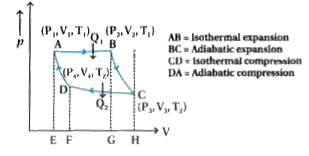 (a) Step 1: Isothermal expansion of gas taking its state from `(P_1, V_1, T_1)` to `(P_2, V_2, T_1)`. For this, the conducting bottom of the cylinder is brought into contact with the heat and the gas is slowly allowed to expand isothermally. (b) The heat absorbed by the gas `Q_1` from the reservoir, hence work done by gas (or on surrounding) `W_1=Q_1=muRT_1 ln (V_2/V_1)`...(1) Where `mu` is amount of gas in mole R=Gas constant or `W_1=Q_1`=Area of ABGEA (b) Step 2: (Adiabatic expansion) : Now, the cylinder is PLACED on a thermally insulated stand and gas is adiabatically expanded from state `(P_2, V_2, T_1)` to `(P_3, V_3, T_2)` (Here temperature decreases due to expansion). The work done by the gas in adiabatic expansion (or on surrounding) `W_2=(muR(T_1-T_2))/(gamma-1)`...(2) OR `therefore W_2`= Area of BCHGB (c) Step 3: (Isothermal compression): Now the cylinder is brought in contact with heat sink and isothermally compressed slowly and brought from `(P_3, V_3, T_2)` to `(P_4, V_4, T_2)`. During this process heat released `Q_2` by the gas to the reservoir (sink) at temperature `T_2`. The work done on the gas (or by surrounding) `W_3=-Q_2=-muRT_2 ln (V_4/V_3)` `therefore W_3=Q_2=muRT_2 ln (V_3/V_4)`...(3) (Here work done on the system and system rejected heat so W and `Q_2` are negative) OR `W_3=Q_2` =Area of CDFHC (d) Step 4: (Adiabatic compression): Now the cylinder is placed on a thermally insulated stand and the gas is compressed adiabatically and is taken from state to `[P_4,V_4,T_2]` to `[P_1,V_1,T_1]` The work done on the gas (work done by surrounding) in adiabatic compression. `W_4=-(muR[T_2-T_1])/(gamma-1)` `therefore W_4=(muR[T_1-T_2])/(gamma-1)`....(4) OR `W_4` = Area of ADFEA Total work done by the gas in one COMPLETE cycle from equation (1),(2),(3) and (4) , `W=W_1+W_2 to (-W_3)+(-W_4)` But `W_2=W_4` [`because W_2` is the work done by gas and `W_4` is the work done on the gas] `therefore W=W_1-W_3`...(5) `[because W_1 gt 0, W_3 lt 0]` =Area of ABCDA Now efficiency of engine, `eta=W/Q_1` `=(W_1-W_3)/Q_1=(Q_1-Q_2)/Q_1` `=1-Q_2/Q_1` `therefore eta=1-(muRT_2 ln (V_3/V_4))/(muRT_1 ln (V_2/V_1))` `therefore eta=1-(T_2 ln (V_3/V_4))/(T_1 ln (V_2/V_1))` ...(6) (From equ. (1) and (3)) For adiabatic process `TV^(gamma-1)` = constant `therefore` For step `to` 2 `T_1V_2^(gamma-1)=T_2V_3^(gamma-1)` `therefore (V_2/V_3)^(gamma-1) =T_2/T_1` `therefore V_2/V_3=(T_2/T_1)^(1/(gamma-1))` ...(7) and for step `to` 4 `V_1/V_4=(T_2/T_1)^(1/(gamma-1))` ....(8) From equation (7) and (8) , `V_2/V_3=V_1/V_4` `therefore V_2/V_1=V_3/V_4`....(9) From equation (6) and (9) , `eta=1-T_2/T_1` is the efficiency of carnot engine |
|
| 13. |
When a body is projected vertically up, at a point 'P' in its path, the ratio of potential to kinetic energies is 3 : 4. If the same body were to be projected with two times the initial velocity, the ratio of potential to kinetic energies at the same point is |
|
Answer» `3 : 25` |
|
| 14. |
Angle of an inclined plane with the horizontal is theta. First half of the plane is smooth and the other half is rough. When a body is released from the top of the plane it slides down and comes to rest at the bottom. Coefficient of friction between the body and the inclined plane is |
|
Answer» `MU = 2 tan theta` |
|
| 15. |
The waves genetated due to vibration of an air column in a pipe open at one end or a pipeopen atboth ends are |
|
Answer» TRANSVERSE PROGRESSIVE WAVES |
|
| 16. |
If a number of little droplets of water, all of the same radius r, coalesce to form a single drop of radius R, the rise in temperature will be given by (18 T)/( eta rho s) ((1)/(r ) - (1)/(R )) where T is the surface tension of water,rho isdensity of water and n is a dimensionless constant. Find eta. |
|
Answer» |
|
| 17. |
When a liquid flows on a horizontal surface, which layer is fastest. |
| Answer» SOLUTION : UPPER LAYER | |
| 18. |
A metal rod A of 50 cm length expands by 0.10 cm when its temperature is raised from 0^(0) C " to " 100^(0) C . Another rod B of a different metal of length 60 cm expands by 0.06 emf or the same rise in temperature. A third rod C of 50 cm length is made up of pieces of rods A and B placed end to end expands by 0.03 cm on heating from 0^(0)C " to" 50^(0)C. Find the length of each portion of composite rod C. |
|
Answer» Solution :From the data for rod A, we have `Delta` L = `alpha_(A) L Delta T ` or `alpha_(A) = (Delta L)/(L Delta T) = (0.10)/(50 xx 100) = 2 xx 10^(-5)""^(@)C^(-1)` For rod B, we have `Delta L = a_(B) L Delta T ` If rod C is made of segments of rod A and B of lengths `l_(1) and l_(2)` RESPECTIVELY then we have at `0 " "^(@)C` . `l_(1) + l_(2) = 50` cm At T = `50^(@)C "" l_(1). + l_(2). = 50.03` cm Thus `alpha_(A) l_(1) Delta T + alpha_(B) l_(2) Delta T = 0.03 ` cm or `2 xx 10^(-5) xx l_(1) xx 50 + 10^(-5) xx l_(2) xx 50 = 0.03 cm` or `2l_(1) + l_(2) = (0.03)/(50) xx 10^(5) = 60 cm "" `..... (b) SOLVING (a) and (b) we get `l_(1) = 10 cm and l_(2)` = 40 cm |
|
| 19. |
Reason for the deformation of a regular body |
|
Answer» BULK strain |
|
| 20. |
A force of 8 N acts on an object of mass 2 kg in X-direction and another force of 6 N acts on it in Y -direction. Hence, the magnitude of acceleration of the object will be .... |
|
Answer» `7.0 ms^(-2)` `F= SQRT((8)^(2) + (16)^(2)) = sqrt(64+36) = sqrt(100)` `=ma= 10` `a =(10)/( m ) = (10)/(2) = 5 ms^(-2)` |
|
| 21. |
(a) Distinguish between inertial and gravitational mass. (b) Which is more fundamental -mass or weight- and why ? (c ) Why moon travellers load heavy weights at their back before landing on the moon ? |
|
Answer» Solution :(b) Mass is more FUNDAMENTAL than weight because the mass of a body always remains samewhereas the weight of a body varies from place to place. (c ) As the value of g is very small on the moon the travellers FEEL weightless. To overcome this weightless, they CARRY HEAVY bags. |
|
| 22. |
When you speak of your friend which of the following parameters have a unique value in the sound produced? |
|
Answer» Frequency |
|
| 23. |
A bullet loses 25% of its initial kinetic energy after penetrating through a disatance of 2cm in a target. The further distance it travels before coming to rest is |
| Answer» ANSWER :D | |
| 24. |
A metal ball of surface area 200cm^(2) and temperature 527^(@)C is surrounded by a vessel at 27^(@)C. If the emissivity of the metal is 0.4, then the rate of loss of heat from the ball is (sigma=5.67xx10^(-8)J//m^(2)-s-k^(4)) |
|
Answer» 108 JOULES approx |
|
| 25. |
Answer the following questions based on the P-T phase diagram of carbon dioxide : (a) At what temperature and pressure can the solid, liquid and vapour phases of CO_(2) coexist in equilibrium ? (b) What is the effect of decrease of pressure on the fusion and boiling point of CO_(2) ? (c) What are the critical temperature and pressure for CO_(2) ? What is their significance ? (d) Is CO_(2) solid, liquid or gas at (a) -70^(@)C under 1 atm, (b) -60^(@)C under 10 atm, (c) 16^(@)C under 56 atm ? |
|
Answer» SOLUTION :(a) From phase diagram of `CO_(2)` temperature of triple point `=-56.6^(@)C` and pressure `=5.11` atom (b) With decrease in pressure of `CO_(2)`, boiling and freezing points decreases. (c) Critical temperature of `CO_(2)` is `31.1^(@)C` and pressure is 73.0 atm. If it is compressed at HIGH temperature then this with pressure then it is not converted into liquid. (i) (`-70^(@)C,1.0` atm) point is in gaseous SECTION hence `CO_(2)` is in the gaseous state at this point. (II) `(-60^(@)C," 10 atm")` point is in solid section, hence `CO_(2)` is in solid state at this point. (iii) `(15^(@)C," 56 atm")` point is in liquid section, hence `CO_(2)` is in liquid state at this point. |
|
| 26. |
Dimension of a physical quantity is M^(a)L^(b)T^(c), then it is ...... |
|
Answer» VELOCITY if `a=1,B=0,c=-1` `(A) M^(1)L^(0)T^(-1)` which is not dimension of velocity. (B) `M^(1)L^(1)T^(-2)` which is dimension of force but not ACCELERATION. (c) `M^(0)L^(-1)T^(-2)` Which is not dimension of force. (D) `M^(1)L^(-1)T^(-2)` which not dimension of pressure. |
|
| 27. |
The mass and the radius of a planet are twice that of earth. Then period of oscillation of a second pendulum on that planet will be : |
|
Answer» `2 sqrt(2)s` `G=(GM)/(R^(2))` On PLANET, `g'=(Gxx2M)/((2R)^(2))=(g)/(2)` `(T)/(T)= sqrt((g)/(g'))= sqrt((g)/(g//2))= sqrt(2)` `T'= sqrt(2)xxT= sqrt(2)XX 2=2 sqrt(2)` |
|
| 28. |
If the Earth stops rotating about its axis, then by what value will the acceleration due to gravity change at the equator? |
|
Answer» Solution :The value of G increases by `omega^(2)R`. `omega`-ANGULAR VELOCITY, R-radius of the earth. |
|
| 29. |
Obtain Eq. (7.38) from first principles. |
|
Answer» Solution :The ANGULAR acceleration is uniform, HENCE `(domega)/(dt)=alpha` = constant (i) Integrating this equation, `omega=intalphadt+c` `=alphat+c` (as `alpha` is constant) At `t = 0,ω= ω_(0)` (GIVEN) From (i) we get at `t=0,ω=c=omega_(0)` Thus, `ω = αt + ω_(0)` as REQUIRED. With the definition of `ω= d θ //dt` we may integrate Eq. (7.38) to get .This DERIVATION and the derivation of Eq. (7.40) is left as an exercise. |
|
| 30. |
Find the values of x and y for which vectors vecA=6hati+xhatj-2hatk and vecB=5hati-6hatj-yhatkmay be parellel |
|
Answer» `X=0, y=(2)/(3)` |
|
| 31. |
In the circuit shown in figure , R_(1)=R_(2)=R_(3)=R. Match the following |
|
Answer» <P> |
|
| 32. |
The maximum tension a rope can withstand is 60 kg - wt. The ratio of maximum acceleration with which two boys of masses 20kg and 30kg can climb up the rope at the same time is |
|
Answer» SOLUTION :`m_(1)=20kg, m_(2)=30kg, T=60kgwt=600N` For `.m_(1)., T-m_(1)g=m_(1)a_(1)` `600-20xx10=20xxa_(1)RARR a_(1)=20MS^(-2)` For `.m_(2).,T-m_(2)g=m_(2)a_(2)` `600-30xx10=30xxa_(2)rArr a_(2)=10ms^(-2)` `a_(1):a_(2)=20:10=2:1` |
|
| 33. |
A particle of mass 2 kg is on a smooth horizontal table and moves in a circular path of radius 0.6 m. The height of the table from the ground is 0.8 m. If the angular speed of the particle is 12 rad s^(-1), the magnitude of its angular momentum about a point on the ground right under the centre of the circle is |
|
Answer» `11.52 KG m^(2)s^(-1)` |
|
| 34. |
A vessel show bottom has a round hole with diameter of 1 mm is filled with water. Only surface tension acts at the hole. Surface tension of water is 75xx10^-3 N. m^-1 and g=10m. S^-2. What is the maximum height (in cm) to which water can be filled in the vessel without leakage? |
|
Answer» |
|
| 35. |
A bomb initially at rest at a height of 40 m above the ground suddenly explodes into two identical fragments. One of hem starts moving vertically downwards with an initial sped of 10 m/s. If acceleration due to gravity is 10 m//s^(2), the separation between the fragments, 2 seconds after the explosion is |
|
Answer» Solution :Initial relative velocity `u_(rel)=10-(-10)=20 m//s` Relative ACCELERATION t = 2 sec, relative SEPARATION. `S_(rel)=u_(rel)t+(1)/(2)a_(rel)t^(2)=(20xx2)+0=40 m` |
|
| 36. |
The pressures of a gas in constant volume gas thermometer are 100 cm and 136.99 cm of Hg at 0^(@)C" and "100^(@)C respectively. Calculate the pressure coefficient of the gas. |
|
Answer» |
|
| 37. |
Find the terminal velocity of a steel ball 2 mm in diameter falling through glycerine. Relative density of steel is 8, relative density of glycerine is 1.3 and viscosity of glycerine is 8.3 poise. |
|
Answer» Solution :`v = 2/9 (r^2)/(eta) (rho - rho.) g = 2/9 ((0.1)^2)/(8.3 (8 - 1.3) XX 9.8` `v = 1.758 cm s^(-1)` |
|
| 38. |
A gas under constant pressure of 4.5 xx 10^5 Pawhen subjected to 800 kJ of heat, changes the volume from 0.5m^3 to 2.0 m^2. The change in internal energy of the gas is: |
|
Answer» `6.75xx10^(5)J` |
|
| 39. |
(A): Mass and energy are not conserved separately, but are conserved as a single entity called mass-energy. (R ): Mass and energy conservation can be obtained by Einstein equation for energy. |
|
Answer» Both 'A' and 'R' are TRUE and 'R' is the CORRECT EXPLANATION of 'A's |
|
| 40. |
A cord is attached between a 0.5 kg block and a spring with a force constant K=20 N/m . The other end of the spring is attached to the wall and the cord is placed over a pulley (I= 0.60 MR^2) of mass 5 kg and radius 0.50 as shown in figure. (Assuming no slipping occurs). What is the frequency of the oscillations when the body is set in to motion. |
|
Answer» `E=-mg x + 1/2 K (x+x)^2 + 1/2 I omega^2` `(dE)/(dt) = 0 ` use mg= `kx_0` `V= R omega impliesomega = (vartheta)/(R)` `(DX)/(dt) = vartheta ,(dw)/(dt) = alpha , (dv)/(dt) =a,- mg vartheta + (kx + kx_0) vartheta + (IV)/(R) alpha = 0 ` Finally use a `= R alpha ` `-mg + kx + kx_0 + (I a)/(R^2) = 0 ` `(kx + (IA)/(R^2))=0 ` use `a = - omega^2 x` |
|
| 41. |
The period of oscillation of a simple pendulum of length 'L' suspended from the ceiling of a vehicle which moves with out friction down in an inclined plane of inclination 'alpha' is given by |
|
Answer» `2pisqrt((L)/(gcosalpha))` |
|
| 42. |
The length of second pendulums is 1 m on earth . If mass and diameter of the planet is doubled than that or earth length becomes : |
|
Answer» 2 m When second pendulum is on earth then `T= 2pi sqrt((l)/(g))` (or) `2= 2pi sqrt((R^(2)l)/(GM)) ""....(1)` When second pendulum is on the planet then `=2pi sqrt(((2R)^(2)xxl')/(G(2M)))` `=2pi sqrt((2R^(2) l')/(GM)) ""...(2)` From (1) and (2) we get `sqrt(2l')= sqrt(l)` (or) `l'=(1)/(2)=(1)/(2)=0.5 m`. |
|
| 43. |
A police in a siren car moving with a velocity 20 ms^(-1) chases a thief who is moving in a car with a velocity v_(0)ms^(-1).The police car sounds at frequency 300 Hz, andboth of them move towards a stationary siren of frequency 400 Hz. Calculate the speed in whichthief is moving. |
|
Answer» Solution :Velocity of sound `V=330 m//s` Velocity of a police siren CAR `v_(s)=20 m//s` Frequency of a police siren car `f=300 Hz` Let the velocity of their be v m/s. Frequency of police siren heard by THIEF is `f_(1)=((330-v)/(330/20))xx300` `=((330-v)/(310))xx300HZ` Frequency of stationary sire `=400 HZ` Freqeuncy of stationary siren heard by thief `f_(2)=((330+v)/(330))xx400` It there are no beats then `f_(1)=f_(2)` `((330-v)/(310))xx300=((330+v)/(330))xx400` `(330-v)xx0.9677=(330+v)xx 1.2121` `330xx0.2444=2.7198v` `:.v=(0.2444xx330)/(2.1798)` `=36.99` `=37 m` |
|
| 44. |
Round off to 3 significant figures: (i)20.96(ii)0.0003125 |
|
Answer» Solution :(i)`20.96` has four SIGNIFICANT figures. The fourth significant FIGURE is more than 5 and hence on ROUNDING off to three significant figures, the given measurement will become `20.9+0.1"i.e.,"21.0.` (ii)`0.0003125` has four significant figures. The fourth isgnificant figure is 5 and hence on rounding off to three significant figures, the given measurement will become `0.000312 "or" 3.12xx10^(-4)`. This is because 2 before 5 is an even NUMBER. |
|
| 45. |
If an astronaut comes out of the artificial satellite, then |
|
Answer» He FLIES off tangentially |
|
| 46. |
The average range of frequencies at which human beings can hear sound waves varies from 20 Hz to 20 kHz. Calculate the wavelength of the sound wave in these limits . (Assume the speed of sound to be 340 ms^(-1) |
|
Answer» SOLUTION :`lambda_1 = v/f_1 = (340)/(20) = 17 m` `lambda_2 = v/f_2 = (340)/(20XX 10^3) =- 0.017 m` therefore , the audible wavelenght region is from 0.017 m to 17 m when the VELOCITY of sound in that region is 340 `ms^(-1)` |
|
| 47. |
Two perfectly elastic spheres of masses 2 kg and 3 kg moving in opposite directions with velocities 8 ms^(-1) and 6 ms^(-1) respectively collide with each other. Find their velocities after the impact. |
|
Answer» SOLUTION :Here `m _(1) = 2 kg, m _(2) = 3 kg , u _(1 = 8 ms ^(-1) , u _(2) = - 6 ms ^(-1)` According to the LAW of conservation of linear MOMENTUM `, m_(1) u _(1) + m_(2) u_(2) = m_(1) v _(1) + m_(2) v_(2)` i.e., `(2) (8)+ (3) (-6) =2v _(1) + 3 v _(2) implies 2v _(1) + 3v _(2) =-2 ""...(i)` SINCE the collision is elastic,` u _(1) - u _(2) = v _(2) -v _(1)` i.e., `8- (-6) =v _(2)-v_(1) implies v _(2) -v _(1) =14""...(ii)` On solving the equations (i) and (ii) we GET `v _(1) = - 8.8 ms ^(-1), v _(2) = 5.2 ms ^(-1)` |
|
| 48. |
The pressure - temperature relationship for an ideal gas undergoing adiabatic change is ……………. . |
|
Answer» (a) `P^(1-GAMMA)T^(gamma)="CONSTANT"` |
|
| 49. |
A particle starts from the origin at t=0s with a velocity of 10.0 hatjm//s and moves in the xy-plane with a constant acceleration of(8.0 hati + 2.0 hatj) ms^(-2). What time is the x-coordinate of the particle 16m? |
|
Answer» t = 2s |
|