

Saved Bookmarks
This section includes 7 InterviewSolutions, each offering curated multiple-choice questions to sharpen your Current Affairs knowledge and support exam preparation. Choose a topic below to get started.
| 1. |
If young's modulus y, surface tensions and time t are the fundamental quantities then the dimensional formula of density is |
|
Answer» `s^2s^3 t^(-2)` |
|
| 2. |
A light beam is travelling from region I to region IV (refer figure) The refractive index in regions I , II , III are n_0,n_0/2,n_0/6 and n_0/8 respectively. The angle of incidence theta for which the beam just misses entering region IV is |
|
Answer» Solution :As the beam just misses entering the REGION IV, the angle of refraction in the region IV must be `90^@` Application of Snell.s LAW successively at different interfaces give `n_0 SIN theta= n_0/2 sin theta_1= n_0/6 sin theta_2=n_0/8 sin 90^@` `implies sin theta=1/8 or theta= sin^-1 1/8` |
|
| 3. |
One way of measuring a person's body fat content is by "weighing" them under water. This works because fat tends to floats on water as it is less dense than water. On the other hand muscle and bone tend to sink as they are more dense. Knowing your 'weight' under water as well as your real weight out of water, the percentage of your body's volume that is made up of fat cab easily be estimated, fat (low density) and everything else (high density). The "weight" measured by spring balance both inside and outside the water. Quotes are placed around weight to indicate that the measurement read on the scales is not your true weight, i.e. the force applied to your body by gravity, but a mersurement of the net downward force on the scale. Salt water is denser than fresh water. If Ram is immersed fully first in salt water and then in fresh water and weighed, than |
|
Answer» Reading WOULD be LESS in salt WATER. |
|
| 4. |
A U tube is held such that the radius of one limb is r, and that of other is r_(2)(r_(2)gtr_(1)). A liquid of surface tension S, density rho and angle of contact zero is taken in the U tube. Then difference in the levels of the liquid in the two limbs is, |
|
Answer» Solution :PRESSURE at BOTTOM of Ist limb `p_(1)=h_(1)rhog+p_(0)-(2S)/r_(1)` Pressure at bottom of 2ND limb `p_(2)=h_(2)rhog+p_(0)-(2S)/r_(2)` Difference in the LEVELS is `(h_(1)-h_(2))=(2S)/(rhog)(1/r_(1)-1/r_(2))` 
|
|
| 5. |
One way of measuring a person's body fat content is by "weighing" them under water. This works because fat tends to floats on water as it is less dense than water. On the other hand muscle and bone tend to sink as they are more dense. Knowing your 'weight' under water as well as your real weight out of water, the percentage of your body's volume that is made up of fat cab easily be estimated, fat (low density) and everything else (high density). The "weight" measured by spring balance both inside and outside the water. Quotes are placed around weight to indicate that the measurement read on the scales is not your true weight, i.e. the force applied to your body by gravity, but a mersurement of the net downward force on the scale. Ram and Shyam are having the same weight when measured outside the water. When measured under water, it is found that weight of Ram is more than that of Shyam, then we can say that |
|
Answer» RAM is having more FAT CONTENT than SHYAM |
|
| 6. |
An experiment on the take off performance of an aeroplane shows that the acceleration vaies as shown in (figure) and that it takes 12s to take off from a rest position. a. Write the acceleration vs. time, velocity vs. time and position vs. time relations for complete journey. b. Plot velocity vs. time relation for the motion. c. Find the distance along the run way covered by the aeroplane. |
|
Answer» Solution :For time `t=0` to `6s` We can WRITE equation for this motion, it is `y=mx` type line where m is the slope of the line. Here, `a=((5-0))/((6-0))*timplies a=5/6t(ms^-2)` …(i) `(For 0letlt6s)` From `6s` to `12s` acceleration is constant, we can write equation for this motion, it is `y=const ant`. Hence `a=5(ms^-2)` `(For 6letlt12s)` For time `t=0` to `6s` From Eq. (i) `a=(dv)/(dt)=5/6timpliesdv=5/6tdt` Integrating both sides, we get `underset0oversetvintdv=5/6underset0oversettinttdt` `[v]_0^v=5/6[t^2/2]_0^t` or `(v-0)=5/12(t^2-0)` or `v=5/12t^2` Here velocity at `t=6s` is `v_(t=6s)=5/12xx6^2=15ms^-1` For time `t=0` to `6s` The acceleration is constant. `a=5(ms^-2)` or `(dv)/(dt)=5` or `dv=5dt` Integrating both sides, `underset15oversetvintdv=underset6oversettint5*dt` `[v]_15^v=5[t]_6^t` `v-15=5[t-6]` `impliesv=5t-15` Velocity-time RELATION will be a straight line of type `y=mx+c`. Plotting velocity-time relations For time `t=0` to `6s` `v=5/12t^2` Velocity time graph will be parabola passing through origin. 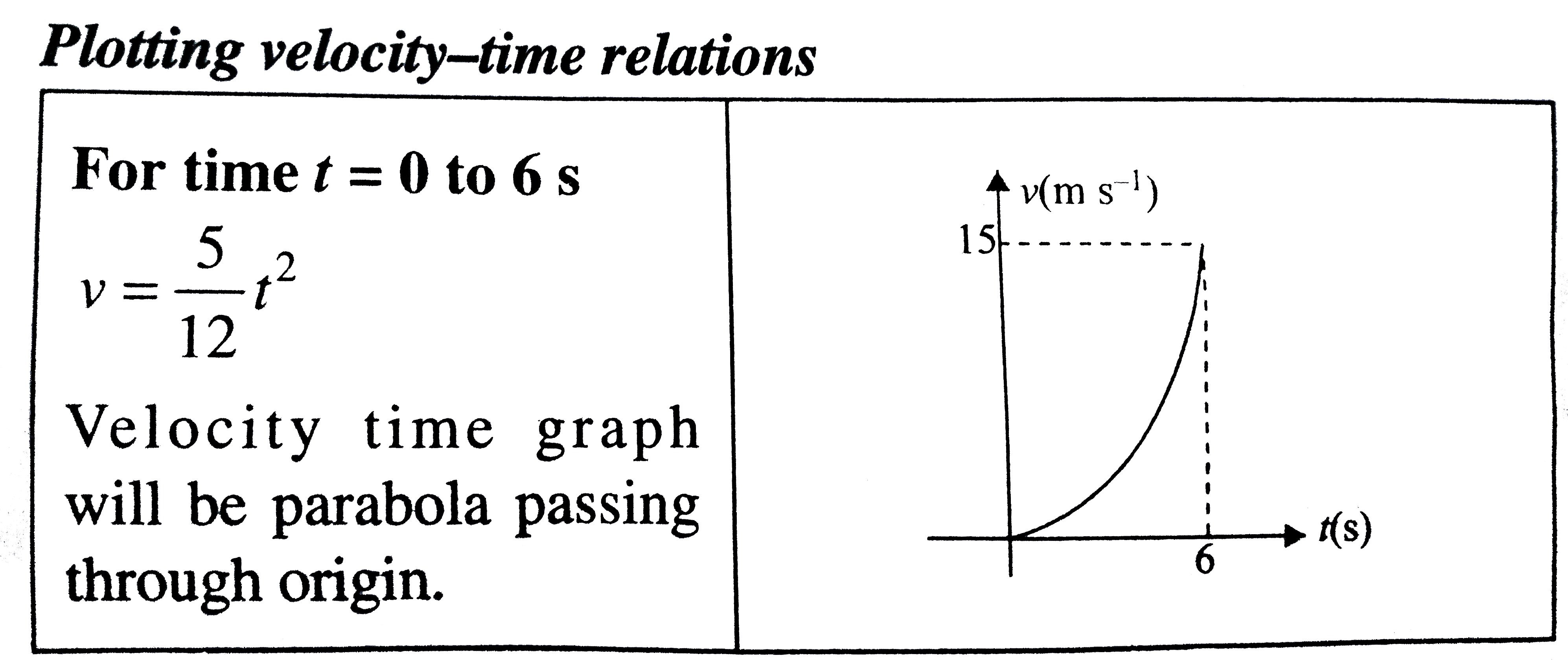 Position time relations For time `t=0` to `6s` As we know `v=(dx)/(dt)=5/12t^2` Hence, `5/12t^2=(dx)/(dt)impliesdx=5/12int t^2dt` Integrating both sides, `underset (0) oversetx int dx=5/12underset (0) overset (t) int t^2dt` `(x-0)=5/12[t^3/3]_0^timpliesx=5/36t^3` Position or the DISTANCE TRAVELLED from 0 to 6s `x_((t=6sec))=5/36xx(6)^3=30m` For time `t=6s` to `12s` `v=5t-15implies(dx)/(dt)=5t-5` or `dx=(5t-15)dt` Integrating both sides `underset(30)overset(x)intdx=underset6oversettint(5t-15)dt` `[x]_30^x=5underset6oversettinttdt-15underset6oversettintdt` `(x-30)=5[t^2/2]_6^t-15[t]_6^t` `x-30=5/2[t^2-6^2]-15[t-6]` `x=5/2t^2-15t+30` At `t=12s`, `x_((t=12s))=5/2(12)^2-15xx12+30=210m` |
|
| 7. |
One way of measuring a person's body fat content is by "weighing" them under water. This works because fat tends to floats on water as it is less dense than water. On the other hand muscle and bone tend to sink as they are more dense. Knowing your 'weight' under water as well as your real weight out of water, the percentage of your body's volume that is made up of fat cab easily be estimated, fat (low density) and everything else (high density). The "weight" measured by spring balance both inside and outside the water. Quotes are placed around weight to indicate that the measurement read on the scales is not your true weight, i.e. the force applied to your body by gravity, but a mersurement of the net downward force on the scale. Ram is being weighed by the spring balance in two different situations. First when he was fuily immersed in water and the second time when he was partially immersed in water, then |
|
Answer» READING will be more in the first case. (Since `W_(app.) = W - Vrho_(l)g`) |
|
| 8. |
Unit of thermal resistane is .... And its dimensional formula is .... |
|
Answer» `J^(-1)sK,M^(-1)L^(-2)KT^(3)` |
|
| 9. |
Water coming out of the mouth of a tap and falling vertically in streamline flow forms a tapering column, i.e., the area of cross-section of the liquid column decreases as it moves down. Which of the following is the most accurate explanation for this? |
|
Answer» As the water moves down, its speed increases and hence its pressure DECREASES. It is then compressed by the atmosphere |
|
| 10. |
A 0.5kg ball is suspended to a stringof length 1m and is rotated in a vertical plane by holding one end of the string. If it is making 30r pm, the maximum tension in the string is (pi^(2)= 10) |
|
Answer» 19.9N |
|
| 11. |
The displacement of a particle executing S.H.M from its mean position is given by x = 0.5 sin (10 pi t + 1.5) cos (10 pi t + 1.5). The ratio of the maximum velocity to the maximum acceleration of the body is given by |
|
Answer» `20 PI` |
|
| 12. |
At what height h will be the value of g be half of that on the surface of earth? |
|
Answer» SOLUTION :c = `GM/R^2` ...... (1) Let the VALUE of G be g/2 at a height H above the ground. then g/2 = `(GM)/(R+h)^2 ..... (2) (1)/(2) 2 = `(R+h)^2/R^2` or `sqrt2` = R+h/R = `RSQRT2` then h = `(sqrt2 - 1)R` = 0.414R |
|
| 13. |
Derive an expression for power and velocity. |
|
Answer» Solution :The work done by a force `vecF` for a displacement `dvecr` is `W=intvecF.dvecr""...(1)` Left hand side of the equation (1) can be written as `W=intdW=int(dW)/(dt)dt""...(2)` (MULTIPLIED and divided by dt) Since, velocity is `vecv=(dvecr)/(dt),dvecr=vecvdt`. Right hand side of the equation (1) can be written as `intvecF.dvecr=int(vecF(dvecr)/(dt))dt` `=int(vecF.vecv)dt[vecv=(dvecr)/(dt)]""...(3)` Substituting equation (2) and equation (3) in equation (1), we get `int((dW)/(dt)-vecF.vecv)dt=0` This relation is true for any arbitrary value of dt. It is implied that the term within the bracket must be equal to zero, i.e., `(dW)/(dt)-vecF.vecv=0` or `(dW)/(dt)=vecF.vecv` Eg: A vehicle of mass 1250 kg is DRIVEN with an ACCELERATION `0.2ms^(-2)` along a straight level road against an external resistive force 500N. Calculate the power delivered by the vehicle's engine if the velocity of the vehicle is `30MS^(-1)`. The vehicle's engine has to do work against resistive force and make vehicle to move with an acceleration. THEREFORE, power delivered by the vehicle engine is P = (resistive force + mass `xx` acceleration) (velocity) `P=vecF_(-"tot")vecv=(F_("resistive")+F)vecv` `=(F_("resistive")+ma)vecv` `=(500N+(1250kg)xx(0.2ms^(-2)))` Power = 22.5 kW |
|
| 14. |
A draining conical reservoir. Water is flowing at the rate of 50m^(3)//"min" from a shallow concrete conical reservoir (vertex down) of base radius 45 m and height 6 m. (a) How fast is the water level falling when the water is 5 m deep. (b) How fast is the radius of the water's surfce changing then ? Answer in cm/min. |
|
Answer» Solution :`(h)/(r)=(6)/(45)=(2)/(15)` `rArr " " (DH)/(dt)=(2)/(15) (DR)/(dt)` `h=5m rArr "" r=(15xx5)/(2)=(75)/(2)` `(DV)/(dt)=(pi)/(3)[2rh(dr)/(dt)+r^(2)(dh)/(dt)]` `rArr" " (150)/(pi)=75xx5 xx(dr)/(dt)((75)/(2))^(2)xx(2)/(15)(dr)/(dt)` `=(75xx5+(75xx75xx2)/(4xx15))(dr)/(dt)` `rArr " " (dr)/(dt)=(2xx150)/(3xx5xx75pi)=(4)/(15pi)m//"min"` `=(400)/(15pi)cm//"min"` `rArr " " (dh)/(dt)=(2)/(15)xx(400)/(15pi)=(800)/(225pi)cm//"min"` |
|
| 15. |
The pair of physical quantities not having the same dimensional formula is |
|
Answer» ACCELERATION, gravitational field strength |
|
| 16. |
P-V diagram of an ideal gas is as shown in figure. Work done by the gas in the process ABCD is |
|
Answer» `4P_(0)V_(0)` `W_(AB) = -P_(0)V_(0), W_(BC) = 0, W_(CD) = 4P_(0)V_(0)` `W_(ABCD) = W_(AB) + W_(BC) + W_(CD) = -P_(0)V_(0) + 0 + 4P_(0)V_(0) = 3P_(0)V_(0)` |
|
| 17. |
A ball is released from a height .h. above the ground. It makes several collisions with the ground. What is the time interval between the instants it was released and it makes 2nd impact with the ground in terms of co-efficient of restitution .e. between ground and ball ? |
| Answer» SOLUTION :`T =t _(1) + 2 t _(2) = sqrt ((2h)/( g )) +2 sqrt ((2h _(1))/( g )) +2 sqrt (( 2)/(g) (E ^(2) H )) implies T = sqrt ((2h)/( g )) (1 + 2e) ` | |
| 18. |
An object executing SHM has an acceleration of 0.2m//s^(2) at a distance of 0.05 m from the mean position. Calculate the period of SHM. |
|
Answer» 5.764 sec |
|
| 19. |
What is accuracy in measurement ? Accuracy depend on which factors ? |
|
Answer» Solution :Accuracy of MEASUREMENT of PHYSICAL QUANTITY DEPEND on difference of measured value and TRUE value. As this difference is less, accuracy of measurement is more and as difference is more, accuracy of measurement is less. |
|
| 20. |
A monkey of mass 40 kg climbs on a massless rope of breaking strength 600 N. The rope will break if the monkey. (Take g=10 m//s^(2)) |
|
Answer» CLIMBS up with a uniform speed of `6 m//s` `T_("max")=mg+ma_("max")` |
|
| 21. |
A particle of mass m id driven by a machine that delivers a constant power k watts . If the particle starts from at rest the force on the particle at time t is : |
|
Answer» `SQRT(mk)t^(-1/2)` `K = ma "" = m((2k)/m)^(1/2)XX1/2T^(-1/2)` `K = mv (dv)/(dt) "" = ((mk)/2)^(1/2).t^(-1/2)` `K/m .dt = vdv "" = sqrt((mk)/2).t^(1/2)` Integrating on both sides `int k/m dt = int vdv` `k/m t =(v^(2))/2 ` ` :. v = sqrt((2k)/mt)` `a = (dv)/(dt)=d/(dt)[((2k)/mt)^(1/2)]` `:. a =((2k)/m)^(1/2) xx1/ 2t^(-1/2)` |
|
| 22. |
A bullet is fired from agun . If it recoils freely then kinetic energyof gun is ……… |
|
Answer» equal to the kinetic energy of bullet Intial momentum of system= Final momentum of system ` :. 0 = mv + MV ` ` :. V = - (mv)/M ` ` :. ` Kinetic energy of gun `kE_(r )` `=1/2 MV^(2)` `=1/2 M (-(mv)/M)^(2)` `=m/M (1/2 mv^(2))` `= m/M (kE_(B))` `=m/M ` (kinetic energy of bullet ) but `m lt M , :. kE_(r ) lt kE_(b)` |
|
| 23. |
Two heavy spheres each of mass 100 kg and radius 0.10 m are placed 1.0 m apart on a horizontal table. What is the gravitational force and potential at the mid point of the line joining the centres of the spheres ? Isan object placed at that point in equilibrium? If so, is the equilibrium stable or unstable ? |
| Answer» Solution :0.27`xx10^(8)` J/kg, an OBJECT PLACED at the mid point is in an unstable EQUILIBRIUM | |
| 24. |
Which of the following physical quantities represent the dimensions of (b)/(a) in the relaction 1, where p is power, x is distance and t is time |
|
Answer» power |
|
| 25. |
Two soap bubbles of different deameters are in contact with a certain portion common to both the bubbles. What will be the shape of the common boundary as seen from inside the smaller bubble? Support your answer with a neat diagram. Give reason for your answer. |
Answer» Solution : When seen from INSIDE the smaller bubble the common surface will APPEAR 2T concave as (1) the pressure (excess) = `(2T)/(R )` will be greater for concave surface & as R is small for the smaller bubble, the pressure will be greater. |
|
| 26. |
A satellite is orbiting the earth close to its surface. A particle is to be projected from the satellite to just escape from the earth the escape speed from the earth is V_(e) its speed with respect to the satellite |
|
Answer» will be LESS than `V_(e)` |
|
| 27. |
A 0.60 kg sample of water ans a sample of ice are placed in two compartments A and B that are separated by a conducting wall in a thermally insulated container. The rate of heat transfer from the water to the ice through the conducting wall is constant P, until thermal equilibrium is reached. The temperatures T of the liquid water and the ice are given in graph as functions of time t. Temperatures of the compartments remain homogeneous during the whole heat transfer process. Given, specific heat of ice = 2100 J/kg-K Specific heat of water = 4200 J/kg-Klatent heat of fusion of ice = 3.3 xx 10^(-5)J/kg The mass of the ice formed due to conversion from hte water till thermal equilibrium is reached , is equal to |
|
Answer» 0.12 KG |
|
| 28. |
The increase in volume of the bubble as it rises from the bottom of the beaker with water at constant temperature is due to |
| Answer» Answer :B | |
| 29. |
A 0.60 kg sample of water ans a sample of ice are placed in two compartments A and B that are separated by a conducting wall in a thermally insulated container. The rate of heat transfer from the water to the ice through the conducting wall is constant P, until thermal equilibrium is reached. The temperatures T of the liquid water and the ice are given in graph as functions of time t. Temperatures of the compartments remain homogeneous during the whole heat transfer process. Given, specific heat of ice = 2100 J/kg-K Specific heat of water = 4200 J/kg-Klatent heat of fusion of ice = 3.3 xx 10^(-5)J/kg The value of rate P is |
|
Answer» 36 W |
|
| 30. |
A 0.60 kg sample of water ans a sample of ice are placed in two compartments A and B that are separated by a conducting wall in a thermally insulated container. The rate of heat transfer from the water to the ice through the conducting wall is constant P, until thermal equilibrium is reached. The temperatures T of the liquid water and the ice are given in graph as functions of time t. Temperatures of the compartments remain homogeneous during the whole heat transfer process. Given, specific heat of ice = 2100 J/kg-K Specific heat of water = 4200 J/kg-Klatent heat of fusion of ice = 3.3 xx 10^(-5)J/kg The initial mass of the ice in the container is equal to |
| Answer» ANSWER :D | |
| 31. |
If a force vecF = 3hati - 4hatj Nproduces an acceleration of 10 ms^(-2)on a body, then the mass of a body is |
|
Answer» SOLUTION :`vecF = 3 hati - 4 hatj N` magnitude : `|vecF| =sqrt(9 + 16) = sqrt25 `= 5N `F= ma rArr m = (|F|)/(a) = 5/10 = 1/2 = 0.5 kg ` |
|
| 32. |
Mention SI unit of G/g |
|
Answer» SOLUTION :`implies G/g=(M^(-1)L^(3)T^(-2))/(M^(0)L^(1)T^(-2))=M^(-1)L^(2)T^(0)` UNIT of `G/g` is `(kg)^(-1)m^2` |
|
| 33. |
A box of mass 50 kg at rest is pulled up on an inclined plane 12 m long and 2m high by a constant force of 100N. When it reaches the top of the inclined plane if its velocity is 2ms^(-2), the work done againest friction in Joules is (g= 10 ms^(-2)). |
| Answer» Answer :B | |
| 34. |
Two cars 1 & 2 starting from rest are moving with speeds V_1 and V_2" m/s "(V_1 gt V_2). Car 2 is ahead of car .1. by .S. metres when the driver of car .1. sees car .2.. What minimum retardation should be given to car.l.avoid collision |
|
Answer» `(V_(1)-V_(2))/(S)` |
|
| 35. |
A uniform square plate in xy plane has a small piece Q of an irregular shape removed and glued to the centre of the plate leaving a hole behind. The moment of inertia about the z-axis then |
|
Answer» INCREASED |
|
| 36. |
As shown in adjacent figure if a load of mass (m) is attached at lower end of wire. Then findthe displacementof the points B,C and D are as shwon infigure. (i) elongation of first wire e_(1) = ((mg)l_(1))/(AY_(1)) (ii) elongationof 2nd wire e_(2) = ((mg)l_(2))/(AY_(2)) + ((mg)l_(1))/(AY_(1)) (iii) elongation of 3rd wire e_(3) = ((mg) l_(3))/(AY_(3)) + ((mg)l_(2))/(AY_(2)) + ((mg) l_(1))/(AY_(1)) |
|
Answer» (i) is correct displacement of `D` is `e_(1) + e_(2) + e_(3)` |
|
| 37. |
The resultant of bar(u) and bar(v) is perpendicular to bar(u) and has a magnitude equal to half of the magnitude of bar(v). The angle between bar(u) " & " bar(v) is |
|
Answer» `120^(@)` |
|
| 38. |
Power is the rate at which work is done. Express power in terms of force and velocity. |
|
Answer» <P> SOLUTION :`P= vecF.vecv` |
|
| 39. |
A body weighing 0.02 kg has a velocity of 0.06 ms^(-1)after one second of start from the mean position. If the time period is 6 s find the K.E., P.E. and the total energy. |
|
Answer» |
|
| 40. |
Define Parsec. |
| Answer» Solution :It is the distance at which ONE astronomical UNIT SUBTENDS an angle of one SECOND of arc. | |
| 41. |
A block A of mass 6kg is applied on a frictionless table. A thread tied to it passes over a frictionless pulley and carries a body B of mass 4kg at the other end. Find the acceleration of the system and tension in the thread (given g=10ms^(-2)) |
|
Answer» |
|
| 42. |
A cubical block of mass M and edge a slides down a rough inclined plane of inclination theta with a uniform velocity. The toruqe of the normal force on the block about its centre has a magnitude |
|
Answer» ZERO |
|
| 43. |
Light is incident normally on face AB of a prism as shown in figure. A liquid of refractive index is placed on face AC of the prism. The prism is made of glass of refractive index 3//2. The limits of mu for which total internal reflection takes place on face AC is |
|
Answer» Solution :CRITICAL angle between glass and liquid face is `sin theta_c= mu/(3/2)=(2MU)/3`Angle of incidence , at face AC is `60^@`. For the TIR to takes place at the face AC, the angle of incidence at the face Ac `I gt theta_c`. `60^@ gt theta_c or sin 60^@ gt (2 mu)/3 or mu LT (3 sqrt3)/4` 
|
|
| 45. |
A spring balance has a scale that reads from 0 to 50 kg. The length of the scale is 20 cm. A body suspended from this balance, when displaced and released, oscillates with a period of 0.6 s. What is the weight of the body? |
|
Answer» Solution :Spring constant `=(50kg)/(0.2 m)="250 kgm"^(-1)` We know that `T=2pisqrt((m)/(k)), T=0.6s"(GIVEN)"` `"i.e."m=(kT^(2))/(4PI^(2))=(250xx(0.6)^(2))/(4xx(3.142)^(2))` `m=2.279kg`. Mass of the body `=2.279 kg` and its WEIGHT is 2.279 kg wt. |
|
| 46. |
Frames moving uniformly with respect to an inertial frame are |
|
Answer» INERTIAL FRAMES |
|
| 47. |
In Column-I quantity and Column-II their value are given. Match them properly : {:("Column-I","Column-II"),("(1) 1 light year",(a) 3.08xx10^16m),("(2) 1 Parsec",(b) 9.46xx10^15m),("(3) A.U.",(c) 1.496xx10^11m):} |
|
Answer» |
|
| 48. |
If a satellite is orbiting in space having air and no energy is being supplied, then the path of that satellite would be |
|
Answer» circular |
|
| 49. |
An India - rubber cube of side 7 cm has one side fixed and a tangential equal to 200 kg.wt is applied to the opposite side. If rigidity modulus of India - rubber is 2 xx10^(7) dync//cm^(2), find the shear and the distance through which the strained side moves? |
|
Answer» |
|
| 50. |
Units for constants in Column-I and SI unit is given in Column-II. Match the followings : |
|
Answer» |
|