

Saved Bookmarks
This section includes 7 InterviewSolutions, each offering curated multiple-choice questions to sharpen your Current Affairs knowledge and support exam preparation. Choose a topic below to get started.
| 1. |
Choose the odd man out from the following laws. |
|
Answer» Newton's first law of motion |
|
| 2. |
When a moving bus takes a right turn, the passengers inside the bus seem to lean towards the left. Explain why. |
| Answer» Solution :When a bus takes a turn, the CENTRIFUGAL force felt by the passengers, isdirected OPPOSITE to the direction of the turn. Hence, when a bus takes a right turn, the passengers INSIDE the bus SEEM to lean TOWARDS left. | |
| 3. |
Boyles' law is applicable in ……………. . |
|
Answer» ISOCHORIC process |
|
| 4. |
Obtain Carnot's theorem. |
|
Answer» Solution :Carnot theorem is divided into two parts: (a) No engine can have more efficiency than the reversible engine operating between the given temperature `T_1` and `T_2` of hot and cold reservoirs. (b) The efficiency of carnot engine is independent of the nature of the working substance. To prove the result (a), imagine a reversible carnot engine R and an irreversible engine I working between the same source and sink. 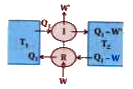 Let us couple the engines I and R in such a WAY so that I acts like a heat engine and R acts as a refrigerator. Suppose I absorb heat `Q_1` from the source, deliver work W. and release the heat `Q_1-W.` to the sink. Arrangement will made such that R returns the same heat `Q_1` to the source, taking heat `Q_2` from the sink and requiring work `W = Q_1 - Q_2` to be done on it. `therefore` Heat given to the sink `Q_2 = Q_1 - W`, necessary work will done. Heat given to the source `Q_1` is same as from R. Suppose `eta_R lt eta_I`, then engine R give less work than engine I. Hence for given `Q_1 W lt W.` With R acting like a refrigerator . `Q_2=Q_1-W gt Q_1 - W.` Thus , the coupled I-R system extracts heat `(Q_1-W)-(Q_1-W.)=(W. ~ W)` from the cold reservoir and delivers the same amount of work in one cycle. This is against the Kelvin Planck statement of the second LAW of thermodynamics. Hence `eta_I gteta_R`is wrong, means no engine can have efficiency greater then that of the carnot engine. A reversible engine with one particular substance cannot be more efficient than the one using another substance. The maximum efficiency of carnot engine `eta=1-T_2/T_1` independent of the nature of the system and hence in carnot engine an IDEAL gas is taken as a working substance, so the maximum efficiency will OBTAINED. From `eta=1-T_2/T_1` and `eta=1-Q_2/Q_1` `Q_2/Q_1=T_2/T_1 rArr Q_1/Q_2 =T_1/T_2` is independent of nature of the system . |
|
| 5. |
Statement : I Moment of inertia about an axis passing through centre of mass is minimum. Statement : II Theorem of parallel axis can be applied only for two dimensional body of negligible thickness. |
|
Answer» Statement I is true, statement II is true , statement II is a CORRECT EXPLANATION for statement I. |
|
| 6. |
The distance between the two atoms in a diatomic molecule O_(2)is 1.21 xx 10^(-10) m. The mass of each oxygen atom is 2.66 xx 10^(-26)kg. Treating the atoms as point masses find the m moment of inertia of the molecule about an axis passing perpendicular to the line joining the centres of the atoms. |
|
Answer» Solution :Let the distance between the two ATOMS be r. Mass of each atom, `m=2.66 XX 10^(-26)` kg `r = 1.21 xx 10^(-10) m` M.I. of the two atoms about the axis AB `=m(r/2)^(2) + m(r/2)^(2) = 2 xx (mr^(2))/4 =1/2 mr^(2)` `=(2.66 xx 10^(-26) xx (1.21 xx 10^(-10))^(2))/2` `=1.95 xx 10^(-46) kg m^(2)` |
|
| 7. |
If 27 small spheres each of M.I. .I. about their diametrical axis are combined to form a big sphere, then the M.I. of the big sphere about its diameter is |
| Answer» ANSWER :A | |
| 8. |
A spring balance is found to have a period of oscillation of 3.14 s, when a 12 kg weight is suspended from it. How much does the spring elongate when a 2 kg weight is suspended from it ? |
|
Answer» |
|
| 9. |
A particle P moves with speed .v. along AB and BC, sides of a square ABCD. Another particle Q also starts at A and moves with the same speed but along AD and DC of the same square ABCD. Then their respective changes in velocities are |
|
Answer» EQUAL in MAGNITUDE but DIFFERENT in DIRECTION |
|
| 10. |
a) The near point of a hypermetropic person is 75cm from the eye. What is the power of the lens requiredto enable the person to read clearly a book held at 25cm from the eye. (b ) In what way does the corrective lens help the above person? Does the lens magnify objects held near the eye? c) The above person prefers to remove the spectacles while looking at the sky. Explain why? |
|
Answer» Solution :a) `u=0.25m,v=0.75m, F=?` `1/F=1/v-1/4` Power `P=-1/0.75+1/0.25=(-100)/75+100/25=(-4)/3+4` P=2.67D (b ) The corrective lens PRODUCES a virtual IMAGE (at 75 cm) of an object at 25cm). The ANGULAR size of this image is the same as the object. In this sense, the lens does not magnify the object but merely brings the object to the near point of the hypermetropic eye which then gets focused on the retina. C) A hypermetropic eye may have normal far point i.e., it may have enough converging power to focus parallel rays from infinity on the retina of the SHORTENED eyeball. |
|
| 11. |
(A) : Plane angle has unit but no dimensional formula (B) : All dimension less quantities are unit less |
|
Answer» Both A & B are true |
|
| 13. |
Two point charges +Qand -Q_(2)areplaced at A and B respectively . A lineof forceemanates from Q_(1)at an angletheta with line joining A and B . Atwhatanglewill itterminate at B ? |
|
Answer» Solution :We knowthat numberof emerging lines offorce f is PROPORTIONAL to magnitude of the change. Thefieldlines emanating from Q1 are spread out EQUALLY in all direction . The number of fieldlines or flux through cone ofhalfangle `theta` is `(Q_(1))/(4pi)2pi (1- cos theta)` Similary the numberof linesof force terminatingon `-Q_(2)` ATAN angle `phi` is `(Q_(2))/(4pi) 2pi (1- cosphi)` . The total lines of force emanating from `Q_(1)` is EQUAL to the totallines of froceterminatingon `Q_(2)` `rArr (Q_(1))/(4pi) 2pi(1-cos theta) = (Q_(2))/(4pi)2pi(1-cosphi)` or`(Q_(1))/(2)(1- cos theta) = (Q_(2))/(2)(1- cos phi)` `Q_(1) sin^(2) theta // 2 = Q_(2) sin^(2) phi //2` `rArr phi = 2 sin^(-1){ sqrt((Q_(1))/(Q_(2))) sin theta//2}` |
|
| 14. |
Calculate the displacement vector itvec(r)_(1) = x_(1) hat(i) + y _(1) hat(j) + z_(1)hat(k), vec(r)_(2) = x_(2) hat(i) + y_(2) hat(j) + z_(2) hat(k) |
|
Answer» Solution :Letus consider a particle moving from a point`P_(1)`having position vector`vec(r)_(1) = x_(1) HAT(i) + y_(1) hat(J) + z_(1) hat(k)`to a point `P_(2)`where its position vector is`vec(r)_(2) = x_(2) hat(i) + y_(2) hat(j) + z_(2) hat(k)` The displacement vector is givne by , `DELTA vec(r) = vec(r)_(2) - vec(r)_(1)` `= (x_(2) - x_(1)) hat(i) + (y_(2) - y_(1)) hat(j) + (z_(2) - z_(1)) hat(k)` |
|
| 15. |
An artificial satellite is revolving in a circular orbit at a height of 1200 km above the surface of the earth. If the radius of the earth is 6400 km, mass is 6 xx 10^(24) kg find the orbital velocity (G = 6.67 xx 10^(-11)Nm^(2)//kg^(2)) |
|
Answer» Solution :`V_(0) = sqrt((GM)/(R+H)) = sqrt(((6.67 XX 10^(-11))(6 xx 10^(24)))/((6400 xx 10^(3)) + (1200 xx 10^(3))))` `= sqrt((6.68 xx 10^(-11) xx 6 xx 10^(24))/(7600 xx 10^(3))) = 7.26 km//s` |
|
| 16. |
A stone is projected from level ground at t=0 sec such that its horizontal and vertical components of initial velocity are 10(m)/(s) and 20(m)/(s) respectively. Then the instant of time at which tangential and normal components of acceleration of stone are same is: (neglect air resistance)g=10(m)/(s^2). |
| Answer» Solution :Suppose a small ball ROLLS down ALONG a spiral with a CONSTANT SPEED it has both centripetal acceleration and tangential acceleration. | |
| 17. |
What is the difference between a dimensional constant and a dimensionless constant? |
| Answer» Solution :g,g,H,c, etc. have dimensions and they hve certain constant values. But constants like 1,2,3,…………. `PI` , e etc. do not have any dimensions. So they are CALLED dimensionless constants. | |
| 18. |
From the follolwing factors choose the odd man out |
|
Answer» static FRICTION |
|
| 19. |
The oscillation of a body on a smooth horizontal surface is represented by the equation x= A cos omega t where x = displacement attime t, omega= frequency of oscillation. Which of the following graphs shows the corrects variation of acceleration 'a' with time 't'. |
|
Answer»
velocity `v= -a omega sin omega t` and ACCELERATION `a= -a omega^(2) cos omega t` and graph (C ) shows the change in acceleration with time. |
|
| 20. |
Keeping the radius of the earth unchanged if the mass of the earth is doubled , then what will be the length of a day? |
|
Answer» Solution : If the present angular velocity is `omega` and the changed angular velocity is `omega`, then according to the principle of conservation of angular momentum, `Iomega= I.omega`. [ here `I` and `I.` are the present and thechanged MOMENTS of INERTIA of the earth respectively ] `:. " " (2)/(5) MR^(2)xx(2pi)/(24)=(2)/(5) xx2M xxR^(2)xx(2pi)/(T.)` [ here the present mass of the earth is M, its RADIUS is R and the changed length of a day is T. ] or, `(1)/(24)=(2)/(T.)or,T.`=48 hours So, the length of a day will be 48 h. |
|
| 21. |
A stair case contains ten steps each 10cm high and 20 cm wide. The minimum horizontal velocity with which the ball has to be rolled off the upper most step, so as to hit directly the edge of the lowest steps is (approximately) |
|
Answer» `42 MS^(-1)` |
|
| 22. |
Derve the relation between tangential acceleration and angular acceleration. |
Answer» Solution :Consider an object moving along a circle of radius r. In a time `Deltat`, the object travels in an are distance As as shown in figure. The corresponding angle subtended is `Deltatheta`. The `Deltas` can be written in terms of `Deltatheta` as,  `Deltas=rDeltatheta""......(1)` In a time `Deltat`, we have `(Deltas)/(Deltat)=t""(Deltatheta)/(Deltat)""......(2)` In the LIMIT `Deltat"to0`, the above equation becomes `(ds)/(dt)=romega"".......(3)` Here `(ds)/(dt)` is linear speed (5) which is tangential to the circle and ois angular speed. So equation (3) becomes `v_(r)=romega""......(4)` which gives the relation between linear speed and angular speed. Eq. (4) is true only for circular motion. In general the relation between linear and angular velocity is GIVEN by `vecv=vecomegaxxvecr"".......(5)` For circular motion eq. (5) reduces to eq. (4) since `vecomegaandvecr` are perpendicular to each other. Differentiating the eq. (4) with respect to time, we get (since r is constant) `(DV)/(dt)=(rdomega)/(dt)=ralpha` Here `(dv)/(dt)` is the tangential acceleration and is denoted as `a_(t)=(domega)/(dt)` is the angular acceleration `alpha`. Then eq. (5) becomes `a_(t)=ralpha""......(6)`. |
|
| 23. |
The distance traversed, during equal intervals of time, of a body falling from rest, stand to one another in the same ratio as the odd numbers beginning with unity[ namely, 1:3:5:7….].Prove it. |
|
Answer» Solution :LET us divide the time interval of motion of an object under free fall into many equal intervals `TAU` and find out the distance traversed during successive intervals of time. Since initial VELOCITY is zero, we have `y =- 1/2 g t ^(2)` Using this EQUATION we can calculate the position of the object after different time intervals `0,tau , 2tau 3 tau....`Which are given in second column of table. If we take `(-1//2) g tau ^(2) as y _(0) `the position coordinate after first time interval `tau,` then third column gives the positions in the unit of `y_(0).` The fourth column gives the distances traversed in successive `taus.` We find that the distances are in the simple ratio `1:3:5:7:9:11...` as show in the last column. This law was established by Galileo GALEI (1564-1642) who was the first to make quantitative studies of free fall. 
|
|
| 24. |
The acceleration of a given particle in SHM is 0.4 ms^(-2) at a dispalcement of 0.1 m. What is the period of oscillation? |
|
Answer» Solution :A. Acceleration a = 0.4 m/s, Displacement y = 0.Im PERIOD of OSCILLATION `T = 2pi SQRT(y/a) = 2pi sqrt((0.1)/(0.4)) =2pi 1/2 = PI ` , TIME period of oscillation T = `pi ` sec . |
|
| 25. |
Two masses of 8 kg and 4 kg are connected by a string as shown in figure over a frictionless pulley. The acceleration of the system is |
|
Answer» `4m//s^(2)` |
|
| 27. |
A small ball is suspended from a point O by a light thread of length. Then the ball is drawn aside so that the thread deviates through an angle theta from the vertical and set in motion in a horizontal direction at right angles to the vertical plane in which the thread is located. what is the initial velocity that has to be imparted 2g/ to the ball so that it could deviate through the maximum angle(pi)/(2)in the process of motion |
| Answer» SOLUTION :`SQRT((2GL)/(COSTHETA))` | |
| 28. |
If vecP+vecQ=vecR"and " P =Q=Rsqrt2, then find the angles between the pairs of vectors (vecP+vecQ),(vecQ,vecR)"and"(vecR,vec P) respectively |
|
Answer» |
|
| 29. |
Calculate'the final speed acquired by the softd cylinder shown in Fig.2.48 when it rolls down and reaches the bottom of the inclined plane' without slipping. Assume that the inclined plane is frictionless. |
Answer» Solution :The cylinder is initially at. rest and lias. potential energy mgh. As it rolls down, it has feotlv rotational. kinetic JL energy and. transl.atibnal. kinetic energy. Let the linear speed !, attained by the cylinder when- it reaches B be V.  `mgh = 1/2 I omega^(2) + 1/2 mv^(2)` M.F. of the-solid cylmder.abbut the axis of rotation = I `I = 1/2 MR^(2)`, m is the mass of the cylinder and r is its RADIUS. `w = v/r` `mgh = 1/2 xx (1/2 mr^(2)) v^(2)/r^(2) + 1/2 mv^(2)` `mgh = 1/4 mv^(2) +1/2mv^(2) = 3/4 mv^(2)` `v^(2) = (4gh)/3, v = sqrt(4/3) gh` |
|
| 30. |
A person will get more quantity of matter in Kg-Wt at |
|
Answer» poles |
|
| 31. |
Define one second. |
| Answer» Solution :One second is the DURATION of 9,192,631,770 periods of RADIATION corresponding to the transition between the two HYPERFINE levels of the ground state of Cesium-133 atom. | |
| 32. |
Moment of inertia of a circular wire of mass M and radius R about is its diameter is |
|
Answer» Solution :(i) Given Data: M = 500 G = 0.5 KG, `R = 10 cm = 10 xx 10^(-2) m` `"Moment of inertia of disc about diameter" =Id=(1)/(4)MR^(2)` `Id=(1)/(4) xx 0.5 xx 0.1 kg m^(2)` (ii) APPLY a parallel axes theorem, moment of inertia of the disc about a TANGENT to the disc and parallel to the diameter of the disc `=(1)/(4)MR^(2)+MR^(2)=(5)/(4)MR^(2)=(5)/(4) xx 0.5 xx 0.1` `=0.0625 kg m^(2)` (iii) Moment of inertia of the disc about an axis passing through the centre of disc and perpendicular to the plane of the disc `=(1)/(2)MR^(2)=(1)/(2) xx 0.5 xx 0.1=0.025 kg m^(2)` |
|
| 33. |
A particle moving with a constant acceleration describes in the last second of its motion 9//25^(th)of the whole distance. If it starts from rest, how long is the particle in motion and through what distance does it move if it describes 6 cm in the first sec.? |
| Answer» Answer :A | |
| 34. |
Heat is flowing through two cylindrical rods of the same material. The diameters of the rods are in the ratio 1 : 2 and their lengths are in the ratio 2 : 1. If the temperature difference between their ends is the same, then the ratio of the amounts of heat conducted through them per unit time will be: |
|
Answer» `1:1` |
|
| 35. |
Which one of the following statement does not hold good when two balls of masses m_1and m_2undergo elastic collision |
|
Answer» When`m_1 lt lt m_2and m_2`at rest, there will be MAXIMUM transfer of momentum Whencollisionis oblique and `m_2` at restwith `m_1= m_2` after collision the ball moves in perpendiculardirection. So option (d) is alsoincorrect. |
|
| 36. |
Column I shows four systems, each of the same length L, for producing standing waves. The lowest possible natural frequency of a system is called it fundamental frequency, whose wavelength is denoted as lambda_(t). Match each system with statements given in Column II describing the nature and wavelength of the standing waves. |
|
Answer» `A rarr (p, t)` : It is a closed organ pipe hence in case of fundamental vibrations length of the tube must be `((1)/(4))^(th)` of the wavelength (half loop). `(lambda_(t))/(4)= L rArr lambda_(t) = 4L` `B rarr (p, s)` : It is open organ pipe hence in case of fundamental vibrations length ofthe pipe must be half of the wavelength (one loop). `(lambda_(t))/(2) = L rArr lambda_(t) = 2L` `C rarr (q, s)` : It is a case of string of length L fixed at both ENDS. In case of fundamental vibrations length of the pipe must be half of the wavelength (one loop). `(lambda_(t))/(2) = L rArr lambda_(t) = 2L` `D rarr (q, r)` : In this case mid-point is fixed hence half-length must form one loop. `(lambda_(t))/(2) = (L)/(2) rArr lambda_(t) = L` |
|
| 37. |
Dimensions of resistance in an electrical circuit, in terms of dimension of mass M, of length L, of time T and of current I, would be |
|
Answer» `ML^(2) T^(-3) I^(-2)` |
|
| 38. |
According to Newton's law of gravitation. Equal forces exerted between earth and apple. The earth attracts an apple, the apple also attract the earth. If it does, why does the earth not 9 move towards the apple ? |
| Answer» Solution :`IMPLIES` Mass of earth is much more than APPLE and HENCE acceleration produce in earth DUE to force of apple is very small and hence earth is not PULL by apple. | |
| 39. |
A uniform metallic rod rotates about its perpendicular bisector with constant angular speed If it is heated . If it is heater uniformly to raise its temperature slightly |
|
Answer» its speed of ROTATION increases. |
|
| 40. |
The springs shown in the figure are all unstretched in the beginning when a man starts pulling the blook. The man exerts a constant force F on the block. Find the amplitude and the frequency of the motion of the block. |
|
Answer» To this `k_1` is in parallel So, effective spring constant is `(k_2 k_3)/(k_2 + k_3) + k_1 = (k_1 k_2 + k_2 K_3 + K_3 k_1)/(k_2 + k_3)` From the previous problem amplitude of oscillation = `F/k` So `A= (F(k_2 + k_3))/(k_1 k_2 + k_2 k_3 + k_3 k_1)` Frequence of oscillation `f= 1/(2pi) SQRT((k)/(m)) = 1/(2pi) sqrt((k_1 k_2 + k_2 k_3 + k_3 k_1)/(m(k_2 + k_3)))` |
|
| 41. |
Draw the velocity-displacement graph of a body executing shm. |
Answer» Solution :The GRAPH is as shown in Fig.As the displacement of the PARTICLE changes from - a to ta the velocity increases from ZERO to maximum at the equilibrium position and then DECREASES to zero at the extreme position + a, where a is the AMPLITUDE of the particle. In the second half of the oscillation the direc-X. tion of the velocity is changed. The -a +a shape of the graph will be the same, but Fig. it will below X.OX.
|
|
| 42. |
A block of mass 50kg rests on a rough horizontal plane whose coefficient of static friction is 0.3. What is the least force required to just move it if it is pulled (i) horizontally and (ii) at 45^(@) to the horizontal. |
|
Answer» |
|
| 43. |
Is evaporation of water a reversible process? |
| Answer» SOLUTION :No, it is an irrversible PROCESS. | |
| 44. |
1 pc is how many astronomical unit? |
|
Answer» Solution :`6.3xx10^(4)AU` `(1 PC)/("1 ASTRONOMICAL UNIT")=(6.46xx10^(15))/(1.5xx10^(11))` `[1AU=1.496xx10^(11)m=~~1.5xx10^(11) m]` `:.1ly=6.3xx10^(4)AU` |
|
| 45. |
To a man walking at 7 kmph due west, the wind appears to blow from the north-west but when he walks at 3 kmph due west, the wind appears to blow from north. The magnitude and actual direction of wind are |
|
Answer» `5kmph, tan^(-1)((3)/(4))` east of NORTH 
|
|
| 46. |
A satellite in force free space sweeps stationary interplanetary dust at a rate (dM)/(dt)=alphavwhere m is mass, v is the velocity of the satellite and alpha is a constant. What is the deceleration of the satellite. |
| Answer» SOLUTION :`F=(DP)/(dt)RARR F=v(DM)/(dt), F=v(alphav)rArr F=alphav^(2) rArr Ma=alphav^(2)rArr a =(alphav^(2))/M` | |
| 47. |
A steel boiler whose thickness is 3cm is placed on a plate of area1 m^(2). The temperature of the plate is 300^(@)C and that of the boiling water in the boiler is 100^(@)C. How much water will evaporate per minute? (Conductivity of steel =63.0Js^(-1)m^(-1)K^(-1) and sp latent heat of vaporizatioin of water =2251.2xx10^(3)Jkg^(-1)). |
|
Answer» |
|
| 48. |
A copper wire of length 2.2 m and a steel wire of length 1.6m, both of diameter 3mm are connected end to end. When stretched by a load, the net elongation is found to be 0.70 mm. Obtain the load applied.(Y_(s)=2.0xx10^(11)Nm^(-2)) (Y_(c)=1.1xx10^(11)Nm^(-2)) |
|
Answer» `1.8xx10^(2)N` `RARR""(W)/(A)=Y_(c)XX((DeltaL_c)/(L_c))=Y_(s)xx((DeltaL_s)/(L_s))` `rArr""(DeltaL_c)/(DeltaL_s)=((Y_s)/(Y_c))xx((L_c)/(L_s))` `=((2xx10^(11)Nm^(-2))/(1.1xx10^(11)Nm^(-2)))((2.2m)/(1.6m))` `=2.5` Also, `DeltaL_(c)+DeltaL_(s)=7xx10^(-4)m` `rArr""DeltaL_(c)=5xx10^(-4)m` `THEREFORE""W=(AxxY_(c)xxDeltaL_c)/(L_c)` `=(pi(1.5xx10^(-3)m)^(2)xx(1.1xx10^(11)Nm^(-2)xx5xx10^(-4)m))/(2.2m)` `=1.8xx10^(2)N` |
|
| 49. |
The system shown in the fig. is in equilibrium. Pulleys A and B have mass M each and the block C has mass 2M. The strings are light. There is an insect (D) of mass M/2 sitting at the middle or the right string. Insect does not move. (a) Just by inspection, say if the tension in the string S1 is equal to, more than or less than 9/2 Mg. (b) Find tension in the string S2, and S1.(c) Find tension in S2 if the insect flies and sits at point E on the string. |
|
Answer» (B) Tension in S2 = Mg/2 , Tension is S1 = 5 Mg (c) Tension in S2 = Mg/7 |
|
| 50. |
Imagine Earth to be a solid sphere. If the value of acceleration due to gravity at a depth 'd' below Earth's surface is the same as its value at a height 'h' above its surface and is equal to g/4then the ratio of h/dwill be ...... |
|
Answer» 1 `:.g/4=g/(1+(h)/R)^2` `:. 4=(1+(h)/R)^2` `:. 2 = 1+h/R` `:.h/R =1 ""...(1)` `implies g(d) = g(1-d/R)^2` `:.g/4=g (1-d/R)` `:. 1/4 = 1 - d/R` `:. d/R = 1-1/4` `:. d/R =3/4 ""...(2)` `:. ` TAKING RATIO of equ . (1) and (2) `h/d =4/3` |
|


