

Saved Bookmarks
This section includes 7 InterviewSolutions, each offering curated multiple-choice questions to sharpen your Current Affairs knowledge and support exam preparation. Choose a topic below to get started.
| 1. |
If the momentum of a body moving with constant velocity is four times its kinetic energy, its velocity is |
|
Answer» `2 MS^(-1)` |
|
| 2. |
Define intensity of gravitation and write its equation, unit and dimensional formula |
|
Answer» Solution :`implies` The force is exerted MUTUALLY on two bodies separated by some distance is explained to occur through the field as under: (1) Every object produces a gravitational field around it, due to its mass. (2) This field exerts a force on ANOTHER body lying in this field. `implies` Intensity of gravitational field : .The gravitational force exerted by the given body on a body of unit mass at a given point is called the intensity of gravitational field `(VECI)` at that point.. It is also known as gravitational field or gravitational intensity. `implies` Suppose a body of mass M at the origin of coordinate system 0 and a body of mass m= 1 kg is placed at point P having position vector `vecr`  `implies` Gravitation force on bodies of mass m and M, `vecF=(GMm)/(r^2)hatr` If `m = 1 kg, vecF = vecI` intensity of gravitation . `:. vecI=-(GM(I))/r^2hatr""...(1)` `implies` Here, force of body of mass M on the body of mass m is toward O, whereas position vector and unit vector is from 0 to P and HENCE native sign is present in formula. `implies` And the value of intensity of gravitation `I= (GM)/r^2 ""...(2)` `implies` Its unit : `N/(kg)` fe and dimensional formula `M^(0) L^(1) T^(-2)`. If a body of mass m is put at this point `P_1`the gravitational force exerted by the field on it is `vecF = vec(Im) =- (GMm)/r^2hatr` `implies`Equation (2) shows that the gravitational intensity due to earth at a point has the same value as the gravitational ACCELERATION (g) at that point. `implies` Here, gravitational intensity and gravitational acceleration are different quantities but their units and dimensional formula are equivalent. `implies` For both `I rarr rand grarr r `graph are same. |
|
| 3. |
An object initially at rest explodes into 3 fragments A,B and C. The momentum of A is pi and that of B is sqrt(3 p hatj) where p is a positive number. The momentum of C will be |
|
Answer» <P>`(1+sqrt3)`P in a DIRECTION making `120^@` with that of A |
|
| 4. |
If a car covers 2/5th of the total distance with v_1 speed and 3/5th distance with v_2 then average speed is |
|
Answer» `1/2 sqrt(v_(1)v_(2))` |
|
| 5. |
Two waves of the same frequency and intensity superimpose each otherin opposite phases. After the superposition, the intensity and frequencyof waves will : |
|
Answer» decreases |
|
| 6. |
The acceleration a of plank p required to keep the centre C of a cylinder in a fixed position with respect to earth during the motion is (Assume sufficient friction is present between cylinder and plank to prevent slipping.) "xg "sintheta where 'x' is |
|
Answer» |
|
| 7. |
Plot a stress tostrain curve for a metal and explain. |
|
Answer» Solution :A stress `to` strain curve for a metal is shown as in figure. From the graph, we can see that in the region between 0 to A, the curve is linear. In this region Hooke.s LAW is obeyed. The BODY regains its original dimensions when the applied force is removed. In this region the solid behaves as an elastic body. 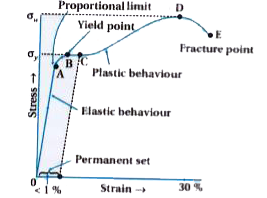 In the region from A to B stress and strain are not proportional. The body still returns to its original dimension when the load is removed. The point B in the curve is known as yield point (also known as elastic limit) and the corresponding stress is known as yield STRENGTH `(sigma_(y))` of the material. If the load is increased further, from point B the stress developed exceeds the yield strength and strain increases rapidly. The portion of the curve between B and D shows this, when the load is removed say at some point C between B and D, the body does not regain its original dimension. In this state, even when the stress is zero, the strain is not zero. The material is SAID to have a permanent set. The deformation is said to be plastic deformation. The point D on the curve isthe ultimate tensile strength `(sigma_(u))` of the material. Beyond this point, additional strain is produced even by a reduced applied force and FRACTURE occurs at point E. If the ultimate strength and fracture points D and E are close, the material is said to be brittle. If they are far apart, the material is said to be ductile. |
|
| 8. |
Imagine a light planet revolving around a very massive star in a circular orbit of radius .r. with a period of revolution T. On what power of .r. will the square of time period depend on the gravitational force of attraction between the planet and the star is proportional to r^(-5//2) |
|
Answer» Solution : The GRAVITATIONAL FORCE PROVIDES NECESSARY centripetal force `(mV^2)/R=K/r^(5//2) rArr V^2=K/(mr^(3/2))` So that `T=(2pir)/V=2pirsqrt((mr^(3//2))/K)` So `T^2 prop r^(7//2)` |
|
| 9. |
A block 'B' rests on 'A'. A rests on a horizontal surface 'C' which is frictionless. There is friction between A and B. If 'B' is pulled to the right, (If P is less than frictional force between A and B) |
|
Answer» B moves FORWARD and A to the LEFT |
|
| 10. |
Four lead spheres a,b,c and d whose radii 1 cm, 2 cm, 3cm and 4 cm respectively are dropped into different liquids of co-efficients of viscosity 1xx10^(-3)Pa-s,2xx10^(-5)Pa-s,6.5xx10^(-3)Pa-s,15.4xx10^(-3)Pa-s. Arrange the spheres with their terminal velocity in descending order |
| Answer» Answer :B | |
| 11. |
If the mass of the electron (9xx10^(-31) kg)is taken as unit of mass, the radius of the first Bohr orbit (0.5xx10^(-10))as unit of length and 500 newton as the unit of force, then the unit of time in the new system would be |
|
Answer» `3 XX 10^(-22) s ` |
|
| 12. |
At 0^(@)C and one atmospheric pressure a tank of volume 1000 litres is filled with a gas what will be the pressure of the gas at 100^(@)C ? |
|
Answer» |
|
| 13. |
A block 'B' rests on 'A'. A rests on a horizontal surface 'C' which is frictionless. There is friction between A and B. If 'B' is pulled to the right |
|
Answer» B moves FORWARD and A to the LEFT |
|
| 14. |
When a train starting from rest is uniformly accelerating, a plumb bob hanging from the roof of a compartment is found to be inclined at an angle of 45^(@) with the vertical. The time taken by the train to travel a distance of 1//2km will be nearly |
|
Answer» 7s |
|
| 15. |
If typical size of a gas molecule is 2Å, average distance between the molecules is |
| Answer» SOLUTION :`ge 20 Å` | |
| 16. |
Arrive at an expression for acceleration due to gravity at a height h (h |
| Answer» SOLUTION :For any PLANET, angular momentum is CONSTANT ( law of conservation of angular momentum) . So no external TORQUE is REQUIRED by the planet by any means | |
| 17. |
A local of mass 'M' is attached to the bottom of a spring of mass M"/"3 and spring constant 'K'. If the system is set into oscillation, the time period of oscillation is |
|
Answer» `(2PI)/(3) sqrt((10M)/(K))` |
|
| 18. |
In dynamic equilibrium, molecules of gas collide and change their speeds during the collision |
|
Answer» but the average PROPERTIES VARY |
|
| 19. |
A 6.0kg object is suspended by a vertical string from the ceiling of an elevator which is accelerating upward at a rate of 2.2 ms^(-2).the tension in the string is |
|
Answer» 11N |
|
| 20. |
Three blocks of uniform thickness and masses m,m and 2m placed at three corners of a triangle having co-ordinates (2.5,1.5),(3.5,1.5) and (3,3) respectively. Find the centre of mass of the system. |
|
Answer» Solution :Centre of mass of the SYSTEM is GIVEN by `x_(CM)=(m(2.5)+m(3.5)+2m(3))/(m+m+2m)` `=2` `y_(CM)=(m(1.5)+m(1.5)+2m(3))/(m+m+2m)` `=2.25` |
|
| 21. |
If the unit of force is 1N, the unit of work done is 10J and the unit of time is 1 second, the unit of mass is |
|
Answer» 10Kg |
|
| 22. |
The focal length of a convex lens of refractive index 1.5 is .f. when it is placed in air. When it is immerse in a liquid it behaves as a converging lens and its focal length becomes xf (x gt 1) The refractive index of the liquid is |
|
Answer» `GT 3//2` |
|
| 23. |
In astronomy order of magnitude estimation plays an important role. The derivative (dp)/(dt) can be taken difference ration (DeltaP)/(Deltar). Consider the star has a radius R, pressure at its centre is P_(e) and pressure at outer layer is zero is the average mass is (M_(Q))/2 and average radius (R_(o))/2 then the expression for P_(c) is |
|
Answer» `P_(c)=3/2(GM_(0)^(2))/(piR_(0)^(4))` `|vec(F)_(1)+vec(F)_(2)|=0` `RARR ` the linear MOMENTUM of the system is conserved `rArr m_(A)v_(A)=m_(B)v_(B)` `rArr v_(A)=(m_(B))/(m_(A))v_(B)=2/1xx3.6=7.2cm//hr` `=(7.2xx10^(-2))/(3.6xx10^(3))=(7.2xx10^(-2))/3600=(7.2xx10^(-2))/(3.6xx10^(3))=2xx10^(-5)` In `10^(-5)m//s, v_(A)=2` |
|
| 24. |
A tank filled with water is connected to another empty tank lying to the right side of the first tank. Untill the level of water in the tanks become same (a) centre of mass of water shifts down at constant rate (b) centre of mass of water shifts down and rate of change of shift in centre of mass decreases gradually and becomes zero (c) centre of mass shifts towards right as well |
|
Answer» only a and C are CORRECT |
|
| 26. |
(A): The root mean square and most probable speeds of the molecules in a gas are the same. (R) : The Maxwell distribution for the speed of the molecules in a gas is asymmetrical. |
|
Answer» If both (A) and (R) are TRUE and (R) is the CORRECT EXPLANATION of (A) |
|
| 27. |
Why is a spring made of steel, not of copper? |
|
Answer» Because steel is cheaper than COPPER |
|
| 28. |
A particle of mass m is at rest at the origin at time t = 0. It is subjected to a force F(t) = F_0 e^(-bt)in the x direction. Its speed v(t) is depicted by which of the following curves ? |
|
Answer»
|
|
| 29. |
A body of mass 5 kg is at rest on a smooth horizontal surface. A horizontal force 'F' acts on it for 4s and then ceases to act. If the body travels 40 m in the next 5s, the value of F is, |
| Answer» Answer :D | |
| 30. |
A person of mass 50 kg stands on a weighing scale on a lift. If the lift is descending with a downward acceleration of 9 ms^(-2), what would be the reading of the weighing scale ? (g = 10 ms^(-2)) |
|
Answer» SOLUTION :m= 15kg , g =10 `m/s^(2)` accelerationof lift= 9`m//s^(2)`  Whenliftdescend(moves in downwarddirectionwithaccelerationof `9m//s^(2))` `=10 - 9 = 1 m//s^(2)` Apparentweightof person `R= mg ` `=50 xx 1` `=50 N` Readingof weighingscale `(R )/( g ) = (50)/( 10) = 5 KG` |
|
| 31. |
A) Work done by frictional force is always negative B) A body at rest can have mechanical energy C) Mechanical energy of freely falling body decrease gradually |
|
Answer» Only A is TRUE |
|
| 32. |
A particle moves from a point (-2hat(i)+5hat(j)) to (4hat(j)+3hat(k)) when a force of (4hat(i)+3hat(j)) N is applied. How much work has been done by the force ? |
| Answer» Answer :C | |
| 33. |
thereare twoidenticalballsof samematerialone beingsolidand theotherbeinghollowHowwillyoudistinguishthemwithoutweighting |
|
Answer» SOLUTION :Solidandhollowballscan bedifferentiated bydifferent METHODS (a)By spinningthanusingequaltorques |
|
| 34. |
For one mole of a monoatomic gas match the following. |
|
Answer» <P> |
|
| 35. |
A physical quantity is measured as Q = (2.1 pm 0.5) units. Calculate the percentage error in (1) Q^(2)(2)2Q |
|
Answer» Solution :`P = Q^(2)` `(Deltap)/(p) = (2DeltaQ)/(Q) = 2 ((0.5)/(2.1)) = (1.0)/(2.1) = 0.476 , (Deltap)/(p) XX 100% = 47.6% = 48% , R = 2Q` `(DeltaR)/(R) = (DELTAQ)/(Q) rArr (0.5)/(2.1) = 0.238` `(DeltaR)/(R) xx 100% = 24%` |
|
| 36. |
A platinum wire can be sealed through glass, but a brass wire cannot be sealed in glass because |
|
Answer» PLATINUM has greater DENSITY than brass |
|
| 37. |
The moment of inertia of a thin uniform rod of mass M and length l about an axis perpendicular to the rod through its centre is I. The moment of inertia of the rod through its end point is |
|
Answer» `(I)/(4)` `l = (Ml^(2))/(12) "" … (i)` The moment of inertia of the rod through its end POINT is `I. = (Ml^2)/(3) = 4 ((Ml^2)/(12)) = 4L ""` (Using (i)) |
|
| 38. |
A sphere of mass 0.3 kg moving wth a velocity of 4m/s collides with another sphere of mass 0.5 kg which is at rest. Assuming the collision to be elastic, their velocities after the impact are |
|
Answer» 4m/s `0 m//s^(-1)` |
|
| 39. |
A strip cantilever getsdepressed by 3 mm dueto someload whatdepressionwill be produced in anothercantilever with lengthand breath doublethose of the first ? |
|
Answer» SOLUTION :Depressionproducedin cantilever `DELTA=(4WI^(3))/( Ybd^(3))` `THEREFORE delta prop (l^(3))/(b) therefore(delta_(2))/(delta_(1))=((l_(2))/(l_(1)))^(3)((b_(1))/(b_(2)))=2^(3)xx(1)/(2)=4` `therefore delta =4xx12 mm` |
|
| 40. |
A man weights 80 kg on earth surface. The height above ground where he will weigh 40 kg is (radius of earth r) |
|
Answer» 0.31 TIMES r |
|
| 41. |
The potential energy of a projectile at its maximum height is equal to its kineic energy there. Find its range for velocity of projection u. |
|
Answer» |
|
| 42. |
A spring is stretchedby applying a load to itsfree end. The strainproducedin the spring is |
|
Answer» Volumetric |
|
| 43. |
A tank which is open at the top, contains a liquid up to a height H. A small hole is made in the side of the tank at a distance y below the liquid surface. The liquid emerging from the hole lands at a distance x from the tank. a. If y is increased from zero to H, x will first increase adn then dereases. b. x is maximum for y=H//2 c. The maximum valuefo x is H. d. The maximum alue of x will depend on the density of the liquid. |
|
Answer» a,B and are correct |
|
| 44. |
A string of cross section 2cm^2is doubled in length by the application of a longitudinal force2 xx 10^5dynes. The youngs modulus is |
|
Answer» `10^7 dy//cm^2` |
|
| 45. |
Which of the following has the least number of significant figures? |
|
Answer» `1.64 XX 10^(20)` kg 1.64 x 10²⁰ kg has three significant figures. 0.006 m2 has one significant figures. 7.2180 J has FIVE significant figures. 5.045 J has FOUR significant figures. |
|
| 46. |
A uniform solid of mass m is placed ona sheet of paper on a horizontal surface. The coefficient of friction between paper and sphere is mu. If the paper is pulled horizontally with an acceleration |
|
Answer» the tension in the STRING is equal to `MG SIN THETA` `fR=Ialpha, I=(2mR^(2))/5,a_(0)=Ralpha` |
|
| 47. |
In an experiment of simple pendulum, the errors in the measurement of length of the pendulum (L) and time period (T) are 3% and 2% respectively. The maximum percentage errors in the value of L/T^(2) is |
|
Answer» SOLUTION :Maximum percentage error in the value of`L/T^(2)=((DeltaL)/Lxx100)+2((DELTAT)/Txx100)` `=3+(2xx2)=3+4=7%` |
|
| 48. |
The formula for time period T for a loaded spring, T= 2π.Does the time period depend on lenght of the spring ? |
| Answer» SOLUTION :Although length of the spring does not APPEAR in the expression for the TIME period, YET the time period depends on the length of the spring. I t is because, force constant of the springdepends on the length of the spring. | |
| 49. |
A liquid is contained in a vertical tube of semicircular cross section. The contact angle is zero. Find the ratio of force of surface tension on the curved part and on the flat part. |
|
Answer» SOLUTION :Force on curved part `(F_(1))=Sxxpir` Force on FLAT part `(F_(2))=Sxx2r` `:.(F_(1))/(F_(2))=pi:2` 
|
|


