Saved Bookmarks
This section includes 7 InterviewSolutions, each offering curated multiple-choice questions to sharpen your Current Affairs knowledge and support exam preparation. Choose a topic below to get started.
| 1. |
If no external force is acting on a two body system, what will happen to (i) velocity of centre of mass and (ii) angular momentum ? |
|
Answer» Solution :(i) WHATEVER be the interaction between the two bodies, their centre of mass would remain remain unaffected if no external force is acting. So, if the centre of mass is at rest or in motion INITIALLY it would continue in that state, i.e, would be at rest or in motion with a uniform velocity. (ii) External force = 0, so, external torque on the SYSTEM =0. HENCE, the angular momentum of the system would remain CONSERVED. |
|
| 2. |
Plot the corresponding SHM of particle. Indicate the intial (t=0) position of the particle, the radius of the circle and angular speed of the rotating particle. Consider sense of rotation to be anticlockwise and x in cm and tis in s. (b) x=cos((pi)/(6)-t) |
|
Answer» Solution :`X=COS ((pi)/(6)-t)=1.cos [-(t-(pi)/(6))]=1.cos(t-(pi)/(6)).` `or x = cos (1.t-(pi)/(6))=cos(t+(11pi)/(6)).` Comparing this with `x=A cos (omegat+PHI)` we get, `A=1cm, OMEGA="1 rad s"^(1), phi=-(pi)/(6)" rad"{:("2pi-(pi)/(6)),((=11pi)/(6)):}` 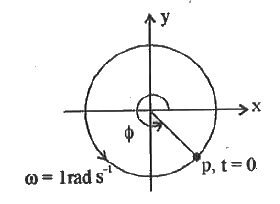
|
|
| 3. |
Find the external work done by the system in kcal, when 20 kcal of heat is supplied to the system the increase in the internal energy is 8400 J (J = 4200J/kcal) |
| Answer» Answer :B | |
| 4. |
A sonometer wire is vibrating in resonance with a tuning fork. Keeping the tension applied same, the length of the wire is doubled. Under what conditions would the tuning fork still be is resonance with the wire? |
|
Answer» Solution :INITIALLY `f _(1) = (1)/( 2L ) sqrt ((T)/(mu)) = f ` (FREQUENCY of given tuning fork) Finally, `f ._(1) = (1)/(2 (2 L )) sqrt((T)/(mu))` `(because ` Length of wire is made doubled) For SECOND harmonic of sonometer wire, `2 f._(1) = 2 xx (1)/(2 (2L)) sqrt ((T)/( mu ))` `= (1)/( 2 L ) sqrt ((T)/( mu))= f` Thus, given tuning form will resonate with given sonometer. (i) initially in first harmonic (i.e. fundamental frequency). (II) finally (when length of wire is doubled in second harmonic (i.e. first overtone) |
|
| 5. |
Elastic headon collision, consider two particles one is moving and another one is stationary with their respective masses m and M/m. A moving particle meets collides elastically on stationary particle in the opposite direction. Find the kinetic energy of the stationary particle after a collision. |
|
Answer» Solution :mass of the moving particle `m_(1)` = m (say) mass of the stationary particle `m_(2) = 1/m M` Velocity of the moving particle before collision = `v_(1i)` (say) Velocity of the stationary particle before collision = `v_(2I)` = 0 Velocity of the stationary particle after collision = `v_(2F)` (say) `v_(2f) = (m_(2)-m_(1))/(m_(1)+m_(2)) v_(2i) + (2m_(1))/(m_(1)+m_(2)) v_(1i) ("or") v_(2f) = 0 + (2M)/(m+M/m) v_(1i) = (2m)/(m+1) v_(1i)` KINETIC ENERGY of the stationary particle after a collision `=1/2 M/m ((2m)/(m+1) v_(1i))^(2) = (4m)/((1+m)^(2)) xx 1/2 M v_(1i)^(2)` `= (4m)/((1+m)^(2)) xx` kinetic energy of moving particle before collision |
|
| 6. |
Velocity - time graph of a particle moving in a straight line is as shown in figure. Mass of the particle is 2 kg. Work done by all the forces acting on the particle in time interval between t = to t = 10 is |
| Answer» ANSWER :A | |
| 7. |
A body is projected with a velocity u at an angle of 60^@to the horizontal. The time interval after which it will be moving in a direction of 30^@to the horizontal is |
|
Answer» `(U)/(SQRT3 g)` |
|
| 8. |
An air bubble of radius 1 cm rises from the bottom portion through a liquid of density 1.5 g c c^(-1) at a constant speed of 0.25cms^-1. If the density of air is neglected, the coefficient of viscosity of the liquid is approximately, (in Pa-s) |
|
Answer» 13000 |
|
| 9. |
Arrange the following simple pendulum in ascending order of their periods of oscillationa) of length 1 m at a place of g= 8m//s b) of length 2 m at a place of g: = 10 m//s c) of length 4 m at a place of g = 4m//s |
| Answer» Answer :A | |
| 10. |
In the above problem angle mde by velocity vector with x axis after 4 seconds is tan^(-1) |
|
Answer» 3 |
|
| 11. |
If Q, E and W denote respectively the heat added, change in internal energy and the work done in a closed cyclic process, then …………… . |
|
Answer» `W=0` Therefore, the change in internal energy is zero. |
|
| 12. |
A rubber ball of radius R and mass m is released at a depth h below the surface of water. How much above the suface of water will the ball rise? [Neglect all types of obstruction] |
|
Answer» |
|
| 13. |
A long steel bar is under a tensile stress due to a force F as shown. For what angle thetathe tensile and shearing stress are maximum? |
|
Answer» `90^@` and `45^@` |
|
| 14. |
The escape velocity of a body from Earth's surface isv_(e ). What will be the escape velocity of the same body from a height equal to 7R from Earth's surface. |
|
Answer» Solution :`v_(E) prop 1/(sqrt(r))`WHERER is the POSITION of bodyfrom the SURFACE . ` (v_(e))/(v.) = sqrt((r.)/r ) = sqrt((R+7R)/R ) = sqrt((8R)/R ) = sqrt(8) = 2sqrt(2)` ` :. v. = (v_(e))/(2sqrt(2))` |
|
| 15. |
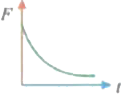
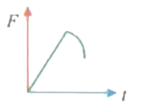
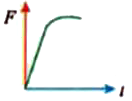
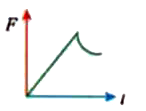
If F=F_(0)(1-e^(-t//lambda)) the F-t graph is |
|
Answer»
|
|
| 16. |
A raindrop falling from a height 'h' above ground, attains a near terminal velocity when it has fallen through a height (3/4)h. Which of the diagrams shown below correctly shows the change in kinetic and potential energy of the drop during it fall up the ground ? |
|
Answer»
|
|
| 17. |
A stone is thrown vertically up from a bridge with velocity 3ms^(-1). If it strikes the water under the bridge after 2 s, the bridge is at a height of (g=10ms^(-2)) |
|
Answer» 26 m |
|
| 18. |
Match the following :{:("Column I","Column II"),(1."Scalar product of two vectors","(i)parabola"),(2."Cross product of two vectors","(ii)Circle"),(3."Trajectory of a projectile","(iii)"u^(2)//g),(4."Maximum range of a projectile","(iv)Torque"),(,"(v)"u^(2)sin2theta//g),(,"(vi)Work"):} |
|
Answer» 1 - (IV), 2 - (vi), 3 - 9ii), 4 - (V) |
|
| 19. |
In an emergency, the vacuum brake is used to stop , the high speed train. How does this vacuume brake work? |
| Answer» Solution :Steam at high pressure is made to enter the CYLINDER of vacuum brake. Due to high VELOCITY, pressure decreases in ACCORDANCE with Bernoulli’s principle. Due to this decrease in pressure, the piston gets lifted. CONSEQUENTLY brake gets lifted. | |
| 20. |
The length of an iron rod is measured by a brass scale. When both of them are at 20^(@)C, the lengthis 80 cm. What is the length of the rod at 100^(@)C as measured by the scale at 100^(@)C?The coefficient of linear expansion of brass and iron are 24xx10^(-6)(C^(@))^(-1) and 18xx10^(-6)(C^(@))^(-1) respectively. |
|
Answer» |
|
| 21. |
A body of mass 10kg is on a rough inclined plane having an inclination of 30^(@) with the horizontal. If coefficient of friction between the surfaces of contact of the body and the plane is 0.5. The least force required to pull the body up the plane is |
|
Answer» 80.5 N |
|
| 22. |
A ball is thrown vertically downwards from a height of 20 m with an initial velocity v_0. It collides with the ground, loses 50 percent of its energy in collision and rebounds to the same height. The initial velocity v_0 is (take g = 10 ms^(-2)) |
|
Answer» `28 MS^(-1)` Let v be the velocity of the ball with which it collides with ground. Then according to the law of CONSERVATION of energy, Gain in kinetic energy = loss in potential energy i.e., `= 1/2 mv^2 - 1/2 mv_0^2 = mgh` (where m is the mass of the ball) or `v^2 - v_0^2= 2gh "" .......(i)` Now , when the ball collides with the ground 50% of its energy is lost and it rebounds to the same height h. `:. (50)/(100) (1/2 mv^2) = mgh " or " I/4 v^2 = gh` or `v^2 = 4gh` Substituting this value of `v^2 ` in EQN. (i) we GET `4gh - v_0^2 = 2gh " or " v_0^2 = 4gh - 2gh = 2gh " or " v_0 = sqrt(2gh)` Here, `G = 10 ms^(-2) and h = 20 m` `:. v_0 = sqrt(2(10 ms^(-2))(20 m)) = 20 ms^(-1)`. 
|
|
| 23. |
Calculate the magnitude and direction of total linear acceleration of a particle moving in a circle of radius 0.4 m having an instantaneous angular velocity of 2 "rad" s^(-1) and angular acceleration 5"rad"s^(-2) |
|
Answer» |
|
| 24. |
A light stringht fixed at one end to a wooden clamp on a ground passes over a fixed pulley and hangs at the other side. It makes an angle 30^(0) with the ground . A boy weighing 60kg climbs up the rope. The wooden clamp can tolerate upto vertical force 360 N. Find the, maximum acceleration in the upward direction with which the boy can climb safely . The friction of pulley and wooden clamp may be ignored (g=10 m//s) |
|
Answer» |
|
| 25. |
A body moves along a circular path of radius 5 m.The coefficient of friction between the surface of the path and the body is 0.5. The angular velocity in rad/s with which the body should move so that it does not leave the path is (g=10 ms^(-2)) |
|
Answer» 4 |
|
| 26. |
(A) When external forces are involved, momentum of the system is not conserved.(B) When stationary bomb explodes, energy released is converted to K.E of fragments (C ) When rubber ball hits the wall, its kinetic energy is not conserved. |
|
Answer» A and C are TRUE |
|
| 27. |
Newton 's first law of motion describes the following |
|
Answer» ENERGY |
|
| 28. |
A particle is dropped from height H. At a point its kinetic energy is x times of its potential energy. Find the speed of the particle at that point (Reference of O.E. is ground) |
|
Answer» `[2gxH]^(1//2)` |
|
| 29. |
The acceleration due to gravity on the surface of the moon is 1.7 ms^(-2). What is the time period of a simple pendulum on the surface of moon if its time period on the surface earth is 3.5 s. ? (g on the surface earth 9.8 ms^(-2).) |
|
Answer» SOLUTION :`g_(m)= 1.7ms^(-2), g_(e)= 9.8 MS^(-1) , T_(e)= 3.5 s^(-1)` As `T_(e)= 2pisqrt((L)/(g_(e)))` and `T_(m)= 2pisqrt((l)/(g_(m)))` `:. (T_(m))/(T_(e))= sqrt((g_(e))/(g_(m)))` or `T_(m)= T_(e) sqrt((g_(e))/(g_(m)))= 3.5 sqrt((9.8)/(1.7))= 8.4 s` |
|
| 30. |
A body of mass 5kg at rest is acted upon by two mutually perpendicular forces 6N and 8N simultanecusly. Its kinetic energy after 10s is, |
|
Answer» 100J |
|
| 31. |
Ratio of densities of materials of two circular discs of same mass and thickness is 5:6. The ratio of their M.I about natural axes is |
| Answer» ANSWER :B | |
| 32. |
A particle starts from the origin at t = 0 s with a velocity of 10.0hat(j) m/s and moves in the x-y plane with a constant acceleration of (8hat(i)+2hat(j))ms^(-2). The y-coordinate of the particle in 2 sec is __ |
| Answer» ANSWER :A | |
| 33. |
A horizontal disc is freely rotating about a vertical axis passing through its centre at the rate of 100 rpm. A bob of wax of mass 20g falls on the disc and sticks to it a distance of 5cm from the axis. If the moment of inertia of the disc about the given axis is 2xx10^(-4)kg m^(2), find new frequency of rotation of the disc. |
|
Answer» Solution :`I_(1)=` Moment of inertia of the disc `=2xx10^(-4)KGM^(2)` `I_(2)=` Moment of inertia of the disc `+` Moment of inertia of the bob of wax on the disc `=2xx10^(-4)+mr^(2)=2xx10^(-4)+20xx10^(-3)(0.05)^(2)` `=2xx10^(-4)+0.5xx10^(-4)=2.5xx10^(-4)kgm^(2)` `(n//t)_(1)=100` rpm , `(n//t)_(2)=?` By the principle of conservation of angular momentum , `I_(1)omega_(1)=I_(2)omega_(2)` `I_(1)2PI((n)/(t))_(1)=I_(2)2pi((n)/(t))_(2)` `2xx10^(-4)xx100=2.5xx10^(-4)((n)/(t))_(2)` `2xx110^(-4)xx100=2.5xx10^(-4)((n)/(t))_(2)` `((n)/(t))_(2)=(100xx2)/(2.5)=80` rpm |
|
| 34. |
Select the wrong odd man out from the following statements indicating the properties of an elastic collision. |
|
Answer» In an elastic collision total kinetic ENERGY is conserved |
|
| 35. |
An observer is moving with half the speed of light towards a stationary microwave source emitting waves at frequency 10GHz. What is the frequency of the microwave measured by the observer ? ( speed of light =3xx10^(8)ms^(-1)) |
|
Answer» `17.3GHz` `upsilon=(C)/(2)` and `c=3xx10^(8)m//s` As speed of OBSERVER is not very much less than the speed of light , therefore, `v^(')=sqrt((1+upsilon//c)/(1-upsilon//c))xxv=sqrt((1+1//2)/(1-1//2))xxv` `=sqrt(3)xx10GHz=17.3GHz` |
|
| 36. |
When an arrow is shot, wherefrom the arrow axquires its KE? |
| Answer» Solution :A stretched how possesses potential ENERGY on ACCOUNT of change in its shape. To SHOOT the ARROW, the BOW is released. Potential energy of bow is converted into KE of arrow. | |
| 37. |
A spherical ball is falling with a uniformvelocity v through a viscous medium of coefficient of viscosity eta.If the viscous force acting on the spherical ball is F then |
|
Answer» `F PROP eta and F prop (1)/(v)` |
|
| 38. |
Two identical balls, each of mass m, are tied with a string and kept on a frictionless surface. Initially, the string is slack. They are given velocities 2u and u. in the same direction. Collision between the balls is perfectly elastic. After the first collision, what is the total loss in kinetic energy of the balls? |
|
Answer» `2"MU"^(2)` |
|
| 39. |
Two identical balls, each of mass m, are tied with a string and kept on a frictionless surface. Initially, the string is slack. They are given velocities 2u and u. in the same direction. Collision between the balls is perfectly elastic. What is the impulse generated in the string during the second collision? |
|
Answer» `"mu"//2` |
|
| 40. |
Two identical balls, each of mass m, are tied with a string and kept on a frictionless surface. Initially, the string is slack. They are given velocities 2u and u. in the same direction. Collision between the balls is perfectly elastic. What is the final in kinetic energy of the balls? |
|
Answer» `"mu"^(2)//4` 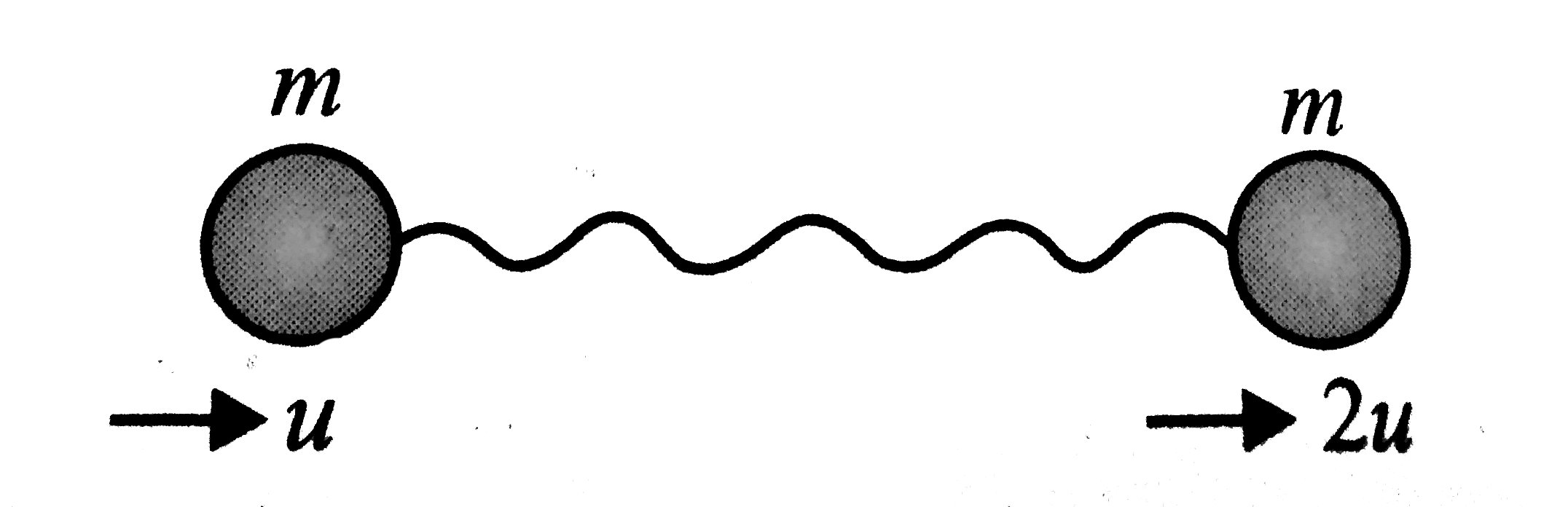 Now after some time the string will become tight. Let at that point the comon velocity of the balls be `v`. 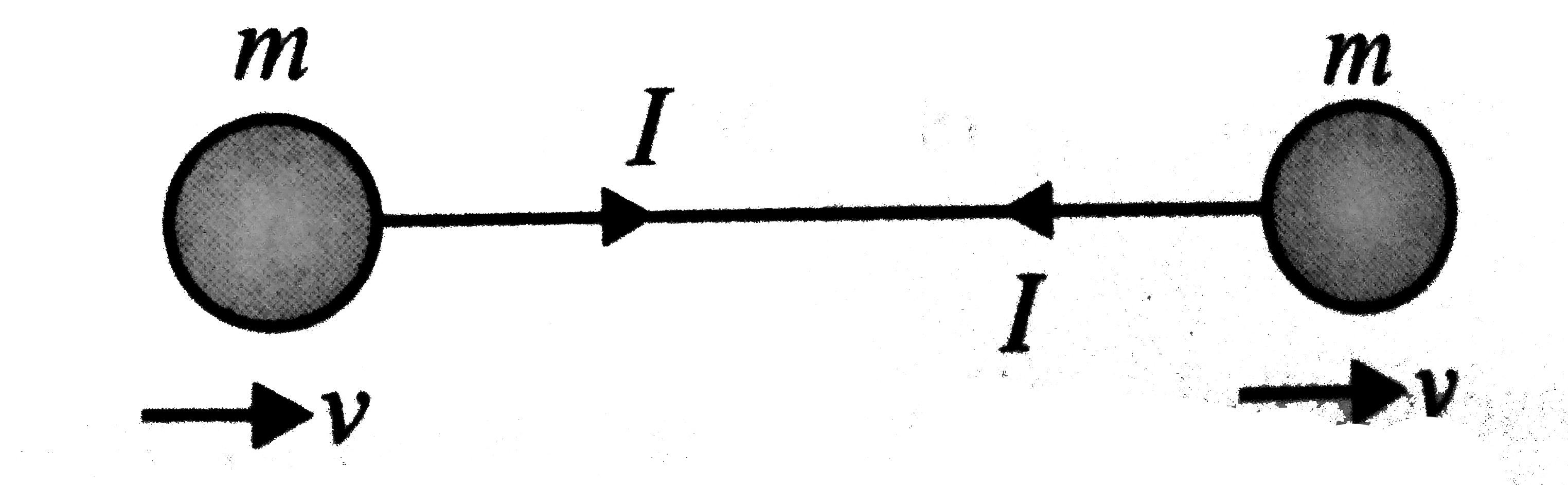 `2MV+"mu"+2"mu"impliesv=3u/2` `KE_(i)=1/2"mu"^(2)+1/2m(2u)^(2)=5"mu"^(2)//2` `KE_(f)=1/2 2m v^(2)=1/22m((3u)//2)^(2)=(9"mu"^(2))/4` `KE_(LOSS)=KE_(i)-KE_(f)=(5"mu"^(2))/2(9"mu"^(2))/4="mu"^(2)//4` |
|
| 41. |
What are the exchange particles for the operation of (i) strong nuclear forces (ii) weak muclear forces ? |
| Answer» SOLUTION :(i) MESONS (II) VECTOR BOSONS. | |
| 42. |
Suppose a body that is acted on by exactly two forces isaccelerated. For this situation mark out the incorrect statements. |
|
Answer» the BODY can not move with constant speed |
|
| 43. |
A uniform frictionless ring of mass M and radius R, stands vertically on the ground. A wall touches the ring on the left and another wall of height R touches the ring on right (see figure).There is a small bead of mass m positioned at the top of the ring. The bead is given a gentle push and it being to slide down the ring as shown. All surfaces are frictionless. (a) As the bead slides, up to what value of angle thetathe force applied by the ground on the ring is larger than Mg? (b) Write the torque of force applied by the bead on the ring about point A as function of theta. (c) What is the maximum possible value of torque calculated in (b)? Using this result tell what is the largest value of (m)/(M) for which the ring never rises off the ground? |
|
Answer» (b) `MGR (2 cos theta - 3 cos^(2) theta)` (C) `tau_("max") = (mgR)/(3); ((m)/(M))_("max") = 3` |
|
| 44. |
Universal Law of Gravitation : 9. Mass 1 kg is divided into two parts .x.m and (1-x) m for a given seperation, the value of x. for which the gravitational attraction between the two pieces becomes maximum is |
|
Answer» `2//1` |
|
| 45. |
In the above question, What power output must the motor have that drives the conveyor belt |
|
Answer» 632 W |
|
| 46. |
In the above problem M.I. of system about z-axis passing through centre is ___ |
| Answer» Answer :A | |
| 47. |
A and B are two satellite revolving round the earth in circular orbits have time orbits have time period 8hr and 1hr respectively. The ratio of their radius of orbits |
|
Answer» `8^(3//2) : 1` |
|
| 48. |
The M.I. of a thin circular disc about a tangent in the same plane of disc is I. Then M.I. about one of the diameters is |
|
Answer» `0.2I` |
|
| 49. |
Tube A has both ends open, while tube B has one end closed, otherwise they are identical the ratio of fundamental frequency of tubes A & B? |
|
Answer» Solution :The fundamental frequency for tube A with both into OPEN is `V_(B) = V/(2L)` The fundamental frequency for tube B WIT ONE end closed is `V_(B) = V/(4L) , (VA)/(VB) = (V//2L)/(V//4L) =2` |
|
| 50. |
Two balls are projected from the same point in the direction in clined at 60^(@) and 30^(@) to the horizontal.If they attain the same height, what is the ratio of their velocities of projection? What is the ratio of their initial velocities if they have same horizontal range? |
|
Answer» |
|