

Saved Bookmarks
This section includes 7 InterviewSolutions, each offering curated multiple-choice questions to sharpen your Current Affairs knowledge and support exam preparation. Choose a topic below to get started.
| 1. |
Find the refractive index of the material of refracting angle 60^@ when the angle of minimum deviation is 30^@ |
|
Answer» 1.414 |
|
| 2. |
Which of the following physical quantities have same dimensional formula? |
|
Answer» MOMENT of INERTIA and moment of force |
|
| 3. |
What would be the length of a simple pendulum on Moon if we get its period of 2s? |
| Answer» SOLUTION :`L= 0.16 m = 16 CM` | |
| 4. |
Two persons P and Q crosses the river starting from point A on one side to exactly opposite point B on the other bank of the river. The person P crosses the river in the shortest path. The person Q crosses the river in shortest time and walks back to point B. Velocity of river is 3 kmph and speed of each boat is 5 kmph w.r.t river. If the two persons reach the point B in the same time, then the speed of walk of Q is |
Answer» Solution : `t_(P) = (d)/(SQRT(V_(B)^(2) - V_(W)^(2))) = (d)/(sqrt(5^(2) - 3^(2))) = (d)/(4)` `t_(Q) = (d)/(V_(B)) = (d)/(5), t_(P) = t_(Q) + Delta t` `(d)/(4) = (d)/(5) + (x)/(V_("man")), ""` But `x = V_(W)(d)/(V_(B))` `(d)/(4) = (d)/(5) + (V_(W)d)/(V_(B)V_("man")),(cancel(d))/(4) = (cancel(d))/(5) + (3cancel(d))/((5)V_("man"))` `(1)/(4) - (1)/(5) = (3)/(5V_("man")), (1)/(20) = (3)/(5V_("man"))` `V_("man") = ((3)(20))/(5) = 12` kmph |
|
| 5. |
An electron and proton enter a uniform magnetic field perpendicularly. Both have same kinetic energy. Which of the following is true? |
|
Answer» Trajectory of electron is less curved or `qvB=(mv^(2))/r :. r=(mv)/(QB)` Now kinetic ENERGY of the PARTICLE, `K=1/2 mv^(2)rArr mv=sqrt(2mK)` Therefore, Eq(i) becomes `r=(sqrt(2mK))/(qB)` or `r prop sqrt(m)` `:. (r_(e))/(e_(p))=sqrt((m_(e))/(m_(p)))` As `m_(e) lt m_(p)` so, `r_(e) lt r_(p)` Hence , trajectory of proton is less curved. |
|
| 6. |
What is meant by trajectory . |
| Answer» Solution :The PATH FOLLOWED by the particle is CALLED its TRAJECTORY . | |
| 7. |
Two soap bubbles of radii 4 cm and 5 cm coalesce to form a common surface. The radius of curvature of this common surface will be |
| Answer» Answer :A | |
| 8. |
Among the known types of forces in nature, the gravitational force is the weaknest. Why then does it play a dominant role for motion of bodies on the terrestrial astronomical and cosmological scale? |
|
Answer» Solution :Amongst the various basic forces of nature, gravitational FORCE is the weakest force and nuclear force is the strongest force. The gravitational force between two particles (i) depends upon the mass of two particles and the distance between them (ii) is independer of chenge on two particle (iii) is active up to very large distance. As a result of it, graviational forces PLAY prominent ROLE for INITIATING the birth of stars, for the motion of various planets around the sun and evolution of the universe. |
|
| 9. |
Why a passenger falls backward when a bus suddenly starts moving from rest possition ? |
| Answer» Solution :The lower part of the BODY of the passenger COMES into motion along with the BUS, while the upper part of the body remains at rest due to inertia of rest. Hence the passenger FALLS backwards. | |
| 10. |
A fighter plane flying horizontally at an altitude of 1.5 km withspeed 720 km/h passes directly overhead an anti - aircraft gun . Atwhat angle from the vertical should the gun be fired for the shell with muzzle speed 600"ms"^(-1) to hit the plane ? At what minimum altitude should the pilot fly the plane to avoid being hit ? (Take g=10 " ms "^(-2)). |
|
Answer» |
|
| 11. |
The resistance of a certain platinum resistsance thermometer is fouond to the 2.56 ohms at 0^(@)C, 2.56 ohms at 100^(@)C and 6.78 ohms at 444.6^(@)C (the boiling point of sulphur on the perfect gas scales). Calculate the temperature of the bath in which the platinum resistance is 5.06 ohms. |
|
Answer» |
|
| 12. |
For example, the true value of a certain length is near 3.678 cm. In one experiment, the measured value is found to be 3.5cm. While in another experiment, the length is determined to be 3.38 cm. The first measurements has |
|
Answer» more ACCURACY but LESS precision |
|
| 13. |
A string passes over two smooth pulleys kept at a horizontal distance 2l. The two free ends of the string support two equal masses. From the middle of the string a third object of the same mass is suspended and released. How farwould this mass descend vertically? |
|
Answer» |
|
| 14. |
Two bars are unstressed and have lengths of 25 cm and 30 cm at 20^(@)C as shown in Figure. Bar (1) is of aluminiumand bar (2) is of steel. The cross-sectional areas of the bars are 20cm^(2) for aluminiumand 10cm^(2) for steel. Assuming that the top and bottom supports are rigid, compute the stress in each member when the temperature is 70^(@)C. Take Y_(a)=0.70xx10^(5) N//mm^(2), Y_(s)=2.1xx10^(5) N//mm^(2), alpha_(a)=24xx10^(-6)//""^(@)C and alpha_(s)=12xx10^(-6)//""^(@)C |
|
Answer» Solution :Given Data: Lengths of Aluminium, `L_(a)=25cm=250mm` Length of steel, `L_(s)=30cm=300mm` Cross-SECTIONAL area of aluminium `A_(s)=20cm^(2)=2000mm^(2)` Cross -sectional area of steel, `A_(s)=10cm^(2)=1000 mm^(2)` `Y_(a)=0.7xx10^(5)N//mm^(2), Y_(s)=2.1xx10^(5)N//mm^(2), alpha_(a)=24xx10^(-6)//""^(@)C and alpha_(s)=12xx10^(-6)//""^(@)C` Due to rise in temperature, both bars will tend to increase in length. As the supports are rigid, both of them will be under compression, but the total length will REMAIN unchanged. Hence, contraction of the two bars due to compressive STRESS = Elongation of the two bars due to rise in temperature Let `sigma_(s)=` compressive stress in steel , `sigma_(a)=` compressive stress in aluminum T = Rise in temperature `=70-20=50^(@)C` Contraction of the two bars due to compressive stress `=(sigma)/(2.1xx10^(5))xx300+(sigma_(a))/(0.7xx10^(5))xx250........(1)` Elongation of the two bars due to rise of temperature `=alpha_(s).T.L_(s)+alpha_(a).T.L_(a)`. `=12xx10^(-6)xx50xx300+24xx10^(-6)xx50xx250=10^(-6)[48xx10^(4)]=0.48mm "" .....(2)` Equating equations (1) and (2), we get `(sigma_(s))/(2.1xx10^(5)) xx 300 +(sigma_(a))/(0.7xx10^(5))xx250` `142.86sigma_(s)+357sigma_(a)=48,000` Also, force in steel = Force in aluminium `sigma_(s)xxA_(s)=sigma_(a)xx A_(a) , sigma_(s)xx1000=sigma_(a)xx2000, sigma_(s)=2sigma_(a) "" ...(3)` From equation (3), substituting the value of `sigma_(s) = 2sigma_(a)`, we get `142.86xx2sigma_(a)+357 sigma_(a)=48,000` `sigma_(a) = 74.68 N//mm^(2) , sigma_(s)=149.36 N//mm^(2)` |
|
| 15. |
The mass of H_(2) molecule is 3.32xx10^(-24) g .If 10^(23) hydrogen molecules per second strike 2 cm^(2) of wall at an angle of 45^(@) with the normal,when moving with a speed of 10^(5) cm/s,the pressure exerted on the wall is nearly |
|
Answer» `1350 "N/m"^(2)` |
|
| 16. |
A 1kg ball moving at 12ms^(-1) collides head on with a 2kg ball moving in the opposite direction at 24m/s. The velocity of each ball after the impact, if the coefficient of restitution is 2/3, is |
|
Answer» `-28m//s, -4m//s` |
|
| 17. |
Write the difference between C and H. |
|
Answer» Solution :Systematicerrors: systematicerrorsarereproduciable inaccuraciesthat areconsistentlyin thesamedirectio. Theseoccur oftendueto aproblemthatpersiststhroughouttheexperiment . Random ERRORS: Random errorsmayarisedueto RANDOMAND unpresdictablevariations in EXPERIMENTAL conditions likepressure, temperaturevoltage supplyetc.errors may alsobesomtimescalled" chanceerror ".whendifferentreadingare obtainedby a personeverytimehe repatsthe experimentpersonalerroroccurs . |
|
| 18. |
A glass rod of radius r_(1) is inserted symmetrically into a vertical capillary tube of radius r_(2) such that their lower ends are at the same level. The arrangement is now dipped in water. Find the height to which water will rise in to the tube. (S = surface tension of water, d= density of water). |
|
Answer» Solution :Total upward force due to surface tension `=S[2pir_(1)+2pir_(2)]""...(1)` This SUPPORTS the weight of the LIQUID column of HEIGHT H. Weight of liquid column `=h[pir_(2)^(2)-pir_(1)^(2)]rhog""...(2)` Equating (1) and (2), `hpi(r_(2)+r_(1))(r_(2)-r_(1))rhog=2piS(r_(1)+r_(2))orh(r_(2)-r_(1))rhog=2S` `thereforeh=(2S)/((r_(2)-r_(1))rhog)` |
|
| 19. |
When 200J of work is done on a fly wheel its frequency of rotation increases from 4Hz to 9Hz. The M.I of the wheel about the axis of rotation is |
|
Answer» `0.15kgm^(2)` |
|
| 20. |
A gas expands in a piston - cylinder device from volume V_1 to V_2, the process being described byP = a/V + b ,a and b are constants. Find work done in the process in joule. (a = 10 J, b = 2.1 Nm^(-2),V_1 = 1 m^3, V_2 = 2 m^3) |
|
Answer» |
|
| 21. |
If the radius of the earth is 6400 km, the height above the surface of the earth, where the value of acceleration due to gravity will be 1% of its value from the surface of the earth is |
|
Answer» 6400km |
|
| 22. |
A rectangular frame having dimensions of 5 cm xx 3 cm xx 3 mm is placed vertical in such a way that its longest side just touches the water surface. What will be the downward force acting on the frame? Surface tension of water is 0.72 Nm^(-1). |
|
Answer» Solution :T=surface tension FORCE `=T XX 2 ("LENGTH+ THICKNESS")` `=0.072 xx 2(5 xx 10^(-2) +3 xx 10^(-3))` `=0.144 (0.05+0.003)` `=0.007 or 7 xx 10^(-3)N` |
|
| 23. |
One end of a light string is slipped around a peg fixed in a horizontal table top, while the other end is tied to a 0.5 kg small disc. The disc is given an initial velocity of magnitude 3.4m//s so that it moves in a horizontal circle of radius 0.75 m. The object comes to rest after 2.5 revolutions (a) For the entire motion, what work is done by the frictional force ? (b) Assume that the magnitude of the frictional force is constant and determine the coefficient of kinetic friction at the interface (c) Determine the tension in the string at the instant that the disc completes the first revolution (d) How much work is done by the tension inthe string ? |
|
Answer» |
|
| 24. |
Consider two sources A and B as shown in the figure below . Let the two sources emit simple harmonic waves of same frequency but of different amplitudes , and both are in phase (same phase) . Let O be any point equidistant from A and B as shown in the figure . Calculate the intensity at points O , Y and X . ( X and Y are not equidistant from A & B) |
Answer» Solution : The distance between OA and OB are the same and hence , the waves STARTING from A and B reach O after COVERING EQUAL distances (equal path lengths) . Thus , the path difference between two waves at O is zero . `OA - OB = 0` Since the waves are in the same phase , at the point O , the phase difference between two waves is also zero . thus ,the RESULTANT intensity at the point O is maximum . Consider a point Y , such that the path difference between two waves is `lambda` . Then the phase difference at Y is `Delta phi = (2pi)/(lambda) xx Delta r = (2pi)/(lambda) xx lambda = 2pi` Therefore , at the point YH , the two waves from A and B are in phase , hence the intensity will be maximum . Consider a point X , and let the path difference the between two waves be `(lambda)/(2)` . Then the phase difference at X is `Delta phi = (2pi)/(lambda) (lambda)/(2) = pi` Therefore , at the point X , the wave meet and are in out of phase . Hence , due to destructive interference , the intensity will be maximum . |
|
| 25. |
Force acting on a particle is F--8x in SHM, The amplitude of oscillations is 2 (in m) and mass of the particle is 0.5kg. The total mechanical energy of the particle is 20J. Find the potential energy of the particle in mean position (in J). |
|
Answer» |
|
| 26. |
Consider two cylindrical rods of identical dimensions, one of rubber and the other of steel. Both the rods are fixed rigidly at one end to the roof. A mass M is attached to each of the free ends at the centre of the rods. |
|
Answer» Both the rods will elongate but there shall be no perceptible change in shape. 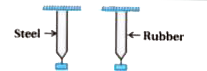
|
|
| 27. |
A boy carrying a box on his head is walking on a level road from one place to another on a straight road is doing no work. The statement is |
|
Answer» partly correct |
|
| 28. |
Calculate the work done in blowing a soap bubble slowly of surface tension 0.08Nm^(-1) from to a radius of 0.08 m. |
|
Answer» |
|
| 29. |
Statement A: Modification of space by a mass particle is called gravitational field Statement B: Law of gravitation is a consequence of “Action at a distance concept": |
|
Answer» A is true, B is FALSE |
|
| 30. |
A particle executing simple harmonic motion of amplitude 5 cm has maximum speed of 31.4 cm"/"s. The frequency of its oscillation is………. |
|
Answer» 4 Hz `v_("MAX")= A omega = A(2pi f)` `therefore f= (v_("max"))/(2pi A)` `=(31.4)/(2(3.14)(5))= 1Hz`. |
|
| 31. |
A sinking ship often turns over as it is immersed in water. Why? |
| Answer» Solution :When a SHIP is floating , the positions of metacentre of the ship LIES over the centre of gravity of ship. When a ship starts SINKING, some water enters ship. As a result of it, the POSITION of centre ofgravity is raised above the position of metacentre. The ship turns over due to a couple formed by its weight and the buoyant force acting on it. | |
| 32. |
Compute the bulk modulus of water from the following data: Initial volume = 100.0 litre, Pressure increase = 100.0 atm (1 atm = 1. 013xx 10^(5) Pa), Final volume = 100.5 litre. Compare the bulk modulus of water with that of air (at constant temperature). Explain in simple terms why the ratio is so large. |
|
Answer» <P> Solution :`Delta P = 100 atm = 100 xx 1.013 xx 10 ^(5) Pa``V _(1) = 100` liter `= 100 xx 10 ^(-3) m ^(-3) =0.1 m ^(3)` `V _(2) = 100.5 ` liter ` = 100.5 xx 10 ^(-3) m ^(-3)` ``THEREFORE Delta l = 1.87 xx 10 ^(-3) m = 1.87 mm` _(2) = 100.5 ` liter `= 100. 5 xx 10 ^(-3) m ^(-3)` `Delta V =V_(2) - V _(1) = (100.5 xx 10 ^(-3) - 100 xx 10 ^(-3))= 0.5 xx 10 ^(-3) m ^(-3)` Bulk modulus for water, `B _(w) = ( P)/((Delta V )/(V))= (PV)/(Delta V )= (100 xx 1 . 0.13 xx 10 ^(5) xx 100 xx 10 ^(-3))/( 0.5 xx 10 ^(-3))` `= 2.026 xx 10 ^(9) Pa` Bulk modulus for air `B _(a) = 1.0 xx 10 ^(5) Pa ` `therefore` Ratio `= ("Bulk modulus for water" (B _(w)))/("BUlk modulus for air" (B _(a)))` `= (2.026 xx 10^(9))/( 1. 0 xx 10 ^(5)) = 2.026 xx 10 ^(4)` The ratio is large. Becaue gaes are more compressive than liquid and intermolecular distance in liquid are very small compared to gases. |
|
| 33. |
A body of mass 2 kg slides down with an acceleration of 3 m//s^(2) on a rough inclined plane having a slope of 30^(@). The external force required to take the same body up the plane with the same acceleration will be : (g = 10 m//s^(2)) |
| Answer» Answer :B | |
| 34. |
A rolling body is kept on a plank B. There is sufficient friction between A and B and no friction between B and the inclined plane. Then body: |
|
Answer» A ROLLS |
|
| 35. |
In an elastic collision , the final kinetic energy is always less than the initial kinetic energy of the system . |
| Answer» Solution :TRUE , usually in an ELASTIC collision the FINAL kinetic energy is always less than the initial kinetic energy of the SYSTEM. | |
| 36. |
Two rods, each of coefficient of linear expansion alpha_(2) and length l_(2), form the two sides of an isosceles triangle and the base is formed by another rod of length l_(1) and coefficient of linear expansion alpha_(1). The base is fixed horizontally at its mid-point. What should be the relationship between l_(1) " and " l_(2) so that the distance of the vertex from the mid-point of the base, does not change for any increase in temperature? |
|
Answer» Solution :ABC is the isosceles TRIANGLE and D is the fixed POINT on the base [Fig. 5.8]. From the figure, `""AD=sqrt(l_(2)^(2)-(l_(1)/2)^(2))=x` (say) `therefore "" x^(2)=l_(2)^(2)-(l_(1)/2)^(2)` Suppose with the RISE in temperature by t, the length of AB and AC change to `l^(.)""_(2),BC " to " l^(.)""_(I)` and AD to y. `therefore "" l^(.)""_(2)=l_(2)(1+alpha_(2)t),l^(.)""_(1)=l_(1)(1+alpha_(1)t)` `therefore "" y^(2)=l^(.)""_(2)""^(2)-((l^(.)""_(1))/2)^(2)={l_(2)(l+a_(2)t)}^(2)-(l_(1)^(2)(1+alpha_(1)t)^(2))/4` `""~=l_(2)^(2)(1+2alpha_(2)t)-l_(1)^(2)((1+2alpha_(1)t)/4)` `""`[neglecting higher powers of `alpha_(1) " and "alpha_(2)`] By condition, length AD should remain the same, i.e. `"" x^(2)=y^(2)` or, `""l_(2)^(2)-l_(1)^(2)/4=l_(2)^(2)(1+2alpha_(2)t)-1/4l_(1)^(2)(1+2alpha_(1)t)` or, `"" 2l_(2)^(2)alpha_(2)t=1/2l_(1)^(2)alpha_(1)t` or, `"" l_(2)^(2)/l_(1)^(2)=1/4*alpha_(1)/alpha_(2) " or, " l_(2)/l_(1)=1/2sqrt(alpha_(1)/alpha_(2)).` 
|
|
| 37. |
A circular turn table has a block of ice placed at its centre. The system rotates with an angular speed w about an axis passing through the centre of the table. If the ice melts on its own without any evaporation, the speed of rotation of the system |
|
Answer» becomes zero |
|
| 38. |
A man holds a 2 kg book between his palms. So that each hand exerts the same horizontal force on the book. The coefficient of static friction between the plams and the book is 0.4 and g=10 ms^(-2). If the book is prevented from falling, the least force exerted by each hand on the book is |
| Answer» ANSWER :B | |
| 39. |
A body oscillator with SHM according to the equation (in SI units) x= 10cos [2pi t +(pi)/(4)] At t= 1.5s calculate the acceleration of the body. |
| Answer» SOLUTION :`a= 279 MS^(-2)`. | |
| 40. |
A body oscillator with SHM according to the equation (in SI units) x= 10cos [2pi t +(pi)/(4)] At t= 1.5s calculate the speed. |
| Answer» SOLUTION :`V= +44.4 MS^(-1)`. | |
| 41. |
A body oscillator with SHM according to the equation (in SI units) x= 10cos [2pi t +(pi)/(4)] At t= 1.5s calculate the displacement. |
| Answer» SOLUTION :`X= -7.07m` | |
| 42. |
When a 'U' shaped slider of negligible mass is dipped in a soap solution and lifted, a thin film of soap is formed in the frame. It supports a weight of 2.0 xx 10^(-2) N. If the length of the slider is 40 cm, the surface tension of the film of soap is |
|
Answer» Solution :`W=2.0xx10^(-2)N,l=40cm=0.4m` UPWARD force DUE to surface tension `Txx2l` In EQUILIBRIUM, `W=Txx2l`, `T=W/(2l)=(2XX10^(-2))/(2xx0.4)=2.5xx10^(-2)Nm^(-1)`. |
|
| 43. |
A meteorite has mass of 500 kg and is composed of a metal. The temperature of the meteor is -20^(@)C and its speed is 10 km/hr when it is at large distance from a planet. The meteorite crashes into the planet and its entire kinetic energy gets converted into heat. This heat is equally shared between the planet and the meteorite. Assume that the heating of meteorite is uniform and the average specific heat capacity of the metal, for its solid, liquid and vapour phase, is 1200 J kg^(-1) .^(@)C^(-1). The latent heat of fusion and vaporization of the metal are L_(f) = 4 xx 10^(5) J kg^(-1) and L_(v) = 1.1 xx 10^(7) J kg^(-1) respectively. The melting point and boiling points are 380 .^(@)C and 2380 .^(@)C respectively. Find the temperature of the meteorite material immediately after the impact. Take: G = 6.6 xx 10^(11) N m^(2) kg^(-2), mass of planet M = 6 xx 10^(24) kg, radius of planet R = 6600 km |
|
Answer» |
|
| 44. |
Examine Tables 61. -6.3 and express (a) the energy required to break one bond in DNA in eV, (b) The kinetic energyof an air molecule(10^(-21)J) in eV , (c ) The daily intake of a human adult in kilocalories . |
|
Answer» Solution :Energy required to break ONE bond of DNA is `(10^(-20)J)/(1.6xx10^(-19)J"/"eV) CONG 0.06 eV` Note `0.1 eV= 100 meV` (100 millielectron VOLT). |
|
| 45. |
A ball dropped from a height og h.If the co-efficient of restitution be e , to what height will it rise after jumping twice from the ground. |
|
Answer» eh/2 |
|
| 46. |
A body of mass 5 kg is moving with a momentum of 10 kg ms^(-1). A force of 0.2 N acts on it in the direction of motion of body for 10 s. The increase in its kinetic energy is |
|
Answer» 2.8 J Impulse = `p_2 - p_1 = F xx t` `:. p_2 - 10 = 0.2 xx 10 or p_2 = 12 kg ms^(-1)` Final kinetic energy = `(p_2^2)/(2m) = (12xx 12)/(2 xx 5) = 14.4 J` INCREASE in kinetic energy = `14.4 J - 10 J = 4.4 J` |
|
| 47. |
A convergent lens of power 16D is used as a simple microscope. Then magnification produced by the lens, when the final image is formed at least distance of distinct vision is |
|
Answer» 6 |
|
| 48. |
A circular turn table has a block of ice placed at its centre. The system rotates with an angularspeed omega about an axis passing through the centre of the table. If the ice melts on its own without any evaporation, the speed of rotation of the system: |
|
Answer» becomes zero |
|
| 49. |
A carnot engine absorbs heat at 127^(@)C and rejects heat at 87^(@)C. The efficiency of engine is |
|
Answer» `10%` |
|
| 50. |
Two moles of an ideal monoatomic gas occupy a volume V at 27^(@)C. The gas expands adiabatically to a volume 8V. Find the change in internal energy of the system. [Given C_(V) = (3R)/(2)J mol^(-1).^(@)C^(-1)] |
|
Answer» Solution :For an adiabatic change, `TV^(gamma -1)` = constant `:. (T_(2))/(T_(1)) = ((V_(1))/(V_(2)))^(gamma - 1) = ((V)/(8V))^((5)/(3)-1) = ((1)/(8))^(2//3)` Here, `gamma = (5)/(3)` monoatomic gas `= ((1)/(2^(3)))^(2//3) = ((1)/(2))^(2) = (1)/(4)` or `T_(2) = (T_(1))/(4) = ((273 + 27))/(4) = (300)/(4) = 75 K` Now, `Delta U = nC_(V)dT` or `Delta U= 2 xx (3R)/(2) xx (75 - 300) = 3 xx 8.3 xx (-225) = 5602.5 J` |
|