

Saved Bookmarks
This section includes 7 InterviewSolutions, each offering curated multiple-choice questions to sharpen your Current Affairs knowledge and support exam preparation. Choose a topic below to get started.
| 1. |
A particle of mass m is at rest at the origin at time t=0. It is subjected to a force F(t)=F_(0)e^(-bt) in the X - direction. Its speed V(t) is depicted by which of the following curves. |
|
Answer» Solution :As the force is exponentially decreasing, its acceleration, i.e., rate of INCREASE of VELOCITY will decrease with time. Thus, the graph of velocity will be an increasing curve with decreasing SLOPE with time. `a=(F)/(m)=(F_(0))/(m)e^(-bt) RARR (dv)/(dt)=(F_(0))/(m)e^(-bt) rArr int_(0)^(v)dv=int_(0)^(t)(F_(0))/(m)e^(-bt)dt` `rArr v=[(F_(0))/(m)((1)/(-b))e^(-bt)]_(0)^(t)=[(F_(0))/(m)((1)/(b))e^(-bt)]_(t)^(0)` `=(F_(0))/(mb)(e^(0)-e^(-by))=(F_(0))/(mb)(1-e^(-bt))` |
|
| 2. |
The momentum of a body is increased by 25%. The kinetic energy is increased by about |
|
Answer» SOLUTION :Kinetic energy of a BODY is , `K = (p^2)/(2m)` where p is the momentum and m is the mass of the body. `:. K prop p^2` when the momentum of a body is INCREASED by 25% , its mometum will become `p. = p + 25/100 p = 125/100 p = 5/4 p` `:. (K.)/(K) = (p.^2)/(p^2) = (5/4)^2 = 25/16 or K. = 25/16 K` Percentage increase in the kinetic energy of the body `= (K. - K)/(K) xx 100 % = ((25//16) K-K)/(K) xx 100%` `= 9/16 xx 100% = 56%`. |
|
| 3. |
Two coherent narrow slits emitting sound of wavelength lamda in the same phase are placed parallel to each other at a small separation of 2lamda. The sound is detected by moving a detector on the screen sum at a distance D(gtgtlamda) from the slit S_1 as shown in figure. Find the distance x such that the intensity at P is equal to the intensity at O. |
|
Answer» Given that there will be a maximum intensity at P. `RARR path difference =/_\x=nl`  From the ure (in question) `(S_1P)^2-(S_2P)^2` =(sqrtD^2+x_2)^2-[(sqrtD-2lamda^2+x^2]^2` `=4lamdaD=4lamda^2=4lamdaD` `(lamda^2` is so small and can neglected ) `S_1P-S_2P=(4lamdaD)/(2sqrt(x^2+D^2))=nlamda` `=(2D)/(sqrt(x^2+D^2))=n` `rarr n^2(x^2+D^2)=4D^2` `rarr x=D/n sqrt4-n^2` When `n=1, x=sqrt3D(1st order)` n=2, `x=0 (2ND order) `:.Wen x=sqrt3D` at P there will be maximum intensity |
|
| 4. |
Consider a two-particle system with the particles having masses m_(1)and m_(2) . If the first particle is pushed towards the centre of mass through a distance d, by what distance should the second particle be moved so as to keep the centre of mass at the same position? |
|
Answer» |
|
| 5. |
In a vertical disc two grooves are made as shown in figure. AB is a diameter. Two balls are dropped at A one in each groove, simultaneously. Then: |
|
Answer» Time to each at C is less than that to reach at B |
|
| 6. |
Three spherical balls of masses 1 kg, 2kg and 3 kg are placed at the corners of an equilateral triangle of side 1 m. The magnitude of the gravitational force exerted by 2 kg and 3 kg masses on 1 kg mass. |
|
Answer» 19 G |
|
| 7. |
Assertion: In isothermal process whole of the heat energy supplied to the body is converted into internal energy. Reason: According to the first thermodynamics DeltaQ=DeltaU+PDeltaV |
|
Answer» Both assertion and reason are TRUE and the reason is the CORRECT EXPLANATION of the assertion. |
|
| 8. |
An ornament weighing 36g in air weights only 34g in water. Assuming that some copper is mixed with gold to prepare the ornament, find the amount of copper in it. Specific gravity of gold is 19.3 and that of copper is 8.9 |
|
Answer» `2.2g` |
|
| 9. |
The frequency of a vibrating wire is 200 Hz. The velocity of a particle on the wire is 4.35m*s^(-1) when it is at a distance of half its amplitude. Calculate the acceleration of the particle at that instant. |
|
Answer» Solution :Here, `omega=2pin=2pi*200=400pi"rad"*s^(-1)" "[becausen=200Hz]` Let A be the AMPLITUDE of the particle. If `X=A/2`, then `v=4.35m*s^(-1)` `therefore" "v=omegasqrt(A^(2)-x^(2))` or, `4.35=400pisqrt(A^(2)-A^(2)/4)=400pi*(Asqrt3)/2` or, `A=(4.35xx2)/(400pixxsqrt3)m`. `therefore` Required ACCELERATION, `a=omega^(2)x=omega^(2)*A/2=(400pi)^(2)xx1/2xx(4.35xx2)/(400pixxsqrt3)` `=(400pixx4.35)/sqrt3=3154m*s^(-2)` (approx.) |
|
| 10. |
If gravitational field due to a uniform thin hemispherical shell at point P (see figure) is I, then find the magnitude of gravitational field at Q (Mass of hemispherical shell is M, radius R) |
| Answer» SOLUTION :`((GM)/(2R^2) -1)` | |
| 11. |
The relation between Young's modulus (Y) bulk modulus (K) and modulus of elasticity (eta) is: |
|
Answer» `(1)/(Y)=(1)/(K)=(3)/(ETA)` |
|
| 12. |
Two bodies are in equilibrium when suspended in water from the arms of a balance. The mass of one body is 28g and its density is 5.6g/c.c. If the mass of the other body is 36g, find its density d. |
|
Answer» SOLUTION :Weight of WATER DISPLACED by first body = `(28)/(5.6)g`, Weight of water displaced by second body = `(36)/(d)g`, Apparent weight of first body = `(28-(28)/(5.6))g` Apparent weight of second body = `(36-(36)/(d))g` since bodies are in equilibrium `(28-(28)/(5.6))g=(36-(36)/(d))g""d=(36)/(13)~~2.8g//c c`. |
|
| 13. |
In the arrangement shown in figure the ends of an in extensible move downwards with uniform speed u. pulleys A and B are fixed. Find the speed with the mass M moves upwards. |
|
Answer» Solution :SUPPOSE the distance of point O from the ceiling is y and the distance of point O from each pulley is x and the distance beween the two pulleys is `l`. `x^(2)=y^(2)+(1^(2))/(4)""(##AKS_DOC_OBJ_PHY_XI_V01_A_C04_SLV_026_S01.png" width="80%"> Diiferentiating the above EQUATION w.r.t. to "t" `2X((dx)/(dt))=2y((dy)/(dt))+(1)/(4)2l((dl)/(dt))` But, `u=-(dx)/(dt), v+(dy)/(dt) and (dl)/(dt)` `:. -xu = yu and v=-u(x)/(y) = usectheta` `:. VELOCITY of mass = v = usectheta (upwards) |
|
| 14. |
If earth shrinks to 1/64 of its volume with mass remaining same, duration of day will be |
|
Answer» `1.5h` |
|
| 15. |
If a drop of water falls on a very hot iron, it takes long time to evaporate. Explain why? |
| Answer» Solution :When a drop of WATER falls on a very hot iron it gets insulated from the hot iron due to a thin LAYER of water VAPOUR which is a bad conductor of heat. It takes quite LONG to evaporate as heat is conducted from hot iron to the drop through the insulating layer of water vapour very slowly. | |
| 16. |
A piece of lead falls from a height of 100 m on a fixed non - conducting slab which brings it to rest . The temperature of the piece immediately after collision increase by ( specific heat of lead is 30.6 cal kg^(-10) C^(-1) and g= 9.8ms^(-2)) |
|
Answer» `6.72^(@)C` |
|
| 17. |
One -fourth chain is hanging down from a table. Work done to bring the hanging part of the chain on the table is (mass of chain = M and length = L) |
|
Answer» `(MGL)/(32)` |
|
| 18. |
When the net force and net torque acts on the body is zero then the body is in |
|
Answer» TRANSLATIONAL EQUILIBRIUM |
|
| 19. |
The graph between period oscillation (T) and mass attached (m) to a spring will be: |
|
Answer»
|
|
| 20. |
The rectangular components of a vector lying in xy plane are (n+1) and 1. If coordinate system is turned by 60^@ . They are n & 3 respectively the value of 'n' |
|
Answer» 2 |
|
| 22. |
In the following situations, the length and area of cross-section of each rod is same. Find temperature theta at junction of rods. (a) (b) (c ) (d) The thermal conductivity of each rod is K. |
|
Answer» Solution :(a) Thermal resistance ofrod 1 `R_(1) = (L)/(2KA) = R_(0)` Thermal resistance of rod 2 `R_(2) = (L)/(KA) = 2 R_(0)` Heat CURRENT in rods is same `i= (Delta theta)/(R )` `i= (100 - theta)/(R _(1)) = (theta - 2 0)/(R_(2))` `(100 - theta)/(R_(0)) = (theta- 20)/(2 R_(0))` `200 - 2 theta = theta - 20` `3 theta = 220` `theta = (220)/(3).^(@)C` (B) `R_(1) (L)/(KA) = R_(0)` `R_(2) = (L)/(2KLa) = (R_(0))/(2)` `R_(3) = (L)/(4 KA) = (R_(0))/(4)` `i = i_(1) + i_(2)` `(100 - theta)/(R_(1)) = (theta - 40)/(R_(2)) + (theta - 10)/(R_(3))` `(100 - theta)/(R_(0)) = (theta - 40)/(R_(0)//2) + (theta - 10)/(R_(0)//4)` `100 - theta = 0 (theta - 40) + 4 (theta - 10)` `= 2 theta- 80 + 40 - 40` `7 theta = 220` `theta = (220)/(7).^(@)C` (c ) `R_(1) = (L//2)/(KA) = (L)/(2KA) = R_(0)` `R_(2) = (L)/(KA) = 2 R_(0)` `R_(3) = (L//2)/(2KA) = (L)/(4KA) = (R_(0))/(2)` `i = i_(1) + i_(2)` `(100 - theta)/(R_(1)) = (theta - 20)/(R_(2)) + (theta - 40)/(R_(3))` `(100 - theta)/(R_(0)) = (theta - 20)/(2 R_(0)) + (theta - 40)/(R_(0) // 2)` `100 - theta = (theta - 20)/(2) + 2 (theta - 40)` `200 - 2 theta = theta - 20 + 4 theta - 160` `7 theta = 380` `theta = (380)/(7).^(@)C` Let `(L)/(KA) = R` `i = i_(1) + i_(2)` `(T_(1) - theta)/(R ) = (theta - T_(2))/(R + (R)/(2)) + (theta - T_(3))/(R + (R)/(2))` `T_(1) - theta = (2)/(3) (2 theta - T_(2) - T_(3))` `3 T_(1) - 3 theta = 4 theta - 2 T_(2) - 2 T_(3)` `7 theta = 3 T_(1) + 2 T_(2) +2 T_(3)` `theta = (3 T_(1) + 2 T_(2) + 2 T_(3))/(7)` 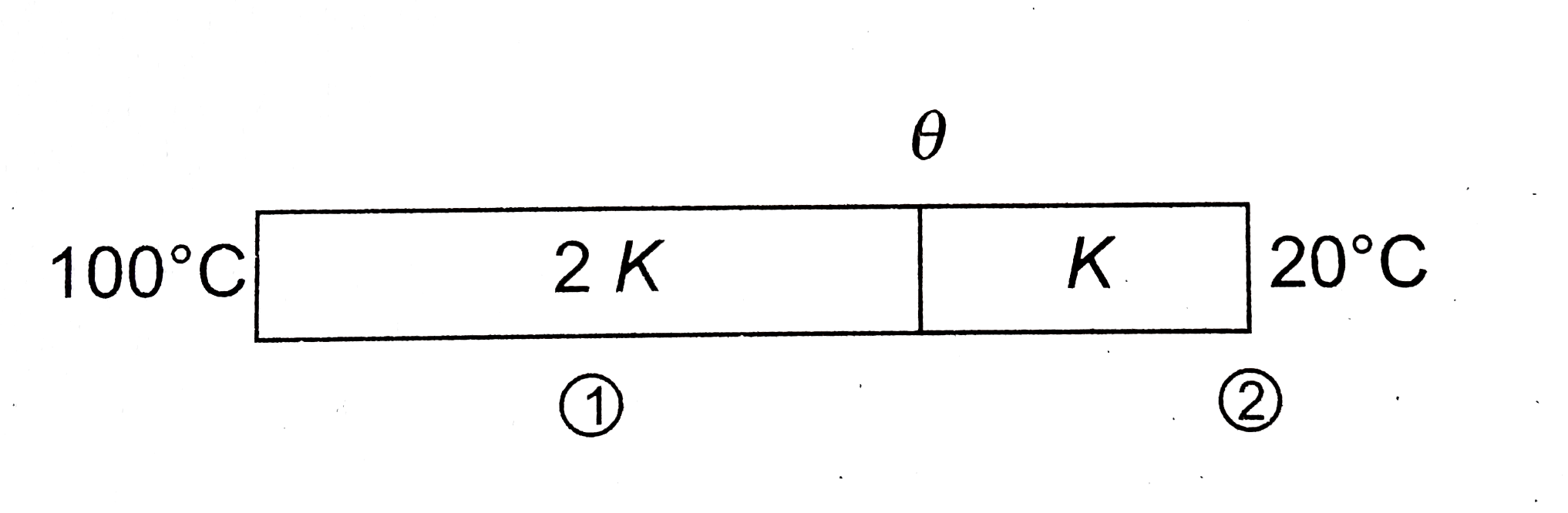 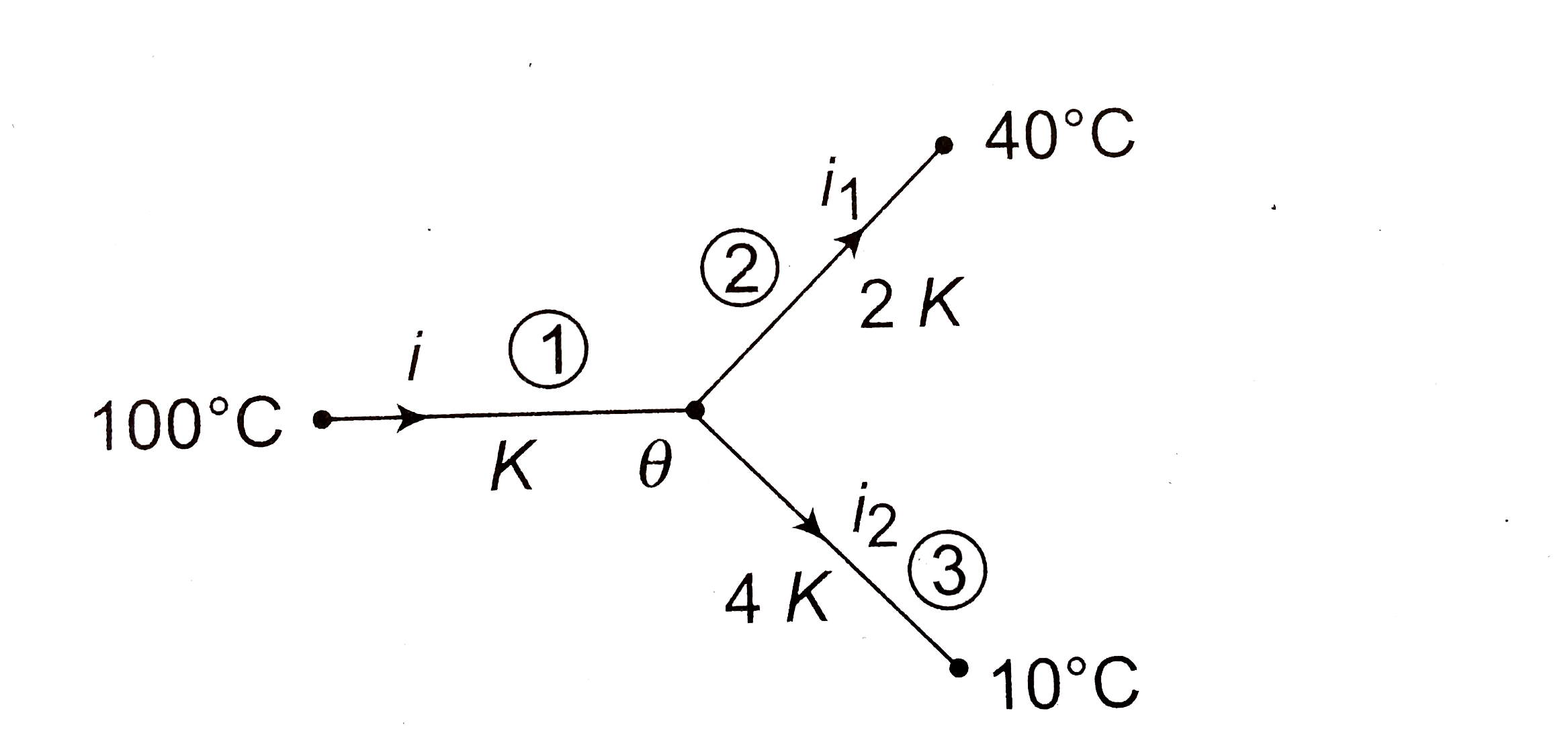 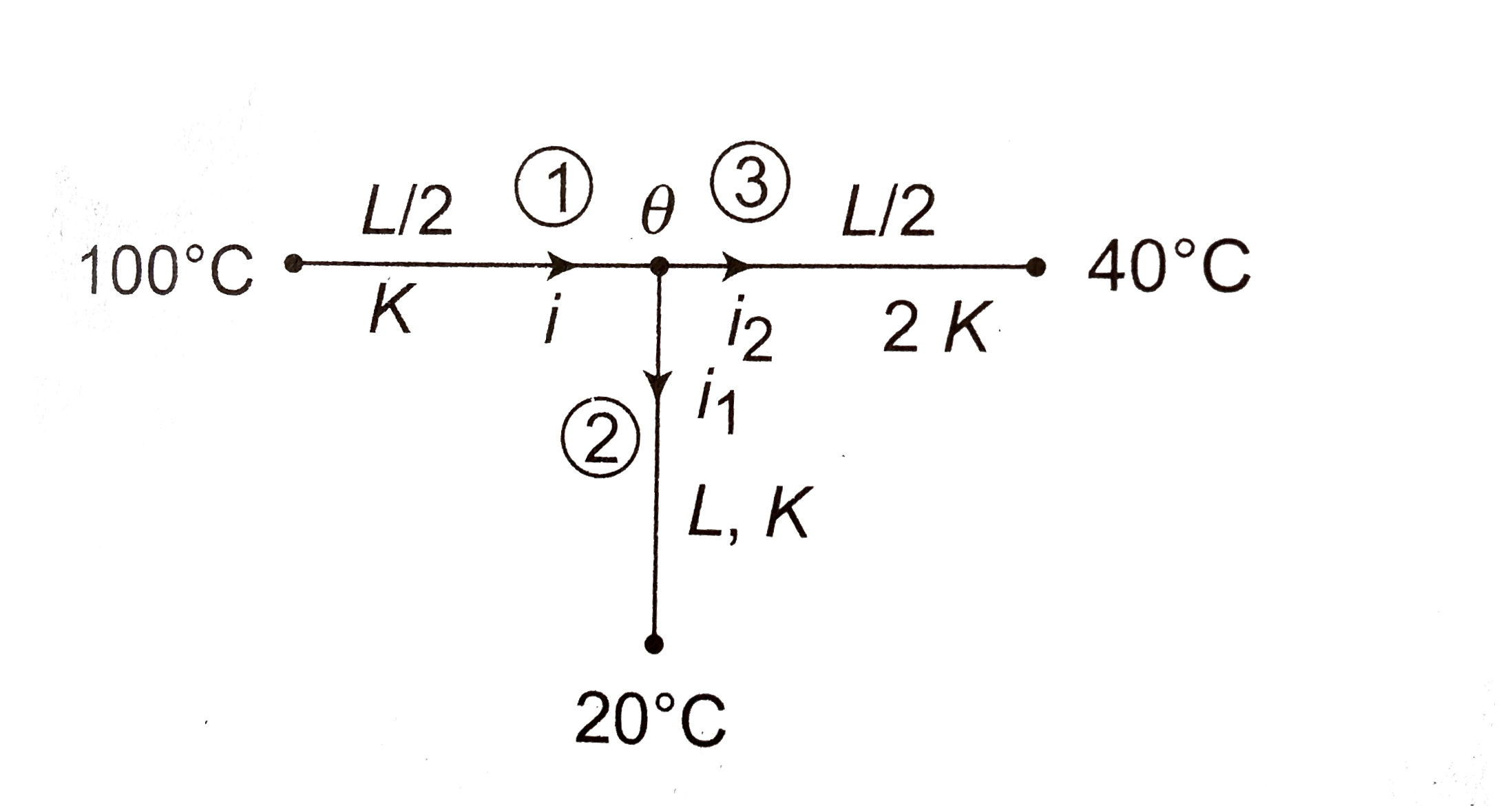 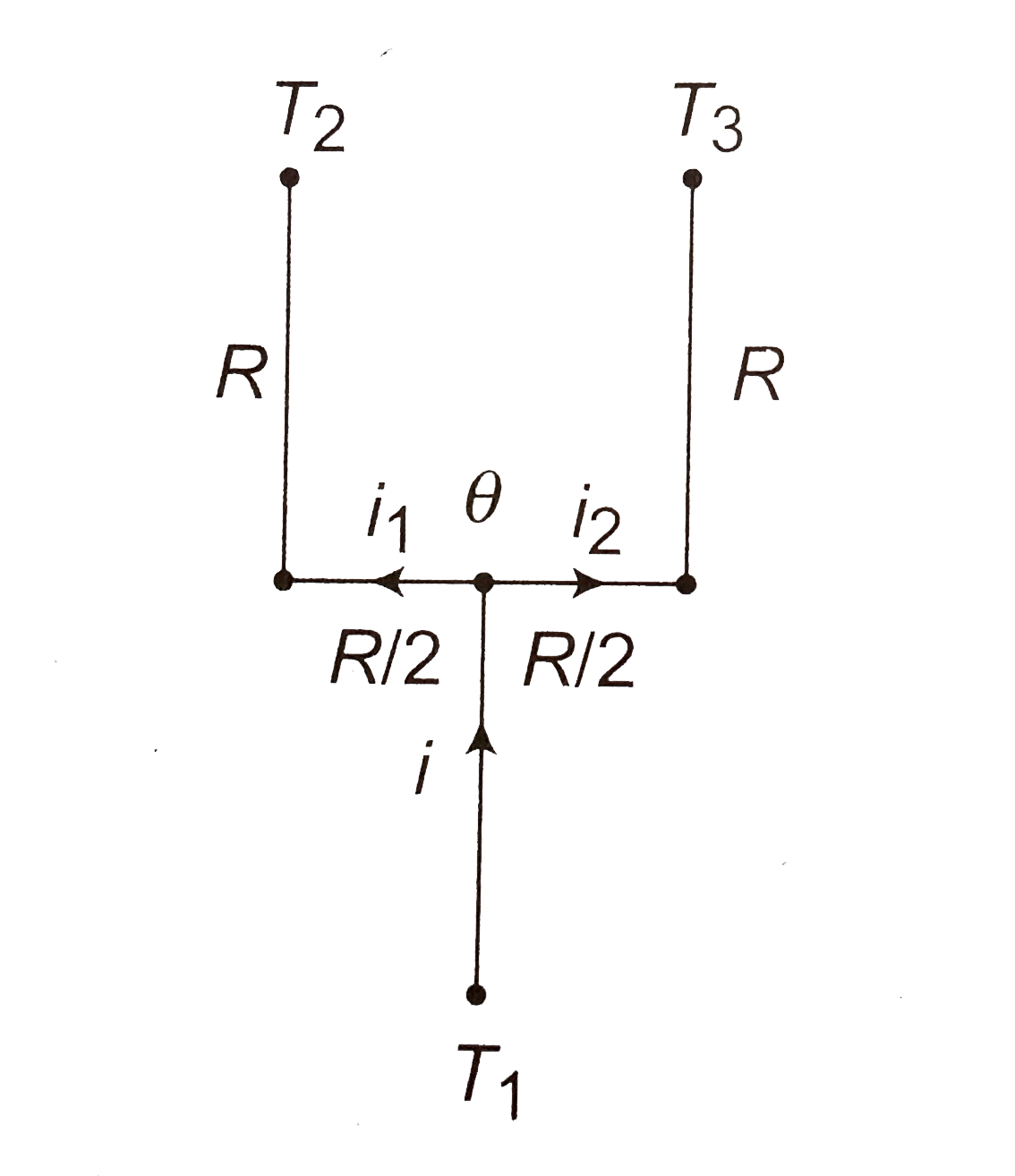
|
|
| 23. |
Which informations cannot be drawn from average velocity ? |
|
Answer» Solution :The ACTUAL DISTANCE covered by the object cannot be found. The path of MOTION of the object cannot be found. The velocities of the object at DIFFERENT positions on the path cannot be found. |
|
| 24. |
If bar(P) - bar(Q) vec(R ) and P = Q = R. Angle between bar(P) and bar(Q) " is " beta. Angle between bar(P) " & " bar(R ) " is " alpha. If ""^(beta)//_(alpha) value is n/2 find n. |
|
Answer» |
|
| 25. |
A capillary tube is immersed vertically in water such that the height of liquid column in it is 'x'. This arrangement is taken into a mine of depth 'd' and the height of the liquid column is found to be 'y'. If 'R' is the radius of the earth, then the depth of mine is |
|
Answer» `d=R((y-X)/(x))` |
|
| 26. |
A shell of mass 3m is moving horizontally through air with velocity u when an internal explosion causes it to separates into two parts of masses m and 2m, which continue to move horizontally in the same vertical plane. If the explosion generates additional energy, of amount 12mu^(2) prove that the two fragments separate with relative speed 6u. |
|
Answer» |
|
| 27. |
Total KE of sphere of mass M rolling with velocity v is |
|
Answer» `(7)/(10)MV^(2)` |
|
| 28. |
The ……….. Error are those which occur ……… by …………. . |
|
Answer» |
|
| 29. |
Find the efficiency of a cycle consisting of two isochoric and two adiabatic lines if the volume of the ideal gas changes n=10 times within the cycle. The working gas has gamma=1.5. |
|
Answer» |
|
| 30. |
A batsman deflects a ball by an angle of 45^(@) without changing its initial speed which is equal to 36 km/h. what is the impulse imparted to the ball? Given, mass of ball is 0.157 kg. |
|
Answer» Solution :Let initial velocity of the ball is `vec(v_(1))` and FINAL velocity of the ball is `vec(v_(2))`. `therefore` Impulse,`vec(I) = m(vec(v_(2)) - vec(v_(1)))` [ m = mass of the ball ] Magnitude of initial and final velocities are the same, i.e., `|vec(v_(1))| = |vec(v_(2))| = 36km CDOT h^(-1)` `"" = (36 xx 10^(3))/(3600) m cdot s^(-1)` `"" 10 m cdot s^(-1)` From FIGURE, `|vec(v_(2)) - vec(v_(1))| = sqrt( v_(1)^(2) + v_(2)^(2) + 2v_(1)v_(2) cos 45^(@))` `= sqrt(10^(2) + 10^(2) + 2 xx 10 xx 10 xx (1)/(sqrt(2)))` `approx` 18.5 m`cdot s^(-1)` `therefore ""|vec(I)| = m|vec(v_(2)) - vec(v_(1))|` = 0.157 `xx 18.5 "kg" cdot m cdot s^(-1) = 2.9 "kg" cdot m cdot s^(-1)` The direction of imparted impulse is ALONG bisector of the angle between `vec(v_(2)) and - vec(v_(1))` 
|
|
| 31. |
A column of Hg of 10cm length is contained in the middle of a narrow horizontal 1 m long tube which is closed at both ends. Both the halves of the tube contain air at a pressure 76 cm of Hg. By what distance will the column of Hg be displaced if the tube is held vertical ? |
|
Answer» Solution :If initially the length of air column on each side is L, according tothe given problem, 2L + 10 = 100, i.e., L = 45 cm `"…(1)"` Now if the tube is held VERTICAL the Hg column will be displaced downward by y such that `P_(B)+10=P_(A)"...(2)"` Now applying gas equation to air enclosed in side A, `(P_(0)LA)/(RT)=(P_(A)(L-y)A)/(RT)," i.e., "P_(A)=(LP_(0))/((L-y))"...(3)"` while for air enclosed in side B, `(P_(0)LA)/(RT)=(P_(B)(L+y)A)/(RT)," i.e., "P_(B)=(LP_(0))/((L+y))"...(4)"` Substituting the values of `P_(A)" and "P_(B)` from equation (3) and (4) in (2), with L = 45 anhd `P_(0)=76CM` of Hg we get `(45 times 76)/((45-y))-(45 times 76)/((45+y))=10" (or) "y^(2)+684-(45)^(2)=0" (or) "y=-342+345=3cm` 
|
|
| 32. |
A jet of water with a cross sectional area 'a' is striking against a wall at an angle theta to the horizontal and rebounds elastically. If the velocity of water jet is v and the density is rho, the normal force acting on the wall is |
|
Answer» `2av^(2)RHO COS theta` |
|
| 33. |
A wire of length L and radius r is fixed at one end and a force F applied to the other end produces an extension l. the extension produced in another wire of same material of length 2L and radius 2r by a force 2F is |
|
Answer» l |
|
| 34. |
A bead slides on a fixed frictionless wire bent into a horizontal semicircle of radius R_(0) as shown in figure. In addition to any normal forces exerted by the wire, the bead is subjected to an external force that points directly away from origin and depends on distance r from the origin according to the formula F=F_(0)((r )/(R_(0)))^(2)hat(r) |
|
Answer» Given force is a CENTRAL force |
|
| 35. |
What can be said for the centre of mass of system M(vecdv_(cm))/(dt)=vecMa_(cm)=vecF? |
|
Answer» Solution :It can be SAID that from `M(vecdv_(CM))/(dt)=vecMa_(cm)=vecF`, The centre of MASS of system on which whole mass of system is concentrated and it move under the EXTERNAL FORCE. |
|
| 36. |
A unknown solid sphere of mass m and radius r is kept on rough horizontal surface with coefficient of friction mu=1/3 as shown in the figure. An impulse J="MV"_(0) is applied tangentially on the sphere at an angle 37^(@) with the horizontal as shown in the figure. (Assuming J gtgt Mgdt, g=10" m/s"^(2)) |
|
Answer» The velocity of centre of mass of the sphere just after IMPULSE applied is `v_(0)` |
|
| 37. |
An ideal gas at temperature T_1 is compressed to 32th of its original volume, then its temperature T_2 will be _____ (gamma=1.4) |
|
Answer» SOLUTION :For an ADIABATIC PROCESS, `T_1V_1^(gamma-1)=T_2V_2^(gamma-1)` `THEREFORE T_2=T_1(V_1/V_2)^(gamma-1)` `=T_1(V_1/(V_1//32))^(gamma-1)=T_1(32)^(1.4-1)` `=T_1xx(2^5)^(2//5)` `=T_1xx4` `=4T_1` |
|
| 38. |
Ona statightroada policemanin ajeepchasesathiefwitha speedv.Whenthe thiefis adistancedfromthepolice- jeep, thethiefescapeswitha bikewitha constantaccelerationa.The policecancatchthe thiefifv^(2)ge2 ad - proveit . |
|
Answer» Solution :F thevelocityof thebikeof thethiefincrease from0 tovin timet , V= ator ,`t= ( v) /(a)` thedistancetravelledby thethiefin timet , ` s =(1)/(2)at^(2)=(1)/(2)a ( (v)/( a))^(2)= ( 1)/(2)( v^(2))/(a)` the distancetravelledbythepolice- jeepin timethas TOBE atleast( s+d) . hence, v `* ((v)/(a)) ge s+d` or ,` (v^2)/(a )ge(1)/(2)( v^(2))/(a)+ DOR ,(1)/(2) (v^(2))/(a)ged ` `or ,v^(2)ge2ad ` |
|
| 39. |
A block is placed on a horizontal table which can rotate about its axis. A block is placed at a certain distance from centre as shown in figure. Table rotates such that particle does not slide. Select possible direction of net acceleration of block at the instant shown in figure. Then match the column. {:("Column-I","Column-II"),("(A) When rotation is clockwise with constant " omega ,"(P) 1"),("(B) When rotation is clockwise with decreasing "omega,"(Q) 2"),("(C) When rotation is clockwise with increasing "omega,"(R) 3"),("(D) Just after clockwise rotation begins from rest","(S) 4"):} |
|
Answer» |
|
| 40. |
A particle is projected with a velocity vecv=ahati+bhatj. Find the radiu of curvature of the trajectory of the particle at the (i) point of projection (ii) highest point. |
|
Answer» <P> Solution :(i) Let the angle of projection be `theta`At the point of projection `P,a_(n)=gcos theta_(0)` Hence the radius of curvature at P is `r_(p)=(v_(p)^(2))/(alpha_(n))=(v_(0)^(2))/(g cos theta_(0))` Since `TAN theta_(0)=b//a,cos theta_(0)=a/(sqrt(a^(a)+b^(2)))` Substituting `v_(0)=sqrt(a^(2)+b^(2))` and `cos theta_(0)=a/(sqrt(a^(2)+b^(2)))`, we have `R-(p)=(a^(2)+b^(2))^(3//2)g//a` (ii) At the highest position Q, the VELOCITY of the particle is `v_(Q)=v_(0)cos theta_(0)` Since it moves horizontally at highest point `Q.veca_(n)=vec(g) (_|_ vecv)` Hence the radius of curvature at Q is `r_(Q)=(v_(Q)^(2))/(a_(n))=(v_(0)^(2)cos^(2)theta)/g`  Where `v_(0)cos theta=v_(X)=a` (given) Then `r_(Q)=(a^(2))/g` |
|
| 41. |
Two ,netal rods are fixed end to end between two rigid supports as shown in figure. Each rod is of length land area of cross -section is A. When the system is heated up, detennine the condition when the junction between rods does not shift ? (Given : Y_(1) and Y_(2) are Young's modulus of ,naterials of the rods, alpha_(1) and alpha_(2) are coefficientsof linear expansion ) |
|
Answer» SOLUTION :Since, each ROD is prevented from expansion so, they are under compression and mechanical strain The net strain in each rod. `epsilon_(1) = alpha_(1) 1 Delta T - (Fl)/(A Y_(1)) , epsilon_(2) = alpha_(2) l Delta T - (Fl)/(A Y_(2))` ` epsilon_(1) = epsilon_(2) = 0` `alpha_(1) 1 Delta T - (Fl)/(A Y_(1)) = 0 and alpha_(2) l Delta T - (Fl)/(A Y_(2))= 0 ` `alpha_(1) l Delta T - (Fl)/(A Y_(1)) = 0 and alpha_(1) 1 Delta T - (Fl)/(A Y_(2)) = 0 ` Solving , we GET `"" alpha_(1) Y_(1) = alpha_(2) Y_(2)` |
|
| 42. |
What is the relation between torque and angular momentum ? |
|
Answer» Solution :We have the EXPRESSION for magnitude of ANGULAR momentum of a rigid body as, `L = I omega ` . The expression for magnitude of torque on a rigid body is, `TAU = I alpha ` We can further write the express.ion for torque as, ` tau = 1 (d omega )/(dt) "" ( because alpha = (d omega)/(dt) )` where `omega` is angular velocity and a is angular ACCELERATION. We can also write equation, `tau = (d(I omega))/(dt)` ` tau = (dL)/(dt)` |
|
| 43. |
A particle of mass m, initially at rest is acted upon by a variable force F for a brief interval of time T. It begins to move with a velocity u after the force stops acting. F is shown in the graph as a function of time. The curve is a semicircle. Then |
|
Answer» `u=(piF_(0)^(2))/(2m)` |
|
| 44. |
A body is uniform rotating about axis fixed in an inertia frame of reference Let vec(A) be a unit vector along the axis of rotaiton and vec(B) be the unit vector along the resultant force on a particle P of the body away from the axis. The value of vec(A).vec(B) is |
|
Answer» 1 |
|
| 45. |
Two particles A and B initially at resst move towards each other under a mutual force of attraction . At the instant when the speed of A is V and the speed of B is 2v, the speed of the centre of mass of the system is |
| Answer» ANSWER :A | |
| 46. |
Sound of freqeuncy 1000 Hz from a stationary source is reflectd form an object approaching the source is 30 ms^(-1), back to a stationary observer located at the source. The speed of sound in a air is 330 ms^(-1). The frequency of the sound heard by the observer is : |
|
Answer» 1000 Hz `v'=v_(0)((v+v_(0))/(v))` When `v_(0)`= frequency of source v= SPEED of sound in AIR `v_(0)`= speed of the object The frequency of reflected sound from the object heard by the stationary observer located at the source is `v''=v''((v)/(v-v_(0)))=v_(0)((v+v_(0))/(v-v_(0)))` `=1000 ((330+30)/(330-30))=1200 Hz` |
|
| 47. |
A car starts from rest with an acceleration 6m//s^(2) whichdecreases to zero linearly with time, in 10 second, after which the car continues to travell with constant speed. The time required for the car to travel 400 mfrom the start is 16.67t sec. The value of 't' is |
|
Answer» |
|
| 48. |
The interference phenomenon can take place |
|
Answer» in TRANSVERSE wave only |
|
| 49. |
Two bullets A & B fired simultaneously, horizontally and with different speeds from the same plane. Which bullet will hit the ground first ? |
|
Answer» the FASTER one |
|
| 50. |
A nucleus of mass 218 amu is in free state decays to emit an alpha - particle. Kinetic energy of alpha - particle emitted is 6.7 Mev. The recoil energy in (MeV) emitted by the daughter nucleus is |
|
Answer» `1.0` |
|


