

Saved Bookmarks
This section includes 7 InterviewSolutions, each offering curated multiple-choice questions to sharpen your Current Affairs knowledge and support exam preparation. Choose a topic below to get started.
| 1. |
Fundamental frequency of one open pipe is equal to third harmonic of closed pipe of length 20 cm. Find length of open pipe. |
|
Answer» 16 cm (ii) For CLOSED pipe of length L., third harmonic is, `(3v)/(4L.)` As per the statement, `(v)/(2L) = (3v)/(4L.)` `therefore L = (2L.)/(3) = (2 xx 20)/(3) = 12.33 cm ~~13.2 cm` |
|
| 2. |
Two capillary tubes of glass of radii 3 mm and 2 mm are placed vertically in water, ratio of height of water in the tubes is |
|
Answer» `3:2` |
|
| 3. |
The displacement of a particl executing SHM is given by Y=10 sin (3t+pi//3)m and t is in seconds. The initial displacement and maximum velocity of the particle are respectively |
|
Answer» `5sqrt(3)` m and 30m/sec |
|
| 4. |
The ratio of energy required to accelerate a car from rest to 20 ms^(-1) to the energy needed to accelerate from 20 ms^(-1) to 40 ms^(-1) is |
|
Answer» `1:1` |
|
| 5. |
Figure 10.24(a) shows a thin liquid film supporting a small weight =4.5 times 10^-2 N What is the weight supported by a film of the same liquid at the same temperature in Fig.(b) and ( c) ? Explain your answer physically. |
| Answer» SOLUTION :`4.5 TIMES 10^-2 N` for (B) and (C ) the same as in (a). | |
| 6. |
A motor is used to lift water from a well of depth 10m and to fill a water tank of volume 30m^(3) in 10 minutes. The tank is at a height of 20m above ground. If 20% of energy is wasted, the power of the motor is (in kW) |
|
Answer» 18.75 |
|
| 7. |
Why do we use multi-stage rocket for launching a satellite? |
|
Answer» Solution :An artifical satellite is launched with the help of a mutlistage rocket. When the rocket is fired, the fuel of first stage rocket STARS burning. This makes the rocket to each the desired height with a denfinite speed. Now the first stage is detached itself from the remaining roacket and the fuel of second stage rocket stars burning. This will make the desired direction of rocket and wull increase the height as well as the speed of rocket. When the fuel of second stage rocket is burnt completely, this stage is ALSO separated from the remaining rocket. Now the fuel of last stage rocket stars buring. This will GIVE the desired height and speed to the rocket. When the desired height is attained, the body placed at the nose of rocket is projected horizontally with the desirad speed by automatic mechanical arrangement. (All these calculations are done in advance.) Now the body will start orbiting around the EARTH with a denfinite PERIOD and becomes asatellite of earth. |
|
| 8. |
A cubical block is floating in a liquid with half of its volume immersed in the liquid. When the whole system accelerates upwards with acceleration of (g)/(3), the fraction of volume immersed in the liquid will |
| Answer» Answer :A | |
| 9. |
A peiece of metal weight 45g in air and 25g 30^(@)C. When the temperature of the liquide raised to 40^(@) |
|
Answer» SOLUTION :`M_(1) =` mass of the METAL PIECE in air `M_(2) =` mass of the metal piece in LIQUID at `30^(@)C` `M_(3) =` Mass of the metal piece in liequid at `40^(@)C` `rho_(1) =` density of liquid at `30^(@)C` `rho_(2) =` density of liquid at `40^(@)C` Mass expelled `Deltam_(1) = M_(1) - M_(2) = V_(1)rho_(1)` at `30^(@)C` `Deltam_(2) = M_(1) - M_(3) = V_(2)rho_(2)` at `40^(0)C, (20)/(18) = (V_(1)rho_(1))/(V_(2)rho_(2))` `(10)/(9) = (V_(1) xx 1.5 xx 10^(3))/(V_(1)(1 + gammaDeltat) xx 1.25 xx 10^(3)), 1 + gammaDeltat = (9 xx 1.2)/(10)` `= (10.8)/(10) = 1.08, gammaDeltat = 1.08 - 1, 3alpha = 0.08` `ALPHA = (0.08)/(3) = :. alpha = 2.6 xx 10^(-3//@)C` |
|
| 10. |
The pressure in air bubble just below the water surface is (Surface tension of water is 72 dyne cm^(-3)and atmospheric pressure 1 xx 10^5 Nm^(-2) ,Radius of bubble = 0.1mm) |
|
Answer» `1.0144 XX 10^5 NM^2` |
|
| 11. |
What is the difference between the periodic motion and the oscillatory motion ? |
| Answer» SOLUTION :OSCILLATORY MOTION is to and FRO. | |
| 12. |
An organ pipe closed at one end is excited to support the third overtone. Which of the following pairs arefound that air in the pipe has : |
|
Answer» 4 nodes and 4 antinodes Thus length `=7xx((LAMBDA)/(4))`  Number of nodes =4 Number of antinodes |
|
| 13. |
The moment of inertia of a body about a given axis is 1.2 kg m^2. Initially, the body is at rest. In order to produce a rotational kinetic energy of 6000 joule, an angular acceleration of 25 rad/s^2 must be applied about that axis for a duration of |
|
Answer» 4 s Substituting the given values , we get `6000 = (1)/(2) xx 1.2 xx (25)^(2) xx t^(2)` or `t^(2) = 16` or t = 4s |
|
| 14. |
A body of mass m moving with velocity u collides head on elastically with another body of mass 2m at rest. What is the ratio of kinetic energy of the colliding body before and after collision ? |
|
Answer» |
|
| 15. |
Energy required to break one bond in DNA is |
|
Answer» `10^(-10) J` |
|
| 16. |
The upper half of an inclined plane of inclination 'theta' is perfectly smooth while the lower half is rough. A block starting from rest at the top of the plane will again come to rest at the bottom. The coefficient of friction between the block and the lower half of the plane is given by |
|
Answer» `mu=2 tan THETA` `V_("smooth")=sqrt(2gh sin theta)` |
|
| 17. |
A particle of mass 1 kg is projected upwards with velocity 60ms^(-1). Another particle of mass 2kg is just dropped from a certain height. After 2s, match the following. [Take, g =10 ms^(-2)] {:("column1","column2"),("Accelertion of CM","P Zero"),("B Velocity of CM","Q 10 SI unit"),("C Displacement of CM","20 SI unit"),("-","S None"):} |
|
Answer» `=((1)(-10)+2(-10))/(3) = -10 MS^(-2)` `u_(CM) = ((m_(1)u_(1) + m_(2)u_(2))/(m_(1) + m_(2)`, after 2s `=((1)(40)+(2)(20))/(3) = (40+40)/3 = 80/3` |
|
| 18. |
Six forces are acting on a particle. Angle between two adjacent force is 60^(@). Five of the forces have magnitude F_(1) and the sixth has magnitude F_(2). The resultant of all the forces will have magnitude of |
|
Answer» ZERO |
|
| 19. |
Which of the diagram shown in figure most closely shows the variation in kinetic energy of the earth as it moves once around the sun in its elliptical orbit ? |
|
Answer»
This fluctuationis represented by option (D) . |
|
| 20. |
What do you mean by propagation of errors? Explain the propagation of errors in addition and multiplication. |
|
Answer» Solution :A number of measured quantities may be involved in the final calculation of an experiment. Different types of instruments might have been used for TAKING readings. Then we may have to look at the errors in measuring various quantities, collectively. The error in the final result depends on (i) The errors in the individual measurements (ii) On the nature of MATHEMATICAL operations performed to get the final result. So we should KNOW the rules to combine the errors. The various possibilities of the propagation or combination of errors in different mathematical operations are discussed below: (i) Error in the sum of two quantities Let `DeltaA` and `DELTAB` be the absolute errors in the two quantities A and B respectively. Then, Measured value of `A= Apm DeltaA` Measured value of `B=B pm DeltaB` Consider the sum, Z = A + B The error `DeltaZ` in Z is then given by `Zpm DeltaZ - (ApmDeltaA) + (BpmDeltaB)` = `(A + B) pm (DeltaA + DeltaB) = Z pm (DeltaA + DeltaB)` (or)`DeltaZ = DeltaA + DeltaB` The maximum possible error in the sum of two quantities is equal to the sum of the absolute errors in the individual quantities. Error in the product of two quantities: Let `DeltaA` and `DeltaB` he the absolute errors in the two quantities A and B. respectively. Consider the product Z = AB The error `DeltaZ` in Z is given by `Z pm DeltaZ = (A pm DeltaA)(BpmDeltaB)` `= (AB)pm(ADeltaB) pm (BDeltaA)pm(DeltaA.DeltaB)` Dividing L.H.S by Z and R.H.S by AB, we get, `1 pm (DeltaZ)/(Z) = 1 pm (DeltaB)/(B) pm (DeltaA)/(A) pm (DeltaA)/(A). (DeltaB)/(B)` As `DeltaA//A, DeltaB//B` are both small quantities, their product term `(DeltaA)/(A). (DeltaB)/(B)` can be neglected The maximum fractional error in Z is `(DeltaZ)/(Z) = pm ((DeltaA)/(A) +(DeltaB)/(B))` |
|
| 21. |
A given quantity of an ideal gas at pressure p and absolute temperature T obeys P prop T^3during adiabatic process. The adiabatic bulk modulus of the gas is |
| Answer» ANSWER :C | |
| 22. |
If a drop of water falls on a very hot iron, it does not evaporates for a long time. Give reason. |
| Answer» Solution :A vapour film is formed between water DROP and the hot IRON. Vapour being a poor conductor of HEAT makes the water DROPLET to evaporate slowly | |
| 23. |
Match Column-I with Column-II : {:("Column-I","Column-II"),("(1) 1 kg m",(a) 1Js^-1),("(2) 1 g cm",(b) 1 gfxx1cm),(,(c) 1kgfxx1m):} |
|
Answer» |
|
| 24. |
The isothermal bulk modulus of a perfectgas at a atmospheric pressure is |
|
Answer» `1.03xx10^(5)`NEWTON/`m^(2)` |
|
| 25. |
A system goes from P to Q by two different paths in the P-V diagram as shown in Fig. Heat given to the system in path 1 is 1000 J. The work done by the system along path 1 is more than path 2 by 100J. What is the heat exchanged by the system in path 2? Path-1: Heat given= Delta Q_(1) work done by the system Delta W_(1) Path-2 : Heat given = Delta Q_(2) workdone by the system Delta W_(2) |
|
Answer» <P> SOLUTION :For path 1`Delta Q_(1) = (U_(Q)-U_(P))+Delta W_(1) :. U_(Q)-U_(P) = Delta Q_(1)-Delta W_(1)` For path 2 `U_(Q)-U_(P)=Delta Q_(2)-Delta W_(2)` `:. Delta Q_(1)-Delta W_(1)=Delta Q_(2)-Delta W_(2)` `Delta Q_(1)-Delta W_(1)+Delta W_(2)=Delta Q_(2)` `Delta Q_(1)-(Delta W_(1)-Delta W_(2))=Delta Q_(2)` `:. 1000-100= Delta Q_(2) "" 900J=Delta Q_(2)` |
|
| 26. |
A point source of light is placed inside water and a thin converging lens of focal length f is placed just outside the surface of water. The image of source is formed at a distance of 50 cm from the surface of water. When the lens is placed just inside the water surface the image is formed at a distance of 40 cm from the surface of water. if focal length of the lens in air is f=(100k)/8 cm, then find the value of k. (given refractive index of lens is 3/2 and that of water is 4/3 and in both cases image is formed inside water for the viewer in air). |
|
Answer» |
|
| 27. |
A particle is executing SHM. Then the graph of acceleration as a function of displacement is…………….. |
|
Answer» STRAIGHT line |
|
| 28. |
Two identical springs each of force constant k are connected in parallel and they support a mass mu.Calculate the ratio of the frequency of oscillation of the mass in two systems. |
|
Answer» Solution :For paralle combination the effective force CONSTANT, `k_(p)=k+k=2K` `v_(p)=(1)/(2pi) sqrt((k_(p))/(m))` `=(1)/(2pi) sqrt((2k)/(m)) ""...(2)` `:.` RATIO of frequencies `=(v_(s))/(v_(p))= sqrt((k//2)/(2k))=(1)/(2)` |
|
| 29. |
Two identical balls A and B having velocities of 0.5 m/s and -0.3 m/s respectively collide elastically in one dimension. The velocities of B and A after the collision respectively will be |
|
Answer» `-0.5` m/s and 0.3 m/s |
|
| 30. |
Can the whole of heat be converted into work ? |
| Answer» SOLUTION :no according to SECOND law of thermodynamics the WHOLE of heat cannot be CONVERTED into WORK | |
| 31. |
Passage - II: Two rods of different metals having the same area of cross section A are placed between the two massive walls as shown in Fig. The first rod has a length l coefficient of linear expansion alpha_(1) and Young's modulus Y_(1). The corresponding quantities for second rod are l, alpha_2 and Y_2. The temperature of both the rods is now raised by t^(@) C. Find the force with which the rods act on each other (at higher temperature) in terms of given quantities |
|
Answer» `(A(alpha_1+ alpha_2) t y_(1) t_(2) )/( y_(1) + y_(2) )` |
|
| 32. |
Passage - II: Two rods of different metals having the same area of cross section A are placed between the two massive walls as shown in Fig. The first rod has a length l coefficient of linear expansion alpha_(1) and Young's modulus Y_(1). The corresponding quantities for second rod are l, alpha_2 and Y_2. The temperature of both the rods is now raised by t^(@) C. Also find the length of the rods at higher temperature |
|
Answer» `I_(0) (1+ alpha_(2) t) (FI_(2) )/( Ay_2) ` |
|
| 33. |
If the mass of Earth is 80 times of that of a planet and 'g' diameter is double that of planet and 'g' on the Earth is9.8 ms^(-2)Calculate te value of on that planet? |
|
Answer» Solution :ACCELERATION DUE to GRAVITY`G = (GM)/(R^(2))` `g_(p) = (GM_(P))/(R_(P)^(2)) and g_(e) = (GM_(e))/(R_(e)^(2))` `(g_(p))/(g_(e )) = (GM_(P))/(R_(P)^(2)) XX (R_(e)^(2))/(GM_(e)) = (M_(P))/(M_(e)) ((R_(e))/(R_(P)))^(2)` ` g_(P) = g_(e) ((M_(P))/(M_(e))) ((R_(e))/(R_(p))) = 9.8 (1/80) (2)^(2) = 9.8 xx1/20 ` ` g_(P) = 0.49 ms^(-2)` |
|
| 34. |
Two bodies of masses 10 kg and 20 kg are located in x-y plane at (0, 1) and (1, 0). The position of their centre of mass is |
|
Answer» (2/3, 1/3) |
|
| 35. |
Apply Lami's theorem on sling shot and calculate the tension in each string? |
Answer» SOLUTION : Given F = 50 N, `theta = 30^@` Here T is resolved into its components as T SIN `theta` and T cos `theta`as shown. ACCORDING to Lami.s THEOREM, ` (F)/(sin 2 theta) = (T)/(sin (180 - theta)) = (T)/(sin ( 180 - theta))` `(F)/(sin 2 theta) = (T)/(sin theta)` `(F)/(2 sin theta cos theta) = (T)/(sin theta)` ` therefore T = (F)/(2 cos theta) = (50)/(2 cos 30^@) = 28.868 N ` |
|
| 36. |
Just as precise measurements are necessary in science, it is equally important to be able to make rough estimates of quantities using rudimentary ideas and common estimate is difficult to obtain, try to get an upper bound on the quantity ): (a) the total mass of rain-bearing clouds over India during the Monsoon (b) the mass of an elephant (c) the wind speed during a strom (d) the number of strands of hair on your head (e) the number of air molecules in your classroom. |
|
Answer» Solution :In India, average rainfall is 100 cm or 1 m. According to meterologist let AREA of country is A. `A=3.3Mkm^(2)` `=3.3xx10^(6)xx(10^(3))^(2)` `=3.3xx10^(12)m^(2)` Mass M = density `xx` volume = density `xx` Area `xx` height `=10^(3)xx3.3xx10^(12)xx1` `=3.3xx10^(15)kg` (b) Mass of elephant can be FOUND by using law of floatation. Suppose area of bottom of boat is A and its `d_(1)` height is sink in water. Hence, displaced volume of water is, `V_(1)=Ad_(1)` Now, if elephant is BROUGHT in boat, its `d_(2)` height is sink in water. Displaced volume of water is, ` V_(2)=Ad_(2)` `:.` Displaced volume due to elephant, `V=V_(2)-V_(1)=A[d_(2)-d_(1)]` If density of water is `rho`, then Mass of elephant `=Vrho` `=A(d_(2)-d_(1))rho` (c) If balloon is placed at height h from the ground. When storm is not there, then balloon is at position A from point O on ground OA=h. When storm is there, balloon will shift to position B in time .t. by AB=x. Due to displacement of balloon now position B makes an angle of `theta` at O.  `TANTHETA=(AB)/(AO)=(x)/(h)` `:.htantheta=x` `:.(htantheta)/(t)=(x)/(t)` `:.(htantheta)/(t)=v` Thus, speed of storm v can be found. (d) Suppose, person has hairs on head in 8 cm radius and thickness of hair is `10xx10^(-5)cm`. No. of hairs, `=("Area of region of hairs")/("Cross-sectional area of one hair")` `=(pi(0.08)^(2))/(pi((10xx10^(-5))/(2))^(2))` `=(64xx10^(-4))/(25xx10^(-10))` `=2.56xx10^(6)` No. of hairs (e) Volume of 1 mole air molecule at NTP is `22.4xx10^(-3)m^(3)` and no. of molecules in 1 mole are `N_(A)=6.02xx10^(23)`. Size of normal room is `10mxx10mxx5` m, then volume of room `V=500m^(3)` No. of molecules in room, `N=(N_(A))/(22.4xx10^(-3))xxV` `=(6.02xx10^(23)xx500)/(22.4xx10^(-3))` `~~1.34xx10^(28)` |
|
| 37. |
Consider the flaw of a liquid through p pipe of varying cross section. A tank of 5 m height is filled with water. Calculate the velocity of efflux through a hole, 3 m below the surface of water. |
| Answer» SOLUTION :VELOCITY of EFFLUX `v=SQRT(2gh)=sqrt(2xx9.8xx3)=7.67ms^-1` | |
| 38. |
A block of mass m is attached with a massless spring of force constant k. The block is placed over a rough inclined surface for which the coefficient of frictionis mu=3/4. The minimum value of M required to move the block up the plane is (Neglect mass of pulley string and friction in pulley) |
|
Answer»
|
|
| 39. |
(A) :There is no atmosphere on the moon surface (R) : RMS speed of the gas molecules is greater than the escape velocity on moon |
|
Answer» Both (A) and (R) are true and (R) is the CORRECT EXPLANATION of (A) |
|
| 40. |
A chain AB of length lis located on a smooth horizontal table so that its fraction of length h hange freely with end B on the table. At a certain moment, the end A of the chain is set free. With what velocity with this end of the chain slip off the table? |
|
Answer» Solution :Let m be the mass per unit length of the chain. Let at any instant x be the length of hanging part of chain and T the tension in chain. Then x mg-T= x ma ....... (1) and T=(l-x)ma...... (2) Adding these EQUATIONS, we get x mg = [x m + (l -x) m ]a = l ma ( or) ` a=(x)/(l) g , " As a " (dv)/(dt) implies (dv)/(dt)= (x)/(l) g ` Multiplying both SIDES by `(DX)/(dt) , ` we get ` (dx)/(dt) (dv)/(dt) = (x)/(l) g(dx)/(dt) or vdv = (x)/(l) g dx ` INTEGRATING both sides , we get ` int_0^(v) v dv = (g)/(l) int_h^(l) x dx ` `[(v^(2))/(2)]_0^(v)=(g)/(l)[(x^(2))/(2)]_(h)^(l)=(g)/(l)[(l^(2)-h^(2))/(2)] :. v=sqrt( {(g(l^(2)-h^(2)))/(l)})` |
|
| 41. |
A liquid of density 'd' and surface Tension ‘T' ascends into a capillary tube. Then the potential energy of the risen liquid is |
|
Answer» `(2 piT)/( d G ) ` |
|
| 42. |
There is a small hole at the centre of meta disc.On heating the size of the hole |
|
Answer» decreases |
|
| 43. |
A solid cylinder of mass 2 kg and radius 50 cm rolls up an inclined plane of angle of inclination 30^(@). The centre of mass of the cylinder has speed of 4 m/s. The distance travelled by the cylinder on the inclined surface will be, [ take g=10m//s^(2)] |
|
Answer» `2.4 m` `(3)/(4)MV^(2)=mghimpliesh=(3v^(2))/(4g)=(3xx(4)^(2))/(4xx10)=1.2m` 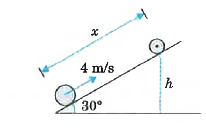 Now, `(3)/(4)mv^(2)=mghimpliesh=(3v^(2))/(4g)=(3xx(4)^(2))/(4xx10)=1.2m` x=2.4 m Hence option (a) is correct. |
|
| 44. |
A massless string is wrapped around a uniform solid cylinder of mass 30 kg and radius 0.20 m. One end of the string is attached to the cylinder and the free end is pulled tangentially by a force that maintains a constant tension of 3.0 N. Find a) the angular acceleration and b) the angular speed of the cylinder 2.0 s after the force is applied to the cylinder at rest. |
|
Answer» Solution :We know that `tau=Ialpha` F.r `=Ialpha""F.r=(mr^(2))/(2).ALPHA` `alpha=(2F)/(mr)=(2xx3)/(30xx0.2)=1rad//s^(2)` b) `omega_(2)-omega_(1)=alphat :.omega_(2)=alphat` angular SPEED after 2 sec, `omega_(2)=1xx2=2` rad/sec. |
|
| 45. |
Match Column-I with Column-II : {:("Column-I","Column-II"),("(1) Maximum value of g","(a) At Earth's center"),("(2) Minimum value of g","(b) At poles"),("(3) Zero value of g","(c) At equator"):} |
|
Answer» |
|
| 46. |
A slightly conicalwire of length l and radius r_(1) and r_(2)is stretchedby two forcesappliedparallel to length in oppositedirectionsand normal to end faces. If Y denotesthe Young.s modulus, then findthe elongationof the wire. |
Answer» SOLUTION : Consideran elementof length dx at distance x asshown in FIG. The radius of the section `r_(x) =r_(1)+((r_(2)-r_(1))/(l))x` The extensiion of the element `DL=(F(dx))/( A_(x)Y)=(Fdx)/( pi r_(x)^(2)Y)` Totalextension `Deltal=int_(0)^(l)(Fdx)/(pi[r_(1)+(r_(2)-r_(1))/(l)x]^(2)Y)=(FL)/(pi r_(1)r_(2)Y)` |
|
| 47. |
A baby cries on seeing a dog and the cry is detected at a distance of 3.0 m such that the intensity of sound at this distance is 10^(-2) W m^(-2) . Calculate the intensity of the baby's cryat a distance 6.0 m |
|
Answer» Solution :`I_(1)` is the intensity of sound detected at a distance 3.0 m and it is given as `10^(-2) W m^(-2) `. Let `I_(2)` be the intensity of sound detected at a distance 6.0 m . Then `r_(1) = 3.0 m , r_(2) = 6.0` m and since `I prop (1)/(r^(2))` the POWER output does not depend on the observer and depends on the BABY . therefore , `(I_(1))/(I_(2)) = (r_(2)^(2))/(r_(1)^(2)) implies I_(2) = I_(1) (r_(1)^(2))/(r_(2)^(2))` `I_(2) = 0.25 XX 10^(-2) W m^(-2)` |
|
| 48. |
In a closed room, heat transfer takes place by |
|
Answer» CONDUCTION |
|
| 49. |
When we see an object, the image formed on the retina is |
|
Answer» (A) (C ) and (D) |
|
| 50. |
The radius of a planet is R_1 and asatellite revolve round of in a circle of radius R_2 .The time period of revolution is T. The acceleration due to the gravitation of the planet at its surface is . |
|
Answer» SOLUTION :Orbital velocity of the satellite `V_0 =SQRT(G^(1)R_2)` where `g^1=g(R_1/R_2)^2` and angular velocity `OMEGA=V_0/R_2=sqrt(g^(1)/(R_2))=sqrt((g(R_1)^2)/(R_2^3))` But time period of revolution `T = (2PI)/omega= 2pi sqrt((R_2^3)/(gR_1^2))` (or) `T^(2)= 4pi^(2) (R_2^3)/(gR_1^2) ` (or ) `g = (4pi^2)/T^2 (R_2^3)/R_1^2` |
|


