

Saved Bookmarks
This section includes 7 InterviewSolutions, each offering curated multiple-choice questions to sharpen your Current Affairs knowledge and support exam preparation. Choose a topic below to get started.
| 1. |
Explain current transfer characteristics. |
|
Answer» Solution :This gives the variation of collector current `(I_(C)` with changes in base current `(I_(B))` at constant collector - emitter voltage `(V_(CE))`. It is SEEN that a SMALL `I_(C)` flows even when `I_(B)` is zero. This current is called the common emitter leakage current `(I_("CEO"))` , which is due to the flow of minority charge carriers. Forward current gain: (i) The ratio of the CHANGE in collector current `(DeltaI_(C))` to the change in base current `(DeltaI_(B))` at constant collector - emitter voltage `(V_(CE))` is called forward current gain `(beta)`. `Beta=((DeltaI_(C))/(DeltaI_(B)))_V_(CE)` (ii) It is value is very HIGH and it generally ranges from 50 to 200. It depends on the construction of the transistors and will be provided by the MANUFACTURER. 
|
|
| 2. |
A bismuth ball of 5 mm radius is placed in a magnetic field with an induction 2 xx 10^(-5)T. What is the magnotic moment of the ball? What is its direction? The magnetic susceptibility of bismuth is a chi_(m)=-1.76 xx 10^(-4). |
|
Answer» |
|
| 3. |
Describethe working principleof a moving coil galvanometer. Why is necessaryto use (i) a radial magnetic field and (ii) a cylinderical soft iron core in a galvanometer ? Write the expression for currentsensitivity of thegalvanometer . Can a galvanometer as such be used formeasuring the current ? Explain . |
|
Answer» Solution :A moving coilgalvanometer works on the principle that when a current carrying loopor coil is placed in the uniform magneticfield, it experience a torque. (i) Radial magnetic field, produced by clindrical poles of permanentmagnet ofgalvanometeris alwaysparallelto the planeof the coil. Torqueproducedin the coil of GALVANOMETER is given by, `tau = NIABsin THETA` (ii) Cylindricalsoftiron CORE, when placed insidethe core makes teh magneticfieldstrongerand radicalbetweenit and pole pieces. Irrespectiveof position of rotationof coil, magneticfield is alwaysparallel to the plane. Current sensitivity `= (phi)/(I)= (phi(NAB))/(Kphi) = (NAB)/(K)` No , Galvanometer cannot beused formeasuringcurrent as it is very sensitive instrument,even for small value of current it gives full SCALE deflection. Galvanometercan be used in seriesconnection for measuringcurrent, it ha large resistanceso, the value of current will not be accurately measured. |
|
| 4. |
To reduce de-Broglie wavelength of an electron from 10^(-10) m to0.5xx10^(-10) m,its energy should be … |
|
Answer» increased to 4 times `therefore K prop (1)/(lambda^(2))` `therefore (K_(2))/(K_(1))=((lambda_(1))/(lambda_(2)))^(2)=((10^(-10))/(0.5xx10^(-10)))^(2)=4` `therefore K_(2)=4K_(1)` |
|
| 5. |
The limiting friction between two bodies in contact is independent of |
|
Answer» Nature of SURFACES in contact |
|
| 6. |
A particle oscillates between the points x=40mm and x=160mm with an acceleration a =k(100-x),where k is a constant.The velocity of the particle is 8 m m/s when =100 m and is zero at both x=40 mm and x=160mm.Determine (a)the value of k (b) the velocity when x=120 mm. |
| Answer» SOLUTION :0.09`S^(-2)` (B)`PM`16.97 mm/s | |
| 7. |
A particle of mass 2mis dropped from a height 80 m above the ground. At the same time another particle of mass m is thrown vertically upwards from the ground with a speed of 40 m/s. If they collide head-on completely inelastically, the time taken for the combined mass to reach the ground, in units of second is: |
|
Answer» `((sqrt(112) - 2)/(3))` at COLLISION , `v_(A) = 20v_(B = -20` Velocity of combined mass = `(2m xx 20 - m xx 20)/(2m + m) = (20)/(3) m//s` Time taken by combined mass to REACH the ground Time = `((sqrt(112) - 2)/(3))`SEC. 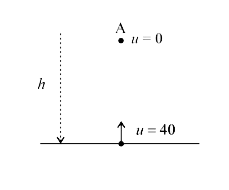
|
|
| 8. |
Two cities are 150 km apart. Electric power is sent from one city to another city through copper wires. The fall of potential per km is 8 volt and the average resistance per km is 0.5Omega. The power loss in the wire is |
|
Answer» 19.2 kW |
|
| 9. |
Two large glass containers of equal volume each hold 1 mole of gas. Container 1 is filled with hydrogen gas (2g/mol), and container 2 holds helium (4g/mol). If the pressure of the gas in container 1 equals the pressure of the gas in container 2, which of the following is true? |
|
Answer» The temperature of the GAS is container 1 is lower than the temperature of the gas is container 2. `v_(rms)=sqrt((3RT)/(M))`. Hydrogen has a smaller molar mass than does helium, so `v_(rms)` for hydrogen must be greater than `v_(rms)` for helium (because both samples are at the same T). |
|
| 10. |
The frequency changes by 10% as a sound source approaches a stationary observer with constant speed v_s. What would be the percentage change in frequency as the source recedes the observer with the same speed. Given that v_s lt v(v = speed of sound in air) |
|
Answer» 0.143 |
|
| 11. |
Even though electric current have both magnitude and direction,it is treated as a scalar quantity,Why? |
| Answer» SOLUTION :SINCE it does not OBEY the VECTOR ALGEBRA. | |
| 12. |
In S.H.M. the ratio of kinetic energy at mean position to the potential energy when the displacement is half of the amplitude is |
|
Answer» `(4)/(1)` At mean position, `y=0:.K.E.=(1)/(2)m omega^(2)a^(2)` At, `y=(a)/(2),P.E.=(1)/(2)m omega^(2)(a^(2))/(4)=(1)/(8)m omega^(2)a^(2)` `:.` RATIO `=((1//2)m omega^(2)a^(2))/((1//8)m omega^(2)a^(2))=("K.E. at mean position")/("PE at "a//2)=(4)/(1)` |
|
| 13. |
A bomb of mass 9 kg explodes into 2 pieces of mass 3 kg and 6 kg. The velocity of mass 3 kg is 1.6 m/s, the K.E. of mass 6 kg is: |
|
Answer» Solution :The bomb initially was at rest therefore Initial momentum of bomb = 0 Final momentum of SYSTEM =`m_1v_1 + m_2v_2` As there is no external FORCE `:.m_1v_1 + m_2v_2 = 0 implies 3 xx 1.6 + 6 xx v_2 = 0` Velocity of 6 kg mass, `v_2 = 0.8 m//s ("numerically")` Its kinetic energy `=1/2 m_2v_2^2 = 1/2 xx 6 xx (0.8)^2 = 1.92J` 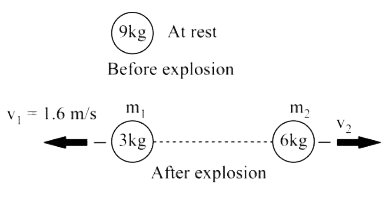
|
|
| 14. |
A body of mass 1 kg is executing S.H.M. given by x=6cos(100t+pi//4) cm, what is its maximum K.E. ? |
|
Answer» Solution :Here `""OMEGA=100` rad/s. `:.""` r = 6 CM = 0.06 m. Max K.E. `=(1)/(2)m omega^(2)r^(2)=(1)/(2)xx1xx(100)^(2)xx((6)/(100))^(2)` `=18` J. Hence CORRECT choiceis (a). |
|
| 15. |
(a) Ground wave propagation-Surface wave (b) Sky wave propagation-Antenna (c ) Space wave propagation-50 MHz (d) Skip distance-No reception |
|
Answer» |
|
| 16. |
The radii of circular orbits of two satellites A and B of the earth, are 4R and R, respectively. If the speed of satellite A is 3V, then the speed of satellite B will be : |
|
Answer» 12V `v=sqrt((GM_(e))/(R ))` `v prop (1)/(sqrt(R ))` `(V_(A))/(V_(B))=sqrt((R_(B))/(R_(A)))=sqrt((R )/(4R))=(1)/(2)` `(3V)/(V_(B))=(1)/(2)` `V_(B)=6V`. This correct CHOICE is (a). |
|
| 17. |
If two lenses of power 2D and 3D are kept in contact with each other, then focal length of the combination will be .......... cm. |
|
Answer» 5 `(P_1=2D,P_2=3D)` `THEREFORE` The focal length of combination `f=1/P=1/5=0.2=20` cm |
|
| 18. |
A bullet fired into a fixed target loses half of its velocity in penetrating 15 cm.How much further it will penetrate before coming to rest? |
|
Answer» 5 cm |
|
| 19. |
Calculate the number of half lives elapsed , at the endof which , the activity of a radioactive sample decrease by 90% . |
|
Answer» Solution : The change in activity with time follows the same LAW as that of number of radioactive atoms. `:.` Percentage of radioactive atoms left undecayed. 100 - 90% = 10% i.e., `N/N_(0) = 1/10 ` From `(N/N_0)=(1/2)^n` [where n = no . of half lives ELAPSED] `(1/2)^(n)=1/10" or ", 2^(n)=10` or n log 2 = log 10 or `n=1/(0.3010) = 3.3` Thus , at the end of 3.3 half lives, the activity (and hence the number of atoms ) WOULD have DECREASED by 90%. |
|
| 20. |
A body of mass 1 kg is attached to one end of a wire and rotated in a horizontal circle of diameter 40cm with constant speed of 2m/s What is the area of cross section of the wire if the stress developed in the wire is 5 xx 10^6 N/m^2 . |
|
Answer» Solution :`F = T = (mv^2)/r = (1 xx 4)/(0.2)= 20N` `STRESS = F//A THEREFORE A = F/(stress) = 20/(5 xx 10^6)` `4 xx 10^(-6) m^2 = 4mm^2` |
|
| 21. |
The electromagnetic waves do not transport |
| Answer» Answer :B | |
| 22. |
A hot air balloon is ascending straight up at a constant speed of 7.0 m/s. When the balloon is 12.0 m above the ground, a gun fires a pellet straight up from ground level with an initial speed of 30.0 m/s. Along the paths of the balloon and the same altitude at the same time. How far above ground level are these places ? |
|
Answer» `1.5 m//s^(2)` |
|
| 23. |
The ___________ a property of materials C, Si and Ge depends upon the energy gap between their conduction and valence bands. |
| Answer» SOLUTION :CONDUCTIVITY (or RESISTIVITY too) | |
| 24. |
In the exp of finding sp heat capacity of an unknown sphere (S_(2)) mass of the sphere and caloreter aro 1000m and 200gm respectively and sp heat capacity of calorimeter is equal to (1)/(2)cal//gm^(@)C The mass of liquid 9water) used is 900gm Initially both the water and the calorimeter were at room temp 20.0^(@)C while used is 900gm Initially both the water and the calorimeter were at room temp 20.0^(@)C while the sphere was at temp 800^(@)C initially If the steady state temp was found to be 40.0^(@)C estimate sp heat capacity of the unknown sphere (S_(2)) (use S_(water) = 1 cal//g^(@)C) Also fin the maximum permissible error in sp heat capacity of unknown sphere (S_(2)) mass end specific heats of sphere and calorimater are correctly known) . |
|
Answer» Solution :To DETERMINE the specitle heat CAPACITY of unkonw soild We USE`s_("SOLID")=(m_(1)s_(1)+m_(2)s_(2))/(m_(1))((0_(s)-0_(2))/(0_(1)-0_(s)))and" get "s_(solid)=1//2cal//g// .^(@)C` `((Deltas)/(s))_(max)=20Deltatheta((1)/(0_(s.s)-2_(2))+(1)/(0_(1)-0_(s s)))=2(0.1^(@)C)((1)/(40.0-20.0)+(1)/(80.0-40.0))=1.5%` . |
|
| 26. |
For which of the following stopping potential required is maximum ? |
| Answer» ANSWER :D | |
| 27. |
One extremely small and another extremely big square frames are coplanar and concentric with side length I and L respectively. (where L gt gt l ). Find mutual inductance of this system. |
|
Answer» |
|
| 28. |
Time taken by a 836 W heater to heat one litre of water from 10^@C to 40^@C is :- |
| Answer» Answer :C | |
| 30. |
The radionuclide ""^(11)C decays according to ""_(6)^(11)C to ""_(5)^(11)B + e^(+) + upsilon, T_(1//2) = 20.3 min The maximum energy of the emitted positron is 0.960 MeV. Given the mass values: m(""_6^11C) = 11.011434 u and m(""_6^11B) = 11.009305u. Calculate Q and compare it with the maximum energy of the positron emitted. |
|
Answer» Solution :The disintegration ENERGY, `Q = (m_C - m_B - 2m_c)c^2 = (m_C - m_B -2m_c) (931.5 c^2)/(c^2) MEV` `2m_c = 2 xx 0.0005486 = 0.0010972` `:. Q = {:(11.011434-),(11.0104022):}/(0.0010318 xx 931.5)""{:(11.009305 + ),(.0010972):}/(11.0104022)` SINCE the maximum energy of positron emitted is 0.960 MeV, the neutrino carries only NEGLIGIBLE energy. |
|
| 31. |
The equation of resultant wave due to the two waves is y' (x, t) |
|
Answer» `2ym (sinphi)[sin(kx - OMEGAT + PHI)]` `y_(2) = y_(m) sin(kx - omegat + phi)` Resultant is OBTAINED by superposition `y' = y_(1) + y_(2)` = `y_(m)[2sin(kx - omegat + (phi)/(2))cos((phi)/(2))]` |
|
| 32. |
An ionised H-molecule consists of an electron and two protons. The protons are separated by a small distance of the order of angstrom In the ground state |
|
Answer» the electron would not MOVE in circula orbits `rArr` Options (A) and (C) are correct. 
|
|
| 33. |
A wheel with 8 metallic spokes each 50 cm long is rotated with a speed of 120 rev/min in a plane normal to the horizontal component of the Earth's magnetic field. The Earth's magnetic field at the place is 0.4 G and the angle of dip is 60^(@). Calculate the emf induced between the axle and the rim of the wheel. How will the value of emf be affected if the number of spokes were increased ? |
|
Answer» Solution :As per question NUMBER of spokes in wheel n = 8, length of each spoke l = 50 cm = 0.50 m, angular speed `omega = 120rpm = (120)/60 rps = 2 rps = 4pi rad s^(-1)` earth.s magnetic field `B_(E) = 0.4G = 4.0 x 10^(-5)` T andangle of dip `delta = 60^(@)` As the wheel is rotated in a plane normal to the horizontal component `B_(H)` of the earth.s magnetic field, hence emf induced between the axle and the rim of the wheel `varepsilon 1/2B_(H)l^(2)omega = 1/2B_(E) COS delta l^(2)omega=1/2xx4.010^(-5)xxcos60^(@)xx(0.05)^(2)xx4pi = 3.14xx10^(-5)V` The value of emf REMAINS unaffected when there are 8 spokes in the wheel because all the spokes are connected in parallel. |
|
| 34. |
Two identical copper spheres are separated by 1m in vacuum. How many electrons would have to be removed from one sphere and added to the other so that they now attract each other with a force of 0.9N? |
|
Answer» `6.25 XX 10^15` |
|
| 35. |
The potential energy of a satellite of mass m revolving at height R above the surface of the earth where R= radius of earth is |
|
Answer» `-MGR` |
|
| 36. |
Instead of using two slits as in young.s experiment, if we use two separate but identical sodium lamps, which of the following occur a) uniform illumination is observed b) widely separate interference c) very bright maximum d) very minimum. |
|
Answer» a only |
|
| 37. |
Two idential pith balls , each of mass m and charge +q. are suspended from a point with threads of lengthl each. If in equiilbrium statetheta be the angle which each thread makes with vertical in equilibrium , find value of charge on each ball. |
|
Answer» Solution :The EQUILIBRIUM state is shown in following Forces ACTING on EITHER ball are (i)Weight mg in vertically downward direction. (ii)Coulombian force ` F= (1)/(4 pi in _0) . (Q^(2))/((AB)^(2)) = (1)/( 4 pi in _0).( q^(2))/(4 l ^(2) sin ^(2) theta)`in horizontal direction, and (iii)Tension in thread T. In equilibrium state ` T cos theta = mg ""...(i) ` and ` "" T sin theta =F= (q^(2))/( 4 pi in _0. 4 l^(2)sin ^(2) theta ) ""...(ii )` `rArr ""tan theta =( q^(2))/(4 pi in _0 . 4l^(2) sin ^(2) theta. mg) ` or ` ""q= 2l sin theta sqrt( 4 pi in_0 mg. tan theta ) ` ` (##U_LIK_SP_PHY_XII_C01_E10_007_S01.png" width="80%"> |
|
| 38. |
A 2V battery is connected across the points A and B as shown in the figure given below . Assuming that the resistance of each diode is zero in forward bias and infinity in reverse bias , the current supplied by the battery when its positive terminal is connected to A is |
|
Answer» 0.2 A `IMPLIES i=V/R=2/10=0.2A` |
|
| 39. |
Carbon, silicon and germanium along have four valence electron each. Their valence and conduction bands are separated by energy band gaps represented by (E_g)_C,(E_g)_(Si) and (E_s)_(Ge) respectively. Which one of the following relationship is true in their use: |
|
Answer» `(E_g)_Cgt(E_g)_(SI)` |
|
| 40. |
What is meant by power factor of an ac circuit? |
| Answer» Solution : Power FACTOR is the COSINE of the ANGLE between the VOLTAGE and the CURRENT in ACcircuit. | |
| 41. |
(a) Why are infrared waves often called heat waves? Explain. (b) What do you understand by the statement, "Electromagnetic waves transport momentum"? |
|
Answer» Solution :Stating the FORMULA CALCULATING r Reason for CALLING IF rays as heat rays Infraced rays are readily absorbed by the (water) molecules in most of the substance and hence INCREASES their thermal motion. (If the student just writes that " infrated ray produce HEATING effects " . award mark only ) |
|
| 42. |
There is a dust particle in a glass slab of thickness t and refractive index mu =1.5. When seen from one side of the slab, the dust particle appears at a distance 6 cm. From opposite side it appears at 4 cm. Find the thickness t of the glass slab. |
| Answer» SOLUTION :`15CM` | |
| 43. |
Consider a toroid with rectangular cross section, of inner radius a, outer radius be and height h, carrying n number of turns. Then the self-inductance of the toroidal coil when current I passing through the toroid is |
|
Answer» `(mu_(0)n^(2)h)/(2pi)In((b)/(a))` Magnetic field inside a rectangular toroid is given by `B=(mu_(0)nI)/(2pir)""......(i)` 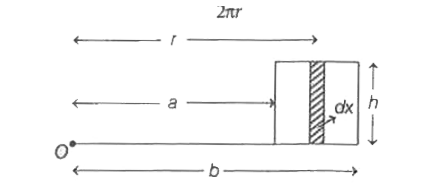 usind the INFINITESIMAL cross-sectinoal area element. `dx=hdr` `:.` Flux passing through the cross-section of toroid. `phi=intB.dx=int_(a)^(b)(mu_(0)nI)/(2pir).(hdr)` `phi=(mu_(0)nIh)/(2pi)int_(a)^(b)(1)/(r)dr` `impliesphi=(mu_(0)nhI)/(2pi)[logr]_(a)^(b)` `impliesphi=(mu_(0)nhI)/(2pi)(logb-loga)` `phi=(mu_(0)nhI)/(2pi)In((b)/(a))` Now, self inductance of rectangular toroid, `L=(nphi)/(I)` PUTTING the value of `phi` we get `L=(mu^(2)nh)/(2pi)In((b)/(a))` |
|
| 44. |
A man in an empty swimming pool has a telescope focused at 4 o'clock sun. When the swimming pool is filled with water, the man observes the setting sun through telescope. If sun rises and sets at 6 o'clock, then refractive index of water is : |
| Answer» Answer :A | |
| 45. |
Following figure shows cross-sections through three long conductors of the same length and material, with square cross-section of edge lengths as shown. Conductor B will fit snugly within conductor A , and conductor C will fit snugly within conductor B . Relationship between their end to end resistance is |
|
Answer» `R = R = R` |
|
| 46. |
In figure shown below, the time taken by the projectile to reach from A to B is t then, the distance AB is equal to |
|
Answer» `(UT)/(SQRT3)` |
|
| 47. |
(a) Find the energy in electron volts required to strip a calcium atom (Z=20) of its last electron, assuming the other 19 have been removed. How does this compare with the energy required to excite the K_(alpha) x-ray lines of Ca, which is about 3.7 keV? (b) Why there is a difference? |
| Answer» Solution :(a) 5.4 KEV, (B) because other ELECTRONS change the POTENTIAL | |
| 48. |
The current in a coil is changed from 5A to 10A in 10^(-2)s. Then, an emf of 50mV is induced in a coil near by it. Calculate mutual inductance of two coils. |
| Answer» Answer :A | |
| 49. |
The horizontal speed of a jet of water is 100 cm/sec and 50 cm^3 of water hits the plate each second. Assume that the water moves parallel to the plate after striking it. The force exerted on the stationary plate if it is held perpendicular to the jet of water is : |
| Answer» Answer :A | |