

Saved Bookmarks
This section includes 7 InterviewSolutions, each offering curated multiple-choice questions to sharpen your Current Affairs knowledge and support exam preparation. Choose a topic below to get started.
| 1. |
Two slits are made one millimetre apart and the screen is placed one metre away. What is the fringe separation when blue-green light of wavelength 500 nm is used ? |
|
Answer» Solution :Distance between two consecutive bright or two consecutive dark FRINGES is called "fringewidth". Its symbol is B. Its formula is : `beta=(lamdaD)/(d)` `:.beta=((500xx10^(-9))(1))/((1xx10^(-3)))` `:.beta=5xx10^(-4)m` Two SLITS are made 1.33 mm apart and the screen isplaced 1.33m away. What is the FRINGE seperation when blue-green light of wavelength 630 nm is used ? |
|
| 2. |
What isment by magnetic declination ? |
| Answer» Solution :The ANGLE between the GEOGRAPHIC MERIDIAN and MAGNETIC meridian at that place | |
| 3. |
In a CE transistor amplifier, the audio signal voltage across the collector resistance of 2kOmega is 2V. If the base resistance is 1kOmega and the current amplification of the transistor is 100, the input signal voltage is ……….. |
|
Answer» 0.1 V Output voltage `V_(o)=I_(c )R_(c )` `therefore I_(c )=(V_(o))/(R_(c ))=(2)/(2xx10^(3))=10^(-3)A=1mA` `BETA=(I_(c ))/(I_(B)) rArr I_(B)=(I_(c ))/(beta)=(10^(-3))/(100)=10^(-5)A` INPUT voltage `V_(i)=I_(B)R_(B)=10^(-5)xx1xx10^(3)=10^(-2)V` `therefore V_(i)=10xx10^(-3)V=10mV` |
|
| 4. |
Explain the elementaryidea of an oscillatorwith the help of blockdiagram . |
|
Answer» SOLUTION :Oscillator : An oscillatoris an electronicdevice which generatesan AC signal from a DC source.Oscillatorsare used in radio /TVreceiverset, radio/TV transmitters,RADAR, smartphones and microwavesovens. No inout is applied to the oscillator,yet an output is obtained from it. An oscillator requiresan AMPLIFIER and a feeback networkwith frequencydetermining components. when a part of the outputof an amplifier is coupled to the input of theamplifier, it is calledfeedback. When the feedbacksampleis out ofphase with theinput, it is callednegative feedback.When the feedback sampleis in phasewith theinput, it is calledpositive feedback. For an oscillator, a positivefeedback is required. The block diagram of oscillatoris shownbelow : 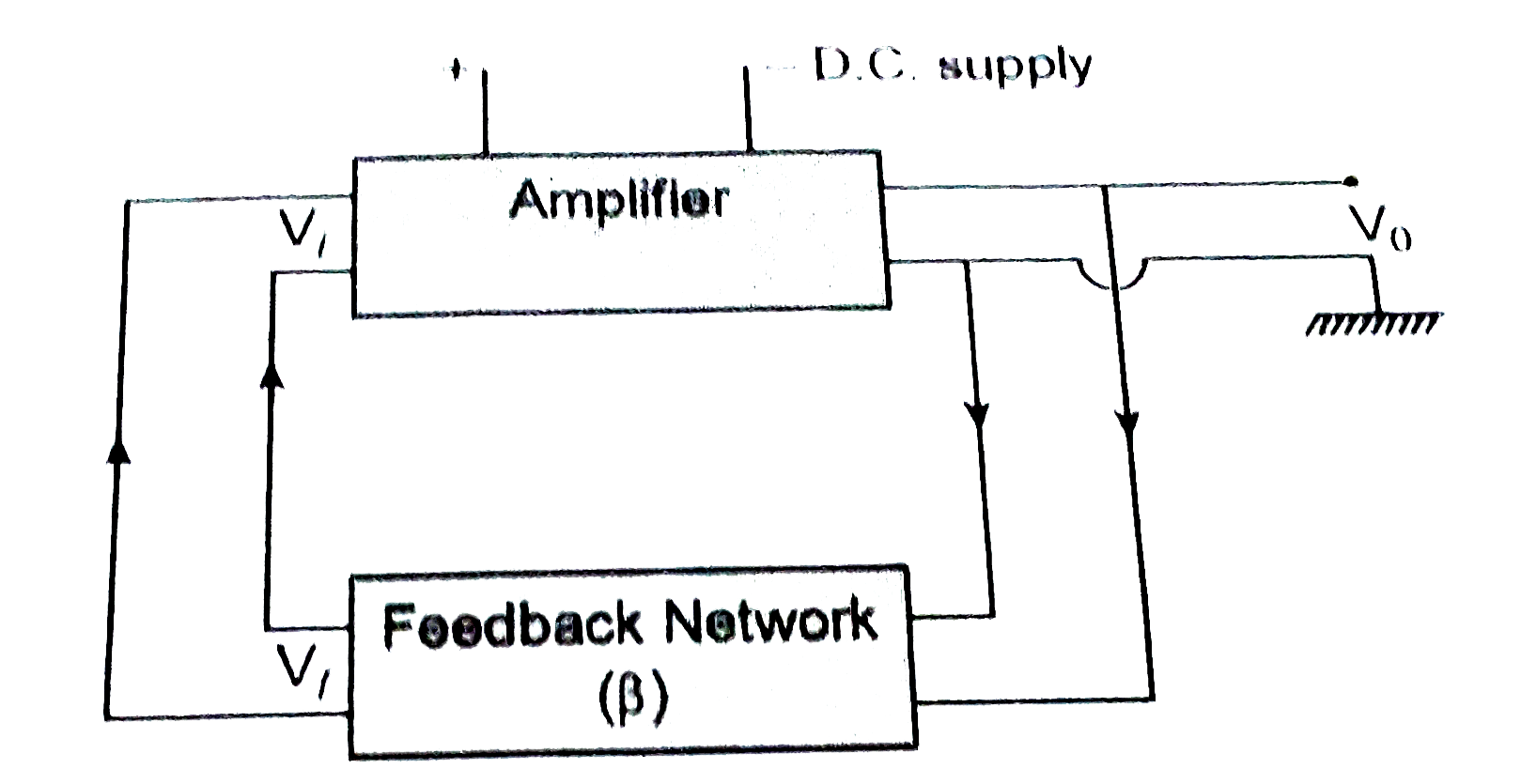 The VOLTAGE gain of a complete system is givenby `A_(f)= (A)/(1- A beta)` Where `A_(f)` is the voltagegain withfeedback, A isvoltagegain withoutfeedback and `beta` is the feedback factor. If for some FREQUENCY `Abeta = 1`, then the systemgain becomes `oo` and the circuit beginsto oscillate at that frequency. This condition`(Abeta = 1)` is called the Barkhausen criterionfor sustainedoscillations. The frequencyof oscillations depends on the LC or RC combinations used in a feedbacknetwork. When the power supply connectedto the oscillator is turned ON,electrical noise of a widerange of a frequenciesisgeneratedin the circuit, butthe condition`Abeta =1` is satisfiedonly for a particularfrequencyand the oscillatorat that frequency . |
|
| 5. |
The self inductance L of a solenoid depends on the number of turns per unit length 'n' as |
| Answer» Answer :B | |
| 6. |
Where was the lake Wentworth? |
|
Answer» in NEW Hampshire |
|
| 7. |
The sky wave propagation is suitable for radiowave of frequency : |
|
Answer» UPTO `2MHZ` |
|
| 8. |
One metallic plate, oscillates perpendicular to magnetic field between two flat unlike magnetic poles,____ |
|
Answer» there is no effect on oscillations of PLATE. |
|
| 9. |
A steady electric current is flowing through a cylindrical conductor i) The electric field at the axis of conductor due to the current is zero ii) The magnetic field at the axis of the conductor is zero iii) The Electric field in the vicinity of the conductor is zero iv) The magnetic field in the vicinity of the conductor is zero |
|
Answer» Only i, II are true |
|
| 10. |
What happens to the rms speed of the molecules in a sample of helium gas if the temperature is increased from -73^(@)C to 527^(@)C? |
| Answer» Solution :When we use the ideal Gas law or the formulas for `v_(rms)`, we have to use ABSOLUTE temperatures-that is, temperatures expressed in kelvins. The conversion between degrees celsius and kelvins is `T_(""^(@)C)+273=T,` so `-73^(@)C=200K and 527^(@)C=800K`. therefore, the absolute temperature of the gas is increased by a factor off 4 (from 200 K to 800 K). since `v_(rms)` is proportional to `sqrt(T)`, if T INCREASES by a factor of 4, then `v_(rms)` increases by a factor of `sqrt(4)=2`. | |
| 11. |
A closed organ pipe and an open pipe of same length produce 4 beats when they are set into vibrations simultaneously. If the length of each of them were twice their initial lengths, the number of beats produced will be________ |
|
Answer» |
|
| 12. |
A long solenoid of radius 2R contains another coaxial solenoid of radius R. The coils have the same number of turns per unit length and initially both carry zero current. At time, t=0, current start increasing linearly with time in both solenoids. At any moment the current flowing in the inner coil is twice as large as that in the outer one and their directions are same. A charged particle, initially at rest between the two solenoids, start moving along a circular trajectory due to increasing current in the solenoid as shown in the figure What is the radius of the circle ? (Assume magnetic field due to each solenoid remains uniform over its cross-section.) |
|
Answer» `sqrt(2)R` Flux ENCLOSED by particle's trajectory of radius `r` is `phi=piR^(2)xx2B+pixxr^(2)xxB=(2R^(2)+r^(2))pimu_(0)nkt` `Exx2pi r=(2R^(2)+r^(2))pi mu_(0)nk` `(mv^(2))/(r )=qvB` `V=(qE)/(m)t` |
|
| 13. |
In a prison of small angle A, a beam of light is incident on its surface at an angle of incidence I and leaves the opposite surface of it is angle of 90^(@) with the surface. If prison material has refractive index of m then the value of angle of incidence will be: |
|
Answer» A/m |
|
| 14. |
A convex lens of focal length 100 cm and a concave lens of focal length 10 cm are placed coaxialiy at a separation of 90 cm. If a parallel beam of light is incident on convex lens, then after passing through the two lenses the beam |
|
Answer» Converges |
|
| 15. |
What are magnetic elements ? |
|
Answer» Solution :These are the QUANTITIES whose definition at a PLACE leads us, to a complete KNOWLEDGE of earths . Megnetic field at that place, these are : (I) Declination (II) Dip or inclination (III) The horizonal component of earth.s magnetic field. |
|
| 16. |
Name an appropriate communcation channel needed to send a signal of band width 100 kHz over a distance of 8 km. |
| Answer» SOLUTION :GROUND WAVE PROPAGATION [`i.e.` STANDARD AM propagation]. | |
| 17. |
In a photoelectric effect experiment , the maximum kinetic energy of the ejected photoelectrons is measured for various wavelength of the incident light. Figure shows a graph of this maximum kinetic energy K_(max) as a function of the wavelength lamda of the light falling on the surface of the metal. Which of the following statement/i is/ are correct? |
|
Answer» Threshold frequency for the metal is `1.2xx10^(15)m` Threshold frequncy, `v_0=(c)/(lamda_0)=(3xx10^(8))/(250xx10^(-9))HZ=1.2xx10^(15)Hz` Work function of the metal, `W=(hc)/(lamda_0)=(1242eVnm)/(250)=4.068eV` `(hc)/(lamda)=(hc)/(lamda_0)+K_(MAX)` `K_(max)=(1242eVnm)/(100nm)-4.968eV` `=7.432eVapprox7.4eV` Photoelectric effect takes placeonly for light of wavelength less than 250 nm, whereas `lamda_(red)approx700nm`. |
|
| 18. |
A steel cable of diameter 3cm is kept under a tension of 10KN. The densityof steel is7.8 g// cm^(3).With what speed would transverse waves propagate along the cable ? |
|
Answer» Solution :`T= 10 kN= 10^(4) N` `D = 3cm , r= (D)/(2) = (3)/(2)CM= (3)/(2) xx10^(-2) cm ,` `A =pir^(2) = (22)/( 7) xx[ (3)/(2) xx10^(-2)] ^(2)` `:. A= (22)/( 7)xx(9)/(4) xx10^(-4) m^(2) , RHO = 7.8 G //cm^(3) ` `= 7.8 xx 10^(3) kg//m^(3)` ` V= sqrt((T)/( mu ))=sqrt(( T )/( A_(rho)))` `= sqrt((10^(4))/(((22)/(7)) xx((9)/(4)) xx10^(-4) xx7.8xx 10^(3)))` ` :. v=42.6 m //s ` |
|
| 19. |
Describe schematically the equipotential surfaces corresponding to (a) a constant electric field in the z-direction, (b) a field that uniformly increases in magnitude but remains in a constant (say, z) direction, (c) a single positive charge at the origin, and (d) a uniform grid consisting of long equally spaced parallel charged wires in a plane. |
|
Answer» Solution :(a) Planes parallel to x-y plane. (b) Same as in (a), EXCEPT that planes differing by a fixed potential get closer as field INCREASES. (c) CONCENTRIC spheres centred at the origin. (d) A periodically varying SHAPE near the GRID which gradually reaches the shape of planes parallel to the grid at far distances. |
|
| 20. |
Two electric charges of 9mu C and - 3mu c are placed 0.16 m apart in air. There are two points A and B on the line joining the two charges at distances of (i) 0.04 m from-3muC and in between the charges and (ii) 0.08m from - 3mu C and outside the two charges. The potentials at A and B |
|
Answer» `0V,0V` |
|
| 21. |
What efforts can help Mukesh materialise his dream of becoming a car driver? |
|
Answer» HARD work |
|
| 22. |
What we call the vertical plane passing through the axis of a freely suspended needle. |
| Answer» SOLUTION :MAGNETIC MERIDIAN | |
| 23. |
If the earth were to suddenly shrink to I//n of its present radius without any change in its mass the duration of the new day will be |
|
Answer» `(24)/(n)H` `(2)/(5)MR^(2)((2pi)/(24))=(2)/(5)(MR^(2))/(n^(2))((2pi)/(T))` `T=(24)/(n^(2))` |
|
| 24. |
A jet plane of wing span 20 m is travelling towards west at a speed of 400 m s^(-1). If the earth's total magnetic field is 4 xx 10^(-4) T and the dip angle is 30^(@), at that place, the voltage difference developed across the ends of the wing is |
|
Answer» Solution :Given, Speed (v) `= 400 ms^(-1)` MAGNETIC FIELD (B) `= 4xx10^(-4)T` Dip angle `theta = 30^(@)` We know that, Voltage difference = Blv sin `theta` `= 4xx10^(-4)xx20xx400xx sin 30^(@)` `= 32000xx10^(-4)xx sin 30` `= 32000xx10^(-4)xx(1)/(2)=1.6 V` |
|
| 25. |
In the following common - emitter configuration an n-p-n transistor with beta=100 is used. The output voltage of the amplifier will be |
| Answer» Solution :`A_(V)=(DeltaV_(CE))/(DeltaV_(BE))=beta(R_(L))/(R_(i))` | |
| 26. |
What is the meaning of homage? |
|
Answer» To disrespect |
|
| 27. |
What is the minimum distance between an object and its image formed by a concave mirror? |
|
Answer» |
|
| 28. |
The amplitude of the magnetic field part of a harmonic electromagnetic wave in vacuum is B_(0) = 510 nT. What is the amplitude of the electric field part of the wave? |
| Answer» SOLUTION :`153 N//C` | |
| 29. |
A metal sphere with a charge Q is surrounded by an uncharged concentric thin spherical shell. The potential difference between them is V. If the shell is now given an additional charge Q, what is the new potential difference between them? |
| Answer» SOLUTION :Potential difference will remain at V because additional charge given to SPHERE raises the potential of both SPHERICAL shell and the metal sphere by an EQUAL amount. | |
| 30. |
'A system displaying a hysteresis loop such as a ferromagnet, is a device for storing memory.' Explain the meaning of this statement. |
| Answer» Solution :MAGNETISATION of a ferromagnet for a particular field depends both on the field and also on history of magnetisation (i.e., how many cycles of magnetisation it has gone through etc.). In other words, the value of magnetisation is a record or .MEMORY. of its cycles of magnetisation If information BITS can be made to correspond to these cycles, the SYSTEM displaying such a hysteresis loop can act as a device for STORING information. | |
| 31. |
An electron is revolving around the nucleus with a constant speed of 2.2xx10^(6)ms^(-1). Find the de-Broglie wavelength associated with it. |
|
Answer» Solution :Here `v=2.2xx10^(6)ms^(-1)`, mass of electron `m=9.1xx10^(-31)kg and h=6.63xx10^(-34)JS` `therefore`de-Broglie wavelength `lamda=(h)/(MV)=(6.63xx10^(-34))/(9.1xx10^(-31)xx2.2xx10^(6))=3.31xx10^(-10)m=3.31` Å |
|
| 32. |
A driver in a stationary car horns which produces sound waves having frequency 2000 Hz. The waves are directed normally towards a reflecting wall. If the wall approaches the car with a velocity u = 3.3 m/s. The change in the frequency of sound after reflection from the wall is x%. Then x |
|
Answer» |
|
| 33. |
What was the difficulty in established the wave theory of light and who explained it ? |
|
Answer» SOLUTION :The only major difficulty in established the wave theory of light was that since that a wave required a medium for its PROPAGATION how could light waves propagates through vacuum ? Maxwell had developed a set of equations describing the laws of electricity and magnetism and USING these equations he derived the wave equation from which he predicted the existence of electromagnetic waves. From the wave equation, Maxwell calculate the speed of electromagnetic waves in free space and he found that the theoretical value was very close to the measured value of speed of light. From this he propounded that light must be an electromagnetic wave. Thus, according to Maxwell, light waves are associated with changing electric and MAGNETIC fields. Changing electric FIELD produces a time and space varying magnetic field and a changing magnetic field produces a time varying electric field. This changing electric and magnetic fields result in the propagation of electromagnetic waves even in vacuum. |
|
| 34. |
A thin disc of radius R and mass M has charge q uniformly distributed on it. It rotates with angualr velocity omega. The ratio of magnetic moment and angular momentum for the disc is |
|
Answer» `Q/(2M)` |
|
| 35. |
If the magnitude of electric field at a distance x on axial line and at a distance y on equatorial line on a given dipole are equal, then |
| Answer» ANSWER :D | |
| 36. |
What is the (a)Momentum (b)speed ,and (c )de-Broglie wavelength of an electron with kinetic energy of 120 eV. |
|
Answer» Solution :Kinetic ENERGY , `K=120 eV=120xx1.6xx10^(-19)J` `=1.92xx10^(-17)J` `=1.92xx10^(-17)J` `h=6.63xx10^(-34)Js` `m=9.1xx10^(-31)Kg` (a)Momentum of electron, `p=sqrt(2mK)` `therefore p=sqrt(2xx9.1xx10^(-31)xx1.92xx10^(-17))` `therefore p=sqrt(34.944xx10^(-48))` `therefore p=5.91xx10^(-24) kgms^(-1)` (B)Speed of electron, `v=(p)/(m)=(5.91xx10^(-24))/(9.1xx10^(-31))` `therefore v=0.649xx10^(7)` `therefore v~~6.5xx10^(6)m//s` (c )de-Broglie wavelength, `LAMBDA=(h)/(p)` `therefore lambda=(6.63xx10^(-34))/(5.91xx10^(-24))` `therefore lambda=1.121xx10^(-10)m` `therefore lambda=0.1121 nm` |
|
| 37. |
The unit of magnetic flu xxdensity is ................ |
| Answer» SOLUTION :WEBER `"METRE"^(2)` (or ) TESLA | |
| 38. |
Give a classification of semiconductors and write examples of each. |
|
Answer» Solution :Semiconductors are in the original element and compound. (i) Elemental semiconductors : Si and Ge (ii) Compound semiconductors : Examples are, (A) INORGANIC : CDS, GaAs, CdSe, InP etc. (B) ORGANIC : anthracene, doped pthalocyanines etc. (C ) Organic polymers : polypyrrole, polyaniline, polythiophene, etc. Most of the currently available semiconductor devices are based on elemental semiconductors Si or Ge and compound inorganic semiconductors. After 1990, a few semiconductor devices using organic semiconductors and semiconducting polymers have been developed signalling the birth of a futuristic technology of polymer electronics and MOLECULAR - electronics. |
|
| 39. |
Two point charges of 6 nC and 12 nC are placed at the corners of B and C of an equilateral triangle ABC of side 0.03 m . Calculate the magnitude of the resultant electric intensity at the vertex A of triangle. |
Answer» Solution : `E=(1)/(4piepsilon_(0))(q)/(d^(2))or(9xx10^(9))(q)/(d^(2))` `E=6xx10^(4)NC^(-1)` and `E_(2)=12XX10^(4)NC^(-1)` `E=sqrt(E_(1)^(2)+E_(2)^(2)+2E_(1)E_(2)costheta)`, `theta=60^(@)` `E=15.87xx10^(4)NC^(-1)` or `6sqrt(7)xx10^(4)NC^(-1)` |
|
| 40. |
Where was Saheb employed? |
|
Answer» At a tea STALL in Seemapuri |
|
| 41. |
Electric field due to dipole at large distance ( r) falls off as…….. |
|
Answer» `1/r^2` |
|
| 42. |
If the intensity of light falling on a metal plate is doubled, what will be the effect on photocurrent and maximum kinetic energy of emitted photoelectrons ? |
| Answer» SOLUTION :As photocurrent is proportional to INTENSITY of incident light, the photocurrent will be doubled, but the maximum kinetic ENERGY of EMITTED photoelectrons does not depend upon the intensity of incident light, HENCE the maximum kinetic energy remains unchanged. | |
| 43. |
A narrow beam of unpolarised light of intensity I_(0) is incident on a polaroid P_(1). The light transmitted by it is then incident on a second polaroid P_(2) with its pass axis making an angle of 60^(@) to the pass axis of P_(1). Find intensity of light transmitted by P_(2). |
|
Answer» Solution :According to Malus' Law `I=I_(0)cos^(2) theta` `I=((I_(0))/2)cos^(2) theta` where `I_(0)` is the INTENSITY of UNPOLARIZED light. `theta=60^(@)C` (given) `I=(I_(0))/2cos^(2) 60^(@)=1/2=(I_(0))/2xx(1/2)^(2)=(I_(0))/8` |
|
| 44. |
Microwave oven consumes less power due to |
|
Answer» small frequency ofradiation |
|
| 45. |
In a single-slit diffraction experiment if the slit width is doubled then intensity of central fringe increases to ____the original intensity. |
|
Answer» |
|
| 46. |
The Bohr model for the H-atom relies on the Coulomb's law of electrostatics. Coulomb's law has not directly been verified for very short distances of the order of angstroms. Supposing Coulomb's law between two opposite charge +q_(1),-q_(2) is modified to|F|=(q_(2)q_(1))/((4pi epsi_(0)))(1)/(r^(2)),r ge R_(0) =(q_(1)q_(2))/(4pi epsi_(0))(1)/(R_(0)^(2))((R_(0))/(r))^(e),r lt R_(0) Calculate in such a case, the ground state energy of a H-atom if epsi=0.1 R_(0)=1Å |
|
Answer» Solution :Here for very small DISTANCE `r le R_(0)` (where `R_(0)=iÅ)` in the modified FORMAT of Coulomb.s law, Taking `epsi=2+delta` `F=(q_(1)q_(2))/(4pi epsi_(0)R_(0)^(2))((R_(0))/(r))^(2+delta).....(1)` `=(ke^(2))/(R_(0)^(2))xxR_(0)^(2)xx(R_(0)^(delta))/(r^(2+6)) ( :.k=(1)/(4pi epsi_(0)) and q_(1)=q_(2)=e)` `:.F=ke^(2)xx(R_(0)^(delta))/(r^(2+delta))....(2)` `=9xx10^(9)xx(1.6xx10^(-19))^(2)xx(R_(0)^(delta))/(r^(2+delta))` `:.F=(2.304xx10^(-28))xx (R_(0)^(delta))/(r^(r+delta))......(3)` Assuming forthe sake of simplicity. `3=3.304xx10^(-28)Nm^(2)=f...(4)` `F=fxx(R_(0)^(delta))/(r^(2+delta))....(5)` `:. (mv^(2))/(r)=fxx(R_(0)^(delta))/(r^(+delta)) ( :.` F is centripetal force) `:.v^(2)=(f)/(m)xx((R_(0)^(delta))/(r^(delta+1)))` `:.v=((R_(0)^(delta))/(m))^(1//2)xx(1)/(r^(((delta+1)/(2)))).....(6)` According to Bohr.s first postulate, for n=1 `mvr=(h)/(2PI)` `r=(h)/(2pi mv).....(7)` `:.r=(h)/(2pim)xx((m)/(fR_(0)^(delta)))^(1//2)xxr^(((delta+1)/(2)))` Multiplying by `r^(-1)` on both the sides, `1=(h)/(2pim)xx((m)/(fR_(0)^(delta)))^(1//2)xxr^(((delta+1)/(2)))` `r^(((delta+1)/(2)))=((2pi m)/(h))xx((fR_(0)^(delta))/(fR_(0)^(delta)))^(1//2)` `r^(((delta+1)/(2)))=((4pi^(2)m^(2))/(h^(2))xx(fR_(0)^(delta))/(m))^(1//2)` `r^(((delta+1)/(2)))=((4pi^(2)mfR_(0)^(delta))/(h^(2)))^(1//2)` Taking power `((2)/(delta-1))` on both the sides, `r=((4pi^(2)mfR_(0)^(delta))/(h^(2)))^(1//delta-1)` `:. r=((h^(2))/(4pi^(2)mfR_(0)^(delta)))^(1//delta-1)....(8)` Now `in =2+delta` (as PER equation (1)) `:.0.1=2+delta ( :.`From statement `epsi=0.1`) `:.delta=-1.9....(9)` `:. r=((h^(2))/(4pi^(2)mfR_(0)^(delta)))^(1//delta-1)` `:. r=((h^(2))/(4pi^(2)mfR_(0)^(delta)))^(1//2.9)` By placing respective values, new orbital radius of electron in the ground state of H-atom, `r={((6.625xx10^(-34))^(2))/(4xx(3.14)^(2)xx9.1xx10^(-31)xx2.304xx10^(-28xx(1xx10^(-10))^(-1.9)))}` `:.r{((6.625)^(2))/(4xx(3.14)^(2)xx9.1xx2.304xx10^((-68+31+28-19)))}^(1//2.9)` `:.r=(5.308xx10^(-2)xx10^(-28))^(1//2.9)` `:.r=(5.308xx10^(-30))^(1//2.9)` `:.r=8.53xx10^(-11)m` `:.r=0.8053xx10^(-10)m` `:.r=0.8053Å` Above value is smaller than `1Å` Since above orbital radius in the ground state, is `r=r_(1)=8.053xx10^(-11)m...(10)` Now taking `r=r_(1) and v=v_(1)` in equation (7), `v_(1)=(h)/(2pi mr_(1))` `=(6.625xx10^(-34))/(2xx3.14xx9.1xx10^(-31)xx8.053xx10^(-11))` `=1.439xx10^(-2)xx10^(-34+31+11)` `:.v_(1)=1.439xx10^(6)m//s` `rArr` Kinetic energy, `K_(1)=(1)/(2)mv_(1)^(2)` `=(1)/(2)xx9.1xx10^(-31)xx(1.439xx10^(6))^(2)` `:.K_(1)=9.422xx10^(-19)J` `:.K_(1)=(9.422xx10^(-19))/(1.6xx10^(-19))=5.889eV` Since,in H-atom electron and proton are separated by `R_(0)=1Å`, their electrostatic potential energy is, `U_(0)=k(q_(1)q_(2))/(R_(0))k((e)-(e))/(R_(0))` `:.U_(0)=-(ke^(2))/(R_(0))=-(f)/(R_(0))` `:.U_(0)=-(2.304xx10^(-28))/(1xx10^(-10))=-2.304xx10^(-18)J` `:.U_(0)=-(2.304xx10^(-18))/(1.6xx10^(-19))eV` `:.U_(0)=-14.4eV` Now, in the process when distance between electron and proton in H-atom decreases from `R_(0)=1Å r_(1)=0.8053Å`, if additional potential energy sotred is U. then. `U.=int dU=int (-F)dr ( :. F=-(dU)/(dr))` `:. U.= int-kq_(1)q_(2)(R_(0)^(delta))/(r^(2+delta))dr` (From equation (3)) `:.U. int -k(e)(-e)(R_(0)^(delta))/(r^(2+delta))dr` `=ke^(2)R_(0)^(delta)int_(R_(0))^(r) r^(-2-delta)dr` `=fR_(0)^(delta){(r^(-1-delta))/(-1-delta)}_(R_(0))^(r)` `-(fR_(0)^(delta))/(1+delta){(1)/(r^(1+delta))}_(R_(0))^(r)` `=-(2.304xx10^(-28)xx(10^(-10))^(-1.9))/(1-1.9){(1)/(r^(1-1.9))-(1)/(R_(0)^(1-1.9))}` `=(2.304xx10^(-28)xx10^(19))/(0.9)(r^(0.9-R_(0)^(0.9))` `=2.56xx10^(-9){(0.8053xx10^(-10))^(0.9)-(1xx10^(-10))^(0.9)}` `=2.56xx10^(-9)xx10^(-9){(0.8053)^(0.9)-1}` `=2.56xx10^(-18){0.8229-1}` `=2.56xx10^(-18)(0.1771)` `=0.4534xx10^(-18)J` `:.U.=-(0.4534xx10^(-18))/(1.6xx10^(-19))eV` `:.U.=-2.834eV` `rArr U_(1).=U_(0)+U.=(-14.4)+(-2.834)` `:.U_(1)=-17.234eV` Now required total energy of electron in the FINAL state, `E_(f)=K_(1)+U_(1)` `=5.889xx+(-17.234)` `:.E_(f)=-11.345 eV` |
|
| 47. |
P-type semi-conductor is |
|
Answer» GERMANIUM doped witharsenic |
|
| 49. |
Many of the applications of capacitors depend on their ability to store energy. : In a charged capacitor energy is stored in the |
|
Answer» POSITIVELY CHARGED plate |
|