

Saved Bookmarks
This section includes 7 InterviewSolutions, each offering curated multiple-choice questions to sharpen your Current Affairs knowledge and support exam preparation. Choose a topic below to get started.
| 1. |
The de-Broglie wavelength of neutrons in thermal equilibrium is : |
|
Answer» `(30.8)/(sqrtT)Å` |
|
| 2. |
Two insulated charged copper spheres A and B have their centres separated by a distance of 50 cm. What is the mutual force of electrostatic repulsion if the charge on each 6.5xx10^(-7) C? The radii of A and B are negligible compared to the distance of separation. |
|
Answer» SOLUTION :(a) `1.5 xx10^(2)` N (B) 0.24 N |
|
| 3. |
In anastromical telescope , if the focal lengths of the objective and the eyepiece are f_o and f_e respectively , then the magnification of this instrument is almost |
|
Answer» `(f_(o)+f_(E))` |
|
| 4. |
A projectile is thrown at an angle of 30^(@) with a velocity of 10m/s. the change in velocity during the time interval in which it reaches the highest point is |
|
Answer» 10 m/s |
|
| 5. |
Consider a two -input AND gate of figure. Out of the four entries for the truth. Tablegiven here, the correct ones are |
|
Answer» All |
|
| 6. |
If the above needle is taken to the pole and the magnetic equator have it will align ? |
| Answer» Solution :At the pole, DIP is `90^@` and therefore the dip needle stands vertical . At the equator , dip is zero Here the needle stands HORIZONTAL. | |
| 7. |
The two lenses of a compound microscope are of focal lengths 2 cm and 5 cm. If an object is placed at a distance of 2.1 cm from the objective of focal length 2 cm the final image forms at the least distance of distinct vision of a normal eye. Find the distance between the objective and eyepiece |
|
Answer» 46.17 cm |
|
| 8. |
A uniformly charged conducting sphere of 2.4 m diameter has a surface charge density of 80xx10^(-6)cm^(-2) a. Find the charge on the sphere. b. What is the total electric flux leaving the surface of the sphere? |
|
Answer» SOLUTION :(a)Diameter of the SPHERE ,d =2.4m Radius of the sphere , r= 1.2m Surface charge density, `sigma=80.0muC//m^(2)=80xx10^(-6)C//m^(2)` Total charge on the surface of the sphere. Q= Charge density `XX` Surface area `=sigmaxx4pir^(2)` `=80xx10^(-6)xx4xx3.14xx(1.2)^(2)` `=1.447xx10^(-3)C` Therefore , the charge on the surface is `1.447xx10^(-3)C`. (B)Total electric flux `(phi_("total"))` leaving out the surface of a sphere containing net charge Q is given by the relation , `phi_("Total")=(Q)/(epsilon_(0))` where , `epsilon_(0)=`Permittivity of free space `=8.854xx10^(-12)N^(-1)C^(2)m^(-2)` `Q=1.447xx10^(-3)C` `phi_("Total")=(1.44xx10^(-3))/(8.854xx10^(-12))` `=1.63xx10^(8)NC^(-1)m^(2)` Therefore , the total electric flux leaving the surface of the sphere is `1.63xx10^(8)NC^(-1)m^(2)`. |
|
| 9. |
The electric and magnetic fields of an electromagnetic wave are: |
|
Answer» in OPPOSITE PHASE and PERPENDICULAR to each other |
|
| 10. |
निम्नलिखित संख्याओं का दशमलव रूप में व्यक्त कीजिए : 1/9 |
|
Answer» `0.bar3` |
|
| 11. |
A uniform disc of mass m and radius r rotates about frictionless axle passing through its centre and perpendicular to its plane. A chord is wound over the rim of the disc. A uniform force F is applied to the other end of chord. The tangential acceleration is proportional to : |
|
Answer» `R^(1)` `alpha=(Fr)/((1)/(2)Mr^(2))=(2F)/(r.M)` `r.alpha=a=(2F)/(M)` = CONSTANT. |
|
| 12. |
A double slit experiment is performed with light of wavelength 500nm. A thin film of thickness 2mu m and refractive index 1.5 is introduced in the path of the upper beam. The location of the central maximum will |
|
Answer» remain unshifted |
|
| 13. |
Assertion : When a sphere is rolls on a horizontal table it slows down and eventually stops. Reason : When the sphere rolls on the table, both the sphere and the surface deform near the contact. As a result, the normal force does not pass through the centre and provide an angular declaration. |
|
Answer» Assertionis CORRECT, reason is correct, reason is a correct explanation for ASSERTION. |
|
| 14. |
A particle moving with a uniform acceleration 24m and 64m in the first two consecutive interval of 4 seconds each . It's initial velocity is |
|
Answer» `1m/s` |
|
| 15. |
For spheres each of mass M and radius R are placed with their centers on the four corners A,B,C and D of a square of side b. The spheres A and B are hollow and C and D are solids. The moment of inertia of the system about side AD of square is |
|
Answer» `8/3MR^2+2Mb^2` |
|
| 16. |
Using the tabular values of atomic masses, find the threshold kinetic energy of an alpha paricles required to acitivate the nuclear reaction Li^(7)(alpha, n)B^(10). What is the velocity of the B^(10) nucleus in this case? |
|
Answer» Solution :The `Q of Li^(7) (alpha,n)B^(10)` was calculated in problem 266(c ). It is `Q= 2.79MeV` Then the threshold energy of `alpha`-particle is `T_(th)=(1+(m_(alpha))/(m_Li))|Q|=(1+(4)/(7))2.79= 4.38MeV` The velocity of `B^(10)` in this case is simply the velocity of centre of mass:- `v=sqrt(2m_(alpha)T_(th))/(m_(alpha)+m_(Li))=(1)/(1+(m_(Li))/(m_(alpha)))sqrt((2T_(th))/(m_(alpha)))` This is beacuse both `B^(10)` and `n` are at rest in the `CM` frame at theshold. Substituting the VALUES of VARIOUS QUANTITIES We get `v= 5.27cc10^(6)m//s` |
|
| 17. |
Show that the time period (T) of oscillations of a freely suspended magnetic dipole of magneticmoment (m) in a uniform magnetic field (B) is given by T=2 pi sqrt((I)/(mB)) , where I is moment of inertia of the magnetic dipole. |
|
Answer» Solution :Let a small magnetic needle of magnetic moment `vecm` be FREELY suspended in a uniform magnetic field `vecB` so that in equilibrium positive magnet comes to rest along the direction of `vecB`. If the magnetic needle is rotated by a small angle `theta` from its equilibrium position magnet comes to rest along the direction of `vecB`. if the magnetic needle is rotated by a small angle `theta` from its equilibrium and then released , a restoring TORQUE acts on the magnet, where Restoring torque`vectau = vecm xx vecB` or `tau = - m B sin theta` If I be the moment of inertia of magnetic needle about the axis of suspension, then `tau = I alpha = I (d^2 theta)/(dt^2)` Hence, in equilibrium state, we have `I = (d^2 theta)/(dt^2) = - m B sin theta` If `theta ` is small then `sin theta to theta` and we get ,br>`I (d^2 theta)/(dt) = - MB theta ` or `(d^2 theta)/(dt^2) = - (mB)/(I) theta` As here angular acceleration is directly proportional to angular displacement and direction towards the equilibrium position, motion of the magnetic needle is simple harmonic motion, and Angular frequency of SHM `omega = SQRT((mB)/(I))` `therefore ` Time PERIOD of oscillation `T= (2pi)/(omega) = 2pi sqrt((I)/(mB))`. 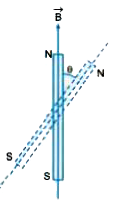
|
|
| 18. |
The resistance of a metal wire is 10 Omega . A current of 30 mA is flowing in it at 20^@ C. If p.d. across its ends is constant, then its temperature is increased to 120^@ C, then the current flowing in the wire will be in mA( alpha= 5 xx 10^(-3//0) C) |
| Answer» ANSWER :A | |
| 19. |
A rocket of mass 6000kg is set for vertical firing. If the exhaust speed is 1000m/sec. The rate of mass of gas ejected to supply a thrust needed to give the rocket an initial upward acceleration of 20.2 m/ s^2 is |
| Answer» Answer :D | |
| 20. |
Define the distance of closest approach. An a-particle of kinetic energy 'K' is bombarded on a thin gold foil. The distance of the closest approach is 'Y. What will be the distance of closest approach for an a-particle of double the kinetic energy? |
|
Answer» Solution :For distance of closest appraoch, see Very Short ANSWER Question Number 2. Distance of closest APPROACH is GIVEN by the formula. `r_(0) =(1)/(4 pi in_(0)) .(2Ze^(2))/(K)`, where K = initial value of the kinetic energy of alpha-particle. Thus, `r_(0) prop (1)/(k)`. Hence, if kinetic energy of a-particle is doubled to 2K, the distance of the closest approach is reduced to `r_(0)//2`. |
|
| 21. |
A completely transparent material will be invisible in vacuum when its refractive index is : |
| Answer» Answer :D | |
| 22. |
How will you represent a resistance of 3700 Omega +- 5% using colour code? |
| Answer» SOLUTION :ORANGE,VIOLET,RED and GOLD. | |
| 23. |
The message of Nalanda was heard across the mountains and oceans of the Asian main-land and, for nearly |
|
Answer» SIX centuries |
|
| 24. |
The natural frequency of an LC - circuit is 125KHz. Then the capacitor C is replaced by another capacitor with a dielectric medium of dielectric constant k. In this case, the frequency decreases by 25kHz. The value of k is |
|
Answer» 3 |
|
| 25. |
From the following, what charges can be present on oil drops in Millikan's experiment |
|
Answer» ZERO, equal to the magnitude of charge on a particle |
|
| 26. |
Find integrals of given functions int(4+sqrt(t))/(t^3) dt |
|
Answer» |
|
| 27. |
Four charges are arranged at the corners of a square as shown in the figure. The direction of electric field at the centre of the square is along |
| Answer» ANSWER :A | |
| 28. |
The resistance of the wire is 121 ohm. It is divided into 'n' equal parts and they are connected in parallel, then effective resistance is 1'ohm. The value of 'n' is |
|
Answer» 12 |
|
| 29. |
Some equipotential surfaces are shown in the figure below, what can you say about the magnitude and the direction of the electric field ? |
Answer» Solution :First we will find the direction of the `vec(E )` noting that the `vec(E )` LINES are always perpendicular to the local equipotential surfaces and points in that direction in which the potential is decreasing . So it will be as shown below. 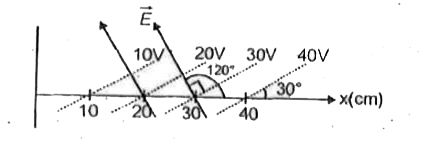 NOTE that we have drawn the `vec(E )` lines perpendicular to all equipotential surface and it si pointing in that direction in which the potential is decreasing. so the total angle `vec(E ) ` is making with the positve x-axis is `120^(@)` as shown . . 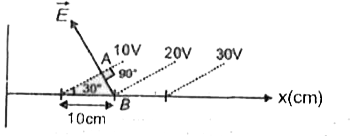 Now, how to calculate the magnitude of the ELECTRIC field for this we need to jump from one equipotential surface to ANOTHER through shortest (perpendicular ) distance then calculate, E = `("Change in potential")/("distance travelled")` Let us suppose we are jumping from 20 V line to 10V line from B to A. note that the BA line is the shortest length between the two equipotential surface . the potential difference between the two lines is (20 V-10 V) = 10 volt now, calculate the length AB = 10sin `30^(@)` cm = 5 cm = `5xx 10^(-2)` m Therefore, E `= (10V)/(5 xx 10^(-2)m)` = 200 [ V/m] Hence, the complete answer is that the `vec(E )` has the value 200 V/m and makes `120^(@)` with positve x-axis. |
|
| 30. |
The condition under which a microwave oven heats up a food item containing water molecules most efficiently is |
|
Answer» The FREQUENCY of the MICROWAVE must match the resonant frequency of the water molecules |
|
| 31. |
How will the interference pattern in Youngs double slit experiment change, when the entire set up is immersed in water ? |
| Answer» SOLUTION :When APPARATUS is immersed in water, wavelength REDUCES to `lamda/mu_w`. Therefore, FRINGE width `beta ALPHA lamda` decreases | |
| 32. |
A point charge q si located on the plane dividingvacumm and infiniteuniformistropicdielectricwith permittivity eposilon. Find the moduliof the vectors D and Eas well as the potentail varphi as funtions of distancer fromthe charge q. |
|
Answer» <P> SOLUTION :`E_(p) = (Q vec(r_(1)))/(4pi epsilon_(0) r_(1)^(3)) + (q vec(r_(2)))/(4pi r_(2)^(3) epsilon_(0)), P` in 1`E_(R ) = (q" vec(r_(1)))/(4pi epsilon_(0) r_(1)^(3)), P` in 2 where`q'' = (2q)/(epsilon + 1) , q' = q'' - q` In the limit `vec(l) rarr 0` `vec(E_(p)) = ((q + q') vec(r))/(4pi epsilon_(0) r^(3)) = (q vec(r))/(2pi epsilon_(0) (l + epsilon) r^(3))`, in either part, Thus `E_(p)= (q)/(2pi epsilon_(0) (l + epsilon) r^(2))` `varphi = (q)/(2pi epsilon_(0)(l + epsilon) r)` `D = (q)/(2pi epsilon_(0)(l + epsilon) r^(2)) xx {{:("1 in vacum"),(epsilon" in dielectric"):}` 
|
|
| 33. |
A uniform rope of their mass density lamda and length l is coiled on smooth horizontal surface. One end is pulled up by an external agent wit consant vertical velocity v. Choose the correct option(s) |
|
Answer» <P>Power developed by external agent as a function of `X` is `P=lamdaxgv` Energy lost in the complete lift `=W_(F)-DeltaK.E. -DeltaU=(lamda lv^(2))/2` |
|
| 34. |
The planes sources of sound of frequency n_(1)=400Hz,n_(2)=401Hz of equal amplitude of a each, are sounded together. A detector receives waves from the two sources simultaneously. It can detect signals of amplitude with magnitude ge a only, |
|
Answer» |
|
| 35. |
The two lenses of a compound microscope are of focal lengths 2 cm and 5 cm. If an object is placed at a distance of 2.1 cm from the objective of focal length 2 cm the final image forms at the final image forms at the least distance of distinct vision of a normal eye. Find the magnifying power of the microscope. |
|
Answer» 20 |
|
| 36. |
Function of a rectifier is |
|
Answer» to convert a.c. INPUT into d.c. output. |
|
| 37. |
A ball of sqrt(3)xx10^(-2)kg hits a hard surface at 45^(@) to normal with speed 4sqrt(2)m//s and rebounds with 8//sqrt(3) m//s, at 60^(@) angle. If ball remains in contact for 0.1 sec, what force does it exert ? |
Answer» Solution :During rebounce, horizontal component of MOMENTUM (parallel to surface) does not change but vertical component (normal to surface) changes by, `DELTA p=mv_(2)cos 60-(-mv_(1)cos 45)` `=m(8//sqrt(3))1//2+m(4sqrt(2))1//sqrt(2)=m((4//sqrt(3))+4)` `=sqrt(3)xx10^(-2)((4//sqrt(3))+4)=(4+4sqrt(3))xx10^(-2)=10.92xx10^(-2)N-s` `THEREFORE F=(Delta p)/(Delta t)=(10.92xx10^(-2))/(0.1)=10.92xx10^(-1)N`, Normal to surface. |
|
| 38. |
Mention the factors on which the resonant frequency of a series LCR circuit depends. Plot a graph showing the variation of impedance of a series LCR circuit with the frequency of the applied source. |
Answer» SOLUTION :RESONANT FREQUENCY `f=1/2pisqrtLC`. It depends on the SELF inductance L of the coil and the caapacitance C of thecapacitor. 
|
|
| 39. |
If mu_(1) and mu_(2) are the refractive indices of the material of core and cladding respectively of an optical fiber, then |
|
Answer» `mu_(1) GT mu_(2)` |
|
| 40. |
What is enriched Uranium? |
| Answer» SOLUTION :SAMPLE that has GREATER abundance of `_92U^235` than in naturally OCCURRING Uranium. | |
| 41. |
Assertion (A) : If a proton and an alpha particle enter a uniform magnetic field normally with the same velocity, the time period of revolution of the alpha particle is double than that of proton. Reason (R) : In a magneitc field the time period of revolution of a charged particle is directly proportional to its mass. |
|
Answer» <P>If both ASSERTION and reason are true and the reason is the CORRECT explanation of the assertion. |
|
| 42. |
Zener diode can be used |
|
Answer» As VOLTAGE regulator |
|
| 43. |
The current gain of a transistor is 100 . If the base current changes by 200 muA , what is the change in collector current ? |
|
Answer» 200 mA |
|
| 44. |
In a Geiger-Marsden experiment, what is the distance of closet approach to the nucleus of a 5.0 MeV -particle before it comes momentarily to rest and reverses its direction ? |
|
Answer» |
|
| 45. |
A parallel plate capacitor is filled by a dielectric whose relative permittivity varies with the applied voltage (U ) as epsilon = alpha U wherealpha=2V^(-1). A similar capacitor with no dielectricis charged to U_(0) = 78 V. lt is then connected to the uncharged capacitor with the dielectric. Find the final voltage on the capacitors. |
|
Answer» Solution :Let the capacitance of capacitor without dielectric is C and hence, charge on capacitor `Q_(1)=CU` where U is the FINAL potential of a capacitor As the capacitor with dielectric having relative permittivity `epsilon` and its capacitance `in` C. Hence, charge on the capacitor is, `Q_(2)= in CU = aUxx CU= aCU^(2)` `[ because in = AU]` The initial charge on the capacitor is, `Q_(0)=CU_(0)` From the conservation of charge, `Q_(0)= Q_(1)+Q_(2)` `CU_(0)=CU+aCU^(2)` `:.aU^(2)+U-U_(0)=0` Now a = `2V^(-1)` and `U_(0)` = 78 V `:. 2U^(2) + U-78=0` is a binomial equation of U. `:. 2U^(2) +13U -12 U -78 =0` `:. U(2U+13) - 6 (2U+13) =0` `:.(2U+13)` (U-6) =0 `:. U= -(13)/(2) "or" U =6` `:. U = -(13)/(2)` is impossible `:. U = 6V` final voltage |
|
| 46. |
When a hydrogen atom is raised from the ground state to fifth stale(excited state) : |
|
Answer» both KE and PE INCREASE |
|
| 47. |
A charged 30 muFcapacitor is connected to a 27 mH inductor. What is the angular frequency of free oscillations of the circuit ? |
|
Answer» Solution :Here, C = `30 muF = 30 xx 10^(-6) F` and L = 27 mH `=27 xx 10^(-3)` H `therefore` Angular frequency `omega_(0) =1/sqrt(LC) = 1/sqrt(30 xx 10^(-6) xx 277 xx 10^(-3)) = 1.1 xx 10^(3)s^(-1)` |
|
| 48. |
A glass surface is coated by an oil film of uniform thickness 1.00xx10^-4cm. The index of refraction of the oil is 1.25 and that of the glass is 1.50. Find the wavelengths of light in the visible region (400nm-750nm) which are completely transmitted by the oil film under normal incidence. |
|
Answer» `d=1xx10^-4cm` `10^-6m` `mu_(oil)=1.25 and mu` `=1.50` `LAMDA(2mud)/((n+1/2)) `=(2xx10^-6xx(1.25)xx2)/((2n+1))` `=(5xx10^-6m)/(2n+1)` `RARR lamda=(5000nm)/(2n+1)` ` For the wavelength is the region (400nm-750 nm) when n=3, `lamda=5000-(2xx3+1) `5000/7=714.3` when n=4 `lamda=5000/(2xx4+1)` `=5000/9=555.6nm` `when n=5 lamda=5000/(2x5+1)` =5000/11=454.5nm` |
|
| 49. |
A soap film is formed on a rectangular wire frame of size 5cm xx 2cm. If S.T. of soap solution is 30 dyne/cm, the work done is |
|
Answer» 300 ergs |
|
| 50. |
Derive an Expression for instantaneous induced emf in an A.C generator |
Answer» Solution : In the above figure N and S are poles of a magnet, `theta` is the angle between the direction of magnetic FIELD B and area vector A. When the COIL is rotated in the magnetic field, the flux linked with the coil varies. At any instant of time .t., `A cos theta` is the component of area vector along the direction B. The magnetic flux linked iwth the coil at any instant of time .t. is given by `phi_(B)= B XX` component of area vector along the field direction. For 1 turn `phi_(B)= BA cos theta` For n turns `phi_(B)= nAB cos theta` `phi_(B)= nAB cos omega t` ....(1) `[because theta= omega t]` where `.omega.` is the angular velocity of the coil at time t From the Faraday.s second law, `e= - (d phi)/(dt)` `e= - (d)/(dt)[ n AB cos omega t]` [From (1) `phi= nAB cos omega t`] `e= (-nAB)[-sin omega t] xx omega` `e= nA B omega sin omega t` `e= e_(0) sin (omega t)` where `e_(0)` is the PEAK value of emf `=nAB omega` |
|