Saved Bookmarks
This section includes 7 InterviewSolutions, each offering curated multiple-choice questions to sharpen your Current Affairs knowledge and support exam preparation. Choose a topic below to get started.
| 1. |
Two wires of same material are subjected to the same tensions. What is the ratio of extensions produced if the length of the first wire is double that of the other while its radius is half that of the other |
| Answer» ANSWER :A | |
| 2. |
A convergent lens with a focal length of f=10cm is cut into two halves that are then moved apart to a distance of d=0.5 mm (a double lens). Find the fringe width on screen at a distance of 60 cm behind the lens if a point sources of monochromatic light (lambda=5000Å) is placed in front of the lens at a distance of a = 15cm from it. |
|
Answer» `1/v + 1/15 = 1/10` `:. V = 30 cm` `m = v/u = 30/(-15) = -2` 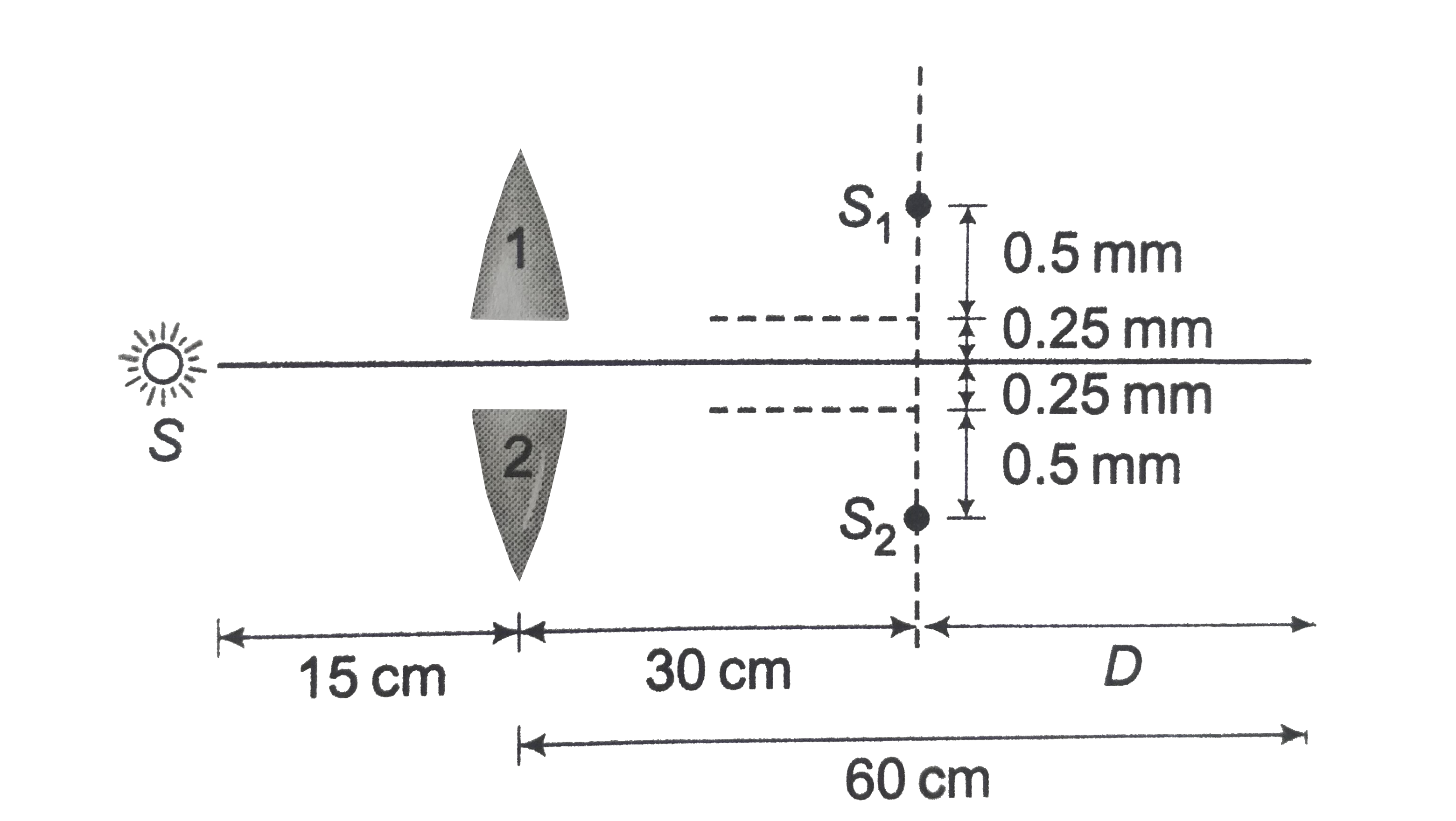 Distance between two SLITS, d = 1.5 MM, D =30 cm Fringe width, `omega = (lambdaD)/(d)` `=((5.0xx10^(-7))(0.3))/((1.5xx10^(-3))) =10^(-4) m` =0.1 mm |
|
| 3. |
In the Q.122 how much distance is covered by the particle in returning to the starting point? |
|
Answer» `(2r_(0))/(a)` 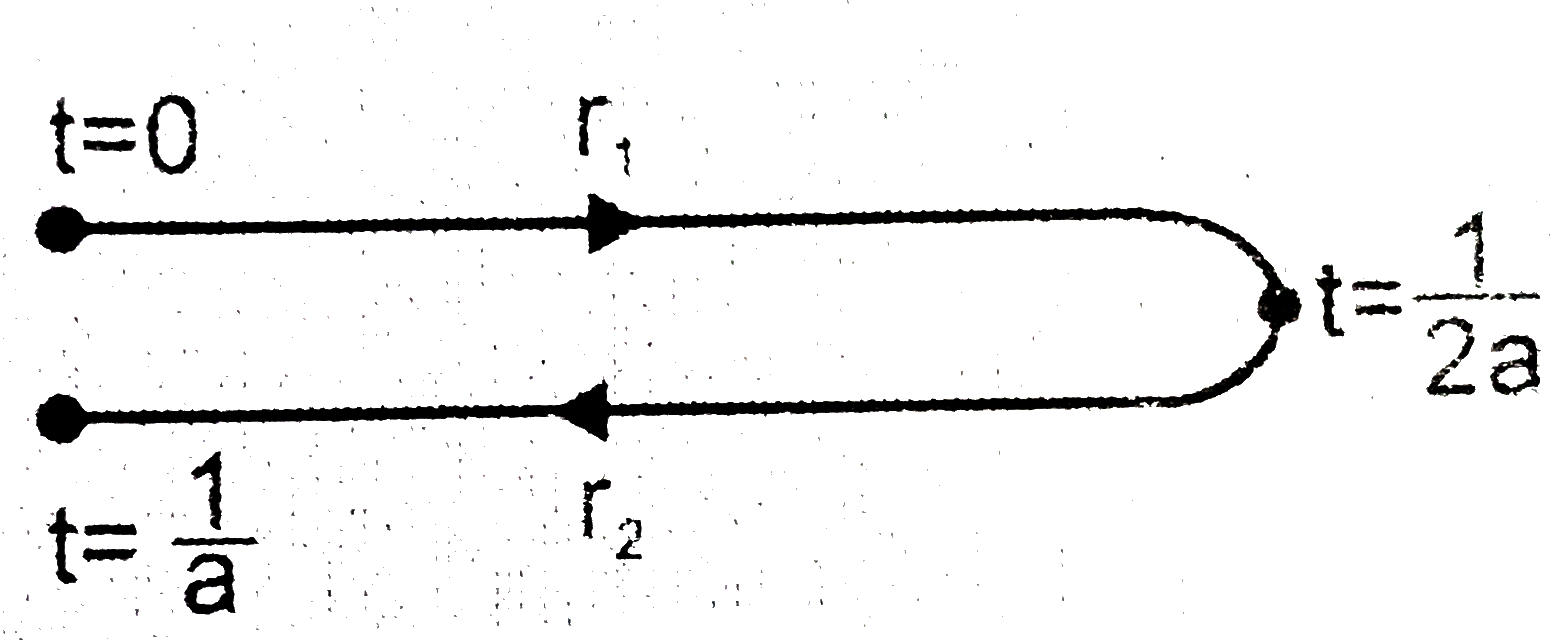 `r_(1)=r_(0)(1-axx(1)/(2a))(1)/(2a)=(r_(0))/(4a)` Total distance `=r_(1)+r_(2)=(r_(0))/(4a)+(r_(0))/(4a)=(r_(0))/(2a)` |
|
| 4. |
An oil drop of 12 excess electrons is held stationary under a constant electric field of2.55 xx 10 ^(4) NC^(-1)in Millikan's oil drop experiment. The density of the oils is 1.26 g cm ^(-3)Estimate the radius of the drop(g= 9.81 m s ^(-2)and e = 1.60 xx 10 ^(-19) C ) |
|
Answer» Solution :Here ` E= 2.55 xx 10 ^(4) NC^(-1)`, density of oil `rho =1.26 g CM ^(-3)= 1.26 xx 10^(3)kg m ^(-3) ` As the oil drop has 12 excess electrons hence , charges on oil drop `|q|=12e =12 xx 1.60 xx 10 ^(-19) C.` As the oildrop REMAIN stationary in an electric field, it is possible onlyif weight of oil drop acting verticallydownward is just BALANCED by force due to electric field which must act in vertically upward direction i.e. `mg= ( 4)/(3)r^(3)rho g= q_E ` ` rArr "" r=[( 3qE)/( 4pi rho g) ] ^(1//3)=[( 3xx12xx1.60 xx 10 ^(-19)xx 2.55 xx 10 ^(4) )/(4xx 3.14 xx 1.26 xx 10 ^(3)xx 9.81)]^(1//3) ` `=9.81 xx 10 ^(-7)m or 9.81 xx 10 ^(-4)mm. ` |
|
| 5. |
The current-voltage graphs for a given metallic at two difference temperatures T_(1) &T_(2) are shown in figure. The temperature. T_(2) is greaterthan temperature T_(1). State whether statement is true or false. Given reason. |
Answer» Solution :The given statemenet is true. It is DEAL from the FIGURE that the resistance of metallic WIRE is larger at temperature `T_(2)` thenat temperature, `T_(1)` So it implies that `T_(2) gt T_(1)`. 
|
|
| 6. |
The electrical analog of mass is |
|
Answer» resistance |
|
| 7. |
A ray of light is travelling from air into a medium which its velocity is reduced to 3/4 of its velocity in air. If it is incident at a very small angle on the surface of separation and if I and r are angles of incidence and reflection respectively, then the deviation of the ray is given by : |
|
Answer» `DELTA =i` |
|
| 8. |
Which of the following parameters are the same for all hydrogen-like atoms and ions in their ground states ? |
|
Answer» RADIANS of the orbit |
|
| 9. |
Two convex lenses of same focal length but of aperture A_(1) and A_(2)(A_(2)ltA_(1)), are used as the objective lenses in two astronomical telescopes having indentical eyepieces. What is the ratio of their resolving power ? Which telescope will you prefer and why ? Give reason. |
|
Answer» Solution :We know that resolving power of a TELESCOPE is given by the relation `R.P.=(A)/(1.22lamda)` where A=aperture of objective LENS of telescope and `lamda=`wavelength of light used. as apertures of two telescope objectives are `A_(1) and A_(2) and A_(1) gt A_(2)`, hence `((R.P.)_(1))/((R.P.)_(2))=(A_(1))/(A_(2))implies(R.P.)_(1)gt(R.P.)_(2)`. As focal LENGTHS of lenses of two telescopes are equal, hence their magnifying powers are equal, but resolving power of telescope NUMBER 1 is more, hence we shall prefer this telescope having aperture of objective `A_(1)`. |
|
| 10. |
A nuclear reactor generates P = 20 MW power at efficiency eta = 60% by nuclear fission of a radio-nuclide whose half life is T = 2.2 years. If each fission releases energy E = 200 MeV, calculate time during which mu = 10 mole of the radionuclide will be consumed completely. (Avogadro number , N = 6 xx 10^(23), log_(e)2 = 0.693, 1 "year" = 3.15 xx 10^(7)s) |
|
Answer» |
|
| 11. |
Two conducting plates X and Y, each having large surface aera A (on one side), are placed parallel to each other as show in figure. Find the surface charge density at the inner surface of the plate X. |
|
Answer» `(Q)/(3A)` |
|
| 12. |
Solid targets of different elements are bombarded by highly energetic electron beams. The frequency of the characteristic X-rays emitted from different target varies with atomic number Z as ...... |
|
Answer» `F prop sqrt(Z)` `(Z- SIGMA) prope sqrt(f) or f prop (Z-sigma)^(2)` Note : The CORRECT answer should have been `fprop (Z-sigma)^(2)`, where `sigma` is the SCREENING constant. |
|
| 13. |
(A) : Magnetic field is useful in producing parallel beam of charged particle. (R) : Magnetic field inhibits the motion of charged particle moving across it. |
|
Answer» Both 'A' and 'R' are TRUE and 'R' is the correct EXPLANATION of 'A'. |
|
| 14. |
You arerequired to select a carbonresistorofresistance47 kOmegapm 10 % fromalargecollection. Whatshouldbethesequenceofcolorbandsusedtocode it ? |
| Answer» SOLUTION :YELLOW, VIOLET, ORANGE, SILVER. | |
| 15. |
For a CE transistor amplifier the audio signal voltageacross the collectorresistance of 2.0 komegais 2.0 V suppose the current amplification factorof the transistor is 100 what should be the valueof R_(B)in series with V_(BB)10 timesthesignal currentalso calculatethe DCdrop across thecollector resistance |
| Answer» SOLUTION :`14 XX 10^(3)Sigma10 mA` | |
| 16. |
A spectral line is obtained from a gas discharge tube at 5000A^0. If the rms velocity of gas molecules is 10^(5) ms^(-1), then the width of spectral line will be |
|
Answer» `1.66 A^(0)` |
|
| 17. |
A small object stuck on the surface of a glass sphere (mu = 1.5) is viewed from the diametrically opposite position. What is the transverse magnification produced ? |
| Answer» ANSWER :C | |
| 18. |
Name the device 'D' which is used as a voltage regulator in the given circuit . Rewrite the circuit by replacing 'D' with the proper circuit symbol. Give its working principle. |
Answer» SOLUTION :D is a zenar diode 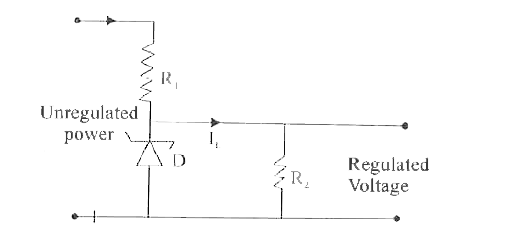 PRINCIPLE : If you INCREASE or decrease the INPUT VOLTAGE it results in the increase or decrease in voltage drop across `R_1` but the voltage across the zenar diode remains constant. `therefore` A constant voltage acts across `R_2`. |
|
| 19. |
In a Fresnel biprism experiment, the two positions of lens give separation between the slits as 16 cm and 9 cm respectively. What is the actual distance of separation ? |
|
Answer» Solution :ACTUAL DISTANCE of separation, `sqrt(1_(1)r_(2))= sqrt(16xx9)=12` |
|
| 20. |
It has been postulated that there may be some particle moving with speed greater than the speed of light. Such particles have been named as |
|
Answer» Mesons |
|
| 21. |
Interstellar space has an extremely weak magnetic field of the order of 10^(12) T. Can such a weak field be of any significant consequence ? Explain. |
| Answer» Solution :We know the relation `r =(mv)/(Bq)`. Therefore, an extremely MINUTE field of the order of `10^(-12)`T will bend charged particles in a circle of very large radius. Over a small distance, the deflection due to the circular orbit of such large radius may not be NOTICEABLE, but over the gigantic INTERSTELLAR distances, the deflection can significantly AFFECT the passage of charged particles eg., cosmic rays. | |
| 22. |
The resultant of the system in the figure is a force of 8 N parallel to the given force through R. The value of PR equals to? |
|
Answer» `1/(4RQ)` |
|
| 23. |
A rod OA of length l is rotating (about end O) over a conducting ring in crossed magnetic field B with constant angular velocity omega as shown in figure. |
|
Answer» Current flowing through the rod is `(3B omega l^(2))/(4R)` Magnetic force `F=(3B omega l^(2))/(4R)xx l xx B=(3B^(2)omega l^(3))/(4R)` Torque, `tau =(3B^(2)omega l^(3))/(4R)xx(l)/(2)=(3B^(2)omega l^(4))/(8R)` `therefore` Force to be applied at the end `= (3B^(2)omega l^(3))/(8R)` 
|
|
| 24. |
Two cells E_(1) (with emf 4V and internal resistance 2Omega) and E_(2) (with emf 2V and intenral resistnace 2Omega) are connected in parallel. The combination is connected in parallel with a 8Omega resistance R as shown in figure. Calcualte the currents passing through 2V cell and through the resistance R. |
Answer» Solution : Applying Kirchhoff.s second law to the loop ABEFA. then `-2+2I_(2)-2I_(1)+4=0` `2I_(1)-2I_(2)=2"….(1)"` Applying Kirchhoff.s seocnd law to the loop BCDEB, then `-8(I_(1)+I_(2))-2I_(2)+2=0` `8I_(1)+10I_(2)=2"..........(2)"` Solving equation (1) and (2), we GET `I_(1)=(2)/(3)A,I_(2)=-(1)/(3)A,I_(1)+I_(2)=(1)/(3)A` Thus, the current PASSING through 2V CELLS is `I_(2)=-(1)/(3)A.` That is `(1)/(3)A` current flows though 2V CELL from B to E direction. And `(1)/(3)A` current flows through `8OMEGA` resistance from C to D. |
|
| 25. |
What was life for Evelyn? |
|
Answer» dance |
|
| 26. |
The given loop is kept in a uniform magnetic field perpendicular to the plane of the loop. The field changes from 1000 Gauss to 500 Gauss in 5 seconds. The average induced emf in the loop is |
|
Answer» `28muV` 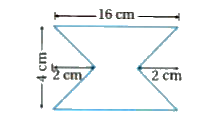 Area of loop `A=(16xx4-4xx2)` =64-8 `=56 "CM"^2` `=56xx10^(-4) m^2` `dB=(500-1000)xx10^(-4)` T `=-500xx10^(-4)` T `THEREFORE` Induced emf `EPSILON=(AdB)/(DT)` `=(56xx10^(-4)xx(-500xx10^(-4)))/5` `=56xx10^(-6)` V `=56 muV` |
|
| 27. |
Three resistance, each of 1Omega,are joined in parallel. Three such combinations are put in series. The resultant resistance is |
| Answer» Solution :`R_(p)=1+1+1=3Omega, (1)/(R_(S))=(1)/(3)+(1)/(3)+(1)/(3)=(3)/(3)=1 rArr R_(S)=1Omega` | |
| 28. |
The figure shows a parallel-plate capacitor having square plates of edge a and plate-separation di The gap between the plates is filled with a directric of dielectric constant k which varies as K=K_(0) + alphaxparallel to an edge as where K and alphaare constants and x is the distance from the left end. Calaculate the capacitance. |
|
Answer» `(epsilon_0a^2)/(d)(K_(0)+(aalpha)/2)` |
|
| 29. |
(i) StateBohr'squantizationconditionfor definingstationaryorbits. Howdoesde- Brogliehypothesis explainthe stationaryorbits ? (ii) findthe relation beweenthe threewavelengths lambda_(1), lambda _(2)" and"lambda_(3) from theenergyleveldiagramshown : |
|
Answer» Solution :Only those ORBITS are STABLE for which the angular MOMENTUM of revolving electron is an integral multiple of `(h/(2pi))`where h is the PLANCK’s constant. Thus the angular momentum (L) of the orbiting electron is quantised. That is `L = (nh)/(2pi)` According to dc Broglie hypothesis Linear momentum `= h /lamda` and for CIRCULAR orbit L = rnp, where rn is the radius of quantised orbits `=r_nh/lamda` Also, `L=(nh)/(2pi)` `:. (r_nh)/lamda=(nh)/(2pi) " or" 2pir=nlamda` Hence, circumference of permitted orbits are integral multiples of the wavelength |
|
| 30. |
Which type of rays are used for LASIK eye surgery ? |
|
Answer» (A) GAMMA |
|
| 31. |
Explain linear charge density, surface charg density and volume charge density for uniformly charge distribution. |
|
Answer» Solution :Linear charge density (`lambda` ): AMOUNT of charge pe unit length is called linear charge density `(lambda)` `lambda = ("Total charge on line")/("length of line") = Q/l` Unit: C/m Dimensional formula : `M^(0)L^(-1)T^(1)A` Surface charge density (`sigma`) : Amount of charge PER unit AREA is called surface charge density `(sigma)` `sigma = ("Total charge on surface")/("Area of surface") = Q/A` Unit: `C//m^(2)` Dimensional formula: `M^(0)L^(-2)T^(1)A` Volume charge density (`rho`): Amount of charge per unit volume is called volume charge density (`rho`). `rho = ("Total charge on volume")/("Volume") = Q/v` Unit: `C/m^(3)` Dimensional formula: `M^(0)L^(-3)T^(1)A^(1)` |
|
| 32. |
Hardended steel andcertain magnutude alloys (e.g. cobalt, steel , tungsten, steel , etc.) When magnetised retain their magnetism indefinitely are called ? |
| Answer» SOLUTION :PERMANENT MAGNETS | |
| 33. |
Prove that the vectors vec A = 8 hat i + 9 hat j + 7hat k and vec B = 24 hat i + 27 hat j + 21 hat k are parallel to each other. |
| Answer» SOLUTION :NA | |
| 34. |
A : Interference obey is the law of conservation energy. R : The energy is redistributed in case or interference. |
|
Answer» Both A and R are true and R is the CORRECT EXPLANATION of A |
|
| 35. |
For a given optical system, the principal axis is x-axis and coordinates of object are (-30,+1,0) and coordinates of image are (+20,-2,0) All coordinates are in cm. If the optical system is a spherical refracting surface, its centre of curvature is at what point? |
|
Answer» `-15` CM 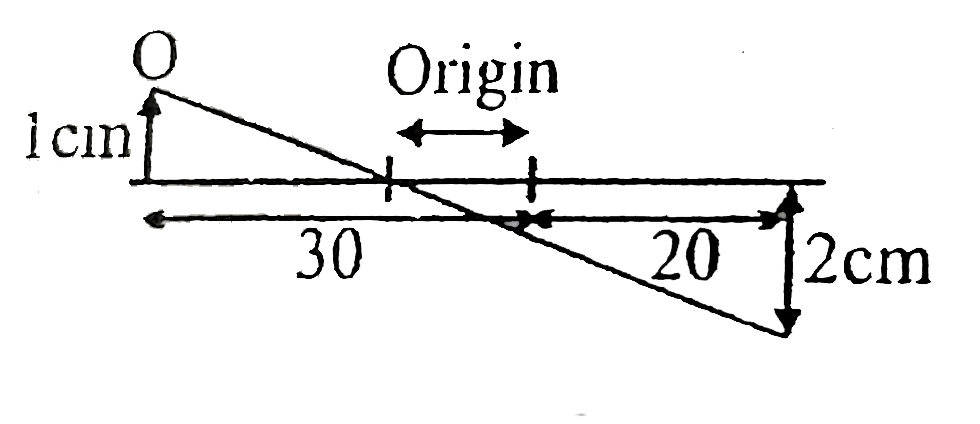 `30-50/3=40/3` |
|
| 36. |
Electric potential in a region of space is given by V=3x^(2)V. What will be electric field intensity at a point P (2 m, 0). |
|
Answer» Solution :As we can see here that the electric potential is DEPENDENT only on ONE variable that is x-coordinate. We can calculate electric field intensity at the given POINT simply differentiating the given function with respect to x. Electric field intensity is given by: `E= -(dV)/(dx)= -(d(3x^(2)))/(dx)=-6x rArr -6(2) N//C=-12N//C` The direction of the electric field intensity will be along the negative direction of X-axis. In this question, if the y-coordinate of the given point were not 0, even then the electric field intensity would be same. We can conclude here that the planes parallel to x-z planes can be considered as equipotential surfaces. |
|
| 37. |
Two concentric sphere of radii r_1 and r_2 carry charges q_1 and q_2 respectively. If the surface charge density (sigma) is same for both spheres, the electric potential at the common centre will be |
|
Answer» `( SIGMA )/( in_0)(r_1)/( r_2)` |
|
| 38. |
The major product formed in the reaction is - CH_(3)CHClCH_(2)CH_(2)OH underset("heat")(KOH//H_(2)O)(to) |
|
Answer» `CH_(3)CH=CHCH_(2)OH` 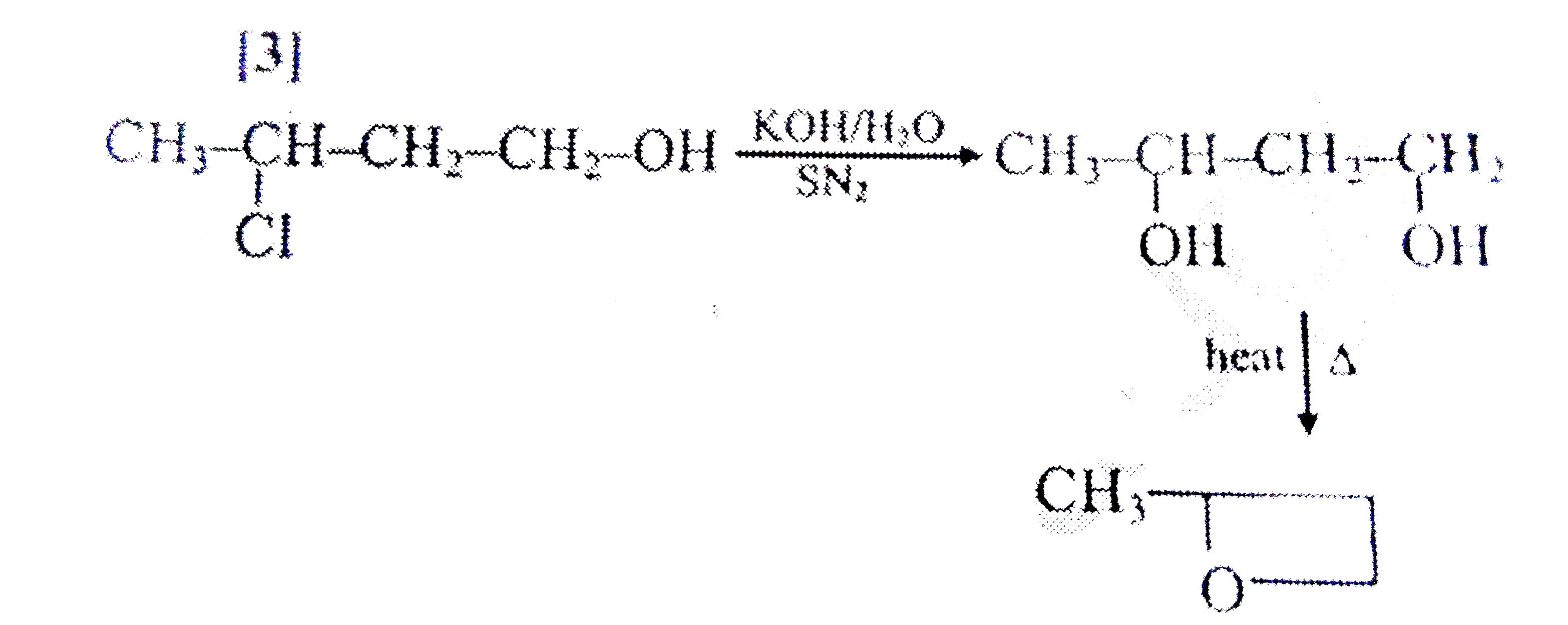
|
|
| 39. |
Dynamic mass of the photon in usual notations is given by |
|
Answer» `(HV)/(c)` |
|
| 40. |
Two charges 5 xx 10^(-8) and -3 xx 10^(-8)C are located 16 cm apart. At what points (s) on the line joining the two charges is the electric potential zero? Take the potential at infinity to be zero. |
|
Answer» Solution :Let O be a point situated at a distance x CM from +ve charge of `5 xx 10^(-8)`C where the NET electric potential is ZERO. For net potential to be zero `V_1 + V_2 = 0`  Thus,`1/(4piepsi_0)[q_1/x+q_2/((r -x))] = 0 or 1/(4piepsi_0)[(5xx10^(-8))/x-(3XX10^(-8))/((16-x))]=0` `rArrx = 10 cm` Again point lies outside the charges at O., then `or 1/(4piepsi_0) [(5xx 10^(-8))/x-(3xx10^(-8))/((x-16))] = 0` `rArrx = 40 cm` |
|
| 41. |
A small electric dipole is placed at origin with its dipole moment directed along positive x-axis. The direction of electric field at point (2, 2 sqrt2, 0) is |
|
Answer» ALONG POSITIVE x-axis |
|
| 42. |
A body of mass 1 Kg is moving with a velocity 1 m/s, a wave is associated with this body : Can you measure wave length of this wave. Explain? |
| Answer» SOLUTION :No. WAVE LENGTH of MATTER wave is very SMALL. | |
| 43. |
A wheel with 10 metallic spokes each 0.5m long is rotated with a speed of 120 rev/min in a plane normal to the earth.s magnetic field at the place. If the magnitude of the field is 0.4 G, the induced e.m.f. between the axle and the rim of the wheel equal to |
|
Answer» `1.256 XX 10^(-3) V` |
|
| 44. |
(a) How does one demonstrate, using a suitable diagram, that unpolarised light when passed through a Polaroid gets polarised? (b) A beam of unpolarised light is incident a glass-air interface. Show using a suitable ray diagram, that light reflected from the interface is totally polarised, when mu=tani_(B), when mu is the refractive index of glass with respect to air and i_(B), is the Brewster's angle. |
Answer» Solution :Condition : The reflected ray is totally plane polarised, when reflected and refracted rays are perpendicular to each other. 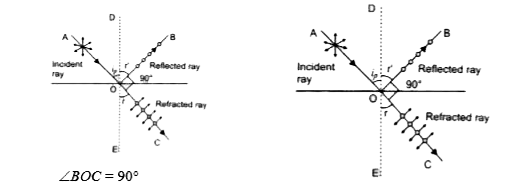 If `i_p`is angle of incidence, r' is angle of reflection and r the angle of refraction, then according to law of reflection `i_p=r'` and form fig, `r'+90^@+r=180^@` `rArr i_p+r=90^@`...(i) `rArr r=(90^@-i_p)` ...(II) From SNELL’s law, refractive index of second MEDIUM realstive to first medium (air) say. `n=(sin i_p)/(sin r)=(sin i_p)/(sin(90^@-i_p))=(sin i_p)/(cos i_p)` `rArr n =TAN i_p` `therefore ` Angle of incidence , `i_p=tan^(-1)(n)`. |
|
| 45. |
In an intrinsic semiconductor , the energy gap E_(g) is 1.2 eV . Its hole mobility is much smaller than electron mobility and independent of temperature . What is the ratio between conductivity of 600 K and that at 300 K ? Assume that the temperature dependence of intrinsic carrier concentration n_i is given by n_(i)=n_(0) exp ((-E_(g))/(k_T)), where n_(0) is a constant and k_=8.62xx10^(-5)eV//K. |
|
Answer» SOLUTION :`n_(i) = n_(o)` exp `(- (E_(g))/(2 k_(B) T))` , where `n_(o)` is a constant For an intrinsic SEMICONDUCTOR `mu_(e) gt gt mu_(h), n_(e) = n_(h)= n_(i)` `sigma = e (n_(e) mu_(e) + n_(h) mu_(h)) = en_(i) (mu_(e) + mu_(h)) ~~ en_i mu_e` But `n_(i) = n_(o)` exp `(- (E_(g))/(k_(B) T))`, where `E_(g) = (E_(g))/(2)` `sigma = e mu_(e) n_(o)` exp `[(- E_(g))/(k_(B) T)]` Here all the pre-exponential terms are assumed to be independent of TEMPERATURE . So we can put a constant , `sigma_(o) = e mu_(o) n_(o)` `therefore sigma = sigma_(o)` exp `[(- E_(g))/(k_(B) T)] , E_(g) = (E_(g))/(2) = (1.2)/(2) = 0.6` eV `K_(B) = 8.62 xx 10^(-5) c V K^(-1)` `therefore sigma_(660 K) = sigma_(o) "exp" (-0.6)/(8.62 xx 10^(-5) xx 600) , sigma_((300K)) = sigma _(o) " exp " (-0.6)/(8.62 xx 10^(-5) xx 300)` `(sigma_((600K)))/(sigma_((300K))) = ((exp ((-0.6)/(8.62 xx 10^(5) xx 600)))/(exp ((-0.6)/(8.62 xx 10^(-5) xx 300)))) = exp [(0.6)/(8.62 xx 10^(-5)) ((1)/(300) - (1)/(600))]` = exp `((0.6 xx 10^(5))/(8.62 xx 600)) = exp (11.6) = 1 xx 10^(5)` This shows that the conductivity of a semiconductor increases rapidly with rise in temperature |
|
| 46. |
(A) : A spark occur between the poles of a switch when the switch is opened. (R) : Current flowing in the conductor produces magnetic field. |
|
Answer» Both 'A' and 'R' are TRUE and 'R' is the correct explanation of 'A'. |
|
| 47. |
A parallel plate capacitor of capacitance 'C' is charged to 'V' volt by a battery . After some time the battery is disconnected and the distance between the plates is doubled . Now a slab of dielectric constant 1 lt k lt 2 is introduced to fill the space between the plates . How will the following be affected ? (i) The electric field between the plates of the capacitor . (ii) The energy stored in the capacitor . Justify your answer in each case. |
|
Answer» SOLUTION :Let initially a capacitor of CAPACITANCE C is charged to a potential difference of V volt so that charge on the capacitor Q = CV On disconnecting the battery , charge Q on capacitor remainsconserved . Now distance between the plates of capacitor is DOUBLED i.e., d. =2 d and the intervening space is filled with a dielectric medium for which `1 lt k lt 2 `. Thus , new capacitance `C. = (K in_(0) A)/(d.) = (K in_(0) A)/(2d) = (K)/(2) C` . As `Klt 2 ` . hence `C. lt C` (i) Initial value of electric field was `F = (sigma)/(in_(0)) = (Q)/(A in_(0))` and new value of electric field `E. = (sigma)/(K in_0) = (Q)/(A K in_(0)) = (E)/(K)` . So the electric field between the plates of the capacitor . (ii) Initial value of energy stored in capacitor `U = (Q^2)/(2C)` and new value of energy stored in capacitor `U. = (Q^2)/(2C.)` As `C. lt C` , hence `U. gt U` . So the value of energy stored in the capacitor increases . 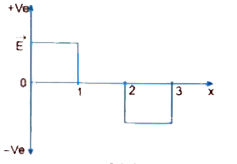
|
|
| 49. |
Calculate the specific activites of Na^(24) and U^(235) nucliedes whose half-lifes are 15 hours and 7.1.10^(8) years respectively. |
|
Answer» Solution :The specific acivity of `Na^(24)` is `lambda(N_(A))/(M)=(N_(A)In 2)/(MT_(1/2))= 3.22xx10^(17) dis//(gm.sec)` Here M= MOLAR weight of `N_(a)^(24)= 24 gm, N_(A)` is Avogadro NUMBER & `T(1/2)` is the half-life of `Na^(24)` SIMILARLY the soecific activity of `U^(235)` is `(6.023xx10^(23)xxIn 2)/(235xx10^(8)xx365xx86400)` `=0.793xx10^(5) dis(gm-s)` |
|
| 50. |
The angle between the instantaneous velocity and the acceleration of the particle executing S.H.M. is, |
| Answer» Answer :B | |