

Saved Bookmarks
This section includes 7 InterviewSolutions, each offering curated multiple-choice questions to sharpen your Current Affairs knowledge and support exam preparation. Choose a topic below to get started.
| 1. |
To demonstrate the phenomeon of interference we require two sources which emit radiation of |
|
Answer» NEARLY the same FREQUENCY |
|
| 2. |
A thin conductinrod AB is introduced in between the two point charges +q_(1) and q_(2) as shown in figure.For this situtation mark the correct statement (s). |
|
Answer» The TOTAL experienced by `q_(1)` is vector SUM of electric force experienced by `1q_(1)` due to `q_(2)` anddue to induced charges on rod. |
|
| 3. |
What is the order of energy gap in a conductor, semiconductor and insulator |
|
Answer» Solution :CONDUCTOR - no energy GAP Semiconductor `LT`3eV INSULATOR `gt`3eV |
|
| 4. |
Derive sigma = (n e^(2) tau)/(m) where the symbols have their usual meaning. |
|
Answer» Solution :It is the time interval between two successive collisions of electron with the vibrating ATOMS of a CURRENT carrying conductor. We know that the relation between electric current (I) and drift velocity `(V_(d))` `I = N e A V_(d)` -----(1) Expression for drift velocity in terms of electric FIELD and relaxation time is given by `V_(d) = (e E tau)/(m)` --------(2) SUBSTITUTING (2) in (1) `rArr = I = (n e A e E tau)/(m)` `rArr I = (n A e^(2) E tau)/(m)` But `E = (V)/(I)`, Where `V rarr` Potential across the conductor `I rarr` length of the conductor `I = (n A e^(2) V tau)/(ml)` `(I)/(V) = (n A e^(2) tau)/(ml)` `(V)/(I) = (ml)/(n A e^(2) tau) rArr R = ((m)/(n A e^(2) tau)) I` `R = ((m)/(n e^(2) tau))(I)/(A)` `R = (rho I)/(A)` Here `rho = (m)/(n e^(2) tau)` The conductivity of the material `sigma = (1)/(rho) = (1)/((m)/(n e^(2) tau))` `sigma = (n e^(2) tau)/(m)` |
|
| 5. |
Explain the working of transistor as an oscillator using a labelled circuit diagram. |
|
Answer» Solution :An L-C circuit can be used to produce oscillations of desired frequency. It consists of a tank circuit consisting of inductor L and capacitor C connected in parallel. The frequency of the tank circuit is given by `v=(1)/(2pisqrt(LC))` Due to the resistance of inductive coil, there occurs a small but constant energy loss and oscillations thus produced are damped. To transmit SPEECH or MUSIC, we require UNDAMPED electromagnetic waves called carrier waves.  To do so an L-C circuit is coupled with transistor in such a way that there is a proper feedback to the L-C circuit at the proper timings so that the energy of L-C circuit remains the same throughout oscillaitons. When key K is pressed, the collector ATTAINS positive potential due to which a weak collector current will START rising in `L_(1)`. The increasing magnetic flux is linked with `L_(1)` and hence with L. |
|
| 6. |
Calculate the angle of emergence (e) of the ray of light incident normally on the face AC of a glass prism ABC of refractive index sqrt(3). How will the angle of emergence change qualitatively, if the ray of light emerges from the prism into a liquid of refractive index 1.3 instead of air ? |
|
Answer» Solution :As shown in the diagram, the angle of incidence Zi at the face AB of glass prism ABC is `30^(@)` and refractive index of glass prismn =` sqrt(3)` . If `anglee` be the angle of emergence in AIR medium then as per snell.s law: `(sin i)/(sin e) = n_(ag) = (1)/(n_(gn))implies ( sin 30^(@))/(sin e) = (1)/(sqrt(3))` `implies sin e = sqrt(3) XX sin 30^(@) = (sqrt(3))/(2) implies e= sin^(-1) ((sqrt(3))/(2))= 60^(@)` 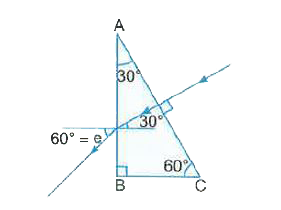 If the prism is immersed in a liquid of refractive index `n_(g), = 1.3`, then new angle of emergence e will be given by : `(sin i)/(sin e) = (1)/(n_(g)) or sin e= n_(gl)xx sin I = (sqrt(3))/(1.3) xx sin 30^(@)` `implies sin e = (sqrt(3))/(1.3) xx(1)/(2) = (1)/(1.3) ((sqrt(3))/(2))` Obviously sin e. `LT`sin e and HENCE e. `lt` e. So the angle of emergence decreases when the prism is immersed in the liquid. |
|
| 7. |
A body projected obliquely with velocity 19.6 ms^(-1) has its kinetic energy at the maximum height equal to 3 times its potential energy there. Its position after 1 second of projection from the ground is (h= maximum height) |
|
Answer» `H/2` |
|
| 8. |
When a plane mirror is rotated through an angle theta , then the reflected ray turns through the angle 2theta , then the size of the image. |
|
Answer» Is DOUBLED infinite |
|
| 9. |
a. Draw the graph showing the variation of potential with frequency of incident radiation. b. What does the slope of the graph represent? c. From the slope how will you find the value of 'h' ? |
Answer» Solution :a. 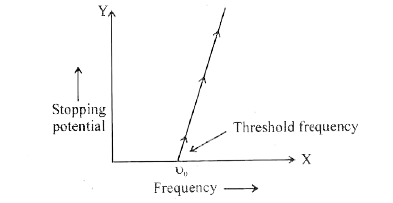 b. Slope of the graph gives `(H)/( c)` c. KNOWING the slope from the graph and the value of .e., we can FIND the value of h. |
|
| 10. |
In the Rutherford’s nuclear model of the atom, the nucleus (radius about 10^(–15) m) is analogous to the sun about which the electron move in orbit (radius ~~ 10^(–10) m) like the earth orbits around the sun. If the dimensions of the solar system had the same proportions as those of the atom, would the earth be closer to or farther away from the sun than actually it is? The radius of earth’s orbit is about 1.5 xx 10^(11) m. The radius of sun is taken as 7 xx 10^8 m. |
|
Answer» Solution :The RATIO of the radius of electron’s orbit to the radius of nucleus is `(10^(-10) m)//(10^(-15) m) = 10^5`, that is, the radius of the electron’s orbit is `10^5` times LARGER than the radius of nucleus. If the radius of the earth’s orbit around the sun were `10^5` times larger than the radius of the sun, the radius of the earth’s orbit WOULD be `10^5 xx 7 xx 10^8 m = 7 xx 10^(13) m`. This is more than 100 times greater than the actual ORBITAL radius of earth. Thus, the earth would be much farther away from the sun. It implies that an atom contains a much greater fraction of empty space than our solar system does. |
|
| 11. |
Draw I-V characteristic of a solar cell. |
Answer» SOLUTION :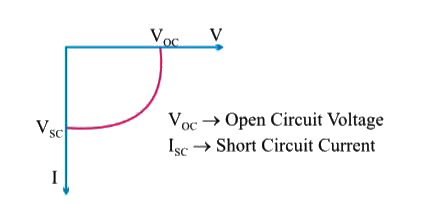
|
|
| 12. |
2 moles of ideal monatomic gas is carried from a state (P_(0) , V_(0))to a state (2P_(0) , 2V_(0))along a straight line path in a P- Vdiagram. The amount of heat absorbed by |
|
Answer» <P>`3P_(0) V_(0)` 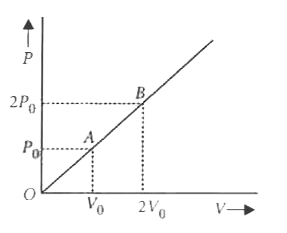 TOTAL work done forpath AB , `W_(AB) ` = are under curve`AB = P_(0)V_(0) + 1/2 P_(0) V_(0) = 3/2 P_(0)V_(0)` Change in internal energy for PATH AB `Delta U_(AB) = nC_(v) Delta T "" (. :. " for monatomic gas, " C_(V) = 3/2 R) ` ` :.Delta U _(AB) = n 3/2 R ((4P_(0)V_(0))/(nR) - (P_(0)V_(0))/(nR)) ` `rArrDelta U_(AB) = (9P_(0)V_(0))/2` ` :. `The amount of heat absorbed by the gas in the process is , `Delta Q = W_(AB) + Delta U_(AB) = 3/2 P_(0)V_(0) + 9/2 P_(0)V_(0) = 6P_(0)V_(0)` |
|
| 13. |
For the circuit shown here, would the balancing length increse, decrease or remain the same, if (i) R_(1) is decreased: (ii)R _(2) is increased , without any other change, (in each case) in the rest of the circuit. Justify your answers in each case. |
|
Answer» SOLUTION :(i) decreases ( The protential GRADIENT would INCREASE) (ii) increases (The TERMINAL p.d. ACROSS the cell would increase) |
|
| 14. |
If a broad source is used in interference experiment choose the incorrect statement |
|
Answer» a broad source is EQUIVALENT to a large number of NARROW sources lying SIDE by side |
|
| 15. |
Number of moles in 180 g glucose is |
|
Answer» 1 |
|
| 16. |
In a transistor (beta = 45) , the voltage across 5kOmega load resistance in collector circuit is 5V. The base current is : |
|
Answer» 0.022 mA Now `I_cR_L=5V:.I_c=5/R_L=5/(5XX10^(3))=10^(-3)=1MA` `:.I_b=I_c/45= 10^(-3)/45=0.022 xx10^(-3)A=0.022mA ` |
|
| 17. |
Assertion : A current I flows along the length of an infinitely long straight and thin walled pipe. Then the magnetic field at any point inside the pipe is zero. Reason : oint vecB.dvecl=mu_(0)I |
|
Answer» If both ASSERTION and REASON are TRUE and the reason is the CORRECTEXPLANATION of the assertion. |
|
| 18. |
A 10muF capacitor is charged to a voltage of 600 V Suppose it is discharged through an electrolytic bath containing acidified water. How much hydrogen will be liberated? What energy can be gained by burining this hydrogen? How can it be made consistent with the energy conseryation law ? |
Answer»  of the capacition through the ELECTROLYTE part of the energy stored in it will be liberated in the form of heat, with only a small fraction heing spent on the CHEMICAL reaction. |
|
| 19. |
On a glass plate, a light beam is incident at an angle of 60^(@). If the reflected and the refracted rays are mutually perpendicular, the refractive index of glass is |
|
Answer» `(sqrt3)/(2)` `RARR""N=(sin i)/(sinr.)=(sin 60^(@))/(sin 30^(@))=sqrt3` |
|
| 20. |
A circuit with R=70 Omega in series with a parallel combination of L=1.5H and C=30 mu F is a driven by a 230 V supply of angular frequency 300 rad//s. (a) Find the impedance of the circuit. (b) What is the RMS value of total current ? (c ) What are the current amplitudes in the L and C arms of the circuit ? (d) How will the circuit behave at omega=1//sqrt(LC) ? |
|
Answer» |
|
| 21. |
A solenoid has a core of material with relative permeability 400. The winding of the solenoid are insulted from the core and carry a current of 2A. If the number of turns is 1000 per metre, calculate (a) H, (b) M, (c) B and (d) the magnetising current i_(m). |
|
Answer» Solution :(a) The FIELD H is dependent of the material of the core, and is `H=nI=100 xx 2.0=2 xx 10^(3) A//m` (b) The magnetic field B is given by `B=mu_(r) mu_(0)H` `=400 xx 4pixx10^(-7) (N//A^(2)) xx 2 xx 10^(3) (A//m)` =1.0T (c) Magnetisation is given by `M=(B-mu_(0) H)//mu_(0)` `=(mu_(r) mu_(0) H-mu_(0) H)=(mu_(r)-1)=399 xx H` `=8 xx 10^(5) A//m` (d) The magnetising current `I_(M)` is the additional current that needs to be passed through the WINDING of the solenoid in the absence of the core which would give a B value as in the PRESENCE of the core. Thus `B=mu_(r) n(I+I_(M))`. Using I=2A, B=1 T, we get `I_(M)=494A`. |
|
| 22. |
The essential condition for demodulation is |
|
Answer» `v_clt LTRC` |
|
| 23. |
A steady current of 1 A is flowing through the conductor. The number of electrons flowing through the cross-section of the conductor in 1 sec. is : |
|
Answer» `6.25xx10^(15)` |
|
| 24. |
What is the focal length of a convex lens of focal length 30 cm in contact with a concave lens of focal length 20 cm? Is the system a converging or a diverging lens? Ignore thickness of the lenses. |
|
Answer» Solution :Here, `f_(1) = +30 CM` and `f_(2) = -20 cm` `THEREFORE 1/f = 1/f_(1) + 1/f_(2) = 1/30 + 1/(-20) =(2-3)/60 = -1/60 rArr f=-60 cm` `-ve` sign shows that the system is a diverging lens |
|
| 25. |
A satellite is moving in a circular orbit around the earth. If gravitational pull suddenly disappears, then it: |
|
Answer» continuesto move with same speed along the same PATH Thus correct choice is (b). |
|
| 26. |
Compare and contrast the interference and diffraction. |
|
Answer» Solution :(1) The pattern formed in both is due to the superposition of the WAVES. The interference pattern obtained by SUPERPOSING two waves originating from the two narrow slits. The diffraction pattern is a superposition of a continuous family of waves originating from each point on a single slit. (2) The interference pattern has a number of equally spaced bright and dark bands. The diffraction pattern has a central brightmaximum which is twice as wide as the other maxima. The intensity fall as we go to successive maxima AWAY from the centre, on higher side. (3) For a slit of width a, the first order minimum of the diffraction pattern is obtained to be at angle `THETA.=(lamda)/(a)`. Where a for two thin slits at distance a, interference pattern for first order maximum is obtained at `theta=(lamda)/(a)`. (4) In interference and diffraction, light energy is redistributed. If it reduces in one region, producing a dark fringe, it INCREASES in another region, producing a bright fringe. There is no gain or loss of energy, which is consistent with the principle of conservation of energy. |
|
| 27. |
What was the emphasis of the End Child Slavery Week? |
|
Answer» ABOLITION of CHILD Slavery |
|
| 28. |
What was the only thing that the Earth needed according to Lencho? |
|
Answer» a shower |
|
| 29. |
A current carrying squre loop isplaced near an infinitely long current carryingwire as shown in figure. The loop torqueacting on theloop is |
|
Answer» `(mu_0)/(2PI) i_1 i_2 R` |
|
| 30. |
If two persons talk to each other on moon, they cannot hear each other? Why is it so? |
| Answer» SOLUTION :Sound is a LONGITUDINAL WAVE motion and it REQUIRES a material medium for it.s propagation. SINCE, there is no atmosphere on the moon, the wave cannot propagate from one place to the other. | |
| 31. |
In the circuit, all capacitor are identical, each of capacity 2 mu F and they are infinite in number. If AB is connected to a battery of 10V then the charge drawn from the battery is |
|
Answer» `40mu C` |
|
| 32. |
The quantity X=(epsilon_(0)LV)/(t) : epsilon_(0) is the permittivity of free space, L is length, V is potential difference and t is time . The dimensions of X are same as that of |
|
Answer» RESISTANCE |
|
| 33. |
An electron of mass m , Charge e falls through a distance h meter in a unfirom electric field E. Then time of fall |
|
Answer» `t=SQRT((2hm)/(EE))` |
|
| 34. |
The ratio of first three Bohr radii is ……….. |
|
Answer» `1:(1)/(2):(1)/(3)` `:.ralphan^(2)` `:.r_(1):r_(2):r_(3)=1^(2):2^(2):3^(2)` `=1:4:9` |
|
| 35. |
A nonuniformly charged ring is kept near an uncharged conducting solid sphere. The distance between their centres (which are on the same line normal to the plane of the ring)is 3m and their radius is 4m. If total charge on the ring is 1muC, then the potential of the sphere will be |
|
Answer» `2.25 kV` So `V_(C)=(kq)/(SQRT(3^(2)+4^(2)))=(9xx10^(9)xx10^(-6))/(5)` `=1.8xx10^(3)V=1.8kV` 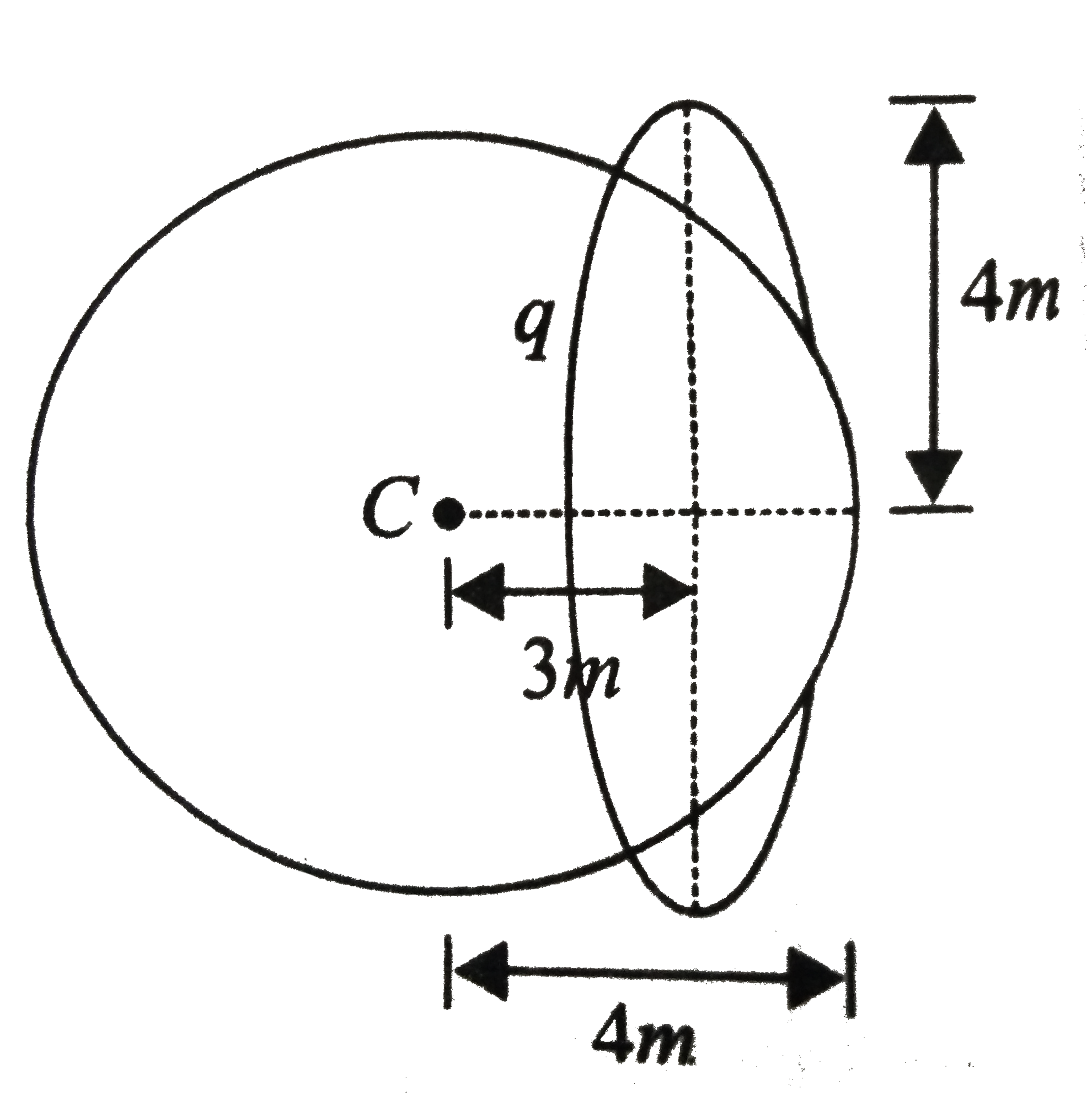
|
|
| 36. |
The magnitudes of two vectors vecP and vecQ differ by 1. The magnitude of their resultant makes an angle of tan^(-1) (3//4) with P. The angle between P and Q is |
|
Answer» `45^(@)` |
|
| 37. |
Pick the odd one out from the following |
|
Answer» X-RAYS |
|
| 38. |
A meter bridge is set up as shown in figure, to determine an unknown resistance X using a standard 10 Omega resistor. The galvanometer shows null poii1t when tapping key is at 52cm mark. The end corrections are 1cm and 2cm respectively, for the ends A and B. The determined value of V is |
|
Answer» `10.2 OMEGA` |
|
| 39. |
The magnetic field strength at a point due to a bar magnet varies………………..as……………….of distance of the point from the centre of magnet. |
|
Answer» |
|
| 40. |
Let S be the set of all real numbers. Then the relation R={(a,b):1+ab>0}on S is |
|
Answer» REFLEXIVE and SYMMETRIC but TRANSITIVE |
|
| 41. |
Blue colour of the sky and Red colour during sunrise and sunset are due to_____ |
| Answer» SOLUTION :SCATTERING | |
| 42. |
A proton, a deutron and an alpha- particle accelerated through the same potential difference enter a region of uniform magnetic field, moving at right angles to it. What is the ratio of their kinetic energy? |
|
Answer» `1:1:2` |
|
| 43. |
A hypothetical atom has two energy levels, with a transition wavelength between them of 580 nm. In a particular sample at 300 K, 4.0xx10^(20) such atoms are in the state of lower energy. (a) How many atoms are in the upper state, assuming conditions of thermal equilibrium? (b) Suppose, instead, that 3.0xx10^(20) of these atoms are ''pumped'' into the upper state by an external process, with 1.0xx10^(20) atoms remaining in the lower state. |
| Answer» Solution :(a) `5.0xx10^(-16)ltlt1`, so no electron, (B) 68 J | |
| 44. |
Four identical spheres each of radius 'a' are placed on a horizontal table touching one another so that their centres lie at the corners of a square of side 2a. Position of their centre of mass is : |
|
Answer» 2A, a  `X=(Mxx0+Mxx2a+M(2a)+Mxx0)/(M+M+M+M)=a` Then `y=(Mxx0+Mxx0+Mxx2a+Mxx2a)/(M+M+M+M)=a` |
|
| 45. |
The air column in a pipe closed at one end is made to vibrate in its third over tone by tuning fork of frequency 220Hz. The speed of sound in air is 330m/sec. End correction may be neglected. Let P_0denote the mean pressure at any point in the pipe and Delta P_0the maximum amplitude of pressure vibration Find the length of the air column |
|
Answer» 3.2 m |
|
| 46. |
The air column in a pipe closed at one end is made to vibrate in its third over tone by tuning fork of frequency 220Hz. The speed of sound in air is 330m/sec. End correction may be neglected. Let P_0denote the mean pressure at any point in the pipe and Delta P_0the maximum amplitude of pressure vibrationWhat is the amplitude of pressure variation at the middle of the column |
|
Answer» `(DELTA P_0)/(SQRT2)` |
|
| 47. |
If standard heat of dissociationof PCl_(5) is 230 atm cal than slope of the graph of log kvs (1)/(T)is : |
| Answer» Answer :2 | |
| 48. |
According to huygen's principle, light is propagated in the form of |
|
Answer» Particle |
|
| 49. |
When a pin is moved along the principal axis of a small concave mirror, the image position coincides with the object at a point 0.5m from the mirror. If the mirror is placed at a depth of 0.2m in a transparent liquid, the same phenomenon occurs when the pin is placed 0.4m from the mirror. find the refractive index of the liquid shown in fig. |
|
Answer» In the SHOWN figure, OBJECT appears at DISTANCE `d=mu_e(0.2)+0.2` Now, for IMAGE to further coincide with the object, `d=|R|` SOLVING we get, `mu_e=1.5` |
|
| 50. |
At what angle should a ray of light be incident on the face of a prism of refracting angle 60^(@) so that it just suffers total internal reflection at the other face ? The refractive index of the material of the prism is 1.524 |
|
Answer» SOLUTION :sin `i_(E) = (1)/(N) = (1)/(1.524)= 0.6562 "" therefore i_(e) = 41^(@)` i.e., `r_(2) = i_(e) = 41^(@)` `r_(1) + r_(2) = A ` `r_(1) = A - r_(2) = 60 - 41 = 19^(@)` `(sin i_(1))/(sin r_(1))= n "" therefore sin i_(1) = n sin r_(1) = 1.524 sin 19^(@) = 0.4962 ` `i_(1) = sin^(1) (0.4962) i_(1) = 29^(@) 45. APPROX 30^(@)` . |
|