

Saved Bookmarks
This section includes 7 InterviewSolutions, each offering curated multiple-choice questions to sharpen your Current Affairs knowledge and support exam preparation. Choose a topic below to get started.
| 1. |
A particle of mass 1kg is projected at an angle of theta=pi//4 from horizontal with a muzzle velocity of 20 m//s. A long slender rod of mass 5kg and length 30 m is suspended vertically from a point at the same horizontal leves as that of point of projection and at a distance of 60m from the projection point. The rod can rotate freely. If collision occurs, it is perfectly plastic. (g=10m//s^(2)) Angular velocity of rod after collision is |
|
Answer» `(1)/(4sqrt(2))rad//sec` |
|
| 2. |
A particle of mass 1kg is projected at an angle of theta=pi//4 from horizontal with a muzzle velocity of 20 m//s. A long slender rod of mass 5kg and length 30 m is suspended vertically from a point at the same horizontal leves as that of point of projection and at a distance of 60m from the projection point. The rod can rotate freely. If collision occurs, it is perfectly plastic. (g=10m//s^(2)) If the rod tilts to an angle theta after collision, then |
|
Answer» `theta=0^(@)` |
|
| 3. |
A particle of mass 1kg is projected at an angle of theta=pi//4 from horizontal with a muzzle velocity of 20 m//s. A long slender rod of mass 5kg and length 30 m is suspended vertically from a point at the same horizontal leves as that of point of projection and at a distance of 60m from the projection point. The rod can rotate freely. If collision occurs, it is perfectly plastic. (g=10m//s^(2)) If projectile is fired horizontally, it will |
|
Answer» hit the rod between `O` and `A` (EXCEPT mid point) |
|
| 4. |
Name the phenomenon which proves the transverse nature of light? |
| Answer» SOLUTION :POLARIZATION | |
| 5. |
Three particles, each of mass 1gm and carrying a charge q, are suspended from a common point by insulated massless strings, each 100cm long. If the particles are in equilibrium and are located at the corners of an equilateral triangle of side length 3cm, calculate the charge q on each particle. (Take g=10m//s^2). |
Answer» 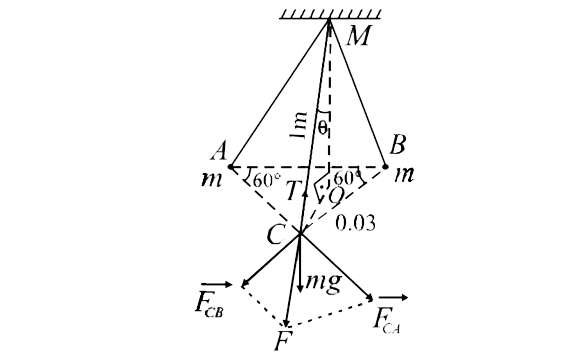 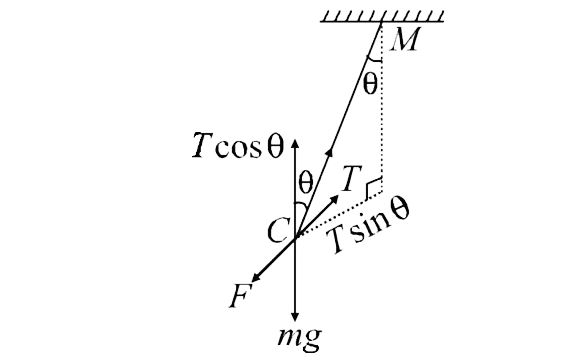 Let T make and angle `theta` with the vertical `OC=2/3sqrt((0.03)^2-(0.015)^2)=0.0173m` `:.` `OM=0.9997` NOTE THIS STEP: Resolving T in the direction of mg and F and applying the condition of equilibrium, we get `Tcos theta=mg`, `Tsintheta=F` `:.` `tan theta=(F)/(mg)` ...(i) `F=sqrt(F_(CA)^2+F_(CB)^2+2F_(CA)F_(CB)cosalpha)` `:.` `F=sqrt(F_(CA)^2+F_(CA)^2+2F_(CA)^2xx1/2)` `F=sqrt3F_(CA)=sqrt3xx(kq^2)/((CA)^2)` ...(II) [where `F_(CB)=Force on C due to B F_(CA)=Force on C due to A `|vecF_(CB)|=|vecF_(CA)|` and `alpha=60^@`] ALSO, `tantheta=(OC)/(OM)=(0.0173)/(0.9997)` ...(iii) From (i), (ii) and (iii) `(0.0173)/(0.9997)=(sqrt3xx9xx10^9xxq^2)/((0.03)^2xx10^-3xx9.8)` On SOLVING, we get `q=3.16xx10^-9C`. |
|
| 6. |
Which of the following is a correct relation |
|
Answer» `._(a)mu_(R)=._(a)mu_(w)xx._(r)mu_(OMEGA)` |
|
| 7. |
A very long uniformly charged thin wirewhose one end is at point (0,a) extends along positive y-axis . The charge per unit length of wire is lamda . The electric field at origin is |
|
Answer» `(lamda)/(4piepsi_0a)(-hatj)` 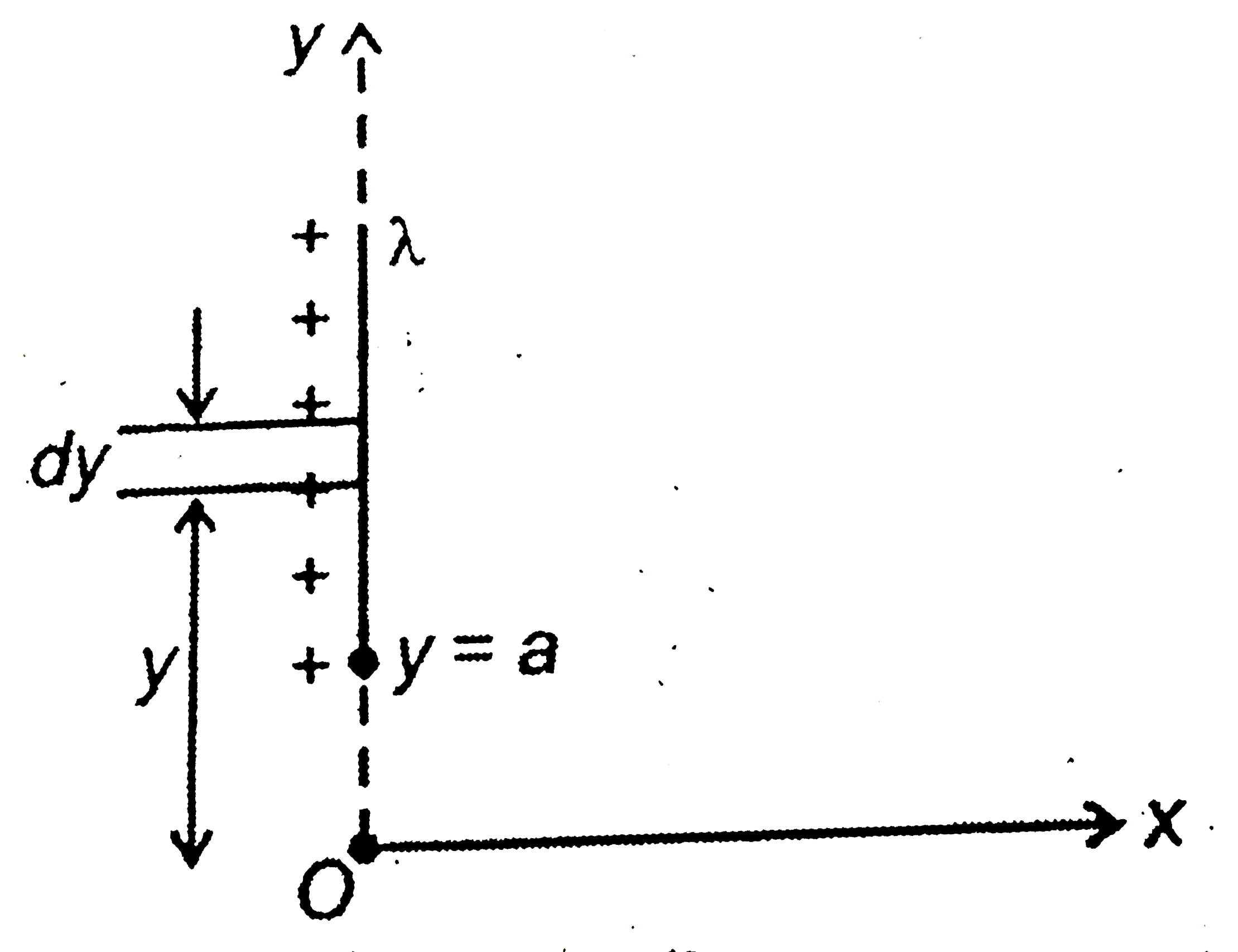 Consider on INFINITESIMALLY small element of length dy at a distance y from origin O. The CHARGE on this section is `dq=lamdady` Now, `dvecE_0 = (1)/(4piepsi_0).(dq)/(y^2) (-hatj)` `vecE_0 = (lamda)/(4piepsi_0) underset(a) OVERSET(00)INT (dy)/(y^2)(-hatj)= (-lamdahatj)/(4piepsi_0)[(1)/(-y)]_a^(oo)` `=(-lamdahatj)/(4piepsi_0) [ - (1)/(oo)- (-1/a)]` `VECE=(lamda)/(4piepsi_0a)(-hatj)` |
|
| 8. |
Two paralle plane sheets 1 and 2 carry uniform charge densites sigma_(1) and sigma_(2) (see fig. The electric field in the region marked I is (sigma_(1) gt sigma_(2)): |
|
Answer» `-(sigma_(1))/(2epsilon_(0))` |
|
| 9. |
The air column in a pipe closed at one end is made to vibrate in its third over tone by tuning fork of frequency 220Hz. The speed of sound in air is 330m/sec. End correction may be neglected. Let P_0denote the mean pressure at any point in the pipe and Delta P_0the maximum amplitude of pressure vibrationWhat is the maximum pressure at the open end of the pipe ? |
| Answer» Answer :A | |
| 10. |
For making a telescope two lenses of focal lengths 5 cm and 50 cm are to be used . Which lens will you use for objective ? |
|
Answer» Solution :FOCUSSING for infinity the magnifying power of a telescope is GIVEN by, `m=(f_o)/(f_e)` Where `f_o` = focal length of the objective and `f_e` = focal length of the eyepiece so for higher magnifying power `f_o` should be GREATER than `f_e` Hence the lens of large focal length i.e ., 50 cm is to be used as objective . |
|
| 11. |
A thick rope of rubber of density 1.5 kg//m^(3) and Y=5xx10^(6)Nm^(-2) metres in length when hung vertically will increase in length by: (g=10ms^(-2)) |
|
Answer» `9.6xx10^(-5)m` |
|
| 12. |
A : In double slit experiment, the pattern on the screen is actually a superposition of sngle-slit diffraction from each slit and the double -slit interference pattern. R : The diffraction pattern has a central bright maximum which is twice as wide as the other maxima. |
|
Answer» Both A and R are TRUE and R is the correct explanation of A |
|
| 13. |
A horizontal wire AB of length T and mass 'm' carries a steady current I_1 free to move in vertical plane is in equilibrium at a height of 'h' over another parallel long wire CD carrying a steady current I_2 which is fixed in a horizontal plane as shown. Derive the expression for the force acting per unit length on the wire AB and write the condition for which wire AB is in equilibrium. |
|
Answer» FE- Ferromagnetic |
|
| 14. |
When a beam of unpolarised light is incident on a glass plate at the polarising angle , then : |
|
Answer» the REFLECTED ray and the refracted ray are both PARTIALLY polarised |
|
| 15. |
A small, electrically charged bead can slide on a circular, frictioless, insulating rod. A point - like electric dipole (vec(P)) is fixed at the centre of the circle with the dipole.s axis lying in the plane of the circle. Intially the bead is on the plane of symmetry of the dipole, as shown in the figure. The bead is slightly displaced along ring, tangentially with intial speed very close to zero. (Ignore the effect of gravity, assuming that the electric forces are much greater than the gravitational ones). The normal force exerted by rod on the bead is (q = angle between an radius vector of bead, (considering dipole as origin) |
|
Answer» <P>`(2K|vec(p)|theta.costheta)/(r^(3))` |
|
| 16. |
A small, electrically charged bead can slide on a circular, frictioless, insulating rod. A point - like electric dipole (vec(P)) is fixed at the centre of the circle with the dipole.s axis lying in the plane of the circle. Intially the bead is on the plane of symmetry of the dipole, as shown in the figure. The bead is slightly displaced along ring, tangentially with intial speed very close to zero. (Ignore the effect of gravity, assuming that the electric forces are much greater than the gravitational ones). How would the bead move in the absence of rod (intial motion is perpendicular to and negligibly small) |
|
Answer» On circular PATH, as it was moving with the frictionless, circular, INSULATING rod |
|
| 17. |
A satellite has kinetic energy K, potential energy V and total energy E. Which of the following statements is true ? |
|
Answer» `K=-V//2` Kinetic energy of satellite, `K=(GMm)/(2r)` Total energy of satellite, `E-K+V` `E=(GMm)/(2r)-(GMm)/(r )=-(GMm)/(2r)" or "K+V=(V)/(2), :. K=-(V)/(2)`. |
|
| 18. |
A circular coil of Radius R is folded across its diameter such that the planes of two half rings are perpendicular to each other as shown in the figure. If the current through the coil is calculate the magnetic dipole moment of the configuration so formed. |
|
Answer» `(piR^2l)/2(hati+hatj)` |
|
| 19. |
What should be the length of the dipole antenna for a carrier wave of frequency3 xx 10^8 Hz? |
|
Answer» 1m `=(lambda)/(2)=(C)/(2V)=(3xx10^(8))/(2xx3xx10^(8))=0.5m` |
|
| 20. |
(A):The position -time graph of a body may be a straight line parallel to time axis (R ):It is possible that position of a body does not change with time. |
|
Answer» |
|
| 21. |
In experiment, an oil drop carrying a change Q is held staionary by a potential difference of 2400 V between the keep a drop of half the radius stationary the potentia difference had to be made 600 volt. What is the charge on the second drop |
| Answer» Answer :B | |
| 22. |
The given graph represents V-1 characteristic for a semiconductor device. Which of the following statement is correct? |
|
Answer» It is V-1 characteristic for SOLAR cell where point A represents open circuit voltage and point B short circuit current |
|
| 23. |
Obtain an expression for Magnetic field inside a solenoid by using Ampere's Circuital Law. |
|
Answer» SOLUTION :Consider a RECTANGULAR Amperian loop abcd. Along cd the field is zero because the field at the exterior is weak and moreover the field is along the axis of the SOLENOID with no PERPENDICULAR or normal component. Therefore the field outside the solenoid approaches zero. Alongtransverse sections bc and ad, the field component is zero. Let the field along be ab be B. The relevant length of the Amperian loop is l. Let n be the number of turns PER unit length. The total number of turns corresponding to the length l is nl. The enclosed current `I_(e)=Inl` where I is the current in the Solenoid.  From Ampere's circuital law `Bintdl=mu_(0)I` i.e., `Bl=mu_(0)Inl`. Therefore `B=m_(0)nI`. The direction of magnetic field is given by the right-hand rule. Note: The solenoid is used to obtain a uniform magnetic field. |
|
| 24. |
Given structures are lying in vertical plane and are hinged at x. Every structure is made up of two identical rods with mass M & length L each. Initially all are at rest and released. Initially in every case, one of the rods of the structure is vertical and the other horizontal |
|
Answer» `{:(P,Q,R,S),(2,3,4,1):}` for `(2),alpha_(x)=(PI)/(I)=(3mgL)/(2.2mL^(2))=(3g)/(4L)` When K.E. becomes maximum the COM of the structure is lowest. `K.E._(Max) =2MG [3+sqrt(10)/(4)]L` Angle turned for `(1)` `(pi)/(2)+ tan_(-1) ((1)/(3))` Moment of inertia `B rarr(2ML_(2))/(3)` |
|
| 25. |
A light string is tied at one end to fixed support and to a heavy string of equal length L at the other end as shown in figure. Mass per unit length of the strings are u and 9u and the tension is T. Find the possible values of frequencies such that point A is a node/ antinode. |
|
Answer» Solution :`F/2, f, (3f)/2`…. ETC, when A is a node and `3/2f, 5/4 f, 7/4f`… etc, when A is an ANTINODE, Here `f = 1/L SQRT(T/mu)` |
|
| 27. |
Derive an expression for capacitance of the above capacitor with the dielectric slab in between the plates |
|
Answer» `E= SIGMA epsilon_0` |
|
| 28. |
A mixture of oxygen and inflammable gas is burnt in a closed vessel placed in water The temperature of water rises. Consider water and mixture as one system, has heat been given to the water ? |
| Answer» SOLUTION :INCREASED | |
| 29. |
A 6 cm long toothpick is floating on the surface of water the surface tension on one side of it is 50 dynes/cm and some camphor placed on the other reduces the surface tension to 45 dynes/ cm. The resultant force acting on the toothpick will be (in dynes) |
|
Answer» ZERO |
|
| 30. |
A small air bubble is situated at a distance of 3 cm from the center of a glass sphere of radius 9 cm. When viewed from the nearest side, the bubble appears to be at a distance of 5 cm from the surface. Its apparent distance when viewed from the farthest side is nx5 cm where 'n' is? |
|
Answer» |
|
| 31. |
There is one coil of resistance 5 Omega and magnetic flux linked with the coil is changed by Delta phi in 0.1 s. Induced current is found to decrease linearly from 4 A to zero in the given time interval. Calculate value of Delta phi in Wb. |
|
Answer» Average CURRENT `i_(AV) = 2 A` Average emf induced `e_(av)= (DELTAPHI)/(Deltat)` Average current `i_(av)= e_(av)//R= (1)/(R)(Deltaphi)/(Deltat)` Substituting VALUES we get the following: `2= (1)/(5) xx (Deltaphi)/(0.01)` `Deltaphi= 1Wb` Hence answer is 1. |
|
| 32. |
The kinetic energy of photo-electrons emitted by a metal surface depends upon …. Of radiation |
|
Answer» INTENSITY |
|
| 33. |
If hat idenotes a unit vector along an incident ray , hat ra unit vector along the refracted ray into a medium of refractive index mu and n a unit vector normal to the boundary of the media directed towards the incident medium, then the law of refraction can be written as |
|
Answer» `hati . HATN = MU (hat r.hatn)` |
|
| 34. |
(A): The distance of closest approch to a gold nucleus of an alpha -particle of K.E 5.5Mev is about 4.0 xx 10^(-14)m (R): Rutherford by assuming that the coulomb repulsive force was only responsible for scattering. |
|
Answer» Both .A. and .R. are true and .R. is the correct explanation of .A. |
|
| 35. |
(A) : A loosely round helix made of stiff wire is suspended vertically with the lower end just touching a dish of mercury. When a current is passed through the wire, the helical wire executes oscillatory motion with the lower end jumping out of and into the mercury. (R) : When electric current is passed through helix, a magnetic field is produced both inside and outside the helix. |
|
Answer» Both 'A' and 'R' are true and 'R' is the correct explanation of 'A'. |
|
| 36. |
125 small water droplets, each of radius, 0.1 mm come together to form a large drop. S.T. of water is 70 dyne/cm. The amount of energy |
|
Answer» `2.8 piergs` is RELEASED |
|
| 37. |
Transistor output characteristic curves are the graphs drawn with |
|
Answer» COLLECTOR current `I_C` on y-axis and the collector EMITTER voltage` V_(CE)` on X-axis for a CONSTANT BASE current |
|
| 38. |
A parallel bean of light travelling in water (refractie index =4/3) is refracted by a spohereical bubble of radius 2 mm situation in water. Assuming the light rays to be paraxial. i. find the position of the image due to refraction at the first surface and the positoin of the final image, and ii draw a ray diagram showing the positions of oth the images. |
|
Answer» 2 MM JO the left |
|
| 39. |
A sound wave of frequency f travels horizontally to the right. It is reflected from a large verticalplane surface moving to the left with a speed v. The speed of sound in the medium is c, then |
|
Answer» The FREQUENCY of the reflected WAVE is a `(f(c + v))/(c - v)` |
|
| 40. |
An electron is trapped in a one-dimensional infinite well of width 200 pm and is in its ground state. What are the (a) longest, (b) second longest, and (c) third longest wavelengths of light that can excite the electron from the ground state via a single photon absorption? |
| Answer» SOLUTION :(a) `4.37xx10^(-8)m`, (B) `1.65xx10^(-8)m`, (C) `8.77xx10^(-9)m` | |
| 41. |
Consider a non conducting plate of radius a and mass m which has a charge q distributed uniformly over it, The plate is rotated about its own axis with an angular speed omega. Show that the magnetic moment M and the angular momentum L of the plate are related as M/L=q/(2m). |
|
Answer» Solution :If `sigma` is the surface CHARGE density, then `q = sigmapia^(2)` Current i `= sigmaomegardr` The magnetic moment of the element ring `dM=i(dA)=sigmaomegar dr(pir^(2))=pisigmaomegar^(3) dr` and `M=pisigmaomegaint_(0)^(a)R^(3)dr=(pisigmaomegaa^(4))/4=(PIA^(2)sigma)(omegaa^(2))/4` The angular momentum of the disc about its axis `L=(ma^(2))/2omega`. The ratio `M/L=((qomegaa^(2))/4)/((omegama^(2))/2)=q/(2m)` |
|
| 42. |
Figure shows two capacitors in series. The rigid center section of length .b. is movable. The area ofeach plate is S. If the voltage difference between the plates is maintained constant at V_0 The change in stored energy if the center section is removed is |
|
Answer» `(Sepsilon_0V_0^2A)/(2B(a-B))` |
|
| 43. |
To a man going east in a car with velocity of 40 km/h., a train appears to move towards north with a velocity of 40sqrt3 km/h. The magnitude of actual velocity of the train is |
|
Answer» 30 km/h |
|
| 44. |
A transformer is used to light100 W - 110 lamp from 220 V mains. If the main current is 0.5 A, the efficiency of the transformer is |
|
Answer» 0.9 |
|
| 45. |
If a ball is thrown at a velocity of 45m//s in vertical upward direction, then what would be the velocity profile as function of height? Assume g=10m//s^(2) |
|
Answer»
|
|
| 46. |
A steel wire of negligible mass length L_0 and cross sectional area A_0 is kept on a smooth horizontal table with one end fixed. A ball of mass M is attached to the other end. The wire and ball are rotating with angular velocity omega . If elongation in the wire is DeltaL, then the value of Young's modulus of elasticity will be |
|
Answer» `(ML_0^2omega^2)/(A_0DeltaL)` |
|
| 47. |
Like poles of bar magnet ...... each other and its unlike poles ...... each other. |
|
Answer» REPEL, attract |
|
| 49. |
v_(1) is the frequencyof the series limit of Lyman series, v_(2) the frequency of the first line of Lyman series and v_(3) is the frequency of the series limit of the Balmer series. Then |
|
Answer» `v_(1)-v_(2)=v_(3)` `v_(1)=RC[1-(1)/(OO)]=RC` `v_(2)=RCp[1-(1)/(4)]=(3)/(4)RC` `v_(3)=RC[(1)/(4)-(1)/(oo)]=[(RC)/(oo)]=(RC)/(4)` `RARR v_(1)-v_(2)=v_(3)` |
|
| 50. |
Two identical circular coils are separated by a distance twice the radius of either of the coil. If n = 2, r = 0.08 m, i = 3A, then calculate the resultant magnetic field at the mid point of the line joining their centres, for currents in the same sense and opposite sense in the two circular coils. |
|
Answer» Solution :Give : n =2, r = -0.08 m, i = 3A Magnetic field at a point on the axis, `""=(mu_(0)/(4PI))((2pinir^(2))/((r^(2)+x^(2))^(3//2)))` At P, `""B=(10^(-7) times 2 times 3.142 times 2 times 3 times r^(2))/(r^(2)+r^(2))^(3//2)` `""=(37.7 times 10^(-7) times r^(2))/(2.828 times r^(3))` `""=(13.33 times 10^(-7))/(0.08)` `""=1.67 times 10^(-5)T` For currents in the same direction `B_(p)=2B=3.34 times 10^(-5)T` For currents in the same OPPOSITE direction `B_(p)^(')=` zero. 
|
|


