

Saved Bookmarks
This section includes 7 InterviewSolutions, each offering curated multiple-choice questions to sharpen your Current Affairs knowledge and support exam preparation. Choose a topic below to get started.
| 1. |
Who occupied the back benches in the class? |
|
Answer» WEAK students |
|
| 2. |
A ring rolls on a plane surface. The fraction of total energy associated with its rotation is : |
|
Answer» SOLUTION :`T.E.=(1)/(2)mv^(2)+(1)/(2)Iomega^(2)=(1)/(2)mv^(2)+(1)/(2)mr^(2)omega^(2)` `=(1)/(2)mv^(2)+(1)/(2)mv^(2)=mv^(2)` `therefore (E_("rotational"))/(E_("total"))=((1)/(2)mv^(2))/(mv^(2))=(1)/(2)` |
|
| 3. |
A body of mass m is placed at the centre of the spherical shell of radius R and mass M. The gravitation potential on the surface of the shell is |
|
Answer» `-G/H (M+m)` |
|
| 4. |
In the arrangement shown in the figure a light ray is incident at an angle of 37^@ on the layer of water. Find the angle of emergence (e) through the layer of glass. |
| Answer» SOLUTION :`E= SIN^(-1)( 0.4)` | |
| 5. |
The binding energy per nucleon for the parent nucleus is E_(1) and that for the daughter nuclei is E_(2). Then : |
|
Answer» `E_(1) = 2 E_(2)` |
|
| 6. |
Determine the maximum wavelength of incident radiation that can be used to remove tha remaining electron from a singly ionized helium atom He^(+)(Z=2). Assume the electron is in its ground state |
|
Answer» 6.2 NM |
|
| 7. |
Light of frequency 1.5 times the threshold frequency is incident on a photosensitive material, photo electric current is emitted. If the frequency of light is halved and intensity is doubled, the photoelectric current becomes |
|
Answer» 4 times the ORIGINAL current |
|
| 8. |
A full wave rectifier uses two diodes with a load resistance of 100Omega . Each diode is having negligible forward resistance. Find the efficiency of this full wave rectifier |
|
Answer» SOLUTION :Forward resistance of the diode, `r_f =0 OMEGA `, LOAD resistance, `R_L = 100 Omega ,eta = ?` Efficiency of full wave RECTIFIER`eta =( 0.812R_L )/(r_f +R_L)` ` =( 0.812xx 100)/( 100 ) = 0.812` The percentage efficiency of the full wave rectifier=81.2% |
|
| 9. |
Calculate the momentum and the de Broglie wavelength in the following cases : (i) an electron with kinetic energy 2 eV. (ii) a bullet of 50g fired from rifle with a speed of 200 m/s (iii) a 4000 kg car moving along the highways at 50 m/s Hence show that the wave nature of matter is important at the atomic level but is not really relevant at macroscopic level. |
|
Answer» Solution :(i) Momentum of the electron is P `= sqrt(2mK)` `= sqrt(2 xx 9.1 xx 10^(-31) xx 2 xx 1.6 xx 10^(-19)) = 7.63 xx 10^(-25)"kg ms"^(-1)` Its de Broglie wavelength is `lambda = (h)/(p) = (6.626 xx 10^(-34))/(7.63 xx 10^(-25)) = 0.868 xx 10^(-9)m = 8.68 Å` (ii) Momentum of the bullet is `p = mv = 0.050 xx 200 = "10 kg ms"^(-1)` Its de Broglie wavelength is `lambda = (h)/(p) = (6.626 xx 10^(-34))/(10) = 6.626 xx 10^(-33)`m (III) Momentum of the car is `P = mv = 4000 xx 50 = 2 xx 10^(5)"kg ms"^(-1)` Its de Broglie wavelength is `lambda = (h)/(p) = (6.626 xx 10^(-34))/(2 xx 10^(5)) = 3.313 xx 10^(-39)`m From these calculations, we notice that electron has significant value of de Broglie wavelength (`~~ 10^(-9)` m which can be measured from diffraction studies) but bullet and car have negligibly small de Broglie wavelengths associated with them (`~~ 10^(-33)m and 10^(-39)`m respectively, which are not MEASURABLE by any experiment). This implies that the wave NATURE of matter is important at the atomic level but it is not really relevant at the macrosopic level. |
|
| 10. |
Pure Si at 300 K has equal electron (n_(e)) and hole (n_(h)) concentrations of 1.5xx10^(16)m^(-3) doping by indium increases n_(h) to 4.5xx10^(22)m^(-3). Caculate n_(e) in the doped Si- |
| Answer» SOLUTION :`5 xx 10^(9) m^(-3)` | |
| 11. |
Identify the wrong statement |
|
Answer» a) Current loop is equivalent to a magnetic dipole |
|
| 12. |
Bullets of 0.03 kg mass each, hit a plate at the rate of 200 bullet//s, with a velocity of 50 ms^(-1) and reflect back with a velocity of 30 ms^(-1). The average force acting onthe plate, in Newton is, |
|
Answer» 120 `P_(1)=nmv_(1)= 200 xx 0.03 xx 50` ` = 300 kgms^(-1)` `P_(2)=-nmv_(2)= 200 xx 0.03 xx 30` ` = -180 kgms^(-1)` Force acting, `P_(2) – P_(1)=-180-300` |
|
| 13. |
A point object moves along the principal axis of a convex lens of focal length f such that its realimage, also formed on the principal axis at a distance (4f)/(3)(at t=0) moves away from the lens with uniform velocity alpha. Find the velocity of the point object as a function of time t. |
|
Answer» `((F)/(f+ ALPHA t))^2 alpha` |
|
| 14. |
The bulbs of two identical thermometers are coated one with lamp black an the other with silver thin film coated. When exposed in sun light for shorter time then the reading of the thermometer with lamp black coating will be |
|
Answer» more than that with SILVER coating |
|
| 15. |
Moving particles of matter should display wavelike properties under suitable conditions. Name the scientist who pur forward this hypothesis. |
| Answer» SOLUTION :LOUIS DE BROGLIE | |
| 16. |
Assertion :- When a bar magnet moves along the axis of conducting coil, than its kinetic energy and a part of magnetic energy of bar magnet is converted into electrical energy of coil. Reason :- Lenz law is based on conservation of energy. |
|
Answer» If the ASSERTION & REASON are TRUE& the Reason is a correct explanation of the Assertion . |
|
| 17. |
A ray of light is incident normally on one refracting surface of an equilateral prism . If the refrctive index of a material of the prism is 1.5., then |
|
Answer» the EMERGENT RAY is DEVIATED by `30^(@)` |
|
| 18. |
The fundamental of a sonometer wire increases by 6 Hz if its tension is increased by 44 % keeping the length constant. Find the change in the fundamental frequency of the sonometer wire, when the length of the wire is increased by 20% keeping the original tension in the wire. |
| Answer» ANSWER :C | |
| 19. |
A piece of copper of mass 1kg heated upto temperature 80°C and then dropped in a. glass beaker filled with 500cc of water at 20°C. After some time the final temperature of water is recorded to be 35°C. The specific heat capacity of copper is: (take specific heat capacity of water = 4200 J// kg^(@) C and neglect the thermal capacity of beaker) |
|
Answer» `420 J// kg^(@) C` |
|
| 20. |
In the circuit shown, the resistances are given in ohms and the battery is assumed ideal with emf equal to 3.0 volts. The resistor that dissipates the most power is |
|
Answer» `R_(1)` |
|
| 21. |
A convex lens of focal length 40 cm is in contact with a concave lens of foal length 25 cm. The power of the lens combination is |
|
Answer» <P>`-1.5D` `therefore"Power of lens combination "P=P_(1)+P_(2)=+2.5-4.0=-1.5D` |
|
| 22. |
A tank with a smallcircular holecontains oil on top ofwater . It is immersed in a larger tankof the same oil . Water flows through the hole . (a) Whatis the velocityof this flowintially ? (b) Whenthe flows stops , what would be the position of the oil - water interface in the tank ? (density of oil = 8 gm/cc) |
|
Answer» Solution :ApplyingBernoulli.s equation between points 1 and 2 ` rArr P_(atm) +eho_(0)gh_(0) + rho_(w)gh_(w) = P_(atm) +rho_(0)G(h_(0)+h_(w))+1/2 rho_(w) V^(2)` `rArr 1/2 rho_(w)v^(2) = gh_(w) (rho_(w) - rho_(0))` ` rArr v = sqrt(2gh_(w)(1- (rho_(0))/(rho_(w)))) = sqrt(2 xx 9.8 xx 10/100 (1- (800)/1000))` ` = 0.63 ` m/s (b) In the termsof the heighth of oil water interface ` P_(atm) +rho_(0)g xx 5 + rho_(w)gh = P_(atm) +rho_(0)g (10+5) +1/2 rho_(w) v^(2)` ` rArr 1/2 rho_(w)v^(2) = g (rho_(w)H - rho_(n).10)` FLOW stops when `rho _(w)h - rho_(o) xx 10 ` ` :.h = 0.8 xx10 = 8 cm ` ` :. ` The interface is at a height 8 cm abovethe base . 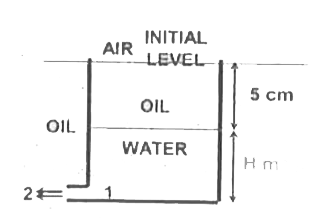
|
|
| 23. |
Rahim was a student of science and was suffering from some disease. He was under treatement of a restered medical practioner. The doctor sent Rahim repeatedly for x-rays examination. Rahim was hestitant for the same. He told the doctor that they had been tanght that the repeated exposure to x-rays would be harmful. The doctor told him not to worry as he knew things better. Read the above passage and answer the following questions: (i) For what purpose x-ray examination of a patient is required by a doctor? (ii) Is the doctor right to ask Rahim for repeated x-ray examination? (iii) What do you learn from this study? |
|
Answer» Solution :(i) x-rays examination of a patient is required to diagnose the location of a defect or disease especially in bones, as x-rays can pass through blood and flesh but not through bones. (ii) No, the DOCTOR is not right as REPEATED x-rays exmanination of a human body may destroy small and sensitive tissue of the body which may cause further PROBLEMS. (III) The doctor is not expected to misguide a patient for extraneous considerations. For a patient, the doctor is next only to GOD. He shouldalways provide a fair treatment. |
|
| 24. |
A vehicle sounding a whistle of frequency 256Hz is moving on a straight road,towards a hill with velocity of 10ms^-1. The number of beats per second observed by a person travelling in the vehicle is (velocity of sound = 300ms^-1 |
|
Answer» 0 |
|
| 25. |
If 10% of the main current passes through the galvanometer of resistance 99 Omega, then the shunt resistance will be |
|
Answer» `9.9 OMEGA` |
|
| 26. |
State Brewester's law |
| Answer» SOLUTION :The REFRACTIVE INDEX of the reflecting MEDIUM is equal to the tangent of the polarizing angle. | |
| 27. |
The distances of two satellites P and Q from earth are in the ratio 3:1. The ratio of their total energy will be: |
|
Answer» `1:1` So CORRECT CHOICE is (d). |
|
| 28. |
In a room containing air, heat can go from one place to another by |
|
Answer» CONDUCTION |
|
| 29. |
When the frequency of the incident light on a photo sensitive metal is changed from 7.6 xx 10^(14) Hz to 6 xx 10^(14) Hz the value of stopping potential changes by 0.66 V. Calculate Planck's constant. [Note : Any form of Einstein's P.E. Equation can be considered] |
|
Answer» Solution :`HV = hv_(0) + eV_(s)` `H xx 7.6 xx 10^(14) = hv_(0) + 1.6 xx 10^(-19)V_(1)` `h xx 6 xx 10^(14) = hv_(0) +1.6 xx 10^(-19)V_(2)` Subtracting the above two equations we GET `h(1.6 xx 10^(14)) = 1.6 xx 10^(-19)(V_(1)-V_(2))` Here `(V_(1)-V_(2)) = 0.66` given, simplifying we get `h = 6.6 xx 10^(-34)` Js |
|
| 30. |
In the hydrogen atom, an electron revolve around a proton in a circular orbit of radiu 0.53 A. The radial acceleration and the angular velocity of the electron are......and…………. (m_(e) = 9.1 xx 10^(-31) kg, e = 1.6 xx 10^(-19)C) |
|
Answer» Solution :Suppose, charge on a proton and an electron is e The electric force between them at DISTANCE d will be: `F = (ke^(2))/r^(2)` `=(9 xx 10^(9) xx (1.6 xx 10^(-19))^(2))/(0.53 xx 10^(-10))^(2)` `= 82.02 xx 10^(-9)` `therefore F = 8.2 xx 10^(-8)` N The centripetal ACCELERATION `=("Centripetal force")/("mass")` `therefore a_( c) = F/m` [Mass of electron, `m_(e) = 9.1 xx 10^(-31) kg`] `=(8.1 xx 10^(-8))/(9.1 xx 10^(-31))` `therefore a_( c) = 0.9 xx 10^(23) m//s^(2)` Centripetal force `=(MV^(2))/r = (mr^(2)omega^(2))/r [therefore v= romega]` `therefore F = mromega^(2)` `therefore omega = [F/(mr)]^(1/2)` `=[17 xx 10^(32)]^(1//2)` `therefore omega = 4.1 xx 10^(16)` rad/s |
|
| 31. |
A carbon resistor has coloured strip as shown in the figure.What is its resistance? |
| Answer» SOLUTION :`68xx10^4=+-5%OMEGA` | |
| 32. |
Inverse process of X-ray production is |
|
Answer» PHOTOELECTRIC effect |
|
| 33. |
When light incidents on transparent medium at polarization angle, then elements ..... are there in reflected light. |
|
Answer» Only 15% `sigma` |
|
| 34. |
When the key is closed, a spark is generated between the ends of the rods. a. Explain the cause of the spark. b. Explain why a spark is also produced when the key is opened. c. Why are no sparks produced when the key is left closed? |
|
Answer» SOLUTION :a. The INDUCED e.m.f is secondary b. During decay actually a large e.m.f should be induced in the secondary C. No variation of FLUX takes place |
|
| 35. |
Which one of the following is the natural nanomaterial. |
| Answer» Answer :a | |
| 36. |
The energy of a photon is equal to the K.E. of a proton. The energy of a photon is E. If lamda_(1) and lamda_(2)are the de broglie wavelengths of proton and photon, then (lamda_(1))/(lamda_(2)) is proportional to : |
|
Answer» <P>`E^(@)` For photon `E_(p)=1//2 mv^(2)=((mv)^(2))/(2m)=(p^(2))/(2m)` `rArr p= SQRT(2mE_(p))` `:.` for proton `lambda_(1)=(H)/(p)=(h)/(sqrt(2mE_(p)))` But `E_(ph)=E_(p)=E` `:. (lambda_(1))/(lambda_(2))-(h)/(sqrt(2mE))xx(E)/(hc)= (sqrt(E))/(sqrt(2)C)` `:. (lambda_(1))/(lambda_(2)) prop sqrt(3)` |
|
| 37. |
In the YDSE the monochronic source of wavelength lambdais palced at a distance d/2from the central axis (as shown in the figure ) , where d is the separation betweentwo slits S_(1) and S_(2).Find the position of the central maxima . (Given d = 6 mm ) |
|
Answer» |
|
| 38. |
A body of mass 5 kg moving on a horizontal surface with a velocity of 10 ms^(-1) comes to rest in 2s. The force required to make this body move with a velocity of 10 ms^(-1) on the same surface is |
| Answer» Answer :C | |
| 39. |
A compound microscope consists of an objective lens with focal length 1.0 cm and eye piece of the focal length 2.0 cm anda tube 20 cm from eye lens, the distance between the two lenses is |
|
Answer» `6.00 cm` `m = m_(o) XX m_(E) = (L/f_(o)) xx (D/(f_(e)))` Here, `L = 20 cm, d = 25 cm` (near point), `f_(o) = 1 cm` and `f_(e) = 2 cm` `:. m = (20)/(1) xx (25)/(2) = 250` |
|
| 40. |
In which position of an object for a convex lens is the image virtual. |
| Answer» SOLUTION :When OBJECT LIES between POLE and FOCUS. | |
| 41. |
A rocket is going away from the earth at a speed of 10^(6)m//s.If the wavelength of the light wave emitted by it be 5700 Å, what will be its Doppler's shift |
| Answer» ANSWER :B | |
| 42. |
A conducting sphere of radius R is give a charge Q. The electric potential and the electric field at the centre of the sphere are, respectively |
|
Answer» a) ZERO, `(Q)/(4PI epsilon_(0) R^(2))` |
|
| 43. |
The wavelength of spectrum line is inversely proportional to the ......... |
|
Answer» ENERGY DIFFERENCE `DeltaE=(hc)/(lamda)` `:.` In `E=(hc)/(DeltaE)`, hc constant `:.lamdaprop(1)/(DeltaE)` |
|
| 44. |
Two protones are keptat a separationof 10 nm. Let F_(n) and F_(e)be thenuclear forceand theelctromagneticforce betweenthem . |
|
Answer» `FE LT ltFn` |
|
| 45. |
The wavelength of the matter wave associated with a particle is independent of its |
|
Answer» mass |
|
| 46. |
Four photodiodes D_(1), D_(2),D_(3) and D_(4) are made of semiconductors having band gaps of 2.5 eV, 3 eV, 2 eV, 3.5 eV respectively. Which one will be able to detect light of wavelength 600 nm? |
|
Answer» `D_(4)` |
|
| 47. |
What is magnetic dipole moment for a coil ? Write its SI unit and dimensional formula. |
|
Answer» Solution :1. The product of current flowing from coil and area vector of that coil is known as magnetic dipole MOMENT. 2. If I current flow through coil and A be the area of this coil, then magnetic dipole moment is given by, `vecm=IvecA` 3. If N number of turns, then dipole moment is DEFINE as, `vecm=NIvecA` 4. SI unit of dipole moment is `Am^(2)` and its dimensional formula is given by `[M^(0)L^(2)T^(0)A^(1)]`. 5. `vectau=vecmxxvecB` `thereforetau=mBsintheta` `therefore" If "vecmandvecB` both are parallel `(theta=0^(@))` or anti parallel `(theta=180^(@))` to each other than torque will be ZERO and it is stable equilibrium. 6. If `theta=0^(@)`, then coil is in stable equilibrium. 7. When `theta=180^(@)` then it is in maximum unstable equilibrium because at any small rotation of thecoil produces a torque which brings it back to itsoriginal position. |
|
| 48. |
Two thin lenses of focal lengths f1 and f2, are in contact and coaxial. The power of combination is |
|
Answer» `SQRT(f_1/f_2)` `THEREFORE`Power of combination P =`1/f=(f_1+f_2)/(f_1f_2)` |
|
| 49. |
A symmetric biconvex lens of radius of curvature R and made of glass of refractive index 1.5, is placed on a layer of liquid placed on top of a plane mirror as shown in the figure. An optical needle with its tip on the principal axis of the lens is moved along the axis until its real, inverted image coincides with the needle itself. The distance of the needle from the lens is measured to be x. On removing the liquid layer and repeating the experiment, the distance is found to be y. Obtain the expression for the refractive index of the liquid in terms of x and y. |
|
Answer» Solution :Let` mul `denotethe refractive index of the liquid when the IMAGE , of the needle COINCIDES with the LENS itself , its DISTANCE form the lens , equals the relevant focal length with liquids layer present ,the given set up , is equivalent to a combination of the given (convex ) lens and a concavo plane/ piano concave .liquid. lens and ` ( 1)/(f) =((1)/( f_1) +(1)/(f_2)) ` as per the given data , we then have ` (1)/( f_1) =(1)/( y) =( 1.5- 1 ) ((1)/( R) -( 1)/(-R)) ` = `(1)/(R) ` ` therefore (1)/(x) =( mu _1 -1 ) (-(1)/(R))+( 1)/( y) = ( -mu _t)/(y) + ( 2)/(y)` ` therefore ( mu _t)/( x) =(2)/( y) -(1)/( y ) =((2x-y)/( xy )) ` `mu l =((2x-y)/( x))` |
|
| 50. |
In the question number 42, the time lag between the current maximum and the voltage maximum is |
|
Answer» `15.5 ms` Then, `tan phi = (X_(C ))/(R )=(1//omega C)/(R )=(1)/(omega CR)=(1)/(2pi upsilon CR)` `tan phi = (1)/(2pixx60xx10^(-4)xx40)` `tan phi=(0.6634), phi = tan^(-1)(0.6634)` `=33.56^(@)=33.56xx(pi)/(180)` RAD `therefore` Time LAG, `Delta t = (phi)/(omega) = (180)/(120 pi)=1.55xx10^(-3)s "" [because omega 2pi upsilon = 120 pi)` `= 1.55 ms` |
|