

Saved Bookmarks
This section includes 7 InterviewSolutions, each offering curated multiple-choice questions to sharpen your Current Affairs knowledge and support exam preparation. Choose a topic below to get started.
| 1. |
If a hemispherical body is placed in a uniform electric field E then the flux linked with the curved surface is |
|
Answer» `2pi R^(2)E` |
|
| 2. |
In two days the radioactivity of a radon specimen decreased to 1/1.45 of its original value. Find its half-life. |
|
Answer» |
|
| 3. |
An astronaut drops a rock from the top of a crater on the moon. When the rock is halfway down to the bottom of the crater, its speed is what fraction of its final impact speed? |
|
Answer» `(1)/(4sqrt(2))` |
|
| 4. |
Which of the following electromagnetic waves have minimum frequency |
|
Answer» Microwaves |
|
| 5. |
(A) : Higher the range, lower is the resistance of ammeter. (R) : To increase the range of ammeter, additional shunt needs to be used across it. |
|
Answer» Both 'A' and 'R' are true and 'R' is the correct EXPLANATION of 'A'. |
|
| 6. |
The view in the figure is form above a plane mirror suspended by a threadconnectedto the centre of the mirror at a point A. A scaleis located0.75m (the distanceform point A to point P) to the rightof the centre fo the mirror. Initially, the palneof the mirror is parallel to the sidefo the scale, and the angleof incidence of a light raywhich isdirectedat the centreof the mirroris 30^(@). A small torqueappleid to the threadcausesthe mirrorto turn11.5^(@) away formits initial positon. The reflectedray thenintersects the scaleat point Q. The distanceform point P to point Q on the scale is |
|
Answer» `1.00m` 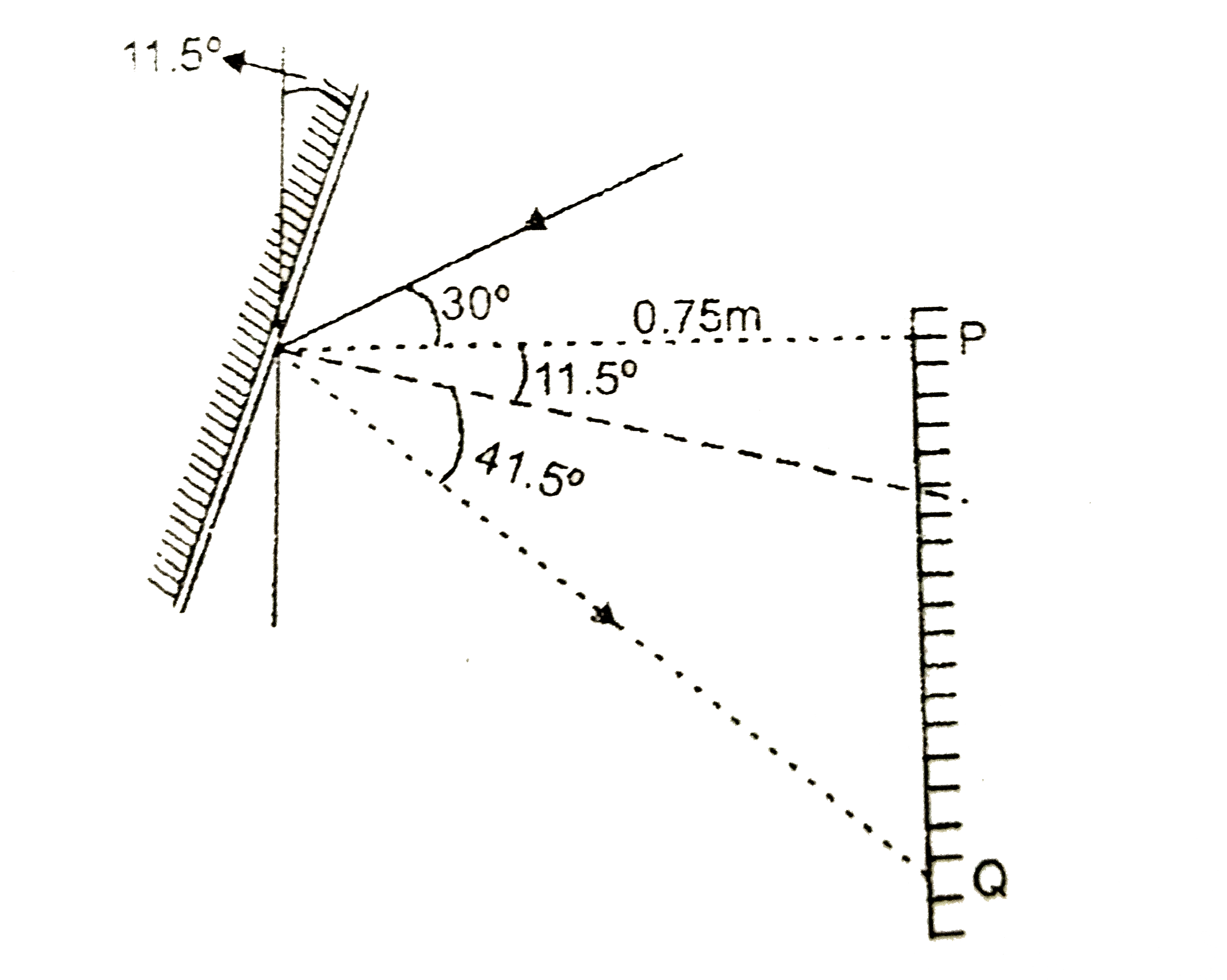 `tan (11.5+41.5)^(@)` `= tan 53^(@) = (PQ)/(0.75) RARR PQ = (4)/(3) XX 0.75 = 1M` |
|
| 7. |
In an ac circuit , the flow of current is opposed by inductors and capacitors.The is called reactance.An electric bulb B and a parallel plate capacitor C are connected in serise to an AC mains as shown in the figure.The bulb glows with some brightness . How will the glow of the bulb be affected on introducing a dielectric slab between the plates of the capacitor?Given reasons in support of your answer, (##ANE_RJB_PHY_XII_C07_E03_004_Q01##) |
| Answer» Solution :Bulb glows withgreater brightness Introduction of the dielectric SLAB incrases the capacity of the capacitor by K TIMES, where K is the DIELECTRICCONSTANT of the MATERIAL between the plates , Hance capacitiv reactanc `X_E=1/C(OMEGA)` decreases. | |
| 8. |
A metallic rod of length lis hinged at one end and the other end is rotated with a constant angular speed omega about an axis passing through the hinge. A constant and uniform magnetic field B, parallel to the axis of rotation exists everywhere. The induced emf between the two ends of rod is 1/2 Bl omega^(2). |
|
Answer» |
|
| 9. |
A cyclist is moving on a smooth horizontal curved path of radius of curvature 10m.with a speed 10 ms^(-1). Then his angle of leaning is |
|
Answer» `15^(@)` |
|
| 10. |
Answer question (a) - (e) on the basis of data given in the following table and your understanding of the relation studied concepts : In a school laboratory following lenses are available : All these lenes are converging lenses. Which two lenses would you select to design a compound microscope and why? |
| Answer» Solution :To design a COMPOUND microscope we shall select lens no. 10 (f = 2 cm and APERTURE A = 1 cm) as the objective lens and lens no. 7 (f = 3 cm and aperature A = 2 cm) as the eyepiece. It is due to the FACT that both the lenses in a compound microcope be of small focal length and small aperature. However, comparatively focal length and aperture of objective is even smaller than that of eyepiece. | |
| 11. |
Bindingenergy per nucleon curve as a function of atomic mass number has a sharp peak for helium nucleus. we can conclude from this that helium nucleus |
|
Answer» is very STABLE |
|
| 12. |
Answer question (a) - (e) on the basis of data given in the following table and your understanding of the relation studied concepts : In a school laboratory following lenses are available : All these lenes are converging lenses. Which two lenses would you choose to prepare an astronomical telescope? Give reason for your choice. |
| Answer» SOLUTION :To design an astronomical TELESCOPE we SHELL select LENS no. 3 (focal length f = 100 cm and aperture A = 20 cm) as the objective lens and lens no. 11 (focal length f = 2 cm and aperture A = 1.5 cm) as the eyepiece because focal length and aperature of objective of a telescope should be as possible but focal length and aperature of eyepiece should be small. | |
| 13. |
Which mode of wave propagation is suitable for television broadcast and satellite communication, and why ? Draw a suitable diagram depicting this mode of propagation of wave. |
|
Answer» Solution :The space wave propagation is suitable for TELEVISION BROADCAST and SATELLITE communication. The radiowaves from the transmitting antenna T can reach the receiving antenna R along the three paths as shown in figure. 
|
|
| 14. |
In a zener diode, break down occurs in reverse bias due to |
|
Answer» thin DEPLETION region |
|
| 15. |
When a steel ball is dropped in oil |
|
Answer» a)The ball attains CONSTANT velocity after some time |
|
| 16. |
In the above question the energy before and after the collision will be : |
|
Answer» `E=(1)/(2)Iomega^(2)+(1)/(2)MV^(2)` `=(1)/(2)xx(1)/(2)xx2xx0.04xx9+(1)/(2)xx0.5xx25` `=0.18+6.25=6.43J` Also energy after collision `E_(C)=(1)/(2)xx((M)/(2)+m)R^(2)omega^(2)` `=(1)/(2)[(2)/(2)+0.5]xx0.04xx(10.3)^(2)` `=(1)/(2)xx1.5xx0.04xx106.09` = 3.18 J |
|
| 17. |
A stone projected vertically from the ground.It reaches the maximum height of 500 m in 10 sec.After what time it will reach the ground from the maximum height reached? |
|
Answer» 5s |
|
| 18. |
A few countires are using powerful electromagnets to develop high speed trains, called maglev trains (also known as bullet trains). Maglev is short for 'magnetic levitation', which means that these trains will float over a guil way using the basic principles of magnets to replace the old steel wheel and track trains. The big difference between a maglev train and a conventional train is that maglev trains do not have an engine. The engine for maglev trains is rather inconspicuous as instead of fossil fuels it uses magnetic field. The magnetised coil running along the track, called the guideway, repels the large magents on the trains's under carriage allowing the train to levitate between 1 to 10 cm above the guideway . This is called electrodyanmic suspension (EDS). Once the train is levitated, power is supplied to the coils within the guideway walls to create a unique system of magnetic fields that pull and push the train along the guideway. The electric current supplied to the coils in the guideway wall is constantly alternating to change the polarity of the magnetised coils. This change in polarity causes the magnetic field in fornt of the train to pull the vehicle forward, while the magnetic field behind the train adds more forward thrust. Maglev trains float on a cushion of air eliminating friction. This lack of friction and the train's aerodynamic design allows these trains to reach unprecedented group transportation speed of 400 km h^(-1) or even more. The force which makes maglev move is |
|
Answer» GRAVITATIONAL |
|
| 19. |
Answer question (a) - (e) on the basis of data given in the following table and your understanding of the relation studied concepts : In a school laboratory following lenses are available : All these lenes are converging lenses. (d) What should be teh distance between objective and eye piece of your telescope and what is the expected value of its magnifying power? |
|
Answer» Solution :As `f_(0)=100cm and f_(e)=2CM`, hence distance MAINTAINED between the two lenses (or LENGTH of telescope tube, `L=f_(0)+f_(e)=100+2=102cm=1.02m` and magnifying power of telescope `m=(f_(0))/(f_(e))=(100cm)/(2cm)=50` |
|
| 21. |
A few countires are using powerful electromagnets to develop high speed trains, called maglev trains (also known as bullet trains). Maglev is short for 'magnetic levitation', which means that these trains will float over a guil way using the basic principles of magnets to replace the old steel wheel and track trains. The big difference between a maglev train and a conventional train is that maglev trains do not have an engine. The engine for maglev trains is rather inconspicuous as instead of fossil fuels it uses magnetic field. The magnetised coil running along the track, called the guideway, repels the large magents on the trains's under carriage allowing the train to levitate between 1 to 10 cm above the guideway . This is called electrodyanmic suspension (EDS). Once the train is levitated, power is supplied to the coils within the guideway walls to create a unique system of magnetic fields that pull and push the train along the guideway. The electric current supplied to the coils in the guideway wall is constantly alternating to change the polarity of the magnetised coils. This change in polarity causes the magnetic field in fornt of the train to pull the vehicle forward, while the magnetic field behind the train adds more forward thrust. Maglev trains float on a cushion of air eliminating friction. This lack of friction and the train's aerodynamic design allows these trains to reach unprecedented group transportation speed of 400 km h^(-1) or even more. The disadvantage of maglev trains is |
|
Answer» less heat generated |
|
| 22. |
Answer question (a) - (e) on the basis of data given in the following table and your understanding of the relation studied concepts : In a school laboratory following lenses are available : All these lenes are converging lenses. Draw the ray diagram for image formation of a far off object in normal arrangement of astronomical telescope. |
Answer» SOLUTION :The RAY DIAGRAM is SHOWN here : 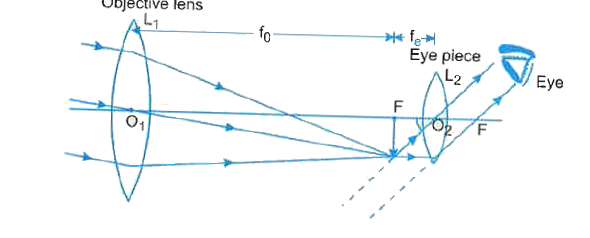
|
|
| 23. |
What is a communication system? |
| Answer» SOLUTION :The SET up used to TRANSMIT information from one point to another is CALLED a communication system | |
| 24. |
According to the kinetic theory of gases, the pressure exerted by a gas on the walls is measured as |
|
Answer» RATE of change of MOMENTUM imparted to the walls PER SECOND per unit AREA |
|
| 25. |
A few countires are using powerful electromagnets to develop high speed trains, called maglev trains (also known as bullet trains). Maglev is short for 'magnetic levitation', which means that these trains will float over a guil way using the basic principles of magnets to replace the old steel wheel and track trains. The big difference between a maglev train and a conventional train is that maglev trains do not have an engine. The engine for maglev trains is rather inconspicuous as instead of fossil fuels it uses magnetic field. The magnetised coil running along the track, called the guideway, repels the large magents on the trains's under carriage allowing the train to levitate between 1 to 10 cm above the guideway . This is called electrodyanmic suspension (EDS). Once the train is levitated, power is supplied to the coils within the guideway walls to create a unique system of magnetic fields that pull and push the train along the guideway. The electric current supplied to the coils in the guideway wall is constantly alternating to change the polarity of the magnetised coils. This change in polarity causes the magnetic field in fornt of the train to pull the vehicle forward, while the magnetic field behind the train adds more forward thrust. Maglev trains float on a cushion of air eliminating friction. This lack of friction and the train's aerodynamic design allows these trains to reach unprecedented group transportation speed of 400 km h^(-1) or even more. The levitation of the train is due to |
|
Answer» mechanial FORCE |
|
| 26. |
A car moving at a speed V is stopped by a retarding force F in a distance S. If the retarding force were 6F, the car will be stopped in a distance : |
|
Answer» `(S)/(12)` `F.S. =(1)/(2) m upsilon^(2)` `S=(m upsilon^(2))/(2F)`For constant m and `upsilon` `Sprop(1)/(F)` When FORCE BECOMES 6 times then distance `(1)/(6)th` Hence correct CHOICE is (c). |
|
| 27. |
The position vectors of radius are vec(r_(1))=2hati+hatj + hatk , vec(r_(2))=2hati - 3hatj + hatk while those of linear momentum are 2hati + 3hatj - hatk. The angular momentum is : |
|
Answer» `2hati-4hatk` `vec(r )=(4hati-2hatj+2hatk)` `L=vec(r )xxvec(p)=(4hati-2hatj+2hatk)xx(2hati+3hatj-hatk)` `(4hati-8hatk)` |
|
| 28. |
Calculate the energyreleasedin the reaction""_(92)^(235)U +""_(0)^(1)n- to""_(36)^(92) Kr+""_(0)^(1) n+Q Given: Mass of""_(92)""^(235 )U =235.0439amu Mass of""_(56 )^(141)Ba =140.9178 am u Mass of""_(36 )^(92) Kr =91.8854a m uandmass ofneutron=1.008655am u. Expressthe resultin joules . |
|
Answer» Solution :Given : Mass of ` ""_(92)""^(235 )U =235.0439amu ` Mass of ` ""_(56 )^(141)Ba =140.9178 am u` Mass of ` ""_(36 )^(92) Kr =91.8854a m u ` andmass ofneutron`=1.008655am u`. Expressthe resultin joules . Totalmass ofreactants `=235.0439+ 1.008655` `=236.052555a m u` totalmass ofproducts `=140.9178+91.8854 +(3 XX 1.008655)` `=232.8032 +3.025965 ` ` =235.829165 am u` Massdefect,` Deltam=236.0525555 -235 .829165` `Delta m=0.22339am u ` Energyreleased peratomof `U^(235 )= Delta m xx 931.5 MeV ` `=0.22339 xx 931.5 xx 10^6 xx 1.6 xx 10^(-19)` `=332.94 xx 10^(-13)` `=3.3294 xx 10^(-11) J` |
|
| 29. |
Answer question (a) - (e) on the basis of data given in the following table and your understanding of the relation studied concepts : In a school laboratory following lenses are available : All these lenes are converging lenses. Why do we prefer an objective lens of large aperature in a telescope? |
| Answer» SOLUTION :APERTURE of TELESCOPE objective is taken LARGE so as to increase its RESOLVING power. | |
| 30. |
A brass wire of length 5 m and cross section area 10^(-6) m^(2) hungfrom rigidsupportwith brass weight of volume 10^(-3)m^(3) hangingfrom other end. Then the decreasein length of the wire when brassweight is completely immersed in water is, (g=10m//s^(2), Y_("brass")=10^(11)N//m^(2), rho_(w)=10^(3)kg//m^(3)) |
|
Answer» `5xx10^(-4)m` |
|
| 31. |
Temperature dependence of resistivity p(T) of semiconductors, insulators and metals is Significantly based on the following factors : |
|
Answer» number of charge carriers can change with temperature T. Resistivity of metal , `rho= (m)/("ne"^(2)TAU )` where n is number density of charge carrier PER unit volume. With increase in temperature `tau`time interval between two successive collision decrease. Resistivity `rho prop (1)/(tau)` . Hence `rho` depend on temperature. |
|
| 32. |
Initially the circuit is in steady state. When the switch S is closed, the heat generated in the circuit will be |
|
Answer» `(epsilon^2C)/2` |
|
| 33. |
The magnetic charges-2 Am and +2 Am are separated by a distance of 15 cm.The magnetic moment is |
|
Answer» `0.25 Am^(2)` |
|
| 34. |
A charge Q has been divided on two concentirc conducting spheres of radii R_(1) and R_(2) (R_(1) gt R_(2)) such that the surface charge densities on both the sphere is same. Find the potential at their common center. |
Answer» Solution :Let charge `Q_(1)` is given on the outer sphere then charge on the inner sphere is `Q_(z) = Q - Q_(1)`. Now it has been given that both the sphere have same SURFACE charge density i.e charge per unit area on both the sphere is same. 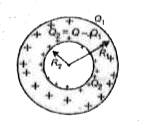 Therefore, `(Q_(1))/(4 PI epsilon_(0)R_(1)^(2)) = (Q_(2))/(4 pi epsilon_(0)R_(2)^(2))`( because area of sphere is `4 pi R^(2)` ) or , `(Q_(1))/(R_(1)^(2))= (Q-Q_(1))/(R_(2)^(2))` (because `Q_(2) = Q - Q_(1)` ) Doing CROSS multiplcation we get `Q_(1) = (Q.R_(1)^(2))/(R_(1)^(2) + R_(2)^(2))` therefore `Q_(2) = Q - Q_(1) = Q -(Q.R_(1)^(2))/(R_(1)^(2) + R_(2)^(2)) = (Q.R_(2)^(2))/(R_(1)^(2) + R_(2)^(2))` Now, the potential at the common centre O will be the surface potential of respective spheres added together. i.e. V = `(Q_(1))/(4 pi epsilon_(0)R_(1)) + (Q_(2))/(4 pi epsilon_(0)R_(2))` Subsitute for `Q_(1) and Q_(2)` and get V = `(1)/(4 pi epsilon_(0))[ (Q_(1))/(R_(1)) + (Q_(2))/(R_(2))] = (1)/(4 pi epsilon_(0)) [ (Q.R_(1)^(2))/(R_(1)(R_(1)^(2) + R_(1)^(2))) + (Q.R_(2)^(2))/(R_(2)(R_(1)^(2) + R_(1)^(2))) ]= (1)/(4 pi epsilon_(0)) (Q(R_(1) + R_(2)))/((R_(1)^(2) + R_(2)^(2)))` 
|
|
| 35. |
A loop is formed by two parallel conductors connected by a solenoid with inductance L and a conducting rod of mass M which can freely slide over the conductors. The conductors are located in a uniform magnetic field with induction B perpendicular to the plane of loop. The distance between conductors is l. At t = 0, the rod is given a velocity v_(0) directed toward right and the current through the inductor is initially zero (below figure) . |
|
Answer» The maximum CURRENT in circuit during the motion of ROD is `v_(0)sqrt(M//L)` |
|
| 36. |
A ball is projected at an angle 30° with the horizontal. What is the component of acceleration along the velcoity of projection ? |
|
Answer» G |
|
| 37. |
A body of mass m rests on a horizontal plane with the friction coefficient k. At the moment t=0 a horizontal force is applied to it, which varies with time as F=at, where a is a constant vector. Find the distance traversed by the body during the first t seconds after the force action began. |
|
Answer» Solution :Since, the applied force is proportional to the TIME and the frictional force also EXISTS, the MOTION does not start just after applying the force. The body starts its motion when F equals the limiting friction. Let the motion start after time `t_0`, then `F=at_0=kmg` or, `t_0=(kmg)/(a)` So, for `t=let_0`, the body remains at rest and for `tgtt_0` obviously `(mdv)/(dt)=a(t-t_0)` or, `mdv=a(t-t_0)dt` Integrating, and noting `v=0` at `t=t_0`, we have for `tgtt_0` `UNDERSET(0)overset(v)intmdv=aunderset(t_0)overset(t)int(t-t_0)dt` or `v=(a)/(2m)(t-t_0)^2` Thus `s=int vdt=(a)/(2m)underset(t_0)overset(t)int (t-t_0)^2dt=(a)/(6m)(t-t_0)^3` |
|
| 38. |
A hydrogen atom in ground state absorbs 10.2 eV of energy. The orbital angular momentum of the electron is increased by |
|
Answer» `3.16 xx10 ^(-34 ) Js` `epsi_0 -epsi_1 = Delta EPSI ,AsDelta = 10.2eV & E_1=- 13.6 EV` `epsi_2=- 3.4eVVimpliesn=2` `DeltaL=L_2 -L_1= 1.05 xx 10 ^(-34) Js` |
|
| 39. |
For an electron microscope that uses electrons accelerated throught 120 kV. |
|
Answer» Resolving power is approximately 5 TIMES larger than that of an ordinary microscope using white light. |
|
| 40. |
Which gives the variation of magnetic suscetibility(x)withmagnetising field for a paramagnetic substance ? |
|
Answer»
|
|
| 41. |
A magnetic needle is pivoted through its centre of mass and is free to rotate in a plane containing uniform magnetic field 200 xx 10^(-4)T. When it is displaced slightly from the equilibrium it makes 20 oscillations per second. If the moment of inertia of the needle about the axis of oscillation is 0.75 xx10^(-5) kg m^(2), find the magnetic moment of the needle. |
|
Answer» Solution :Magnetic field induction , `B = 200 xx 10^(-4)T = 2 xx 10^(-2)T ` Frequency v=2Hz MOMENT of inertia , `I=0.75 xx 10^(-5) kgm^(2)` Frequency of oscillation , ` v=(1)/(2PI)sqrt((MB)/(I))` On squaring we can write . ` v^(2) = (1)/(4pi^(2)) xx (MB)/(I) IMPLIES M = (4pi^(2) xx v^(2) xx I)/(B)` `=(4(3.14)^(2) xx 2^(2) xx 0.75 xx 10^(-5))/(2 xx 10^(-2)) = 0.059` `:.` Magnetic moment of the needle , `M~= 0.06 Am^(2)` |
|
| 42. |
In Young.s duble slitexperiment ,when a glass plate (mu=1.5)of thickness is introduce path of one of the interfering beams (wavelength =lambda) ,the intensity at the position where centre maxima occurred previous remains unchanged .The minimum thickness at the gives |
|
Answer» `2 LAMBDA ` |
|
| 43. |
The torsion modulus of a spiral spring is 2 N·m/rad. The spring is turned 10 times. What is the work done? |
|
Answer» `W=1/2Malpha=1/2//alpha^2` Note that the torsion modulus `f = M//alpha`is an analogue of the spring constant `k = F//x` |
|
| 44. |
Which son agreed to give Yayati his youth and take his old age? |
|
Answer» ELDEST SON |
|
| 45. |
One mole of an ideal gas at temperature T_(1) expands according to the law (P/V) = constant. Find the work done when the final temperature becomes T_(2). |
|
Answer» `R(T_(2) - T_(1))` `W = underset(V_(1))overset(V_(2))int PDV = underset(V_(1))overset(V_(2))int KVdV (.:. P/V = K = "constant")` ` :. W = 1/2 K(V_(2)^(2) - V_(1)^(2))` As we know, in case of an ideal gas, `PV = RT . " But " P = KV` , ` :. KV^(2) = RT " or " K(V_(2)^(2) - V_(1)^(2)) = R (T_(2) - T_(1))` ` :. W = R/2 (T_(2) - T_(1))` |
|
| 46. |
A road runs between two parallel rows of buildings.A motorist moving just in the middle with a velocity of 30 km/h, sounds the horn. He hears an echo one second after sounding the horn. Find the distance (in metre) between thetwo rows of the buildings. The velocity of sound =330 m/s. |
Answer» Solution :Suppose 2 y is the distance between two rows of the buildings. The distance travelled by a CAR in 1 SECOND  `x=(30xx5/18)xx1=8.33m` The distance travelled by sound in 1 second `2l=330xx1=330m` `:.l=165m` From the figure `y=SQRT(l^(2)-(x/2)^(2))` `=sqrt(165^(@)-(8.33/2)^(2))` `=164.95m` Thus the distance between two rows of the buildings `2y=329.9m` |
|
| 47. |
The resistance of moving coil galvanometer is made twice its original value in order to increase current sensitivity by 50% Will the voltage sensitivity change ? If so, by how much? |
|
Answer» Solution :Yesvoltagesensitvitywill change . Voltagesensitivity is `V_(s) = (I_(s))/(R)` WHENTHE RESISTANCEIS doubled,then newresistanceis `R = 2R` INCREASE incurrentsensitivity is `V_(S) = ((3)/(2) I_(s))/(2R) = (3)/(4)V_(s)` . Hence ,the voltagesensitivitydecreases .The percentagedecrease in voltagesensitivityis `(V_(s) - V_(s))/(V) XX 100% = 25%` . |
|
| 48. |
A heavy disc with radius R is rolling down hanging on two non-stretched string wound around the disc very tightly. The free ends of the string are attached to a fixed horizontal support. The strings are always tensed during the motion. At some instant, the angular velocity of the disc is omega, and the angle between the strings is alpha. Find the velocity of centre of mass of the disc at this moment |
|
Answer» Solution :The velocities of POINT `A` and `B` being PERPENDICULAR to the strings, the instantaneous axis of rotation MUST be at `D`, instantaneous point of intersection of the line of the two strings. Therefore, `V_(CM)=omega.OD=(omegaxxOB)/(cos.(alpha)/(2))=(omegaR)/(cos.(alpha)/(2))` 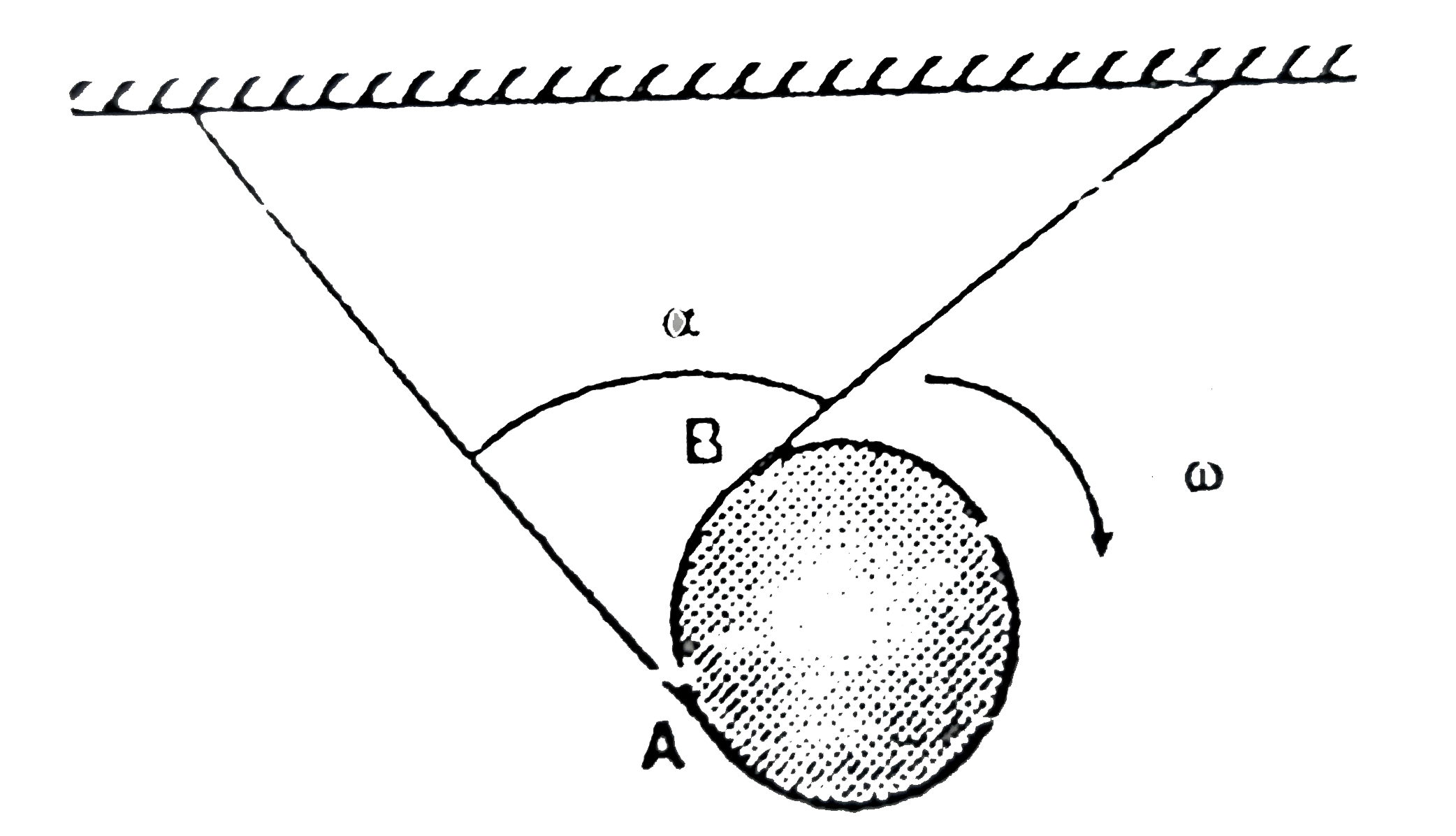
|
|
| 49. |
In Thomson spectrograph experiment, four positive ions P,Q,R and S are situated on Y-X curve a shown in the figure |
|
Answer» The specific CHARGE of R and S are same |
|
| 50. |
cos120^(@) is equal to- |
|
Answer» -1/2 |
|


