Saved Bookmarks
This section includes 7 InterviewSolutions, each offering curated multiple-choice questions to sharpen your Current Affairs knowledge and support exam preparation. Choose a topic below to get started.
| 1. |
Here is an example of where you must dig information out of a graph, not just read off a number. In Fig. 5-24a, two forces are applied to a 4.00 kg block on a frictionless floor, but only force vec(F)_(1) is indicated. That force has a fixed magnitude but can be applied at an adjustable angle theta to the positive direction of the x axis. Force F_(2) is horizontal and fixed in both magnitude and angle. Figure 5-24b gives the horizontal acceleration a_(x) of the block for any given value of theta from 0^(@) to 90^(@). What is the value of a_(x) for theta=180^(@) ? |
|
Answer» Solution :(1) The horizontal acceleration `a_(x)` depends on the net horizontal force `F_("net, x")`, as given by Newton.s second law. (2) The net horizontal force is the sum of the horizontal COMPONENTS of forces `vec(F)_(1)` and `vec(F)_(2)`. Calculations: The x COMPONENT of `vec(F)_(2)` is `F_(2)` because the vector is horizontal. The x component of `vec(F)_(1)` is `F_(1)cos theta`. USING these EXPRESSIONS and a mass m of 4.00 kg, we can write Newton.s second law `(vec(F)_("net")=m vec(a))` for motion along the x axis as `F_(1)cos theta+F_(2)=4.00a_(x),""(5-35)` From this equation we see thyat when angle `theta=90^(@),F_(1)cos theta` is zero and `F_(2)=4.00a_(x)`. From the graph we see that the corresponding acceleration is `0.50" m"//"s"^(2)`. Thus, `F_(2)=2.00` N and `vec(F)_(2)` must be in the positive direction of the x axis. From Eq. 5-35, we find that when `theta=0^(@)`, `F_(1)cos 0^(@)+2.00=4.00a_(x).""(5-36)` From the graph we see that the corresponding acceleration is `3.0" m"//"s"^(2)`. From Eq. 5-36, we then find that `F_(1)=10` N. 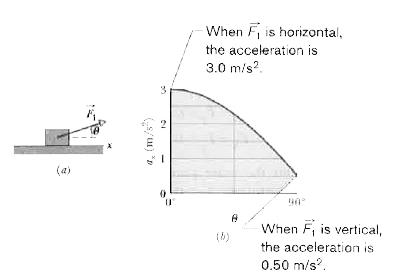 FIGURE 5-24 (a) One of the two forces applied to a block is shown. Its angle `theta` can be varied. (b)The block.s acceleration component `a_(x)` versus `theta`. Substituting `F_(1)=10" N",F_(2)=2.00" N"," and "theta=180^(@)` into Eq. 5-35 leads to `a_(x)=-2.00" m"//"s"^(2)` |
|
| 2. |
A hair dresser stand with her nose 20cminfront of a lane mirror. For what distance must she focus her eyes in order to see her nose in the mirro? |
Answer» Solution :(a) From the figure, IMAGE is situated at `40cm` from EYE 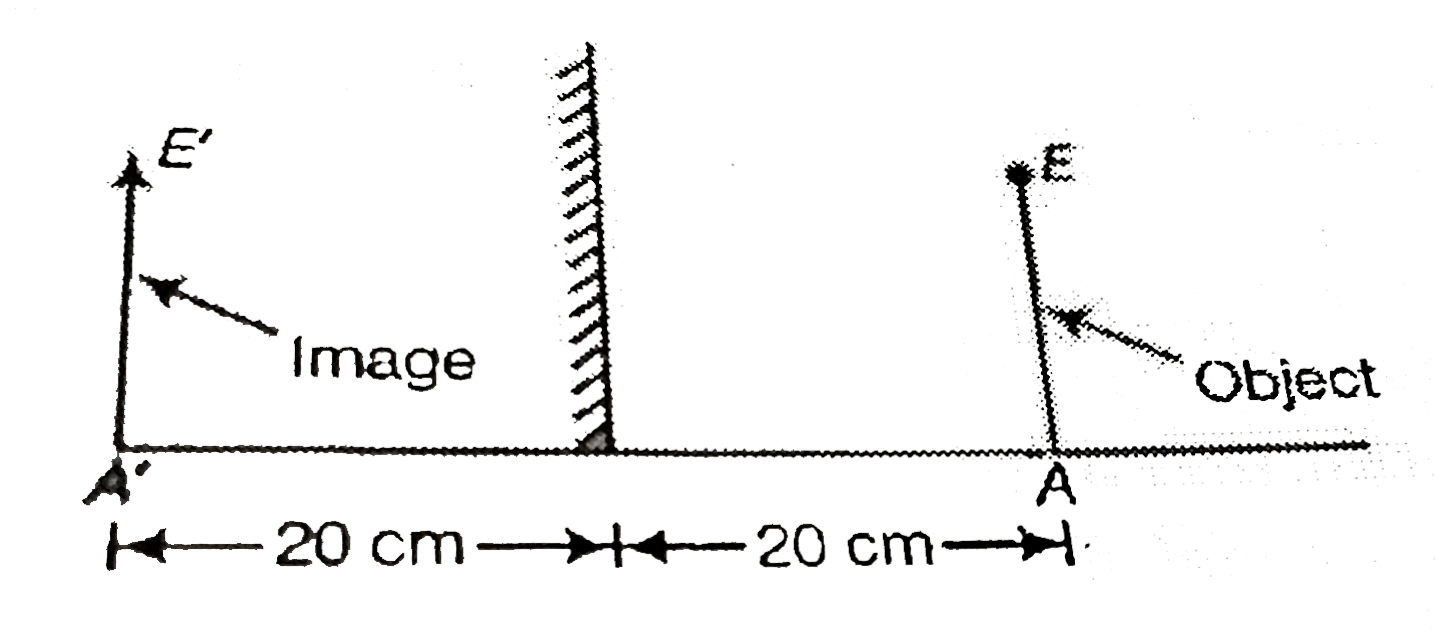
|
|
| 3. |
Two insulated identically sized charged copper spheres A and B have their centers separated by a distance of 50 cm. q= 6.5 xx 10^(-7)C . A third sphere of the same size but uncharged is brought in contact with the first, then brought in contact with the second, and finally removed from both. What is the new force of repulsion between A and B? |
|
Answer» Solution :Charge on each of the SPHERES A and B is `q=6.5 xx 10^(-2)C` When a similar but unchargod sphoro C is placed in contact with sphere A, cach sphere shares a change `q/2` EQUALLY. Now when THO sphere C `("with charge "q/2)` is placed in contact with sphere B (with charge q). the charge is redistributed equally, so that charge on sphore B or `C=1/2 (q+q/2)=3/4 q` 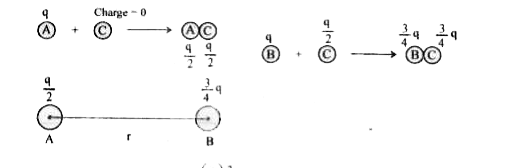 `F=(9 xx 10^(9) xx q_(A) q_(B))/(r^(2)) =(9 xx 10^(9) xx (q/2) 3/4)/(r^(2))=3/8 xx F_(1)=3/8 xx 1.5 xx 10^(-2) =5.7 xx 10^(-2)N` |
|
| 4. |
How is the speed of em-waves in vacuum determinedby the electricand magneticfields ? |
|
Answer» SOLUTION :Speed of em WAVES is determined by the ratio of the peak values of electric and MAGNETIC field vectors. [Alternaitvely,Give full creidt, if student writes directly `C=(E_(@))/(B_(@))`] |
|
| 5. |
Which device is used to transmit voltage over large distances? |
| Answer» SOLUTION :`rArr` To increase or DECREASE voltage and to transmit it safely a DEVICE CALLED transformer is USED. It can increase or decrease voltage safely at very large distance. | |
| 6. |
A spark passes in air when the potential gradient at the surface of charged conductor is 4xx10^(6) Vm^(-1). What must be the radiusof an insulated metal sphere which can be chargedtoa potentialof 4xx10^(6) V before sparking into air ? |
|
Answer» |
|
| 7. |
The ratio of densities of nitrogen and oxygen is 14 : 16. The temperature at which the speed ofsound in nitrogen will be same as that in oxygen at 55^@Cis |
| Answer» Answer :D | |
| 8. |
A uniform disc of mass m and radius R is thrown on horizontal law in such a way that it initially slides with speed V_0 without rolling. The distance travelled by the disc till it starts pure rolling is (Coefficient friction between the contact is 0.5) |
|
Answer» ` v_0^2 / 9G` |
|
| 9. |
The given circuit shows an arrangement of four capacitors. A potential differnce 30 V is applied across the combination. It is observed that potentials at connected between A an B differ by 5 V. Also if a conducting wire is connected between A and B, electrons will flow from A to B. Of course, we have bot actually connected any wire between A and B, we have described only an if situation. Answer the following question. . Charge on capacitor C_(1) is. |
|
Answer» `60 muC` `V_(4)=V_(1)` `V_(4)=17.5 V` Consider any branch say, `XAY` Since `C_(1)` and `C_(2)` are in series, charge on `C_(2)` is also `35 mu C`. Using `Q = CV` for `C_(2)` `C_(2) = C = (35)/(V_(2)) = (35)/(12.5) = 2.8 mu F` Equivalent capacitance of branch `XAY` is the series equivalent of `C_(3)=C=2.8 muF` and `C_(4)=2 muF` i.e., `1.17 muF`. There branches are in parallel between `X` and `Y`, Hence equivalent capacitance between `X` and `Y` is `1.17+1.17=2.34 muF`. Capacitor `C_(5)` is connected in the part of circuit between `X` and `A` either in series or parallel with `C_(1)=2 muF`. Let the equivalent capacitance of `C_(1)` and `C_(5)`, i.e., the equivalent capacitance between `X` and `A` be `C'_(1)`. Capacitor `C_(6)` is connected between `A` and `B` Obviously, the circuit then becomes a Wheatstone bridge. Further, since equivalent capacitance between `X` and `Y` is INDEPENDENT of the value of `C_(6)`, it implies that bridge is in the balanced condition and potentials at `A` and `B`are now equal, so that `(C'_(1))/C_(3)=C_(2)/C_(4)` or `(C'_(1))/(2.8)=(2.8)/2` (`C_(2)=2.8 muF`, as or determined earlier) or `C_(1)=3.92 muF` `C'_(1)` is the equivalent capacitance of `C_(1)=2 muF` and `C_(5)`, Since `C'_(1)gtC_(1)`, we can conclude that `C_(1)` and `C_(5)` are in parallel, So each individual capacitance .Hence, `C_(1)` and `C_(5)` are in parallel, so `C'_(1)=C_(1)+C_(5)` or `C_(5)=C'_(1)-C_(1)=3.92-2=1.92 muf` `V'_(1)+V_(2)=30` 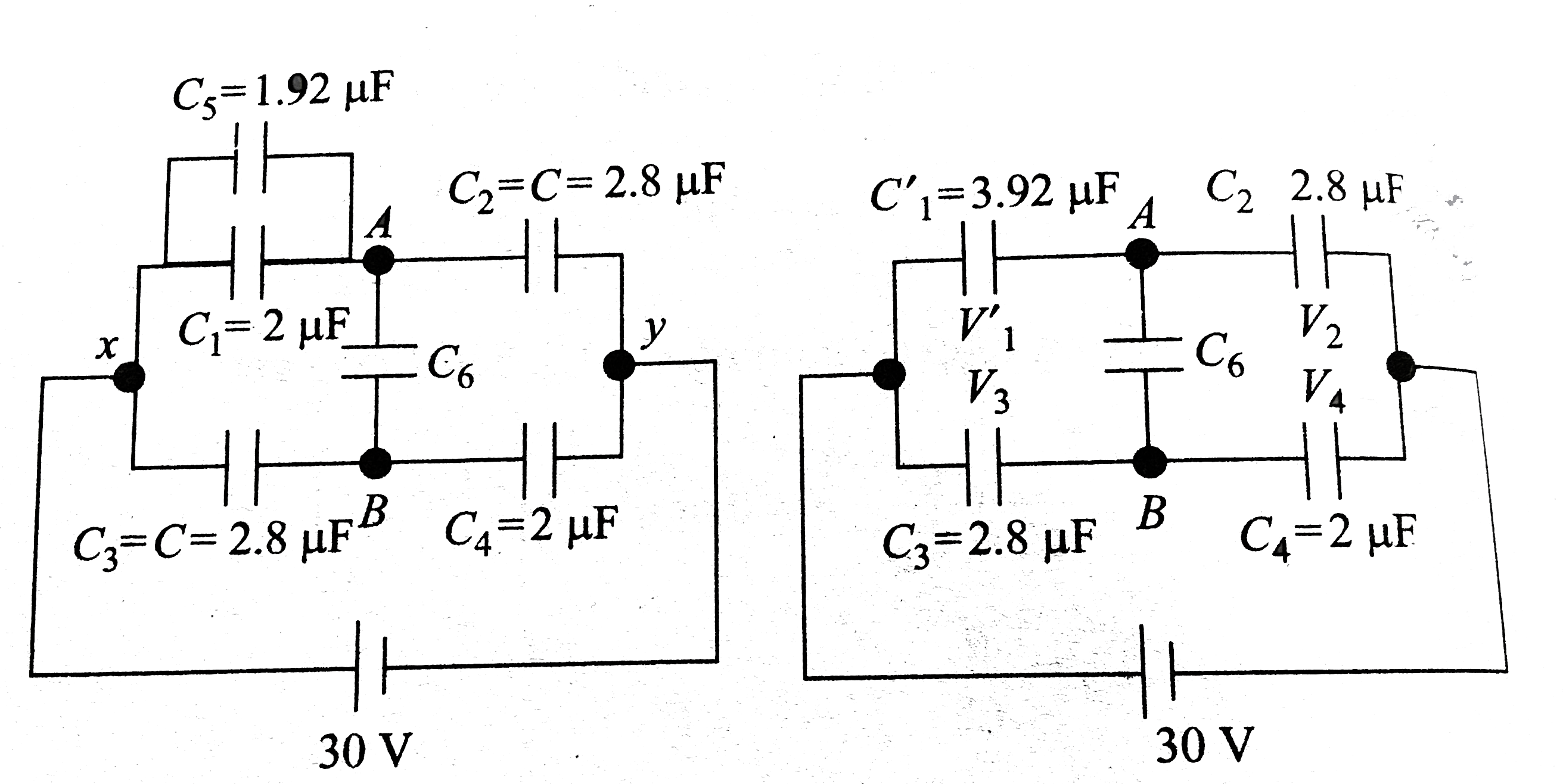 . . . . Since the bridge is in a balanced condition, `A` and `B` at same potential and `C_(6)` has zero charge. `C'_(1)` and `C_(2)` are in series. Therfore, charge on `C'_(1)` and `C_(2)` has the same value, so that potential differnce will be in the inverse ratio of capacitance [`Q=CV` or `V=Q/C "hence for same" Q,Vprop1/C']` `(V'_(1))/(V'_(2))=(2.8)/(3.92)~~0.71` or `V'_(1)=0.71 V_(2)` From Eq. (iv), `0.71 V_(2)+V_(2)=30` or `V_(2)=17.5 V` Hence `V'_(1)=30-V_(2)=12.5 V` Since `C'_(1)`, is parallel equivalet of `C_(1)` and `C_(5)`, so potential differnce across each is `V'_(1)=12.5 V`. Hence, charge on `C_(5)` is `C_(5)V'_(1)=1.92 xx12.5=24 muC`. |
|
| 10. |
आमाशय से भोजन कहाँ प्रवेश करता है |
|
Answer» क्षुद्रांत्र में |
|
| 11. |
The given circuit shows an arrangement of four capacitors. A potential differnce 30 V is applied across the combination. It is observed that potentials at connected between A and B differ by 5 V. Also if a conducting wire is connected between A and B, electrons will flow from A to B. Of course, we have bot actually connected any wire between A and B, we have described only an if situation. Answer the following question. . Equivalent capacitor between X and Y is. |
|
Answer» `2.34 muF` `V_(4)=V_(1)` `V_(4)=17.5 V` Consider any BRANCH say, `XAY` Since `C_(1)` and `C_(2)` are in series, CHARGE on `C_(2)` is ALSO `35 mu C`. Using `Q = CV` for `C_(2)` `C_(2) = C = (35)/(V_(2)) = (35)/(12.5) = 2.8 mu F` Equivalent capacitance of branch `XAY` is the series equivalent of `C_(3)=C=2.8 muF` and `C_(4)=2 muF` i.e., `1.17 muF`. There branches are in parallel between `X` and `Y`, Hence equivalent capacitance between `X` and `Y` is `1.17+1.17=2.34 muF`. Capacitor `C_(5)` is connected in the part of circuit between `X` and `A` either in series or parallel with `C_(1)=2 muF`. Let the equivalent capacitance of `C_(1)` and `C_(5)`, i.e., the equivalent capacitance between `X` and `A` be `C'_(1)`. Capacitor `C_(6)` is connected between `A` and `B` Obviously, the circuit then becomes a Wheatstone bridge. Further, since equivalent capacitance between `X` and `Y` is independent of the value of `C_(6)`, it implies that bridge is in the balanced condition and potentials at `A` and `B`are now equal, so that `(C'_(1))/C_(3)=C_(2)/C_(4)` or `(C'_(1))/(2.8)=(2.8)/2` (`C_(2)=2.8 muF`, as or determined earlier) or `C_(1)=3.92 muF` `C'_(1)` is the equivalent capacitance of `C_(1)=2 muF` and `C_(5)`, Since `C'_(1)gtC_(1)`, we can conclude that `C_(1)` and `C_(5)` are in parallel, So each individual capacitance .Hence, `C_(1)` and `C_(5)` are in parallel, so `C'_(1)=C_(1)+C_(5)` or `C_(5)=C'_(1)-C_(1)=3.92-2=1.92 muf` `V'_(1)+V_(2)=30` 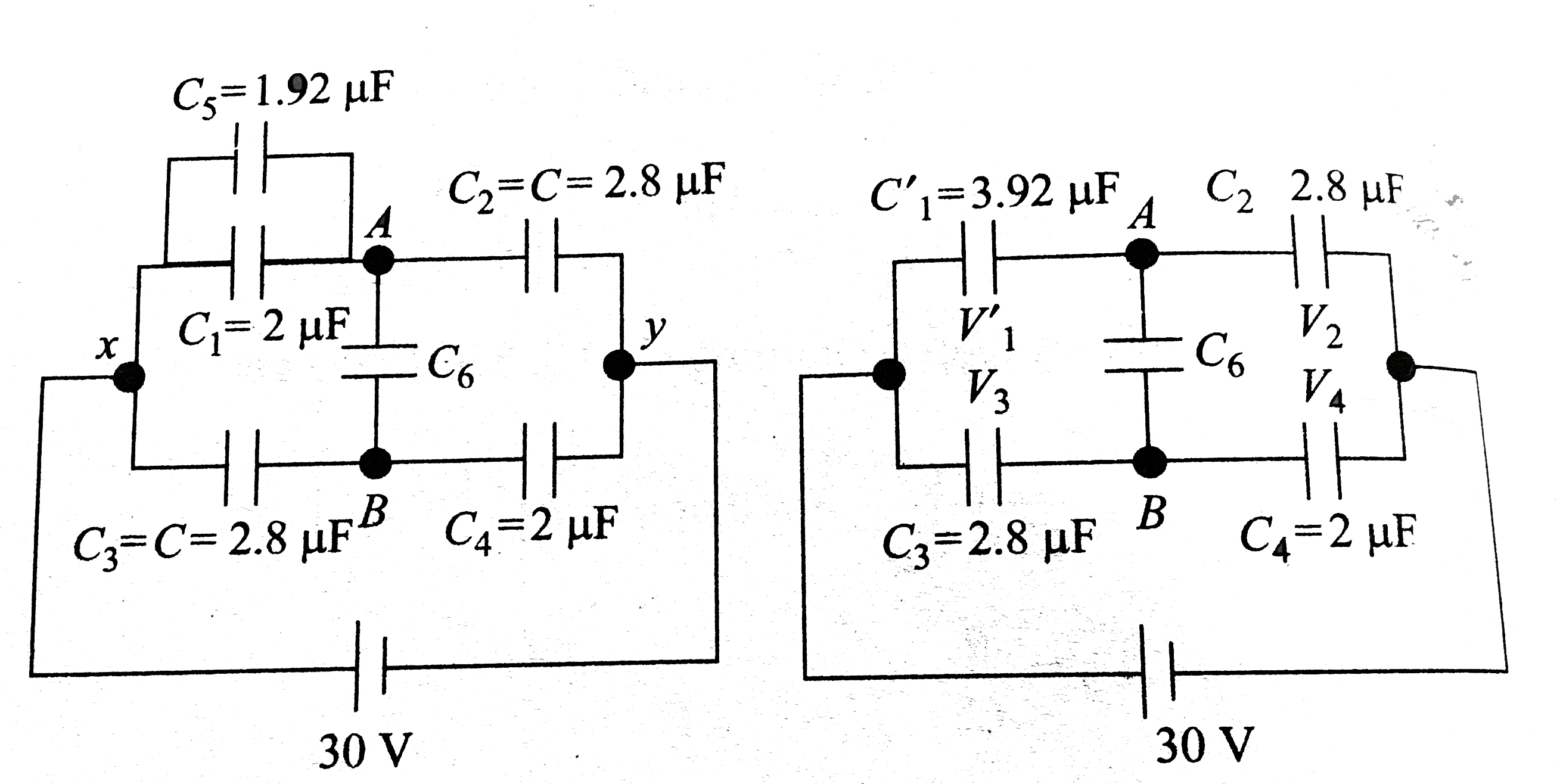 . . . . Since the bridge is in a balanced condition, `A` and `B` at same potential and `C_(6)` has ZERO charge. `C'_(1)` and `C_(2)` are in series. Therfore, charge on `C'_(1)` and `C_(2)` has the same value, so that potential differnce will be in the inverse ratio of capacitance [`Q=CV` or `V=Q/C "hence for same" Q,Vprop1/C']` `(V'_(1))/(V'_(2))=(2.8)/(3.92)~~0.71` or `V'_(1)=0.71 V_(2)` From Eq. (iv), `0.71 V_(2)+V_(2)=30` or `V_(2)=17.5 V` Hence `V'_(1)=30-V_(2)=12.5 V` Since `C'_(1)`, is parallel equivalet of `C_(1)` and `C_(5)`, so potential differnce across each is `V'_(1)=12.5 V`. Hence, charge on `C_(5)` is `C_(5)V'_(1)=1.92 xx12.5=24 muC`. |
|
| 12. |
The given circuit shows an arrangement of four capacitors. A potential difference 30 V is applied across the combination. It is observed that potentials at connected between A an dB differ by 5 V. Also if a conducting wire is connected between A and B, electrons will flow from A to B. Of course, we have bot actually connected any wire between A and B, we have described only an if situation. Answer the following question. . Potential difference across C_(4) is. |
|
Answer» `12.5 V` `V_(4)=V_(1)` `V_(4)=17.5 V` Consider any branch say, `XAY` SINCE `C_(1)` and `C_(2)` are in series, charge on `C_(2)` is also `35 mu C`. Using `Q = CV` for `C_(2)` `C_(2) = C = (35)/(V_(2)) = (35)/(12.5) = 2.8 mu F` Equivalent capacitance of branch `XAY` is the series equivalent of `C_(3)=C=2.8 muF` and `C_(4)=2 muF` i.e., `1.17 muF`. There branches are in parallel between `X` and `Y`, Hence equivalent capacitance between `X` and `Y` is `1.17+1.17=2.34 muF`. Capacitor `C_(5)` is connected in the part of circuit between `X` and `A` either in series or parallel with `C_(1)=2 muF`. Let the equivalent capacitance of `C_(1)` and `C_(5)`, i.e., the equivalent capacitance between `X` and `A` be `C'_(1)`. Capacitor `C_(6)` is connected between `A` and `B` Obviously, the circuit then becomes a WHEATSTONE bridge. Further, since equivalent capacitance between `X` and `Y` is independent of the value of `C_(6)`, it implies that bridge is in the balanced condition and POTENTIALS at `A` and `B`are now equal, so that `(C'_(1))/C_(3)=C_(2)/C_(4)` or `(C'_(1))/(2.8)=(2.8)/2` (`C_(2)=2.8 muF`, as or determined earlier) or `C_(1)=3.92 muF` `C'_(1)` is the equivalent capacitance of `C_(1)=2 muF` and `C_(5)`, Since `C'_(1)gtC_(1)`, we can conclude that `C_(1)` and `C_(5)` are in parallel, So each individual capacitance .Hence, `C_(1)` and `C_(5)` are in parallel, so `C'_(1)=C_(1)+C_(5)` or `C_(5)=C'_(1)-C_(1)=3.92-2=1.92 muf` `V'_(1)+V_(2)=30` 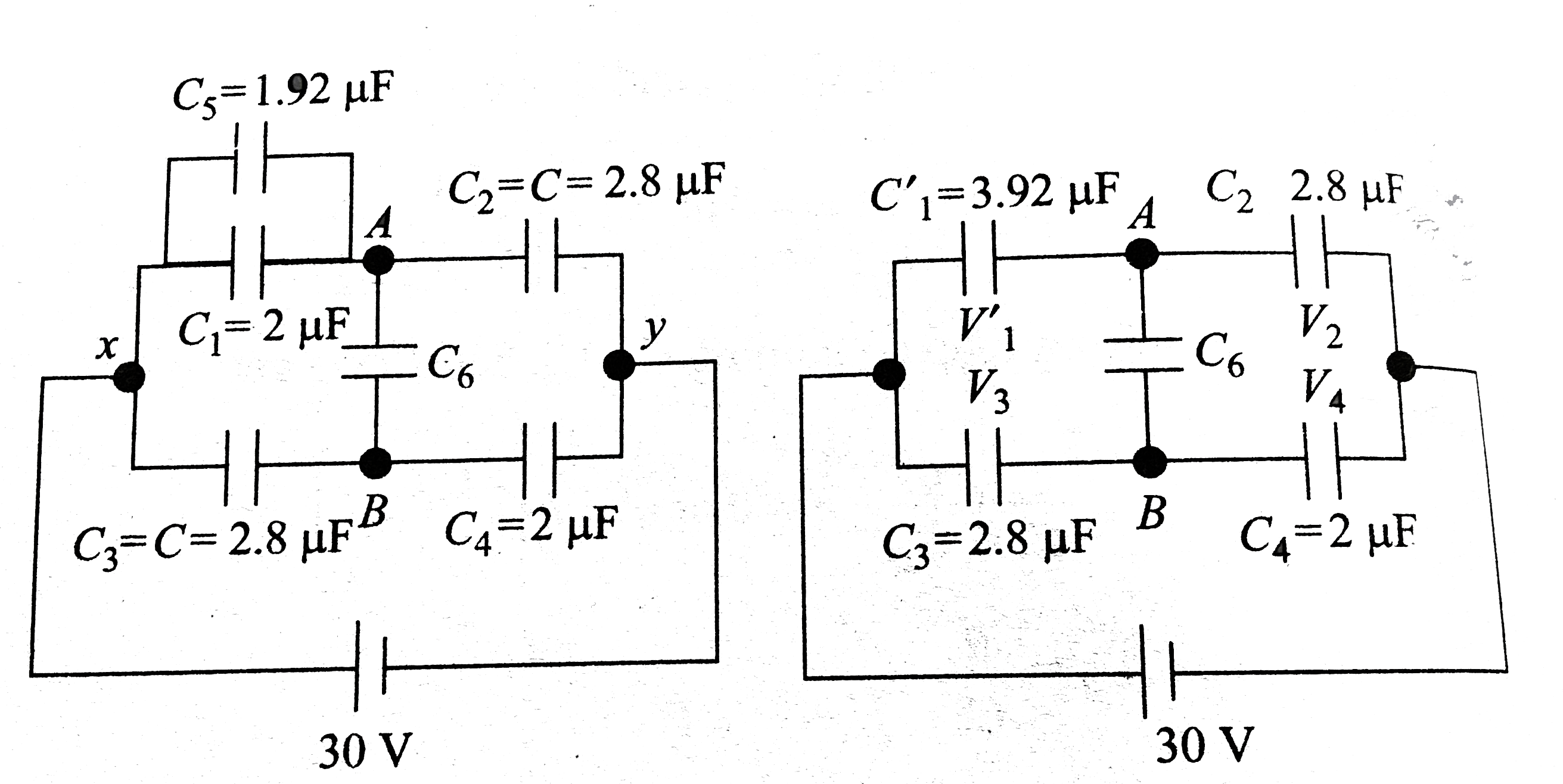 . . . . Since the bridge is in a balanced condition, `A` and `B` at same potential and `C_(6)` has zero charge. `C'_(1)` and `C_(2)` are in series. Therfore, charge on `C'_(1)` and `C_(2)` has the same value, so that potential differnce will be in the inverse ratio of capacitance [`Q=CV` or `V=Q/C "hence for same" Q,Vprop1/C']` `(V'_(1))/(V'_(2))=(2.8)/(3.92)~~0.71` or `V'_(1)=0.71 V_(2)` From Eq. (iv), `0.71 V_(2)+V_(2)=30` or `V_(2)=17.5 V` Hence `V'_(1)=30-V_(2)=12.5 V` Since `C'_(1)`, is parallel equivalet of `C_(1)` and `C_(5)`, so potential differnce across each is `V'_(1)=12.5 V`. Hence, charge on `C_(5)` is `C_(5)V'_(1)=1.92 xx12.5=24 muC`. |
|
| 13. |
A light containing only one color or one wavelength is called ? |
| Answer» SOLUTION :MONOCHROMATIC | |
| 14. |
A luminious hemispherical dome rests on a horizontal plane. Find the illuminance at the centre of the plane if its luminances in L and is independent of direction. |
|
Answer» |
|
| 15. |
If radiation of all wavelangths from ultavoilet to infraed is passed through hydrogen gas at room temperature , absorption lines will be observed in the |
|
Answer» LYMAN series |
|
| 16. |
A person is listening to two trains one approaching him while the other moving away fromhim. The speed of both the trains is 5 m/s. If both trains give off whistle of their nature frequency of 280 Hz then the observer will hear ... no of beats/s. (Velocity of sound = 350 m/s) |
|
Answer» 6 |
|
| 17. |
In a biprism experiment , the distance between the virtual images of the slits is 2.5 mm and eye-piece is at a distance of 1 m from the slits. If the fringe width is 0.3 mm then the frequency of the source of light is: |
|
Answer» `4 XX 10^14 HZ` |
|
| 18. |
In a double slit experiment, when light of wavelength 400 nm was used, the angular width of the first minima formed on a screen placed i m away was found to be 0.2^(@). What will be the angular width of the first minima if the entire experimental apparatus is immersed in water (u_("water")=4//3) |
|
Answer» `0.1^(@)` and `(theta.)/(theta)=(lambda.)/(lambda)=(lambda)/(mulambda)=(1)/(mu)` `theta.=(theta)/(mu)=(0.2)/((mu)/(3))=(0.6)/(4)=0.15^(@)` |
|
| 19. |
Hysteresis loops for two magnetic materials A and B are as given below: These materials are used to make magnets for electric generators, transformer core and electromagnet core. Then, it is proper to use |
|
Answer» A for electric GENERATORS and TRANSFORMERS |
|
| 20. |
The rms value of of current in an a.c. Circuit is 10 A. What is peak current. |
|
Answer» SOLUTION :`I_(RMS) = I_0/SQRT2 ,I_0 = sqrt2 I_(rms)`. `= sqrt2 XX 10 A = 14.14 A` |
|
| 21. |
Which one among the following waves bats use to detect the obstacles in their flying path? |
|
Answer» INFRARED WAVES |
|
| 22. |
A container having base area A_(0). Contains mercury upto a height l_(0). At its bottom a thin tube of length 4l_(0) and cross-section area A(AltltA_(0)) having lower end closed is attached . Initially the length of mercury in tubeis 3l_(0). in reamining part 2 mole of a gas at temperature T is closed as shown in figure . Determine the work done (in joule) by gas if all mercury is displaced from tube by heating slowly the gas in the rear end of the tube by means of a heater. (Given : density of mercury = rho, atmospheric pressure P_(0) = 2l_(0)rhog, C_(v) of gas = 3//2 R, A = (3//rho)m^(2), l_(0) = (1//9)m , all units is S.I.) |
|
Answer» <P> `P' =P_(0) +rhogl_(0) + rhogx = 3rhogl_(0) + rhogx IMPLIES W= - int_(3//0)^(0) (3rhogl_(0) + rhogx) Adx = 13.5 rhogAl_(0)^(2) = 5` |
|
| 23. |
The first overtone of a open.organ pipe beats with the first overtone of a closed organ pipe with a beat frequency of 2.2 Hz. The fundamental frequency of the closed organ pipe is 110 Hz. Find the lengths of the open pipe. (Speed of sound v = 330 nVs) |
|
Answer» `I_(0) = 3.8937 m` |
|
| 24. |
The source of temperature of a carnot engine is 127^@C.It takes 500 calories of heat from the source and rejects 400 cal to the sink the during each cycle. What is the temperature of the sink |
| Answer» ANSWER :B | |
| 25. |
A cylindrical tube, open at both ends, has a fundamental frequency f_(0) in air. The tube is dipped vertically into water such that half of its length is inside water. The fundamental frequency of the air column now is |
|
Answer» `3f_(0)//4` |
|
| 26. |
A block of mass 4 kg is placed on the floor. The coefficient of static friction is 0.4. If a force of 12 N is applied on the block parallel to the floor, the force of friction between the block and floor (g = 10 ms^(-2)) |
|
Answer» Solution :Force of limiting friction, `F_(f)= m_(s) MG` `F_(f) = 0.4 xx 4 xx 10 = 16 N` Since applied force 12 N is less than limiting friction therefore, force of friction will be 12 N as friction will be 12 N as friction is a SELF adjusting force upon `F_(f)` Hence correct CHOICE is (c) |
|
| 27. |
In the circuit shown, the emf of each battery is E. Find the charges that will flow when the switch S is closed, through sections 1, 2 and 3 in the directions indicated by the arrows. |
| Answer» SOLUTION :`(EC_(1)(C_(1)-C_(2)))/(C_(1)+C_(2))(EC_(2)(C_(1)-C_(2)))/(C_(1)+C_(2)),E(C_(2)-C_(1))` | |
| 28. |
If the four forces as shown are in equilibrium Express vecF_(1) & vecF_(2) in unit vector form. |
|
Answer» |
|
| 29. |
A fax message is to be sent from Delhi to Washington via a geostationary satellite. The minimum distance between the dispatch and its getting received is (Take height of the geostationary satellite=36000km) |
|
Answer» `72xx10^(3)KM` `s=2h=2xx36000=72000km ` |
|
| 30. |
What is angle of polarisation and obtain theequation for angle of polarisaition. |
|
Answer» Solution :The ANGLE of incidence at which a beam of unpoolarised lightfalling on a TRANSPARENT surface is reflectedas a beam of plane POLARISED light is CALLED polarising angle or Breswter.s angle It is DENOTED by `i_(p)` `i_(p) = 90^(@) - r_(p)` |
|
| 31. |
Which one is incorrect pair ? |
|
Answer» MAGNETIC sensing of birds- Cryptochromes protein (Cry4) |
|
| 32. |
A planet of mass 4 times earth spinsabout itself and completes onerotation is 96 hours . The radius of a secondary stationary satellite about this planet in comparisons to the radiusof the geostationary orbit around the earth is |
|
Answer» 4 TIMES |
|
| 33. |
A parallel plate capacitor has plates of area 4 m^(2) separated by distance of 0.5 mm. The capacitor is connected across a cell of emf 100 V. (a) Find the capacitance, charge and energy stored in the capacitor. (b) A dielectric slab of thickness 0.5 mm is inserted inside this capacitor after it has been disconnected from the cell. Find the answers to part(a) if K = 3. |
|
Answer» Solution :(a) ` C_0 = (in _0 A)/( d) =( 8.85xx 10 ^(-22) xx4)/( 0.5xx 10 ^(-5)) = 7.08xx 10 ^(-2)muF` ` Q_0 =C_0 V_0 =( 7.08xx 10 ^(-2) xx 100 ) muC= 7.08 mu C ` ` U_0 = (1)/(2) C_0 V_0 ^(2) = 3.54 xx10 ^(-4) J` (b) As the cell has been disconnected ` Q= Q_0` ` C= (Kin _0A)/( d) =KC_0 = 0.2124mu F ` `V= (Q)/(C) =(Q_0)/(KC_0) =( V_0)/( K) =(100)/( 3)V ` ` U = (Q_0^(2))( 2KC_0)= (U_0)/(K) =118 xx 10 ^(-6) J` |
|
| 34. |
The intensity of sun light (in W // m^(2)) at the solar surface will be: |
|
Answer» <P>`5.6 xx 10^(6)` `(P)/(A)=(3.9 xx 10^(26))/(4pi r^(2))=5.62 xx 10^(7) W // m^(2)`. |
|
| 35. |
When the voltage drop acrossa p-n junction diode is increased from 0.65 V to 0.70 V , the change in the diode current is 5 mA . The dynamic resistance of the diode is |
| Answer» Answer :C | |
| 36. |
Which of the following has the shortest wavelength ? |
| Answer» SOLUTION :X-rays have the SHORTEST WAVE LENGTH . | |
| 37. |
An ammeter is obtained by shunting a 30Omega galvanometer with a30Omega resistance .What additional shunt should be connected across it to double its range? |
| Answer» Answer :A | |
| 38. |
A pulse travelling on a string is represented by the function y = (a^3)/((x - vt)^2+ a^2where a = 5 mm andv = 20 cm/s where the maximum of pulse is located at t = 0.1s and 2s. Take x = 0 in the middle of the string |
|
Answer» x = 0, 20 cm and 40 cm |
|
| 39. |
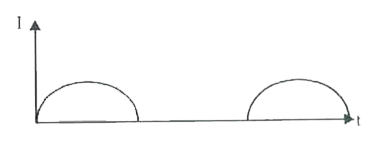
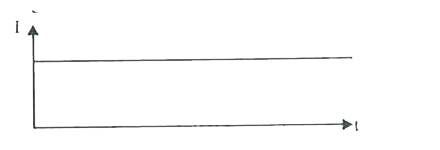
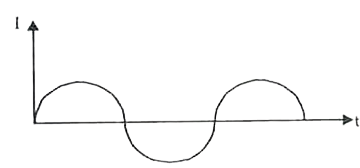
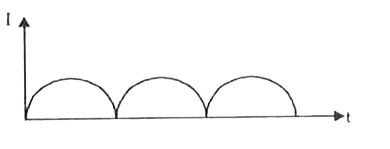
A p - n junction (D) shown in the figure can act as a rectifier . An alternating current source (V) is connected in the circuit. The current (I) in the resistor (R) can be shown by : |
|
Answer»
|
|
| 40. |
Monochromatic light of wavelength 632.8 nm is produced by a helium-neon laser. The power emitted is 9.42mW. How fast does a hydrogen atom have to travel in order to have to have the same momentum as that of the photon ? |
|
Answer» Solution :Here, `lamda=632.8nm=632.8xx10^(-9)m`, `P=9.42mW=9.42xx10^(-3)W` Momentum of a HYDROGEN ATOM is EQUAL to the momentum of a photon. Therefore, required speed (v) of the hydrogen atom is `v=("Momentum of photon ")/(m_(H))=(1.05xx10^(-27))/(1.66xx10^(-27))=0.63ms^(-1)` |
|
| 41. |
Who gave quantum model of atom? |
|
Answer» Rutherford |
|
| 42. |
Monochromatic light of wavelength 632.8 nm is produced by a helium-neon laser. The power emitted is 9.42mW. How many photons per second, on the average, arrive at a target irradiated by this beam ? (Assume the beam to have uniform cross-section which is less than the target area), |
|
Answer» <P> Solution :Here, `lamda=632.8nm=632.8xx10^(-9)m`,`P=9.42mW=9.42xx10^(-3)W` Number (n) of photons falling per second on the TARGET is `n=(P)/(E)=(9.42xx10^(-3))/(3.14xx10^(-19))=3XX10^(16)` photons/sec |
|
| 43. |
A photo cell is illuminated by a small bright source placed lm away. When the same source of light is placed 1/2 m away, the number of electrons emitted by photo cathode would |
|
Answer» increases by a FACTOR 4 |
|
| 44. |
Monochromatic light of wavelength 632.8 nm is produced by a helium-neon laser. The power emitted is 9.42mW. Find the energy and momentum of each photon in the light beam, |
|
Answer» <P> Solution :Here, `lamda=632.8nm=632.8xx10^(-9)m`,`P=9.42mW=9.42xx10^(-3)W` Energy of each photon in the light beam is `E=(hc)/(lamda)=(6.62xx10^(-34)xx3xx10^(8))/(632.8xx10^(-9))=3.14xx10^(-19J)` Momentum of each photon in the light beam is `P=(H)/(lamda)=(6.62xx10^(-34))/(632.8xx10^(-9))1.05xx10^(-27)KGMS^(-1)` |
|
| 45. |
गॉस का नियम सत्य होगा, यदि किसी आवेश के कारण बल निम्नानुसार परिवर्तित होता है |
| Answer» Answer :B | |
| 46. |
A photon of frequency v has momentum associated with it equal to (c is velocity of photon): |
|
Answer» <P>`hv_(C)` |
|
| 47. |
An uncharged parallel plate capacitor filled with a dielectric of dielectric constant K is connected to an air filled identical parallel capacitor charged to potential V_1.If the common potential is V_2. the value of K is |
|
Answer» `(V_(1)-V_(2))/(V_(1))` |
|
| 48. |
The current through a P-N junction diode is 55mA at a forward bias voltage of 3.0 V. If the tempe- rature is 27^(@)C, find the static resistance of the diode. |
|
Answer» SOLUTION :The STATIC resistance `R_(DC)=(V)/(I)=(3)/(55xx10^(-3))=54.5Omega` |
|
| 49. |
A particle with charge e and mass m flies with non-relativistic velocity v at a distance b past a stationary particle with charge q. Neglecting the bending of the trajectory of the moving particle, find the enegry lost by this particle due to radiation during the total flight time. |
|
Answer» Solution :Most of the radiation occurs when the moving particle is closest of the stationary particle. In that ragion, we can write `R^(2) = b^(2) + v^(2) t^(2)` and apply the previous problem's formula THUS `DeltaW~~(1)/((4piepsilon_(0))^(3))(2)/(3c^(2)) int_(-OO)^(oo) ((qe^(2))/(m))^(2) (dt)/((b^(2)+v^(2)t^(2))^(2))` (the intergral can be taken between `+- oo` with littel error.) Now `int_(-oo)^(oo) (dt)/((b^(2)+bv^(2)t^(2))^(2)) = (1)/(v) int_(-oo)^(oo)(dx)/((b^(2)+X^(2))^(2)) = (PI)/(2vb^(3))`. Hence `Delta W ~~(1)/(4piepsilon_(0))^(3) (piq^(2)E^(4))/(3c^(3)m^(2)vb^(3))`. |
|
| 50. |
Induced emf has no direction of its own. comment |
| Answer» SOLUTION :The STATEMENT is true. According to Lenz.s law the direction of the INDUCED emf is to be DETERMINED by the cause of emf. | |