Saved Bookmarks
This section includes 7 InterviewSolutions, each offering curated multiple-choice questions to sharpen your Current Affairs knowledge and support exam preparation. Choose a topic below to get started.
| 1. |
Which of the following disaccharide will not reduce Tollen's reagent ? |
|
Answer» <P>P 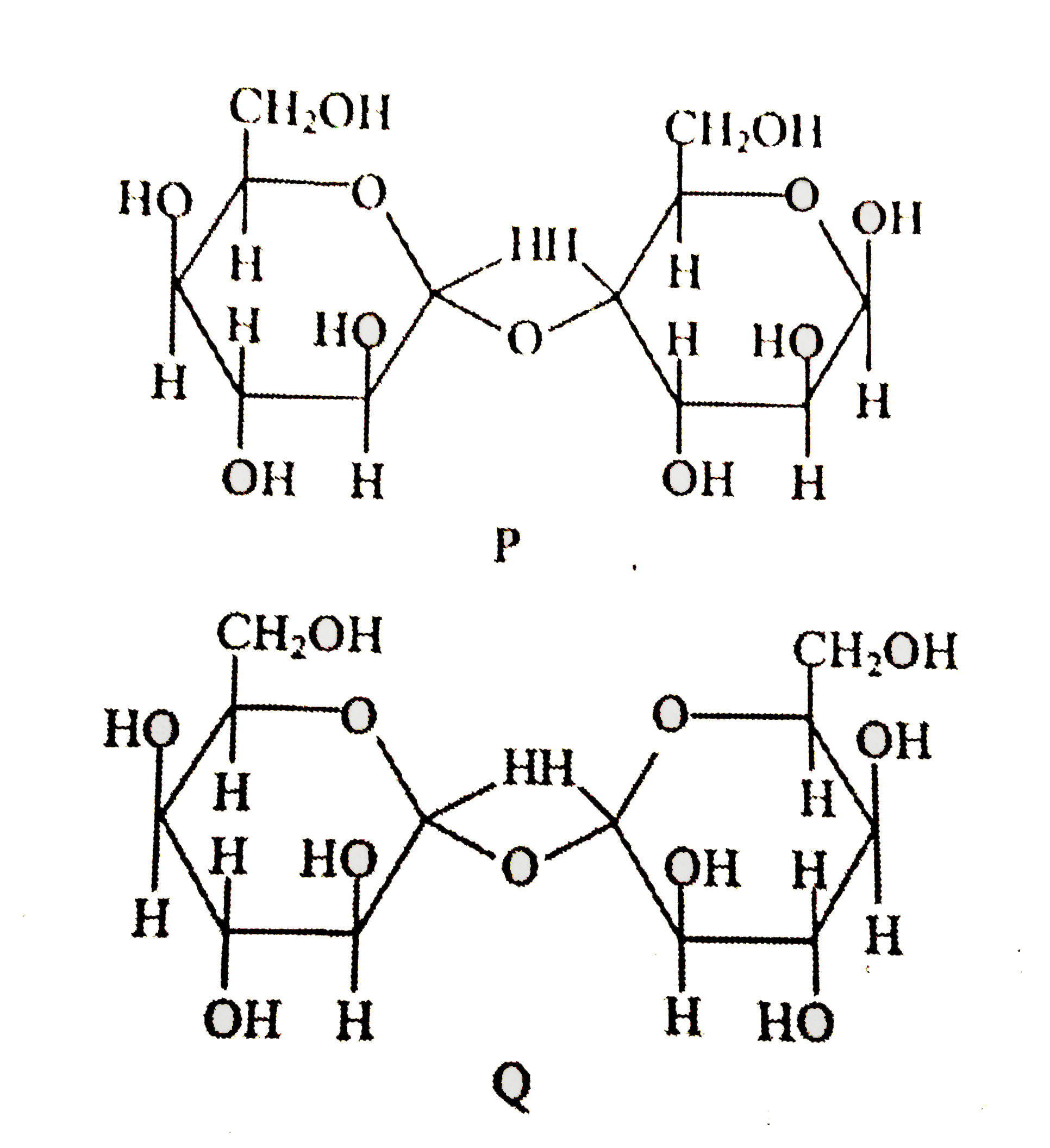
|
|
| 2. |
Under constant temperature, graph between P and 1//V is a : |
|
Answer» PARABOLA |
|
| 3. |
In Fig. 16-45, a string, tied to a sinusoidal oscillator at P and running over a support at Q, is stretched by a block of mass m. The separation L between P and Q is 1.20 m, and the frequency f of the oscillator is fixed at 120 Hz. The amplitude of the motion at P is small enough for that point to be considered a node. A node also exists at Q. A standing wave appears when the mass of the hanging block is 286.1 g or 4470g, but not for any intermediate mass. What is the linear density of the string? |
|
Answer» |
|
| 4. |
An astronaut whose height is 1.50 m floats ''feet down'' in an orbiting space shuttle at a distance r=root3(6.67)xx10^(6)m away from the centre of Earth. The gravitational acceleration at her feet and at her head is found to be Nxx10^(-6)ms^(-2). What is the value of N ? [M_(E)=6xx10^(24)" kg and "G=6.67xx10^(-11)"N m"^(2)"kg"^(-2)] |
|
Answer» |
|
| 5. |
What is meant by red shift and blue shift? |
| Answer» SOLUTION :If the SOURCE of light moves away from the observer on EARTH. Then the wavelength of lightobserved shifts towards the HIGHER wavelength. This shift of wavelength is CALLED red shift. Ifthe source of light moves towards the observer on Earth, thenthe wavelength of light shifts towards the lowerwavelength. This shift is known as the blue shift. | |
| 6. |
The ionisation energy of hydrogen atom is 13.6 eV, the ionisation energy of a singly ionsed helium atom would be |
| Answer» Solution :`E_(2)^(1) = (2)^(2) E_(1) = 4 xx 13.6 = 54.4 eV` | |
| 7. |
A satellite is moving round the earth. In order to make it move to infinity, it velocity must be increased by: |
|
Answer» `82.8%` `therefore` % increase in velocity `=(v_(e )-v_(0))/(v_(0)) XX 100` `=(sqrt(2gR)-sqrt(gR))/(sqrt(gR)) xx 100=41.4%` So the CORRECT choice is (b). |
|
| 8. |
A photoelectric surface is illuminated successively by monochromatic light of wavelength lambda and ( lambda)/(2). If the maximum kinetic energy of the emitted photoelectrons in the second case is 3 times that in the first case, the work function at the surface of material is |
|
Answer» `(HC)/(LAMBDA)` `KE_1=(hc)/(lambda)-phi`.............. (1) ` 3KE_1=(2hc)/(lambda)-phi` ` KE_1=(2hc)/(3lambda)-(phi)/(3)`................... (2) Equating (1) and (2) `(hc)/(lambda)-phi=(2hc)/(3lambda)-(phi)/(3)` `(hc)/(3lambda)=(2phi)/(3) implies phi = (hc)/(2lambda)` |
|
| 9. |
Obtain the first Bohr’s radius and the ground state energy of a muonic hydrogen atom [i.e., an atom in which a negatively charged muon (mu^(–)) of mass about 207m_e orbits around a proton]. |
|
Answer» Solution :Acording to Bohr MODEL if electron revolvi in orbit on r then `r=(n^(2)h^(2)epsi_(0))/(pi me^(2))` [ `:.` All other terms are constant and energy of electron in orbit of radius r,] `E=-(me^(4))/(8 epsi_(0)^(2)n^(2))` `:. E prop-m ""...(2)` [ `:.` All other terms are constant From equation (1)] `:.(r_(mu))/(r_(e))=(m_(e))/(m_(mu))` where `r_(mu` = orbital radius of muon `r_(e)=` orbital radius of electron `m_(e)=` mass of electron `m_(mu)`= mass of moun `:. r_(mu)=r_(e)xx(m_(e))/(m_(mu))` `0.53xx10^(-10)xx(m_(e))/(207m_(e))` `=2.56xx10^(-13)m` Frm equation (2), `(E_(mu))/(E_(1))=(m_(mu))/(m_(e))` where `E_(mu)=` GROUND state energy of moun `E_(e)=` ground state energy of electron `F_(mu=E_(e)xx(m_(mu))/(m_(e))` `:.E_(mu)=13.6xx207eV` `:.E_(mu)=-2.8152xx10^(3)eV` `:. E_(mu=-2.8KeV` |
|
| 11. |
What do the actions of the boy show? |
|
Answer» The boy was persistent and hardworking |
|
| 12. |
A classical model for the hydrogen atom consists of a singal electron of mass m_(e) in circular motion of radius r around the nucleous (proton). Since the electron is accelerated, the atom continuously radiates electromagnetic waves. The total power P radiated by the atom is given by P = P_(0)//r^(4) where P_(0) = (epsi^(6))/(96pi^(3)epsi_(0)^(3)c^(3)m_(epsi)^(2)) (c = velocity of light) (i) Find the total energy of the atom. (ii) Calculate an expression for the radius r(t) as a function of time. Assume that at t = 0, the radiys is r_(0) = 10^(-10)m. (iii) Hence or otherwise find the time t_(0) when the atom collapses in a classical model of the hydrogen atom. Take: [2/(sqrt(3))(e^(2))/(4piepsi_(0))1/(m_(epsi)c^(2)) = r_(e) ~~ 3 xx 10^(-15) m] |
|
Answer» (ii) `(DE)/(dt)=-P` (loss of energy per sec) `implies d/(dt) (- e^(2)/(8pi in_(0) r))= - P_(0)/r^(4) implies (e^(2)/(8pi in_(0) r^(2))) (dr)/(dt)= - P_(0)/r^(4)` `implies e^(2) underset(r_(0))overset(r)(int) r^(2) dr= -8 pi in_(0) P_(0) underset(0)overset(t) (int) dt` `implies r^(3)=r_(0)^(3) - (6P_(0) (4pi in_(0))t)/e^(2) implies r=r_(0) [1-(3cr_(e)^(2) t)/r_(0)^(3)]^(1//3)` (iii) For `r=0`, (to collapse and fall into nucleus) `implies 1- (3cr_(e)^(2) t)/r_(0)^(3)=0` `implies t=r_(0)^(3)/(3cr_(e)^(2))=10^(-30)/(3xx3xx10^(8)xx9xx10^(-30))=(10^(-10)XX100)/81 sec` |
|
| 13. |
de-Borglie wavelength of particle moving at a (1^(th))/(4) od speed of light having rest mass m_(0) is…. |
|
Answer» <P>`(3.87h)/(m_(0)c)` but m=`(m_(0))/(sqrt(1-(V^(2))/(v^(2)))` `lambda=(h(sqrt(1-v^(2)//c^(2))))/(m_(0)c)` Now `v=(c )/(4)` `lambda=(hsqrt(1-(c^(2))/(16c^(2))))/(m_(0)c//4)=(hsqrt(((16c^(2)-c^(2)))/(16c^(2))))/(m_(0)c//4)` `sqrt((15)/(16)h)/(m_(0)c//4)=(4xx0.968h)/(m_(0)c)` `lambda =(3.87h)/(m_(0)c)` |
|
| 14. |
In case of liquids, the Ohm'slaw is |
|
Answer» FULLY obeyed |
|
| 15. |
A spherical uniform planet is rotating about its axis. The velocity of a point on its equator is 7.5 kms^(-1). Due to the rotation of the planet about its axis, the acceleration due to gravity g at equator is 1//2 of g at poles. What is the escape velocity ("in km s"^(-1)) of a particle on the planet from the pole of the planet? |
|
Answer» |
|
| 16. |
Gas can be liquefied by ……………. |
|
Answer» INCREASING Pressure |
|
| 17. |
Two hydrogen like atoms A and B having (N)/(Z) ratio equal to 1 have atomic number Z_(A) and Z_(B) A is moving, while B is stationary and both are in ground state. The minimum kinetic energy which A must have to have an inelastic collision with B such that both A and B getting excited is 221 e V. If situation is reversed and B is made to stike A which is stationary and both in ground state then minimum kinetic energy which B must have to make an inelastic coliision with both getting excited is331.5 e V. Assume mase of proton = mass of neutron. Inwhich of the following case energy of emitted photon will be same (Neglecting recoil of atom) |
|
Answer» A makes a TRANSITION from n=2 to 1 and B makes a transition from n = 4 to 2 |
|
| 18. |
Two radiations with photon energies 0.9 eV and 3.3 eV respectively are falling on a metallic surface successively. If the work function of the metal is 0.6 eV, then the ratio of maximum speeds of emitted electrons will be………………… |
|
Answer» `1 : 4` `v_(2_(max)) = sqrt((2(h upsilon - phi))/(m)) = sqrt((2(3.3-0.6))/(m)) = sqrt((2(2.7))/(m))` `(v_(1_(max)))/(v_(2_(max)))=sqrt((2(0.3))/(m))XX sqrt((m)/(2(2.7)))=sqrt((0.3)/(2.7))=(1)/(3)` `(v_(1) : v_(2))_(max) = 1 : 3` |
|
| 19. |
The length of second pendulum is 1 m on earth. If mass and diameter of the planet is doubled than that of earth, then length becomes: |
|
Answer» 1 m `therefore 2=2pi sqrt((L)/(m)) & 2=2pi sqrt((l.)/(m.))` `therefore (l)/(g)=(l.)/(g.) RARR l.=l.(g.)/(g)=l.(M.)/(M)xx(R^(2))/(R.^(2))=2.(1)/(4).l` `rArr l.=0.5l=0.5 xx 1m=0.5m` Correct choice is (c ). |
|
| 20. |
Using Rutherford's model of the atom, derive the expression for the total energy of the electron in hydrogen atom. What is the significance of total negative energy possessed by the electron? |
|
Answer» Solution :From Rutherford's model of the atom, the magnitude of this force is `F=(1)/(rpiin)*(2e.(Ze))/(r_(2))` For hydrogen atom, Let, fc-Centripetal force REQUIRED to KEEP a revolving electron in orbit. FE- Electrostatic force of attraction between the revolving electron and the nucleus.Then, for a dynamically stable orbit in hydrogen atom, where`Z=1`, `Fc=Fe` `(mv^(2))/(r)=((e)(e))/(4piepsi_(0)r^(2))""...(i)` `r=(e)/(4piepsi_(0)mv^(2))""...(ii)` K.E. of electron in the orbit, `k=(1)/(2) mv^(2)`, From equations (i), `K=(e^(2))/(8piepsi_(0)r)` POTENTIAL energy of electron in orbit,`U=((e)(e))/(4piepsi_(0)r)=(-e^(2))/(4piepsi_(0)r)` `therefore` Total energy of electron in hydrogen atom. `E=K+U=(e^(2))/(8piepsi_(0)r)-(e^(2))/(4piepsi_(0)r),E=-(e^(2))/(8piepsi_(0)r)` Here, negative sign indicates that the revolving electron is bound to the positive nucleus. |
|
| 21. |
Point charges of 10nC,20nCand10nC arekept at the corners A,B C of a square ABCD of side 3m. Calculate the magnitude of the resultant electric intensity at D. |
Answer» SOLUTION : Electric intensity , `E=(1)/(4piepsilon_(0))(q)/(d^(2))` Here `E_(A)=E_(C)=9xx10^(9)xx10xx10^(-9)//9` `=10NC^(-1)` `E_(B)=(9xx10^(9)xx20xx10^(9))/((3sqrt(2))^(2))` `=10N//C^(-1)` Resultant of `E_(A)&E_(C)`is `(SQRT(2)xxE_(A))=10sqrt(2)` `E_(B)`is ALONG `sqrt(2)xxE_(A)` Resultant electric intensity at D is equal to `(sqrt(2)xxE_(A))+E_(B)=10+10sqrt(2)` `24.14NC^(-1)` |
|
| 22. |
A flexible wire loop is placed in a uniform external magnetic field if current is passed through wire assuming normal magnetic field. What will be the effect on wire. |
|
Answer» SHAPE will change |
|
| 23. |
What is meant by mass number? |
| Answer» Solution :The total NUMBER of neutrons and protons in the nucleus is CALLED the MASS number and it isdenoted by A. Hence , A = Z + N. | |
| 24. |
Consider the transistor shown in figure, its terminals are marked as 1,2 and 3. Using multimeter one try to identify the base of transistor, he proceed in the way as follows. Experiment I: He touches the common lead of the multimeter to 2, then on touching other lead of multimeter to 1 he hasn.t got any beep (indication of conduction) but when connected to 3 got the beep. Experiment II: He connected the common lead of multimeter to 1 and other lead to 2 and 3 one by one then in this case he got beep for both connections. From this we conclude that |
|
Answer» 1 is base |
|
| 25. |
The ratio of speed of an electron in ground state in Bohrs first orbit of hydrogen atom to velocity of light in air is |
|
Answer» `(e^(2))/(2epsilon_(0)H c)` |
|
| 26. |
The equation of an alternating current is given as I = 5 sin (314 t) A. The frequency of a.c. and rms value of current are respectively ………..Hz and ………………..A. |
| Answer» SOLUTION :`50 HZ, 5/sqrt(2) A` | |
| 27. |
In terms of the ratio r of the amplitudes of two coherent waves producing an interference pattern, the ratio of the intensity maximum to intensity minimum in the pattern is |
|
Answer» `(r+1)/(r-1)` |
|
| 28. |
Obtain an expression for the critical velocity of a satellite orbiting around the Earth. |
|
Answer» Solution :Suppose a satellite of mass is taken above the Earth 's atmosphere to an altitude H and then projected horizontally with the critical velocity `v_(c )`. This PUTS the satellite into a circular orbit of RADIUS R = R + h, where R is the radius of theEarth. Let M be the mass of the Earth. For the satellite to perform UCM with orbital radius r, the centripetal force necessary is `mv_(c)^(2)//r`. In this case, it is the gravitational force `GmM//r^(2)` exerted on the satellite by the Earth. `therefore (mv_(c)^(2))/(r) = (GmM)/(r^(2))""...(1)` `therefore v_(c)^(2) = (GM)/(r)` `therefore v_(c)=sqrt((GM)/(R+H))""...(2)` `vec(v_(c))` is along the tangent to the path of the satellite as shown in the figure. 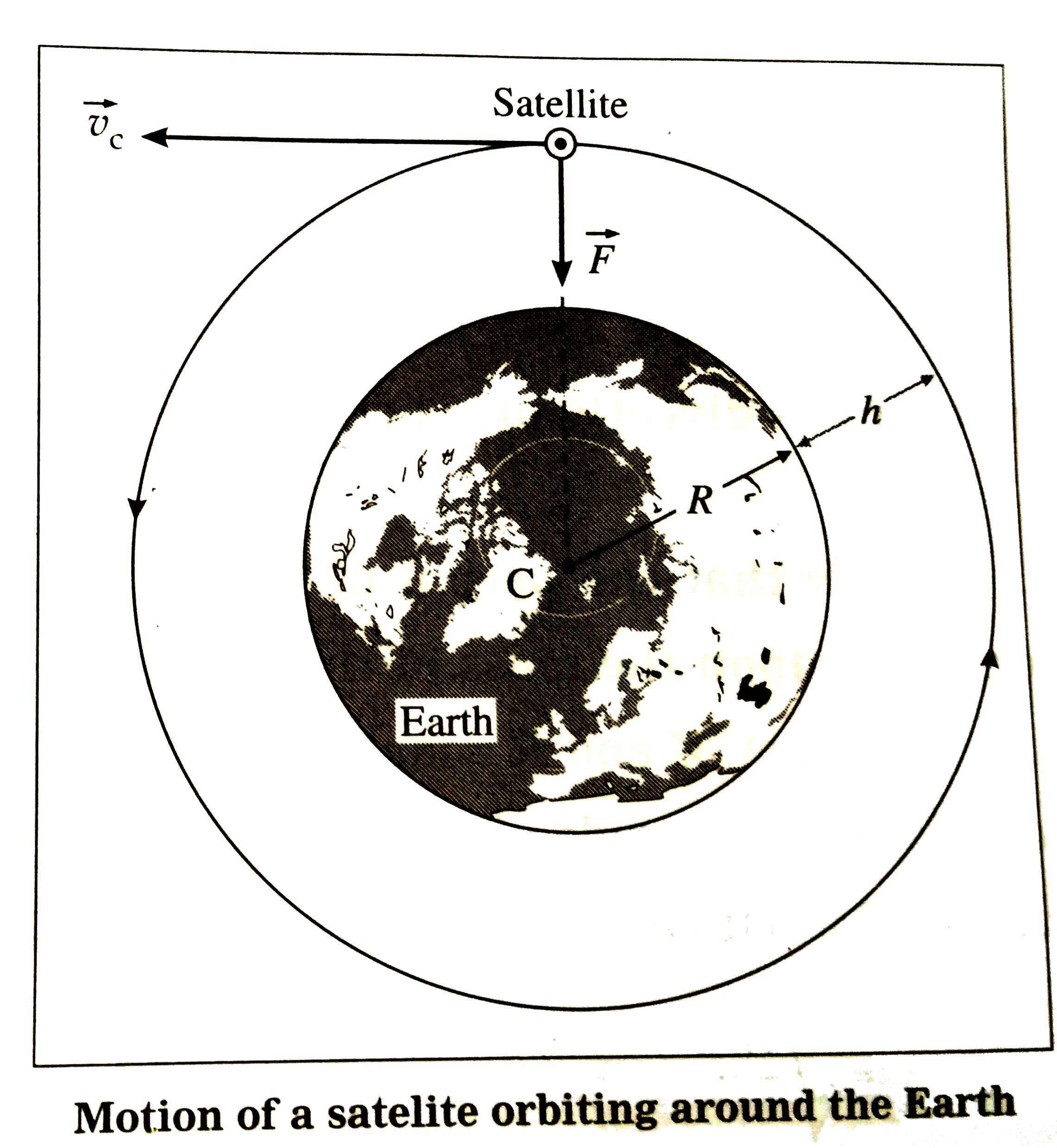
|
|
| 29. |
If the maximum frequency of an audio signal be f, then what would be the bandwidth of an Amplitude Modulated (AM) wave? |
| Answer» SOLUTION :N/A | |
| 30. |
The phase difference between the flux linkage and the induced e.m.f. in a rotating coil in a uniform magnetic field |
|
Answer» `PI` |
|
| 31. |
(A) : When a mixer in a kitchen is switched on the sound from a radio in the kitchen gets nosiy. (R) : The sparking inside the mixer generates electromagnetic waves |
|
Answer» Both 'A' and 'R' are TRUE and 'R' is the CORRECT EXPLANATION of 'A'. |
|
| 32. |
When an unpolarised light of intensity I_(0) is incident on a polarised sheet, the intensity of light which does not get transmitted is : |
|
Answer» `I_(0)` So light that is not TRANSMITTED is `I_(0) -(I_(0))/(2) = (I_(0))/(2)` . |
|
| 33. |
Convert the following decimal numbers into binary numbers . |
|
Answer» 97 |
|
| 34. |
The time period of a thin bar magnet in Earth's magnetic field is T. If the magnet is cut into two equal parts perpendicular to its length, the time period of each part in the same field will be |
|
Answer» `T//2` For HALF portion, `T. =2pi sqrt(M/2).(l^(2)xx2)/(4xx12xxlxxmxxB_(H))` `therefore T./T =sqrt(4/1)=2/1 IMPLIES T.=2T` |
|
| 35. |
Alpha-particle scattering experiment was performed by_______ . |
| Answer» SOLUTION :GEIGER andMarsden | |
| 36. |
Even if a physical quantity depends upon three quantities, out of which two ae dimensionally same, then the formula cannot be derived by the method of dimensions. This statement |
|
Answer» MAY be true |
|
| 37. |
A vertical tube of length 100 cm contains a mercury pallet of length 5 cm as shown in the figure. The length of the tube above mercury pallet if the tube is inverted is nearly: (atmospheric pressure = 75 cm Hg of Hg) |
|
Answer» 56 cm |
|
| 38. |
What is the electric field in between the plates of a capacitor in the presence of adielectric medium? |
| Answer» SOLUTION :DECREASES | |
| 39. |
How does an oscillating charge radiate an electromagnetic wave ? Give the relation between the frequency of radiated wave and the frequency of oscillating charge. |
| Answer» SOLUTION :A charge Q OSCILLATING at a certain frequency produces an oscillating electric FIELD in space, which produces an oscillating magnetic field, which in turn is a source of oscillating electric field and so on. The oscillating electric and magnetic fields thus regenerate each other i.e., an electromagnetic wave PROPAGATES through the space. The frequency of the electromagnetic wave equals the frequency of oscillation of the charge. | |
| 40. |
A 110 V d.c. heater is used on an a.c source such that the heat produced is same as it produces when connected to 110 V dc in same time -intevals. What would be the r.m.s. value of the alternating voltage? |
|
Answer» 110 V |
|
| 41. |
For the L shaped conductor in a uniform magnetic field B shown in figure the emf across its ends when it rotates with angular velocity omega about an axis through one its ends O and normal to its plane will be |
|
Answer» `2 BOMEGA L^(2)` |
|
| 42. |
A ball is thrown straight upward and falls back to the ground 3 seconds later. At the moment the ball reaches its highest point |
|
Answer» its POTENTIAL ENERGY is minimized |
|
| 43. |
A 6 volt battery of internal resistance 1 Omega is connected across a uniform wire AB of length 100 cm. The positive terminal of another battery of emf 4V and internal resistance 1 Omega is joined to the point A as shown. Find the distance of point D from A is potential of C is equal to potential of D.(resistance of AB = 5 Omega) |
|
Answer» 80 cm |
|
| 44. |
Decimal representation of a rational cannot be |
|
Answer» TERMINATING |
|
| 45. |
A mass is suspended separately by two different springs in successive order then time periods is t_(1) and t_(2)respectively. If it is connected by both spring as shown in figure then time period is to, the correct relation is |
|
Answer» `t_(0)^(2) = t_(1)^(2) + t_(2)^(2)` `T =2pi sqrt(m//k)`, where ks is the spring CONSTANT. `therefore t_(1) = 2pi sqrt(m//k_(1))`..........(i) and `t_(2) = 2pi sqrt(m//k_(2))`.........(II)  Now, when they are CONNECTED in parallel as shown in figure (a), the system can be replaced by a single spring of spring constant `k_(eff)= k_(1) + k_(2)`. [Since, `mg = k_(1)x + k_(2)x = k_(eff)x`] `therefore t_(0) =2pi sqrt(m//k_(eff)) = 2pisqrt(m//(k_(1)+k_(2)))`.........(iii) From (i), `1/t_(1)^(2) = 1/(4pi^(2)) xx k_(1)/m` From (ii), `1/t_(2)^(2) = 1/(4pi^(2)) xx k_(2)/m`...........(v) From (iii), `1/t_(0)^(2) = 1/(4pi^(2)) xx (k_(1) + k_(2))/m`.............(vi) ADDING equation (IV) and (v), we get `=1/t_(1)^(2) + 1/t_(2)^(2) =1/(4pi^(2)m) (k_(1) + k_(2)) =1/(t_(0)^(2))` `therefore t_(0)^(-2) =t_(1)^(-2) + t_(2)^(-2)` |
|
| 46. |
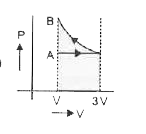
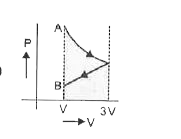
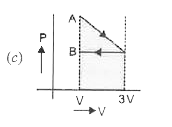
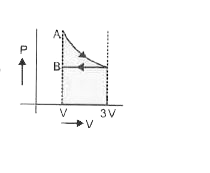
One mole of an ideal gas goes from an initial state A to final state B via two processes: It first undergoes isothemal expansion from volume V to 3V and then its volume is reduced from 3V to V at constant pressure. The cormect P-V diagram representing the two processes is : |
|
Answer»
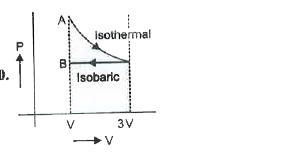 CORRECT CHOICE is (d). |
|
| 47. |
Draw the I-V characterisitcs of a Zener diode. Also sketch the circuit diagram of Zener diode as a voltage regulator. |
Answer» SOLUTION :
|
|
| 48. |
The vaue of 2.2 + 4.08 + 3.125 +6.3755 with due regard to significant places is |
|
Answer» 15.78 CM |
|
| 49. |
A body is just floating in liquid (their densities are equal). If the body is slightly pressed and released, it will: |
|
Answer» START oscillating Thus correct CHOICE is (b) . |
|
| 50. |
A Plano-convex lens of radius of curvature 0.1m is kept over a plane glass plate with curved surface of the lens touching it. The gap between the glass plate and the curved surface of the lens is filled with a liquid. If the combined focal length of the combination is 0.4m, calculate the refractive index of the material of the liquid. Given R.I. of the material of the lens is 1.5. |
|
Answer» Solution :For plano-convex lens, R = 0.1m, `n_(1) = 1.5` `rArr(1)/( f_(1)) = ( n_(1) -1) ((1)/( R_(1)) - (1)/( R_(2)))` `(1)/(f_(1)) = ( 1.5 -1) ((1)/(0.1) - ( 1)/( oo)) = (0.5 )/(0.1)` `(1)/( f_(1)) = 5` or `f_(1) =0.2m` Also, COMBINED focal LENGTH `F = 0.4 m` `rArr (1)/(F) = (1)/( f_(1)) + ( 1)/( f_(2))` `(1)/(0.4) = ( 1)/( 0.2) + ( 1)/( f_(2))` `(1)/( f_(2)) = ( 1)/( 0.4) - (1)/( 0.2)` `= ( 10)/( 4) - ( 10)/( 2)` `(1)/( f_(2)) = ( 10-20)/( 4) = ( -10)/(4)` for lens formed by liquid FILLED in space. `(1)/(f_(2)) = ( n-1) ((1)/( R_(1)) - ( 1)/(R_(2)))` `- (10)/( 4) = ( n_(2) -1)((1)/( oo) - (1)/( 0.1))` `( - 10)/( 4) = ( -(n_(2)-1))/(0.1)` `( -10)/( 4) = (- ( n_(2) -1))/( 0.1)` `n_(2) -1 = (1)/( 4)` `n_(2) = 1+( 1)/( 4) = ( 5)/( 4) =1.25 ` |
|