Saved Bookmarks
This section includes 7 InterviewSolutions, each offering curated multiple-choice questions to sharpen your Current Affairs knowledge and support exam preparation. Choose a topic below to get started.
| 1. |
A wire of c.s.S = 2.5 mm^(2) is bent to make the three sides of a square and is free to turn about the horizontal axis infity Find the magnetic induction B which is vertically upward if the frame is deflected by theta=30^@) from the vertical when a current I=16A is passed through the wire. The density of the wire sigma=8900 kgm^(-3) |
|
Answer» |
|
| 2. |
If I_(1), I_(2) and I_(3) are wave lengths of the waves giving resonance with fundamental, first and second over tones of closed organ pipe. The ratio of wavelengths I_(1):I_(2):I_(3) is..... |
|
Answer» `1:2:3` |
|
| 3. |
The adjoining figure shows two bulbs B_1and B_2resistor R and an inductor L. When the switch S is turned off |
|
Answer» Both `B_1` and `B_2` DIE out PROMPTLY |
|
| 4. |
A small disc is placed in the path of the light from distance source. Will the center of the shadow be bright or dark? |
| Answer» SOLUTION :(i) Wave diffracted from the edge of circular obstacle interfere CONSTRUCTIVE at the center of the shadow resulting in the formation of bright spot. (II) CENTRE of the shadow is bright due to diffraction. | |
| 5. |
Figure8-5a shows two industrial spies sliding an initially stationary 225 kg floor safe a displacement vec(d) of magnitude 8.50 m. The push vec(F)_(1) of spy001 is 12.0 N at an angle of 30.0^(@) downward from the horizontal, the pull vec(F)_(2) of spy 002 is 10.0 N at 40.0^(@) above the horizontal. The magnitudes and directions of these forces do not change as the safe moves, and the floor and safe make frictionless contact. (a) What is the net work done on the safe by forces vec(F)_(1) and vec(F)_(2) during the displacement vec(d) ? |
|
Answer» Solution :KEY IDEAS the net work W DONE on the safe by the two forces is the sum of the works they do individually. (2) Because we can treat the safe as a particle and the forces are constant in both magnitude and direction, we can use either Eq. `8-7 ( W = Fd cos phi) "or Eq." 8-8(W=VEC(F)*vec(d))` to CALCULATE those works. Let.s choose Eq. 8-7. Calculations: From Eq. 8-7 and the free-body diagram for the safe in Fig. 8-5b, the work done by `vec(F)_(1)` is `W_(1)=F_(1)d cos phi_(1)=(12.0N)(8.50m)(cos 30.0^(@))` `=88.33J`, and the work done by `vec(F)_(2)` is `W_(2)=F_(2)d cos phi_(2)=(10.0N)(8.50m)(cos40.0^(@))` `=65.11J`. Thus, the net work W is `W=W_(1)+W_(2)=88.33J+65.11J` `=153.4J~~153J`. During the 8.50 m displacement, therefore, the spies transfer 153 J of energy to the kinetic energy of the safe. 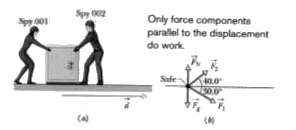 FIGURE 8-5 (a) Two spies MOVE a floor safe through a displacement `vec(d)` (b) A free-body diagram for the safe. |
|
| 6. |
"Whiplash injury"commonly occurs in a rear-end collision where a front car is hit from behind by a second car. In the 1970s, researches concluded that the injury was due to the occupant's head being whipped back over the top of the seat as the car was slammed forward. As a result of this finding, head restraints were built into cars, yet neck injuries in rarend collisions continued to occur. In a recent test to study neck injury in rear-end collisions, a volunteer was strapped to a seat that was then moves abruptly to simulate a collision by a rear car moving at 10.5 km/h. Figure 2-15 a gives the accelerations of the volunteer's torso and head during the collision, which began at time t=0. The torso acceleration was delayed by 40 ms because during that time interval the seat back had to compress against hte volunteer. The head acceleration was delayed by an aditional 70 ms. What was the torso when the head began to accelerate ? |
|
Answer» Solution :KEY IDEA We can calculate the torso speed at any time by finding an area on the torso a(t) graph. Calculations : We knowthat the initial torso speed is `v_(0)=0` at time `t_(0)=0` , at the start of the " collision."Wewant the torso speed `v_(1)` at time `t_(1)=110ms`, which is when the head begins to accelerate. Combining Eqs. 2-27 and 2-28, we can write `v_(1)-v_(0)= `( area between acceleration curve and time axis, from `t_(0)` to `t_(1)` ). (2-31) For convenience, let us separate the area into THREE regions ( Fig. 2-15b). From 0 to 40 ms, region A has no area : `"area"_(A)=0`. From 40 ms to 100 ms, regionB has the shape of a triangle, with area `"area"_(B)= 1/2 (0.060 s) (50 m//s^(2))= 1.5 m//s.` From 100 ms to 110 ms, region C has the shape of a rectangle, with area `"area"_(C)= (0.010 s) (50 m//s^(2))= 0.50 m//s`. Substituting these values and `v_(0)=0` into Eq. 2-31 gives us `v_(1)-0 = 0+1.5 m//s + 0.50 m//s`, or `v_(1) = 2.0 m//s = 7.2 km//h`. Reasoning: When the head is just STARTING to move forward, the torso already has a speed of 7.2 km/h. Researchers argue that it is this difference in speeds during the early stage of a rear-end collision that injures the neck. The backward whipping of hte head happens later and could, especially if there is no head restraint, increase the injury. 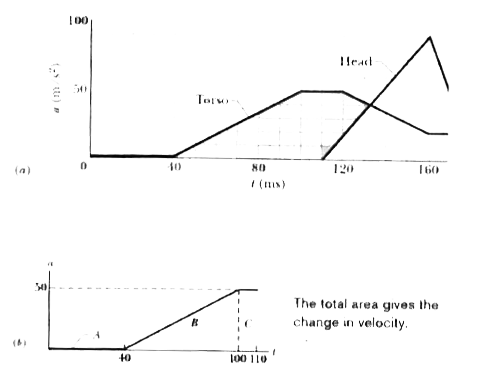
|
|
| 7. |
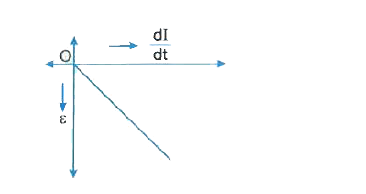
A coil of area 0.1 m^(2) has 500 turns. After placing the coil in a magnetic field of strength 4 xx 10^(-4)T , it is rotated through 90^(@) in 0.1 s. The average emf induced in the coil is |
|
Answer» 0.012 V |
|
| 8. |
Taking that earth revolves round Sun in a circular orbit of radius 15xx10^(10)m, with a time period of 1 year, the time taken by another planet, which is at a distance of 540xx10^(10)m, to revolve round the Sun in circular orbit once, will be: |
|
Answer» 216 YEARS Thus correct choice is (a). |
|
| 9. |
Two sound waves of frequencies 100Hz and 102Hz and having same amplitude .A. are interfering A stationary detector which can detect waves of amplitude greater than or equal to A. In a time interval of 12 seconds, find the total duration (in sec.) which detector is active. |
|
Answer» |
|
| 10. |
Magnetic field mass lines are always nearly normal to the surface of a ferromagnetic at every point. (This fact is analogous to the static electric field lines being normal to the surface of a conductor at every point.) Why ? |
| Answer» SOLUTION :Magnetic field lines are always nearly NORMAL to the SURFACE of a ferromagnetic at every point. The proof of this important fact is based on the boundary conditions of magnetic FIELDS (B and H) at the interface of two media. | |
| 11. |
The cells of emf's E_(1) and E_(2) be connector in parallel in a circuit. Let r_(1) and r_(2) be the internal resistance of the cells. Then the current through the circuit is |
|
Answer» `(E_(1)+E_(2))/((r_(1)+r_(2)))` |
|
| 12. |
Two charged spheres separated by a distance d exert some force F on each other. If they are immersed in a liquid of dielectric constant 2. Then what is the force exerted, if all other conditions are same. |
| Answer» ANSWER :A | |
| 13. |
In the following circuit find I_1 and I_2 |
|
Answer» 0,0 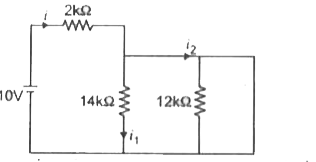 From figure it is clear that CURRENT DRAWN from the BATTERY `i=i_2=10/2=5mA and i_1=0` |
|
| 14. |
A particle is projected with a velocity v so that its horizontal range twice the greatest height attained. The horizontal range is |
|
Answer» `(v^(2))/(2g)`  `R= 2H rArr (v^(2)sin 2 theta_(0))/(g)= (2v^(2) sin^(2) theta_(0))/(2g) rArr COS theta_(0)= (1)/(2)` `rArr cos theta_(0)= (1)/(SQRT5)` `sin theta_(0)= (2)/(sqrt5) therefore R= (2v^(2) sin theta_(0)cos theta_(0))/(g)= (2v^(2) xx (1)/(sqrt5) (2)/(sqrt5))/(g)= (4v^(2))/(5g)` |
|
| 15. |
For the circuit shown in Fig. the emf of the generator is E. The current through the inductor is 1.6 A. While the current through the condenser is 0.4 A. Then |
|
Answer» Current drawn from the generator is `I=2A` `implies I=I=(E_(0))/(X_(C))` `sin(omega t+pi//2)+(E_0)/(X_L) sin (omegat-pi//2)` `=[(E_0)/(X_C)-(E_0)/(X_L)] cos omega t` to find, `I_(v)=|(1)/(SQRT(2)[(E_0)/(X_C)-(E_0)/(X_L)]|`...(i) Given`I_(Cv)=(E_0)/(sqrt(2)X_(C))=0.4A`, ...(ii) `I_(Lv)=(E_0)/(sqrt(2)X_(L))=1.6 A` ...(iii) From EQUATIONS (i) (ii) and (iii) `I_(v)=1.2A` Dividing (ii) by (iii) `(X_L)/(X_C)=1/4 implies (OMEGAL)/(1//omegaC)=1/4 implies omega^(2)LC= 1/4 implies omega=(1)/(2sqt(LC))`. 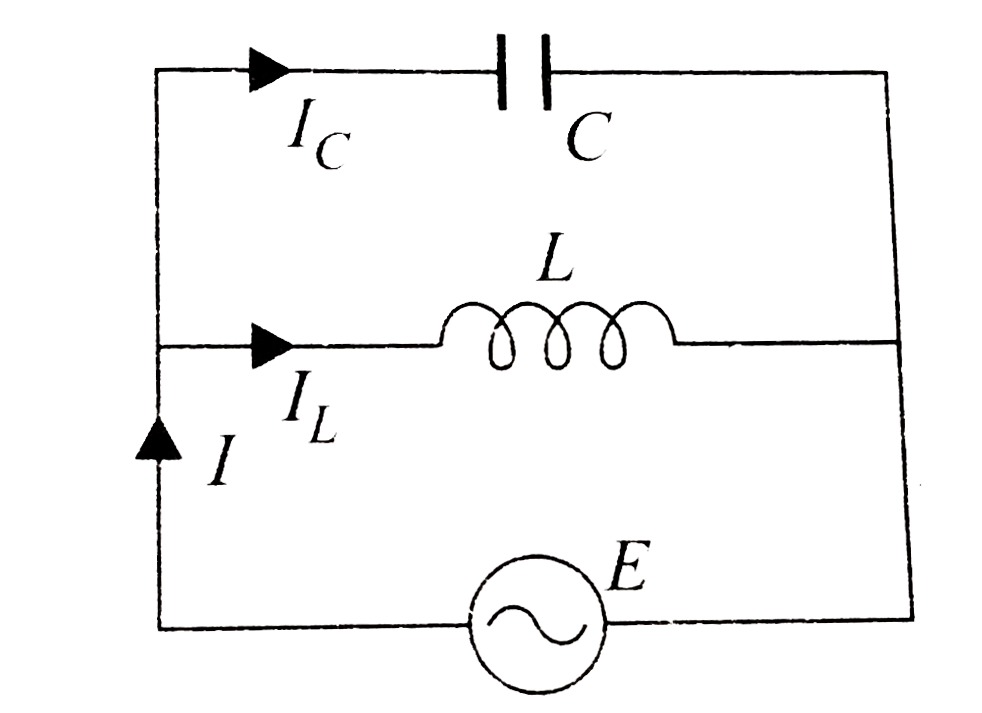
|
|
| 16. |
A candle flame 1.6 cm high is imaged in a ballbearing of diameter 0.4 cm. If the ball bearing is 20 cm away from the flame, find the location and the height of the image. |
|
Answer» 1.0 MM inside the ball BEARING, 0.08 mm |
|
| 17. |
When the negative feedback is applied to an amplifier of gain 50, the gain after feedback falls to 25. Calculate the feedback ratio. Data : A = 50, A_f = 25 |
|
Answer» Solution :VOLTAGE gain after FEEDBACK, `A_f= (A)/(1 + A BETA )` `25= ( 50)/( 1 +50beta)` hencethefeedbackratio` beta ` = 0.02` |
|
| 18. |
A toroid of n turns mean radiusR and sectionalradiusa carriers current I it is placed on a horizontal table taken as x-y plane its magnetic moment m |
|
Answer» is non zero and points in thez DIRECTIN buy SYMMETRY |
|
| 19. |
The ratio of the energies of the hydrogen atom in its first excited state to second excited state is |
|
Answer» `(1)/(4)` |
|
| 20. |
Trackof three chargedparticlesin a uniform electroastatic field give the sign of the three charges which particle has the highest charge to mass ratio |
| Answer» SOLUTION :`5.7 xx10^(-3) N` | |
| 21. |
A charge Q is to be divided into twosmall objects. What should be the value of the charges on the objects so that the force between the objectswill be maximum. |
|
Answer» Solution :LET q and (Q-q) be the chargeson those BODIES Force between the charges `F=(1)/(4PI in_(0)) ((Q-q)q)/( r^(2)) rArr q=(Q)/(2)` For F to be maximum `(dF)/(dq)=0` `rArr (Q)/(r^(2)) -(2q)/(r^(2))=0 rArr q=(Q)/(2)` Thuswe have to divide charges EQUALLY on the objects. |
|
| 22. |
The pressure exerted by an electromagnetic wave of intensity I(wm^(-2) on a non reflecting surface is: (C is the velocity of light) |
| Answer» ANSWER :C | |
| 23. |
Can two separate p-n junction diodes placed back to back be used to form p-n-p transistor ? |
| Answer» Solution :No. When we join two p-n JUNCTIONS the n- region will from the BASE. For a transistor the base MUST be very thin and it must be lightly doped. These two conditions will not be satisfied when we make a transistor by JOINING two p-n junction. The thickness will be LARGE and doping will be heavy. So, p-n-p transistor cannot be formed by joining two p-n junction diodes. | |
| 24. |
Dimsensional formula for thermal condu-ctivity |
|
Answer» `L^(2)T^(-2)K^(-1)` |
|
| 25. |
Which of the following colours suffers maximum deviation in a prism? |
|
Answer» blue |
|
| 26. |
A conducting wire XY of mass m and negligible resistance slides smoothly on two parallel conducting wires as shown in Fig. The closed circuit has a resistance R due to AC. AB and CD are perfect conductors There is magnetic field B = B (t) hat k. (i) Write down question for the acceleration of the wire XY. (ii) If B is independent of time, obtain upsilon (t), assuming upsilon (0) = u_(g). (iii) For (b), show that the decrease in kinetic energy of XY equals the heat lost in R. |
|
Answer» Solution :Fig. shows a conducting WIRE XY of mass m and negligible resistance sliding smoothly over two parallel conducting WIRES AB and CD. The magneitic field applied is `vec B = B (t) hat k` (i) At time t, suppose XY is at x = x (t) Magnetic FLUX associated with area ACYX `phi = B (t).l.x.(t)` emf induced, `e = (d phi)/(DT) = - [(dB)/(dt) lx (t) + B (t) l.v. (t)]` current induced , `i = (e)/(R )` Force on XY, `F = B i l = B ((e)/(R )) l` or `m (d^(2) x)/(dt) = (B(t).l)/(R ) [ -(dB)/(dt) lx (t) - B (t).l.upsilon (t)]` `:.` Acceleration of wire ,`(d^(2) x)/(dt^(2)) = -(l^(2) B)/(mR) (dB)/(dt) x (t) = (l^(2) B^(2))/(mR) ((dx)/(dt))` (ii) When B is independent of time, it is constant w.r.t. time. Therefore, `(dB)/(dt) = 0` From (ii), `(d^(2) x)/(dt^(2)) + (l^(2) B^(3))/( m R) (dx)/(dt) = 0` or `(d upsilon)/(dt) + (l^(2) B^(2))/(m R) upsilon = 0`.`:. upsilon= A exp (-(l^(2) B^(2) t)/(m R))` At `t = 0, upsilon = u_(0) = A``:. upsilon (t) = u_(0) exp (-(l^(2) b^(2) t)/(mR))` (iii) Now, `I^(2) R = (B^(2) l^(2) upsilon^(2) (t))/(R^(2)) xx R` using (iii) `I^(2) R = (B^(2) l^(2))/(R ) u_(0)^(2) exp (-(2 l^(2) B^(2) t)/(mR))` Power lost `= int_(0)^(t) I^(2) R dt = (B^(2) l^(2))/(R ) u_(0)^(2) (mR)/(2 l^(2) B^(2)) [1 - e^(-l^(2) b^(2) t//mR)] = (m)/(2) u_(2) - (m)/(2) upsilon^(2) (t)` =decrease in KE of wire XY, which was to proved. |
|
| 27. |
A beaker having water of refractive index of 4/3 water is filled upto 16 cm in it. As shown in figure, a concave mirror is kept 3 cm above the surface of water. If the object is place at the bottom of beaker and its image is ob tained from this mirror at 7 cm below the surface of water, then what will be the focal length of this concave mirror ? |
|
Answer» 4 cm `implies h_i=h_0xx3/4` `=(16xx3)/(4)`=12 cm `therefore` Object distance from concave MIRROR =u=12+3=15 cm  Image distance =v=7+3=10 cm `therefore 1/f=1/u+1/v` `implies1/f=(1)/(-15)+(1)/(-10)+(2+3)/(-30)=(5)/(-30)=-1/6` Thus, focal LENGTH =f=6 cm |
|
| 28. |
The maximum percentage error in the calculation of Young's modulus of the wire is |
|
Answer» `(22)/(3)`% |
|
| 29. |
The electric potential V as a function of distance x is 1 given by V=(5x^(2) + 10x - 9) Volt. Where x is in metre.Find the electric field at a point x = 1m |
|
Answer» |
|
| 30. |
Two identical sources of light are separated through a distance d = (lambda)/(8), where lambda is the wavelength of the waves emitted by either source. The phase difference of the sources is (pi)/(4).Intensitydistribution in the radiation field as a function of theta is : |
|
Answer» `4 I_(0) cos^(2)(pi)/(4)` The phase DIFFERENCE between the sources `Delta phi= (pi)/(4)` Also ` x = d sin theta` `therefore phi = (2pi)/(lambda).x = (2pi)/(lambda) .(lambda)/(8) sin theta = (pi)/(4) sin theta` `therefore` Total phase difference, `phi= phi. + Deltaphi. = (pi)/(4) sin theta + (pi)/(4)` or `phi = (pi)/(4)(sin theta + 1)` `therefore` Required INTENSITY is `I = 4I_(0) cos^(2)(phi)/(2)` or `I = 4I_(0)cos^(2)[(pi)/(8)(sin theta + 1)]` |
|
| 31. |
किसी स्थिर लिफ्ट (ऊपर से खुली हुई) में खड़ी हुई एक लड़की एक गेंद को ऊपर की ओर 50 m/s की चाल से फेंकती है। बताइए कि गेंद को वापस उसके हाथों में पहुँचने में कितना समय लगेगा? (यदि g= 10 m/s^2) |
|
Answer» 5s |
|
| 32. |
Two point changesq_(1) = 2muC and q_(2) = 1muC are placed at distance b = 1cm and a = 2cm from the origin on the y and axes. The electric field vertor a point P (a.b) will subtend an angle .theta. with the x - axes given by |
|
Answer» `TAN THETA = 1` |
|
| 33. |
A mark on the surface of a glass sphere (mu = 1.5)is viewed from a diametrically opposite position. It appears to be at a distance 10cm from its actual position. The radius of the sphere is |
|
Answer» 5cm |
|
| 34. |
Show that when the unpolarized light passe through polariser then the intensity emerging light is half that of the intensity the incident light. |
|
Answer» Solution :If the intensity of light on the POLARISER is I then the intensity of emergent light (from Malu law) is `I=I_(0)cos^(2)theta` where `theta` is an angle BETWEE pass-axis of both polaroid. When unpolarized light incident on a polaroid the intensity of emerging light is equal to th average intensity between `theta=0` to `2pi`. `:.` Average intensity, `ltIgt""=I_(0)ltcos^(2)thetagt` `=I_(0)int_(0)^(2pi)(cos^(2)theta)/(2pi)d""theta` `=(I_(0))/(2pi)int_(0)^(2pi)[(1+cos2theta)/(2)]d"theta` `(I_(0))/(2pi){[theta]_(0)^(2pi)+[(sin2theta)/(2)]_(theta)^(2pi)}` `=(I_(0))/(4pi){(2pi-0)+(sin4pi-sin0)/(2)}` `=(I_(0))/(4pi){(2pi+0)-0}` `=(I_(0))/(4pi)xx2pi` `=(I_(0))/(2)` Hence, the intensity of emerging light is half that of the intensity of the incident light that means 50%. |
|
| 35. |
An object with a net positive charge of 2 xx 10^(-12) C contains 1.5 xx 10^7 protons. Calculate the number of electrons present on it. |
| Answer» SOLUTION :`2.5xx10^6` ELECTRONS | |
| 36. |
How do you determine the resolving power of your eye ? |
|
Answer» Solution :Make black strips of equal width separated by white strips. All the black strips having same width, while the width of white strips should increase from left to right. Now WATCH the pattern with one eye. By MOVING away (or) closer to the WALL, FIND the position where you can justsee some two black strips as separate strips. All black strips to the left of this strips would merge into one another and would not be distinguishable on theother hand, the black strips to the right of this would be more plane and more clearly visible. Note the width d of the white strips and measure the Real image formed by the objective lens of the microscope distance D of the wall from eye. Then resolution of your eye `=d/D` 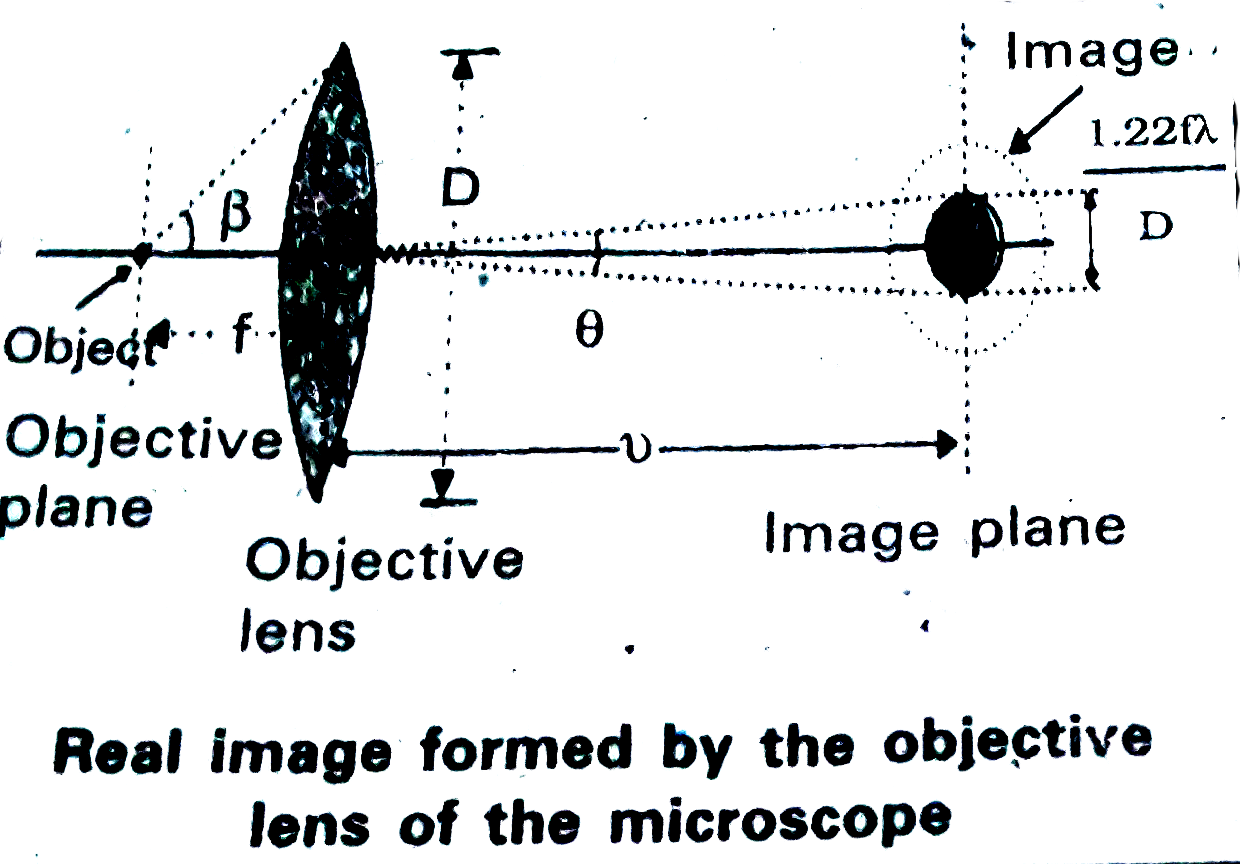
|
|
| 37. |
A wire is bent to form a semi circle such that the radius of the semicircle is R. The charge per unit length is lambda. The total electric field at the centre will be |
|
Answer» `2lambda//piepsi_(0)R` |
|
| 38. |
A coin is placedon a horizontal platform which undergoes vertical simple harmonic motion of angular frequency omega. The amplitude of oscillation is graduallyincreased. The coin will leave contact with platform for the first time : |
|
Answer» atthe mean POSITION of platform Thus CORRECT choice is (d). |
|
| 39. |
A soap film is formed on a wire ring held vertically and allowed to drain. A diffuse source of while light is observed by reflection in the soap film . In this connection indicate the wrong statement : |
|
Answer» The colours are due to refraction of light by the wedge-shaped film |
|
| 40. |
vec(A) and vec(B) are two vectors in a plane and vec(C ) is a vector perpendicular to this plance their resultant is : |
|
Answer» NEVER zero |
|
| 41. |
A particle starts its motion along x-axis from rest with a variable acceleration a = 12-6t m//s^(2). It starts its motion at t=0 from x = 0 . Choose the correct position (x) versus time ( t) curve. |
|
Answer»
|
|
| 42. |
A Carnot engine whose sink is at 300 K has an efficiency of 40%. By how much should the temperature of source be increased so as to increase its efficiency by 50% of original efficiency: |
|
Answer» 380 K New EFFICIENCY. `eta. =eta +(50)/(100) cdot eta =40% +(50)/(100)xx40% =60%` `therefore eta.=1-(T_(2))/(T_(1)) rArr (60)/(100)=1-(300)/(T_(1))w` `rArr T_(1) =750 K` `therefore` Increase in temperature of SOURCE `=T_(1).-T_(1)=750-500=250 K`. `therefore` Correct choice is (d). |
|
| 43. |
Average emf induced in an a.c. generator is zero for one complete cycle. |
| Answer» Solution :True - Since `varepsilon = varepsilon_(0) SIN omegat = N A BOMEGA sin omegat`, the average value of e for one complete cycle is ZERO. | |
| 44. |
Three resistances 1Omega, 2Omega and 3Omega are connected in parallel. The ratio of currents passing through them when a p.d. is applied across the ends is |
|
Answer» `2:3:6` |
|
| 45. |
The self inductance L of a slenoid of length l and area of cross-section A, with a fixed number of turns N increase as |
|
Answer» L and A increase |
|
| 46. |
An alpha-particle and a proton are accelerated through the same potential difference. Find the ratio of their de-Broglie wavelengths. |
|
Answer» Solution :We know that if a prticle of mass m and charge q is accelerated through a potential V, its de-Broglie wavelength is given by `lamda=(lamda)/(mv)=(H)/(p)=(h)/(sqrt(2mK))=(h)/(sqrt(2qmV))` Where K is the kinetic enegy of charge particle. We know that `q_a=2q_(p) and m_(a)=4m_(p)` SINCE accelerating potential V is same, hence the RATIO of de-Broglie.s wavelengths is given by `(lamda_(p))/(lamda_(alpha))=sqrt((q_(alpha)*m_(alpha))/(q_(p)*m_(p)))=sqrt(((2q_(p))(4m_(p)))/(q_(p)*m_(p)))=2sqrt(2) implies lamda_(p)=2sqrt(2)lamda_(alpha)`. |
|
| 47. |
Calculate the potential difference across the resistor of 400 Omega as measured by the voltmeter V of 400 Omega either by applying Kirchhoff's laws or otherwise |
Answer» SOLUTION :The given circuit may be redrawn as follows: Clearly this is a case of balanced Wheat-Stone Bridge. The 100Omega and D can be removed Now the reading of the voltmete`r = V_(BC) = I_(1), (200Omega) =(10V)/((100+200)Omega)XX(200Omega)=(20)/(3)Volt` 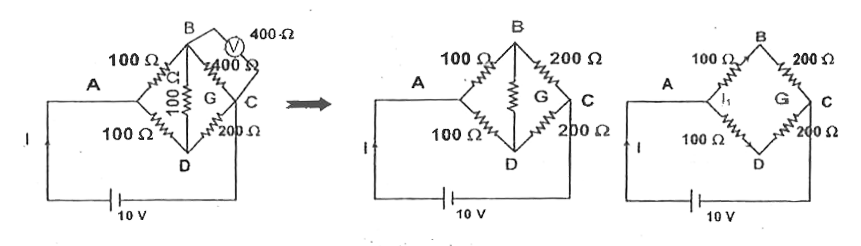
|
|
| 48. |
Discuss the power in AC circuit with only an inductor. |
|
Answer» Solution :The current reaches its maximum value later than the voltage by one-fourth of a PERIOD `(T)/( 4) = ((pi )/( 2))/( omega)` . The instantaneous power supplied to the INDUCTOR is, `P_(L) = IV = I_(m) sin ( omega t - ( pi )/( 2)) xx V_(m) sin (omega t )` `= - I_(m) V_(m) cos ( omega t ) sin ( omega t )` ` = - ( I_(m) V_(m))/( 2) sin ( 2 omega t )` The average power over a complete cycle is, `P_(L) = langle-(I_(2)V_(m) sin ( 2 omega t ))/(2)rangle= (I_(m) V_(m)) /(2) lt sin 2 omega t gt` `= - ( I_(m) V_(m) )/( 2) = 0 ` Since the average of `sin ( 2 omega t )` over a completecycle is zero. Thus, the average power supplied to an inductor over one completecycle is zero. Figures explains it in detail.  0-1 current i through the COIL entering at A increase from zero to a maximum value. Flux lines are setup means the core gets magnetised. With the polarity shown voltage and current are both positive. So their product p is positive. Enbery is ABSORBED from the source.  1-2 current in the coil is still positive but is decreasing. The core gets demagnetised and the net flux becomes zero at the end of a half cycle. The voltage v is negative ( SInce di `//` dt is negative. ) The product of voltage and current is negative and energy is begin returned to source.  2-3 current i becomes negative means it enters at B and comes out of A. Since the direction of current has changed, the polarity of the magnet changes. The current and voltage are both negative. So, their product p is positive . Energy is absorbed.  3-4 current i decreases and reaches its zero value at 4 when core is demagnetised and flux is zero. The voltage is positive therefore, negative energy absorbed during the `1//4` cycle 2-3 is returned to the source. |
|
| 49. |
Atom of ""_(100)Fm^(257) follow Bohr model. Its radius is n times Bohr radius then value of n…………. |
|
Answer» Solution :For `""_(100)Fm^(257)` atom electron will be in l, m, n, o, p orbit. `:.` Electron will be residing upto `5^(TH)` orbit, `:.r_(p)=(p^(2))/(Z)r_(0)` `nr_(0)=((5)^(2))/(100)r_(0)` `:.nr_(0)=(1)/(4)r_(0)"":.n=(1)/(4)` |
|