

Saved Bookmarks
This section includes 7 InterviewSolutions, each offering curated multiple-choice questions to sharpen your Current Affairs knowledge and support exam preparation. Choose a topic below to get started.
| 1. |
In a series of radioactive decays, if a nucleus of mass number 180 and atomic number 72 decays into another nucleus of mass number 172 and atomic 69, then the number of alpha and beta particles released respectively are |
|
Answer» 2,3 |
|
| 2. |
The time required for the light to go from A to B, when a ray of light goes from point A in a medium where the speed of light is v_1 to a point B in a medium where the speed of light is v_2 as shown in figure, is : |
|
Answer» `t = (a SEC i)/(v_1) + (B sec R)/(v_2)` |
|
| 3. |
Two isolated metallic solid spheres of radii R and 2R are charged such that both have the same charge Q. The spheres are located far away from each other and connected by a thin conducting wire. Find the heat dissipated in the wire. |
| Answer» SOLUTION :`(kQ^2)/(12 R)` | |
| 4. |
...... gave the concept of wave theory of propagation of light |
|
Answer» Newton |
|
| 5. |
In a method for comparing emfs by a potentiometer a balance point is found to be 50 cm with a Daniel cell of emf 1.1 volt. Where will you get the balance point with a Leclanche cell of emf 1.5 volt? |
|
Answer» |
|
| 6. |
A bar magnet has length 10 cm and pole strength 50 Am. Calculate the magnetic field at a point distance 20 cm from the centre of the magnet . a. on the axial line b. on the equatorial line |
|
Answer» |
|
| 7. |
A capacitor blocks D.C, but allows A.C to pass through it. Explain why. |
| Answer» SOLUTION :`X_C = (1)/(2PI V C)` | |
| 8. |
The time period of planet X around sun is 8 times that of Y. The distance of X from the sun is how many times greater than that of Y ? |
|
Answer» 4 times `(R_(1))/(R_(2))=(8)^(2//3) rArr R_(1)=4R_(2)`. Thus CORRECT choice is (a). |
|
| 9. |
Statement-1: Colour of a glowing black body changes on increasing its temperature. Statement-2: Spectral emissive power associated with each wavelength does not increase in same proportion on increasing temperature of the Black Body. |
|
Answer» STATEMENT-1 is TRUE, statement-2 is true and statement-2 is correct explanation for statement-1. |
|
| 10. |
The ratio of magnetic field at the center due to the rotation of a Bohr's electron in the first state of hydrogen atom and second excited state of Li^(++) atom is |
|
Answer» `9:1` |
|
| 11. |
An alternating voltage with frequency omega=314s^(-1) and amplitude V_(m)=180 V is fed to a series circuit consisting of a capacitor and a coil with active resistor's capacitance will the voltageamplitude across the coil be maximum ? What is this amplitude equal to ? What is the corresponding voltage amplitude across the condenser ? |
|
Answer» Solution :`V_(L)= I_(m) sqrt(R^(2) + omega^(2) L^(2))` `= ( V_(m) sqrt(R^(2)+ omega^(2) L^(2)))/( sqrt( R^(2) +(omegaL-(1)/( OMEGAC))^(2)))` for a given `omega , L, R`,this is MAXIMUM when `(1)/( omega C)= omegaL` or `C=(1)/( omega^(2) L ) = 28 . 2 mu F. ` For that `C, ` `V_(L)= (Vsqrt(R^(2)+ omegaL^(2)))/( R) = Vsqrt( 1+ ( omegaL // R )^(2))= 0.540 k V` At this `C` `V_(C)=(1)/(omegaC) (V_(m))/( R)=(V_(m) omega L)/( R)=. 509 k V` |
|
| 12. |
In the nucleus of _11Na^23 the number of protons, neutrons and electrons are |
|
Answer» 11,12,0 |
|
| 13. |
In previous problem ( i.e., Question) ,if lift is moving downward with constant acceleration 'a', then its time period |
|
Answer» `T = 2pi sqrt((m)/(k))` |
|
| 14. |
A person moves 30 m along north direction, then moves 40 m along east direction and finally moves 20 m along south direction. Find distance & displacement |
| Answer» SOLUTION :`90 m, 10 SQRT(17) m` | |
| 15. |
A monochromatic light of wavelength lamda is incident on an isolated metallic sphere of radius a. The threshold wavelength is lamda_(0), which is larger than lamda. Find the number of photoelectrons emitted before the emission of photo electrons stops. |
|
Answer» Solution :As the metallic sphere is isolated, it becomes positively charged when ELECTRONS are EJECTED from it. There is an extra attractive force on the photoelectrons. If the POTENTIAL of the sphere is raised to V, the electron should have a minimuin ENERGY W+eV to be able to come out. Thus, emission of photoelectrons will stop when `(hc)/(lamda)=W+eV=(hc)/(lamda_(0))+eVorV=(hc)/(e)((1)/(lamda)-(1)/(lamda_(0)))` The charge on the sphere needed to take its potential to V is `Q=(4piepsi_(0)a)V` The number of electrons emitted is, therefore, `n=(Q)/(e)=(4piepsi_(0)aV)/(e)=(4piepsi_(0)ahc)/(e^(2))((1)/(lamda)-(1)/(lamda_(0)))` |
|
| 16. |
A converging lens is kept coaxially in contact with diverging lens--- both the lenses being of equal focal lengths. What is the focal length of the combination ? |
|
Answer» Solution :Let focal length of converging LENS `f_(1) = +F` and focal length of diverging lens `f_(2) =-f`.If focal length of combination be `f_(EQ)`, then: `1/f_(eq) =1/f_(1) + 1/f_(2) =1/(+f) +1/(-f) =0` `rArr f_(eq) = OO` or `P_(eq) =0` |
|
| 17. |
When ultraviolet rays are incident ono metal plate, the photoelectric effect does not occur. It occurs by incidence of |
|
Answer» INFRARED rays |
|
| 18. |
What is change in internal energy when 1 gm ice at 0^@C is converted into water at 0^@C . |
|
Answer» a)80 J |
|
| 19. |
There are three Newton's laws of motion namely first, second and third laws. We can derive |
|
Answer» Second and third LAWS from the first LAW |
|
| 20. |
A parallel plate capacitor with dielectric constant K 'between the plates has a capacity C and is charged to a potential V The dielectric slab is slowly removed ftom between the plates and tiien reinserted. The net workdone by the system in the process is : |
|
Answer» ZERO |
|
| 21. |
Show that the frequency intervals between the neighbouring spectral lines of a true ratational spectrim of a diatomic molecules are equal. Find the moment of intertial and the distance between the nuclei of a CH molecule if the intervals between the neighbouring lines of the true rotational spectrum of these molecules are equal to Delta omega= 5.47.10^(12)s^(-1) |
|
Answer» SOLUTION :From `E_(J)=( ħ^(2))/(2l)J(J+1)` and the SELECTION rule `DeltaJ=1 or J rarr J-1` for a pure rational specturm we get `omega(J,J-1)=( ħJ)/(I)` Thus transition lines are equispaced in frequency `Delta omega=( ħ)/(I)` In the case of `CH` molecule `I=( ħ)/(Delta omega)= 1.93xx19^(-40)gm cm^(2)` Also `I=(m_(c )m_(H))/(m_(c )+m_(H))d^(2)` so `d= 1.117xx10^(-8)cm= 111.7 p m` |
|
| 22. |
Figure shows a square loop 100 turns as area of 2.5 xx 10^(-3) m^(2) and a resistance of 100 Omega. The magnetic field has a magnitude B = 0.40 T . The work done in pulling the loop out of the field slowly and uniformly in 1.0 "s is n" xx 10^(-6) then n is |
|
Answer» SOLUTION :The side of the square is 1 = `sqrt(2.5xx10^(-3)m^(2))= 0.05` m As it is uniformly PULLED out in 1.0 s the SPEED of the LOOP is V = 0.05 m/s The emf induced in the left arm of the loop is `epsilon Nv B1 = 100 xx(0.05 m//s)xx (0.40T ) xx (0.05m) = 0.1 v ` The current in the loop is `i=(0.1V) /(100 Omega) = 1.0 xx10^(-3)` A The FORCE on the left arm due to the magnetic field is `F=i//B =(1.0 xx10^(3)A) (0.05 m ) (0.40t) = 2.0xx 10^(-5)N` This force is towards left in the figure. To pull the loop uniformly an external force of `2.0xx10^(-5) N` `W = (2.0 xx10^(-5) N) xx(0.05 m) = 1.0 xx10^(-6) J` |
|
| 23. |
In a thermal reactor the mean lifetime of one generation of thermal neutrons is tau=0.10 s. Assuming the multiplication constant to be equal to k=1.010, find : (a) how many times the number of neutrons in the reactor, and consequently its power, will increase over t=1.0 mi n , (b) the period T of the reactor, i.e., the time period over which its power increases e-fold. |
|
Answer» Solution :(a) This number is `K^(n-1)` where `n=` no. of generations in TIME `t=t//T` SUBSTITUTION GIVES `388`. (B) We write `k^(n-1)=E^(((T)/(tau)-1)In k)` or `(T)/(tau)-1=(1)/(In k)` and `T=tau(1+(1)/(In k))=10.15 sec` |
|
| 24. |
Two condensers of capacities C and 3C are connected in parallel and then connected in series with a third condenser of capacity 3C. The combination is charged with a battery of 'V'volt. The charge on condenser of capacity C is (in coulomb) |
|
Answer» `1//2 (CV )` |
|
| 25. |
Assertion: Resolving power of an electron microscope is extremely high. Reson: An electron microscope makes use of electron waves whose wavelength is very small. |
|
Answer» If both assertion and reason are TURE and the reason is the correct EXPLANATION of the assertion. |
|
| 26. |
What role does electrostatics play in a xerox copying machine? |
| Answer» SOLUTION :A xerox copying machine is one of the MANY industrail applications of the forces of attraction and REPULSION betweenchargedbodies. Particles of black powder, called toner, stick to a tiny carrier bead of the machine on account of electrostatic forces. The negativelychargedtoner particles areattractedfrom carrier beadto a roating drum, wherea positively chargedimage of document being copied has formed. A charged sheetof paperthen ATTRACTS the lonerparticles from the drum to itself. They are then heatfused in placed to produced the PHOTO copy. | |
| 27. |
What is approximate wavelength range of visible spectrum? |
| Answer» Solution :The FREQUANCY range for the VISIBLE SPECTRUM PART of the electromagetic wave is `4 xx 10^11` kHz to `7.7 xx 10^11` kHz. | |
| 28. |
Derive the equation for acceptance angle and numerical aperture, of optical fiber. Acceptance angle in optical fibre: |
|
Answer» Solution :To ensure the critical angle incidence in the core-cladding boundary inside the OPTICAL fibre, the light should be incident at a certain angle at the end of the optical fiber while entering in to it. This angle is called acceptance angle. It depends on the refractive indices of the cladding `n_(2)` and the outer medium `n_(3)`. Assume the light is incident at an angle called acceptance angle `i_a` at the outer medium and core boundary at A. The Snell.s law in the product form, equation for this refraction at the point A. 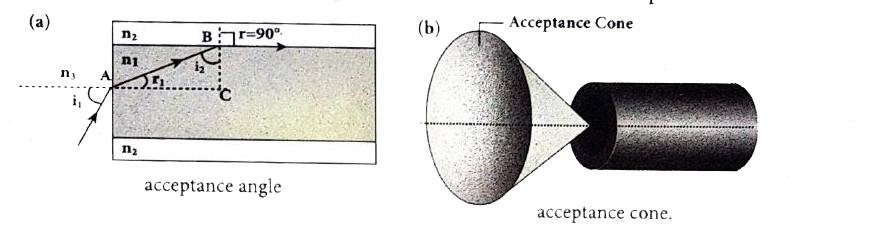 `n_(3) sin i_(a)=n_(1) sin r_(a)` To have the total internal reflection inside optical fibre, the angle of incidence at the core-cladding interface at B should be atleast critical angle `i_c.` Snell.s law in the product form,equation for the refraction at point b is `n_(1) sin i_(c)=n_(2) sin 90^(@)` `n_(1) sin i_(c)=n_(2)"sin 90^(@)=1` `sin i_(c)=n_(2)/n_(1)` From the RIGHT angle `triangleABC`, `i_(c)=90^(@)-r_(a)` Now, equation (3) becomes, `sin (90^(@)-r_(a))=n_(2)/n_(1)` Using trigonometry, `cos r_(a)=n_(2)/n_(1)` Substituting for `cos r_(a)` `sin r_(a)=SQRT(1-((n_(2))/(n_(1))^(2))=sqrt((n_(1)^(2)-n_(2)^(2))/(n_(1)^(2))) ..........(5)` Substituting this in equation (1) `n_(3) sin i_(a)=n_(1) sqrt((n_(1)^(2)-n_(2)^(2))/(n_(1)^(2)))=sqrt(n_(1)^(2)-n_(2)^(2)) .......(6)` On further simplification, `sin i_(a)= sqrt((n_(1)^(2)-n_(2)^(2))/(n_(3))) (or) sin i_(a)=sqrt((n_(1)^(2)-n_(2)^(2))/(n_(3)^(2))) .........(7)` `i_(a)=sin^(-1) (sqrt((n_(1)^(2)-n_(2)^(2))/(n_(3)^(2))) .........(8)` If outer medium is air, then `n_(3)=1`. The acceptance angle `i_(a)` becomes. `i_(a)=sin^(-1) (sqrt(n_(1)^(2)-n_(2)^(2))` ...........(9) Light can have any angle of incidence from 0 to `i_(a)` with the normal at the end of the optical fibre forming a conical shape called acceptance cone. In the equation (6), the TERM `(n_3 sin i_(a))` is called numerical aperture NA of the optical fibre. `NA=n_(3) sin i_(a) (sqrt(n_(1)^(2)-n_(2)^(2)) .....(10)` If outer medium is air, then `n_(3)=1`. The numberical aperture NA becomes, `NA=sin i_(a)=sqrt(n_(1)^(2)-n_(2)^(2)) .......(11)` |
|
| 30. |
A parallel plate capacitor is filled by a dielectric whose permittivity varies with the applied voltage according to the law epsilon= alphaU . where alpha = 1V^(-1) .The same (but containing no dielectric) capacitorcharge to a voltage U_0 = 156 Vis connected in parallel to the first ..nonlinear.. uncharged capacitor Determine the final voltage U across the capacitors (nearly). |
|
Answer» |
|
| 31. |
Which of the following represents correct mirror formula ? |
|
Answer» `(1)/(F)=(1)/(V)-(1)/(U)` |
|
| 32. |
What is the function of a modem ? |
| Answer» Solution :Modem PERFORMS the FUNCTIONS of both modulator and demodulator. While TRANSMITTING SIGNAL, modem acts as a modulator while in receiving MODE, modem acts as a demodulator. | |
| 33. |
An emf of 20 V is applied at time t = 0 to a circuit containing in series 10 mH inductor and 5Omega resistor. The ratio of the currents at time t = oo and t = 40 s is close to (take e^2 = 7.389) |
|
Answer» 1.06  `=4(1-e^(-500t))` `rArr` At `t=oo [("INFINITE"),(because e=e)]` i=4(1-e) `i_0=4A`  `i_0=4A` `rArr` At t=40 s `i_(40) = 4(1-e^(-500xx40))` `=4(1-1/((e^2)^10000))` `=4(1-1/((7.29)^10000))` `i_0/i_40 = 1/(1(1/((7.29)^10000)))` =1.06 |
|
| 34. |
Which of the following changes in the artificial transmutation of elements? |
|
Answer» NUMBER of neutrons |
|
| 35. |
Define the terms : Threshold frequency |
| Answer» Solution :THRESHOLD FREQUENCY is the MINIMUM frequency of the incident RADIATION below which photo emission TAKE place in the substance. | |
| 36. |
A thin, spherical, conducting shell of radius R is mounted on an isolating support and charged to a potential of-170 V. An electron is then fired directly toward the center of the shell, from point P at distance r from the center of the shell (r gt gt R). What initial speed v_0 is needed for the electron to just reach the shell before reversing direction? |
| Answer» SOLUTION :`7.73 XX 10^(6) m//s` | |
| 37. |
A band playing music at a frequency fi s moving towards a wall at a speed v_h. A motorist is following the band with a speed v_m . If v is the speed of sound, the expression for the beat frequency heard bythe motorist is (n(V+V_m)V_b)/((V^2 - V_b^2)) . Then n |
|
Answer» |
|
| 38. |
The matter-wave picture of electromagnetic wave/radiation elegantly incorporated the |
|
Answer» Heinsenberg's UNCERTAINTY principle |
|
| 39. |
Which one of the following represent Curie's law? |
|
Answer» `M=C_X/T` |
|
| 40. |
Two capillaries of length l and 2l or radii R and 2R are connected in series. The net rate of flow of fluid through them will be |
|
Answer» a)`8/9 XX (piPR^4)/(8etal)` |
|
| 41. |
Calculate the gain ofa negative feedback amplifier with an internal gain of A = 100 and feedback factor beta =(1)/(1000) |
|
Answer» SOLUTION :Fornegativefeedback`A_f = ( A )/( 1+A BETA)` ` thereforeA_f = (100)/( 1+100 XX (1/1000) ) = (100)/( 1+0.1 ) = (100)/( 1.1)` `= 90.909~= 90.91` |
|
| 42. |
Kitchen of the cell is |
|
Answer» Mitochondria |
|
| 43. |
Assertion: Long distance communication between two points on the earth is achieved using sky waves. Reason: sky wave propagation takes place above. The frequency of 30 MHz. |
|
Answer» |
|
| 44. |
The electric force experienced by a charge of 1.0xx10^(-6) C is 1.5 xx 10^(-3) N . Find the magnitude of the electric field at the position of the chaerge. |
|
Answer» SOLUTION :`F_e=thetaE, E=(F_e)/THETA=(1.5xx10^-3)/(1.0xx10^-6 )` ` =1.5xx10^3N//C` |
|
| 45. |
A positive charge q is projected in magnetic field of width (mv)/(sqrt(2)qB) with velocity v as shown in figure. Then time taken by charged particle to emerge from the magnetic field is |
|
Answer» `(m)/(sqrt(2)qB)` (B) `C*O_(2)` is information (C ) TYNDALL effect is more dominatingin lyophobic solution. (D) Extent of PHYSISORPTION decreases with increasesin temperature. |
|
| 46. |
The following figure represents the electric potential as a function of x -coordinate Plot thecorresponding electric field as a function of x. |
|
Answer» Solution :In the given problem SINCE the potential depends only on x we can use `vecE=-(dV)/(dx)-hati` (the other two terms `(partialV)/(partialy) "and " (partialV)/(partialz)` are zero ) From0 to 1 cm the slope is CONSTANT and so `(dV)/(dx) =25 Vcm^(-1)` . So `vecE=-25V cm^(-1) hati` From 1 to 4 cm the potential is constant V = 25 V . It implies that `(dV)/(dx)=0`. So `vecE=0` From 4 to 5 cm the slope `(dV)/(dx) = -25 V cm^(-1)` So `vecE=+25V cm^(-1)hati` The plot of electric field for the various points along the x axis is given below . 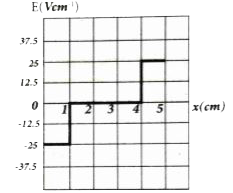
|
|
| 47. |
Calculate the number of nuclei of carbon -14 undecayed after 22,920years if the initial number of carbon - 14 atoms is 10, 000. The half- life of carbon-14 is 5730 years. |
|
Answer» SOLUTION :To get the time interval in terms of half-life, n = `(t)/(T_(1/2)) = (22,920 yr)/(5730 yr) = 4` The number of NUCLEI remaining undecayed after 22,920 yeras, `N = ((1)/(2))^(n) N_(0) = ((1)/(2))^(4) XX 10,000 Rightarrow N = 625` |
|
| 48. |
The displacement y (in metres) of a body varies with time T (in sec.) asy=(-3)/(2)t^(2)+36t+2. How long does the body takes to come to the rest ? |
|
Answer» 8s `implies-3t+36=0 implies t=12s` |
|
| 49. |
The ratio of radii of Fresnel.s fourth and ninth zone is |
| Answer» Answer :D | |
| 50. |
A cylindrical container is shown in figure-2.7 in which a gas is enclosed. Its initial volume is Vand temperature is T. As no external pressure is applied on the light piston shown, gas pressure must be equal to the atmospheric pressure. If gas temperature is doubled, find its final volume. In its final state if piston is clamped and temperature is again doubled, find the final pressure of the gas. |
|
Answer» Solution :In the initial state the pressure, volume and temperature of GAS `P_(0)` and T respectively if `P_(0)` is the atmospheric pressure. It is given that temperature of gas is INCREASED to double its value i.e. up to 2T. As in initial and final state pressure of gas remains constant as initially as well as finally the PISTON is exposed to atmospheric pressure. Thus we have from charls and Gay Lussac LAW `(V_(1))/(T_(1))=(V_(2))/(T_(2))` Here `""V_(2)=(V_(1)T_(2))/(T_(1))=2V` `["As"V_(1)=V,T_(1)=T" and "T_(2)=2T]` Thus after increasing the gas temperature to 2T, its volume becomes 2V. Now the piston is clamped that means, now the volume of gas remains constant. Again its temperature isdoubled from 2T to 4r, let the pressure changes from `P_(0)` to P'. Thus we have `(P_(1))/(T_(1))=(P_(2))/(T_(2))` or `""P_(2)=P'=(P_(1)T_(2))/(T_(1))=2P_(0)` `["As"P_(1)=P_(0),T_(1)=2T" and "T_(2)=4T]` Thus in final state gas pressure becomes `2P_(0)`. |
|