

Saved Bookmarks
This section includes 7 InterviewSolutions, each offering curated multiple-choice questions to sharpen your Current Affairs knowledge and support exam preparation. Choose a topic below to get started.
| 1. |
A body is dropped from a certain height. At the instant it loses P.E.U. It acquires a velocity 'v' the mass of the body is : |
|
Answer» `U^(2)//2V` `:. 1/2mv^(2)=U` `:. M=(2U)/(V^(2))` |
|
| 2. |
A non-polar molecule with polarzabillity beta is located at a great distance l from a polar molecule with electric moment p. Find the magnitude of the interactionforce betweenthe molecules if the vector p si oriented along astraight line passing through both molecules. |
|
Answer» Solution :From the genral formula `VEC(E) = (1)/(4pi epsilon_(0)) (3 vec(p). vec(r ). vec(r ) - vec(p) r^(2))/(r^(5))` `vec(E) = (1)/(4pi epsilon_(0)) (2vec(p))/(l^(3))`, where `r = l`, and `vec(r ) uarr uarr vec(p)` This will cause the induction of a dipole moment. `vec(p_("ind")) = BETA (1)/(4pi epsilon_(0)) (2 vec(p))/(l^(3)) xx epsilon_(0)` THUS the force, `vec(F) = (beta)/(4pi ) (2P)/(l^(3)) (del)/(del l) (1)/(4pi epsilon_(0)) (2p)/(l^(3)) = (3 beta p^(2))/(4pi^(2) epsilon_(0) l^(7))` |
|
| 3. |
N identical cells, each of emf epsilon and internal resistances r are joined in series. Out of these, n cells are wrongly connected, i.e. their terminals are connected in reverse order as required for series connection. If epsilon_(o) be the emf of the resulting battery and r_(o) be its internal resistance then for n lt N//2 |
|
Answer» `epsilon_(0) = (N-n)EPSILON,r_(o) = (N-n)R` |
|
| 4. |
Assertion: Digital signals are continous variations of voltage of curren t. Reason: Digital signals are essentially single valued functions of time. |
|
Answer» |
|
| 5. |
A conducting rod AB of mass M and length L is hinged at its end A. It can rotate freely in the vertical plane (in the plane of the Figure). A long straight wire is vertical and carrying a current I. The wire passes very close to A. The rod is released from its vertical position of unstable equilibrium. Calculate the emf between the ends of the rod when it has rotated through an angle theta (see Figure). |
|
Answer» |
|
| 6. |
An oil dropof 12 exess electronsis held stationaryunder a constanteletric fieldof 2.55 xx10^(4) NC^(-1)the density of the oilis 1.26g cm^(-3)estimage the radius of the drop(g=9.81 m s^(-2) e =1.60 xx10^(-19) C) |
| Answer» SOLUTION :(a) ZERO ,(B) zero(C ) 1.9 N/C | |
| 7. |
charge density for intrinsic semiconductor will be: |
|
Answer» `15xx1O^17m^-3` |
|
| 8. |
The value of beta of a transistor is 19. The value of alpha will be …… |
|
Answer» 0.93 `ALPHA=(BETA)/(1+beta)=(19)/(20)=0.95` |
|
| 9. |
AND gate : |
|
Answer» It has no equivalenc to switching CIRCUIT. |
|
| 10. |
The direction of magnetic field lines of bar magnet is |
|
Answer» `barm.barB` |
|
| 11. |
Two ships are 10sqrt(2)km apart on a line running south to north. The one further north is moving west with a speed of 25 km/h, while the other towards north with a speed of 25 km/h. |
|
Answer» Their distance of closest approach is `5sqrt(2)`km. 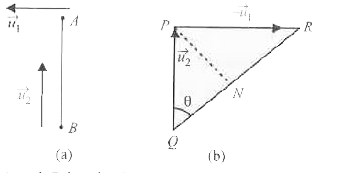 Let A and B be the initial positions of the two ships such that AB = `10sqrt(2)` km. The ship at A is moving with velocity `u_(1)`(25 km/h) westward and the ship B north ward with velocity `u_(2)`(25 km/h). The relative velocity of ship B with respect to that of ship A is GIVEN by `vecv_(BA) = vecv_(B) - vecv_(A) = vecu_(2)-vecu_(1) = vecu_(2) + (-vecu_(1))` In figure (b) `vec(OP)` and `vec(PR)`represent velocities `vecu_(2)`and `-vecu_(1)`RESPECTIVELY. Then `vec(QR)`represents the relative velocity of B with respect to A. Now, `|vec(QR)| = sqrt(PQ^(2) + PR^(2)) =sqrt(25^(2) + 25^(5)) = 25sqrt(2) km//h` and `tan theta = (PR)/(QP) = 25/25 =1 therefore theta = 45^(@)` Now, we can suppose that the ship A is at rest at P and the ship B is moving along QR with a velocity of `25sqrt(2)`km/h. The closest distance between the ships will be PN, which is the perpendicular distance of P from QR. Now, `(PN)/(PQ) = sin 45^(@) rArr PN =PQ sin 45^(@)` or `QN = PQ cos 45^(@) = 10sqrt(2) xx 1/sqrt(2) = 10 km` `therefore` time required to reach the closest distance `=(QN)/("relative velocity") = 10/(25sqrt(2)) h` `=10/(25sqrt(2)) xx 60` min = 17 min. |
|
| 12. |
A parent nucleus X undergoes alpha-undergoes alpha-decay with a half-life of 75000 years. The daughter nucleus Y undergoes beta-decay with a half-life of 9 months. In a particular sample, it is found that the rate of emission of beta-particles is nearly constant (over several months) at 10^(7)//"hour". What will be the number of alpha-particles emitted in an hour ? |
|
Answer» `10^(2)` `therefore` From the law of radioactive decay, `(-(dN)/(dt))_(alpha-"particle") = lambda_(alpha) N_(alpha) and (-(dN)/(dt))_(beta-"particle") = lambda_(beta) N_(beta)` Now, `lambda_(alpha)N_(alpha) = lambda_(beta) N_(beta)` (At steady STATE) `rArr""(-(dN)/(dt))_(alpha-"particle") = (-(dN)/(dt))_(beta-"particle")` `rArr""(-(dN)/(dt))_(alpha-"particle") = 10^(7)//"hour"` |
|
| 13. |
The half-life period of a radio-active element X is same as the mean life time of another radioactive element Y. Initially they have the same number of atoms. Then |
|
Answer» X will DECAY FASTER than Y |
|
| 14. |
(A): When two coils are wound on each other, the mutual induction between the coils is maximum(R) : Mutual induction does not depend on the orientation of the coils. |
|
Answer» Both .A. and .R. are true and .R. is the CORRECT explanation of .A. |
|
| 15. |
Tangent at any point, to a magnetic lines of force gives the _____ of magnetic intensity at that point. |
| Answer» SOLUTION :DIRECTION | |
| 16. |
A monoatomic gas is suddenly compressed to(1//8)^(th)ofinitial volume adiabatically . The ratioof its final pressure to the initial volume adiabatically. The ratio of (Given the ratio of the specific heats of the given gas to be 5/3 ) |
|
Answer» 32 ` P_(1)V_(1)^(gamma)=P_(2) V_(2)^(gamma) ` `thereforeP_(2)/P_(1) = (V_(1)/V_(2))^(gamma) = ((8V_(1))/V_(1))^(5/3) =2^(5) = 32 ` |
|
| 17. |
Name one device for producing polarized light. Draw a graph showing the dependence of intensity of transmitted light on the angle between polarizer and analyser. |
|
Answer» Solution :Nicol prism or calcite prism , According to Law of Malus, when a beam of completely plane polarized light is incident on an analyser, the resultant intensity of light `(I)` transmitted from the analyser varies directly as the square of the cosine of the angle `(theta)` between planes of TRANSMISSION of analyserand polarizer, (Law of Malus) i.e.,`I prop cos^(2)theta and I = I_(0) cos^(2) theta`...(i) where `I_(0) =` intensity of the light from polariser From (i), we note that if the transmitted axes of polariser and analyser are parallel (i.e. `theta = 0^(@) or 180^(@)`), then `I = I_(0)`. It means the intensity of transmitted light is maximum. When the transmission axes of polariser and analyser are prependicular (i.e. `theta = 90^(@)`), then `I = I_(0) cos^(2) 90^(@) = 0`. It means the intensity of transmitted light is zero. On plotting a GRAPH between `I and theta` as given by RELATION (i), we get the CURVE as shwon in Fig. 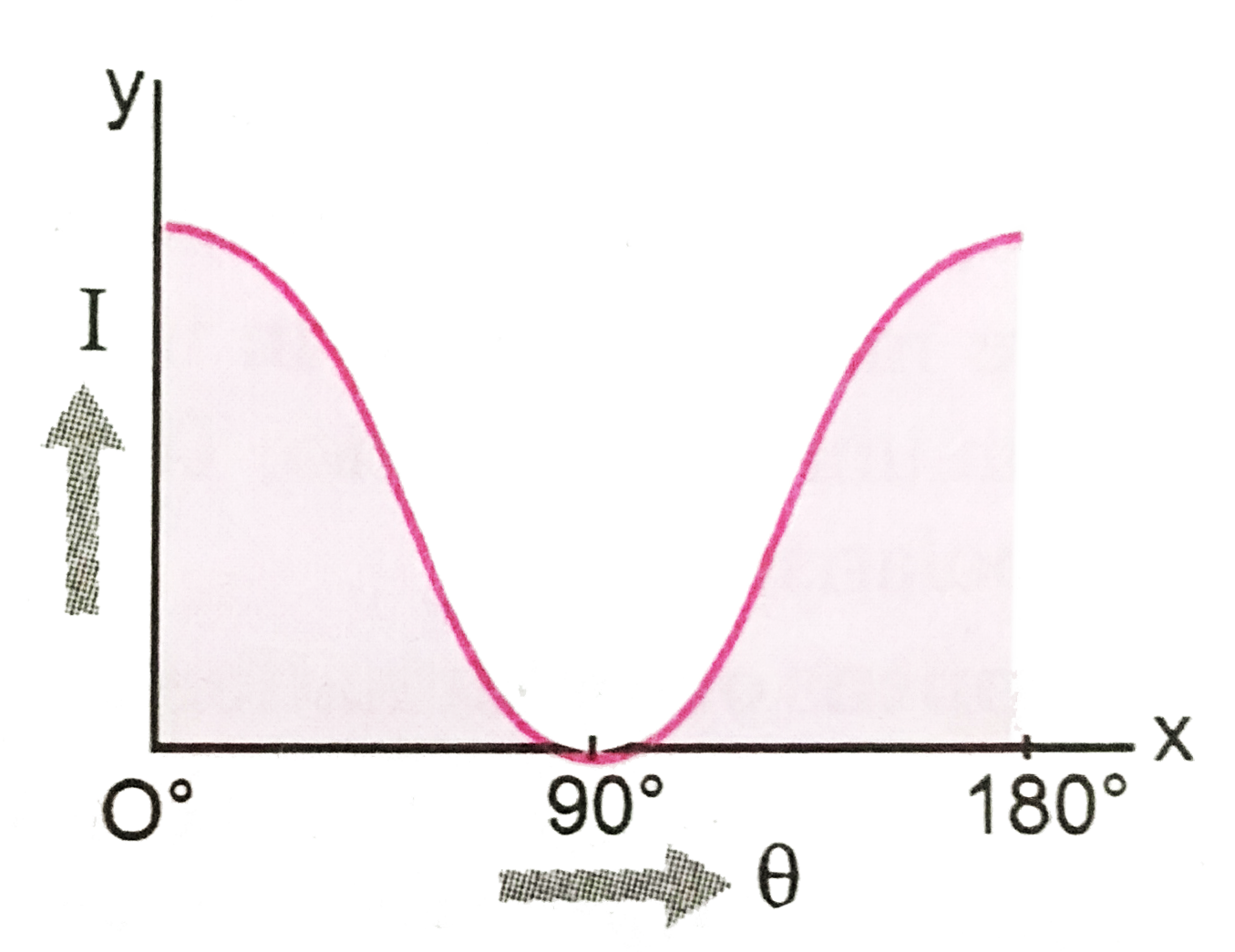
|
|
| 18. |
What is astigmatism? |
| Answer» Solution :Astimatism is the defect ARISING due to different CURVATURES ALONG different planes in the EYE lens. Astigmatic person cannot see all the directions equally well. The defect due to astigmatism is more SERIOUS than mypia and hyperopia. | |
| 19. |
A moving coil galvanometer has a coil with 175 turns and area 1 cm^(2).It uses a torsion band of torsion constant 10^(6) N-m/rad. The coil is placed in a magnetic field B parallel to its plane. The coil deflects by 1° for a current of 1 mA. The value of B (in Tesla) is approximately |
|
Answer» `10^(-1)` `B = (10^(-6) XX pi)/(175 xx 10^(-4) xx 10^(-3)) = 10^(-3) T` |
|
| 20. |
In a metre bridge when the resistance in the left gap is 2Omega and an unknown resistance in the right gap, the balance point is obtained at 40 cm from zero end. On shunting the unknown resistance with 2Omega, find the shift of the balance point on the bridge. |
|
Answer» Solution :The unknown resistance (S)is on the RIGHT gap, So at null point, `S = R (100 - l)/(l) = 2 xx (100 - 40)/(40) = 3Omega` When S is shunted with 2`Omega`, the resistance on the right gap is, `S' = (3 xx 2)/(3 + 2 ) = 1.2Omega` If balance is obtained at a DISTANCE l', then `S' = R(100 - l')/(l') = R((100)/(l') - 1)` or, `"" l' = (100R)/(R + S') = (100 xx 2)/(2 + 1.2) = 62. 5 cm` `therefore` Shift in balance point= 62.5 - 40 = 22.5 cm |
|
| 21. |
Two batteries of emfs epsilon_(1) and epsilon_(2) (epsilon_(2) gt epsilon_(1)) and internal resistances r_(1) and r_(2) respectively are connected in parallel as shown in fig. |
|
Answer» The equivalent emf `epsilon_(eq)` of the two cells is between `epsilon_(1) and epsilon_(2)," i.e.,"epsilon_(1) lt epsilon_(eq)lt epsilon_(2)` |
|
| 22. |
Discuss the experimental results of GeigerMarsden's a-particle scattering. |
Answer» Solution :A typical graph of the total number of al-particles scattered at different angles in a GIVEN interval of time is shown in below FIGURE. The dots in this figure represent the data points and the solid curve is the THEORETICAL prediction BASED on the assumption that the atom has positively charged nucleus. Many of the `alpha`-particles pass through the foil. It means that they do not suffer any collisions. Only about 0.14% of the incident`alpha` particles scatter by more than `1^(@)` and about 1 in 8000 deflect by more than `90^(@)` |
|
| 23. |
Consider the following statements. SI : The nuclear force is independent of the charge of nucleons. S2 : The number of nucleons in the nucleus of an atom is equal to the number of electrons in the atom. S3 : All nuclei have masses that are less than the sum of the masses of constituent nucleons. S4 : Nucleons belong to the family of leptons while electrons are members of the family of hadrons. Choose the correct statement/statements from these. |
|
Answer» S1 only NUMBER of nucleons = Number of protons `+` number of neutrons = mass number All nuclei have masses that are less than the sum of the masses of its constitents. The DIFFERENCE in mass of a nucleus and its constituents is known as mass DEFECT. Nucleons belong to the family of hadrons while ELECTRONS belong to family of leptons. |
|
| 24. |
What is series connection of capacitors ? |
Answer» Solution :Figure shows CAPACITORS `C_(1)` and `C_(2)` combined in series.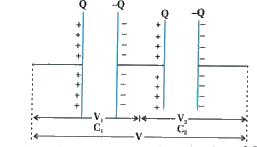 The left plate of `C_(1)` and the right plate of `C_(2)` are connected to two terminals of a battery and have charges Q and -Q. HENCE, the right plate of `C_(1)` has charge - Q and the left plate of `C_(2)` induces charge + Q. Hence, both capacitors have same charge on each capacitor even though they have different capacitance. Suppose, potential difference between two PLATES of capacitor `C_(1)` and `C_(2)` are `V_(1)` and `V_(2)` respectively. If potential difference between two ends of combination V, then `V=_(1)+V_(2)` `:. V= (Q)/(C_(1))+(Q)/(C_(2)) [ because C=(Q)/(V) implies V = (Q)/(C)]` `:. (V)/(Q)=(1)/(C_(1))+(1)/(C_(2))` This combination as an effective capacitor with charge Q and potential difference V. The effective capacitance of the combination is, `C=(Q)/(V)` `:.` From equation (2) and (3) `(1)/(C) =(1)/(C_(1))+(1)/(C_(2))` |
|
| 25. |
Fig.shows a potentiometer with a cell of 2.0 V and internal resistance 0.40 Omegamaintaining a potential drop across the resistor wire AB. A standard cell which maintains a constant emf of 1.02 V (for very moderate currents up to a few mA) gives a balance point at 67.3 cm length of the wire. To ensure very low currents drawn from the standard cell, a very high resistance of 600 kOmegais put in series with it, which is shorted close to the balance point. The standard cell is then replaced by a cell of unknown emfand the balance point found similarly, turns out to be at 82.3 cm length of the wire.(a) What is the value of epsi ? (b) What purpose does the high resistance of 600 kOmegahave ? (c) Is the balance point affected by this high resistance ? (d) Would the method work in the above situation if the driver cell of the potentiometer had anemf of 1.0 V instead of 2.0 V? (e) Would the circuit work well for determining an extremely small emf, say of the order of afew mV (such as the typical emf of a thermo-couple) ? If not, how will you modify the circuit ? |
|
Answer» Solution : (a) In a potentiometer `epsi_1/epsi_2 = l_1/l_2`and in present problem with standard cell of emf `epsi_1` = 1.02 V,`l_1 = 67.3 cm` and with a cell of unknown emf `epsi`, the null point is obtained at 82.3 cm. Hence, we have `(1.02)/(epsi) = (67.3)/(82.3)` `epsi = (1.02 xx 82.3)/(67.3) = 1.25 V` (b) The high resistance of 600 k`Omega`reduces the current through the galvanometer when the jockeycontact is far away from the balance point. The galvanometer is thus protected from thedamage likely to be caused by the high current. (c) There is no effect of this high resistance on the balance point. (d) In case, the driving emf is smaller than the emf to be measured, balance point cannot be found. (e) In such a case, the balance point will be very close to the end giving a very large percentage errorin MEASUREMENT of `epsi` . If a resistance is placed in series with the wire AB such that potential drop across AB is only SLIGHTLY larger than the emf to be measured, the balance point will be found ona larger length and the percentage ERROR will be very small. |
|
| 26. |
An electron in an atom is revolving round the nucleus in a circular orbit of radius 5.3 xx 10^(-11)m, with a speed of 2 xx 10^(6) ms^(-1). The resultant orbital magnetic moment and angular momentum of the electron is ...... Take charge of electron = 1.6 xx 10^(-19) C, mass of electron = 9.1 xx 10^(-31) kg. |
|
Answer» <P> Solution :The current FLOWING in circular path of electron with frequency f is `I= fe`But `f= (omega)/( 2pi ) "" therefore I= (omega e)/( 2pi) ` but `omega = (v)/( r)` `therefore I= (ve)/( 2pi r)` `m= IA` `= (ve)/(2pi r)xx pi r^(2) ` `= (1)/(2) ver` `= (1)/(2) xx 2 10^(6) xx 1.6 xx 10^(-19 ) xx 5.3 xx 10^(-11)` `= 8.48 xx 10^(-24) "Am"^(2)` ANGULAR momentum `L=pr` `-m_(e) vr ""("where" p = mv)` `L= 9.1 xx 10^(-31) xx 2 xx 10^(6) xx 5.3 xx 10^(-11)` `= 96.46 xx 10^(-36) ` `therefore L= 9.65 xx 10^(-35)` Nms 
|
|
| 27. |
A long roundconductorto cross-sectionalarea S is made of material whoseresistivitydepends onlyon a distance r fromthe axis of the conductoras rho = alpha//r^(4), where alpha is a constant. Find : (a) the resistance per unit lengthof sucha conductor, (b) the electric field strengthin the conductordue to which a current I flow though it. |
|
Answer» Solution :(a) Consider a cylinder of UNIT length and divide it into shellsof radius `r` and thickness `dr` Different sections are in parallel. For a typical section, `d((1)/(R_(1))) = (2pi r dr)/((alpha//r^(2))) = (2pi r^(3) dr)/(alpha)` Intergating, `(1)/(R_(1)) = (piR^(4))/(2 alpha) = (S^(2))/(2pi alpha)` or,`R_(1) = (2pi alpha)/(S^(2))`, where `S = pi R^(2)` (b) Suposse the electric field inside is `E_(x)= E_(z)` (Z axis is alongthe axis of the conductor). This electric field cannot dependon `r` in steadyconditionswhen other componetsof `E` are absent, otherwiseone violates the circulation theorem `oint vec(E) . vec(dr) = 0` The CURRENT through a sectionbetweenradii `(r + dr, r)` is `2pi r dr (1)/(prop//r^(2)) E = 2pi r^(3) dr (E)/(prop)` Thus `I = int_(0)^(R) 2pi r^(3) dr (E)/(prop) = (pi R^(4) E)/(2 prop)` HENCE `E = (2 OO pi L)/(S^(2))` when `S = R^(2)` |
|
| 28. |
An electron moving around the nucleus with the an angular momentum l has a magnetic moment |
|
Answer» a) `e/ML` |
|
| 29. |
An ideal gas has a specific heat at constant pressure C_P=(5 R/2). The gas is kept in a closed vessel of volume 0.0083 m^3, at a temperature of 300 K and a pressure of 1.6 xx10^6 N//m^2. An amount of 2.49xx10^4 Jof heat energy is supplied to the gas. Calculate the final temperature and pressure of the gas. |
|
Answer» Solution :Given that initial pressure, volume and temperature of gas is `P_1=1.6xx10^6 N//m^2` `V_1=0.0083m^3` `T_1`=300 K From gas law we can FIND the number of moles of gas in the CONTAINER as `n=(PV)/(RT)=(1.6xx10^6xx0.0083)/(8.314xx300)` `=16/3`mole It is given thatmolar specificheat of gas at constantpressureis `C_P=(5R)/2` THUS gas is monoatomic, hence its MOLAR specific heat at constant volume is given as `C_V=(3R)/2` As gas is heated in a closed vessel i.e. at constant volume, if its temperature is raised from `T_1` to `T_2` then, we have heat supplied to the gas is `Q=n C_V(T_2-T_1)` or `2.49xx10^4=16/3xx3/2R(T_2-300)` or `T_2=300+(3xx2xx2.49xx10^4)/(16xx3xx8.314)` `=300+374.36` =674.36 K For constantvolume process ,we have `P_2/P_1=T_2/T_1` Thus `P_2=T_2/T_1xxP_1` `=674.36/300xx1.6xx10^6` `=3.6xx10^6 N//m^2` |
|
| 30. |
On a hot summer night, the refractive index of air is smallest near the ground and increases with height from the ground. When a light beam is directed horizontally, the Huygen's principle leads us to conclude that as it travels, the light beam: |
|
Answer» BECOMES narrower 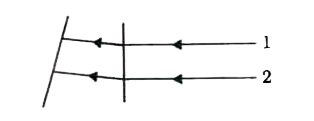 Ray 2 will travel faster than 1, so beam bends upwards. Ray 2 will travel faster than 1, so beam bends upwards.
|
|
| 31. |
Draw symbolic representation of () photodiode, (i) light emitting diode. |
Answer» SOLUTION :(a) and (B), RESPECTIVELY. . 
|
|
| 32. |
Who sent Mahesh ot the police pen? |
|
Answer» SHIBU Babu |
|
| 33. |
Consider the shown network. Initially both swiches are open and the capacitor are uncharged. Both the switches are then closed simultaneously at t=0 (a) Obtain the current through switch S_(2) as function of time. (b) If switch S_(2) is opened again after a long time interval, find the total heat that would dissipate in the resistor and the charge that would flow through switch S_(1) after S_(2) is opened? |
|
Answer» Solution :Consider the charges on capacitors and currents through various branches, as shown in the figure For loop `1`, we have `R_(1)(I_(2)+I_(3)-I_(1))=(q_(1))/(C_(1))` `(1)` For loop`2`, `R_(2)i_(3)=(q_(2))/(C_(1))` `(2)` For the outer loop, `i_(3)R_(2)+(q_(1))/(C_(1))=epsilon` `(3)` Also, `i_(1)=(dq_(1))/(dt)` and `i_(2)=(dq_(2))/(dt)` `(4)` Putting the values of `i_(1)` and `i_(2)` from Eq. `(4)` and of `i_(3)` from Eq. `(2)` in `(1)`, we get `(d)/(dt)(q_(2)-q_(1))=(q_(1))/(R_(1)C_(1))-(q_(2))/(R_(2)-C_(2))` `(5)` From Eqs. `(2)` and `(3)`, we get `(q_(2))/(C_(2))+(q_(1))/(C_(1))=epsilon` `(6)` From Eqs. `(5)` and `(6)`, we get `int_(0)^(q_(2))(dq_(2))/(((epsilonC_(2)R_(2))/(R_(1)+R_(2)))-q_(2))=int_(0)^(t)(dt)/(R_(eq)(C_(1)+C_(2)))`, where `R_(eq)=(R_(1)R_(2))/(R_(1)+R_(2))` `rArrq_(2)=(epsilonR_(2)C_(2))/((R_(1)+R_(2)))[1-e^((1)/(R_(eq)(C_(1)+C_(2))))]` Similarly, `q_(1)=(epsilonR_(1)C_(1))/((R_(1)+R_(2)))[1-e^((1)/(R_(eq)(C_(1)+C_(2))))]` `rArr i_(1)=(dq_(1))/(dt)=(epsilonC_(1))/(R_(2)(C_(1)+C_(2)))e^((1)/(R_(eq)(C_(1)+C_(2))))` Similarly, `i_(2)=(epsilonC_(2))/(R_(1)(C_(1)+C_(2)))e^((-1)/(R_(eq)(C_(1)+C_(2))))` From equation `(1)` Current through `S_(2)=(i_(1)-i_(3))=i_(2)-(q_(1))/(R_(1)C_(1))` Putting the values, we get `q_(1)=(12muC)(1-e^((1)/(12mu)))`, `q_(2)=(48muC)(1-e^((1)/(12mu)))` 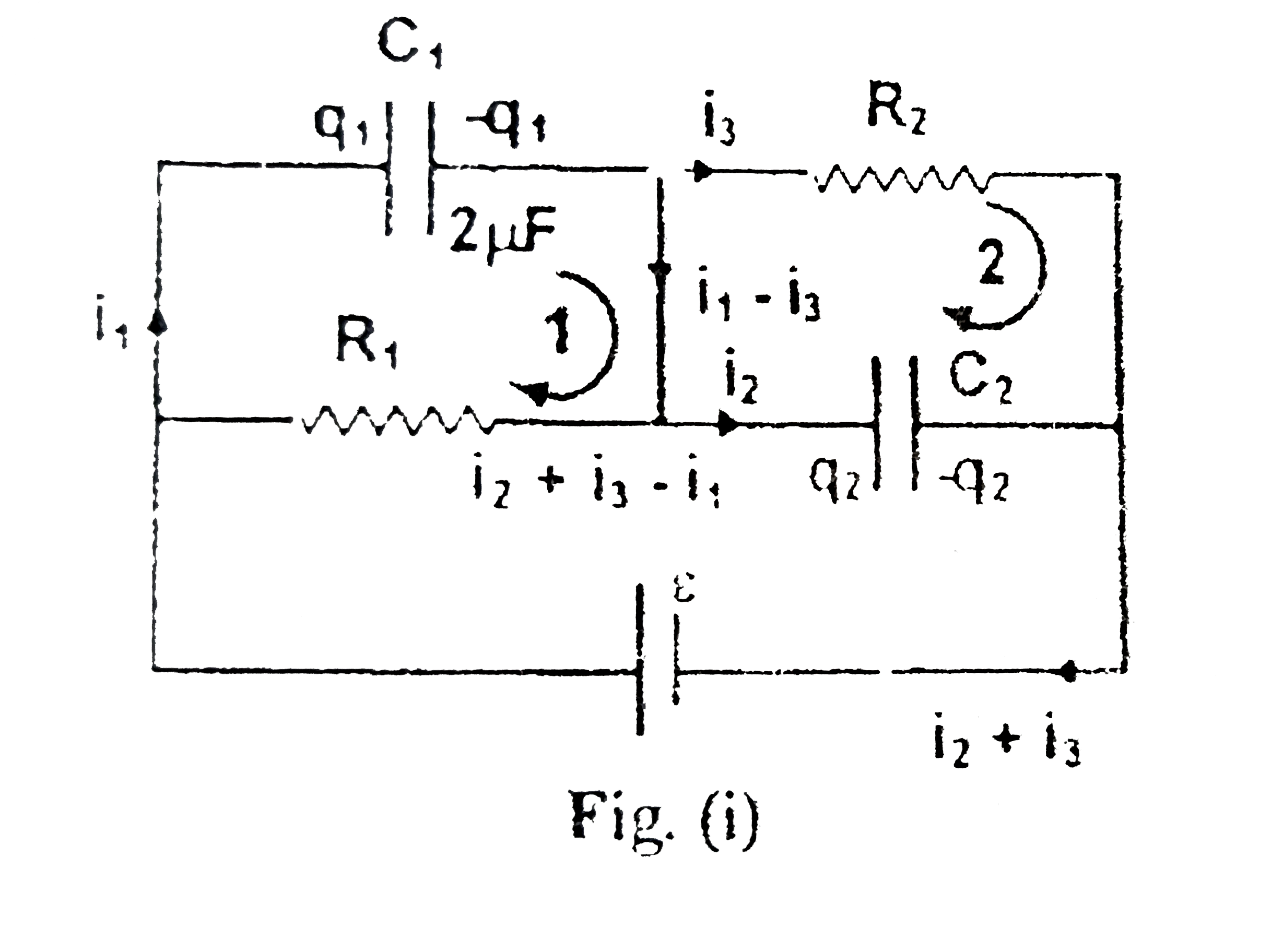 `i_(1)=(1A)e^((1)/(12mu))`, `i_(2)=(4A)e^((1)/(12mu))` Current through SWITCH `s_(2)=-[2-e^((1)/(12mu))]A` along the indicated direction as shown in fig `(i)`, With both the switches closed the steady state charges and currents are as shown in Fig `(ii)`. 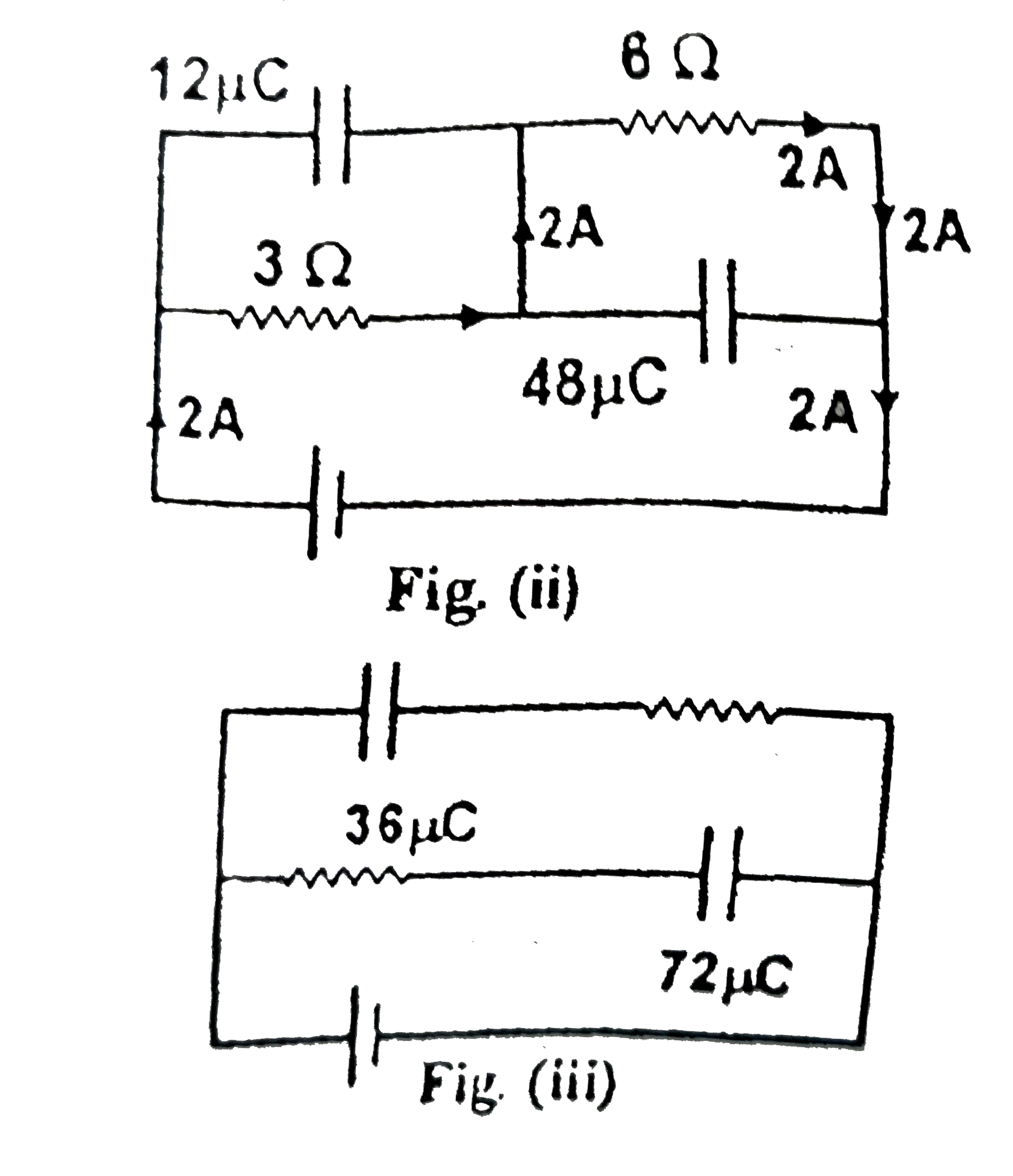 With switch `S_(2)` open and `s_(1)` closed, the steady state charges are as shown in Fig.`(iii)`. HENCE, the charge flown through switch `S_(1)=[(36+72)-(12+48)]muC=48muC`. Total heat dissipated in the resistors `=` [INITIAL ENERGY `+` work done by battery when `48muC` flows through it after switch `S_(2)` is opened ] `-` [FINAL energy] `={(1)/(2)C_(1)V_(1)^(2)+(1)/(2)C_(2)V_(2)^(2)}+epsilon(DeltaQ)-{(1)/(2)C_(1)V'_(1)^(2)+(1)/(2)C_(2)V'_(2)^(2)}=136muJ`. |
|
| 34. |
A very long solenoid of length L has n layers. There are N turns in each layer. Diameter of the solenoid is D and it carries current I. The magnetic field at the centre of the solenoid is ______ |
|
Answer» DIRECTLY proportional to D. |
|
| 35. |
An ideal gas expands isothermally from a volume V_(1)" to "V_(2) and then compressed to original volume V_(1) adiabatically. Initial pressure is P_(1) and final pressure is P_(3). Total work done is W. Then which is true : |
|
Answer» `P_(3) gt P_(1), W gt 0` `THEREFORE W_(AB) =` Area under CURVE AB (+ve work) `W_(BC)=` Area under curve BC (-ve work) `therefore W_(ABC)=W_(AB)-W_(BC)=-` ve work i.e. `W_(ABC) lt 0` Also from graph `P_(3) gt P_(1)`. 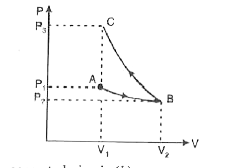 Thus, correct choice is (b). |
|
| 36. |
Lithium has a work function of 2.3 eV. It is exposed to light of wavelength 4.8 xx 10^(-7) m. Find the maximum kinetic energy with which the electron leaves the surface. What is the longest wave length which can produce the photo electrons ? Data : W = 2.3 eV, h=6.626 xx 10^(-34)Js, e=1.6 xx 10^(-19)C. Longest wavelength = ? , Kinetic energy = ? |
|
Answer» Solution :Kinetic energy of ejected ELECTRON = hv-W But,`hv=(hc)/(lambda)` `=(6.26 xx 10^(-34) xx 3 xx 10^(8))/(4.8 xx 10^(-7))`JOULE `hv=(6.626 xx 10^(-34)xx3xx10^(8))/(4.8xx10^(-7)xx1.6xx10^(-19))` hv = 2.588eV `:.` Kinetic energy of ejected electrons = 2.588-2.3 KE = 0.288 eV Work function,`W=hv_(0)=(hc)/(lambda_(0))` `:. lambda_(0)=(hc)/(W)` LONGEST wavelength `lambda_(0)=(6.626xx10^(-34)xx3xx10^(8))/(2.3xx1.6xx10^(-19))` `lambda_(0)=5.40xx10^(-7)m`. |
|
| 37. |
In photoelectric emission the number of photoelectrons emitted per second depends on |
|
Answer» WAVELENGTH of INCIDENT LIGHT |
|
| 38. |
Why did Beinkensopp go to a dentist? |
|
Answer» For his teeth |
|
| 39. |
Gamma decay takes place |
|
Answer» PRIOR to alpha DECAY |
|
| 41. |
A circular coil of radius 0.1 m has 80 turns of wire. If the magnetic field through the coil increases from 0 to 2 tesla in 0.4 sec and the coil is connected to a 11 ohm resistor, what is the current (in A) flow through the resistor during the 0.4 sec? |
|
Answer» (8/7) `I = (|epsi|)/(R ) = 80 xx 22/7 xx ((0.1)^2 xx 5)/(11) = 8/7 A` |
|
| 42. |
Let rho(r) = (Q r)/(piR^4) be the charge density distributionfor a solid sphere of radius R and total charge Q. For a point P inside the sphere at a distance r_1 from the centre of the sphere, the magnitude of electric field is |
|
Answer» `Q/(4piepsilon_0r_1^2)` According to Gauss.s theorem `ointvecE.dvecs=q_"inside"/epsilon_0` `ointE DS COS 0^@=1/epsilon_0 int rho(r) xx dV` `E(4pir_1^2)xx1=(Qr_1)/(epsilon_0pir^4)xx(4/3pir_1^3)` `E=(Q. 4pir_1^4)/(3epsilon_0 . piR^4 (4pir_1^2))=(Qr_1^2)/(3piepsilon_0R^4)` 
|
|
| 43. |
Explain velocity of charge in combined electric and magnetic field in reference to velocity selector. |
|
Answer» Solution :1. A CHARGE q moving with velocity `VECV` in presence of both electric and magnetic fields experiences a force given by, `vecF=vecF_(E)+vecF_(B)` = `vecE_(q)+q(vecv+vecB)""...(1)`  2. Electric and magnetic field are perpendicular to each other and also perpendicular to the velocity of the particle as shown in figure. `vecF_(E)=qvecE=qEhatj""...(2)` and `vecF_(B)=q(vecvxxvecB)=q(vhatixxBhatk)` `vecF_(B)=-qvB(hatj)""...(3)" "(becausehatixxhatk=-hatj)` `thereforevecF=vecF_(E)+vecF_(B)=q[E-VB]hatj` 3. Thus, `vecF_(E)andvecF_(B)` both are opposite to each other 4. Suppose, we adjust the value of `vecEandvecB` such that magnitudes of the two forces are equal. Then, total force on the charge is zero and the charge will move in the fields undeflected. 5. Thus, Eq = qvB `thereforev=E/B""...(4)` 6. This condition can be used to select charged particles of a particular velocity out of a beam containing charges moving with different speeds (irrespective of their charge and mass). The crossed `vecEandvecB` fields THEREFORE, serve as a velocity SELECTOR. Only particles with speed `E/B` pass undeflected through the region of crossed fields. 7. This method was employed by J.J. Thomson in 1897 to measure the charge to mass ratio `e/m` of an electron. 8. The principle is also employed in mass spectrometer, a device that separates charged particles, usually ions according to their charge to mass ratio. |
|
| 44. |
Calculate the density of the nucleus with mass number A. |
|
Answer» Solution :From EQUATION, the radius of the nuclei satisfy the equation `= R_(0) A^(13)`. Then the volume of the nucleus `V = (4)/(3) PI R^(3) = (4)/(3) pi R_(0)^(3)A`  By ignoring the mass difference between the proton and NEUTRON, the total mass of the nucleus having mass number A is equal to A. mwhere m is mass of the proton and is equal to `1.6726 xx 10^(-27)`kg. |
|
| 45. |
What is the meaning of 'immortal'? |
|
Answer» To LIVE a LIMITED time |
|
| 46. |
In which medium out of conductor, semiconductor and perfect dielectric, the wave propagation occurs without attenuation ? |
| Answer» SOLUTION :PERFECT DIELECTRIC. | |
| 47. |
What is the speed of wave Y=asin(wt-2pix/lamda). |
|
Answer» SOLUTION :The GIVEN equation is y = `ASIN(wt - (2pix)/lamda)` …..(1) The standard equation is y = asin(wt - KX) ……(2) comparing (1) and (2) `k = (2pi)/lamda, k = w/v` `thereforew/v = (2pi)/lamda` `therefore v = (lamda w)/2pi)` |
|
| 48. |
A transistor has alpha = 0.95 . The change in emitter current is 100 milliampere , then the change in the collector current is : |
|
Answer» Solution :`(DeltaI_c)/(DeltaI_e)=0.95 IMPLIES (DeltaI_c)/100= 0.95` `:. DeltaI_c = 100 XX 0.95 = 95 mA` |
|
| 49. |
Trace the ays of light showing the formation of an image due to a point object placed on the axis of a spherical surface separating the two media of refractive indices n_(1) and n_(2). Establish the relation between the distance of the object, the image and the radius of curvature from the central point of the spherical surface. Hence derive the expression of the lends maker's formula |
|
Answer» Solution :Refraction of shperical surface: (a) Sign conventions : (i) All distances are measured from the pole of the spherical surface. (ii) Distance measured in the direction of incident light are taken positive. (iii) Distances measured in the opposite direction of incident light are negative. Assumptions : (i) The object is a point object placed on the principal axis. (ii) APerture of the refracing surface is SMALL. (iii) Angle of incidence and angle of refraction are small. I is the real image of a point O placed on the principal axis of spherical surface with centre of curvature C, the radius of curvature R. The rays are incident from a medium of refractive index `n_(1)` to refractive index `n_(2)`. For samll aperture, NM will be taken to the length of the perpendicular from N to principal axis. 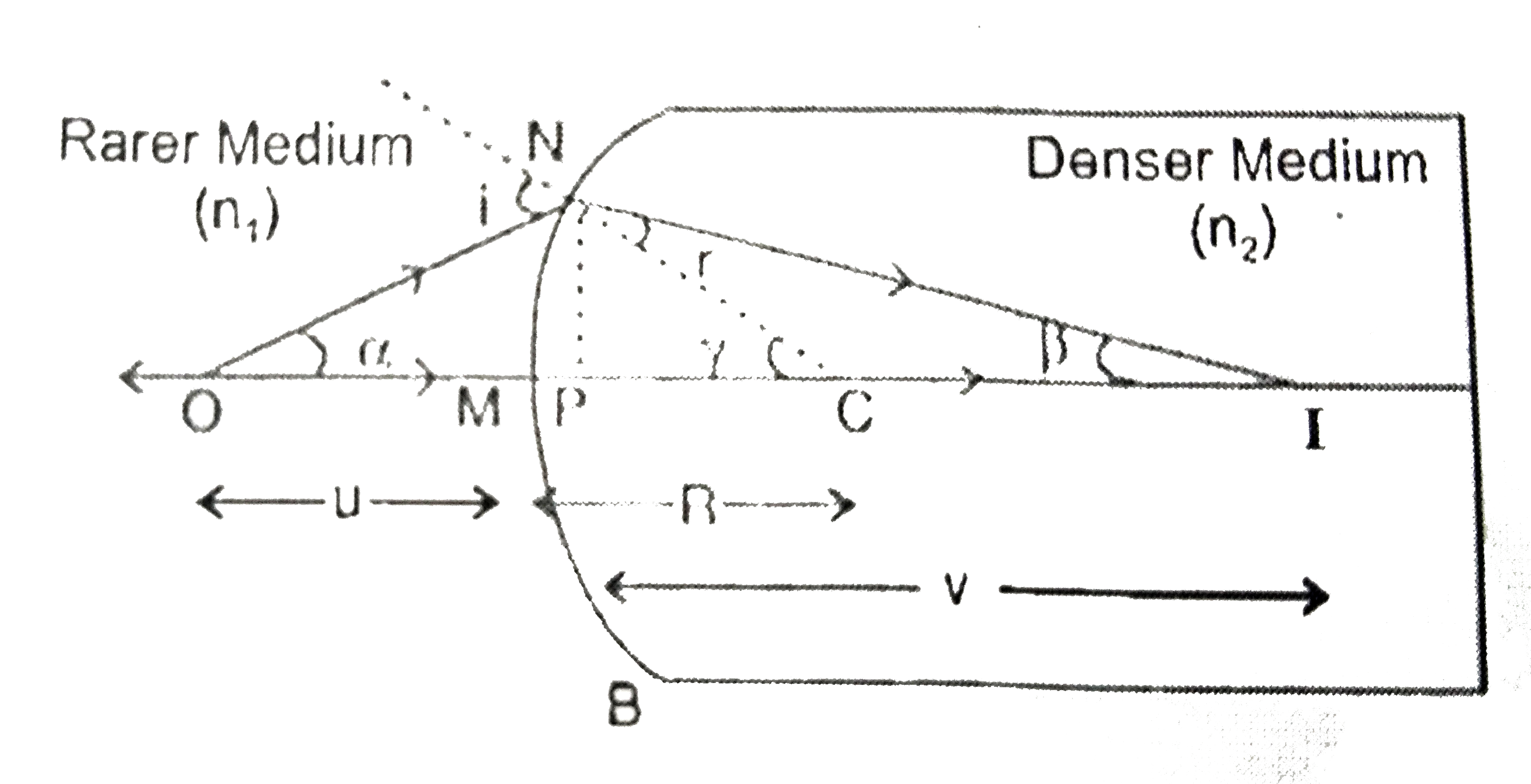 We have, For small angles `tan angleNOM = angleNOM = (MN)/(OM)` `tan angleNCM = angleNCM = (MN)/(MC)` `tan angleNIM = angleNIM = (MN)/(MI)` Exterior angle `i = angle NOM + angleNCM` `i = (MN)/(OM) + (MN))/(MC)`..(i) and `r = angleNCM - angle NIM` `r = (MN)/(MC) - (MN)/(MI)`...(ii) By Snell's law `(sin i)/(sin r)= (n_(2))/(n_(1))` For small angles, `(i)/(r) = (n_(2))/(n_(1))` `:. n_(1) i = n_(2) r` ...(iii) Putting the values of i and r in eq. (iii) `n_(1) ((MN)/(OM) + (MN)/(MC)) = n_(2) ((MN)/(MC) - (MN)/(MI))` Dividing by MN `(n_(1))/(OM) + (n_(1))/(MC) = (n_(2))/(MC) - (n_(2))/(MI) rArr (n_(1))/(OM) + (n_(2))/(MI) = (n_(2))/(MC) - (n_(1))/(MC) rArr (n_(1))/(OM) + (n_(2))/(MI) = (n_(2) - n_(1))/(MC)` Using Cartesian sign convention, `OM = - u, MI = + v, MC = + R " " :. (n_(1))/(-u) + (n_(2))/(v) = (n_(2) - n_(1))/(R)` or `(n_(2))/(v) - (n_(1))/(u) = (n_(2) - n_(1))/(R)` (b) Lens Maker's Formula : The image of point object O is formed in TWO steps. The first reflecting surface forms the image I, of the object O. The image `I_(1)` acts as a virtual object for formation of image I by the second surface. For the first surface ABC 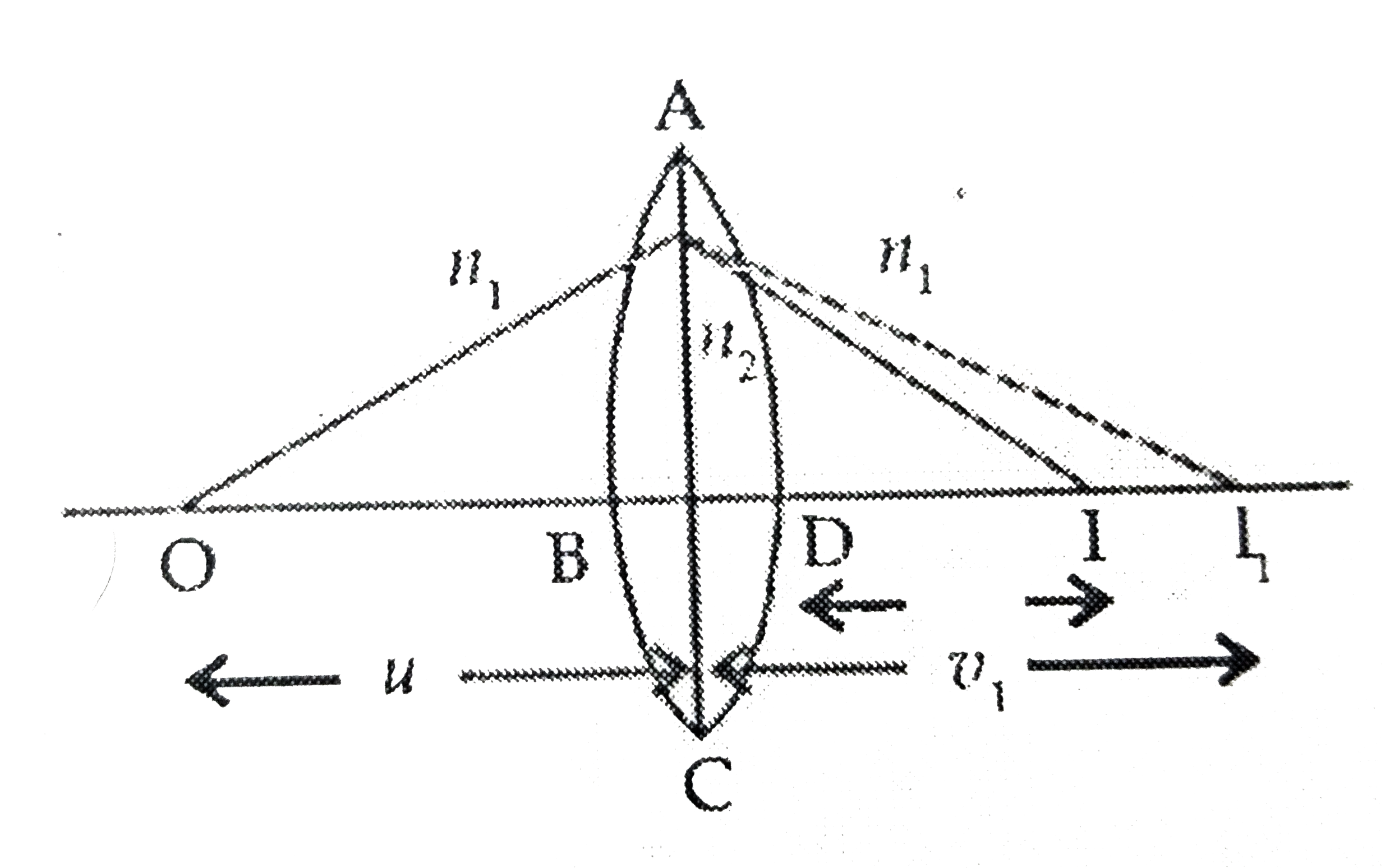 `[ :' (-n_(1))/(U) + (n_(2))/(V) = (n_(2) - n_(1))/(R)]` `(-n_(1))/(OB) + (n_(2))/(BI_(1)) = (n_(2) - n_(1))/(BC_(1))`..(i) For the second surface ADC `(-n_(1))/(DI_(1)) + (n_(2))/(DI) = (n_(2) - n_(1))/(DC_(2))` For a thin lens, `BI_(1) = DI_(1)` `:. (-n_(2))/(BI_(1)) + (n_(1))/(DI) = (n_(2) - n_(1))/(DC_(2))`..(ii) On adding eq. (i) and (ii), we get, `(-n_(1))/(OB) + (n_(1))/(DI) = (n_(2) -n_(1)) [(1)/(BC_(1)) + (1)/(DC_(2))]` If the object is at infinity `:. OB = oo` and I is at the focus of the lens `:. DI = f` (focal length of convex lens] `(-n_(1))/(oo) + (n_(1))/(f) = (n_(2) - n_(1)) [(1)/(BC_(1)) + (1)/(DC_(2))]` By the sign convention, `BC_(1) = + R_(1) and DC_(2) = - R_(2)` `:. (n_(1))/(f) = (n_(2) - n_(1)) ((1)/(R_(1)) - (1)/(R_(2))) rArr (1)/(f) = ((n_(2))/(n_(1)) - (n_(1))/(R_(2))) ((1)/(R_(1)) - (1)/(R_(2))) rArr (1)/(f) = (n_(21) - 1) ((1)/(R_(1)) - (1)/(R_(2)))` `(1)/(f) = (n-1) ((1)/(R_(1)) - (1)/(R_(2)))` where `n_(21) = n`, is the refractive index of material of the lens w.r.t. air |
|
| 50. |
I prop (1)/(lambda^(4)) where I is the intensity of light and lambda its wavelength. a. Which law does the above expression represent ? b. Give the law statement form. c. What conclusion do you draw from this ? |
|
Answer» SOLUTION :Rayleigh.s scattering law. b. Intensity of SCATTERED light is inversely PROPORTIONAL to the FOURTH power of wavelength . C. Shortere the wavelength larger the scattering intensity. |
|