

Saved Bookmarks
This section includes 7 InterviewSolutions, each offering curated multiple-choice questions to sharpen your Current Affairs knowledge and support exam preparation. Choose a topic below to get started.
| 1. |
Write a note on continuous x-ray spectra. |
|
Answer» Solution :Continous x-ray spectra : When a fast moving electron penetrates and approaches a target nucleus, the interaction between the electron and the nucleus either accelerates or DECELERATES it which results in a change of path of the electron. The RADIATION produced from such decelerating electron is called Bremsstrahlung or braking radiation The energy of the photon emitted is equal to the loss of kinetic energy of the electron. Since an electron may lose part or all of its energy to the photon, the photons are emitted with all possible energies (or frequencies). The continuous x-ray spectrum is due to such radiations.  When an electron gives up all its energy, then the photon is emitted with highest frequency `upsilon_(0)` (or lowest wavelength `lambda_(0)`). The initial kinetic energy of an electron is given by eV where V is the accelerating voltage. Therefore, we have `h upsilon_(0) = eV (or) (hc)/(lambda_(0))=eV` `lambda_(0) = (hc)/(eV)` Where `lambda_(0)` is the cut-off wavelength. Substituting the known values in the above EQUATION, we get `lambda_(0) = (12400)/(V)Å` The relation given by equation is known as the Duane-Hunt formula. The value of `lambda_(0)` depends only on the accelerating potential and is same for all targets. This is in good agreement with the experimental results. THUS, the production of continuous x-ray spectrum and the origin of cut-off wavelength can be EXPLAINED on the basis of photon theory of radiation. |
|
| 2. |
A particle of mass 200gm is moving in a circular path of radius 10cm, such that its tangential acceleration varies with time as a_(t) = 6t( m//s^(2)) . The average power delivered to the particle by force acting on it in the first 10sec is 100K watt. The particle starts from rest. Find K. |
|
Answer» |
|
| 3. |
The displacement, velocity amplitude of particular executing S.H.M. is related by the expression |
|
Answer» `V= OMEGA SQRT(a^2 - x^2)` |
|
| 4. |
According to Moseley.s law, the frequency of a spectral line in X-ray spectrum varies as |
|
Answer» ATOMIC NUMBER of element |
|
| 5. |
Each figure in Column - I shows the variation of resistance with temperature. Some materials are mentioned in Column - II. Match Column - I with Column - II. |
|
Answer» |
|
| 6. |
Ifa magnetic substance is keptin a magnetic field then which of the following substance is thrown out |
|
Answer» paramagnetic |
|
| 8. |
The radius of hydrogen atom in its ground state is 5.3xx10^(-11)m. After collision with an electron it is found to have a radius 21.2xx10^(-11) m, then principle quantum number n of the final state of the atom ...... |
|
Answer» Solution :`rpropn^(2)` `(r_(2))/(r_(1))=((n_(2))/(n_(1)))^(2)` `r_(2)=` radius in final state `r_(1)=` radius in ground state `:.(21.2xx10^(-11))/(5.3xx10^(-11))=((n_(2))/(1))^(2)` `:.4=n_(2)^(2)` `:.n_(2)=2` |
|
| 9. |
Following figures show different combinations of identical bulb(s) connected to identical battery(ies). Whichoption is correct regarding the total power dissipated in the circuit– |
|
Answer» PltQltRltS |
|
| 10. |
A toroid having 200 tuns carries a current of 1 A. The average radius of the toroid is 10 cm . The magnetic field at any point in the open space inside the toroid is |
|
Answer» a. `4 XX 10^(-3)`T |
|
| 11. |
When a conservation force does positive work on a body, then the |
|
Answer» POTENTIAL ENERGY of BODY increases |
|
| 12. |
Thermos flask prevents heat loss by |
|
Answer» convention |
|
| 13. |
What are characteristic of photoelectric effect ? |
|
Answer» Solution :(i) The EMITTED electrons are called as PHOTO electrons and current so produced is called PHOTOELECTRIC current and photo current . (II) It is based on the principle of conservation of energy. |
|
| 14. |
Resistance can be connected in series or parallel to obtain the required value of resistance. Derive an expression for the effective value of three resistores connected in parallel. |
| Answer» SOLUTION :REFER TEXT | |
| 15. |
In the above circuit, if the polarity is reversed of battery, the current flowing would be |
|
Answer» 0 mA |
|
| 16. |
An ideal gas at 75 cm mercury pressure is compressed isothermally until its volume is reduced to three quarters of its original volume. It is then allowed to expand adiabatically to a volume 20% greater than its original volume. If the initial temperature of the gas is 17^@C,calculate the final pressure and temperature (gamma= 1.5). |
|
Answer» Solution :First of all the gas is compressed isothermally. Using Boyle'slaw `P_1V_1=P_2V_2` or `P_2=(P_1V_1//V_2)` Here `P_1`=75 cm of mercury and `V_2=3/4V_1` Thus `P_2=(75V_1)/((3//4)V_1)`=100 cmof mercury The gas is now expanded ADIABATICALLY to 20% greater of its ORIGINAL value. Under adiabatic change the pressure and volume of gas are related as `P_2V_2^gamma=P_3V_3^gamma` or `P_3=P_2(V_2/V_3)^(gamma)` Here `V_2=3/4V_1` and `V_3=120/100V_1` Thus `P_3=100xx((3V_1)/4)^(1.5)XX(100/(120V_1))^(1.5)` `=100xx(3/4)^(1.5)xx(5/6)^(1.5)` `=100xx(5/8)^(1.5)` =100 x 0.494 = 49.4 cm of mercury Let the final TEMPERATURE after adiabatic change be then from the relation of temperature and volume in an adiabatic process,we have Now `T_2V_2^(gamma-1)=T_3V_3^(gamma-1)` `T_2=17^@C=(273+27)`=290 K Now `T_3=T_2(V_2/V_3)^(gamma-1)` `=290xx((3V_1)/4)^(1.5-1)xx(100/(120V_1))^(1.5-1)` `=290xx(5/8)^(0.5)`=229.3 K Hence the finaltemperaturewill be `-43.7^@C` |
|
| 17. |
Two identical fuses are rated at 10A. If they are joined |
|
Answer» in PARALLEL, the combination ACTS as a fuse of rating 20A |
|
| 19. |
An aeroplane in a level flight at 144km/h is in an altitude of 1000m. How far from the given target should a body be released to hit the target? |
|
Answer» 571.43 m |
|
| 20. |
A projectile has same range R for the two angles of projection. If T_(1) and T_(2) are the times of flight in two cases, then: |
|
Answer» `T_(1)T_(2)propR` `T_(1)T_(2)=(2usintheta)/g.(2usintheta(90-theta))/g` `T_(1)T_(2)=(4U^(2)sinthetacostheta)/g^(2)` `=2/g.(U^(2)sin2theta)/g=(2R)/g` `implies T_(1)T_(2)prop R` |
|
| 21. |
Choose the correct alternative from the clues given at the end of the each statement : An atom has a nearly continuous mass distribution in a ........ but has a highly non-uniform mass distribution in ....... (Thomson's model/Rutherford's model) |
| Answer» SOLUTION :Thomson.s MODEL, Rutherford.s model | |
| 22. |
Gauss law cannot be used to find which of the following quantity |
|
Answer» ELECTRIC FIELD intensity |
|
| 23. |
How many brothers and sisters did Padma have? |
|
Answer» ONE |
|
| 24. |
A radio can tune in to any station in the 7.5 MHz to 12 MHz band. What is the corresponding wavelength band ? |
|
Answer» Solution :`c=v_(max)lambda_(MIN)rArr rArr lambda_(min)=(c )/(v_(max))` `therefore lambda_(max)=(3xx10^(8))/(12xx10^(6))=25M` `c=v_(min)lambda_(max)rArr lambda_(max)=(c )/(v_(min))` `therefore lambda_(max)=(3xx10^(8))/(7.5xx10^(6))=40 m` Required range of WAVELENGTH, `= lambda_(min)` to `lambda_(max)=25m` to 40 m |
|
| 25. |
What is meant by electromotive force ? |
|
Answer» ELECTRIC field |
|
| 26. |
A triangle is made from thin insulating rods of different lengths, and the rods are uniformly charged, i.e. the linear charge density on each rod is uniform and the same for all three rods. Find a particular point in the plane of the triangle at which the electric field strength is zero |
|
Answer» Solution :We are going to prove that the electric field strength is zero at the SOCALLED incentre, the CENTRE of the triangle's inscribed circle (which has radius r in the figure) Let us consider a small length of rod at position P on one of the sides of the triangle, let it subtend an angle `Delta varphi` at the incentre (see figure). Its distance from the incentre is `r//cos varphi`. Its small length `Deltax` can be found by noting that P is a distance `x=r tan varphi` along the rod from the fixed point Q and so `Deltax=(r Delta varphi)//(cos^(2) varphi)`. Consequently the charge it carries is `Deltaq=(lambda r Delta varphi)/(cos^(2) varphi)` where `lambda` is the linear charge density on the RODS. The magnitude of the elementary contribution of this small piece to the electric field at the incentre is `DeltaE=1/(4pi epsi_(0)) (Delta q cos^(2) varphi)/r^(2)=1/(4pi epsi_(0)) (lambda r Delta varphi)/r^(2)` It can be seen from this result that the same electric field (in both magnitude and DIRECTION) would be produced by an arc of the inscribed circle that subtends `Delta varphi` at the circle's centre and carries the same linear charge density `lambda` as the rod. Summing up the CONTRIBUTIONS of the small arc pieces correspondingto all threesides of the triangle, we will, because of the circular symmetry, obatin zero net field. It follows that the electric field strength produced by the charges sides of the triangle is also zero at the incentre. 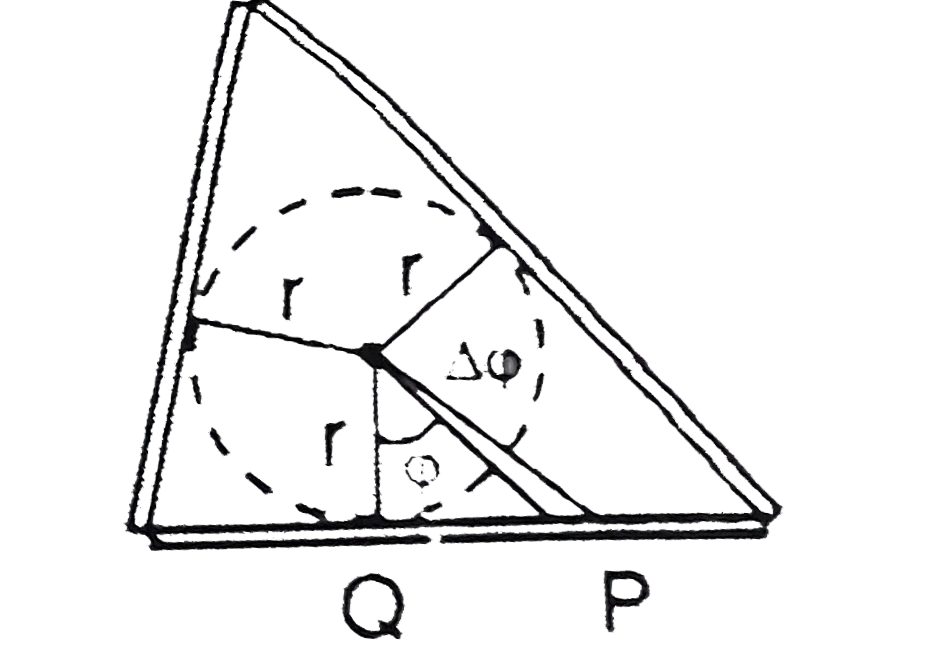
|
|
| 27. |
A long conductor of circular cross section with radius R has current density J(r )=rho_(0)(r^(2))/(R^(2)) (for R//2 le r le R) =0 (for r lt R//2) into the plane of paper There is a point P at distance a from axis of conductor [a gt R]. Two infintely long thin conducting wires carrying current I_(0) in the same direction is placed at distance a, from O perpendicular to OP and parallel to conductor at either sides such that magnetic field at P is zero. Find current I_(0) in wires and direction of current as compared with direction of current in the conductor. (Given rho_(0)R^(2)=64//5pi) |
|
Answer» Solution :Current through conductor `I=int_(0)^(R )2pirdrJ(r )` `=int_(0)^(R//2)2pirJ(r )dr+int_(R//2)^(R )2pirJ(r )dr` `= int_(0)^(R//2)2pir*0*dr+int_(R//2)^(R )2pirp_(0)(r^(2))/(R^(2))dr` `=0+(2pip_(0))/(R^(2))int_(R//2)^(R )r^(3)dr` `=0+(2pip_(0))/(R^(2))[(r^(4))/(4)]_(R//2)^(R )=(2pip_(0))/(R^(2)4)(R^(4)-(R^(4))/(16))` `=(15pi)/(32)p_(0)R^(2)`. 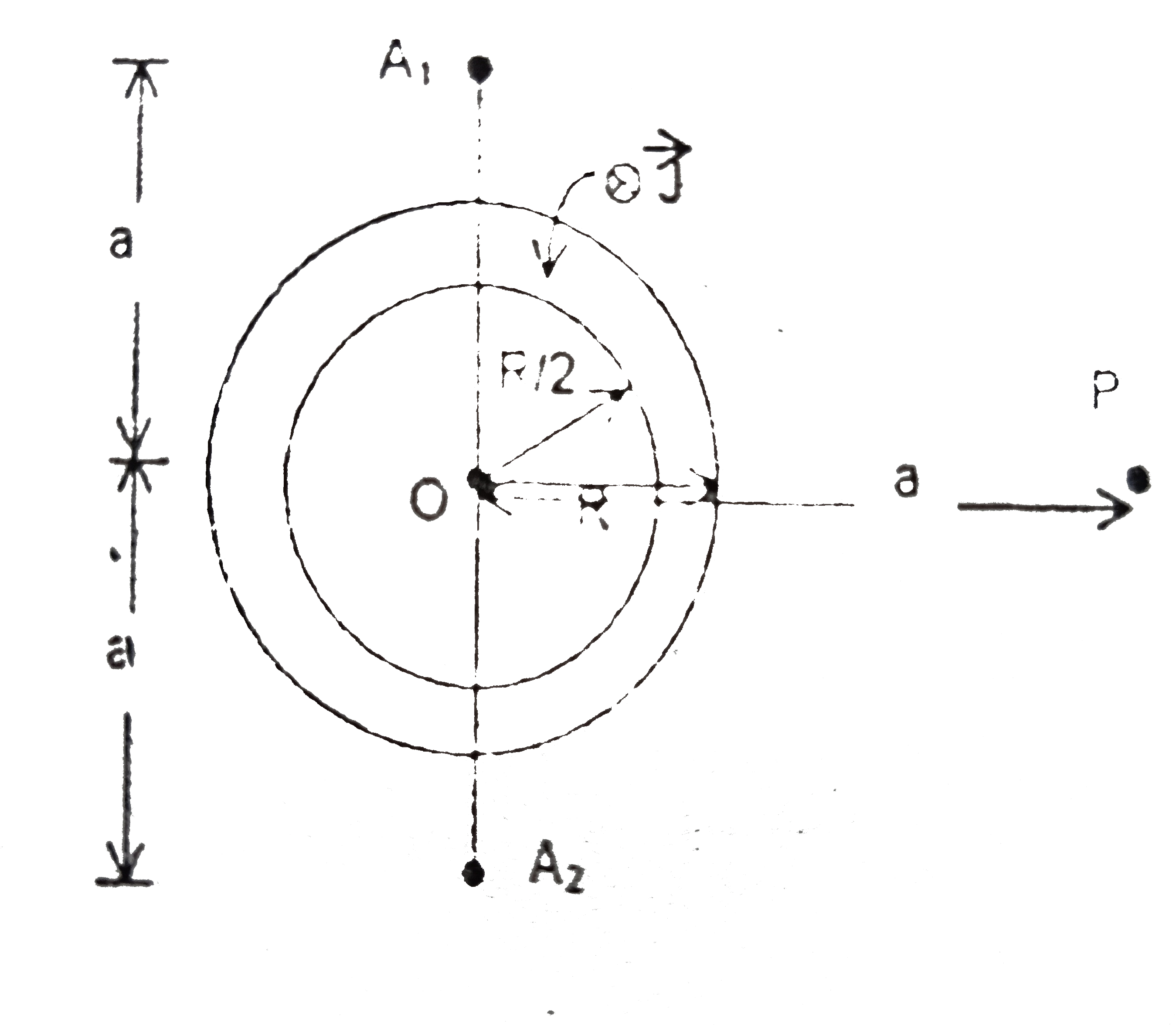 Let us CONSIDER a circle with enter `O` and radius `OP` in line `bot` to conductor, for all point on the circle due to symmetry `B` is same due to condctor. Applying Amperes law `int_(0)^(2pia)B*dl=mu_(0)I` [current inclosed] `rArr B*2pia=mu_(0)(15)/(32)pi p_(0)R^(2)` `rArr B=(15)/(64)(mu_(0)p_(0)R^(2))/(a)` As current is in to the plane `B` is downward at `P`. Now field due to wire `A_(1)` and `A_(2)` MUST cancel `B`. That is possible when current in the wires is out of the plane. Field due to `A_(1)|vecB_(1)|=(mu_(0))/(4pi)(2I)/(asqrt(2))` Due to `A_(2)|vecB_(2)|=(mu_(0))/(4pi)(2I)/(asqrt(2))` Resultant of `B_(1)` and `B_(2)` `VECB'=vecB_(1)+vecB_(2)=2(mu_(0))/(4pi)(2I_(0))/(asqrt(2))*(1)/(sqrt(2))=(2mu_(0)I_(0))/(4pia)` opposite to `vecB` Net field at `P` `vecB+vecB'=0` `=(mu_(0))/(4pi)(2I_(0))/(a)-(15)/(64)mu_(0)(p_(0)R^(2))/(a)=0` `I_(0)=(15pip_(0)R^(2))/(32)` 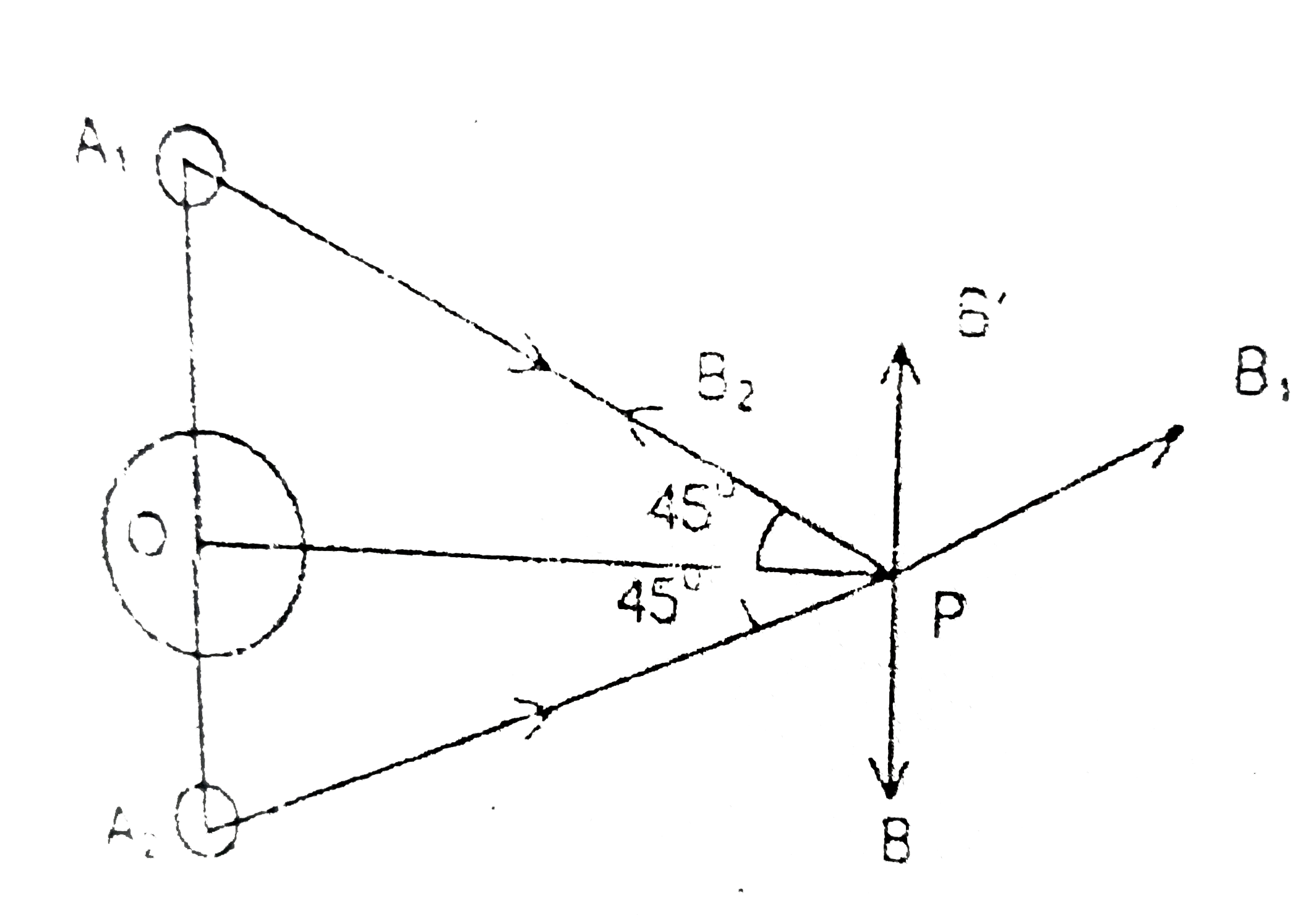
|
|
| 28. |
The ratio of K.E. regd. to be given to satellite to escape earth's gravitational field to K.E. regd. to be given to satellite to move in a circular orbit just above earth's atmosphere is : |
|
Answer» 1 `therefore ((1)/(2)mv_(e)^(2))/((1)/(2)mv_(0)^(2))=((v_(e))/(v_(0)))^(2) =(sqrt(2))^(2)=2` So the CORRECT choice is (B). |
|
| 29. |
The permittivity of free space epsi_0=8.86 xx 10^(-12) coulomb/N-m^2 and the permeability of the free space mu_0 = 1.26 xx 10^(-6) henry/metre.If c is the velocity of light in vacuum, the correct relation between mu^0,epsi_0 and c is |
|
Answer» `mu_0c^2 = epsi_0` |
|
| 30. |
Two indentical discs are moving with the same kinetic energy. One rolls and the other slides. The ratio of their speeds is |
|
Answer» `1:2` `therefore` KINETIC energy for the rolling disc, or `"" KE_(r ) = (1)/(2)mv_(1)^(2) + (1)/(2) I omega^(2)` `""` ( `therefore`MOMENT of INERTIA, I = `(mR^(2))/(2)`) or `"" = (1)/(2) mv_(1)^(2) + (1)/(2) (mR^(2))/(2) ((v_(1))/(R ))^(2) ` or `"" KE_(r ) = (3)/(4) mv_(1)^(2) ""` .... (i) Now, KE for the sliding disc, `therefore "" KE_(s) = (1)/(2) mv_(2)^(2) "" ` ... (ii) Given, KE of rolling disc = KE of sliding disc or,`(3)/(4) mv_(1)^(2)= (1)/(2) mv_(2)^(2) or (v_(1)^(2))/(v_(2)^(2)) = (2)/(3) ` or `"" (v_(1))/(v_(2)) = sqrt((2)/(3))` or `""v_(1) : v_(2) = sqrt(2) : sqrt(3)` |
|
| 31. |
Anelectriccurrent is passed through a circuit containing two wires of the same material, connected in parallel. Iflengthsand radii of the wires are in the ratio of 4 : 3 and 2 : 3 , then ratio of the currents passing through the wires will be |
|
Answer» SOLUTION :we known that `R prop (l)/(r^(2)) rArr (R_(1))/(R_(2))=(l_(1))/(l_(2))xx(r_(2)^(2))/(r_(1)^(2))=(4)/(2)xx(9)/(4)=(3)/(1)` SINCE it is parallel CURRENT, inversely PROPORTIONAL to resistance `V=IR` `R prop (1)/(i), (R_(1))/(R_(2))=(i_(2))/(i_(1))rArr (3)/(1) = (i_(2))/(i_(1))rArr (i_(1))/(i_(2))=(1)/(3)`. |
|
| 32. |
Consider the double cube resistor network shown in fig. Each side of both cubes has resistance R and each of the wires joining the vertices of the two cubes also have same resistance R. find the equivalent resistance between points A & B. |
|
Answer» |
|
| 33. |
The motion of 10 g mass tied to massless spring is represented by S.H.M. x=25cos(3t+(pi)/(4)) where x is in cm and t in second, the force constant of the spring is : |
|
Answer» `9" N m"^(-1)` `IMPLIES""omega=3` rad/s. Now `""v=(1)/(2pi)SQRT((k)/(m))` or `""omega=sqrt((k)/(m))` `implies""k=omega^(2)m` `:.""k=9xx(10)/(1000)=0.09"N"//"m"`. So the correct choice is ( c ). |
|
| 34. |
What we call the radiowaves from transmitting antenna when they propagate so as to reach the receiving antenna? |
| Answer» SOLUTION :GROUND WAVE PROPAGATION | |
| 35. |
The driver of a car travelling with speed 30 m/sec towards a hill sounds a horn of frequency 600 Hz. If the velocity of sound in air 330 m/s , the frequency of reflected sound as heard by driver is : |
|
Answer» 555.5 Hz =`(v + 30)/(v - 30) f = (360)/(300) XX 600 = 720 ` Hz CORRECT CHOICE is (b). 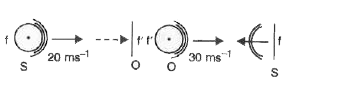
|
|
| 36. |
The half - life of tritium is 12.5 years. What mass of tritium of initial mass 64 mg will remain undecayed after 50 years ? |
|
Answer» Solution :`m=m_(o)/2^(n)` t = NT `50=nxx1.25rArrn=4` `thereforem=m_(o)/2^(4)=64/16=4mg` |
|
| 37. |
मौलिक प्रकार की इकाई कोशिका में a तथा r में संबंध है |
|
Answer» a=r |
|
| 38. |
(A) : Greater is the height of T.V. transmitting antenna, greater is its range. (R) : The range of T.V. transmitting antenna is proportional to square root of its height. |
|
Answer» Both 'A' and 'R' are TRUE and 'R' is the CORRECT EXPLANATION of 'A'. |
|
| 39. |
A particle moving along x-axis has acceleration f, at time t, given by f= f_(0) (1 - (t)/(T)), where f_(0) and T are constants. The particle at t= 0 has zero velocity. In the time interval between t= 0 and the instant when f= 0, the particle's velocity (v_(x)) is |
|
Answer» `(1)/(2) f_(0)T^(2)` `:. v= int dv= int [f_(0) (1-(t)/(T))] dt or, v= f_(0) (t-(t^(2))/(2T))+C` where C is the constant of integration. At t= 0, v= 0 `:. 0 = f_(0) (0-(0)/(2T))+ C rArr C= 0` `:. v= f_(0) (t- (t^(2))/(2T))` If f= 0, then `0 = f_(0) (1- (t)/(T)) rArr t= T` Hence, particle.s velocity in the TIME INTERVAL t=0 and t= T is GIVEN by `v_(x) = underset(t=0)overset(t=T)int dv= underset(t=0)overset(T)int [f_(0) (1-(t)/(T))]dt= (1)/(2) f_(0)T` |
|
| 40. |
In a certain rigion of space, electric field is along the z-direction throughout. The magnitude of electric field is , however, not constant but increases uniformalyalong the positive z-direction, atthe rate of10 ^(5) NC^(-1)per metre, What are the force and torque experienced by a system having a total dopole moment equal to 10^(-7)C-m in the negative z-direction? |
|
Answer» Solution :Here RATE of INCREASE of ELECTRIC fieldalong positivez-direction ` (dE)/( dz)=10 NC^(-1) m^(-1)` and dipolemoment of system along z-direction`p=-10^(-7)C-m ` (because it is along negative z-direction) ` therefore ` Net force acting on the dipole of `F=p .(dE)/( dz)=(-10 ^(-7) ).(10^(5) )=-10^(-2)N ` ` "" 10 ^(-2) `N along negativez-direction As `oversetto E and overset to p`both are along z-axis , hencetorque `|oversetto tau |=|oversetto p xx oversetto E| =pE sin0^(@)=0` |
|
| 41. |
A light stright fixed at one end to a wooden clamp on a ground passes over a fixed pulley and hangs at the other side. It makes an angle 30^@ with the ground. A boy weighing 60 kg climbs up the rope. The wooden clamp can tolerate upto vertical force 360N. Find the, maximum acceleration in the upward direction with which the boy can climb safely. The friction of pulley and wooden clamp may be ignored (g = 10 m//s^2) |
|
Answer» `1 m//s` |
|
| 42. |
The ratio of maximum and minimum intensities of light in interference pattern obtained due to the interference of waves from two coherent sources of light with amplitudes a_1 and a_2 (a_1=2a_2) is : |
|
Answer» `2 : 1` |
|
| 43. |
State Gauss 'law in electrostatics. Consider an overall neutral sphere of radius R. This sphere has a point charge +Q at its centre and this positive charge is surrounded by a uniform density rho of negative charges up to a radius R. Use Gauss, law to obtain expression for the electric field , of this sphere , at a point distant r, from its centre ,wherer lt R,r gt R Show that these two expressions give identical results, for the electric field, at r= R. |
|
Answer» Solution :Consider a sphere of radius R and having point CHARGE +Q at its CENTRE point. Negative CHARGES density of sphere be `RHO. ` then total negative charge on sphere ` =(4)/(3)pi R^(3) rho =-Q` ` rArr "" rho =-(3Q)/( 4 pi R^(3)) ` For a point `P_1 ` situated at a distance r (where r `lt R ) `frm its centre, considering a sphere of radius.r. as the Gaussian SURFACE , we have ` rArr "" phi _in =int oversetto (E) . oversetto (ds) = E . 4 pi r^(2) (1)/(in_0)("charged enclosed")` `"" (1)/( in_0)[Q +rho .(4)/(3)pi r^(3) ]` `rArr ""E. 4 pi r^(2)=(1)/( in_0)[Q -(3Q)/( 4 pi R^(3)).(4)/(3)pi r^(3) ]=(1)/(in_0)[Q -(Qr^(3))/( R^(3)) ]=(Q)/( in_0)[1-(r^(3))/( R^(3)) ]` `rArr ""E= ( Q)/( 4 pi in _0)[(1)/( r^(2)) -(r)/( R^(3)) ]` For r= R, we have ` E_("surface")=0.` (b) For a point `P_2` situated at a distance r (where `r gt R) ` we again consider a spere of radius r as the Gaussian surface. Now total charges enclosed in the surface. `=Q +rho .(4)/(3)pi R^(3)=Q- ( 3Q)/( 4 pi R^(3) ) .(4)/(3) pi R^(3) =Q -Q = 0 ` Thisshown that `phi_in =E. 4pi r^(2)=(1)/(in_0) ` (charge enclosed)`=(1)/(in_0)(0)=0 ` `rArr "" E= 0 ` and field at surface of sphere `E_("surface") =0` . 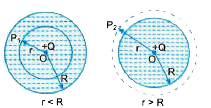
|
|
| 44. |
Figure shows a man pulling on a string attached to a block kept on a rough block surface. Man is heavier than block. Coefficient of friction is same for both block and man. Subscripts R, B and M denote rope block and man respectively, taking string to be light. Mark the correct statement(s). |
|
Answer» `vec(F)_(R//B)-vec(F)_(M//R)` always |
|
| 45. |
Electric field inside the capcitor is 100 V/m and dielectric constant =5.5. What is the polarization ? |
|
Answer» SOLUTION :`epsi_(R)=1+x` `X=4.5` `P=X.E` `P=4.5xx100` `P=450` |
|
| 46. |
Directions for Questions 56 and 57: In each question, there is a table having 3 columns and 4 rows. Based on the table, there are 3 questions. Each question has 4 options (a), (b), (c) and (d), ONLY ONE of these four options is correct. Two charges of opposite sign and equal magnitude Q = 2.0 C are held 2.0 m apart. And there is a point Pat 4.0 cm from +Q charge. In the given table there are four values each of electric field (Column I), potential difference each of electric field (Column I), potential difference {:("Column I","Column II", "Column III"),((I) E=1.27 xx 10^(9) V//m,(i) V=1.5 xx 10^(9) V,(J) (##MST_AG_JEE_MA_PHY_V02_C24_E03_059_Q01.png" width="80%"> The combination for maximum electric field is |
|
Answer» (I) (II) (M) |
|
| 47. |
What is the angular velocity in rad/sec of the hour hand of a clock? |
|
Answer» `pi/21600 (RAD)/SEC` |
|
| 48. |
Describe briefly, by drawing suitable diagrams, the (i) sky wave and (ii) space wave modes of propagation. Mention the frequency range of the waves in these modes of propagation. |
Answer» Solution :(i) SKY wave and space wave PROPAGATION Sky wave propagation is due to IONOSPHERIC reflection of radio waves back to the earth. Space wave propagation is by line of sight propagation, directly between transmitter to RECEIVER/ or by satellite. FREQUENCY range of sky wave: Few MHz to 40 MHz Frequency range of space wave : Above 40 MHz |
|
| 49. |
An alternating voltage V = V_0 sinomegat is applied across a circuit. As a result the current I=I_0 sin (omegat-pi/2) flows in it. The power consumed in the circuit per cycle is …… |
|
Answer» 0 `THEREFORE I_m=I_0` and `delta=pi/2` `therefore P=(V_0I_0)/2 "COS" delta=(V_0I_0)/2 "cos" pi/2` `therefore` P=0 `[because "cos" pi/2 = 0]` |
|
| 50. |
Directions for Questions 56 and 57: In each question, there is a table having 3 columns and 4 rows. Based on the table, there are 3 questions. Each question has 4 options (a), (b), (c) and (d), ONLY ONE of these four options is correct. Two charges of opposite sign and equal magnitude Q = 2.0 C are held 2.0 m apart. And there is a point Pat 4.0 cm from +Q charge. In the given table there are four values each of electric field (Column I), potential difference each of electric field (Column I), potential difference {:("Column I","Column II", "Column III"),((I) E=1.27 xx 10^(9) V//m,(i) V=1.5 xx 10^(9) V,(J) (##MST_AG_JEE_MA_PHY_V02_C24_E03_061_Q01.png" width="80%"> (3) The combination for minimum electric potential is |
|
Answer» (I) (iii) (M) |
|