

Saved Bookmarks
This section includes 7 InterviewSolutions, each offering curated multiple-choice questions to sharpen your Current Affairs knowledge and support exam preparation. Choose a topic below to get started.
| 1. |
The relative permeability of silicon is 0.999837 and that of palladium is 1.000692. What do you infer about the magnetic nature of silicon and palladium? |
|
Answer» SOLUTION :SILICON - DIAMAGNETIC PALLADIUM - PARAMAGNETIC |
|
| 2. |
Four conductors of resistance 16Omega each are connected to form a square. The equivalent resistance across two adjacent corners is in ohm) |
|
Answer» 6 |
|
| 3. |
Two isolated metallic solid spheres fo radii R and 2R are charged in such a way that both of these have same charge density sigma. The spheres are placed far away from each other and are connected by a thin conducting wire. Find the new charge density on the bigger sphere. |
|
Answer» Solution :LET `sigma` be the CHARGE density of the two sphere. So, charge of the fisrt sphere `=q_1= 4pi R^2 sigma` and charge of the second sphere `= q_2= 4 pi (2R)^2 sigma = 16 pi R^2 sigma` When they are connected with a wire, let `q_1'" and "q_2'` be the new charges. Then we may write `q_1'+q_2'= q_1+q_2"""................"(1)` Since the two spheres are at the same potential `(1)/(4 pi in_0R)(q_1')/(R )= (1)/(4pi in_0)(q_2')/(2R)" or "q_1'= (q_2')/(2)` In the equation (1), by substituting `q_1'`, we have `(q_2')/(2)+q_2'= q_1+q_2` or `q_2'= (2)/(3)(q_1+q_2)" or "q_2'=(2)/(3)(4pi R^2 sigma +16 pi R^2 sigma)` `:. ""q_2' = (40 piR^2 sigma)/(3)` Therefore new charge density of the bigger sphere, `sigma' = (q_2')/(4 pi(2R)^2)= (40piR^2 sigma)/(3xx16xxpi R^2)= (5)/(6) sigma`. |
|
| 4. |
4 xx 10^(10) electrons are removed from a neutral metal sphere of diameter 20 cm placed in air. The magnitude of the electric field (in N C^(-1)) at a distance of 20 cm from its centre is |
|
Answer» 5760 Number of electrons (N) `= 4XX10^(10)` Diameter of sphere (D) = 20 cm Radius of sphere (r ) `= (20)/(2)=10 cm = 0.01m` According to question, `E_("outside")=(q)/(4pi epsilon_(0)r^(2))` `= ("ne")/(4pi epsilon_(0)r^(2))` Here, `r=20xx10^(-2)m` `= (4xx10^(10)xx1.6xx10^(-19)xx9xx10^(9))/((20xx10^(-2))^(2))` `= (4xx1.6xx9)/(20xx20xx10^(-4))` `= (4xx16xx9xx10^(4))/(20xx20)` `= 16xx9xx10^(2)` `= 144xx10^(2)=1440 NC^(-1)` |
|
| 5. |
A ray of light is incident at an angle of 60^(@) on one of the faces of a prism which has an angle of 30^(@). The ray emerging out of prism makes an angle of 30^(@) with the incident ray. Calculate the refractive index of material. |
|
Answer» 1.1 `THEREFORE I + e = A + D` `therefore 60 + e = 30 + 30` `therefore e = 0` so the emergent ray is `bot` to the face through which it EMERGES Also `r_(1) + r_(2) = A, "here" r_(2) = 0` `therefore r_(1) = 30^(@)` `mu = (SIN 60^(@))/(sin 30^(@)) = (0.866)/(0.5) = 1.732` |
|
| 6. |
Statement A: Ammeter is a low resistance galvanometer Statement B: Voltmeter is a high resistance galvanometer Read the above statements and chose the correct option given below |
|
Answer» only A is correct |
|
| 7. |
A source 'S' emitting a sound of frequency 300 Hz is fixed on block ‘A’ while detector is fixed onblock 'B' detects the sound. The block 'A' and 'B' are simultaneously displaced towards each other through a distance of 1 m and then left to vibrate. If the velocity of sound in air is 340ms^(-1) and S_A ,S_Bare identical the frequency of block A is 2Hz. Then |
|
Answer» Maximum velocity of detector is `4 PI ms^(-1)` |
|
| 8. |
In LCR circuit when X_(L)=X_(C) (at resonance) the current ……… . |
|
Answer» is zero |
|
| 9. |
InYoung's double silt experiment, the two slitsare 0.15 mm apart. The light source has a wavelenght of 450 nm. The screen is 2 m away from the slits. (i) Find the distance of the second bright frings and also third dark frings from the central maximum. (ii) Find the fringe width. (iii) How will the frings pattern change if the screen is moved away from the silis? (iv) what will happento the fringe width if the whole setup is immersed in water of refractive index 4/3. |
|
Answer» Solution :`d = 0.15 mm = 0.15 XX 10^(-3) m: D = 2 m,` `lambda = 450 = 450 xx 10^(-9) m, n = 4//3` (i) EQUATION for `n^(th)` BRIGHT fringe is, `y_(n)=n(lambdaD)/(d)` Distance of `2^(nd)` bright fringe is, `y=2xx(450xx10^(-9)xx2)/(0.15xx10^(-3))` `y_(2) = 12 xx 10^(-3) m = 12 mm` Equation for `n^(th)` dark fringe is, `y_(n)=((2n-1))/(d)(lambda)/(d)` Distance of `3^(rd)` dark fringe is, `y_(3)=(5)/(2)xx(450xx10^(-9)xx2)/(0.15xx10^(-3))` `y_(2)=15xx10^(-3)m=15mm` (ii) Equation for fringe width is, `beta = (lambdaD)/(d)` Substituting, `beta = (450 xx 10^(-9) xx 2)/(0.15 xx 10^(-3))` `beta = 6 xx 10^(-3) m = 6 mm` (iii) The fringe width will increase as D is increased, `beta = (lambda D)/(d) (or) beta prop D)` The fringe width will decreases as the setup is immersed in water of refractive index 4/3. `beta = (lambdaD)/(d) (or) beta prop lambda` The wavelenght will decrease refractive index n times. Hence `beta prop lambda and beta. prop lambda.` We know that , `lambda = (lambda)/(n)` `(beta.)/(beta)=(lambda.)/(lambda)=(lambda//n)/(lambda)=(1)/(n)(or)beta.(beta)/(n)=(6xx10^(3))/(4//3)` `beta = 4.5 xx 10^(-3) m = 4.5 mm` |
|
| 10. |
In a room heat is transferred via – |
|
Answer» CONDUCTION only |
|
| 11. |
A NOR gate is ON only when all its inputs are |
|
Answer» off |
|
| 12. |
Assertion: It is necessary to use satellites for long distance T.V. transmission. Reason: The television signals are low frequency signals. |
|
Answer» If both ASSERTION and REASON are TRUE and the reason is the correct explanation of the assertion. |
|
| 13. |
Figure shows a conducting rod of negligible resistance that can slide on smooth U- shaped rail made of wire of resistance 1Omega//m. Position of the conducting rod at t=0 is shown. A time t dependentmagnetic filed B=2tTesla is switeched on t=0 At t=0, when the magnetic field to switched on, the conducting rod is moved to the left at constant speed 5cm//s by some external means. The rod moves perpendicular to the rails. At t=2s, induced emf has magnitude. |
|
Answer» `0.12V` `A=20xx30cm^(2)` `=600xx10^(-4)m^(2)` `(dA)/(dt)=-(5xx20)cm^(2)//s=-100xx10^(-4)m//s` `E=-(dphi)/(dt)=-[(d(BA))/(dt)]=-[(BDA)/(dt)+(AdB)/(dt)]` `=-[4xx(-100xx10^(-4))+600xx10^(-4)xx2]` `-[-0.04+0.120]=-0.08V` |
|
| 14. |
Two concave lenses are kept in contact and magnitude of equivalent focal length is found to be f_(1). Now the space between two lenses is filled with liquid of refractive index slightly more than 1. The magnitude of focal length of combination becomes f_(2). |
|
Answer» `f_(1) = f_(2)` |
|
| 15. |
The ratio of vapour densities of two gases at the same temperature is 8:9 compare the r.m.s velocities of their molecules. |
| Answer» SOLUTION :3:2`SQRT2` | |
| 16. |
Brewster's law gives a relationship between angle of polarization and refractive index of the material. State Brewster's law. |
| Answer» SOLUTION :Tangent of poarasing ANGLE is equal to the refractive index of MATERIAL of the REFLECTOR. | |
| 17. |
An electron and a photon each have a wavelength of 1.00 nm. Find a. their momenta, b. the energy of the photon, and c. the kinetic energy of electron. |
|
Answer» Solution :(a) Both electron and photon have same WAVELENGTH. So, they have same momentum also, `P = (H)/(lambda) = (6.6 xx 10^(-34))/(1 xx 10^(-9)) = 6.6 xx 10^(-25) "kg MS"^(-1)` (b) ENERGY of a photon, `E = (hc)/(lambda) = (6.6 xx 10^(-34) xx 3 xx 10^(8))/(1 xx 10^(-9)) = 19.8 xx 10^(-17)J` `= (19.8 xx 10^(-17))/(1.6 xx 10^(-19)) = 12.375 xx 10^(2) = 1.24 xx 10^(3) eV` E = 1.24 keV (c) Kinetic energy of electron, `K = (p^(2))/(2m)` `= ((6.6 xx 10^(-25))^(2))/(2 xx 9.1 xx 10^(-31)) = (43.56 xx 10^(-50))/(18.2 xx 10^(-31))= 2.39 xx 10^(-19) J` `= (2.39 xx 10^(-19))/(1.6 xx 10^(-19))` K = 1.49 eV |
|
| 18. |
The magnetic flux linked with a coil, in webers, is given by the equation phi_(B) = 3t^(2) + 4t + 9. The magnitude of induced emf at t = 2s will be |
|
Answer» 2V `|epsi|=(d phi_(B))/(DT)=6t+4` `|epsi| ("at t=2s")=6 XX 2+4=16V` |
|
| 19. |
A chargo q is uniformly distributed on a ring-shaped conductor of radius a. Find the field potential in an arbitrary point on the conductor's axis a distance I away from the plane in which the conductor lies. Using the relation between the potential and the field intensity, find the field intensity at this point. Compare with Problem 4.11. |
|
Answer» Solution :To find the potential, DIVIDE the ring into SMALL segments and add up the potentials of these segments. The FIELD strength is `E=-(d varphi)/(dx)=-(q)/(4pi epsi_(0))(d)/(dx) (X^(2)+a^(2))^(-1//2)` `=(1)/(2).(q)/(4pi epsi_(0))(z^(2)+a^(2))^(-1//2)*2x=(qz)/(4pi epsi_(0) sqrt((x^(2)+a^(2))^(3)))` |
|
| 20. |
Some scientists have predicted the global nuclear war on the earth would be followed by a serve nuclear winter with a devastating effect on life on earth.What might be the basis of this prediction? |
| Answer» Solution : Nuclear RADIOACTIVE waste will hang like a cloud in the EARTH atmosphere and will ABSORB SUN radiations. | |
| 21. |
A capacitor of capacitance C charged by an amount Q is connected in parallel with an uncharged capacitor of capacitance 2C. The final charges on the capacitors are |
|
Answer» `(Q)/(3) , (2Q)/( 3)` `(Q_1)/(C )=(Q_2)/(2C ) implies2Q_1` so ` Q_1+Q_2=QimpliesQ_1=(Q)/(3)& Q_2= (2Q)/(3)` |
|
| 22. |
An insulating rod having linear charge density lambda = 40.0 mu Cm^-1 and linear mass dinsity mu = 0.100 kg m^-1 is released from rest in a uniform electric field E = 100 Vm^(-1) directed perpendicular to the rod. (a) Determine the speed of the rod after it has travelled 2.00 m (b) How does your answer to part (a) change if the electric field is not perpendicular to the rod ? |
|
Answer» Solution :Arbitrarily take `V = 0` at the initial point. Then at distance d downfield, where L is the rod LENGTH, `V = -E d` and `U_e = lambda L E d` a. `(K + U)_i = (K + U)_f` or `0 + 0 = (1)/(2) mu L v^2 - lambda L E d` or `v = sqrt((2 lambda E d)/mu) = 0.400 MS^(-1)` b. The same. |
|
| 23. |
If a PN junction diode of depletion layerwidth W and barrier height V_(0) is forward biased , then |
|
Answer» W increases , `V_0` DECREASES |
|
| 24. |
At a certain height a shell at rest explodes into two equal fragments. One of the fragments receives a horizontal velocity u. The time interval after which, the velocity vectors will be inclined at 120^@ to each other is |
|
Answer» `u/(SQRT(3)G) ` |
|
| 25. |
Show that the charges oscillate with a frequency given byomega = (1)/( sqrt(LC))when a charged capacitor of capacitance C is connected to an inductor of inductance L. |
Answer» Solution : Consider a capacitor of capacitance C. Let it be CHARGED `q_0` and connected to an ideal inductor of inductance L as shown in fig. The capacitor begins to discharge. As it does so an emf is induced in the inductor. At any instant p.d. across the capacitor = p.d. across the inductor. `(q)/(C ) =-L(dI)/( dt)` `(q)/(C ) +l (DL)/(dt)=0` Where, q and I are the charge and current at any instant But ` I=(dI)/(dt)to (2)` `therefore(q)/(C )+L ((d)/(d t)) ((dq)/( dt)) =0` ` ((d^2 q)/(dt^2))+(q)/(LC) =0TO (3)` The above relation is in the FORM of ` (d^2x)/( dt^2)+ omega ^2x=0to (4)` On comparing (3) and (4) we GET `omega^2= (1)/(LC)` ` omega=(1)/(sqrt(LC))` |
|
| 26. |
A source of sound with natural frequency n = 1800 Hz moves, uniformly along a straight line separated from a stationary observer by a minimum distance d = 250m. The velocity of the source is equal to 0.8v, v being speed of sound. The frequency of sound received by the observer at the moment when the source gets closest to him is 1000x. Then x |
|
Answer» |
|
| 27. |
A electric bulb tungsten filament has area 0.29" cm"^(2) and is buwer being consumed, if emissivity is 0.45 and s=5.68xx10^(-8)"W m"^(-4)m^(-2)k^(-4) ? |
|
Answer» 40 W `=60.4W`. Thus correct choice is (C ). |
|
| 28. |
Digitals signals (i) do not provide a continous set of values (ii) represent values are discrete steps (iii) can utilize binary system and (iv) can utilize decimal as well as binary systems . Which of the above statements are true ? |
|
Answer» 1 and 2 only |
|
| 29. |
Which conclusion we can obtain by the fact that emf is induced in stationary conductor placed in time varying magnetic field ? Discuss characteristic of induced electric field. |
|
Answer» Solution :Faraday verified a fact that an EMF is induced when a conductor is stationary and the magnetic field is changing by numerous experiments. In the case of a stationary conductor, the force on its charges is given by `vecF=q[vecE+(vecvxxvecB)](because v=0)` THUS, any force on the charge must arise from the electric field term E alone. Therefore, to explain the existence of induced emf or induced current, we must assume that a time-varying magnetic field GENERATES an electric field. However, we have to add that electric fields produced by static electric charges have properties different from those produced by time-varying magnetic fields. We learnt that charges in motion (current) can EXERT force/torque on a stationary magnet. Conversely, a bar magnet in motion (or more generally, a changing magnetic field) can exert a force on the stationary charge (due to induced electric field). |
|
| 30. |
Can a satellite move in stable orbit, in a plane not passing through, the earth’s centre, explain. |
| Answer» SOLUTION :For a MOTION in a orbit, there must always , be a centrepetal force for CIRCULAR orbit. Unless the centre of EARTH is at the centre of orbit, the gravitational attraction will not be directed TOWARDS the centre of the orbit. | |
| 31. |
In Fraunhoffer diffraction from a single slit, wave front incident on the slit is |
|
Answer» Planar |
|
| 32. |
What is meant by LC circuit? What are LC oscillations ? |
|
Answer» SOLUTION :A circuit in which inductor having negligible resistance CONNECT with CAPACITOR such type of circuit is known as LC is known as LC circuit. When a charged capacitor is discharged by inductor having negligible resistance the electric OSCILLATIONS of constant amplitude and constant freqency are PRODUCED. Such type of oscillation is known as LC oscillations. |
|
| 33. |
An object is placed at f/2 away from first focus of convex lens where f is the focal length of the lens. Its image is formed at a distance 3f/2 in a slab of refractive index 3/2, from the face of the slab facing the lens, Find the distance of this face of the slab from the second focus of the lens. |
|
Answer» f/2 |
|
| 34. |
The wavelength of K_(alpha) X-rays for lead isotopes P_(b)^(208),P_(b)^(206) and P_(b)^(204) are lambda_(1),lambda_(2), and lambda_(3),respectively. Then ... |
|
Answer» `lambda_(2)= sqrt(lambda_(1)lambda_(3))` `(1)/(lambda)=R(Z-1)^(2)((1)/(1^(2))-(1)/(2^(2)))` Where R = Rydberg.s constant, Z = atomic number of the isotopes. Though `P_(b)^(208) P_(b)^(206), P_(b)^(204)` have different atomic masses, Z will be same for them i.e 82. `:.(1)/(lambda_(1))=R(82-1)^(2)((1)/(1^(2))-(1)/(2^(2)))=(3)/(4)R(81)^(2)` `:.(1)/(lambda_(2))=(3)/(4)R(81)^(2) and (1)/(lambda_(3))=(3)/(4) R(81)^(2)` `rArr ((1)/(lambda_(2)))^(2)=(1)/(lambda_(1))+(1)/(lambda_(3)) rArr lambda_(2)= sqrt(lambda_(1)lambda_(3))` |
|
| 35. |
. Let us now connect two more capacitors in the circuit. One of them, C_(5), is connected in the part of thecircuit between X and A. It connected between either in series or in parallel with C_(1). The other, C_(6), is connected between A and B. It is observed X and Y has the the same value C_(5) is. Capacitance C_(5) will be. |
|
Answer» `32 muC` `V_(4)=V_(1)` `V_(4)=17.5 V` Consider any branch say, `XAY` Since `C_(1)` and `C_(2)` are in series, charge on `C_(2)` is also `35 mu C`. Using `Q = CV` for `C_(2)` `C_(2) = C = (35)/(V_(2)) = (35)/(12.5) = 2.8 mu F` Equivalent capacitance of branch `XAY` is the series equivalent of `C_(3)=C=2.8 muF` and `C_(4)=2 muF` i.e., `1.17 muF`. There branches are in parallel between `X` and `Y`, Hence equivalent capacitance between `X` and `Y` is `1.17+1.17=2.34 muF`. Capacitor `C_(5)` is connected in the part of CIRCUIT between `X` and `A` either in series or parallel with `C_(1)=2 muF`. Let the equivalent capacitance of `C_(1)` and `C_(5)`, i.e., the equivalent capacitance between `X` and `A` be `C'_(1)`. Capacitor `C_(6)` is connected between `A` and `B` Obviously, the circuit then becomes a Wheatstone bridge. Further, since equivalent capacitance between `X` and `Y` is INDEPENDENT of the VALUE of `C_(6)`, it implies that bridge is in the balanced condition and potentials at `A` and `B`are now equal, so that `(C'_(1))/C_(3)=C_(2)/C_(4)` or `(C'_(1))/(2.8)=(2.8)/2` (`C_(2)=2.8 muF`, as or determined earlier) or `C_(1)=3.92 muF` `C'_(1)` is the equivalent capacitance of `C_(1)=2 muF` and `C_(5)`, Since `C'_(1)gtC_(1)`, we can conclude that `C_(1)` and `C_(5)` are in parallel, So each individual capacitance .Hence, `C_(1)` and `C_(5)` are in parallel, so `C'_(1)=C_(1)+C_(5)` or `C_(5)=C'_(1)-C_(1)=3.92-2=1.92 muf` `V'_(1)+V_(2)=30` 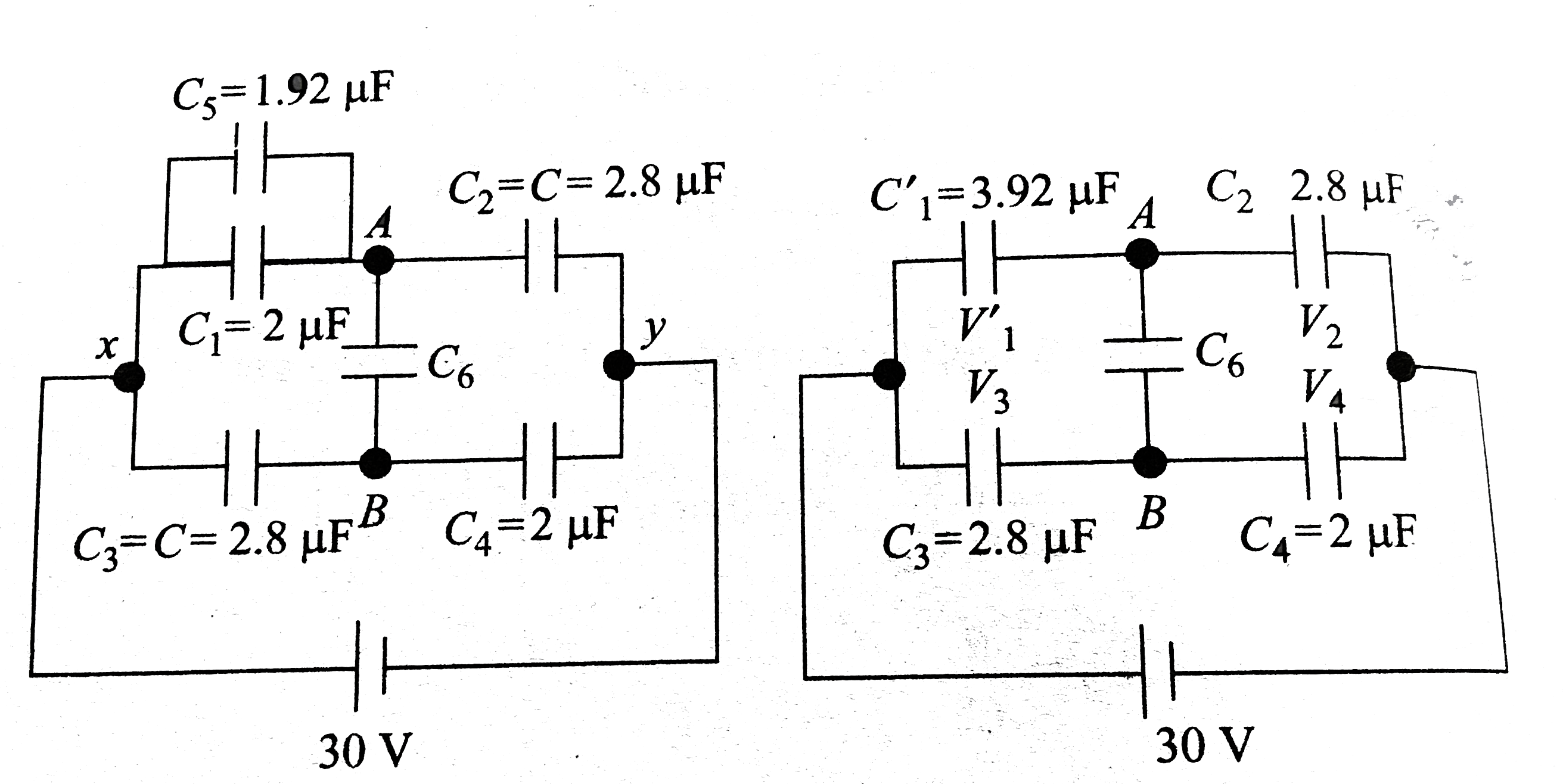 . . . . Since the bridge is in a balanced condition, `A` and `B` at same potential and `C_(6)` has ZERO charge. `C'_(1)` and `C_(2)` are in series. Therfore, charge on `C'_(1)` and `C_(2)` has the same value, so that potential differnce will be in the inverse ratio of capacitance [`Q=CV` or `V=Q/C "hence for same" Q,Vprop1/C']` `(V'_(1))/(V'_(2))=(2.8)/(3.92)~~0.71` or `V'_(1)=0.71 V_(2)` From Eq. (iv), `0.71 V_(2)+V_(2)=30` or `V_(2)=17.5 V` Hence `V'_(1)=30-V_(2)=12.5 V` Since `C'_(1)`, is parallel equivalet of `C_(1)` and `C_(5)`, so potential differnce across each is `V'_(1)=12.5 V`. Hence, charge on `C_(5)` is `C_(5)V'_(1)=1.92 xx12.5=24 muC`. |
|
| 36. |
Let us now connect two more capacitors in the circuit. One of them, C_(5), is connected in the part of thecircuit between X and A. It connected between either in series or in parallel with C_(1). The other, C_(6), is connected between A and B. It is observed X and Y hass the the same malue C_(5) is. Capacitance C_(5) is. |
|
Answer» `1.24 muF` in series with `C_(1)` `V_(4)=V_(1)` `V_(4)=17.5 V` Consider any branch say, `XAY` Since `C_(1)` and `C_(2)` are in series, charge on `C_(2)` is ALSO `35 mu C`. Using `Q = CV` for `C_(2)` `C_(2) = C = (35)/(V_(2)) = (35)/(12.5) = 2.8 mu F` Equivalent capacitance of branch `XAY` is the series equivalent of `C_(3)=C=2.8 muF` and `C_(4)=2 muF` i.e., `1.17 muF`. There branches are in parallel between `X` and `Y`, Hence equivalent capacitance between `X` and `Y` is `1.17+1.17=2.34 muF`. Capacitor `C_(5)` is connected in the part of circuit between `X` and `A` either in series or parallel with `C_(1)=2 muF`. Let the equivalent capacitance of `C_(1)` and `C_(5)`, i.e., the equivalent capacitance between `X` and `A` be `C'_(1)`. Capacitor `C_(6)` is connected between `A` and `B` Obviously, the circuit then becomes a Wheatstone bridge. Further, since equivalent capacitance between `X` and `Y` is INDEPENDENT of the value of `C_(6)`, it implies that bridge is in the balanced condition and potentials at `A` and `B`are now EQUAL, so that `(C'_(1))/C_(3)=C_(2)/C_(4)` or `(C'_(1))/(2.8)=(2.8)/2` (`C_(2)=2.8 muF`, as or determined earlier) or `C_(1)=3.92 muF` `C'_(1)` is the equivalent capacitance of `C_(1)=2 muF` and `C_(5)`, Since `C'_(1)gtC_(1)`, we can conclude that `C_(1)` and `C_(5)` are in parallel, So each individual capacitance .Hence, `C_(1)` and `C_(5)` are in parallel, so `C'_(1)=C_(1)+C_(5)` or `C_(5)=C'_(1)-C_(1)=3.92-2=1.92 muf` `V'_(1)+V_(2)=30` 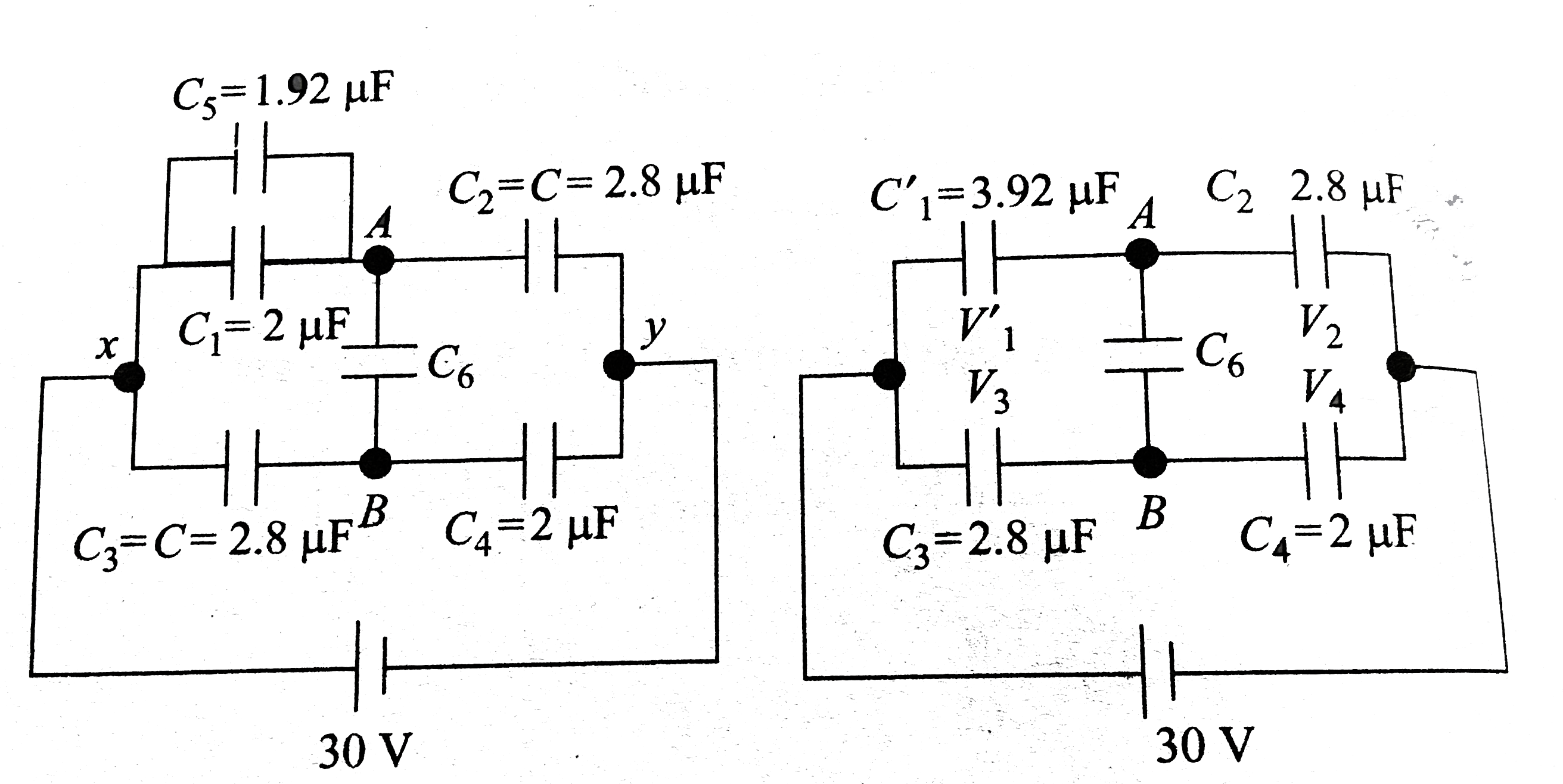 . . . . Since the bridge is in a balanced condition, `A` and `B` at same potential and `C_(6)` has zero charge. `C'_(1)` and `C_(2)` are in series. Therfore, charge on `C'_(1)` and `C_(2)` has the same value, so that potential differnce will be in the inverse ratio of capacitance [`Q=CV` or `V=Q/C "hence for same" Q,Vprop1/C']` `(V'_(1))/(V'_(2))=(2.8)/(3.92)~~0.71` or `V'_(1)=0.71 V_(2)` From Eq. (iv), `0.71 V_(2)+V_(2)=30` or `V_(2)=17.5 V` Hence `V'_(1)=30-V_(2)=12.5 V` Since `C'_(1)`, is parallel equivalet of `C_(1)` and `C_(5)`, so potential differnce across each is `V'_(1)=12.5 V`. Hence, charge on `C_(5)` is `C_(5)V'_(1)=1.92 xx12.5=24 muC`. |
|
| 37. |
Can we use 25 c/s. a.c for lighting purposes ? |
| Answer» SOLUTION :Yes, we can USE 25 c/s. a.c. for lighting purposes. The fluctuations in current will be so rapid (50 times/sec) that the BULB will appear glowing continuously due to persistence of vision. | |
| 38. |
An unpolarised beam of light is incident at the polarising angle on the surface of a transparent medium of refractive index 1.6. The angle of refraction in the medium is : |
| Answer» Answer :C | |
| 39. |
What are (a) the speed and (b) the period of a 220kg satellite in an approximately circular orbit 640km above the surface of the earth? Suppose the satellite loss mechanical energy at the average rate of 1.4 xx 10^(5) J per orbital revolution Adopting the reasonable approximation that due to atmospheric resistance force the trajectory is a circle of slowly dimnishing radius Determine the satellite's (c) altitude (d) speed & (e) period at the end of its 1500^(th) revolution (f) Is angular momentum around the earth 's centre consered for the satellite or the satellite earth system . |
|
Answer» (b) `(220pi)/(7)sqrt(3520)sec~~1.63hour` (c) `[(22 XX 14 xx 64^(2) xx 7040)/(22 xx 14 xx 64^(2) + 7040 xx 6)]km~~411.92 km` (d) `(448)/(sqrt(3406))km//sec~~7.67km//s` (e) `(1703pi)/(56) sqrt(3406) sec ~~ 1.55hour` (f) No . |
|
| 40. |
A particle executes S.H.M. with amplitude 2 cm. At a distance 1 cm from the mean position magnitudes of the velocity and acceleration are equal. The time period of oscillation is : |
|
Answer» `2pisqrt(3)` s `sqrt(r^(2)-y^(2))=omega y` `r^(2)-y^(2)=omega^(2)y^(2)` `IMPLIES""4-1=omega^(2)""implies""omega=sqrt(3)` rad/s. `:.""(2pi)/(T)=sqrt(3)implies""T=(2pi)/(sqrt(3))=(2pi)/(3)sqrt(3)` s. So CORRECT choice is (B). |
|
| 41. |
If all resistors in the shown network are of equal resistance, and the battery is of emf equal to 10 V and internal resistance equal to 1 Omega, what should be resistance of each resistor so that the battery delivers maximum power |
|
Answer» `1OMEGA` |
|
| 42. |
The equivalent capacitance between points A and B will be |
|
Answer» `10 MUF` |
|
| 43. |
The voltage source shown in the fig. is a square wave source. Its polarity changes after every t_(0) = 50 tau second [tau = RC is time constant of the R – C circuit]. The magnitude of voltage across the source remains constant at V_(0). When A is at higher potential compared to B the graph depicts the voltage as positive. Negative voltage means that terminal B is positive. Switch S is closed at t = 0.(a) Taking charge on the capacitor to be positive when plate P is positive, plot the variation of charge on the capacitor as function of time (t). (b) Write the magnitude of maximum current in the circuit. (c) Plot the variation of current as function of time (t). Take clockwise current as positive. |
|
Answer» `q_(0)=CV_(0)` (B) `i_(MAX) =(2V_(0))/(R)` (c) `(##IJA_PHY_V02_C08_E01_103_A02##)` |
|
| 44. |
A body projected along an inclined plane of angle of inclination 300 stops after covering a distance x_(1). The same body projected with the same speed stops after covering a distance x_(2) when the angle of inclination of the inclined plane is increased to 60^(@) the ratio of x_(1)//lx_(2) is |
|
Answer» `sqrt(2)` In first case`0-u^(2)=2(-gsin30^@)x_(1)` or `u^(2)=gx_(1)` In SECOND case`0-u^(2)=2(-gsin60^@)x_(2)` or `u^(2)=sqrt(3)gx_(2)` or `gx_(1)=sqrt(3)gx_(2)` or `x_(1)/x_(2)=sqrt(3)` |
|
| 45. |
What happens when a negative potential is applied to the anode? |
| Answer» SOLUTION :KINETIC ENERGY of the PHOTOELECTRONS DECREASES. | |
| 46. |
What was the status of the ship on January 3? |
|
Answer» pumps had the water LEVEL SUFFICIENTLY under CONTROL |
|
| 47. |
In a Young's double slit experiment using monochromatic light, the fringe pattern shifts by as certasin distance on the screen when a mica sheet of refractive inde 1.6 and thickness 1.964 micron (1 micron =10^-6m) is introduced in the path of one of the interfering waves. The mica sheet is then removed and the distance between the screen and the slits is doubled. It is found that the distance between the successive maxima now is the same as the observed frige-shift upon the introduction of the mica sheet. Calculate the wavelength of the monochromatic light used in the experiment. |
|
Answer» SOLUTION :In the given YOUNG's doule slit EXPERIMENT `mu=1.6` t1.964micron `=1.964xx10^-6m` we know number of fringes shifted `=((mu-1)t)/lamda` so the CORRESPONDING shift=No. of fringes shifted xxfringe width `=(mu-1)/lamdaxx(lamdaD)/d` `=((mu-1)tD)/d.....i` Again when the distance between the SCREEN and the slits is doubled fringe width `=1(2d)`..........ii From i and ii `((mu-1)tD)/d=(lamdaxx2D)/d` `rarr lamda=((mu-1)t)/2` `=((1.6-1)x(1.964)xx10^-6))/2` `=589.2x10^-9=589.2m` |
|
| 48. |
A 0.20 mm wide slit is illuminated by light of wave- length 420 nm. Consider a point P on a viewing screen on which the diffraction pattern of the slit is viewed, the point is at 30^(@) from the central axis of the slit. What is thc phase difference between the Huygens wavelets arriving at point P from the top and midpoint of the slit? |
| Answer» SOLUTION :`0.09 PI RAD = 17^(@)` | |
| 49. |
Standing stationary waves in an oil column can be obtained when the interfering waves are |
|
Answer» Of different FREQUENCIES |
|
| 50. |
What is Huygen's Principle? Explain the optical phenomenon of refraction using Huygen's principle. |
|
Answer» Solution :HUYGEN's principle: Every point on a wave front is the source of SECONDARY wavelets. Refraction of a plane wave using Hyugen's principle. Let the surface PP' separating the two medium of rafractive index `mu_(1) and mu_(2)`. Let `v_(1) and v_(2)` be the velocities of light in medium 1 and medium 2. According to Huygen's principle every point on incident wave fron AB is a source of secondary wavelets. Byt the time wavelet from point B reaches at point C, the wavelet from point A would have rached at point E. Let t be the time taken from B to C is equal to time taken A to D. i.e, `i.e, t=(BC)/(v_(1))=(AE)/(v_(2)) Rightarrow (BC)/(AE)=(upsilon_(1))/(upsilon_(2))` .........(1) First law of refraction: `"In "Delta^(MU)ABC Rightarrow sin i=(BC)/(AC) RightarrowBC=AC sin i.....(2)` Similarly in `"In "Delta^(mu)ABC Rightarrow sin i=(BC)/(AC) RightarrowBC=AC sin i.....(2)` Dividing equation (2) by equation (3) `(BC)/(AE)=(upsilon_(1))/upsilon_(2)=(AC sin i)/(AC sin r)` `(v_(1))/(v_(2))=(sini)/(sin r) ({:(,mu_(1)=c/v_(1),mu_(2)=c/v_(2)),(,v_(1)=(c)/(mu_(1)),&v_(2)=c/mu_(2)):}) rArr c/mu_(1)xxmu_(2)/c=(sin i)/(sin r) therefore (mu=(sin i)/(sin r))` `mu_(1) sin i=mu_(2) sin r` This is the Snell's law of refraction. Second law of refraction: Since incident RAY, refracted ray, refracted ray and the normal all the lie on the same plane PP' at the point of incidence. This proves the second law of refractin. 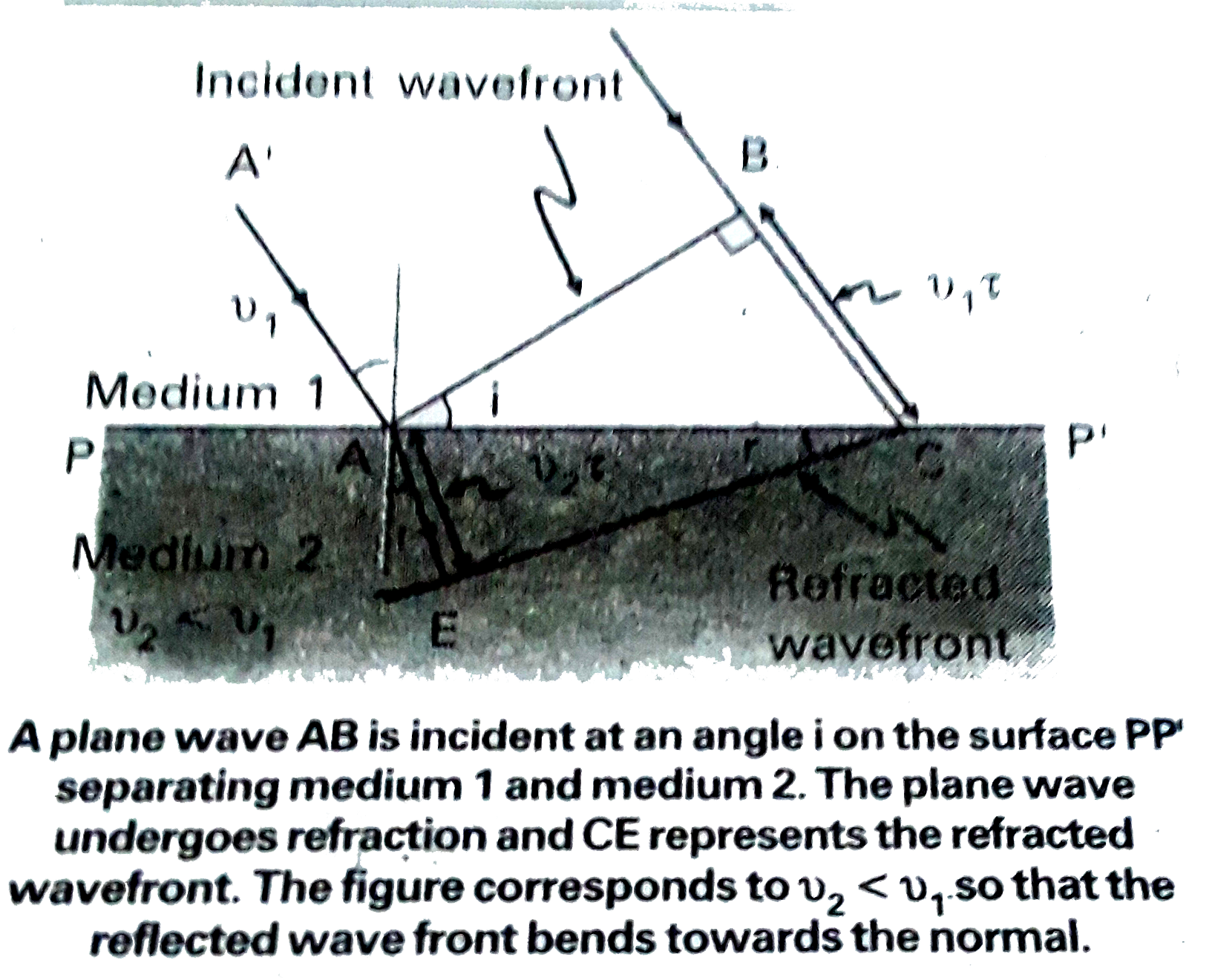
|
|