

Saved Bookmarks
This section includes 7 InterviewSolutions, each offering curated multiple-choice questions to sharpen your Current Affairs knowledge and support exam preparation. Choose a topic below to get started.
| 1. |
A person peddles a stationary bicycle the pedals of the bicycle are attached to a 100 turn coil of area 0.10 m^2 . The coil rotates at half a revolution per second and it is placed in a uniform magnetic field of 0.01 T perpendicular to the axis of rotation of the coil, What is the maximum voltage generated in the coil ? |
|
Answer» Solution : Here F = 0.5Hz: N = 100, `A = 0.1m^2` from the equation `epsi = epsi_0 sin omega t = NBA omega sin omega t` MAXIMUM EMF `epsi_0= NBA omega= NBA(2pi f ) ` ` epsi_0 = 100 xx 0.01xx0.1xx2 xx 3.14 xx 0.5 = 0.314V` |
|
| 2. |
Obtain the expression for electric field due to an infinitely long charged wire . |
Answer» Solution :Electric field DUE to an INFINITELY long charged wire: Consider an infinitely long straight wire having uniform linear charge density `lambda`. Let P be a point located at a perpendicular distance r from the wire. The electric at the point P can be found using Gauss law . We choose two small charge element `A_(1)` and `A_(2)` on the wire which are at equal distance from the point P. The resultant electric field due to these two charge elements points radially away from the charged wire and the magnitude of electric field is same at all points on the circle of radius r. From this property. We can infer that the charged wire possesses a cylindrical symmetry. 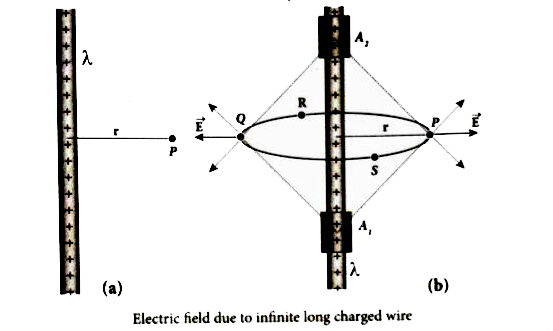 Let us choose a cylindrical Gaussian surface of radius r and length L . The total electric FLUX in this closed surface is `Phi_(E) =oint vecE . d VECA` `Phi_(E)=oint underset("Curved surface ")(oint)vecE.dvecA+ underset("Top surface")intvecE.dvecA+underset("Bottom surfac")int vecE.dvecA` It is seen that for the curved surface `vecE` is perpendicular to `vecA` and `vecE.dvecA` = 0 Substituting these value in the equation (2) and applying Gauss law to the cylindrical surfaces we hav `Phi_(E)= underset("Curved surface ")(int) EdA = (Q_("encl"))/(epsilon_(0))` SINCE the magnitude of the electric field for the entire curved surface is constant E is taken out of the integration and `Q_("encl") ` given by `Q_("encl") = lambdaL.` `E underset("Curved surface ")(int) dA = (lambdaL)/(epsilon_(0))` 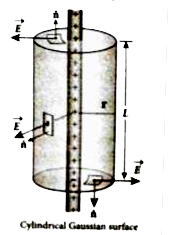 Here `Phi_(E) = underset("Curved surface ")(int) dA ` = total area of the curved surface = `2piL` . Substituting this inequation (4) We get `E.2 pirL = (lambdaL)/(epsilon_(0))( or ) E =(1)/(2piepsilon_(0)) (lambda)/(r)` In vector form `vecE = (1)/(2piepsilon_(0))(lambda)/(r) hatr ` The electric field due to the infinite charged wire depends on `(1)/(r) ` rather than `(1)/(r^(2))` for a point charge . Equation (6) indicates that the electric field ios always along the perpendicular direction ( r) to wire . In fact if `lambda gt ` 0 then `vecE ` points perpendicular outward `(hatr)` from the wire and if `lambda lt 0` then `vecE` points perpendicular inward `(-hatr)` . |
|
| 3. |
Explain the blackbody radiation spectrum in terms of wavelength |
Answer» Solution :Blackbody radiation is the electromagnetic radiation emitted by a blackbody by virtue of its temperature. It extends over the whole range of wavelengths of electromagnetic waves. The distribution of energy over this entire range as a function of wavelength or FREQUENCY is known as the blackbody radiation SPECTRUM. 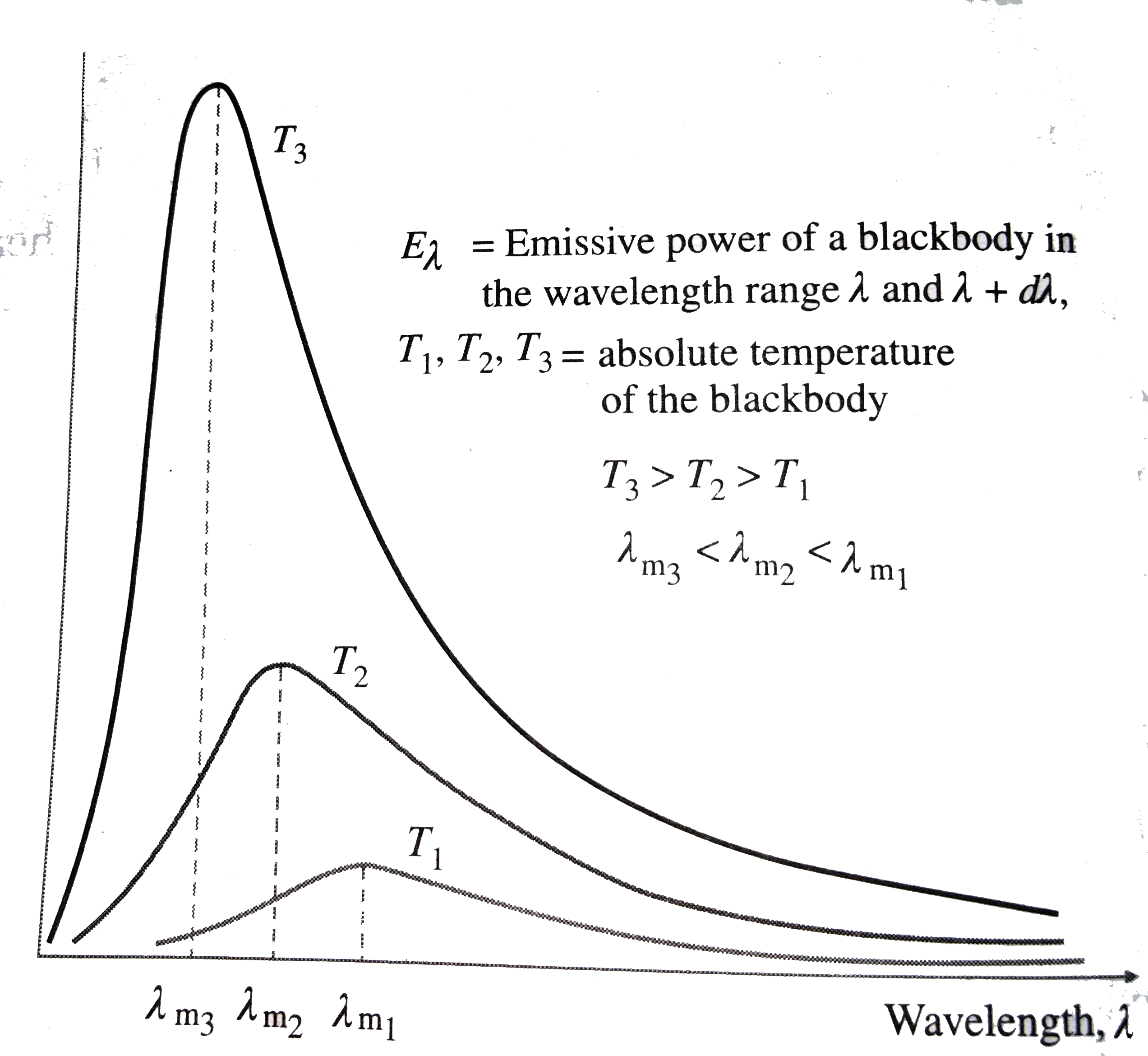 If `E_lamda` is the emissive POWER of a blackbody in the wavelength rang `lamda` and `lamada+d lamada,` the energy it emits per UNIT AREA per unit time in this wavelength range depends on its absolute temperature T. the wavelength `lamda` and the size of the interval `d lamda.` |
|
| 4. |
State Gauss's law in electrostatics. Derive an expression for the electric field due to an infinitely long straight uniformlycharged wire. |
|
Answer» Solution :The total electric FLUX `(varphi)` through any closed SURFACE s in free space to `1/(in_(0))` times the total electric charge q enclosed by the surface. ` varphi= underset (s) oint vec(E). dvec(s) = q//in_(0)` TAKE a thin long wire (`l=alpha`) with linear charge density `LAMBDA`symmetric about the axis of the wire . At P, `vec(E)`is to calculated, draw an imaginary cylinder (Gaussian Surface) at distance r from the line. Charged enclosed =`q= lambda l` from Gauss'a theorem `underset(s) ointvec(E). d vec(S) = q/in_(0)=(lambda l)/in_(0).` Top face (I) BOTTOM face II and curved face III ar the segments of Gaussian surface. So `(lambdal)/(in_(0))=underset (s) oint vec(E) . d vec(S)= underset(I)intvec(E).dvec(S)+underset (II)int vec(E). d vec(S)+underset(III)intvec(E). d vec(S)` In I and II angle between `vec(E) and dvec(S)"is " 90^(@)"so ", cos90^(@) = 0" so ", vec(E). d vec(S)` for both the region is zero. Electric flux will cross through only curved surface and now `underset (III)oint vec(E). d vec(S)= (lambda l)/(in _(0)) rArr underset(III)int vec(E) ds cos0 = (lambda l)/(in_(0)) ` `underset(III) int vec(E) . d vec(S) = (lambdal)/(in_(0))` But `intds = 2 pi rl = CSA=" of cylinder"` `rArr E xx 2 pi rl = (lambda l)/(in_(0)) rArr E=lambda/(2pi in _(0)r)` 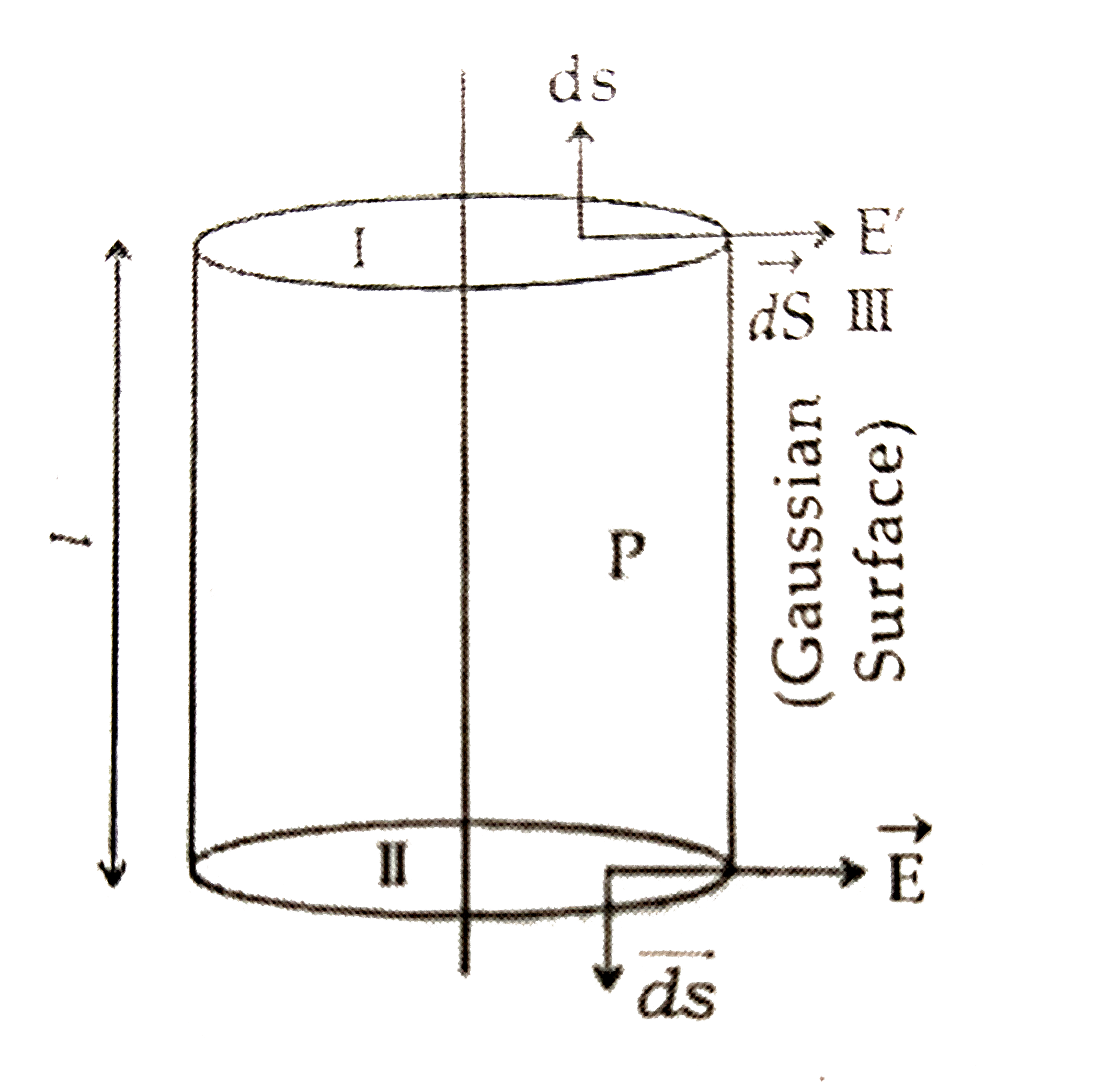
|
|
| 5. |
Define the terms : (i)Declination (ii) Inclination or Dip. |
|
Answer» Solution :(i) Magnetic declination: The ANGLE between the TRUE geographic NORTH and the north SHOWN by a compass needle. (ii) Inclination or Dip The angle made by a magnetic needle with horizontal in the magnetic meridian. |
|
| 6. |
The dimensional formula of torque is (1989) |
|
Answer» `[ML^(2) T^(-2)]` |
|
| 7. |
There are three concentric thin spherical shells A, B and C of radii R, 2R, and 3R. Shells A and Care given charges q and 2q and shell B is earthed. Then which of the given is correct ? |
|
Answer» charge on inner surface of shell C is `4/3`Q |
|
| 8. |
when ac flows through a capacitor, the current |
|
Answer» is in PHASE with the EMF |
|
| 9. |
The thin metallic strip of vernier calliper moves downward from top to bottom in such a way that it justtouches surface of breaker. Main scale reading of calliper is 8.6 cm, whereas its vernier constant is 0.1 mm. The 4th of V.S.D. is coinciding with any main scale division. The actual depth of breaker in mm is (when zero of vernier coincides with zero of main scale). |
|
Answer» 8.64 CM |
|
| 10. |
A spherical distribution of charge density rho = rho_(0)(1-r^(2)//9) exists in the region 0 le r le 2. The dielectric constant of the medium is 2. Find the electric field inside the sphere at a distance r from the centre. |
|
Answer» `(rho_(0))/(90epsi_(0))[15r-r^(3)]` |
|
| 11. |
Given that the atomic mass of argon is 10 times that of helium, at what temperature is the rms speed of a helium atom equal to that of an argon atom at 1247^(@)C ? |
|
Answer» `124.7^(@)C` |
|
| 12. |
Electromagnetic waves are transverse in nature. It is evident by |
|
Answer» Polarization |
|
| 13. |
Find the potential differnce between the points A and B and that between E and F of the circuit in. . |
|
Answer» `V_(AB)=5 V` 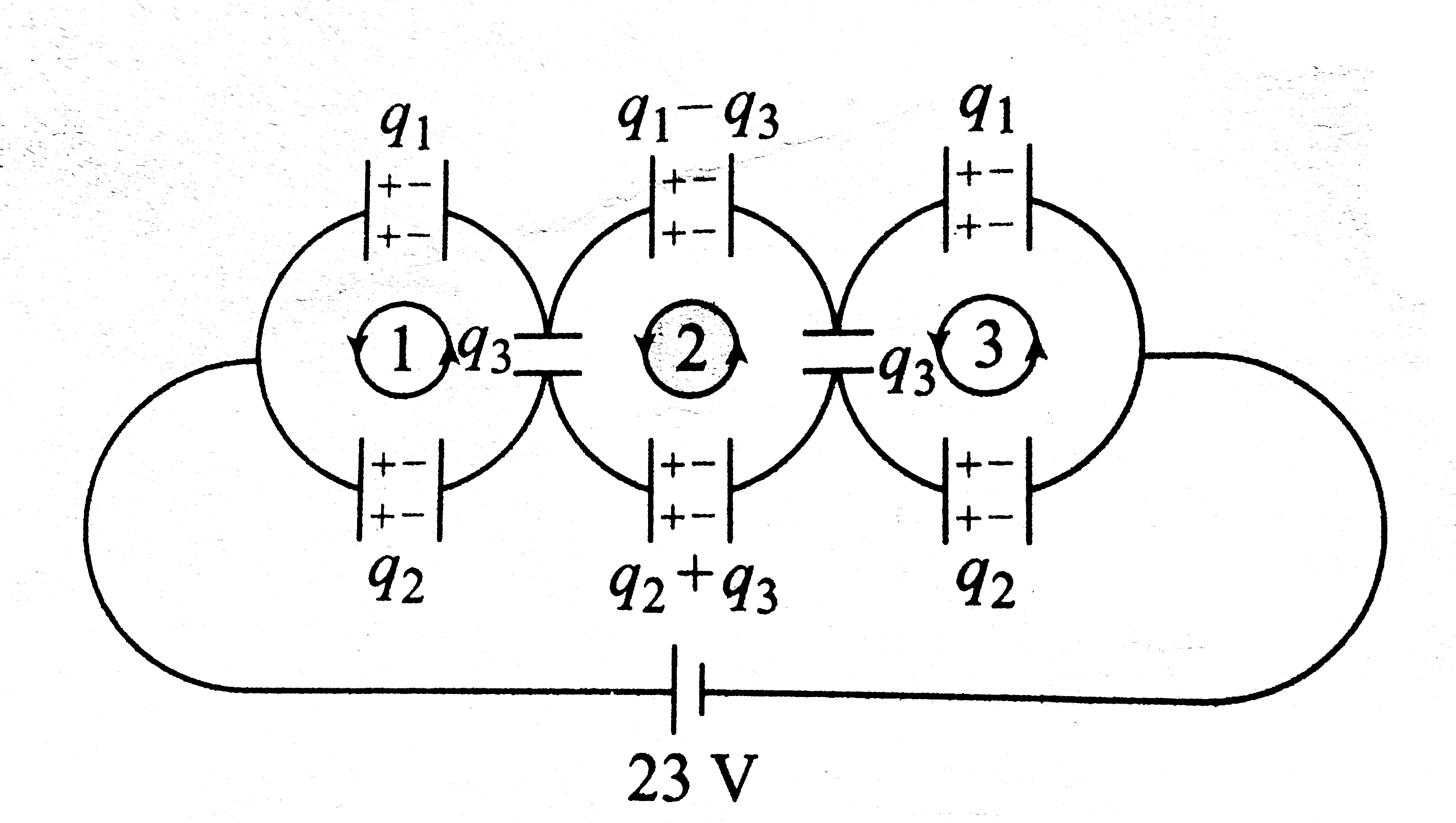 . . `(-q_(2))/5+(q_(3))/(0.75)+(q_(1))/(15)=0` or `q_(1)-3q_(2)+20q_(3)=0` `-(q_(2)_q_(3))/(15)-q_(3)/(0.75)+(q_(1)-q_(3))/5-q_(3)/(0.75)=0` or `3q_(1)-q_(2)-44q_(3)=0` or `23-q_(2)/5-(q_(2)-q_(3))/(15)-q_(2)/5=0` or `345=7q_(2)+q_(3)` Solving for `q_(1),q_(3)`, we get `q_(1)=(19xx345)/(92),q_(2)=(13xx345)/(92),q_(3)=(345)/(92)` Potential difference berween `A` and `B` is `q_(3)/(0.75)=(345)/(92)xx4/3=5 V` Potential difference between `E and F` is also `5 V` but in the oposite direction. |
|
| 14. |
Two equal positive point charges are sperated by a distance of 2a. A point test charge is located in a plane which is normal to the line joining these chargeand midway between them. Calculate the radius r of the circle of symmetry in this plane for which the force on the test charge has the maximum value. |
|
Answer» |
|
| 15. |
The force constant corresponds to …... electric quantity. |
|
Answer» resistance |
|
| 16. |
The energy level just above the valence band is called …………….. Level. |
|
Answer» donor |
|
| 17. |
A thin insulated wire forms a plane spiral of N = 100 tight turns carrying a current I = 8 m A ( milli ampere). The radii of inside and outside turns are equal to a = 50 mm and b = 100 mm, respectively. The magnetic induction at the center of the spiral is |
| Answer» | |
| 18. |
When a ray of light enters a glass slab from air |
|
Answer» its WAVELENGHT decreases When light travels from air to GLASS, frequency v REMAINS unchanged, velocity u decreases and hence wavelenght `lambda` also decreases. |
|
| 19. |
What is the connecting link between plants and animals |
|
Answer» Chrysophytes |
|
| 20. |
Light of wave lenght 600nm is incident normally on a slit of with 3mm. Calculate the angular width of central maximum on a screen kept 3m away from the steb. |
| Answer» SOLUTION :`4 TIMES 10^-4 RAD` | |
| 21. |
Name the part of the electromagnetic spectrum of wavelength 10^(2) m and mention its one application. |
| Answer» SOLUTION :Radio waves. These are USED in SHORT WAVE band radio broadcast. [Delhi 2008) | |
| 22. |
A galvanometer has resistance G and current I_(g) produces full scale deflection. S_(1) is the value of the shunt which converts it into an ammeter of range 0 - I and S_(2) is the value of shunt for the range 0 - 2I. The ratio of S_(1) and S_(2) is |
|
Answer» `(1)/(2)((I-I_(G))/(2I-I_(g)))` |
|
| 23. |
A 1 kg block moving with a velocity of 4 mscollides with a stationary 2 kg block. The lighter block comes to rest after the collision. The loss of kinete energy of the system is |
|
Answer» 1 J `1xx4=2xxv` or `v=2 MS^(-1)` `:.` LOSS of K.E. is GIVEN by. `DeltaE_k=1/2xx1xx4^2-1/2xx2xx(2)^2` =(8-4)=4J |
|
| 24. |
Assuming the gravity to be in negative z - direction, a force vec(F)=vec(V)xx vec(A) is exerted on a particle in addition to the force of gravity where vec(V) is the velocity of the particle and vec(A) is a constant vector in positive x - direction. What minimum speed a particle of mass m be projected so that it continues to move underflected with constant velocity ? |
| Answer» Solution :`|F|=v A sin theta` Here, `theta` is angle between `vec(v)` and `vec(A)` The particle moves undeflected if `vec(F)` acts be in POSITIVE Z - direction. Hence, velocity should be in negative y - direction, or `vec(V)_(MIN)=-(MG)/(A)hat(j)`. | |
| 25. |
Two points +ve charges q each are placed at (-a, 0) and (a,0), A third +ve charge q_(0) is placed at (0, y). Find the value of y for which the force at q_(0) is maximum. |
|
Answer» `(a)/(SQRT(3))`  Force on charge `+q_(0)` due to charge +q at A is `F_(1) = (1)/(4pi epsilon_(0))(q_(0)q)/((a^(2) + y^(2)))` Force on charge `+q_(0)` due to charge +q at B is `F_(2) = (1)/(4pi epsilon_(0))(q_(0)q)/((a^(2) + y^(2))) :. F_(1) = F_(2)` By symmetry, the components of force on charge `q_(0)` due to charges at A and B along X-axis will conact each other while along Y-axis will add up. `:.` The resultant force on charge `+q_(0)` is `F = 2F_(1) cos theta ""(because F_(1) = F_(2))` `F = (2)/(4pi epsilon_(0))(q_(0)q)/(a^(2) + y^(2))(y)/(sqrt(a^(2) + y^(2))) = (2)/(4pi epsilon_(0))(q_(0)QY)/((a^(2) + y^(2))^(3//2))` Force on charge `q_(0)` will be maximum, when `(DF)/(dy) = 0` `:. (2q_(0)q)/(4pi epsilon_(0)) [(1)/((a^(2) + y^(2))^(3//2)) - (((3)/(2)y)(2y))/((a^(2) + y^(2))^(5//2))] = 0` or `(1)/((a^(2) + y^(2))^(3//2)) - (3y^(2))/((a^(2) + y^(2))^(5//2)) = 0` or `1 = (3y^(2))/(a^(2) + y^(2))` or `a^(2) + y^(2) = 3y^(2)` or `2y^(2) = a^(2)` or `y^(2) = (a^(2))/(2)` or `y = (a)/(sqrt(2))` |
|
| 26. |
A wire P has resistance of 20 ohm. Another wire Q of same material but length twice that of P has resistance of 8 ohm. If r is the radius of cross-section of P, the radius of cross-section of Q is |
|
Answer» `r`  The wire Q has resistance of `8Omega`. Let its length be 2l. Let the unknown radius be `r_(Q)`. `R_(Q)=(rho2l)/(pir_(Q)^(2))""...(ii)`<  DIVIDE (i) by (ii) we get `(R_(P))/(R_(Q))=(r_(Q)^(2))/(2r^(2))or(20)/(8)=(r_(Q)^(2))/(2r^(2))orr_(Q)^(2)=5r^(2)orr_(Q)=sqrt(5)r` |
|
| 27. |
Apparent distance of the image formed by a concave mirror dipped in water Find the location of the final image of O formed by the system (Fig. 34-8). Assume that O is on the principal axis of the concave mirror. |
|
Answer» Solution :(1) Here, the image is formed after three events : refraction from water, reflection from mirror, and again refraction from water. (2) As we discussed in Chapter 33, image of one event will act as an object for the next event. Thus, first event we consider is refraction from water for which we can apply fromula for APPARENT depth. Then next event will be reflection from concave mirror. The next event would be again refraction from water surface which will be the last event. Calculation : when the mirror sees the object O, it does not appear to be at 10cm from the water surface. Rather, its apparent distance is `(d_(app))/(n_("reflected"))=(d_(act))/(n_("incident"))` `d_(app)=10xx(4)/(3)=(40)/(3)cm` from water surface The image formed by this refraction will act as an object for the next surface (mirror) : `u=-((40)/(3)+(5)/(3))=-15cm` Note that focal length of mirror (r/2) does not depend on the refractive INDEX of SURROUNDING medium. The image distance is given by `v=(uf)/(u-f)=(-15xx-10)/(-15-10)=-30cm` These reflected rays will not actually be able to meet at 30cm in FRONT of the mirror. However, this image will act as an object for the next event : refraction from the water surface. For this event, we have to MEASURE distance of the object from the water surface : `(d_("app"))/(n_("refracted"))=(d_("act"))/(n_("incident"))` In this event, the rays are incident from water and refracted into air : `(d_(app))/(1)=((85)/(3))/((4)/(3))` `d_(app)=(85)/(4)cm` from water surface. 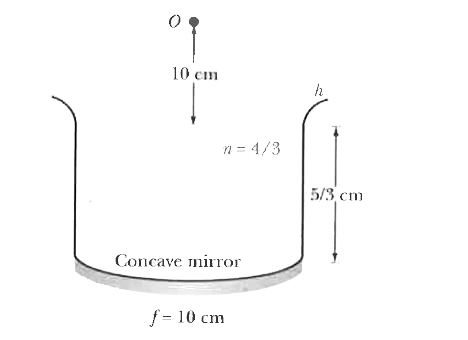 Forming an image of object O by a concave mirror dipped on water. |
|
| 28. |
In a copper voltameter, mass deposited in 6 minutes is m gram. If the current-time graph for the voltameter is as shown here, then the E.C.E of the copper is |
|
Answer» m/5 |
|
| 29. |
In FM, frequency variation of the carrier wave depends upon the __________ amplitude of the signal. |
|
Answer» average |
|
| 30. |
If the excess pressure inside a soap bubble of radius 5mm is equal to the pressure of a water column of height 0.8cm, then what is the surface tension of the soap solution. |
|
Answer» SOLUTION :EXCESS pressure = 4T/R and hydrostate pressure = `hrhog` `therefore 4T/R = `hrhog` `therefore T = (hrhogR)/4` = `(8 xx 10^-3 xx 10^3 xx 98 xx 5 xx 10^-3)/4 = 9.8 xx 10^-3 N/m` |
|
| 31. |
Who wrote this chapter? |
|
Answer» MOTI NISANI |
|
| 32. |
In a pure semiconductor crystal, if current flows due to breakage of crystal bonds, then the semiconductor is called |
|
Answer» acceptor |
|
| 33. |
The deflection in a moving coil galvanometeris reduced to half , when a shunted with a 60Omega coil. The resistance of galvanometer is : |
|
Answer» `60Omega` |
|
| 34. |
How does the resistivity of : (i) a conductor and (ii) a semiconductor vary with temperature ? Give reason for each case. |
|
Answer» Solution : (i) The resistivity of a conductor is given by the relation `RHO= (m)/("ne"^2 tau)` When the temperature rises, the number density of conduction electrons (n) in a conductor does not materially change but amplitude of atomic/molecular vibrations increases and, consequently, frequency of collisions with electrons increases. As a result, relaxation perioddecreases and so resistivity of the conductor increases. (ii) The resistivity of a semiconductor decreases on increasing the temperature. In SEMICONDUCTORS,the number density of electrons (n) increases rapidly with RISE in temperature due to transfer of electrons from valence level to conduction level on account of high KINETIC energy of free electrons. However, the effect of decrease in relaxation period is not of much consequence. Due to increase in value of n, the resistivity decreases. |
|
| 35. |
Ampere's law is the integral form of _____ |
|
Answer» Biot-Savart's law |
|
| 36. |
In Young's double-slit experiment, if both the slits are covered by a thin transparent sheet of thickness t and refractive index n, the optical path difference between the two interfering waves |
|
Answer» increases by (N -1) t |
|
| 37. |
The height above the surface of the earth where the acceleration due to gravity is half of its value at surface is |
| Answer» Answer :A | |
| 38. |
What is the topic of discussion between Nanaji and Naina and Ajit? |
|
Answer» Patriotism |
|
| 39. |
A soap bubble 'A' of radius 0.03 m and another bubble 'B' of radius 0.04 m are brought together so that the combined bubble has a common interface of radius r, then the value of r is : |
|
Answer» <P>0.06 m `(4T)/(0.03)-(4T)/(0.04)=(4T)/r` or r=0.12 m `therefore` CORRECT choice is (c). |
|
| 40. |
When a lamp is connected to an alternating voltage supply, it lights with the same brightness as when connected to a 12 V d.c. battery. What is the peak value of alternating voltage source ? |
| Answer» Solution :The peak voltage of alternating voltage SOURCE `V_(m) =12 xx SQRT(2) .V = 17V` | |
| 41. |
For compound microscope f_(0) = 1 cm, f_(e) = 2.5 cm. An object is placed at distance 1.2 cm from objective lens. What should be length of microscope for normal adjustment? |
|
Answer» 8.5 cm ` = (-1.2 xx 1)/(-1.2 + 1) + 2.5 = 6 + 25 = 8.5 cm` |
|
| 42. |
The earth takes 24 h to rotate once about its axis. How much time does the sun take to shift by 1° when viewed from the earth? |
|
Answer» Solution :Time taken for `360^(@)` SHIFT = 24 h Time taken for `1^(@)` shift `= 24//360 h =" 4 MIN."` |
|
| 43. |
यदिf:RrarrR मे f(x)=X^3+3 सेपरिभषितहै , तब f^(-1)(X) होगा - |
|
Answer» `(X+3)^(1/3)` |
|
| 44. |
A spring is loaded with two blocks m_(1) and m_(2) where m_(1) is rigidly fixed with the spring and m_(2) is just kept on the block m_(1) as shown in the figure. The maximum energy of oscillation that is possible for the system having the block m_(2) in constact with m_(1) is |
|
Answer» `(m_(1)^(2) G^(2))/(2K)` |
|
| 45. |
A particle is projected from point P on inclined plane OA perpendicular to it with certain velocity v. It this another inclined plane OB at point Q perpendicular to it. Point P and Q are at h_(1) and h_(2) height from ground. (alpha gt beta) |
|
Answer» `h_(1)=h_(2)` Parallel to `OB`, `0=v cos(90^(@)-alpha-beta)-g sin beta t`……(`ii`) on SOLVING `v'=(vsin alpha)/(sinbeta)` for `alpha gt beta`, `v' gt v`, so by ENERGY conservation `h_(2) lt h_(1)` |
|
| 46. |
How does the focal length of a convex lens change it monochromatic red light is used instead of violet light? |
| Answer» SOLUTION :From LENS maker.s formula, `fprop1/(n-1)`. As `n_r LT n_v` focal LENGTH will INCREASE when red light is used. | |
| 47. |
Hydra can be |
|
Answer» INCREASE in the focal lengthh of eye LENS |
|
| 48. |
Do the same exercise as above with the replacement of the earlier transformer by a 40,000 - 220 V step-down transformer (Neglect, as before, leakage losses though this may not be a good assumption any longer because of the very high voltage transmission involved). Hence, explain, why high voltage transmission is preferred ? |
|
Answer» Solution : If power is transmitted at 40,000 V, then current in the line `I = P/V = (8 xx 10^(5))/(40,000) = 20 A` (a) `therefore`Line power loss as heat =`I^(2)R = (20)^(2) xx 15 = 6000 W = 6 KW` (b)TOTAL power supplied by the plant = 800 kW + 6 kW = 806 kW (c) Voltage drop along the line = IR = 20 x 15 = 300 V`therefore`Voltage at generating station side of line = 40,000 + 300 = 40,300 V Thus, a step up transformer of 440 V - 40,300 V be used at the generator plant. A comparison of Exercises 7.25 and 7.26 shows that at 4000 V, power loss as heat is 600 kW but at 40,000 V, power loss as heat for same line is reduced to 6 kW only. It is due to this reason (i.e., to reduce the transmission loss) that power transmission is preferred at a highest possible voltage. |
|
| 49. |
Find the magnitude of emf induced in a 200 turn coil with cross-sectional area of 0.16 m^(2) , if the magnetic field through the coil changes from 0.10 Wb m^(-2) to 0.50 Wb m^(-2) at a uniform rate over a period of 0.02 s. |
|
Answer» |
|
| 50. |
Brake or turn? Figure depicts an overhead view of a car's path as the car travels toward a wall. Assume that the driver begins to brake the car when the distance to the wall is d=107 m, and take the car's mass a m=1400 kg, its initial speed as v_(0)=35 m/s and the coefficient of static friction as mu_(s)=0.50. Assume that car'sweight is distributed evenly on the four wheels, even during braking (a) What magnitude of static friction is needed (between tires and road) to stop the car just as it reaches the wall? (b) What is the maximum possible static friction f_(s,"max")/ (c) If the coefficient of kinetic frictic between the (sliding) tires and the road is mu_(k)=0.40, at what speed will the car hit the wall? To avoid the crash, a drivercould elect to turn the car so that it just barely misses the wall, as shown in the figure. (d) What magnitude of frictional force would be required to keep the car in a circular path of radius d and at the given speed v_(0),so that the car moves is a quarter circle and then parallel to the wall? (e) Is the required force less than f_(s."max") so that a circular path is possible? |
|
Answer» |
|