

Saved Bookmarks
This section includes 7 InterviewSolutions, each offering curated multiple-choice questions to sharpen your Current Affairs knowledge and support exam preparation. Choose a topic below to get started.
| 1. |
Why 'damp-proof' is necessary? |
| Answer» Solution :Bricks and mortar are porous and permit rise of SOIL water through them by capillary ACTION. Therefore, brick FOUNDATIONS are COVERED with a layer of cement called damp-proof. | |
| 2. |
What are coherent sources ? |
| Answer» SOLUTION :The TWO SOURCES must emit wave of same frequency and having ZERO phase DIFFERENCE. | |
| 3. |
A motor has an electrical input of 30 kJ and is used to raise 100 kg load to a height of 25 m when fitted to a crane winch. What is the efficienty of winch ? (g=10 ms^(-1)) |
|
Answer» 0.0075 =`(250)/(3)=83.3%` |
|
| 4. |
the net electric flux through each face of a die (singular of dice) has amagnitude in units of 10^(3)N.m^(2)//C that is exactly equal to the number of sport N on the face ( 1 through 6) the flux is inward for N odd outword forN even. What is the net charge inside the die ? |
|
Answer» |
|
| 5. |
Derive the expression for the capacitance of a parallel plate capacitor. And hence write the expression for the capacitance when a dielectric medium is inserted between its plates. |
Answer» Solution : Consider two parallel PLATES P and Q each of area A and separated by a distance d in AIR. Let plate P has surface CHARGE density `+sigma `and plate Q has surface charge density `- sigma ` . The electric field between the plates `E= (sigma)/(epsi_0) = ((q//A))/(epsi_0)` ` E = (q)/(A epsi_0)` But potential difference between plates, V = ED. Now capacitance, `C = q/V = (q)/(Ed) = (q)/((q)/(Aepsi_0) xx d)` `C = (epsi_0 A)/(d)` The capacitance of parallel plate capacitor when a DIELECTRIC medium is inserted between the plates is given by `C_m = (epsi_0 epsi_r A)/(d)` |
|
| 6. |
(A) : Self-inductance is called the inertia of electricity.(R) : Self-inductance is the phenomenon, according to which an opposing induced e.m.f. is produced in a coil as a result of change in current or magnetic flux linked with the coil. |
|
Answer» Both .A. and .R. are true and .R. is the correct EXPLANATION of .A. |
|
| 7. |
In Figure, two isotropic point sources of light (S_(1) and S_(2)) are separated by distance 2.70 mu m along a y axis and emit in phase at wavelength 900 nm and at the same amplitude. A light detector is located at point P at coordinate x_(P) on the x axis. What are (a) the greatest value of x_(P) and (b) the second greatest value at which the detected light is minimum due to destructive interference? |
| Answer» SOLUTION :(a) 7.88 `MU m`, (B) 2.03 `mu m` | |
| 8. |
For an L-C-R series circuit, the Q-factor is … |
|
Answer» `Q=Rsqrt(L/C)` |
|
| 9. |
(a) Obtain the de-Broglie wavelength of a neutron of kinetic energy 150 eV. An electron beam of this energy is suitable for crystal diffraction experment. Would a neutron beam of the same energy be equally suitable? Explain (m_(n)=1.675xx10^(-27)kg) (b) Obtain the de-Broglie wavelength associated with thermal neutrons at room temperatuer (27^(@)C). hence, explain why a fast neutron beam needs to be thermalised with the environment before it can be used for neutron diffraction experiments. |
|
Answer» Solution :(a) We know the mass of NEUTRON `m=1.675xx10^(-27)KG` and kinetic energy of given neutron `K=150eV=150xx1.6xx10^(-19)J=2.4xx10^(-17)J` `therefore`de-Broglie WAVELENGTH `lamda=(h)/(sqrt(2mK))=(6.63xx10^(-34))/(sqrt(2xx1.675xx10^(-27)xx2.4xx10^(-17)))=2.34xx10^(-12)m` The neutron beam of energy `150eV` (i.e., of wavelength `2.34xx10^(-12)m`) is not SUITABLE for crystal diffraction experiment because this wavelength is nearly `(1)/(100)th` time the inter atomic distance in the crystal (which is of the order of `10^(-10)m`). (b) As room temperature `T=27^(@)C=300K`, hence, kinetic energy of thermal neutrons `K=(3)/(2)k_(B)T=(3)/(2)xx1.38xx10^(-23)xx300J` `therefore`de-Broglie wavelength of neutrons `lamda=(h)/(sqrt(2mK))=(6.63xx10^(-34))/(sqrt(2xx1.675xx10^(-27)xx(3)/(2)xx1.38xx10^(-23)xx300))=1.45xx10^(-10)m`. As this wavelength is comparable to the inter-atomc spacing in crystals, neutron beam of thermal energy can be successfully used for crystal diffraction experiments. hence, for neutron diffraction experiments we would first thermalise neutrons with the environment. |
|
| 10. |
In Fig. 30-46, a stiff wire bent into a semicircle of radius a = 1.4 cm is rotated at constant angular speed 30 rev/s in a uniform 20 mT magnetic field. What are the (a) frequency and (b) amplitude of the emf induced in the loop? |
| Answer» SOLUTION :(a) 30 HZ, (B) 1.2 MV | |
| 11. |
When a rectangular glass slab is placed on different coloured letters, the violet coloured letter appears to be raised more. What is the reason behind it? |
|
Answer» Solution :In case of a glass slab, the APPARENT displacement of the letters placed beneath it is, `x = t(1 - (1)/(MU)) or, (t - x) = (t)/(mu)` where t = thickness ofthe slab and `mu` = refractive INDEX of the particular COLOUR of light. SINCE `mu_(v)` for violet colour is maximum, the value of (t - x) i.e. the distance of the letter from top of the slab will be minimum, thus the letters of violet colour will seen to be raised more than other colours. |
|
| 12. |
The temperature of the filament of 100-watt lamp is 4000^(@)C in the steady state and the radius of the glass bulb is 4 cm and the thickness of the wall is 0.4 mm. Assuming that there is no convection, calculate the thermal conductivity of glass. The temperature of the outside air is 27^(@)C. |
|
Answer» |
|
| 13. |
A high-energy gamma-photon may turn into an electron-positron pair in the field of heavy nuclei. What is the minimum energy of the gamma-photon? |
| Answer» SOLUTION :From the law of conservation of energy we obtain for the gamma-photon `epsi_(gamma)ge2m_(0)C^(2)`, where `m_(0)` is the REST mass of an ELECTRON. | |
| 14. |
A uniform magnetic field of 1.5 T exists in a cylindrical region of radius 10.0 cm, its direction parallel to the axis is along east to west. A wire carrying current of 7.0 A in the north to south direction passes through this region. What is the magnitude and direction of the force on the wire if, a. the wire intersects the axis, the wire is turned from N S to north east-south west direction. c. the wire in the N-S direction is lowered from the axis by a distance 6.0 cm. |
|
Answer» Solution :2.1 N VERTICALLY downwards b. same as (a) (remember L SIN `THETA`is CONSTANT) c. 1.68 N vertically downwards. |
|
| 15. |
The limit of resolution of an optical instrument arises an account of ......... |
|
Answer» INTERFERENCE |
|
| 16. |
The element that can be used as an acceptor impurity to doped silicon is |
|
Answer» Antimony |
|
| 17. |
a. Is there any well defined boundary for a nucleus ? b. What is the order of the size of a nucleus? c. How will you conclude that an atom has a lot of empty space ? |
|
Answer» Solution :a. No. b. fermi c. DIAMETER of atom (INCLUDING position of ELECTRONS) is of the order `(~~)` of `10^(-10)m` and that of nucleus is `10^(-15)m`. The ratio is `10^5`. So much empty SPACE is PRESENT. |
|
| 18. |
Four rods of equal length L are joined by four pins A,B,C & D as shown in the figure. Rods are free to rotated about pins. Pin A is given velocity v_(0) and pin C is given 3v_(0) as shown The speed of pin B with respect to pin A is |
|
Answer» `2v_(0)costheta` `rArr v=2v_(0) COT theta` `THEREFORE v_(B)=2v_(0) cosec theta` 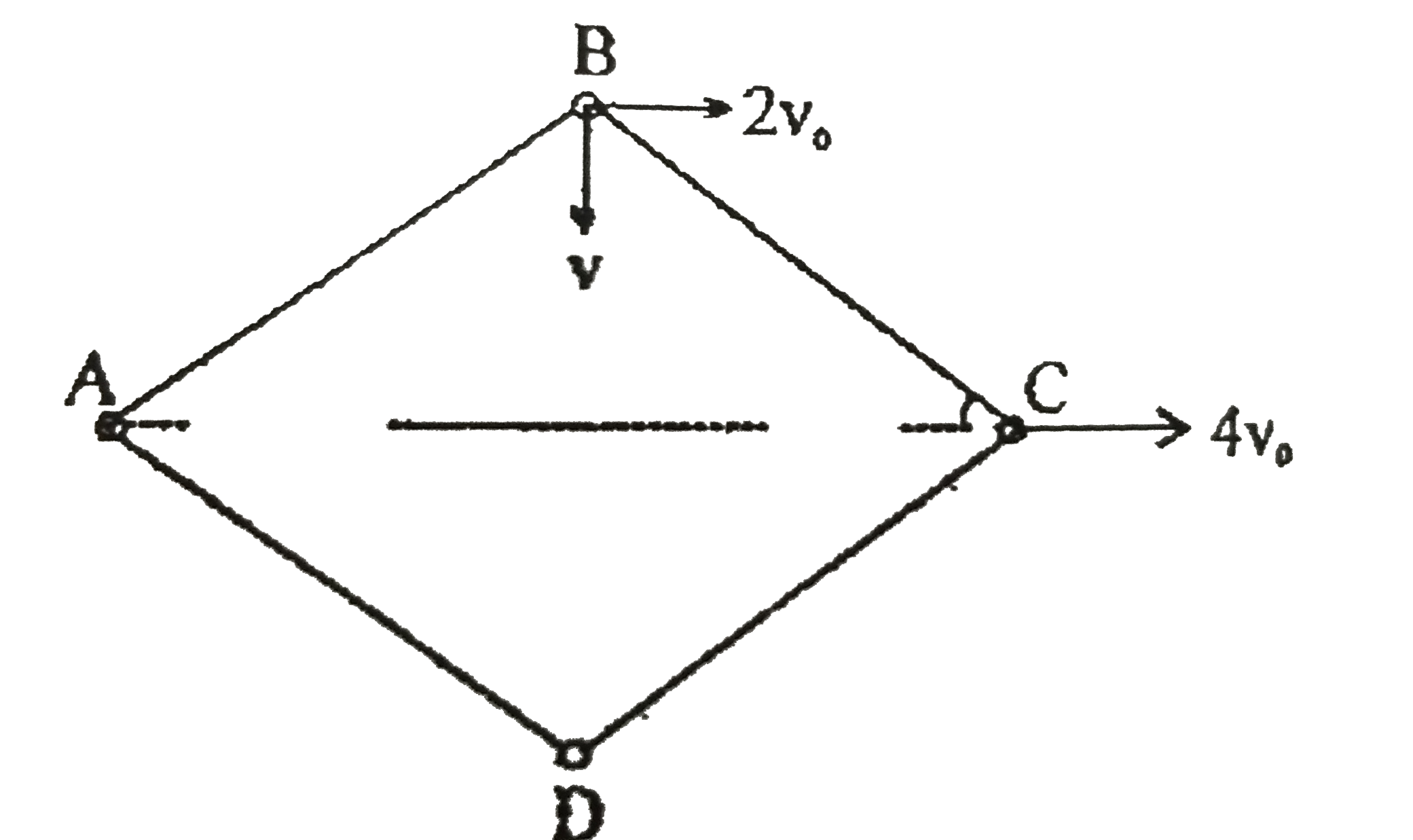 `omega=(2v_(0)sin theta+v cos theta)/(L)=(2v_(0))/(L sin theta)` |
|
| 19. |
The potential energy of particle moving is S.H.M. is (1)/(2)kx^(2). If the frequency of the particle is n, the frequency of oscillation of P.E. is : |
|
Answer» Solution :Here `x=r SIN omegat`. and P.E. `=(1)/(2)kx^(2)=(1)/(2)m omega^(2)x""{because k=m omega^(2)}` P.E. `=(1)/(2)m omega^(2).r^(2)sin^(2)omegat` P.E. `=(1)/(2)m omega^(2)r^(2)[(1-cos 2omegat)/(2)]` `:.` THEREFORE, frequency of P.E. is `2omega` i.e., TWICE the frequency of particle `(omega)`. Hence correct choice is (b). |
|
| 20. |
Four rods of equal length L are joined by four pins A,B,C & D as shown in the figure. Rods are free to rotated about pins. Pin A is given velocity v_(0) and pin C is given 3v_(0) as shown The angular velocity of rod BC is |
|
Answer» `(2v_(0))/(L)` `rArr v=2v_(0) cot theta` `therefore v_(B)=2v_(0) cosec theta` 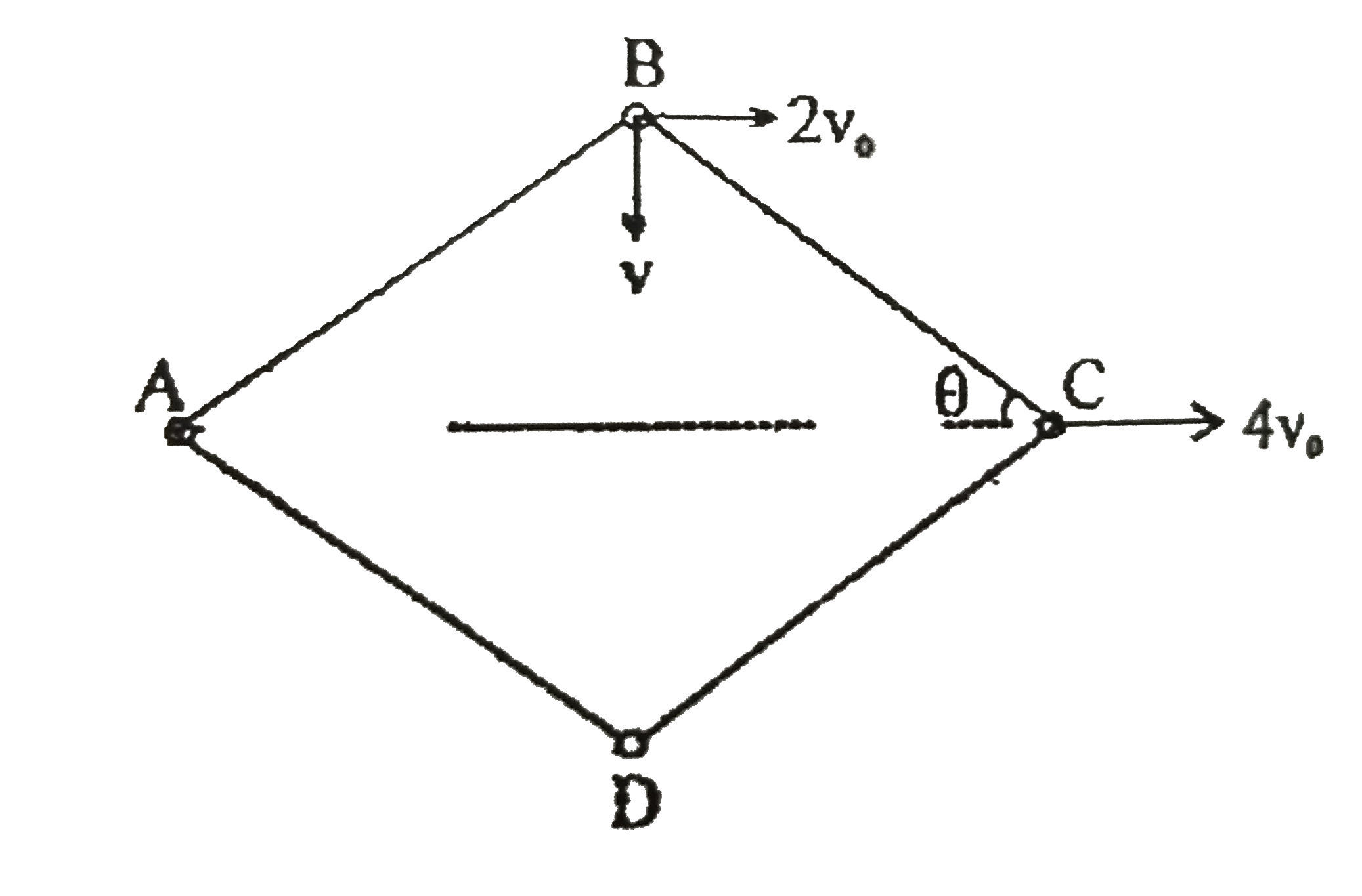 `omega=(2v_(0)sin theta+v cos theta)/(L)=(2v_(0))/(L sin theta)` |
|
| 21. |
The teachers of Geeta's school took the students on a study tirp to a power generating station, loactad nearly 200km away form thecity.Theteacher explained that electrical energy is transmitted over sucha longdistance to their city, in the form of alternatingcurrent (ac) raised to a high voltage. At the receiving endis the city,the voltageis reduced to operate the devices. As a result, the powerloss is reduced. Geeta listened to theteacher and asked question abouthowthe ac isconverted to a higheror lower voltage. (a) Name th device used to change the alternatingtoa higheror lower value. State one cause for power dissipationin thisdevice. (b) Explainwith an example, howpower lossis reduced if theenergy is transmitted overlongdistance as an alternatingcurrentrather than a direct current, (c) Write two values each shown by theteachers and Geeta. |
|
Answer» Solution :(a) The device whichconverts high voltageto low or low voltageto high voltageis called tranformer. Power can LOSS byheat and FLUX leakage. (b) Electricpowerlis transmitted FORM powerstation to homes through cable. These cables haveresistance power P is deliverd to load R via cables resistance `R_(l)` if v isvolt across load R andI current. `P = V - I` Power wasted `P_(l) = I^(2)R_(t) = (P^(2)Rt)/(V^(2))` `P_(t) prop (I)/(V^(2))` highvolt WASTE loss power. (c) They shouldbe polite and thankful to each other. |
|
| 22. |
A gold foil of mass m= 0.20 g was irradiated during t=6.0 hours by a thermal neutron flux falling normally on its suface. Following tau=12 hours after the completion of irradiation the activity of the foil became equal to A= 1.9.10^(7)dis//s. Find the neutron flux density if the effective cross-section of formation of a radioactive nucleus is sigma= 96b, and the half-life is equal to T=2.7 days |
|
Answer» Solution :We apply the formula of the PREVIOUS problem except that have `N=no`. Of radio nuclide and no. of host nuclei originally. Here `n=(0.2)/(197)xx6.023xx10^(23)=6.115xx10^(20)` Then after time `t N=(n.J.sigma.T)/(In 2)(1-e^(-(tIn 2)/(T)))` T= half life of the radionuclide After the SOURCE of neutrons is cut off the ACITIVITY after time `T` will be `A=(n.J.sigma.T)/(In 2)(1-e^(-tIn2//T))e^(tauIn2//Txx(In 2)/(T))=n.J.sigma(1-e^(-tIn2//T))e^(-tauIn2//T)` Thus `J=Ae^(TAU In 2//T)//n sigma(1-e^(-tIn 2//T))= 5.92xx10^(9)part//cm^(2).s` |
|
| 23. |
If vec r and vec F be the distance and force vectors. What meaning can be atteched to vec r .vec F andvec r x vec F ? |
| Answer» SOLUTION :`vec r .vec F` REPRESENTS the workdone WHILL `vec r X vec F` reperesents a torque | |
| 24. |
The natural frequency of vibrations of a nitrogen molecule is 4.4 xx 10^14 rad/s. Find the temperature at which vibrations of the nitrogen molecules are excited. |
|
Answer» |
|
| 25. |
When a mono chromatic point source of light is at a distance of 0.2m from a photo electric cell, the cut off voltage and saturation current are respectively 0.6V and 18 mA. If the same source is placed 0.6m away from the photo electric cell then |
|
Answer» the STOPPING potential will be 0.6 V |
|
| 26. |
What is the mechanical equivalent ofspring constant k in LC oscillating circuit? |
|
Answer» `(1)/(L)` |
|
| 27. |
Statement I : If phase difference between the lightwaves emerging from slits of Young's experiment is pi radian, then central fringe will be dark. Statement II : Light from two coherent sources is reaching screen. If path difference at a point on the screen for the yellow light is (3lambda)/(2), then the fringe at that point is coloured, bright. |
|
Answer» Statement I is true, statement II is false. which given dark fringe. |
|
| 28. |
A car travels starting form rest with constant acceleration alpha and reaches a maximum velocity V. It travels with maximum velocity for some time and retards uniformly at the rate of beta and comes to rest. If s is the total distance and t is the total time of journey then t= |
Answer» Solution :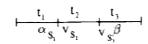 `V=0+alphat, t_1=v/alpha` `S_1=1/2alphat_1^2=v^2/(2ALPHA)` `O-V=betat_3 , t_3=v/beta` `O^2-V^2=-2betaS_3` `S_3=v_2/(2BETA)=1/2 betat_3^2` `t_2=S_2/V=(S-(S_1+S_3))/V=(S-v^2/2(1/alpha+1/beta))/V` `t=t_1+t_2+t_3` `=v/alpha+s/v-v/(2alpha)-v/(2beta)+v/beta` `t=s/v+v/2((alpha+beta)/(alphabeta))` `s_2=s-(s_1+s_2)=s-(v^2/(2alpha)+v^2/(2alpha))` `=s-v^2/alpha=s-(vt-s)` `s_2=2s-vt` [`S_2` = DISTANCE TRAVELLED with CONSTANT velocity] 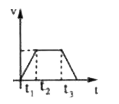
|
|
| 29. |
A radio can tune over the frequency range of a portion of MW broadcast band : (800 kHz to 1200 kHz). If its LC circuit has an effective inductance of 200 uH, what must be the range of its variable capacitor ? [Hint: For tuning, the natural frequency i.e., the frequency of free oscillations of the LC circuit should be equal to the frequency of the radiowave. |
|
Answer» Solution :We know that natural frequency `v_(0) =1/(2PI sqrt(LC))` `rArr C = 1/(4pi^(2) Lv_(0)^(2))` and here L = 200 `mu` H `=2 xx 10^(-4)` H (i) To tune radio station broadcasting at 1200 kHz (i.e. `v_(0) =1.2 xx 10^(6) Hz)`,. We have `C = 1/(4 xx (3.14)^(2) xx (2 xx 10^(-4)) xx (1.2 xx 10^(6))^(2)) = 8.79 xx 10^(-11)`F or 87.9 pF and (ii) to tune radio station broadcasting at 800 kHz (i.e. `v_(0) = 8 xx 10^(5)` Hz) `C = 1/(4 xx (3.14)^(2) xx (2 xx 10^(-4)) xx (8 xx 10^(5))^(2)) = 1.978 xx 10^(-10)` F or 197.8 pF. Thus, the variable capacitor should have a range of about 88 pF to 198 pF. |
|
| 30. |
A prism when placed in water instead of air, its ........ |
|
Answer» ANGLE of prism changes. |
|
| 31. |
A mixture of two diatomic gases exists in a closed cylinder. The volumes and velocities of sound in the two gases are V_1, V_2, c_1 and c_2respectively. Determine the velocity of sound in the gaseous mixture. (Pressure of gas remains constant), |
|
Answer» `c_1c_2 SQRT((V_1 + V_2)/(V_1c_2^2 + V_2c_1^2) )` |
|
| 32. |
A 4 cmobject is placed perpendicular to the principal axis of a convex mirror of focal length 7.5 cm.The distance of the image from the mirror if it is 0.6 cm in size is 51/x where x is |
|
Answer» |
|
| 33. |
The recoil energy of an electron of wavelength 0.1Å in eV will be : |
|
Answer» `1.506xx10^(4)` `E_(r)=(h^(2))/(1*6xx10^(-19)2 m lambda^(2)) eV` `=(6*62xx10^(-34))/(2xx9*1xx10^(-31)xx(0*1xx10^(-10))^(2)XX1*6xx10^(-19))` `E_(r)=1*506xx10^(4)eV` |
|
| 34. |
A hollow cylinder has a charge q coulomb within it. If phiis the electric flux in units of V-m associated with the curved surface B, thc flux linked within the plane surface A is unit of V-m will be q |
|
Answer» `Q/(2epsilon_0)` |
|
| 35. |
Two lighter nuclei are fused together to formanother nucleus an energy is released in theprocess because |
|
Answer» binding energy of lighter NUCLEUS is more |
|
| 36. |
Light of wavelength 589 nm is used to view an object under a microscope. The aperature of the objective has a diameter of 0.900 cm. Find The limiting angle of resolution. |
|
Answer» Solution :Here, `LAMBDA 589NM = 589xx 10^(-9)m` `a = 0.900cm = 0.900xx 10^(-2)m` (or) `triangle THETA = 1.22(lambda/a)= 1.22((589xx10^(-9)m)/(0.900xx10^(-2)m)) RAD` `= 7.89xx 10^(-5)rad` |
|
| 37. |
Light of wavelength 589 nm is used to view an object under a microscope. The aperature of the objective has a diameter of 0.900 cm. Find What effect would this have on the resolving power. If water (mu = 1.33) fills the space between the object and objective. |
|
Answer» Solution :Wavelength of light in water, `lambda_(w)=(lambda_a)/(mu)= (589nm)/(1.33)= 443nm` `triangle theta = 1.22((443xx10^(-9)m)/(0.900xx10^(-2)m)) RAD` `= 6.00xx 10^(-5)rad` SINCE `triangle theta` in this case is LESS than that in case (a), resolving power increases. |
|
| 38. |
The structure of crystal can be studied using |
|
Answer» DIFFRACTION of visible light |
|
| 39. |
Two cylinders A and B fitted with pistons contain equal amounts of an ideal diatomic gas at 300 K. The piston of A is free to move, while that of B is held fixed. The same amount of heat is given to the gas in each cylinder. If the rise in temperature of the gas in A is 30 K, then the rise in temperature of the gas in B is : |
|
Answer» 18 K `therefore Q =nC_(P)Delta T_(1)` and in SECOND case heat is supplied at volume `therefore Q=nC_(V)Delta T_(2)` `nC_(P)Delta T_(1)=nC_(v)Delta T_(2)` For `Delta T_(2)=(C_(rho))/(C_(v)) CDOT Delta T_(1)` `Delta T_(2)=(7)/(5) cdot 30= 42 K` `[because" For diatomic gas "(C_(P))/(C_(v))=gamma =(7)/(5)]` |
|
| 40. |
The maximum voltage that can be applied to 5 KOmegaand 8W resistor without exceeding its heat dissipating capacity is |
| Answer» Answer :D | |
| 41. |
A body X at an original temperature 100^(@)C and another body at an original temperature 0^(@)C and placed in an evacuated conclosure, the walls of which are maintained at 10^(@)C. Which one of the following statementis consistent with Prevost's theory ? |
|
Answer» X EMITS but does not ABSORB heat `P = "constant"` `V_(1) = V, V_(2) = 2V, T_(1) = T` `W = PDeltaV = P(2V - V) , T_(2) = 2T` `W = PV = nRT = RT` |
|
| 42. |
When a 'J' shaped conducting rod rotating in its own plane with constant angular velocity omega, avout one of its end P, in a uniform magnetic field vec(B) directed normally into the plane of paper) then magnetic of emf induced across it will be |
|
Answer» `Bomegasqrt(L^(2)+l^(2))` `e=1/2Bomega(l^(2)+L^(2))` 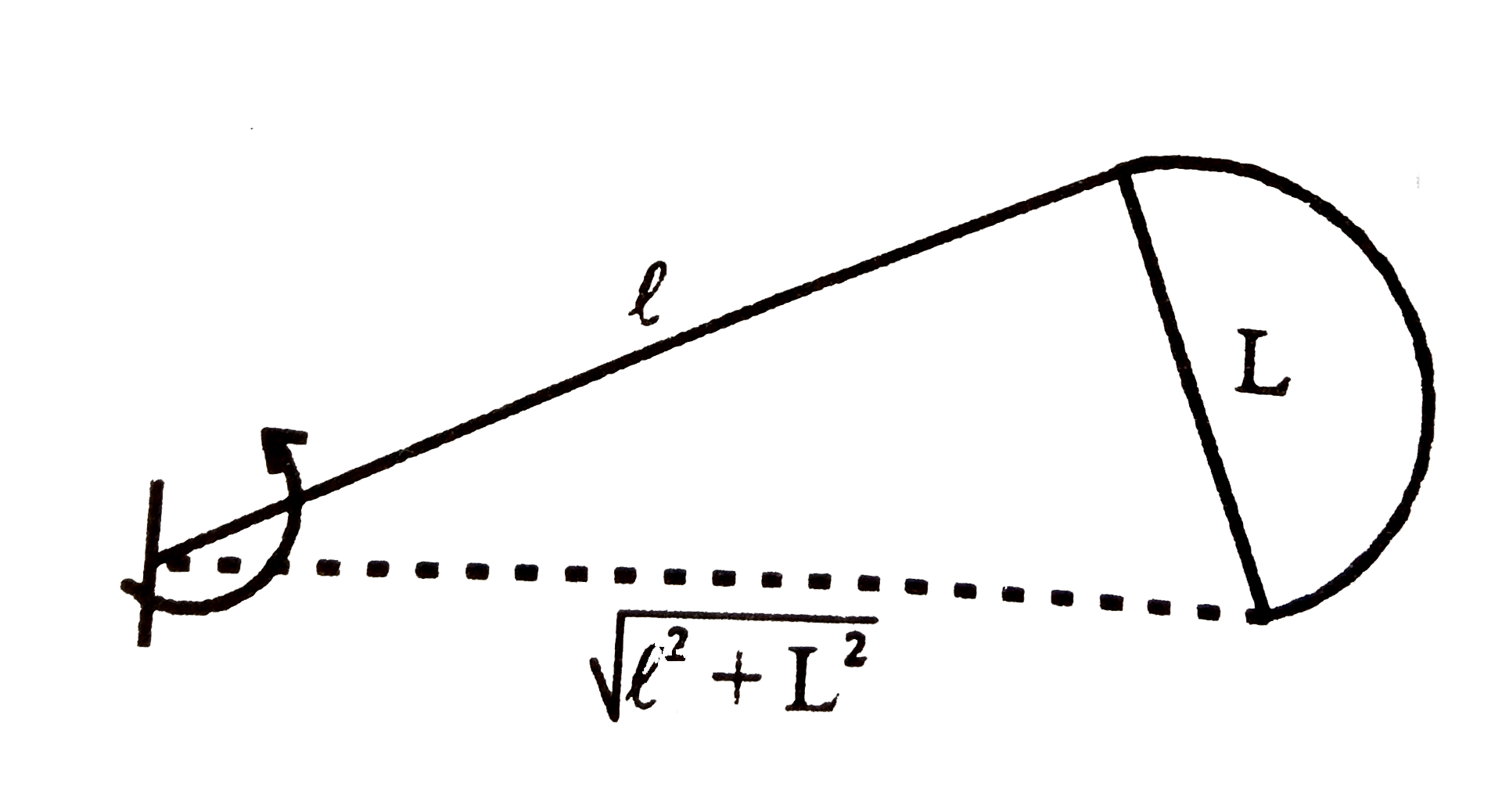
|
|
| 43. |
If the angular momentum of an electron is vecj then the magnitude of the magnetic moment will be |
|
Answer» eJ2m and its angular MOMENTUM, `J = I OMEGA = mr^(2) xx v/r = mvr` ….(ii) From (i) and (ii), we get, `therefore` M/J = 1/2 (evr)/(mvr)=1/2 e/m implies M = (eJ)/(2m)` |
|
| 44. |
Twopointchargesareplacedon they - axisaty=+aandy=- ainvacuum. Themagnitude of eachchargeisq.Determin theelectric fieldintensityatP( x ,0)on thex - axis. |
Answer» Solution :Supposeelectricfieldintensityatthe pointPdue tothe chargesatA andBare` E_ 1and E _ 2` , RESPECTIVELY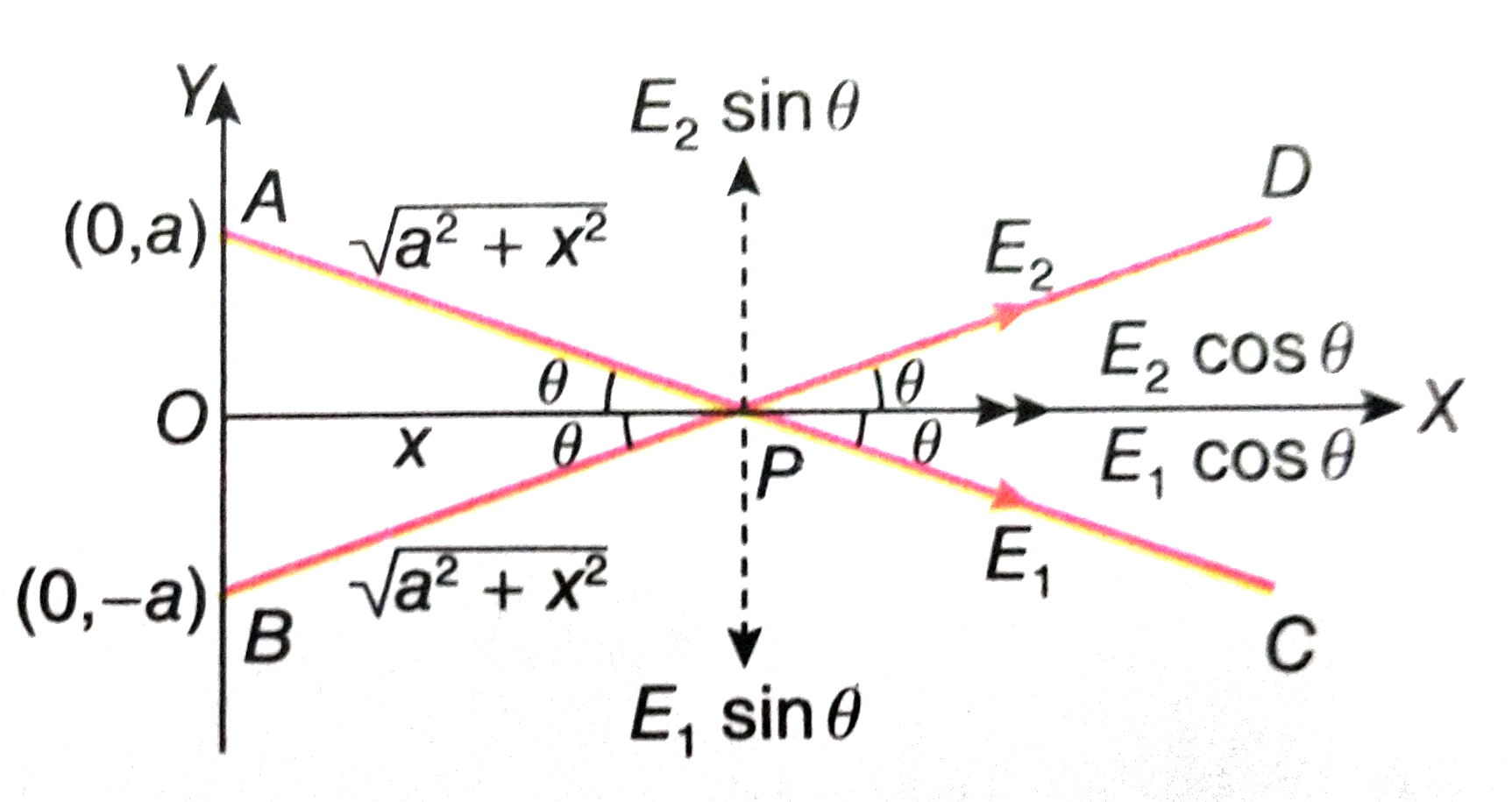 `thereforeE _ 1=( 1 ) /( 4 pi in_ 0)*( q ) /(AP ^ 2 ), ` along` vec( P C ) ` `=(1 ) /(4piin _0 )*( q ) /( a ^ 2+x ^2 ),`along`vec( PC ) ` `E _ 2=( 1 ) /(4piin _0)* ( q ) /( BP^ 2 )`, along`vec( PD ) ` `=( 1 ) /( 4piin_0 )*( q ) /( a^ 2+x ^ 2) `,along`vec( PD)` `therefore E _ 1=E_ 2`(INMAGNITUDE)= E( say) Both`E _ 1and E _ 2 `areresolvedinto twoperpendicular components. It isseen that the sinecomponentsareaddedup as theyactin thesamedirection. `therefore`Field strengtatP `= 2E COSTHETA = 2xx( 1 ) /( 4piin _0 )*(q )/(( a ^ 2+ x ^ 2 )) *( x ) /( sqrt ( a ^ 2+x ^ 2 )) ` `= ( 1 ) /(4piin _0 )*( 2q x ) /(( a ^ 2 + x ^ 2)^ ( 3//2 ) ) ` |
|
| 45. |
Magnetic field in space between the plates is |
|
Answer» `(1)/(2)mu_(0)J^(2)` |
|
| 46. |
A wave is represented by the equation: y=Asin(0.4pix+7pit+pi/3), where x in meter and t in second. The expression represents |
|
Answer» A wave travelling in the NEGATIVE x- DIRECTION with a VELOCITY 0.15 m/s |
|
| 47. |
For a certain gas the ratio of specific heats is given to be gamma = 15, for this gas |
|
Answer» <P>`C_(v) = (3R)/(J)` |
|
| 48. |
Can a current carrying circular loop act as a magnetic dipole? Give the expression for the magnetic field at a point, due to a current carrying circular loop. |
|
Answer» Solution :Yes. `""B=(mu_(@)/(4pi))(2M)/x^(3)` where, m = magnetic moment of the current loop `""m=IA` `""I=` current, `""A=` area of CIRCULAR loop, `""x=` distance of the point on the axis of the coil. |
|
| 49. |
The electrostatic potential is given as a function of x in figure ( a) and (b) . Calculate the corresponding electric fields in regions A, B, C and D . Plot the electric field as a function of x for the figure (b). |
|
Answer» Solution :The relation between electric field and potential `E= -(dv)/(DX)` (a) REGION A: dv = - 3V , dx = 0.2 m Electric field `E_(A)= -((-3))/(0.2) = 15 Vm^(-1)` Region B: dv= 0V , dx = 0.2 m Electric field `E_(B) = -(0)/(0.2) =0` Region C: dv = 2V, dx =0.2 m Electric field `E_(C)= (-2)/(0.2) = 10 Vm^(-1)` Region D: dv= -6 V, dx =0.2 m Electric field `E_(D)= -((-6)/(0.2))= 30 Vm^(-1)` `E_(A)= 15 Vm^(-1)"" E_(B)=0 "" E_(c)=10Vm^(-1) "" E_(D)= 30 Vm^(-1)` (b) 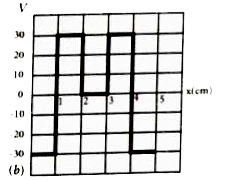
|
|
| 50. |
A cavity of volume V = 1.01 is filled with thernal radiation at a temperature T = 1000K. Find: (a) the heat capacity C_(v), (b) the entropy S of that radiation. |
|
Answer» SOLUTION :(a) The total INTERNAL energy of the cavity is `U = (4 sigma)/(c )T^(4)V` Hence `C_(v) = ((delU)/(delT))_(v) = (16 sigma)/(C )T^(3)V` `= (16xx5.67xx 10^(8))/(3 xx 10^(8)) xx 10^(9) xx 10^(-3)"Joule"//^(@)K` `= (1.6 xx 5.67)/(3)nJ//K = 3.024nJ//K` (B) From first law `TdS = DU + pdV` `= VdU + UdV + (u)/(3)dV (p = (U)/(3))` `= VdU+(4U)/(3)dV` `= (16sigma)/(C)VT^(3)dT +(16sigma)/(3C)T^(4)dV` or `dS = (16sigma)/(C)VT^(2)dT +(16sigma)/(3C)T^(3)dV` `= ((16sigma)/(3C)VT^(3))` Hence `S = (16sigma)/(3C)VT^(3) = (1)/(3)C_(v) = 1.008nJ//K`. |
|