

Saved Bookmarks
This section includes 7 InterviewSolutions, each offering curated multiple-choice questions to sharpen your Current Affairs knowledge and support exam preparation. Choose a topic below to get started.
| 1. |
The electric field of a plane electromagnetic wave is given by vecE(t)=E_(0)(hati+hatj)/sqrt2cos(omegat+kz). At t = 0, a positively charged particle is at the point (x,y,z)=(0,0,pi/k). If its instantaneous velocity at t = 0 is v_(0)hatk, the force acting on it due to the wave is |
|
Answer» zero Because, at t = 0, `VECE=(-(hati+hatj))/sqrt2E_(0)` `rArr` Direction of force `Q(vecvxxvecB)` due to magnetic field is parallel to `vecE" as "vecv||hatk` `therefore` Resultant force is anti-parallel to `((hati+hatj))/sqrt2`. |
|
| 2. |
The velocity-displacement graphof a particle moving along a straight line is shown. The most suitable acceleration-displacement graph will be |
|
Answer»
From v-X graph, the corresponding equation is `v=(-v_0/x_0)x+v_0` (Pattern , y=mx+c) `THEREFORE (dv)/(dt)=(-v_0/x_0) (dx)/(dt)` or `a=(-v_0/x_0)v` `a=(-v_0/x_0)xx[(-v_0/x_0)x+v_0]` `a=(v_0/x_0)^2 x- v_0^2/x_0` (Pattern , y=mx+c) Slope of the line = `(v_0/x_0)^2` Slope is positive . Therefore `theta` is acute . INTERCEPT `=(-v_0^2)/x_0` . It is negative The slope and intercept reveal that the graph (a) is the most suitable representation. |
|
| 3. |
In microwave oven, if frequency of rotation of water molecules is v_(1) and frequency of microwave is v_(2) then …. |
|
Answer» `v_(1)LT v_(2)` |
|
| 4. |
Describe an experiment to studythe effect of frequency of incident radiationon 'stopping potential '. |
|
Answer» SOLUTION :Experimental study of the effect frequencyof incident radiation on stopping potential : (1 ) The experimental set up is shown in fig (2) Monochromatic LIGHT of sufficient light of sufficientenergy (E-hv) from source 's' is incident on photosensitiveplate ' C ' ( emitter ) , electrons are emitted by it (3 ) The electrons are collected by the plate A ( collector ) by the electricfield createdby the battery . (4) The polarity of the plates C andA can reversed by a commutator . ( 5 ) For a particularfrequency of incident radiation , the minimum negative( retarding ) potential `V_(0)`givento the plate A for which the photocurrent stops or becomes zero is called stoppingpotential (6) The experiment is repeated with DIFFERENT frequencies , and their differentstopping potential are measured withvoltmeter. (7) From graph , we note that (i) The values of stopping potentials are different for different frequencies . (ii) The value of stopping potential is more negative for radiationof higherincident FREQUENCY . (iii)The value of saturation current dependson the intensity of incidentradiation but it is independent of the frequency of the incident radiation . 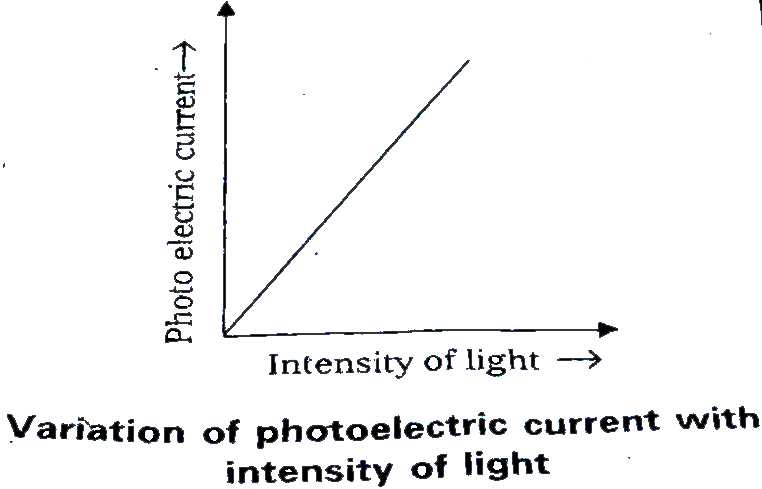 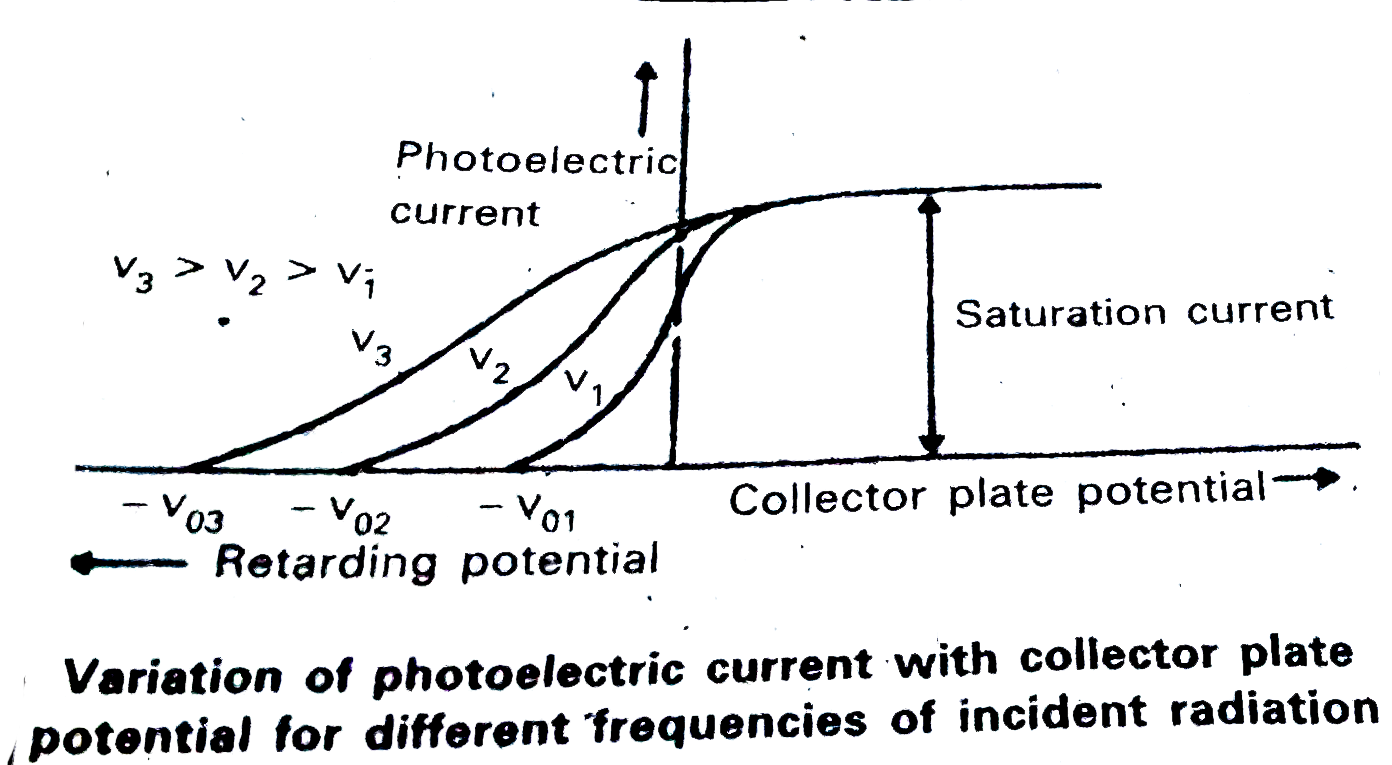
|
|
| 5. |
A uniform electric field E_0 exists in a region at angle 45^(@) with the x - axis. There are twom point A(a, 0) and B(0,b) having potential V_A and V_B, respectively, then . |
|
Answer» `a lt b` |
|
| 6. |
A conductor A with a cavity as shown in Figure is given a charge Q. Show that the entire charge must appear on the outer surface of the conductor. |
| Answer» SOLUTION :The CHARGE will reside on the outer surface of the CONDUCTOR. | |
| 8. |
The half lifeof a radioactivesample._38Sr^90is 28 years. Calculatethe rate ofdisintegrationof 15 mg of this isotope.Given Avogadro number= 6.023xx10^23 |
|
Answer» Solution :Given : T=28 yrs w.k.t : `I=lambda = 0.693/T` i.e., `lambda=0.693/28=0.02475 yr^(-1)` but activityof the SAMPLE `A=(dN)/(dt)=lambdaN` 90 g of `Sr^90` has `6.023xx10^(23)` atoms Hence , `15xx10^(-3)g` of `Sr^90`HR .N. atoms. `therefore N=(15xx10^(-3) xx6.023xx10^23)/90` i.e.,`N=1.00xx10^20` Hence , `A=(dN)/(dt)=IN` may be obtained i.e. , `A=0.02475xx1xx10^20` `=2.475xx18` dis. `yr^(-1)` but 1 yr = 365 x 86400 =`3.15xx10^7` s Hence, `A=(2.475xx10^18)/(3.15xx10^7)` `=7.86xx10^10` dis `s^(-1)` but 1 curie = `3.7xx10^10` dis `s^(-1)` So `A=(7.86xx10^10)/(3.7xx10^10)`=2.12 CI Activityof the sample = 2.12 CU. |
|
| 9. |
Statement-I : Resonance is a special case of forced vibrations in which frequency and nature of vibration of the body is same as the impressed frequency and amplitude of forced vibration is maximum. Statement-II : The amplitude of forced vibration of a body increases with an increase in the frequency of the externally applied periodic force. |
|
Answer» STATEMENT-I is true, Statement-II is true and |
|
| 10. |
A convex lens of focal length 15 cm is split into two halves and the two halves are placed at a separation of 120 cm. Between the two halves of convex lens a plane mirror is placed horizontally and at a distance of 4 mm below the principal axis of the lens halves. An object AB of length 2 mm is placed at a distance of 20 cm from one half lens as shown in.figure. The final image of the point A is formed at a distance ofn/3mm from the principle axis. Determine the value of n |
|
Answer» |
|
| 11. |
What is the meaning of Shaheed-e-Azam? |
|
Answer» The GREAT Eater |
|
| 12. |
The Rydberg constant for hydrogen is 1.097 X 10^(7) ms^(-1). Calculate the short and long wavelength limits of Lyman series. Data: R=1.097xx10^(7)ms^(-1) For short wavelength limit of Lyman Series, n_(f)=1,n_(i)=oo, lambda_(s)=? For long wavelength limit of Lyman series, n_(f)=1, n_(i)=2, lambda_(i)=? |
|
Answer» 602 Å, 906 Å |
|
| 13. |
A converging lens of focal length 15 cm and a converging mirror of focal length 10 cm are placed 50 cm apart with common principal axis. A point source is placed in between the lens and the mirror at a distance of 40 cm from the lens. Find the locations of the two images formed. |
| Answer» Solution :ONE at 15 CM and other at 24 cm from the lens away from the MIRROR | |
| 14. |
According to the classical electromagnetic theory, calculate the initial frequency of the light emitted by the electron revolving around a proton in hydrogen atom. |
|
Answer» Solution :We know that VELOCITY of electron moving around a proton in hydrogen ATOM in an ORBIT of radius `5.3 xx 10^(-11) m` is `2.2 xx 10^(-6) m//s`. Thus, the frequency of the electron moving around the proton is `v = (upsilon)/(2 pi r) = (2.2 xx 10^6 ms^(-1))/(2 pi (5.3 xx 10^(-11) m))` `~~ 6.6 xx 10^(15) Hz`. According to the classical electromagnetic theory we know that the frequency of the electromagnetic waves emitted by the revolving ELECTRONS is equal to the frequency of its revolution around the nucleus. Thus the initial frequency of the light emitted is `6.6 xx 10^(15)` Hz. |
|
| 15. |
A ray of light is incident on a glass slab at grazing incidence. The refractive indexof the material of the slab is given by mu=sqrt((1+y) . If the thickness of the slab is d=2m, determing the equation of the trajectory of the ray inside the slab and the coordinates of the point where the ray exits from theslab. Take the origin to be at the point of entry of the ray. |
|
Answer» Solution :We have `(dy)/(dx)=cot(theta_(y))=sqrt(mu_(y)^(2)-sin^(2)theta)/(SINTHETA)` Here, `mu=sqrt((1+y))` and `theta=90^(@)` Therefore, `(dy)/(dt)=y^(1//2)` Integratin with the boundary condition that `y=0` at `zx=0`, we GET `y=x^(2)//4`to be the equation of the PATH of the ray through the SLAB, the ray will obviously EXIT at thepoint `(2sqrt2m,2m)`. |
|
| 16. |
An electron in a H_2 atom makes a transition from n_(1) to n_(2). The time period of electron in the initial state is eight times that in the final state. Then ratio of n_(1)" to "n_(2): |
|
Answer» `1:2` Now `r alpha N^(2)` `r_(1)/r_(2)=(n_(1))/(n_(2))^(2)` `n_(1)/n_(2)=SQRT((r_(1))/r_(2))=sqrt(4/1)=2/1` |
|
| 17. |
A positively charged glass rod repels a suspended object. Can we conclude that the object is positively charged ? |
| Answer» Solution :Yes. Repulsion TAKES PLACE only between the similarly charged BODIES. Hence it is the surest TEST. | |
| 18. |
The speed of sound in oxygen (O_(2)) at a certain temperature 66" ms"^(-1), The speed of sound in helium (He) at the same temperature will be assume both gases to be ideal) |
|
Answer» `421 MS^(-1)` `V_(He) =460xx(sqrt(1.67))/(1.4)xx8=1420` m/s. So, correct CHOICE is (a). |
|
| 19. |
A cell of emf R is connected with an external resistance R and P.D. across the cell is V . The internal resistance of the cell will be : |
|
Answer» `((E-V)/E) R` |
|
| 20. |
Calculate the resolving power of a microscope, whose limit of resolution is 2.4xx10^(-4) m . |
|
Answer» SOLUTION :R.P. `= 1 // `LIMIT of resolutionor R.P. `= 1 //` dx ` = 4.166 XX 10^(3) m^(-1)` |
|
| 21. |
A boy is standinginsidea train movingwitha constant velcoity of magnitude 10m/s. He throws a ball vetically up with in speed of 5m/s relative to the train . Findthe radiusof curvature of the pathof the ball justat thetimeof projection . |
|
Answer» Solution :The ball CONTINUES to movehorizontally with `(v_(x))_(0) = 10m//sec`.It begins to MOVE up with `(v_(y))= 5m//sec ` Therefore `theta_(0)` is GIVENAS `theta_(0) tan^(-1)((v_(y))/(v_(x)))` or `therefore_(0) tan^(-1) (5//10) = tan^(-1)(1//2)` Now , the required radiusofcurvature of is given as `r = (V^(2))/(g cos theta)` Putting `v = v_(0) = sqrt((v_(x))_(0)^(2) + (v_(y))_(0)^(2)),sqrt(10^(2) + 5^(2)) = 5sqrt(5)m//s` `g = 10 m//s^(2) ` and `theta = tan^(-1)(1//2)` we obtain `r~= 14 m` 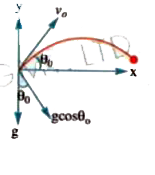
|
|
| 22. |
Two mercury drops (each of radius 'r') merge to form bigger drop. The surface energy of the bigger drop, if T is the surface tension is : |
|
Answer» `4pir^(2)T` `R=2^(1//3)r` `S.E.=T4piR^(2)` `=T4pi2^(2//3)r^(2)=T2^(5//3)pir^(2)` CORRECT choice : (d). |
|
| 23. |
A straight copper-wire of length 1 = 1000 m and corss-sectional area A = 1.0 m m^(2) carries a current i=4.5A. The sum of electric forces acting on all free electrons in the given wire is M xx 10^(6)N. Find M. Free electron density and resistivity of copper are 8.5xx10^(28)//m^(3) and 1.7xx10^(-8)Omega.m respectively. |
|
Answer» |
|
| 24. |
State the law which governs the working of a generator |
| Answer» SOLUTION :Faraday.s LAW of induction, The magnitude of the INDUCED emf in a circuit is equal to the time RATE of CHANGE of magnetic flux through the circuit. | |
| 25. |
A galvanometer has a resistance of 100Omega. A current of 10^(-3)A pass through the galvanometer. How can it be converted into (a) ammeter of range 10 A and (b) voltmeter of range 10v. |
|
Answer» Solution :`G=100Omega,i_(g)=10^(-3)A` a) `i=10A,n=i/(i_(g))=10^(4)` `S=G/((n-1))=100/((10^(4)-1))=100/999Omega` b) `V_(g)=i_(g)G=10^(-3)xx100=10^(-1)V` `V=10VrArrn=V/(V_(g))=10/(10^(-1))=100` `thereforeR=G(n-1)=100(100-1)=9900Omega` |
|
| 26. |
State radioactive decay law. |
| Answer» SOLUTION :The NUMBER of nuclei UNDERGOING decay PER unit time is proportional to number of nuclei in the sample at that time. | |
| 27. |
An object is approaching a fixed plane mirror with velocity 3 ms/s at an angle of 45^(@) with normal, in a medium of refractive index 4/3. The speed of the image with respect tothe mirror is __________m/s. |
|
Answer» |
|
| 28. |
Why a.d.c. voltmeter and d.c. ammeter cannot read a.c. ? |
| Answer» Solution :The average balue of E over a CYCLE is zero . So, a d.c. voltmeter/ammeter will show zero READING with alternatin G voltage/curtrent . | |
| 29. |
Antimony in silicon matrix provides a free : |
|
Answer» HOLE |
|
| 30. |
A magnetic needle is hung by an untwisted wire, so that it can rotate freely in the magnetic meridian. In order to keep it in the horizontal position, a weight of 0.1 g is kept or one end of the needle. If the magnetic pole strength of this needle is 10 Am, find the value of the vertical component of the earth's magnetic field. (g= 9.8 ms^(-2) ) |
|
Answer» Solution :Figure (a) shows the position of magnetic NEEDLE in the magnetic meridian without any weight. In figure (b), a mass mis KEPT on the S-pole on the needle.  The vector sum of torques DUE to all forces must be zero for the equilibrium of the needle in horizontal DIRECTION. `therefore -pB_(v) (l) + m.g(l) =0` [ The torque producing rotations in clockwise direction is taken as negative ] `m = 0.1 g = 10^(-4) kg, p=10 "Am"` `therefore 2pB_(v) = mg` `therefore B_(v) = (mg)/( 2p)` `= (10^(-4)xx 9.8) /( 2 xx 10)` `therefore B_(v) = 4.9 xx 10^(-5)` T |
|
| 31. |
A particle of mass m in suspended at the lower end of a thin negligible mass. The upper end of the rod is free to rotate in the plane of the page about a horizontal axis passing through the point O. The spring is underformed when the rod is vertical as shown in fig. If the period of oscillation of the system is pisqrt((L)/(n)), when it is slightly displaced from its mean position then find n. Take k = (9mgKL)/(l^(2)) and g = 10m//s^(2). |
|
Answer» For small displacement `X = l sin THETA` `kx = kl sin theta` Torque about point `O = I_(o)ALPHA` `(kx)l + mg sin theta l = mL^(2)alpha` ltbr. `alpha = ((kl^(2) + mgL)sintheta)/(mL^(2))` For small `theta` `alpha = -[(kl^(2) + mgL)/(mL^(2))]theta` Time period `T = 2pisqrt((mL^(2))/(kl^(2) + mgL)) = pisqrt((L)/(25))` 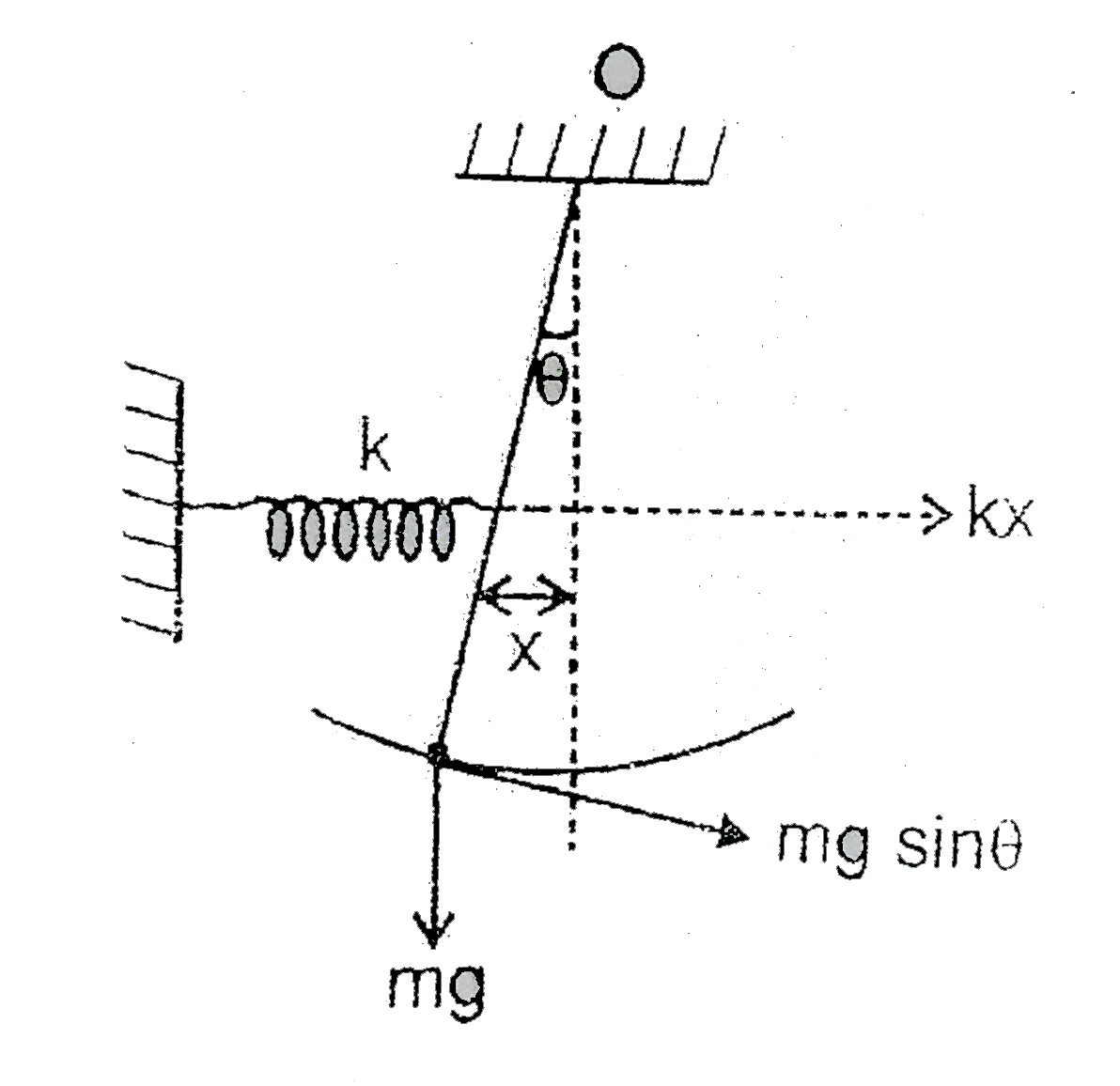
|
|
| 32. |
Alternating current can be measured by |
|
Answer» MOVING COIL galvanometer |
|
| 33. |
A stone is thrown vertically at a speed of 30 ms^(-1) taking an angle of 45^(@) with the horizontal. What is the maximum height reached by the stone ? Take g = 10 ms^(-2). |
|
Answer» 30 m `H_("max") = (30^(2) sin^(2)(45))/(2 xx 10)` `H_("max") = 22.5 m` |
|
| 34. |
Maxwell’s equation intvecB.vecds=0is a statementof |
|
Answer» FARADAY’s LAW of induction |
|
| 35. |
A conducting spherical shell of outer radius R and inner radius r = 3R/4 has no net charge on it. At its center there is a point charge q, and at a distance 2R from its center there is a point charge Q (Fig.) . (a) What is the magnitude of the electrostatic force on the charge q at the center due to the shell ? (b) What is the magnitude of net force on it? |
| Answer» Solution :(a) `(kqq)/(4R^(2))` towards RIGHT , (B) 0 | |
| 36. |
Rain is falling vertically with a speed of 35ms^(-1) Winds starts blowing after sometime with a speed of 12ms^(-1) in east to west direction. In which direction should a boy waiting at a bus stop hold his umbrella? |
Answer» Solution :The velocity of the rain and the wind are represented by the vectors `v_(r) and v_(W)` in the FIGURE and are in the direction specified by the problem. Using the rule of vector addition. We see that the resultant of `v_(r) and v_(w)` is R as SHOWN in the figure. The magnitude of R is. 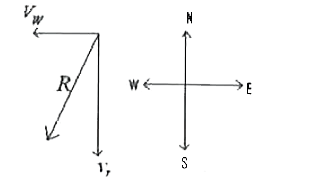 `R= sqrt(v_(r)^(2)+v_(w)^(2))= sqrt(35^(2)+12^(2)) ms^(-1)=37 ms^(-1)` The direction that R makes with the vertical is given by `"tan" theta=(v_(w))/(v_(r))=(12)/(35)=0.343 or, theta= tan^(-1)(0.343)=19^(@)` Therefore, the boy should hold his umbrella in the vertical plane at an angle of about `19^(@)` with the vertical towards the east. |
|
| 37. |
Three metallic plates out of which the middle is given charge Q as shown in the figure. The outer plates can be earthed with the help of switches S_1 and S_2 . The area of each plates is the same. Answer the following question based on the given passage. ,brgt The charge appearing on the outer surface of extreme left plate is |
|
Answer» `-Q//2`  FIELD inside the CONDUCTOR is zero. Charge distribution is shown in fig. |
|
| 38. |
A charge q_(1) exerts some force on a second charge q_(2). If third charge q_(3) is brough near, the force of q_(1) exerted on q_(2) |
|
Answer» DECREASES |
|
| 39. |
A ray of light strikes a plane mirror at an angle of incidence 45^@ as shown in the figure. After reflection, the ray passes through a prism of refractive index 1.50, whose apex angle is 4^@. The angle through which the mirror should be rotated if the total deviation of the ray is to be 90^@ is : |
|
Answer» `1^@` CLOCKWISE |
|
| 40. |
A particle is in its ground state in a unidimensional potential well with infinitely high walls. Find the force with which the particle acts on the walls. Do the calculations for an electron in a well 10^(-10) m wide. |
|
Answer» `F_(av)=Deltap*z=2p(V)/(2L)=p^(2)/(mL)=(h^(2))/(4mL^(3))` |
|
| 41. |
"We know very little and yet it is astonishing that we know so much, and still more astonishing that so little knowledge (or science) pan give us so much ppwer .. " Who made these remarks? |
|
Answer» Newton |
|
| 42. |
Classify a solid substance based on electrical conductivity and resistivity. |
|
Answer» Solution :On the basis of the relative values of electrical conductivity `(sigma)` or resistivity `(rho=(1)/(sigma))`, the solids are CLASSIFIED by three ways. (1) Metals : They posses very low resistivity or HIGH conductivity. `rho~10^(-2) Omega m " to " 10^(-8)Omega m` `sigma ~ 10^(2)Sm^(-1)" to " 10^(8)Sm^(-1)` (2) Semiconductors : They have resistivity or conductivity intermediate of metals and insulators. `rho~10^(-5) Omega m " to " 10^(6)Omega m` `sigma ~ 10^(5)Sm^(-1)" to " 10^(-6)Sm^(-1)` (3) Insulators : They have high resistivity or low conductivity. `rho~10^(11) Omega m " to " 10^(19)Omega m` `sigma ~ 10^(-11)Sm^(-1)" to " 10^(-19)Sm^(-1)` The values of `rho` and `sigma` given above are indicative of magnitudeand could well GO outside the range as well. Relative values of the resistivity are not the only CRITERIA for distinguishing metals, insulators and semiconductors from each other. |
|
| 43. |
A Ge specimen is doped with Al. The concentration of acceptor atoms is ~ 10^(21) m^(-3). Given that the intrinsic concentration of electron-hole pairs is ~ 10^(19) m^(-3) . The concentration of electrons in the specimen is |
|
Answer» `10^(17) m^(-3)` |
|
| 44. |
What is optics ? |
| Answer» SOLUTION :The STUDY of NATURE and PROPERTIES of LIGHT. | |
| 45. |
A point objects O is nat angle of 30^(@)from the plane mirror M, as shown In the figure. If OO'=2m, then find the location of the image |
Answer» Solution :To find the location of IMAGE, we have to draw a perpendicular on the mirror M from the point O as shown in the FIGURE.  Now from the triangle O' AO, we have `sin30^(@)=(OA)/(2)rArrOA=2xxsin30^(@)=1M` `therefore`Distance of the image from the mirror is AI=OA=1m |
|
| 46. |
Matching block type LIST - I(a) Two rotating discs are brought in contact coaxially(b) Contact force on a body placed in on rough surface(c ) To continue a motion is easier than to initiate the motion(d) For a Static friction less than limiting frictionLIST - II(e ) Generated friction is equal to appliedexternal force in magnitude(f)Loss of Rotational KE is transformed partly to heat(g) The resultant of normal reaction and friction(h) Kinetic friction is less than static friction |
|
Answer» a-f, b-g, c-h, d-e |
|
| 47. |
In modulation process, radio frequency wave is termed as : |
|
Answer» MODULATING wave |
|
| 48. |
A current I flows through a long straight conductor which is bent into a circular loop of radius R in the middle as shown in the figure . The magnitude of the net magnetic field at point O will be |
|
Answer» Zero |
|
| 49. |
A change of 0.5 mA in the emitter current of a transistor produces a change of 0.49 mA in collector current Calculate (1) Common base short circuit current gaina alpha. (ii) common emitter short circuit current gain beta. |
| Answer» SOLUTION :(i)0.98 ,(II)49 | |


