

Saved Bookmarks
This section includes 7 InterviewSolutions, each offering curated multiple-choice questions to sharpen your Current Affairs knowledge and support exam preparation. Choose a topic below to get started.
| 1. |
A laser beam has a power of 100 mW. It has an aperture of 5xx10^(-3)m and emits a wavelength 6943 Å. The beam is focused with a lens of focal length 0.1 m. Calculate the areal spread and intensity of the image. |
|
Answer» |
|
| 2. |
Which one of the following phenomena is not explained by Huygen's construction of wavefront? |
|
Answer» refraction |
|
| 3. |
Several identical capacitors were connected in parallel and charged to a voltage φ_(0). Subsequently they were reconnected in series with the aid of a switch. What will be the voltage across the terminals? Will the energy of the system change? |
|
Answer» Solution :The solution is obvious from Figs. 24.11a and 24.11b, which give the diagrams of the parallel and SERIES connections of four identical capacitors. The energy in the case of parallel CONNECTION is `W_("PAR")=(C_("par")Psi_("par")^(2))/(2)=(nC_(N)varphi_(0)^(2))/(2)` and of series connections `W_("ser")=(C_(ser) varphi_("ser")^(2))/(2)=((C_(0)//n)n^(2) varphi_(0)^(2))/(2)=W_("par")` 
|
|
| 4. |
State Lenz's law. |
| Answer» SOLUTION :Lenz.s law STATES that the direction of the INDUCED current is such that it always OPPOSES the cause responsible for its production. | |
| 5. |
Given the frequency of microwave used by microwave oven to cook food. |
|
Answer» 0.951 GHz |
|
| 6. |
Given below are some examples of wave motion. Statein each case if the wave motion is transverse, longitudinal or a combinatin of both. (a) Motion of kink in a longitudinal spring producedby displacing one end of the spring sideways. (b) Waves produced in a cylinder containing a liquid by moving its piston back and forth. (c ) Waves produced by a motorboat sailing in water. (d) Ultrasonic waves in air produced by a vibrating quartz crystal. |
|
Answer» SOLUTION :(a) TRANSVERSE and longitudinal (B) Longitudinal (c) TRANS verse and longitudinal (d) Longitudina |
|
| 7. |
A solid metall sphere of radius R has a charge + 2Q. A hollow spherical shell of radius 3R placed concentric with the spherehas charge - Q. Calculate the potential difference between the spheres. |
|
Answer» `(Q)/(piepsilon_(0)R)` |
|
| 8. |
The Bohr model of atom ...... |
|
Answer» predicts the same emission spectra for all types of atoms |
|
| 9. |
ABCD is a square loop made of a uniform conducting wire. A current enters the loop at A and leaves at D . The magnetic field is : |
|
Answer» ZERO only at the centre of the LOOP |
|
| 10. |
Give the equation which represents law of gauss for magnetism. |
|
Answer» `oint VEC(E ).d vec(a)=(Q)/(epsilon_(0))` |
|
| 11. |
Three particles are projected vertically upwards from a point from the surface of earth with velocities v_(1)=sqrt((2)/(3)gR,)v_(2)sqrt(gR)" and "v_(3)sqrt((4)/(3)gR.) If h_(1)h_(2)h_(3) are the respective maximum heights reached then h_(1):h_(2):h_(3) is given by : |
|
Answer» ``1:2:3` |
|
| 12. |
What should be the size of the antenna or aerial ? How the power radiated is related to length of the antenna and wavelength ? |
|
Answer» Solution :Size of antenna (or) aerial : For TRANSMITTING a signal , we need an antenna . The size of the antenna comparable to the wavelength of the signal (at least `lambda//4`) . So that the antenna properly senses the time VARIATION of the signal . For an e.m waves of FREQUENCY 20 kHz, the wavelength `lambda` is 15 km . Obviously such a long antenna is not possible to construct and operate . There is a need of translating the information contained in our original low frequency base band signal into high frequencies before transmission . Effective POWER RADIATED by an antenna : A linear (length l) show that the power radiated is proportional to `(l)/(lambda^(2))` . For the same antenna length , the power radiated increases with decreasing `lambda` i.e, increasing frequency .Hence the effective power radiated by a long wavelength base band signal would be small . |
|
| 13. |
Three long concentric conducting cylindrical shells have radii R, 2R and 2sqrt2 RInner and outer shells are connected to each other. The capacitance across middle and inner shells per unit length is: |
|
Answer» `(1/3in_0)/(LN2)` |
|
| 14. |
When electron with mass m is accelerated with volt V associated de-Broglie wavelength is lambda .When proton with mass M is accelerated with same voltage associated de-Broglie wavelength will be……… |
|
Answer» <P>`LAMBDA((m)/(M))` `therefore lambda prop (1)/(sqrt(M))`[`because` Remaining TERMS are same] `therefore (lambda_(p))/(lambda_(e))=sqrt((m_(e))/(m_(p)))=sqrt((m)/(M))` `therefore lambda_(p)=lambda sqrt((m)/(M)) [because lambda_(e)=lambda]` |
|
| 15. |
The wavelength involved in the spectrum of deuterium ""_(1)^(2)D are slightly different from that of hydrogen spectrum because ……… |
|
Answer» the size of the TWO nuclei are different m=mass of electron changing `m_("atom")` changes `R_("atom")` Hence the FORMULA for the wavelength of lines of the spectrum `(1)/(lamda)=R_("atom")((1)/(m^(2))-(1)/(n^(2)))` varies SLIGHTLY according to this formula. |
|
| 16. |
A prism is made of glass of unknown refractive index. A parallel beam of light is incident on a face of the prism. The angle of minimum deviation is measured to be 40^(@). What is the refractive index of the material of the prism? The refracting angle of the prism is 60^(@). If the prism is placed in water (refractive index 1.33), predict the new angle of minimum deviation of a parallel beam of light |
| Answer» SOLUTION :`n~=1.53 and D_(m)` for PRISM in WATER `~=10^(@)` | |
| 17. |
A motor cyclist moving with 30 km/ h blows a whistle of 476 Hz towards a cliff. If velocity of sound is 1220 Km/h, the apparent frequency of the echo heard by him is : |
|
Answer» 250 Hz `v. = ((1220)/(1220 - 30)) 476 = 488 Hz.` ` therefore` FREQUENCY of reflected wave i.e., ECHO is 488 Hz and observer is moving towards it. `therefore v.. = ((1220 + 30)/(1220)) 488`= 500 Hz. hence the correct choice is (b) . |
|
| 19. |
In an A.C. circuit of frequency 400/pi Hz is of capacitance CmuF and reactance of capacitance is 25Omega then the value of C = ..... |
|
Answer» `25muF` `omega=2pif =2pixx400/pi`=800 rad/s `X_C=1/(omegaC)` `THEREFORE C=1/(omegaX_C)=1/(800xx25)` `therefore C=1/20000=50xx10^(-6) F = 50 muF` |
|
| 20. |
A domain in ferromagnetic iron in the form of a cube of side length 1mum. Estimate the number of iron atoms in the domain and the maximum possible dipole moment and magnetisation of the domain. The atomic mass of iron 55g/mole and its density is 7.9 g/cm^(3). Assume that each iron has a dipole moment of 9.27 xx 10^(-24) A m^(2). |
|
Answer» SOLUTION :The volume of the cubic domain is `V=(10^(-6) m)^(3)=10^(-18) m^(3)=10^(-12) cm^(3)` Its mass is volume `xx " density "=7.9 g cm^(-3) xx 10^(-12) cm^(3)=7.9 xx 10^(-12)g` It is given that Avagadro number `(6.023 xx 10^(23))` of iron atoms have a mass of 55g. Hence the number of atoms in hte domain is `N=(7.9 xx 10^(-12) xx 6.023 xx 10^(23))/(55)` `=8.65 xx 10^(10)` atoms The maximum possible dipole moment `m_("max")` is achieved for the (UNREALISTIC) case when all the atomic moments are PERFECTLY ALIGNED. Thus, `m_("max")=(8.65 xx 10^(10)) xx (9.27 xx 10^(-24))` `=8.0 xx 10^(-13)Am^(2)` The CONSEQUENT magnetisation is `M_("max")=m_("maxx")//"Domain volume"` `=8.0 xx 10^(-13) Am^(2)//10^(-18) m^(3)` `=8.0 xx 10^(5) Am^(-1)` |
|
| 21. |
Monochromatic radiation of wavelength 640.2 nm (1nm=10^(-9)m) fro a neon lamp irradiates photosensitive material made of caesium on tungsten. The stopping voltage is measured to be 0.54 V. the source is replaced by an iron source and its 427.2 nm line irradiates the sae photocell. predict the new stopping voltage. |
|
Answer» SOLUTION :Here `lamda=640.2nm=6.402xx10^(-7)m,V_(0)=0.54V and lamda.=427.2nm=4.272xx10^(-7)m` Using the relation `hv-phi_(0)=hv-phi_(0)=eV_(0) or (HC)/(lamda)-phi_(0)=eV_(0)`, we have `hc((1)/(lamda.)-(1)/(lamda))=e(V_(0).-V_(0)) or (V_(0).-V_(0))=(hc)/(e)[(1)/(lamda.)-(1)/(lamda)]` `therefore V_(0).=-0.54=(hc)/(e)((1)/(lamda.)-(1)/(lamda))=(6.63xx10^(-34)xx3xx10^(8))/(1.6xx10^(-19))[(1)/(4.272xx10^(-7))-(1)/(6.402xx10^(-7))]=0.97` `implies V_(0).=0.97+0.54=1.51V`. |
|
| 22. |
The power used by the human heart while beating 72 times per minute is given by one of the following if the average work done during one singal beat is 0.5 J. |
|
Answer» 0.06 W =0.6 W |
|
| 23. |
In Young's experiment distance between 5^(th) dark fringe and 3rd bright fringe is x_(5 )-x_(3)=......x |
|
Answer» 2 `x_(5)=(9 lambdaD)/(2D) ""...(1)` For `3^(rd)`bright fringe, `x_(3)=(3lambdaD)/(d) ""...(2)` `:.x_(3)-x_(3)=(9 lambdaD)/(2d)-(3lambdaD)/(d)` `=(3lambdaD)/(2d)=(3)/(2) beta` |
|
| 24. |
A soap film of thickness 00011 mm appears dark when seen by the reflected light of wavelength 580 nm.. What is the index of refraction of the soap solution, if it is known to be between 1-2 and 1.5 ? |
|
Answer» for minimum reflection of LIGHT `2md=nl` `rarr mu=(nlamda)/(2D)=(2nlamda)/(4d)` `=(580x10^-9xx(2n))/(4xx11xx10)` `=(58(2n))/44=0.132(2n)` Given that `mu` has a value in between 1.2 and 1.5. `rarr when n=5, `mu=0.132xx10=1.32` |
|
| 25. |
The x-y plane is the boundary between two transparent media. Medium-1 with z gt0 has refractive indexsqrt2 and medium -2 with zlt 0 has a refractive index sqrt3. A ray of light in medium -1 given by the vector A=6sqrt3 i+8sqrt3j-10k is incident on the plane of separation. If the unit vector in the direction of refracted ray in medium -2 is (1)/(5) (ai+bj-(5)/(sqrt2)k) then the value of ab. |
|
Answer» |
|
| 26. |
In example 9 if B is the mid point of rod then find e_(OB)le_(BA) |
|
Answer» SOLUTION :`e_(OB)= (1)/(2)B omega((l^(2))/(4))= B omega l^(2)` `e_(BA)=(1)/(2)B omega(x^(2))_((l)/(2))^(l)= (1)/(2)B omega xx(3L^(2))/(4)= (3)/(8)B omega l^(2)` `therefore (e_(OB))/(e_(BA))= (1)/(3)` |
|
| 27. |
A thin rod of length f/3 is placed along the optical axis of a concave mirror of focal length f such that its image which is real and elongated just touches the rod. Calculate the magnification |
|
Answer» Solution :longitudinal magnification (m) = `("lenght of image"(L.))/("lenght of object"(l))` Give: length of object, l = `(f)/(3)` LET, l be the length of image, then, `m=(l.)/(l)=(l.)/(f//3)(or)l=(mf)/(3)` Image of one end coincides with the object. THUS, the coinciding end must be at center of curvature. Hence, U = R = 2f `u = u + (f)/(3)` `u=u.(f)/(3)=2f-(f)/(3)=(5f)/(3)` `v=u+(f)/(3)+(mf)/(3)=(5f)/(3)+(f)/(3)+(mf)/(3)=(f(6+m))/(3)` Mirror equation, `(1)/(v) + (1)/(u) = (1)/(f)` `(1)/(-((f(6+m))/(3)))+(1)/(-((5f)/(3)))=(1)/(-f)` After equation, `(3)/(f(6+m))+(3)/(5f)=(1)/(f),(3)/((6+m))=(2)/(5)` `6 + m = (15)/(2) , m = (15)/(2) - 6` `m = (3)/(2) = 1.5` 
|
|
| 28. |
The four arms of a Wheastone bridge (Figure) have the following resistance : AB=100Omega, BC=10Omega, CD=5Omega and DA=60Omega A galvanometer of 15Omega resistance is connected across BD. Calculate the current through the galvano - meter when a potential difference of 10 V is maintained across AC, |
|
Answer» Solution :Considering the MESH BADB, we have `100I_(1)+15I_(g)-60I_(2)=0` `(or) 20I_(1)+3I_(g)-12I_(2)=0"….(1)"` Considering the mesh BCDB, we have `10(I_(1)-I_(g))-15I_(g)-5(I_(2)-I_(g))=0` `10I_(1)-30I_(g)-5I_(2)=0rArr 2I_(1)=6I_(g)-I_(2)=0".....(2)"` Considering the mesh ADCEA, `60I_(2)+5(I_(2)+I_(g))=10` `65I_(2)+5I_(g)=10 rArr 13I_(2)+I_(g)=2"...(3)"` MULTIPLYING Eq. (2) by 10 `20I_(1)-60I_(g)-10I_(2)=0"....(4)"` From Eq. s (4) and (1) we have `63I_(g)-2I_(2)=0 rArr I_(2)=31.5I_(g)"....(5)"` Substituting the value of `I_(2)` into Eq (3), we get `13(31.5I_(g))+I_(g)=2` `410.5I_(g)=2""rArr I_(g)=4.87mA`. |
|
| 29. |
Which one of the following graphs, shows the variation of magnetic induction B with distance from a long thin and straight wire carryning a current |
|
Answer»
|
|
| 30. |
What is robotics ? |
| Answer» Solution :ROBOTICS is an integrated study of mechanical ENGINEERING, ELECTRONIC engineering, computer engineering, and SCIENCE. | |
| 31. |
A force of 100 N produces a change of 0.01% in a length of wire of area of cross -section 1.0 mm^2. Young's modulus of the wire is |
|
Answer» a)`10^11 N/m^2` |
|
| 32. |
Identify the set of acidic oxides. |
|
Answer» `Na_2O,CaO,BAO` (DUE to higher oxidation state of central metal) Basic oxide `to Na_2O, CaO, BaO` (due to lower oxidation state of central metal) Alkaline and alkali metal oxide are always basic. Neutral oxides `to CO,NO,N_2O` Amphoteric oxides `to ZnO,PbO, BeO` (acidic as well as basic) Hence option (d) is correct. |
|
| 33. |
Define: (a) Magnetic declination (b)Magnetic dip. Mention the S.I. unit of magnetisation. |
| Answer» SOLUTION :The S.I. UNIT of MAGNETISATION is `Am^(-1)` . | |
| 34. |
For what distance is ray optics a good approximation when the aperture is 4mm wide and the wavelength is 500 nm ? |
|
Answer» 32m |
|
| 35. |
2A current is flowing in a circular coil of 'n' turn, having 10cm radius. The flux density at its centre is 0.126 xx 10^(-2) wb//m^(2). The value of 'n' is |
|
Answer» 10 |
|
| 36. |
{:("(i) Kirchhoff's Ist Law","(a) Junction rule"),("(ii) Joule's Law","(b) H" =I^(2)RT),("(iii) Kirchhoff's Iind Law", "(c ) Voltage rule"),("(iv) Nichrome", "(d) Alloy"):} |
|
Answer» |
|
| 37. |
Explain the working of a zener diode as a voltage regulator. |
Answer» Solution :Circuit diagram :  Any INCREASE / decrease in the input VOLTAGE results in increase / decrease of the voltage drop across RU without any change in the voltage across the ZENER diode. |
|
| 38. |
What is a diffraction grating? |
| Answer» Solution :A dffraction grating is an optical component with a periodic structure that SPLITS and diffracts light TWO several BEAMS travelling in DIFFERENT direction. | |
| 39. |
Resistors ofhighvalue are madeup ofcarbon. Why ? |
| Answer» SOLUTION :HIGH resistivityand LOWTEMPERATURE Coefficientofresistance. | |
| 40. |
In a Young's double slit experiment the distance between the slits and the screen is 1.60 m . Using light of wavelength 6 xx 10^(-7) m, the distance between the centre of the interference pattern and fourth bright fringe on either side is 16 mm . calculate the slit separation . |
|
Answer» |
|
| 41. |
Water stands upto height h behind the dam as shown in the figure. The front view of the dam gate is also shown in the adjoining figure. Density of water is rho and acceleration due to gravity is g. If atmospheric pressure force is also considered, then the point of application of total force acting on the dam due to water above O is |
|
Answer» `(h)/(rr4r)` 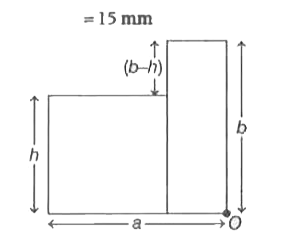 Force on dam = PRESSURE of water `xx` Area = {(density of water) (ACCELERATION due to gravity) (height of water/2} `xx` {(width of dam) (height of water)} `F = (RHO g (h)/(2)) xx [(b -h).h]` `= (rho g)/(2) (BH^(2) - h^(3))` At equilibrium, atmospheric pressure = pressure on dam So, `(dF)/(dh) = 0` `rArr (del)/(del h) {(rho g)/(2) (bh^(2)- h^(3))} = 0` `rArr (rho g)/(2) (2bh - 3h^(2)) = 0` `rArr 2bh - 3h^(2) = 0` `rArr 2b = 3h rArr b= 3h//2` `b-h = (3h)/(2) - h = h//2` is the location where the total weight of water acts at a particular point. To find the point of action of total force, `y_(R ) = (I_(xc))/(y_(c )A) + y_(c )` where, `y_(R )`= location where point of force acts, A = area, `y_(c )`= location where total weight acts = h/2 and `I_(xc)` = moment of inertia (here rectangular plate). `=(1)/(12) Ah^(2) = (1)/(12) bh^(3)` so, `y_(R ) = ((1//12) bh^(3))/((1//2)h.bh) + (1)/(2)h` `= (1)/(6) h + (1)/(2) h = (2)/(3)h` (from the top) So, `y_(R ) = (h)/(3)` (above the base) `= (2)/(3)h` (from the top) 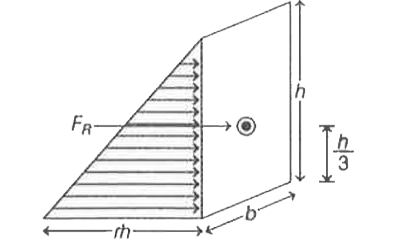
|
|
| 42. |
An electomagnetic wave is entering from onemedium to another. Then the property which remains unaltered is |
|
Answer» Wavelength |
|
| 43. |
A sinusoidal transverse wave is traveling along a string in the negative direction of an x axis. Figure 16-S1 shows a plot of the displacement as a function of position at time t = 0, the scale of the y axis is set by y = 4.0 cm. The string tension is 3.6 N, and its linear density is 28 g/m. Find the (a) amplitude, (b) wavelength, (e) wave speed, and (d) period of the wave (e) Find the maximum transverse speed of a particle in the string. If the wave is of the form y(x,t) =y_(m) sin (kx pm omega t+phi), what are (f) k, (g) omega (h) phi, and (i) the correct choice of sign in front of omega? |
|
Answer» |
|
| 44. |
Three plates A, B and C are placed close to each other with +Q charge given to the middle plate. The inner surfaces to A and C canbe connected to earth through plate D and keys K_(1) and K_(2) . The plates D is a dielectric slab with dielectric constant K_(1) then the charge that will flow through plate D and keys K_(1) and K_(2) . The plate D is a dielectric slab with dielectric constant K, then the charge that will flow though plate D when K_(2) is closed and K_(2) is open is |
|
Answer» `-Q` |
|
| 45. |
We wish to coat flat glass (n=1.50) with a transparent material (n = 1.45) so that reflection of light at wavelength 500 nm is eliminated by interference. What minimum thickness can the coating have to do this? |
| Answer» SOLUTION :86.2 nm | |
| 46. |
The equation of motion of a projectile is y=ax-bx^(3) where a and b are constants of motion. Match the quantities of column I with the relations of column II. {:("Column-I", "Column-II"),((A)"The initial velocity of projection",(p) (a)/(b)),((B)"The horizontal range of projectile",(q)asqrt((2)/(bg))),((C)"The maximum vertical height attained by projectile",(r) (a^(2))/(4b)),((D)"The time of fightof projectile",(s) sqrt((g(1+a^(2)))/(2b))):} |
|
Answer» A-p, B-q, C-r, D-s |
|
| 47. |
Average distance of the earth from the sun is L_(1). If one year of the earth=D days, one year of another planet whose average distance from the sun is L_(2) will be |
|
Answer» `D((L_(2))/(L_(1)))^(1//2)`DAYS `T^(2) prop R^(3). or " T prop r^(3//2)` `:. (D.)/(D)=((L_(2))/(L_(1)))^(3//2)" or D.=D((L_(2))/(L_(1))^(3//2))" days"` |
|
| 48. |
A particle of mass m and positive charge q,moving with a uniform velocity v enters a magnetic field B as shown in figure.(a) Find the radius of the circular arc it describes in the magnetic field. (b)Find the angle subtended by the arc at the centre. (c) How long does the particle stay inside the magnetic field? (d)Solve the three parts of the above problem if the charge q on the particle is negative. |
|
Answer» (b)Angle Subtended by the arc`=pi/2` (c)`THETA=omegat` `pi/2=(QBT)/m rArr t=(pim)/(2qB)` (d)`r=(mv)/(qB) rArr theta=(3pi)/2 rArr t=0/omega =(3pim)/(2qB)` 
|
|
| 49. |
One mole of an ideal gas undergoes cyclic change as shown. The work done in the process is (taking 1 atmosphere =10^(6)" dyne/"cm^(2)): |
|
Answer» 100J 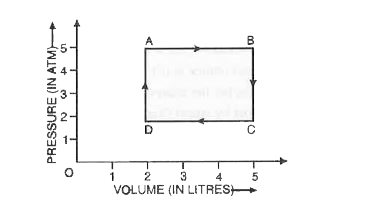 `=DC xxBC =3" litre"xx3` atmosphere `=3xx10^(-3) m^(3)xx3xx10^(5)" N/m"^(2)`. `=9XX10^(2)=900 J`. Thus, correct CHOICE is (d). |
|
| 50. |
In an experiment for determination of refractive index of glass of prism by i - delta plot, it was found that a ray incident at angle 35^(@) , suffers a deviation of 40^(@) and that it emerges at angle 79^(@). In that case which of the following is closest to the maximum possible value of the refractive index? |
|
Answer» 1.5 `or, " " 40^(@) = 35^(@) + 79^(@) - A or, A = 74^(@)` Now, the minimum value of angle of deviation, `delta_(m) le 40^(@)` `"In that case", mu le (sin""(A + delta_(m))/(2))/(sin""(A)/(2))` `or, " " mu le(sin""(74^(@) + 40^(@))/(2))/(sin""(74^(@))/(2))` `or, " " mu le 1.39` `therefore " " mu_(max) = 1.5` 
|
|


