

Saved Bookmarks
This section includes 7 InterviewSolutions, each offering curated multiple-choice questions to sharpen your Current Affairs knowledge and support exam preparation. Choose a topic below to get started.
| 1. |
A ring of mass m sliding on a smooth surface with velocity v_(0) enters rough surface with coefficient of kinetic friction mu_(k), then |
|
Answer» the linear distance moved by centre of MASS before the ring starts pure rolling is `(3v_(0)^(2))/(8 mu_(k)g)` |
|
| 2. |
If angular speed of a particle is doubled and linear speed of a particle is halved. The acceleration in uniform circular motionis |
|
Answer» Zero |
|
| 3. |
If the combination is connected to a battery of emf 20 V and negligible internal resistance, determine the current through each resistor, and the total current drawn from the battery. |
| Answer» SOLUTION :10 A, 5A,4A , 19 A | |
| 4. |
The core of a transformeris laminatedto reduce. |
|
Answer» Copperloss |
|
| 5. |
In a Young.s double slit experiment, the fringes are displaced by a distance x when a glass plate of refractive index 1.5 is introduced in the path of one of the beams. When this plate is replaced by another plate of same thickness, the shift of fringes is (3"/"2)x. The refractive index of second plate is |
|
Answer» SOLUTION :Shift `=((mu-1)t D)/(d) implies X= ((1.5-1)tD)/(d)"……….."(i)` and `(3)/(2)x= ((mu-1)tD)/(d)"""……….."(ii)` Dividing EQ. (i) by Eq. (ii) `""(2)/(3)= (0.5)/(mu-1) implies mu= 1.75`. |
|
| 6. |
(a) Three resistors 2 Omega 4 Omega and 5 Omega are combined in parallel. What is the total resistance of the combination ? (b) If the combination is connected toa bettery of emf 20 V and neglibible internal resistance, determine the current through each resistor, and the total current drawn from the battery. |
Answer» Solution : (i) Current passing through `R_(1)` is , `I_(1) = (EPSILON)/(R_(1)) = (20)/(2) = 10 `A (II) Current passing through`R_(2)` is , `I_(2) = (epsilon)/(R_(2)) = (20)/(4) = 5`A (iii) Current passing through`R_(3)` is , `I_(3) = (epsilon)/(R_(3)) = (20)/(5) = 4 ` A Applying Kirchhoff.s current law, (KCLalso known as junction rule) at junction a, `sum I = 0 ` `therefore I- I_(1) - I_(2) - I_(3) = 0` `therefore I = I_(1) + I_(2) + I_(3) ` `= 10 + 5 + 4 ` `therefore I = 19 A ` . |
|
| 7. |
One ampere of current enters the junction A of a wheatstone bridge ABCD with AB=2Omega,BC=2Omega,AC=4Omega,CD=2Omega and R_(g)=4Omega. Find the current through the galvanometer. |
|
Answer» |
|
| 8. |
A Pendulum bob of mass m and charge q is suspended by a thread of length l. The pendulum is placed in a region of a uniform electric field E directed vertically upward. If the electristatic force acting on the sphere is les than that of gravitational fore, calculate the period with which the pendulum oscillates (Assumes small oscillation) |
|
Answer» `T=2pisqrt(L/(g+(qE)/m))` Net acceleration 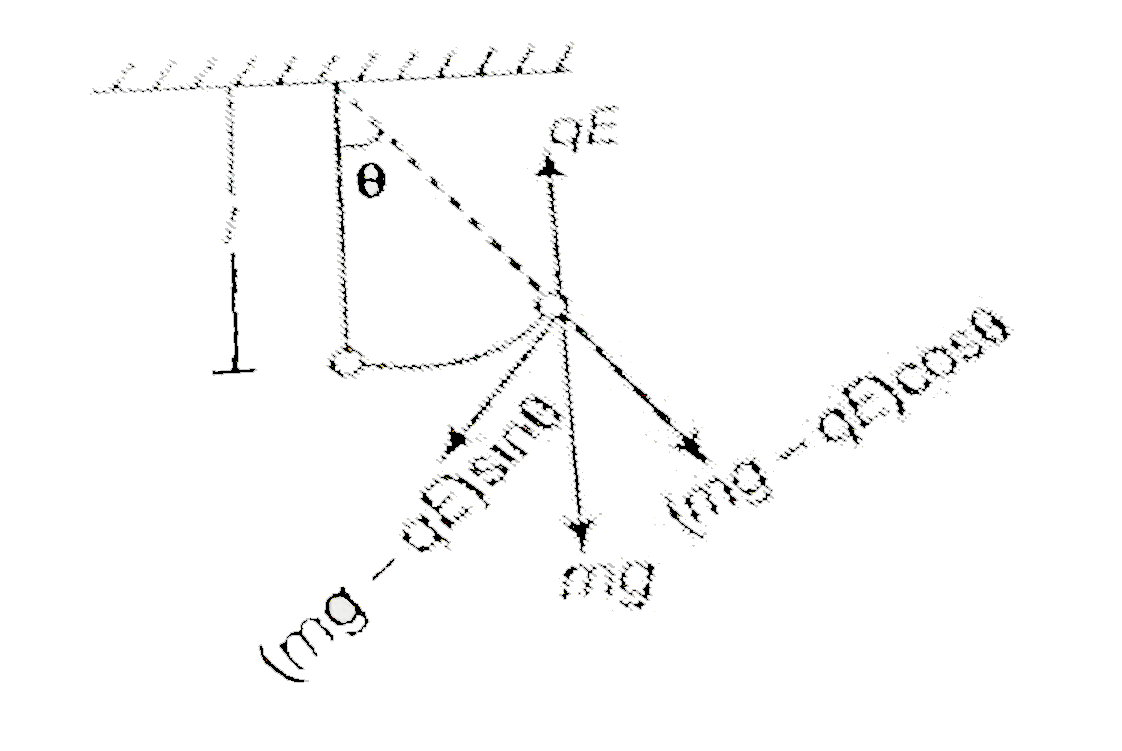 `g'=(g-(qE)/m)` `T=2pisqrt((l/(g')))` `T=2pisqrt(l/((g-(qE)/m)))` |
|
| 9. |
A set of 12 tuning forks is arranged in order of increasing frequencies. Each fork produces Y beats per second with the previous one. The last is an octave of the first. The fifth fork has frequency of 90 Hz. Find Y and the frequency of the first and the last tuning forks. |
|
Answer» Solution :Data ` n_(i+1) - n_(1) =Y., n_(12) = 2n_(1) , n_(5) = 90Hz` ` n_(2) -n_(1)` Y beats/s `"" n_(2)= n_(1) + ` Y beats/ s Siimilarly `n_(3) = n_(2) + Y= n_(1) + Y +Y` `n_(3) =n_(1) +2Y =n_(1) + (3-1) Y` ` n_(x) =n_(1) + (x-1) Y` SIMILARLY` n_(12) = n_(1) + (12-1) Y= n_(1) +11Y` `n_(12) -2n_(1)= n_(1) + 11Y` Also ` n_(5) = n_(1) + (5-1) Y = n_(1) + 4 Y` ` n_(5) = 11Y + 4 Y = 15 Y ` `n_(5) = 90 Hz ` Y =6 The frequency of the FIRST FORK ` n_(1) = 11Y ` beats/s= `11 xx 6 "beats/s " 66 Hz` and the frequency of the last fork ` n_(12) =2n_(1) = 2(66) =132` Hz |
|
| 10. |
If the amplitude of sound is doubled and the reduced to one- fourth the intesity of sound at the same point will |
|
Answer» INCRESASE by a FACTOR of 2 |
|
| 11. |
The de Broglie wavelength lambda of an electron accelerated through a potential V in volts is |
|
Answer» `(1.227)/sqrtVnm` |
|
| 12. |
In a Thomson's set up for elm, the same high tension d.c. supply provides potential to anode for acceleration and also the positive voltage to the deflecting plate in the region of crossed fields. If the supply voltage is doubled, by what factor the magnetic field be increased to keep the electron beam undeflected ? |
|
Answer» 2 times If potential is changed to 2V, let them magnetic field to B. then `(e)/(m)=(2V)/(2d^(2)B.^(2)) or(2V)/(2d^(2)B.^(2))=(V)/(2d^(2)V^(2))` or `B.^(2)=2B^(2) or B.= sqrt(2)B` |
|
| 13. |
If the mass of the earth were 25% of its actual mass and radius were 50% of its actual radius, then escape velocity from the earth’s surface |
|
Answer» `a)11.2km/s` |
|
| 14. |
The velocity of electro magnetic radiation in a medium of permeabilty mu_0 and permittivity epsilon_0 is given by: |
|
Answer» `(1)/saqrt(mu_0epsilon_0)` |
|
| 15. |
The focal lengths of the objective and eyepiece of a microscope are 0.6 cm and 5 cm respectively and the distance between them is 12 cm. Find the distance of the object from the objective when the final image seen by the eye is 25 cm from the eye-piece. Also find the magnifying power. |
|
Answer» |
|
| 16. |
In a galvanometer, a current of 1muA produces a deflection of 20 divisions. It has a resistance of 10Omega. If the galvanometer has 50 vivisions on its scale and a shunt of 2.5Omega. Is connected across the galvanometer, the maximum current that the Galvanometer can measure now is |
|
Answer» `12.5muA` |
|
| 17. |
As astronomical telescope and a Galilean telescope use identical objective lenses. They have the same magnification, when both are in normal adjustment. The eyepeice of the astronomical telescope has a focal length f. |
|
Answer» The TUBE lengths of the TWO TELESCOPES differ by `f` |
|
| 18. |
If 'A' is a square matrix of order 3 x 3 and det(A)=1/2 , then det(Adj A^(-1)) is |
|
Answer» |
|
| 19. |
Two rings have their moments of intertia in the ratio 2:1 and their diameters are in the ratio 2:1. The ratio of their masses will be |
|
Answer» |
|
| 20. |
An inductance of (200/pi) mH, a capacitance of (10^(-3)/pi)F and a resistance of 10Omega are connected in series with an a.c. source 220 V, 50Hz. Then what is the phase angle of the circuit ? |
|
Answer» `pi/4` rad `L=200/pi` mH `C=10^(-3)/pi`F `R=10 Omega` `RARR X_L =2pifL=2pixx50xx200/pixx10^(-3)` `=20Omega` `rArr X_C =1/(2pifC)=1/(2pixx50xx10^(-3)/pi)` `therefore X_C=10Omega` `rArr tan theta =(X_L-X_C)/R` `=(20-10)/10` `=10/10` `tan theta =1` `therefore theta = tan^(-1) (1)` `therefore theta =pi/4` Here, `X_L gt X_C` so, current lags behind by VOLTAGE by `pi/4` rad . |
|
| 21. |
A cell of emf ' epsi ' and internal resistance 'r' is connected across a variable resistor 'R'. Plot agraph showing the variation of terminal potential 'V' with resistance R. Predict from the graph the condition under which 'V' becomes equal to ' epsi ' |
Answer» Solution :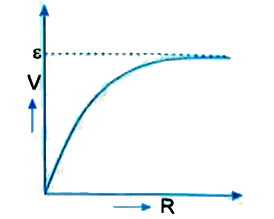 The terminal potential difference `V = IR = (epsi)/((R+r)) .R (epsi)/((1+r/R))` Thus as R increases, V ALSO increases. Graph is shown in adjoining FIG. From the graph it is CLEAR that V becomes equal to `epsi`, when R becomes `OO` |
|
| 22. |
A cell of emf ' epsi 'and internal resistance 'r' is connected across a variable resistor 'R'. Plot a graphshowing variation of terminal voltage 'V' of the cell versus the current 'l'. Using the plot, showhow the emf of the cell and its internal resistance can be determined. |
Answer» Solution :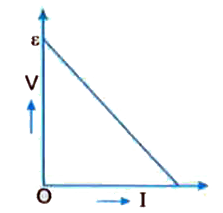 We know that terminal potential difference V across a cell of EMF `epsi` and internal resistance VARIES with current I drawn from it as per relation : `V = epsi - Ir` Thus, V-I graph is a STRAIGHT line graph with a NEGATIVE slope as shown in Fig. If I = 0, then `V = epsi` = emf of the cell. Hence, emf of a cell can be determined by the intercept of V-I graph on the V-axis. Again when `I = I_(MAX)` then V = 0, hence internal resistance of cell `r = (epsi)/(I_(max))` where `I_(max)` is the intercept of V-I graph on the I-axis |
|
| 23. |
A proton and an alpha particle are accelerated through the same potential difference V. The ratio of their de Broglie wavelengths is |
|
Answer» Solution :`LAMBDA=(h)/(p)=(h)/(SQRT(2mqV))` As `m_(ALPHA)=4m_(p)` and `q_(alpha)=2q_(p)` `(lambda_(alpha))/(lambda_(p))=sqrt((2m_(p)q_(p))/(2m_(alpha)q_(alpha)))=sqrt((m_(p)q_(p))/(4m_(p)2q_(p)))=sqrt((1)/(8))` `=(1)/(2sqrt2)` |
|
| 24. |
The terminal Pd of a cell is equal to its emf if |
|
Answer» external resistance is infinity |
|
| 25. |
Suppose 2.80 mol of an ideal diatomic gas, with molecular rotation but not oscillation, experienced a temperature increase of 45,0 K under constant-pressure conditions. What are (a) the energy transferred as heat , (b) the change Delta E_( i n t)internal energy of the gas, (c) the work w done by the gas, and (d) the change Delta K in the total translational kinetic energy of the gas? |
| Answer» SOLUTION :` (a) 6.98xx 10^3J :(B)4.99 XX 10^3 J ,(b ) 4.99xx 10 ^3 J(c )1.99 xx 10^3J ,(d ) 2.99 xx10^3J` | |
| 26. |
A glass prism of refractive index 1.5 is immersed in water (mu = (4)/(3)) . Refer figure. A light beam incident normally on the face AB is totally freflected to reach the face BC if |
| Answer» Answer :D | |
| 27. |
What we name the emitted electrons when the electrons are emitted from a metal surface when illuminated by light. |
| Answer» SOLUTION :PHOTO ELECTRONS. | |
| 28. |
Derive an expression for the potential energy of an electric dipole of dipole moment vecp in an electric field vecE. |
|
Answer» Solution :Consider an electric dipole having charges `q_1 = +Q and q_2=-q` located at `vecr_1 and vecr_2`, respectively. Now potential difference between 1 and 2 equals the work done in bringing a unit + ve charge against the electric field from position 2 to 1. `:. V (vecr_1) - V (vecr_2) = -E` (displacement parallel to the field `vecE`). If 2A be the length of electric dipole and dipole be aligned at an angle `theta` from DIRECTION of electric field, then `V(vecr_1) - V (vecr_2) = -E .2 a cos theta` `:.` Potential energy of the dipole in a uniform electric field `vecE` is given by `u = q[ V(vecr_1) - V (vecr_2)] = -E. 2a cos theta = - pE cos theta = - vecp. vecE`. where p = q.2a = dipole MOMENT of the given electric dipole. 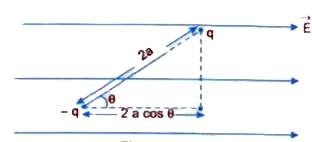
|
|
| 29. |
The velocity-time graph of a particle moving along a straight line is shown in Fig. The displacement of the body in 5 second is : |
|
Answer» Solution :DISPLACEMENT (in magnitude) `=((1)/(2)xx3xx2-(1)/(2)xx1xx2+1xx1)m` =3 m |
|
| 30. |
Sketch a graph that shows change in reactance with frequency of a series LCR circuit. |
Answer» SOLUTION :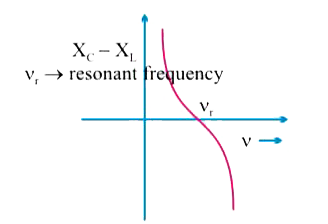
|
|
| 31. |
The depth of a lake at which density of water is 2% greater than on surface. [Compressibility of water =50xx10^(-6)/atm , 1 atm = 10^5N//m^2] |
|
Answer» 2 km `because Deltap=hrhog` and `1/B=C` so r'=r(1+Ch`rho`g) `rArr (rho'-rho)/rho=Chrhog` `rArr H = (Deltarho)/rhoxx1/(Crhog)` `=2/100xx1/((50xx10^(-6))/105 xx10^3xx10)` `=2/5xx10^4 =20/5xx10^3`m = 4 km OR `rho=M/V rArr drho=-M/V^2 dV` `rArr (drho)/rho=(-M/V^2dV)/(M/V)` `rArr (drho)/rhoxx100% =-(dV)/Vxx100` `rArr (dV)/V xx 100=2%[ "as" (drho)/rhoxx100%= 2%]` Now `B=(DeltaP)/((DELTAV)/V)` and compressibility `C=1/B` and `DeltaP=hrho g ` `1/C=(hrhog)/(2/100)` `rArr h=2/100xx1/(V rhog) = 2/100xx1/((50xx10^(-6))/10^5 xx10^3xx10)m` = 4 km |
|
| 32. |
Alternating current of peak value ((2)/(pi)) ampere flows through the primary coil of the transformer. The coefficient of mutual inductance between primary and secondary coil is 1 henry. The peak e.m.f. induced in secondary coil is (Frequency of a.c.=50Hz) |
| Answer» Answer :B | |
| 33. |
An alpha-particle of energy 5 MeV is movingforward for a head on collision. The distance of closest approach from the nucleus of atomic numbe Z=50 is ... xx10^(-14)m (k=9xx10^(9)SI, c=1.6xx10^(-19)C), |
|
Answer» `0.72` `5xx10^(6)xx1.6xx10^(-19)=(k(2Ze^(2)))/(d)` `:.d=(k(2Ze^(2)))/(8XX10^(-13))` `:.d=(230.4xx10^(-28))/(8xx10^(-13))` `:.d=28.8xx10^(-5)m:d=2.88xx10^(-14)m` |
|
| 34. |
Two polaroids are oriented with their planes perpendicular to incident light and transmission axis making an angle of 30^@with each other. What fraction of incident unpolarized light is transmitted? |
|
Answer» Solution :If UNPOLARIZED light is passed through a polaroid `P_1` . its intensity will become half. `So I_1 = 1/2 I_0`,with VIBRATIONS parallel to the axis of `P_1` . Now this light will PASS through the second polaroid `P_2`(Analyser) whose axis is INCLINED at an angle of `30^@`to the axis of `P_1`and hence to the vibrations of `I_1` |
|
| 35. |
An inductor of 3H is connected to a battery of emf 6V through a resistance of 100Omega . Calculate the time constant. What will be the maximum value of current in the circuit? |
|
Answer» Solution :Given that L = 3H.E=6V,R=100`OMEGA` Time constant `tau_L = L/R = 3/100 = 0.03`sec MAXIMUM CURRENT`I_0 = E/R =6/100 ` amp = 0.06 amp |
|
| 36. |
A network of four capacitors of edacity equal to c_1=c,c_2=2c,c_3=3c and c_4=4c are connected to a battery as in figure. The ratio of the chaises on c_2 and c_4 is: |
|
Answer» `7/4` |
|
| 37. |
A voltameter has a resistance 'G' and range 'V'. What resistance should be connected in series with it to increase its range to 'nv'? |
|
Answer» `(n-1)G` |
|
| 38. |
If the solenoid in Exercise 5.5 is free to tum about the vertical direction and a uniform hortzontal magnetic field of 0.25 T is applied, what is the magnitude of torque on the solenoid when its axis makes an angle of 30^@ with the direction of applied field? |
|
Answer» SOLUTION :Above solenoid acts like a bar magnet with magnetic dipole moment `m_(s) = 0.6 Am^(2)`. Now, torque exerted on it by uniform external magnetic FIELD is, `tau= m_(s) B sin theta` `= (0.6) (0.25) sin 30^@` `=(0.6) (0.25) (0.5)` `tau= 0.075` Nm |
|
| 39. |
In a plot of photoelectric current versus anode potential, how does (i) the saturation current vary with anode potential for incident radiations of different frequencies but same intensity? (ii) the stopping potential vary for incident radiations of different intensities but same frequency ? (iii) Photoelectric current vary for different intensities but same frequency of incident radiations ? Justify your answer in each case. |
|
Answer» Solution :(i) The SATURATION current for incident radiations of sama intensity but different frequencies does not depend on the anod epotential because saturation current is a SOLE function of intensity of incident radiation. (ii) The stopping potential `V_(0)` for incident radiations of different intensities but same frequency remains unchanged. the stopping potential, in accordance with Einstein.s equation `h(v-v_(0))=eV_(0)`, depends solely on the frequency of incident radiation and is independent of the intensity of radiation. (iii) The photoelectric current increases with increase in intensity of incident radiation of a given frequency PROVIDED that the frequency of radiation is equal to or more than the threshold frequency for the given METAL. greater inteisty of incident radiation means greater number of incident photons, which in turn leads to mroe photoelectrons and hence HIGHER value of photoelectric current. |
|
| 40. |
A ray of light incident on a slab of transparent material is partly reflected from the surface and partly refracted into the slab. The reflected and refracted rays are mutually perpendicular. The incident ray makes an angle i with the normal to the slab. the refreactive index of the slab is |
|
Answer» `TAN^(-1)(i)` |
|
| 41. |
When the force on a object depends on the position of the object, we cannot find the work done by it on the object by simple multiplying the force by the displacement. The reason is that there is no one value for the force-it changes. So, we must find the work in tiny little displacements and then add up all the workk results. We effectively say, "Yes, the force varies over any given tiny little displacement. but the variation is so small we can approximate the force as being constant during the displacements infinitesimal, then our error becomes infinitesimal and the result becomes precise. But, to add an infinite number of work contributions by hand would take us forever, longer than a semester.So we add them up via an integration, which allows us to do all this in minutes (much less than a semester). Force vec(F)=(3x^(2)N)hat(i)+(4N)hat(j), with xin meters, acts on a particle, changing only the kinetic energy of th particle. How much work is done on the particle as it moves from coordinates (2 , 3 m) to 3 m, 0 m)? Does the speed of the particle increase, decrease, or remain the same? |
|
Answer» Solution :KEY IDEA The FORCE is a variable force because its x component depends on the value of `x`. Thus, we cannot USE Eqs. 8-7 and 8-8 to find the work done. Instead, we must use Eq. 8-36 to integrate the force. Calculation: We set up two integrals, one along each axis: `W = int_(2)^(3)3x^(2)dx+ int_(3)^(0)4dy=3 int_(2)^(3)x^(2)dx+4 int_(3)^(0)dy` `=3[1/2 x^(3)]_(2)^(3)+4[y]_(3)^(0)=[3^(3)-2^(3)]+4[0-3]` `=7.0J`. The positive result means that ENERGY is transferred to the particle by force `vec(F)`. Thus, the kinetic energy of the particle increases and, because `=1//2mv^(2)`, its speed must also increase. If the work had come out negative, the kinetic energy and speed WOULD have decreased. |
|
| 42. |
Two point white dots are 1 mm apart on a black paper. They are viewed by eye of pupil diameter 3 mm. Approximately, what is the maximum distance at which these dots can be resolved by the eye ? (Take wavelenght of light = 500 nm) : |
|
Answer» 5 m `(y)/(D) = 1.22 (lambda)/(d)` `rArr "" D = (y.d)/(1.22 lambda) = (30)/(6.1) APPROX 5 m` `THEREFORE "" D_(MAX). = 5 m` |
|
| 43. |
171 ग्राम शक्कर (C_12H_22O_11) को एक लीटर जल मे घोला गया है घोल की मोलरता है - |
|
Answer» 0.20 M |
|
| 44. |
In the process of photoelectric emission all the emitted photoelectric posses the same kinetic energy. |
| Answer» Solution :False: Emitted photoelectrons have all POSSIBLE values of kinetic ENERGY ranging from ZERO to `K_(max)=eV_(0)`. | |
| 45. |
The work function of tungsten is 4.50 eV. Calculate the speed of the fastest electron ejected from tungsten surface when electromagnetic radiation of energy 6 eV is incident on the surface. |
|
Answer» SOLUTION :DATA: `Phi = -4.50 eV= 4.50 xx 1.6 xx 10^(-19) J = 7.2 xx 10^(-19) J, hv=6eV = 6 xx 1.6 xx 10^(-19) J = 9.6 xx 10^(-19) J, m=9.1 xx 10^(-31)` kg `1/2mv_("max")^(2) = hv- Phi` `therefore v_("max") = sqrt((2(hv-Phi))/(m)) = [(2(9.6 xx 10^(-19) - 7.2 xx 10^(-19)))/(9.1 xx 10^(-31))]^(1//2)` `=(4.8/9.1)^(1/2) xx 10^(6) m//s = 7.263 xx 10^(5) m//s` This gives the SPEED of the fastest electron ejected from TUNGESTEN surface. |
|
| 46. |
An isotope of radium with mass number 226 undergoes radioactive transformation to a lead isotope with mass number 206. How many alpha- and beta-disintegrations were involved in the process? |
|
Answer» `N_(alpha)=(A_(Ra)-A_(Pb))/A_(He)=(226-206)/4=5` After five alpha-disintegrations the decrease in the atomic number will be 10, and `Z_(Ra)-Z_(Ph)=88-82=6`. It follows from this that there are in addition FOUR beta-disintegrations, each of which results in a UNIT increase in the atomic number. |
|
| 47. |
What are alpha rays ? Briefly explain alpha decay. |
|
Answer» Alpha decay. Alpha decay is a process involving the emission of a fast-moving helium nucleus (an alpha-PARTICLE) by nuclei which generally contain 210 or more nucleons. Since `""_(2)H^(4)` contains two protons and two neutrons, after an alpha emission the PARENT nucleus is transformed into a daughter nucleus which has (i) an atomic number SMALLER by two and (ii) mass number smaller by four. Transformation of the `""_(z)X^(A)` nucleus into then `""_(z-2)X^(A-4)` nucleus by an alpha decay can be expressed by the equation. `""_(z)X^(A)=""_(z-2)Y^(A-4)+""_(2)HE^(4)+Q`. e.g. `""_(92)U^(238) rarr ""_(90)Th^(234)+""_(2)He^(4)+Q` If `m_(X), m_(Y)` and `m_(alpha)` represent the mass of parent nucleus X, daughter nucleus Y and `alpha` particle respectively , then the energy released Q is given by `Q=[m_(X)-(m_(Y)+m_(alpha))]c^(2)` The VALUE of K.E. of `alpha`-particle is of the order of 4.9 M eV for various `alpha`-emitters. |
|
| 48. |
Two conducting rings of radii r and 2r move in opposite directions with velocities 2v and v respectively on a conducting surface S. There is a uniform magnetic field of magnitude B perpendicular to the plane of the rings. The potential difference between the highest points of the two rings is |
|
Answer» Solution :REPLACE the induced emfs in the rings by cells of emfs `e_1 = B 2r (2v) = 4Brv , e_2 = B(4r) = 4Brv` The equivalent CIRCUIT is  Hence the potential difference between the highest POINTS of the two rings is `V_2 - V_1 = e_1 + e_2 = 8Brv` |
|
| 49. |
A straight horizontal conducting rod of length 0.45 m and mass 60 g is suspended by two vertical wires at its ends. A current of 5.0 A is set up in the rod through the wires. (a) What magnetic field should be set up normal to the conductor in order that the tension in the wires is zero? (b) What will be the total tension in the wires if the direction of current is reversed keeping the magnetic field same as before? (Ignore the mass of the wires.)g = 9.8 m s^(-2) . |
Answer» Solution :(a)  Suppose, MAGNETIC FIELD `VECB` is applied PERPENDICULARLY inside the plane of figure and also perpendicular to the length of the rod such that magnetic force exerted on the rod can balance its weight. Hence, `IlB=mg` `thereforeB=(mg)/(Il)` `thereforeB=((0.06)(9.8))/((5)(0.45))=0.2613T` In this situation, as shown in FBD figure (2), for vertical equilibrium of the rod, `T.+IlB=mg` `thereforeT.=0""(because"Here",IlB=mg)` (b)  Now, when above magnetic field is reversed if new total tension in the TWO suspension wires is T.. then for vertical equilibrium, `T..=IlB+mg` = `2mg" "(becauseIlB=mg)` = (2) (0.06) (9.8) `thereforeT..=1.176N` |
|