

Saved Bookmarks
This section includes 7 InterviewSolutions, each offering curated multiple-choice questions to sharpen your Current Affairs knowledge and support exam preparation. Choose a topic below to get started.
| 1. |
Find charge in each capacitor: |
Answer» SOLUTION :In SERIES charge will be same on all CAPACITORS and in parallel charge will be PROPOTIONAL to capacitane 
|
|
| 2. |
(Come) back to the future. Suppose that a father is 25.0 y older than his daughter. He wants to travel outward from Earth for 2.000 y and then back for another 2.000 y (both intervals as he measures them) such that he is then 25.0 y younger than his daughter. What constant speed parameter beta(relative to Earth) is required ? |
|
Answer» |
|
| 3. |
A p-n photodiode is fabricated from a semiconductor with band gap of 2.8 eV. Can it detect a wavelengthof 6000 nm? |
|
Answer» Solution :The radiation energy of the WAVELENGTH of 6000 nm. `E=(hc)/(lambda)=(6.625xx10^(-34)xx3xx10^(8))/(6000xx10^(-9)xx1.6xx10^(-19))eV` `=0.00207xx10^(2)eV` `=0.207eV` but `E_(g)=2.8eV` is given `THEREFORE` So, `E gt E_(g)` should be done to test the wavelength of radiation but since there is `E lt E_(g)`the wavelength cannot be tested. |
|
| 4. |
A free electron is located in the field of a monochromatic light wave. The intensity of light is I = 150 W//m^(2), its frequency is omega = 3.4 . 10^(15) s^(-1). Find: (a) the electron's oscillation amplitude and its velocity amplitude, (b) the ratio F_(m)//F_(e), where F_(m) and F_(e) are the amplitudes of forces with which the magnetic and electric components of the ligth wave field act on the electron, demonstrate that the ratio is equal to (1)/(2)v//c, where v is the electron's velocity amplitude and c is the velocity of light. Instruction. The action of the magnetic field component can be disregarded in the equation of motion of the electron since the calculations shown it to be negligible. |
|
Answer» Solution :In a travelling plane electromagnetic wave the intensity is simply the time averaged magnitude of the Polynting VECTOR:- ` I = lt|oversetrarr(E) xx oversetrarr(H)|gt = lt sqrt((epsilon_(0))/(mu_(0)))E^(2) gt = lt c epsilon_(0)E^(2)gt` on using `c = (1)/(sqrt(epsilon_(0)mu_(0))), E sqrt(epsilon_(0)) = H sqrt(mu_(0))`. Now time averaged value of `E^(2)` is `E_(0)^(2)//2` so `I = (1)/(2)c epsilon_(0) E_(0)^(2)` or `E_(0) = sqrt((2I)/(c epsilon_(0)))`, (a) Represent the electric field at any POINT by `E = E_(0) sin omegat`. Then for the electron we have the equation. `m ddotx = eE_(0)sin omegat` so `x =- (eE_(0))/(m omega^(2)) sin omegat` The amplitude of the forced oscillation is `(eE_(0))/(m omega^(2)) = (e)/(m omega^(2)) sqrt((2I)/(c epsilon_(0))) = 5.1 xx 10^(-16) cm` The velocity amplitude is clearly `(eE_(0))/(m omega) = 5.1 xx 10^(-16) xx 3.4 xx 10^(15) = 1.73 cm//sec` (b) For the electric force `F_(e) =` amplitude of the electric force `= eE_(0)` For the magnetic force (which we have neglected above), it is `(evB) = (evmu_(0)H)` `= evE sqrt(epsilon_(0)mu_(0)) = EV(E)/(c)` writing `v=- v_(0) cos omega t` where `v_(0) = (eE_(0))/(m omega)` we see that the magnetic force is apart from a sign `(ev_(0)E_(0))/(2c)sin 2 omegat` Hence `(F_(m))/(F_(e)) =` Ratio of amplitudes of the two forces `= (v_(0))/(2c) = 2.9 xx 10^(-11)` This is negligible and justifies the neglect of magnetic field of the electromagnetic wave in CALCULATING `v_(0)`. |
|
| 5. |
A small angled prism of refrative index 1.7 gives a deviation of 4.9^@. The angle of prism is ....... |
|
Answer» `5^@` `delta=A(n-1)`(n=1.7,`delta=4.9^@`) `THEREFORE 4.9^@=A(1.7-1)` `thereforeA=(4.9^@)/(0.7^@)=7^@` |
|
| 6. |
(A ): Speed of EM wave in a medium depends on electrical permittivity and magnetic permeability of the medium (R) E.M wave transport energy in the form of oscillating electric and magnetic fields |
|
Answer» Both 'A' and 'R' are TRUE and 'R' is the CORRECT EXPLANATION of 'A'. |
|
| 7. |
Refer to figure the arm PQ of the rectangular conductor is moved from x = 0, outwards. The uniform magnetic field is perpendicular to the plane and extends from x = 0 to x = b and is zero for x gt b. Only the arm PQ possesses substantial resistance r. Consider the situation when the arm PQ is pulled outwards from x = 0 to x = 2b and is then moved back to x = 0 with constant speed v. Obtain expressions for the flux, the induced emf, the force necessary to pull the arm and the power dissipated as Joule heat. Sketch the variation of these quantities with distance. |
Answer» Solution :Part I: When slider arm PQ moves towards right from x = 0 to x = b and then from x = b to x = 2b with constant speed v, 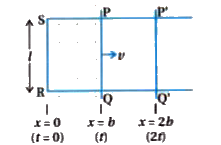 Here POINTS R and S are fixed points whereas points P and Q keep on sliding from S to P. and from R to Q. as slider arm changes its position from x = 0 to x = 2b. Required quantities can be found out as follows: (i)Magnetic flux : `phi`=Blx (From x =0 to x=b) `phi`=Blb (From x =b to x = 2b) Here, from x=0 to x=b , `phi` increases linearly with x whereas from x=b to x=2b, `phi` remains constant ) ...(1) (ii)induced emf : From x=0 to x=b, `phi=Blx=Bl(vt)` `therefore epsilon=-(dphi)/(dt)`=-Blv(1)=-Bvl =constant From x=b to x=2b, `epsilon=0` (`because phi`=constant)...(2) (iii)External FORCE to keep slider arm PQ under equilibrium : `F = I l B sin 90^@ =IlB=epsilon/r lB` `therefore F=((-Bvl))/r lB=-(B^2l^2v)/r` (Where r= resistance of slider arm PQ) ...(3) `therefore` F=constant (`because` B,l,v,r are CONSTANTS) From x=0 to x=b , `F=-(B^2l^2v)/r` = constant From x=b to x=2b, `F=-(B^2l^2v)/(vr)=epsilon^2/(vr)=0 (because epsilon=0)`...(4) (iv) Joulean power , `P=epsilon^2/r=(B^2v^2l^2)/r` From x=0 to x=b , `P=(B^2v^2l^2)/r=epsilon^2/r`=constant From x=b to x=2b, P=0 (`because epsilon=0`) ...(5) From results (1),(2),(3),(4) and (5) graphs of `phi,epsilon,F,P to x` can be plotted as follows : 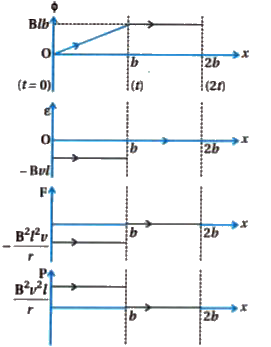 Part II : When slider arm moves towards left from x = 2b to x = b and then from x = b to x = 0 with constant speed v. In this case, all of above graphs are retraced in the directions opposite to previous graphs as shown below. 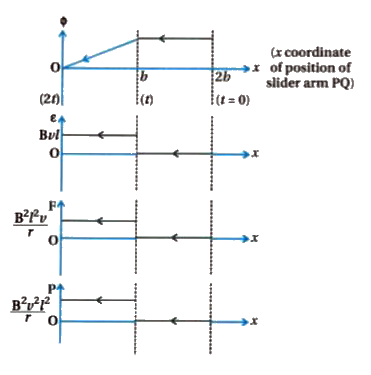
|
|
| 8. |
The altitude of the ozone layer in the atmosphere and the ‘type’ of the electromagnetic waves emitted by the sun being absorbed by it are respectively: |
|
Answer» 80 KM, INFRARED rays |
|
| 9. |
The radius of the curvature is 250m. If the velocity of the train is 90km/hr. The angle of banking of the railway track is, (g=9.8 m/s^2) |
|
Answer» `16^@ 91'` |
|
| 10. |
We obtain a number of lines in emisssion spectrum of hydrogen atom while it has one electron ? |
| Answer» SOLUTION :ALTHOUGH there is only one electron in hydrogen atom, there are no. of ALLOWED energy LEVEL orbits. | |
| 11. |
In a judo foot-sweep move, you sweep your opponent's left foot out from under him while pulling on his gi (uniform) toward that side. As a result, your opponent rotates around his right foot and onto the mat. Figure 10-67 shows a simplified diagram of your opponent as you face him, with his left foot swept out. The rotational axis is through point O. The gravitational force vecF_(g) on him effectively acts at his center of mass, which is a horizontal distance d = 28 cm from point O. His mass is 75 kg, and his rotational inertia about point O is 65kgm^(2). What is the magnitude of his initial angular acceleration about point O if your pull vecF_(a) on his gi is (a) negligible and (b) horizontal with a magnitude of 300 N and applied at height h = 1.4 m? |
| Answer» SOLUTION :(a) `~~3.2rad//s^(2)`, (B) `9.6rad//s^(2)` | |
| 12. |
Photon of 5.5 eV energy falls on the surface of the metal emitting photoelectrons of maximum kinetic energy 4.0 eV. The stopping voltage required for these electrons are |
|
Answer» 5.5 V |
|
| 13. |
The radius of a charged hollow sphere is 10 cm. If V is the potential of a point away from 5 cm from the centre of sphere, then what will be potential of a point away from 15 cm from the centre of sphere ? |
|
Answer» `(V)/(3)` `V_(1)= (kq)/(R) = (kq)/(10)......... (1)` For a point r (r `gt` 10 cm) from a centre of a hollow sphere, the potential `V_(2) =(kq)/(r) = (kq)/(15) .......... (2)` `:. (V_(2))/(V_(1))=(10)/(15) =(2)/(3) :. V_(2)=(2)/(3) V_(1)=(2)/(3)xxV=(2V)/(3)` |
|
| 14. |
A rectangular loop of wire of size 4 cm xx 10 cm carries a steady current of 2A. A straight long wire carrying 5A current is kept near the loop (fig). If the loop and the wire are coplanar, find (i) the torque acting on the loop and (ii) the magnitude and direction of the force on the loop due to the current carrying wire. |
|
Answer» Solution :(i) From the symmetry of the fig it is CLEAR that forces actig on parts BC and AD of rectangular current loop are exactly equal, oppisite and collinear. Again forces acting on parts AB and CD are mutually opposite, collinear but of DIFFERENT magnitudes. Hence, net TORQUE acting on the loop is zero. (ii) Here `I_1 = 5 A, I_2 = 2 A, l = 10 cm = 0.10 m, b = 4 cm = 0.04 m` Distance of AB from current carrying straight wire `r_1 = 1 cm = 0.01 m` `:.` Force on `AB, F_1 = (mu_0 I_1 I_2 l)/(2 pi r_1) = (4 pi xx 10^(-7) xx 5 xx2 xx 0.1)/(2 pi xx 0.01)` `= 2 xx 10^(-5)` Nand the force is attractive in nature. Distance of CD from current carrying straight wire `r_2 = r_1 + b = (1 + 4) cm = 5 cm = 0.05 m` `:.` Force on CD, `F_2 = (mu_0 I_1 I_2 l)/(2 pi r_2) = (4 pi xx 10^(-7) xx 5 xx 2 xx 0.1)/(2 pi xx 0.05)` `= 4 xx 10^(-6)` Nand the force is repulsive in nature, `:.` Net force one the loop `F = F_1 - F_2 = (2 xx 10^(-5) - 4 xx 10^(-6))N` `= 1.6 xx 10^(-5) N` (attractive) 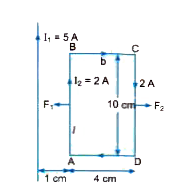
|
|
| 15. |
Figure shows the circuit of a potentiometer . The length of the potentiometerwire AB is 50 cm . Thee.m.f of the battery E_1 is 4 volt , having negligible internal resistance . Values of resistance R_1 and R_2 are 15 ohm and 5 ohm respectively . When both the keys are open, the null point is obtained at a distance of 31.25 cm from end A but when both the keys are closed , the balance length reduce to 5 cm only. Given R_(AB) = 10 Omega The internal resistance of the cell E_(2) is |
|
Answer» `4.5Omega` |
|
| 17. |
A_n YDSE is carried out in a liquid of refractive index mu= 1.3 and thin film of air is formed in from of the lower slit as shown in the figure. If a maxima of third order is formed at the origion O find the thickness of the air film. The wavelength of light in air is 0.78 mu m and (D)/(d)= 1000. |
|
Answer» SOLUTION :`((1)/(MU)-1)t= m (LAMBDA)/(mu)` `0.3t= 3XX 0.78 mu m""t= 7.8 mu m`. 
|
|
| 18. |
The length of a potentiometer wire is L. A cell of emf E is balanced at length L/3 from the positive end of the wire. If the length of wire increases by L/2 then the same cell will give balance point at length : |
|
Answer» 2L/3 |
|
| 19. |
A_n YDSE is carried out in a liquid of refractive index mu= 1.3 and thin film of air is formed in from of the lower slit as shown in the figure. In the above problem find the distance of fourth maxima from 0. |
|
Answer» Solution :`beta= (lambda D)/( MU d)= (0.78)/(1.3)xx 10^(-6)xx 10^(3)= 0.6 MM` Shift in the fringe pattern will be upwards The refrective INDEX of the AIR film is less than the medium Find the maxima `implies : 0.6mm" below "0` `therefore -0.6mm` `therefore 7xx 0.6mm= 4.2mm` above 0 The FOURTH maxima are `4.2mm` above 0 and `0.6mm` below 0. |
|
| 20. |
How do we represent the nuclides ? |
| Answer» SOLUTION :It is REPRESENTED as symbol of the element containing Z PROTONS and (A-Z) i.e., N NEUTRONS. | |
| 21. |
The ratio of angular speed of a second- hand to the hour-hand of a watch is |
|
Answer» `72: 1` HENCE `(omega_(sec))/(omega_("hour"))= (t_("hour"))/(t_(sec))= (12 xx 3600s)/(60S)= 720 THEREFORE omega_(sec): omega_("hour") = 720: 1` |
|
| 22. |
Pick out the correct statement from the following : |
|
Answer» MERCURY vapour lamp produces LINE EMISSION SPECTRUM. |
|
| 23. |
A potential difference of 10V is applied across, a conductor of length 0.1 m. If the drift velocity of electrons is 2xx10^4 m/s, the electron mobility is_______m^2v^(-1)s^(-1). |
| Answer» Answer :D | |
| 25. |
Calcualte the equivalent resistance between the terminals of the cell (figure) The resistance of each equivalent is 1Omega and the intersecting diameters have resistance 2Omega each. |
|
Answer» |
|
| 26. |
Figure shows the circuit of a potentiometer . The length of the potentiometerwire AB is 50 cm . Thee.m.f of the battery E_1 is 4 volt , having negligible internal resistance . Values of resistance R_1 and R_2 are 15 ohm and 5 ohm respectively . When both the keys are open, the null point is obtained at a distance of 31.25 cm from end A but when both the keys are closed , the balance length reduce to 5 cm only. Given R_(AB) = 10 Omega The e.m.f of the cell E_(2) is |
| Answer» Answer :A | |
| 27. |
A potentiometer wire AB of length l = 100 cm and resistance 9Omega is joined to a cell of emf E_(1) = 10 V and internal resistance r_(2) = 2Omega. Another cell of emf E, = 5 V and internal resistance r, = 222 is connected as shown. The galvanometer G will show no deflection when the length AC is |
|
Answer» 50cm |
|
| 28. |
b) What is the magnificiation in this case ? |
|
Answer» SOLUTION :ii) MAGNIFICATION, `m=(v)/(|LUU|)=(25)/(7.14)=3.5` |
|
| 29. |
Two plates of parallel plate capacitor are joined inside with metal rod. The capacitance of a capacitor is ........... . |
|
Answer» zero `:.` NEW CAPACITANCE C = Kc = infinite `xx` C `:. ` C = infinite |
|
| 30. |
A balloon is going vertically upward with a velocity of 15 ms^-1. When it is at a height of 50 m above the ground a stone is gently dropped from it. The stone will reach the ground in time (take g = 10 ms^-2): |
|
Answer» 5 s `:.` Take U as -ve.50=-`15xxt+(1)/(2)10.t^(2)` `implies 5t^(2)-15t-50=0` `implies5t^(2)-15t-50=0` `implies t^(2)-3t-10=0` `implies t=5 s` |
|
| 31. |
A straight section PQ of a circuit lies along the x-axis from x=-(a)/(2) to x=(a)/(2) and carries a steady current i. The magnetic field due to the section PQ at a point x =+a will be |
|
Answer» PROPORTIONAL to a |
|
| 32. |
An oil drop of 12 excess electrons is held stationary under a constant electric field of 2.55xx10^(4) NC^(-1) in Millikan's oil drop experiment. The density of the oil is 1.26 g cm^(-3). Estimate the radius of the drop, (g=9.81 ms^(-2), e=1.60xx10^(-19) C). |
| Answer» SOLUTION :(a) ZERO ,(B) zero(C ) 1.9 N/C | |
| 33. |
A thin spherical conducting shell of radius r_(1) carries a charge Q. Concentric with it is another thin metallic spherical shell of radius r_(2) (r_(2) gt r_(1)). Calculate electric field at distance r when (i) r lt r_(1) ,(ii) r_(1) lt r lt r_(2) and (iii) r gt r_(2). What will be the field in above cases if outer shell (a) is given charge q and (b) is earthed ? |
Answer» Solution :We KNOW that electric field inside a conductor is zero and for EXTERNAL point , whole CHARGE is assumed to be concentrated at centre.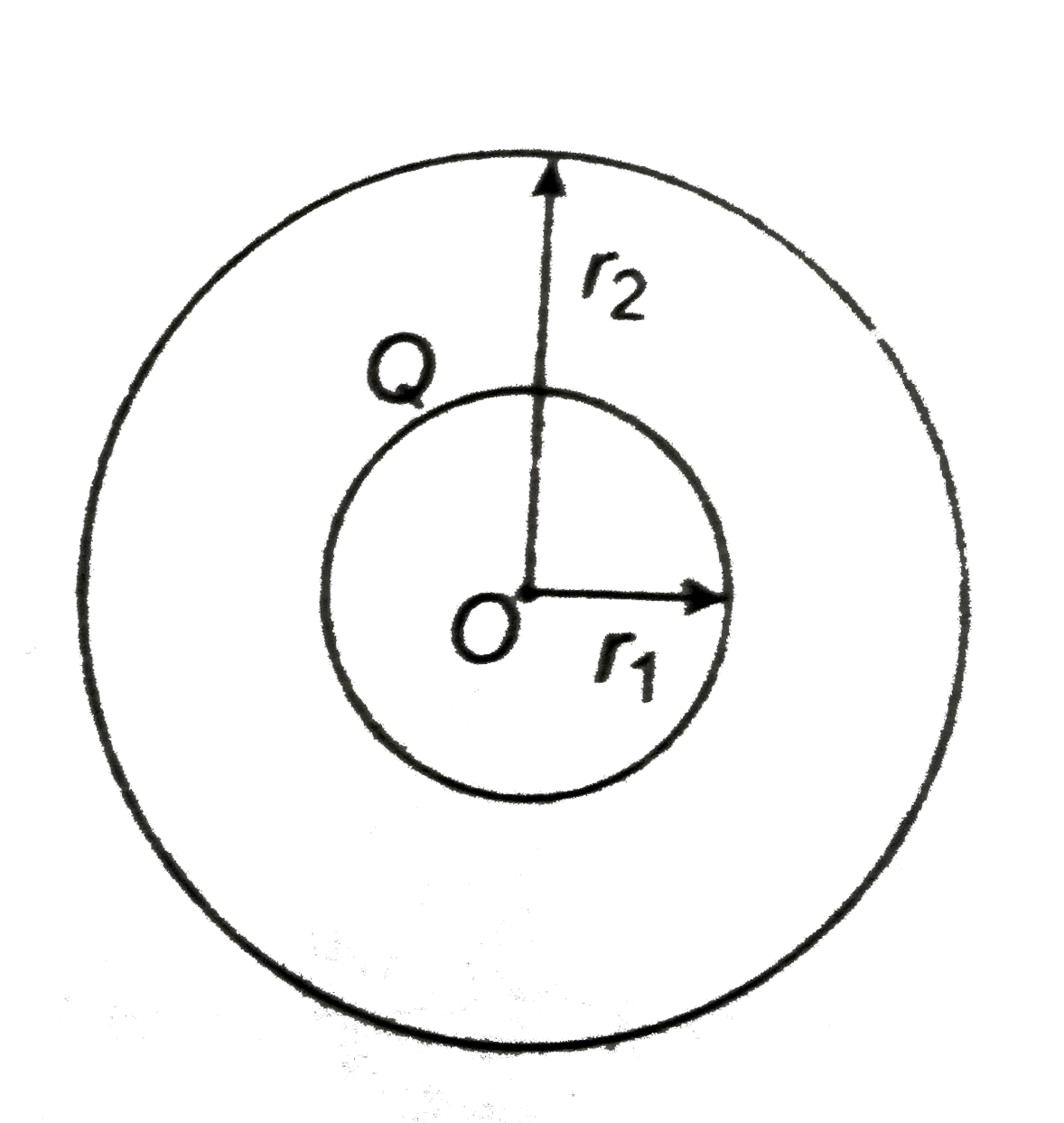 (i) `r lt r_(1) , E = 0` (i) `r lt r_(1) , E = 0` (ii) `r_(1) lt r lt r_(2) , E = (1)/(4pi in_(0)) (Q)/(r^(2))` (iii) `r gt r_(2) , E = (1)/(4 pi in_(0)) (Q)/(r^(2))` (a) 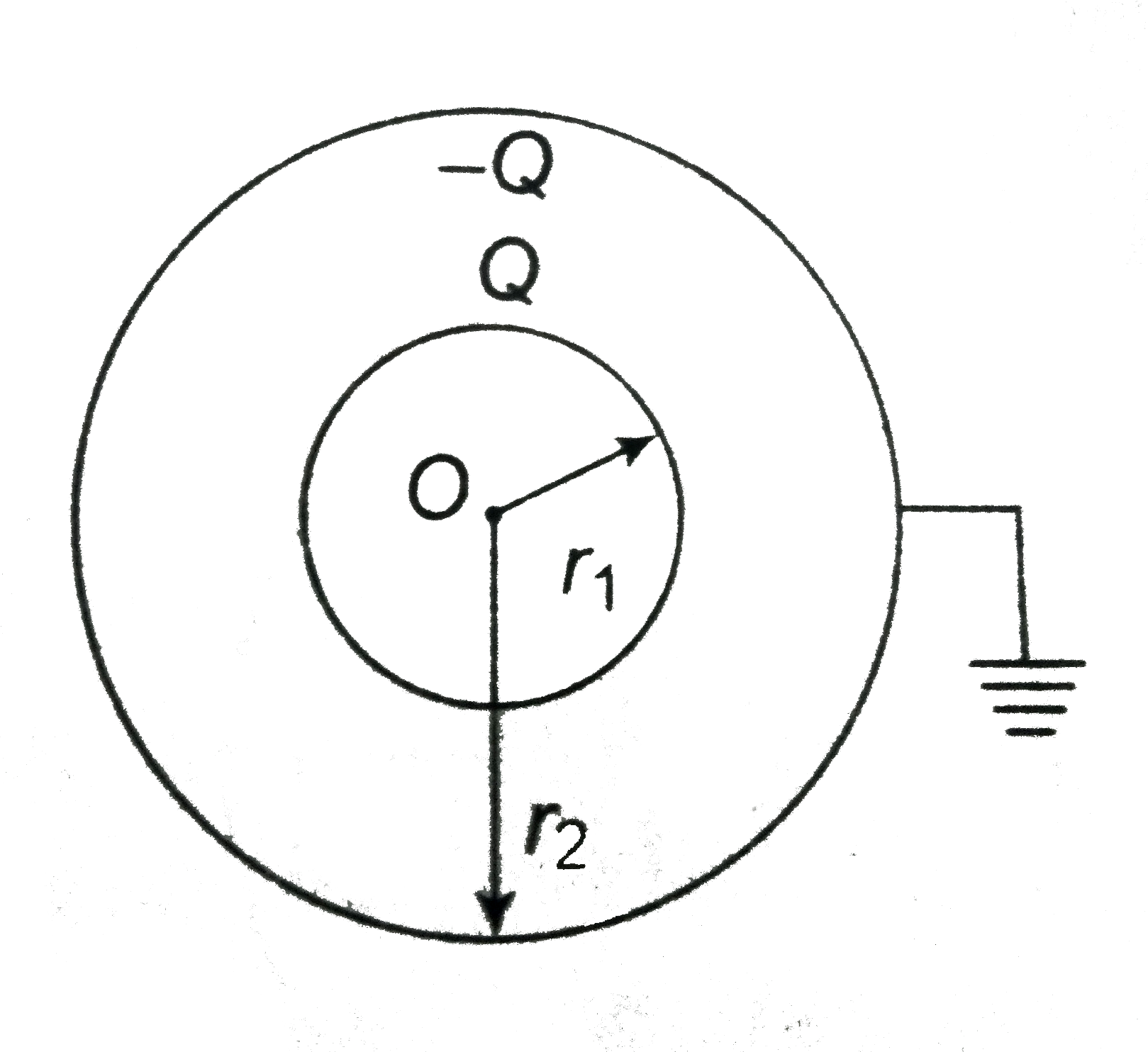 (i) `r lt r_(1) , E = 0` (ii) `r_(1) lt r lt r_(2) , E = (1)/(4 pi in_(0)) (Q)/(r^(2))` (iii) `r gt r_(2) , E = (1)/(4 pi in_(0)) ((Q + q))/(r^(2))` (b)  (i) `r lt r_(1) , E_(0)` (ii) `r_(1) lt r lt r_(2) , E = (1)/(4 pi in_(0)) (Q)/(r^(2))` (iii) Due to eathing , charge on inner surface on outer shell is `-Q`. Therefore, `r gt r_(2) , E = 0` |
|
| 34. |
""^(57)Codecays to ""^(57)Feby beta^(+)- emission. The resulting ""^(57)Feis in its excited state and comes to the ground state by emitting gamma -rays. The half-life beta^(+)-decay is 270 days and that of the gamma -emission is 10^(-8)s . A sample of ""^(57)Cogives 5.0 xx 10^(9)gamma rays per second. How much time will elapse before the emission rate of gamma rays drops to 2.5 xx 10^(9)per second ? |
|
Answer» |
|
| 35. |
A lens is placed in between of source and wall in such a way that the area of images on wall for two different positions are A_1 and A_2 then what would be the area of source ? |
|
Answer» `(A_1+A_2)/2` `thereforeA=sqrt(A_1A_2)` |
|
| 36. |
Derive an expression for the magnetic moment vec(mu) of an electron revolving around the nucleus in terms of its angular momentum vecl. What is the direction of the magnetic moment of the electron with respect to its angular momentum? |
|
Answer» Solution :We know that a revolving electron constitutes an electric current given by `I = e/T = (ev)/(2 pi r)` where `T = (2 pi r)/v` = peroid of revolution of electron revolving in a CIRCULAR orbit of radius r with a speed v. `:.` Magnetic moment `(mu_l)` associated with this CIRCULATING current, `mu_l = I cdot A = (ev)/(2pi r) cdot pi r^2 = (evr)/(2)` As an electron revolving is an anticlockwise direction is equivalent to current in clockwise direction, hence in ACCORDANCE with right hand rule the magnetic moment is in a direction perpendicular to plane of paper (or plane of orbit) directed inward. The above relation may also bewritten as : `mu_l = (e v rm)/(2m ) = e/(2m) cdot l` and in vector notation, `vec(mu)_(l) = -e/(2m) cdot vecl ,` where `l = m v r` = orbital angular momentum of the electron around the nucleus . The -ve sign APPLIED here indicates that the angular momentum of the electorn is opposite in direction to the magnetic moment. 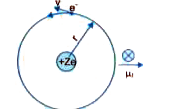
|
|
| 37. |
You may be observed that, the fish inside the aquarium appears to be raised.Obtain an expression for apparent shift of fish |
| Answer» SOLUTION :EXPRESSION for apparent shift is not INCLUDED in the SYLLABUS | |
| 38. |
In Young's Double slit Experiment, if one of the slits is closed, what happens? |
| Answer» SOLUTION :Only a WHITE PATCH is OBTAINED. | |
| 39. |
Balmer series lies in which spectrum? |
|
Answer» VISIBLE |
|
| 40. |
A ball of mass m suspended by a weightless spring can perform vertical oscillations with damping coefficient beta. The natural oscillation frequency is equal to omega_(0). Due to the external vertical force varying as F=F_(0) cos omegatthe ball performssteady - state harmonic oscillations. Find : (a) the mean power ( :P : ) , develocped by the force F. averaged over one oscillations perod, (b) the frequency omega of the force F at which ( : P : ) is maximum, what is ( : P : )_(max) equal to ? |
|
Answer» SOLUTION :Here as usual ` tan varphi=( 2 beta OMEGA)/( omega_(0)^(2)- omega^(2))`where `varphi` is the phase LAG of the displacement `x= a cos ( omegat - varphi), a =(F_(0))/(m) (1)/( sqrt((omega_(0)^(2)- omega^(2))^(2)+ 4 bets ^(2) omega^(2)))` `(a) ` MEAN power DEVELOPED by the force over one oscillation period `=(pi F_(0) a sin varphi)/(T)=(1)/(2) F _(0) a sin varphi` `=(F_(0))/( m) ( beta omega^(2))/( (omega_(0)^(2)- omega^(2))^(2)+ 4 beta^(2) omega^(2))=( F_(0)^(2)beta)/( m) (1)/( ((omega_(0)^(2))/( omega)-omega)^(2)+4 beta^(2))` `(b)` Mean power `lt Pgt`is maximum when `omega= omega_(0)` `(` for the denominator is then minimum Also `lt P gt _(max)=(F_(0)^(2))/( 4 m beta)` |
|
| 41. |
निम्न में से कौन-सा कथन जैविक नामकरण के सर्वमान्यनियमों के लिये गलत है? |
|
Answer» जैविक नाम या तो लैटिन भाषा से व्युत्पन्न होते हैं या इनका लैटनीकरण हो |
|
| 42. |
One slab of p type, if physically join to another n type semiconductor, there is no possibility for the formation of pn junction because |
|
Answer» Continuous contact at the atomic LEVEL is not possible |
|
| 43. |
For wiring in the home, one uses Cu wires or Al wires. What considerations are involved in this ? |
|
Answer» Solution :In household wiring Cu wire or Al wire are used. It is based on CRITERIA of COST and conductivity. Copper is costlier than aluminum. For EQUAL length of wire aluminium is lighter than copper wire. Hence in household wire aluminium wire is more used. Aluminium is also good conductor. Note : Silver or iron wire also can be used but silver wire is very COSTLY and iron wire get rusted over IONS period of time. |
|
| 44. |
What is the nature of Gaussian surface involved in Gauss law of electrostatic ? |
|
Answer» Scalar |
|
| 45. |
The frequency of the simple harmonic motion attained in forced oscillations, after the forced oscillation die out, is |
|
Answer» the NATURAL frequency of the particle |
|
| 46. |
(A) Hydrogen atom consists of only one electron but its emission spectrum has many lines. (R) Only Lyman series is found in the absorption spectrum of hydrogen atom whereas in the emission spectrum, all the series are found. |
|
Answer» Both 'A' and 'R' are true and 'R' is the CORRECT explanation of 'A'. |
|
| 47. |
The resonant frequency of a circuit is f. If the capacitance is made 4 times the initial values, then the resonant frequency will become …… |
|
Answer» `f/2` In `2pif 1/sqrt(LC) 2PI` and L equal `THEREFORE f prop 1/sqrtC` `therefore (f_2)/(f_1)=sqrt(C_1/C_2)=sqrt(C/(4C))=1/2` `therefore f_2=f_1/2` but `f_1=f` `therefore f_2=f/2` |
|
| 48. |
The magnetic induction at a point on the axis of a short magnetic dipole is : |
|
Answer» ` B = mu_0/(4PI) (2M)/r^3` |
|
| 49. |
On dividing a polynomial p(x) by a nonzero polynomial g(x), let q(x) be the quotient and r(x) be the remainder then p(x)-g(x)xq(x)+r(x), where |
|
Answer» r(X)=0 always |
|
| 50. |
For a radioactive material, half – life is 10 minutes. If initially there are 600 number of nuclei, the time taken (in minutes) for the disintegration of 450 nuclei is |
|
Answer» 20 |
|