

Saved Bookmarks
This section includes 7 InterviewSolutions, each offering curated multiple-choice questions to sharpen your Current Affairs knowledge and support exam preparation. Choose a topic below to get started.
| 1. |
1 gram of ice is mixed with 1 gram of steam. At themal equilibrium, the temperature of the mixture is : |
|
Answer» `100^(@)` |
|
| 2. |
(A): A capacitor of suitable capacitance can be used in an A.C. circuit in place of the choke coil. (R): A capacitor blocks D.C. and allows A .C. only. |
|
Answer» Both 'A' and 'R' are true and 'R' is the correct EXPLANATION of 'A'. |
|
| 3. |
Which one of the following electrical meter has the smallest resistance ? |
|
Answer» AMMETER |
|
| 4. |
helium-Neon laser emit monochromatic light of 667 nm abd produce power of 9 kW.number of photon reaching to target every second will be……… |
|
Answer» `3xx10^(16)` `P=(Nhc)/(lambda)`,N=no.of photon EMITTED every second `N=(9xx10^(-3)xx667xx10^(-9))/(6.6xx10^(-34)xx3xx10^(8))` `=(9xx6.67xx10^(-10))/(3xx6.6xx10^(-26))~~3xx10^(16)S` |
|
| 5. |
A crystal diffracts monochromatic x-rays. If the angle of diffraction of the second order is 90^(@), then that for the first order will be |
|
Answer» `60^(@)` |
|
| 6. |
A far sighted man who has lost his spectacles, reads a book by looking through a small hole (3-4 mm )in a sheet of paper. The reason will be |
|
Answer» Because the HOLE PRODUCES an image of the letters at a longer distance |
|
| 7. |
The magnetic needle of a vibration magnetometer completes 10 oscillations in 92s. When a small magnet is placed in the magnetic meridian 10 cm due north of the needle, it completes 15 oscillations in 69s. Find the magnetic moment of the magnet (B_H=0.3G) |
| Answer» SOLUTION :`0.45 Am^(2) or 0.15 Am^(2)` | |
| 8. |
A storage battery of emf 12V and internal resistance of1.5 Omegaisbeingchargedby a 12 Vsupply. How muchresistance isto beput in seriesfor chargingthebatterysafely, be maintainingaconstant chargingcurrent of 6 A. |
| Answer» SOLUTION :R = `16.5 OMEGA ` | |
| 9. |
A calorimeter of specific heat 0.42 J/gm.^(@)C and weighing 40 g contains 50 g of water mixed with 50 g of ice. Dry steam at 100^(@)C is passed into the mixture until the temperature rises to 20^(@)C. Find the mass of steam condensed. |
|
Answer» |
|
| 10. |
A bird is tossing (flying to and fro) between two cars moving towards each other on a straight road. On car has speed of 27 km h^(-1) while the other has the speed of 18 km h^(-1) . The bird starts moving with the speed of 36 km h^(-1) when the two cars were separated by 36 km. The total distance covered by the bird is |
|
Answer» `28.8 KM` |
|
| 12. |
UsingBohr's postulates , obtain the expreesion for the total energy in the stationary states of hydrogen atom . Hence , draw the energylevel diagram showinghow the line spectra correspondingto Balmer series occur duetotransition betweenenergy levels. |
|
Answer» Solution :According to Bohr.s firstpostulate , an electron is revolvingaroundthe nucleus ofhydrogenin a circularorbitsuch thatcentripetal force is provided by electronstaticforce of attraction experiencedby electron due toproton . Thus, we have ` (m v_(n)^(2))/(r_(n)) =(1)/(4 pi in_(0)) .(e^(2))/(r_(n)^(2)) rArrm v_(n)^(2) r_(n) = (e^(2))/(4 pi in_(0))"".......(i)` Again according to Bohr.s quantum condition , we have `m v_(n) r_(n) =n (h)/(2PI)""........(ii)` Dividing (i) by (ii) , weget`v_(n) = (e^(2))/(2 in_(0) n h) ` andfrom(ii) `r_(n) =(n h)/(2 pi m v_(n)) = (nh)/(2pi m((e^(2))/(2in_(0) nh))) = (in_(0) n^(2) h^(2))/(pi m e)` `THEREFORE ` Kineticenergyof revolvingelectron `k_(n) = ( 1)/(2) mv_(n)^(2) = (1)/(2) m ((e^(2))/(2 in_(0) n h)) = (m e^(4))/( 8 in_(0)^(2) n^(2) h^(2))` Again electrostatic potential energy of electron (charge `q_(1)` = -e) PROTON (charge `q_(2)` = + e) system `U_(n) = (1)/(4 pi in_(0)) .(q_(1) q_(2))/(r_(n)) =- (1)/(4 pi in_(0))(e^(2))/(r_(n)) = - ( me^(4))/( 4 in_(0)^(2) n^(2) h^(2))` `therefore `Total energy of the revolving electron in nth orbit will be `E_(n)= K_(n) + U_(n) = (me ^(4))/(8 in_(0)^(2) n^(2) h^(2)) - (m e^(4))/(4 in_(0)^(2) n^(2) h^(2)) =- (me^(4))/( 8 in_(0)^(2) n^(2) h^(2))` The energy level diagram is given in Fig. 12.08. |
|
| 13. |
Energyreleasedby 1kg . U^(235) whenit isfissoned |
|
Answer» `8 XX 10^(10) KWH` |
|
| 14. |
A vessel completely filled wit water is suspended with help of strings from a spring balance as shwon in figure. A cork is plugged at the bottom of the vessel. If the initial reading of the spring balannce is W_(0). Then the reading of the spring balance just after the cork is removed and the liquid begins to flow out will be [rho= density of liquid & A=coss -sectional area of narrow pipe] |
|
Answer» `W_(0)+rhogHA` `thereforeFDeltat=Deltap=rhoAv^(2)Deltat` or `F=rhoAv^(2)=2rhogHA` `therefore` READING of spring balance `=W_(0)-2rhogHA` |
|
| 15. |
What is the magnanitude of magnetic force per unit length on a wire carrying a current of 8 A and making an angle of 30^(@) with the direction of a uniform magnetic field of 0.15 T ? |
|
Answer» Solution :I =8A, `THETA = 30^@`, B = 0.15 T `F= Bl // sin theta` `F/l = BI sin theta = 0.15 xx 8 xx sin 30 = 0.6 Nm^(-1)` |
|
| 16. |
If height of transmitting tower increases by 21% then the to be covered increases by |
| Answer» Answer :B | |
| 17. |
The temperature of 10 moles of a gas is increased from 30^@Cto 80^@C constant pressure . If R=8.2J/"mole"K,then the external work done in this process is |
|
Answer» 410J |
|
| 18. |
A simple microscope consists of a concave lens of power -10D and convex lens of power +20D in contact. If the image formed at infinity, then calculate the magnifying power (D=25cm) |
|
Answer» Solution :(a) POWER of COMBINATION `P=P_(1)+P_(2)` `P=+20-10=+10D` `F=1/P=1/10m=100/10cm=10cm` For final image at infinity `M=D/F=25/10=2.5` |
|
| 19. |
An electron and a proton having same momenta enter perpendicularly to a magnetic field, then |
|
Answer» CURVED path of ELECTRON and PROTON will be same (IGNORING the sense of revolution) |
|
| 20. |
Gauss's law in magnelism ensures that |
|
Answer» MAGNETIC monopoles do not exist |
|
| 21. |
Two blocksof masses 10 kg and 4 kg are connected by a spring of negligible mass and placed on a frictionless horizontal surface. An impulse gives a velocity of 14m/s to the heavier block in the direction of the lighter block. The velocity of the centre of mass is : |
|
Answer» 5 m/s `THEREFORE` By conservation of linear momentum `MV=(M+m)V_(C)` `V_(C)=(10xx14)/(10+4)=10ms^(-1)` |
|
| 22. |
Which of the following one, the capacitance of parallel plate capacitor does not depend ? |
|
Answer» On the area of the plate |
|
| 23. |
Answer question on the basis of your understanding of the followingparagraph and the related studied concepts : Bulk matter is made up of many molecules, which are so closely packed that the electrons are no longer attached to individual nuclei. In metallic conductors some of the electrons are practically free to move within the bulk material. Ordinarily, the electrons will be moving due to thermal motion during which they collide with the fixed ions. An electron colliding with an ion emerges with the same speed as before the collision. However, the direction of its velocity after the collision is completely random and there is no preferential direction for the velocities of the electrons. So number of electrons travelling in any direction will be equal to the number of electrons travelling in the opposite direction and there will be no net flow of electrons and hence no net current.When an external electric field vecE is applied across a piece of conductor, electrons will beaccelerated at veca = (e vecE)/(m) . If veca was the velocity of electron after the last collision then velocity vec v_tafter a time t will be vecv_t = vecu + veca tThe average velocity of the electrons at time t is the average of allvec v' s. However, average value of vecu's is zero. As collisions of the electrons occur at random times, let tau be the average time betweensuccessive collision and then the average velocity electrons is expressed as vecv_d (known as the drift velocity) and is given as:vecv_d = - (e vecE)/(m) tau This drift motion of electrons is responsible for establishment of an electric current in the conductor on applying an external electric field across it. The magnitude of current is given as : I = nAev_d, where n= number density of free electrons and A = cross-section area of the conductor. It is to be noted here that drift speed is estimated to be of the order of 10^(-3) ms^(-1)for currents in the range of a few amperes.What is the rate of flow of electric field through the conductor ? |
| Answer» Solution :ELECTRIC field (or electrical energy) leavels at the speed of LIGHT `(c = 3 xx 10^8 m s^(-1))`inside THECONDUCTOR. | |
| 24. |
State and explain Gauss's law in magnetism. |
|
Answer» SOLUTION :Statement:- The net magnetic flux through any closed SURFACE is always zero. `i, e sumbarB.bar(ds) = 0` EXPLANATION:  Consider a Gaussian surface enclosed in a magnetic field `VECB`. SINCE the total magnetic field flux entering the Gaussion surface is equal to number of field lines leaving the closed surface. Hence total magnetic flux is through the Gaussian surface is always zero. |
|
| 25. |
Answer question on the basis of your understanding of the followingparagraph and the related studied concepts : Bulk matter is made up of many molecules, which are so closely packed that the electrons are no longer attached to individual nuclei. In metallic conductors some of the electrons are practically free to move within the bulk material. Ordinarily, the electrons will be moving due to thermal motion during which they collide with the fixed ions. An electron colliding with an ion emerges with the same speed as before the collision. However, the direction of its velocity after the collision is completely random and there is no preferential direction for the velocities of the electrons. So number of electrons travelling in any direction will be equal to the number of electrons travelling in the opposite direction and there will be no net flow of electrons and hence no net current.When an external electric field vecE is applied across a piece of conductor, electrons will beaccelerated at veca = (e vecE)/(m) . If veca was the velocity of electron after the last collision then velocity vec v_tafter a time t will be vecv_t = vecu + veca tThe average velocity of the electrons at time t is the average of allvec v' s. However, average value of vecu's is zero. As collisions of the electrons occur at random times, let tau be the average time betweensuccessive collision and then the average velocity electrons is expressed as vecv_d (known as the drift velocity) and is given as:vecv_d = - (e vecE)/(m) tau This drift motion of electrons is responsible for establishment of an electric current in the conductor on applying an external electric field across it. The magnitude of current is given as : I = nAev_d, where n= number density of free electrons and A = cross-section area of the conductor. It is to be noted here that drift speed is estimated to be of the order of 10^(-3) ms^(-1)for currents in the range of a few amperes.Guess the order of magnitude of thermal speed of free electrons in a conductor in the absence of an external electric field. |
| Answer» Solution :Thermal SPEED of electrons is given as ` = sqrt( (3k_B T)/(m))` where `k_B`is Boltzmann.s current andT= ROOM temperature and its VALUE is of the order of `10^5 MS^(-1)`. | |
| 26. |
To cover a population of 20 lakh, a transmission tower should have a height of (radius of the earth = 6,400 km, population 1000//km^(2)). |
|
Answer» 25 m |
|
| 27. |
At time t = 0 s, voltage of an A.C. generator starts from 0 V and becomes 2V at time t = 1/(100pi)s.The voltage keeps on increasing up to 100 V, after which it starts to decrease. Find the frequency of the generator. |
|
Answer» 2 Hz `therefore V=V_m SIN omegat` Now , `t=1/(100pi) RARR` from V=2V to V =100 V `therefore V_m` = 100 V Now, `V=V_m sin omegat` `therefore 2 = 100 sin (2pi ft)` `therefore 2/100=sin ((2pifxx1)/(100pi))` `therefore 1/50=sin(f/50)` If ANGLE is small then sin `(f/50) approx f/50` `therefore 1/50=f/50` `therefore` f=1 Hz |
|
| 28. |
A magnetic dipole is under the effect of two magnetic fieldinclined at 75^(@)to each other one of the fieldshas a magnitude of 1.5xx10^(-2)t the magnets come to stablethe magnitude of othe field is |
|
Answer» `(15)/(2sqrt(2))xx10^(-2)T` `B_(2)=?` In equilibrium position `tau_(1)=tau_(2)` `MB_(1) sin theta_(1)=MB_(2) sin theta_(2)` `1.5 xx10^(-21) xxsin30^(@)=B_(2)xxsin 45^(@)` 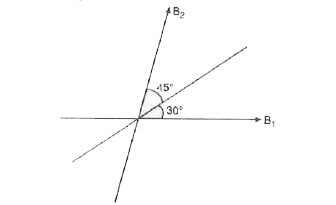
|
|
| 29. |
Green house gases are- |
|
Answer» CFC, `O_(3)` and water VAPOURS |
|
| 30. |
A circle, having radii 'a' has line charge distribution over its circumference having linear charge densitylambda = lambda_(0)cos^(2)theta. Calculate the total electric charge residing on the circumference of the circle. [Hint: int_(0)^(2pi)cos^(2)d theta =pi] |
Answer» Solution :The length of an INFINITESIMALLY SMALL lint element shown in fig. is ADD, then the CHARGE or the line element is 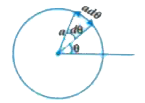 `dq = lambda AD theta (therefore lambda = q/l)` `therefore dq = lambda_(0)cos^(2)theta.d theta`………(i) `(therefore lambda = lambda_(0)cos^(2)theta)` In order to calculate the total charge Q residing on the surface, we have to intigrate dq over the entire surface `therefore Q = int_(0)^(2pi) lambda_(0)cos^(2)theta.d theta` `=alambda_(0) int_(0)^(2pi)cos^(2)theta.d theta` `therefore Q = alambda_(0)pi``(therefore int_(0)^(2pi)cos^(2)theta d theta = pi)` |
|
| 31. |
A shower of protons from outer space deposits equal charges +q on the earth and the moon, and the electrostatic repulsion exactly counter balances the gravitational attraction, How large is q ? |
| Answer» Solution :Here, ELECTROSTATIC repulsive FORCE= gravitational ATTRACTIVE force i.e., `(1)/(4pi in_(0)).(q^(2))/(r^(2)) = (GM_(e )M_(m))/(r^(2)) or q= sqrt(4pi in_(0)GM_(e)M_(m))` | |
| 32. |
Find the magnetic force on a short magnet of magnetic dipole moment M_(2) due to another short magnet of magnetic dipole moment M_(1). |
|
Answer» Solution :To find the magnetic force we will use the formula of `B` due to a magnet.We will also assume `m` and `-m` as pole strengths of `N` and `S` of `M_(2)`.Also length of `M_(2)` as `2a.B_(1)` and `B_(2)` are the strengths of the magnetic field due to `M_(1)` at `+m` and `-m` respectively.They experience magnetic forces `F_(1)` and `F_(2)` as shown. `F_(1)=2(mu_(0)/(4pi))M_(1)/(r-a)^(3)m` and `F_(2)=2(mu_(0)/(4pi))M_(1)/(r-a)^(3)m` `:. F_(res=F_(1)-F_(2)=2((mu_(0))/(4pi))M_(1)m[(1/(r-a)^(3))-(1/(r+a)^(3))]` `=2((mu_(0))/(4pi))(M_(1)m)/r^(3)[(1-a/r)^(-3)-(1+a/r)^(-3)]` By using acceleration, Binomial expansion, and neglecting TERMS of high power we get `F_(res)=2((mu_(0))/(4pi))(M_(1)m)/r^(3)[1+(3a)/r-1+(3a)/r]` `=2((mu_(0))/(4pi))(M_(1)m)/r^(3)(6a)/r` `=2((mu_(0))/(4pi))(M_(1)3M_(2))/r^(4)` `=6((mu_(0))/(4pi))(M_(1)M_(2))/r^(4)` Direction of `F_(res)` is towards RIGHT. Alternative Method `=B((mu_(0))/(4pi))(2M_(1))/r^(3)rArr (dB)/(dr)=-(mu_(0))/(4pi)XX(6M_(1))/r^(4)` `F=-M_(2)xx(dB)/(dr) rArr F=((mu_(0))/(4pi))(6M_(1)M_(2))/r^(4)` 
|
|
| 33. |
The ratio in which x -axis divides the line segment joining (3,6) and (12,-3) is |
|
Answer» Passing through centre of gravity |
|
| 34. |
A simple pendulum of period T has a metal bob which is negatively charged. If it is allowed to oscillate above a positively charge metal plate, its period will be |
|
Answer» REMAINS EQUAL to T |
|
| 35. |
A capacitor of capacitnace C is charged to a potential difference V and then disconnected from the battery. Now it is connected to an inductor of inductance L at t=0. Then |
|
Answer» Energy stored in capacitor and INDUCTOR will be equal at TIME `t=(pi)/(2)sqrtLC` |
|
| 36. |
A certain charge distribution produces electric potential that varies along the X axis as shown in figure. [There is no field in y or z direction] (a) At which point (amongst A, B, C, D and E) does a negative charge feel the greatest force in positive X direction? (b) Find the upper limit of the speed that a proton can have, as it passes through the origin, and still remain bound near the origin. Mass and charge of a proton are m and e. How will your answer change for an electron? |
|
Answer» (b). `SQRT((2eV_(0))/(m))` ELECTRON cannot remain BOUND for any speed. |
|
| 37. |
A man weighing 60 kg is standing on a trolley weighing 240 kg. The trolley is resting on a frictionless horizonral rails. If the man starts walking on the trolley with a constant speed of 1 ms^(-1) then after 4 second. The displacement of the man relative to the ground is : |
|
Answer» 4.2 m `60 xx 1 = (60+ 240) upsilon` or `upsilon= 0.2 MS^(-1)` Resultant speed of man `= (1 -0.2) = 0.8 ms^(-10)` Now `S = UT = 0.8 xx 4 = 3.2 m` (c) is the CHOICE. |
|
| 38. |
Answer question on the basis of your understanding of the followingparagraph and the related studied concepts : Bulk matter is made up of many molecules, which are so closely packed that the electrons are no longer attached to individual nuclei. In metallic conductors some of the electrons are practically free to move within the bulk material. Ordinarily, the electrons will be moving due to thermal motion during which they collide with the fixed ions. An electron colliding with an ion emerges with the same speed as before the collision. However, the direction of its velocity after the collision is completely random and there is no preferential direction for the velocities of the electrons. So number of electrons travelling in any direction will be equal to the number of electrons travelling in the opposite direction and there will be no net flow of electrons and hence no net current.When an external electric field vecE is applied across a piece of conductor, electrons will beaccelerated at veca = (e vecE)/(m) . If veca was the velocity of electron after the last collision then velocity vec v_tafter a time t will be vecv_t = vecu + veca tThe average velocity of the electrons at time t is the average of allvec v' s. However, average value of vecu's is zero. As collisions of the electrons occur at random times, let tau be the average time betweensuccessive collision and then the average velocity electrons is expressed as vecv_d (known as the drift velocity) and is given as:vecv_d = - (e vecE)/(m) tau This drift motion of electrons is responsible for establishment of an electric current in the conductor on applying an external electric field across it. The magnitude of current is given as : I = nAev_d, where n= number density of free electrons and A = cross-section area of the conductor. It is to be noted here that drift speed is estimated to be of the order of 10^(-3) ms^(-1)for currents in the range of a few amperes.If the electron drift speed is so small and the electron charge is small, how can we stillobtain large amounts of current even in a thin conducting wire ? |
| Answer» Solution :We can get a large CURRENT because electron NUMBER density n is ENORMOUS `(= 10^29 m^(-3))` | |
| 39. |
Two blocks of wood of masses m_(1) and m_(2) and each of specific givity 0.5 are submerged at a depth of h_(1) and h_(2) in v vessel (h_(2)gth_(1)) filled with water, which is accelerated upwards with an acceleration g/2. The difference in time taken by the blocks to reach the surface, when frleased with zero velocity is |
|
Answer» ZERO SIMILARLY `a_(2) = 2g` Acceleration relative to water = 3g/2 `t_(l)=2sqrt((h_(1))/(3g))` `t_(2)=2sqrt((h_(2))/(3g))` `thereforet_(2)-t_(1)=2sqrt(((h_(2)-h_(1)))/(3g))` |
|
| 40. |
Out of the following, which is not an essential element of a communication system ? |
|
Answer» transmitter |
|
| 41. |
Answer question on the basis of your understanding of the followingparagraph and the related studied concepts : Bulk matter is made up of many molecules, which are so closely packed that the electrons are no longer attached to individual nuclei. In metallic conductors some of the electrons are practically free to move within the bulk material. Ordinarily, the electrons will be moving due to thermal motion during which they collide with the fixed ions. An electron colliding with an ion emerges with the same speed as before the collision. However, the direction of its velocity after the collision is completely random and there is no preferential direction for the velocities of the electrons. So number of electrons travelling in any direction will be equal to the number of electrons travelling in the opposite direction and there will be no net flow of electrons and hence no net current.When an external electric field vecE is applied across a piece of conductor, electrons will beaccelerated at veca = (e vecE)/(m) . If veca was the velocity of electron after the last collision then velocity vec v_tafter a time t will be vecv_t = vecu + veca tThe average velocity of the electrons at time t is the average of allvec v' s. However, average value of vecu's is zero. As collisions of the electrons occur at random times, let tau be the average time betweensuccessive collision and then the average velocity electrons is expressed as vecv_d (known as the drift velocity) and is given as:vecv_d = - (e vecE)/(m) tau This drift motion of electrons is responsible for establishment of an electric current in the conductor on applying an external electric field across it. The magnitude of current is given as : I = nAev_d, where n= number density of free electrons and A = cross-section area of the conductor. It is to be noted here that drift speed is estimated to be of the order of 10^(-3) ms^(-1)for currents in the range of a few amperes.Are the paths of electrons straight lines between successive collisions in the (i) absence of electric field, (ii) presence of electric field ? |
|
Answer» Solution :(i)In the absence of electric field the PATH of electron between two successive collision is a straight line because `vec MU`remains unchanged. (ii) In the presence of electric field `vecE`, path of electron is in general a curved path because `vecu`and `veca` t NEED not be in same directions. |
|
| 42. |
Column I gives a situation in which two dipoles of dipole moment p hat(i) and sqrt(3)phat(j) are placed at origin. A circle of radius R with centre at origin is drawn as shown in figure. Column II gives coordinates of certain positions on the circle. Match the statements in Column I with the statements in Column II. |
|
Answer» <P> |
|
| 43. |
A circular coil of wire of radius 'r' has 'n' turns and carries a current 'I'. The magnetic induction (B) at a point on the axis of the coil at a distance sqrt3r from its centre is |
|
Answer» `(mu_(0)In)/(4r)` |
|
| 44. |
Consider the following statements (A) and (B)and identify the correct answer given below. Statement (A): Positive values of packing fraction implies a large value of binding energy Statement (B): The difference between the mass of the nucleus and the mass number of the nucleus is called packing fraction |
|
Answer» (A) and (B) are CORRECT |
|
| 45. |
Answer question on the basis of your understanding of the followingparagraph and the related studied concepts : Bulk matter is made up of many molecules, which are so closely packed that the electrons are no longer attached to individual nuclei. In metallic conductors some of the electrons are practically free to move within the bulk material. Ordinarily, the electrons will be moving due to thermal motion during which they collide with the fixed ions. An electron colliding with an ion emerges with the same speed as before the collision. However, the direction of its velocity after the collision is completely random and there is no preferential direction for the velocities of the electrons. So number of electrons travelling in any direction will be equal to the number of electrons travelling in the opposite direction and there will be no net flow of electrons and hence no net current.When an external electric field vecE is applied across a piece of conductor, electrons will beaccelerated at veca = (e vecE)/(m) . If veca was the velocity of electron after the last collision then velocity vec v_tafter a time t will be vecv_t = vecu + veca tThe average velocity of the electrons at time t is the average of allvec v' s. However, average value of vecu's is zero. As collisions of the electrons occur at random times, let tau be the average time betweensuccessive collision and then the average velocity electrons is expressed as vecv_d (known as the drift velocity) and is given as:vecv_d = - (e vecE)/(m) tau This drift motion of electrons is responsible for establishment of an electric current in the conductor on applying an external electric field across it. The magnitude of current is given as : I = nAev_d, where n= number density of free electrons and A = cross-section area of the conductor. It is to be noted here that drift speed is estimated to be of the order of 10^(-3) ms^(-1)for currents in the range of a few amperes.Define drift velocity. On what factors does it depend ? |
| Answer» Solution :Drift VELOCITY of electrons is the constant average velocity of electrons in a conductor when an ELECTRIC FIELD is present across the conductor. Its value depends on (i) magnitude of electric field E, and (ii) the average time between SUCCESSIVE collision of electrons (known as relaxation period) which in turn depends on MATERIAL of the conductor. | |
| 46. |
For a person near point of vision is 100 cm. Then the power of lens he must wear so as have normal vision, should be |
| Answer» Solution :`f=(yD)/(y-D)=(100xx25)/(100-25)=(100)/(3)CM=(1)/(3)cm,p=(1)/(f)=+3D` | |
| 47. |
A magnetic field of 2 xx 10^(-2)T acts at right angles to a coil of area 100cm^(2) with 50 turns. If the average emf induced in the coil is 0.1V when it is removed from the field in time t. The value of .t. is |
|
Answer» 0.1s |
|
| 48. |
Two identical coils, one of copper and the other of aluminium are rotated with the same angular speed in an external magnetic field. In which of the two coils will the induced current be more ? |
|
Answer» Solution :COPPER COIL. [Hint : Induced emf in both COILS is same as per Faraday.s law but induced current is more in copper coil because its RESISTANCE is less than that of ALUMINIUM coil.] |
|
| 49. |
A thin equi-convex lens having radius of curvature 10 cm is placed as shown in figure. Calculate focal length of the lens, if parallel rays are incident as shown. |
|
Answer» `120/7` CM |
|
| 50. |
A liquid of density p flows along a horizontal pipe of uniform cross - section A with a velocity v through a right angled bend as shown in fig. What force has to be exerted at the bend to hold the pipe in equilibrium? |
Answer» Solution :Change in momentum of MASS `Deltam` of liquid as it PASSES through the BEND 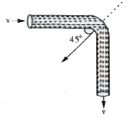 `Deltap =P_(f)-P_(i)` `=Deltamv sqrt(2)` `F =(DeltaP)/(Deltat) = sqrt(2) xx (Deltam)/(Deltat)`, [as `Deltam = rho ADeltaL`] `F=sqrt(2)v(rho.ADeltaL)/(Deltat)`, [as `DeltaL//Deltat=v`] `F=sqrt(2)rhoAv^(2)` So the FORCE to be applied at the bend to hold it in position is`sqrt(2)rhoAv^(2)`in the direction as shown in fig. (Otherwise pipe will move in OPPOSITE direction.) |
|