

Saved Bookmarks
This section includes 7 InterviewSolutions, each offering curated multiple-choice questions to sharpen your Current Affairs knowledge and support exam preparation. Choose a topic below to get started.
| 1. |
A dipole of dipole moment p is placed at origin along x axis. Another dipole of dipole moment also p is kept at (0, 1, 0) along y axis. Find the resultant potential and electric field at (1, 0, 0). |
|
Answer» Solution :We have studied that the electric field and potential both obey the law of superposition. We can find the electric field and the potential due to each of the dipole at the point concerned and then add them. The caution to be exercised is that while finding the electric field/potential due to a given dipole, we need to consider the center of that dipole as the origin. Calculation: Due to the FIRST dipole at the origin, the potential is `V_1 = (KP cos theta)/( r^2) = ( kp)/(1^2) = kp` Due to the second dipole at y = 1, the potential is `V_(2) = (kp cos theta)/( r^2) = ( kp) /( sqrt(2)^2) cos 135^(@) = (kp)/( 2 SQRT2)` Therefore, `V= V_(1) + V_(2) = kp- (kp sqrt2)/( 4)""`. (Answer) Similarly, the electric field in the radial direction due to the first dipole is `E_(r 1) = ( 2k p cos 0)/( r^3) overset(^) (i) = 2k p overset(^)(i)`. Here, the radial direction is also the x direction as can be seen from FIG. 24-35. `E_(p1) = ( 2k p sin 0)/( r^3) overset(^) (j) = 0 overset(^)(j)`. 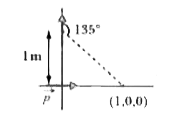 Here, the polar direction is the positive y direction. The magnitude of the electric field in the radial direction due to the second dipole is `- cos 45 overset(^) (i) - sin 45 overset(^)(j) E_(r2) = ( 2k p) /( 2 sqrt2) cos 135^(@) = - (kp)/(2).` Here, the radial direction is shown in Fig. 24-36. A unit vector in the radial direction will be cos `45overset(^)(i) - sin 45 overset(^)(j)`. So, `E_(r2) =- (kp)/(2) ((overset(^)(i))/(sqrt2) - (overset(^)(j))/(sqrt2)).` Similarly, the electric field in the polar direction will be given by `overset(to) (E_(p2))= (kp sin 135^(@) )/( ( sqrt2)^(3)) (- (overset(^)(i) )/( sqrt2)- (overset(^)(j))/(sqrt2))`. 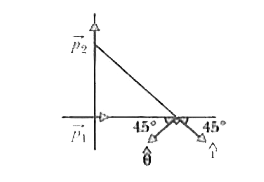 Because a unit vector in polar direction will be `- cos 45 overset(^)(i) - sin 45 overset(^)(j)`, so we have `overset(to)(E) = 2kp overset(^)(i) - (kp)/( 2 sqrt2) overset(^)(i) + (kp)/( 2 sqrt2) overset(^)(j) - (kp)/(4 sqrt2) overset(^)(j) - (kp)/(4 sqrt2) overset(^)(i) - (kp)/( 4 sqrt2) overset(^)(j)` `=((kp (8 sqrt2 - 3 )overset(^)(i) )/(4 sqrt2) + (kp overset(^)(j) )/(4 sqrt2) ).""` (Answer) |
|
| 2. |
An infinitely long wire is bent in the form of a semicircle at the end as shown in the figure. It carries current I along abcdo. If radius of the semicircle be R, then the magnetic field at 'O' which is the centre of the circularpart is |
|
Answer» `(mu_0)/(4 PI )(2I)/( R )( pi +1)` |
|
| 3. |
The current in a coil changes from 0 to 2 A in 0.05sec. If the induced e.m.f. is 80V. What is the self inductance of the coil? |
|
Answer» Solution :`E = L(DI)/DT` `THEREFORE L = e(dt)/dI = 80xx5xx10^-2/2` = 2H |
|
| 4. |
A current carying conductor produces a magnetic field in the surrounding space. : Name the law which gives the relation between cument and the magnitude of the field it produces |
| Answer» SOLUTION :Biot-Savarts LAW | |
| 5. |
माना R वास्तविक संख्याओं का समुच्चय है तथा f:RrarrR एक फलन है जो f(x)=4x+5 द्वारा परिभाषित है, तब f |
|
Answer» एकैकी |
|
| 6. |
The count rate from 100 "cm"^2 of a radioactive liquid is c. Some of this liquid is now discarded. The count rate of the remaining liquid is found to be c/10 after three half-lives. Find the volume of the remaining liquid, in "cm"^3 ? |
|
Answer» Solution :Initial count rate (CR) for `1 CM^2` of liquid = `c/100` After 3 half-lives , CR for `1 cm^3` of liquid =`1/8xxc/100` Let the VOLUME of the remaining liquid = `V "cm"^3` CR of this liquid = `V xx c/800 = c/10` or V=80. |
|
| 7. |
A concave lens is placed in water. Will there be any change in focal length? Give reason. |
|
Answer» SOLUTION :FOCAL LENGTH of lens in water ` f_w = (n_g - 1)/((n_g)/(n_w) - 1) f_a` As `n_s GT n_w , (n_g)/(n_w) gt 1, so f_w gt f_a` That is focal length of lens in water will increase, but the nature of lens will remain unchanged. |
|
| 8. |
The rise or fall of a liquid in capillary tube experiment is given by the formula |
|
Answer» `rrhog//2costheta` |
|
| 9. |
Mention any two factors on which the self inductance of a coil depends. |
|
Answer» SOLUTION :Self inductance of a coil depens on (i) NUMBER of TURNS of the coil (II) area of cross SECTION and length (geometry) (iii) permeability of the medium |
|
| 10. |
A ray of light propagates from glass (refractive index =(3)/(2)) to water (refractive index =(4)/(3)). The value of the critical angel is |
|
Answer» `sin^(-1)((1)/(2))` |
|
| 11. |
A magnet is brought towards a coil (i) speedily (ii) Slowly, then the induced "e.m.f"//"induced" charge will be respectively |
|
Answer» More in FIRST `"CASE"// "More"` in first case |
|
| 12. |
The half-life of""^(215)Atis 100musThe time taken for the radioactivity of a sample of ""^(215) Atto decay to 1/16th of its initial value is |
|
Answer» `400mus` |
|
| 13. |
A wire is stretched so as to change its diameter by 0.25% . The percentage change in resistance is |
|
Answer» `4.0%` So, V = Al or L = V/A Now, `R=(rho l)/(A)=(rho V)/(A^(2))=(rho V)/(pi^(2)D^(4)//16)=(16rho V)/(pi^(2)D^(4))` Taking logarithm of both the side and differentiating it, we get `(DELTA R)/(R )=-4 (Delta D)/(D)` or `(Delta R)/(R )=-4xx(-0.25)=1.0%` |
|
| 14. |
Two monochromatic radiations of frequencies v_(1) and v_(2) (v_(1) gt v_(2)) and having the same intensity are, in turn, incident on a photosensitive surface to cause photoelectric emission. Explain, giving reason, in which case (i) more number of electrons will be emitted and (ii) the maximum kinetic energy of the emitted photoelectrons will be more. |
|
Answer» Solution :(i) Number of electrons EMITTED DEPENDS on intensity of radiation falling on it. Since `v_(1)` and `v_(2)` frequencies have same intensity, therefore same number of electrons will be emitted by both. (II) `hv=phi_(0)+K_("max")` `:.` For given `phi_(0)` (work function of metal) `K_("max")` increases with v `:.` MAXIMUM KINETIC energy of emitted photoelectrons will be more for monochromatic light of frequency `v_(1)` (as `v_(1) gt v_(2)`). |
|
| 15. |
The distance of an interference point on screen from two slits are 1.8xx10^(-5)m. If wavelength of light used is 6000overset@A then the number of bright or dark fringe formed at that point will be…..dark. |
|
Answer» 8th |
|
| 16. |
How can we confine the motion in a comparatively small space? |
| Answer» Solution : By FORCING the CHARGED particle to MOVE along CIRCULAR or SPIRAL path. | |
| 18. |
The total radiant energy per unit area, normal to the direction of incidence, received at a distance R from the centre of a star of radiys r, whose outer surface radiates as a black body at a temperature TK is given by |
|
Answer» `sigmar^(4)T^(4)//R^(4)` 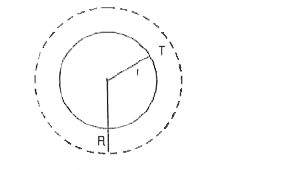 Correct CHOICE is (c ). |
|
| 19. |
During your study in a junior school you were told that light travels in a straight line. But now you know that light travels as a wave and it can bend around objects. In optical region light has a wavelength of about half a micrometre. If it encounters an obstacle of about this size, it may bend around it and can be seen on the other side. however, if the obstacle is much larger, light will not be able to bend to that extent and will not be seen on other side. This is a general property of waves and can be seen in sound waves too. the sound wave of our spech has a wavelength of about 50 cm-1m. if it meets an obstacle of the size of a few metres, it bends around it and reaches points behind the obstacle. but when it comes, across a larger obstacle of a few hundred metres, such as a hillock, most of it is reflected back and is heard as an echo. Q. Under what condition can you observe diffraction of light ? |
| Answer» Solution :Diffraction of light can be OBSERVED when size of the obstacle or the SLIT is comparable OT the WAVELENGTH of light. | |
| 20. |
State the law of radioactive decay. |
| Answer» SOLUTION :It states that the RATE of disintegration is directly PROPORTIONAL to the number of radioactive NUCLEI PRESENT at that instant | |
| 21. |
A and B similarly charged bodies which repel with force F. Anotheruncharged sphere C of same size and material is touched with B and removed. It is kept at mid-point of distance between A and B. Force on C is |
Answer» SOLUTION :`v_(1)=(v)/(cos37^(@))=(5v)/(4)` , 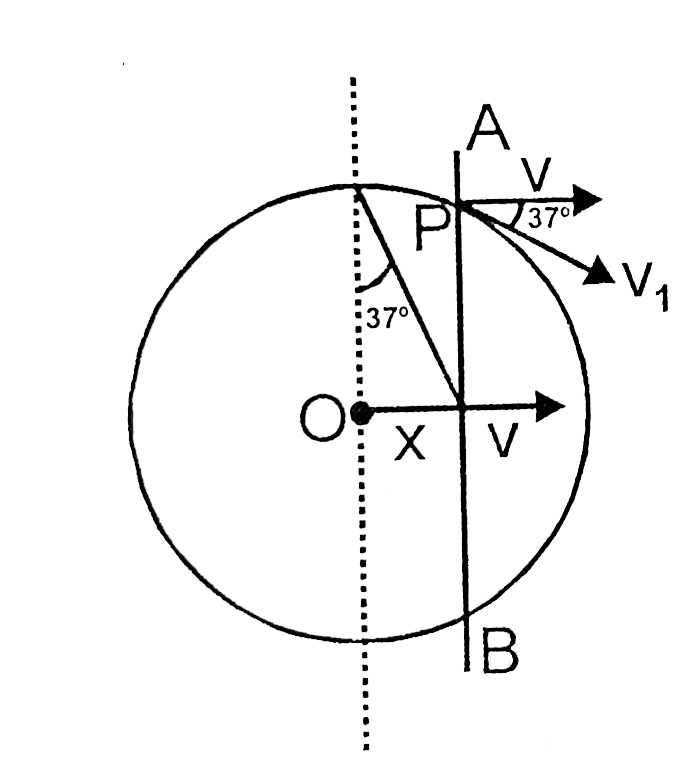
|
|
| 22. |
The heights of two antennas above the earth are h_T and h_R respectively. The maximum line of sight distance d_M between the two antennas is (R→Radius of earth) |
|
Answer» `d_m=sqrt2Rh_T-sqrt2Rh_R` |
|
| 23. |
Half life of ""^(226)Ra is 1600 years.How many distintegrations per second occur in 1 gram of ""^(226)Ra ? |
|
Answer» Solution :Data SUPPLIED, `T_(1//2) = 1600 yrs, LAMBDA = 0.6931//T_(1//2)` No. of atoms in one gram of `Ra^(226), N = (1 xx 10^(-3))/(226) xx 6.023 xx 10^(23)` `(DN)/(DT) = lambda N = (0.6931)/(1600) xx (6.023 xx 10^(20))/(226) = 1.1545 xx 10^(15)` PER year `i.e, (dN)/(dt) = 3.661 xx 10^7 "per sec" = (3.661 xx 10^7)/(3.7 xx 10^(10)) = 0.99 xx 10^(-3) Ci` |
|
| 24. |
What is power of lens ? |
| Answer» SOLUTION :P=1/f(m) (D), D=Dioptre | |
| 25. |
How do you determine the refractive index of a transparent liquid using a spectrometer ? |
| Answer» Solution :Yellow LIGHT has longer wavelength than GREEN, VIOLET, blue components of white light. | |
| 26. |
The position of a particle moving in the XY-plane at any time 't' si given by x =(3t^(2)6t)m, y=(t^(2)-2t) m.Select the correct statement about the moving particle from the following |
|
Answer» The ACCELERATION of the PARTICLE is zero at t=0 second |
|
| 27. |
For transistor action, which of the following statements are correct: Base, emitter and collector regior should have similar size and dopin concentrations.The base region must be very thin are lightly doped.The emitter junction is forward biase and collec tor junction is reverse biased.Both the emitter junction as well as to collector junction are forward biased. |
|
Answer» Base, emitter and collector regior should have similar size and dopin concentrations. |
|
| 28. |
A 750 Hz-20 V source is connected to a resistance of 100 Omega, an inductance of 0.1803 H and a capacitor of 10 muF all in series. Resistance will get heated up by 10^@C in time t. Thermal capacity is 2 J//^@C. Impedance of circuit is |
|
Answer» 834 `OMEGA` |
|
| 29. |
A 750 Hz-20 V source is connected to a resistance of 100 Omega, an inductance of 0.1803 H and a capacitor of 10 muF all in series. Resistance will get heated up by 10^@C in time t. Thermal capacity is 2 J//^@C. Power loss in LCR circuit is |
|
Answer» 0.575 W |
|
| 30. |
During your study in a junior school you were told that light travels in a straight line. But now you know that light travels as a wave and it can bend around objects. In optical region light has a wavelength of about half a micrometre. If it encounters an obstacle of about this size, it may bend around it and can be seen on the other side. however, if the obstacle is much larger, light will not be able to bend to that extent and will not be seen on other side. This is a general property of waves and can be seen in sound waves too. the sound wave of our spech has a wavelength of about 50 cm-1m. if it meets an obstacle of the size of a few metres, it bends around it and reaches points behind the obstacle. but when it comes, across a larger obstacle of a few hundred metres, such as a hillock, most of it is reflected back and is heard as an echo. Q. In a single-slit diffraction experiment if width of the slit is made double of its original width, then what would be the effect on the central diffraction maximum observed on the screen? |
| Answer» SOLUTION :If the width of the slit is MADE double of its present width, the BREADTH of CENTRAL diffraction maximum will become `1/2` of its ORIGINAL breadth and the central maximum will be much more brighter. | |
| 31. |
A red LED emits light at 0.1 watt uniformly around it. The amplitude of the electric field of the light at a distance of 1 m from the diode is : |
|
Answer» 1.73 V/m `:. I=1/2in_0E_0^2xxC` So `E_0=P/(4pir^2)=1/2in_0E_0^2xxC` `E_0^2=(2P)/(4piin_0r^2C)=(2xx0.1xx9xx10^9)/(1xx3xx10^8)` `E_0=sqrt6 =2.45` V/m. |
|
| 32. |
During your study in a junior school you were told that light travels in a straight line. But now you know that light travels as a wave and it can bend around objects. In optical region light has a wavelength of about half a micrometre. If it encounters an obstacle of about this size, it may bend around it and can be seen on the other side. however, if the obstacle is much larger, light will not be able to bend to that extent and will not be seen on other side. This is a general property of waves and can be seen in sound waves too. the sound wave of our spech has a wavelength of about 50 cm-1m. if it meets an obstacle of the size of a few metres, it bends around it and reaches points behind the obstacle. but when it comes, across a larger obstacle of a few hundred metres, such as a hillock, most of it is reflected back and is heard as an echo. Q. Draw diffraction pattern obtained on a screen when a plane wavefront falls on a narrow slit. |
Answer» SOLUTION :The DIFFRACTION PATTERN is SHOWN here. 
|
|
| 33. |
What is the cause of Green house effect? |
|
Answer» INFRARED RAYS |
|
| 34. |
During your study in a junior school you were told that light travels in a straight line. But now you know that light travels as a wave and it can bend around objects. In optical region light has a wavelength of about half a micrometre. If it encounters an obstacle of about this size, it may bend around it and can be seen on the other side. however, if the obstacle is much larger, light will not be able to bend to that extent and will not be seen on other side. This is a general property of waves and can be seen in sound waves too. the sound wave of our spech has a wavelength of about 50 cm-1m. if it meets an obstacle of the size of a few metres, it bends around it and reaches points behind the obstacle. but when it comes, across a larger obstacle of a few hundred metres, such as a hillock, most of it is reflected back and is heard as an echo. Q. Why is diffraction so common is sound but not so common in light ? |
| Answer» SOLUTION :Sound exhibits diffraction very commonly in our dailylife because wavelength of COMMON sound ranges from about 50 cm to 1 m and diffraction will take place even when size of obstacle/aperture is few metres. However, wavelength of VISIBLE LIGHT is about 0.5 micrometre and so we cannot observe diffraction of light in our daily routine. | |
| 35. |
Name the phenomenon which keeps earth's surface warm at night ? |
| Answer» SOLUTION :GREEN HOUSE EFFECT. | |
| 36. |
What is the minimum value of power factor ? When does it occur ? |
|
Answer» SOLUTION :Zero, for a purety inductive or capacitive circuit `phi= +- pi/2` POWER FACTOR `cosphi=cos(+-pi/2)=0`. |
|
| 37. |
If both the length of an antenna and the wavelength of the signal to be transmitted are doubled, the power radiated by the antena. |
|
Answer» Is DOUBLED |
|
| 38. |
The presssure of water at the basement of a building is 196000 pascals and at the third floor it is 98,000pascals. Find the height of the third floor from the basement . |
|
Answer» <P> Solution :Let X METER be the height of the third floor from the basementSo, Here we have x`rho`G=`delta`P i.e. `x*10^3`*9.8=(196000-98000) PASCAL =98,000`N/m^2` x=98000/`10^3*9.8=10m |
|
| 39. |
Which of the following relation is not correct ? |
|
Answer» `CHI` = M/H |
|
| 40. |
Is Ohm's law universally applicable for all conducting elements ? If not, give examples of elements which do not obey Ohm's law. |
|
Answer» Solution :No, Ohms LAW is not universal. hose circuit elements which do not OBEY Ohm.s law are known as non-ohmic elements. For EXAMPLE, discharge TUBE, semiconductor diode, electrolyte ETC. |
|
| 41. |
Shows the 1-V characteristics of a given device. Name the device and write where it is used. |
| Answer» Solution :Zener DIODE, which is used as a VOLTAGE REGULATOR. | |
| 42. |
Nichrome and copper wires of same length and same radius are connected in series. Current I ispassed through them. Which wire gets heated up more ? Justify your answer. |
| Answer» Solution :In series circuit same current I flows through both the wires. HENCE, heat produced `H = I^2 R`or `H PROP R`. For same length and same RADIUS the resistance of NICHROME wire is more due to its higher resistivity, hence nichrome wire is heated up more than the copper wire. | |
| 43. |
A coil of 100 turns and area 5 square centimetre is placed in a magnetic field B = 0.2T. The normal to the plane of the coil makes an angle of 60^@with the direction of the magnetic field. The magnetic flux linked with the coil is |
|
Answer» `5 xx 10^(-3) WB` |
|
| 44. |
A single conducting loop with an area of 2.0 m^(2) rotates in a uniform magnetic field so that the induced emf has a sinusoidal time dependence as shown. Determine the strength of the magnetic field in which the loop rotates. |
|
Answer» 0.5 T |
|
| 45. |
The current capacity of ammeter having 9Omega resistance is 1A. Now to make its capacity 10A. What shunt is required ______ |
|
Answer» `0.01Omega` |
|
| 46. |
A single conducting loop with an area of 2.0 m^(2) rotates in a uniform magnetic field so that the induced emf has a sinusoidal time dependence as shown. What is the period of the induced current? |
|
Answer» 1.25 s |
|
| 47. |
The radius of gyration of a body about an axis at a distance of 6 cm from its centre of mass is 10 cm. Find its radius of gyration about an axis passing through its centre of mass. |
|
Answer» 4 cm |
|
| 48. |
ABC is a right triangle in which AB = 3 cm, BC = 4 cm and right angle is at B. Three charges + 15mu C + 12 mu C and -20 mu C are placed respectively at A, B and C. The force acting on the charge at B is |
| Answer» Answer :D | |
| 49. |
For a transistor amplifier , the voltage gain |
|
Answer» remains constant for all FREQUENCIES. |
|
| 50. |
A parallel monochromatic beam of light is incident normally on a formed on a screen placed perpendicular to the direction the incident beam. At the first minimum of diffraction pattern the phase difference between the rays coming from the two edge ofthe slit is _______ . |
Answer» Solution : Position of MINIMA is given by d SIN `THETA = n lambda` For first minimum, n =1 `:. ""delta = d sin theta = lambda` Hence , plase difference `Deltaphi = (2piDelta)/(lambda) =(2pi)/(lambda).lambda=2pi` |
|