

Saved Bookmarks
This section includes 7 InterviewSolutions, each offering curated multiple-choice questions to sharpen your Current Affairs knowledge and support exam preparation. Choose a topic below to get started.
| 1. |
In the rutherford's nuclear model of the atom, the nucleus (radius about 10^(-15) m )is analogous to the sun about which the electron move in orbit (radius = 10^(-10) m) like the earth orbits around the sun. If the dimensions of te solar system had the same proportions as those of the atom, would the earth be closer to or farther away from the sun than actually it is ? the radius of earth's orbit is about 1.5 xx 10^(11) m. The radius of sun is taken as 7xx 10^(8) m. |
|
Answer» Solution :The ratio of the radius of electron.s orbit to the radius of nucleu·s is `(10^(-10)m)//(10^(-15)m) = 10^(5)`, that is, the radius of the electron.s orbit is `10^(5)` times larger than the radius of nucleus. If the radius of the earth.s orbit around the sun were `10^(5)` times larger than the radius of nucleus. If the radius of the earth.s the radius of the earth.sorbit would be `10^(5) xx 7 xx 10^(8) m = 7 xx10^(13)` m. This is more than 100 times greater than the actual orbital radius of earth. Thus, the earth would be MUCH FARTHER away from the sun.It implies that an atom CONTAINS a much greater FRACTION of EMPTY space than our solar system does. |
|
| 2. |
The frequency of waves emitted from a radar is 750 MHz. The frequency of reflected wave from the aeroplane as observed at the radar station is incrased by 2.5 KHz. The speed of aeroplane is. |
|
Answer» `4 KMS^(-1)` |
|
| 3. |
Acertain amount of current when flowing in a properly set tangent galvanometer, produces a deflection of45^(@). If the current is reduced by a factor of sqrt3, the deflection would |
|
Answer» decrease by `30^(@)` `implies (tantheta_(2))/(TAN45^(@))=1/sqrt3 implies tantheta_(2)=1/sqrt3= TAN30^(@)` `implies theta_(2) = 30^(@)` Deflection decreases by `(45^(@) -30^(@)) = 15^(@)` |
|
| 4. |
A light freely deformable conducting wire with insulation has its two ends (A and C) fixed to the ceiling. The two vertical parts of the wire are close to each other. A load of mass m is attached to the middle of the wire. The entire region has a uniform horizontal magnetic field B directed out of the plane of the figure. Prove that the two parts of the wire take the shape of circular arcs when a current I is passed through the wire. Neglect the magnetic interaction between the two parts of the wire. |
| Answer» | |
| 5. |
Four capacitors are arranged as shown. All are initially uncharged. A 30 V battery is palced across terminal PQ to charge the capacitors and is then removed. The voltage across the terminals RS is then (in volt) |
|
Answer» 10 |
|
| 6. |
In the following nuclear reaction, identify the particle X. ntop+e^(-)+X |
| Answer» SOLUTION :In above NUCLEAR REACTION .X. is anti-nutrino or `botV`. | |
| 7. |
whatis thebohrquantisationconditionfor the angularmomentum of anelectron in thesecondorbit ? |
| Answer» SOLUTION :`MV r - (NH )/( 2PI ) - ( 2 h )/( 2 PI )= (h )/(pi )` | |
| 8. |
A copper conductor of area of cross-section 40 m m^2on a side carries a constant current of 32 xx 10^(-6) A. Then the current density is in amp/m^2) |
|
Answer» `1.6` |
|
| 9. |
A passenger train travels east at high speed. One passenger is located at the east side of one car, another is located in the west side of the car. In the train's frame, these two passengers glance up at the same time. In the earth's frame, |
|
Answer» The GLANCE up simultaneously |
|
| 10. |
Consider the following statements (A) Angle of reposeis equalto angleof friction (B) Angleof friction is independentofcoefficient of friction |
|
Answer» BothA and B are TRUE |
|
| 11. |
A long straight horizontal cable carries a current of 2.5 A in the direction 10^@ north of east . The magnetic meridian of the place happens to be 10^@ west of the geographic meridian The earth's magnetic field at the location is 0.33 G , ad the angle of dip is zero. Locate the line of neutral points (ignore the thickness of the cable ) (At neutral points , magnetic field due to a current - carrying cable is equal and opposite to the horizontal component of earth's magnetic field ). |
|
Answer» Solution :Since the CURRENT is from WEST to east, magnetic lines of FIELD are in the same direction below but in opposite direction above . Al neutral POINT , field of conductor = field of earth i.e., `(mu_0I)/(2pia)=B " or " a = (mu_0I)/(2piB)` 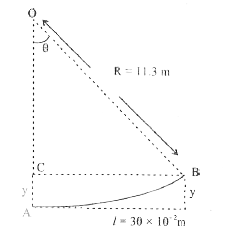
|
|
| 12. |
Two coaxial plane coils, each of n turns of radius a, are separated by a distance a. calcualte the magnetic field on the axis at the point midway between them when a current l flows in the same sense through each coil. Electrons in a colou television tube are accelerated through a potential difference of 25 kV and then deflected by 45^(@) in the magnetic field between the two coils described above. If a is 100 mm and the maximum current available for the coils is 2A, estimate the number of turns which the coils must have. |
| Answer» SOLUTION :APPROXIMATELY 200 TURNS | |
| 13. |
(A): A resistor obeys ohm's law while a diode does not. (R): The expression that V = IR is a statement of Ohm's law is not true. |
|
Answer» Both 'A' and 'R' are TRUE and 'R' is the correct EXPLANATION of 'A' |
|
| 14. |
In the circuit shown in Fig. A2.3, the battery E_1 has an emf of 12 V and zero internal resistance, while the battery E_2 has an emf of 2 V. If the galvanometer G reads zero, then the value of the resistance Y is |
|
Answer» `10 Omega` `2 = 12/(500+Y) Y or 500 + Y = 6Y` or `5Y = 500 or Y = 100 Omega` . |
|
| 15. |
The convex side of a thin concavo-convex lens of glass of refractive index 1.5 has a radius of curvature of 20cm. The concave surface has a radius of curvature of 60cm. What is the focal length of the lens? The convex side is silvered and placed on a horizontal surface. What is the effective focal length of the silvered lens? The concave part is filled with water with refractive index 1.33. What is the effective focal length of the combined glass and water lens? If the convex side is silvered what is the new effective focal length of the silvered compound lens? |
|
Answer» Solution : `(1)/(f_(1))=(1.5-1)[(1)/(20)-(1)/(60)]=(1)/(60)` `f_(1)=60CM` When convex side is silvered and water is not filled: `(1)/(F)=(2)/(f_(1))-(1)/(f_(m))=(-R_(1))/(2)=-10cm` `(1)/(F)=(1)/(-10)-2[(1)/(60)]` `F=(-30)/(4)=-7.5cm` After water is filled : Let `f_(l_(1))` is the focal length of water lens: `(1)/(f_(l_(1)))=((4)/(3)-1)((1)/60)=(1)/180` `(1)/(F) =(2)/(f_(l_(1)))-(2)/(f_(l_(2)))-(1)/(f_(m))` Solving, we get `F=(-90)/(13)cm` 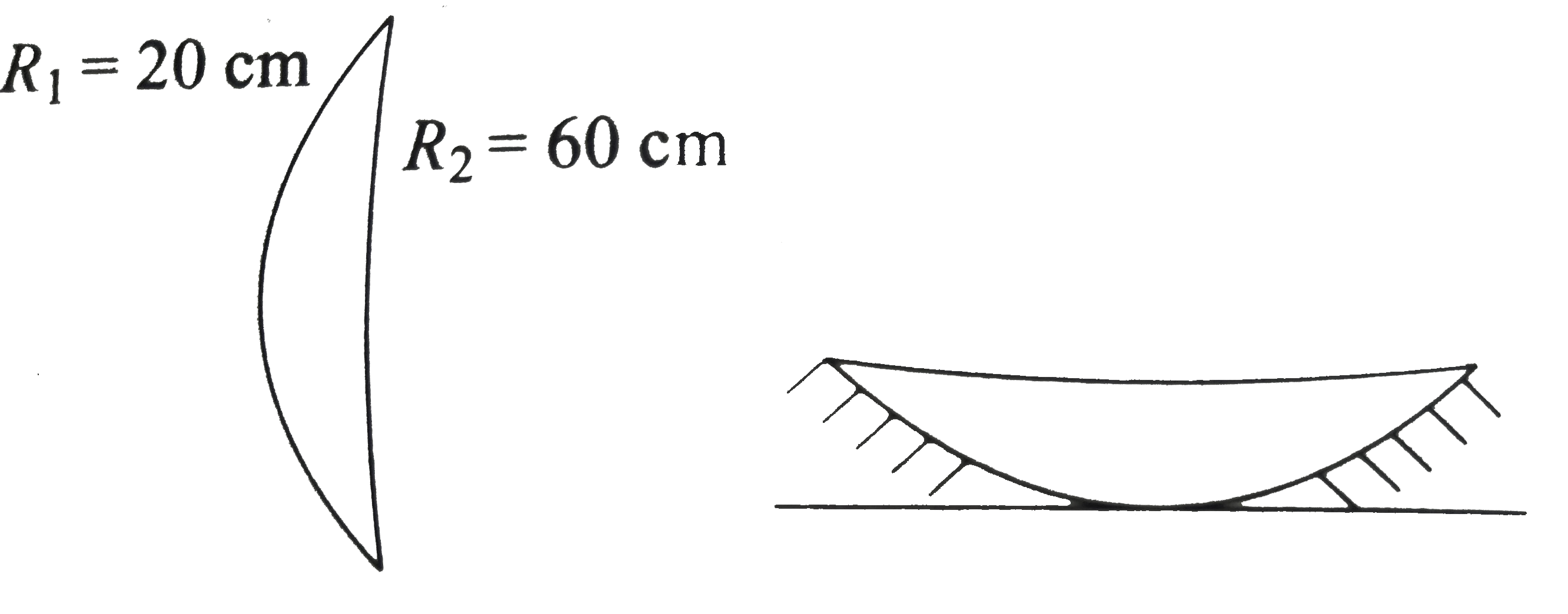 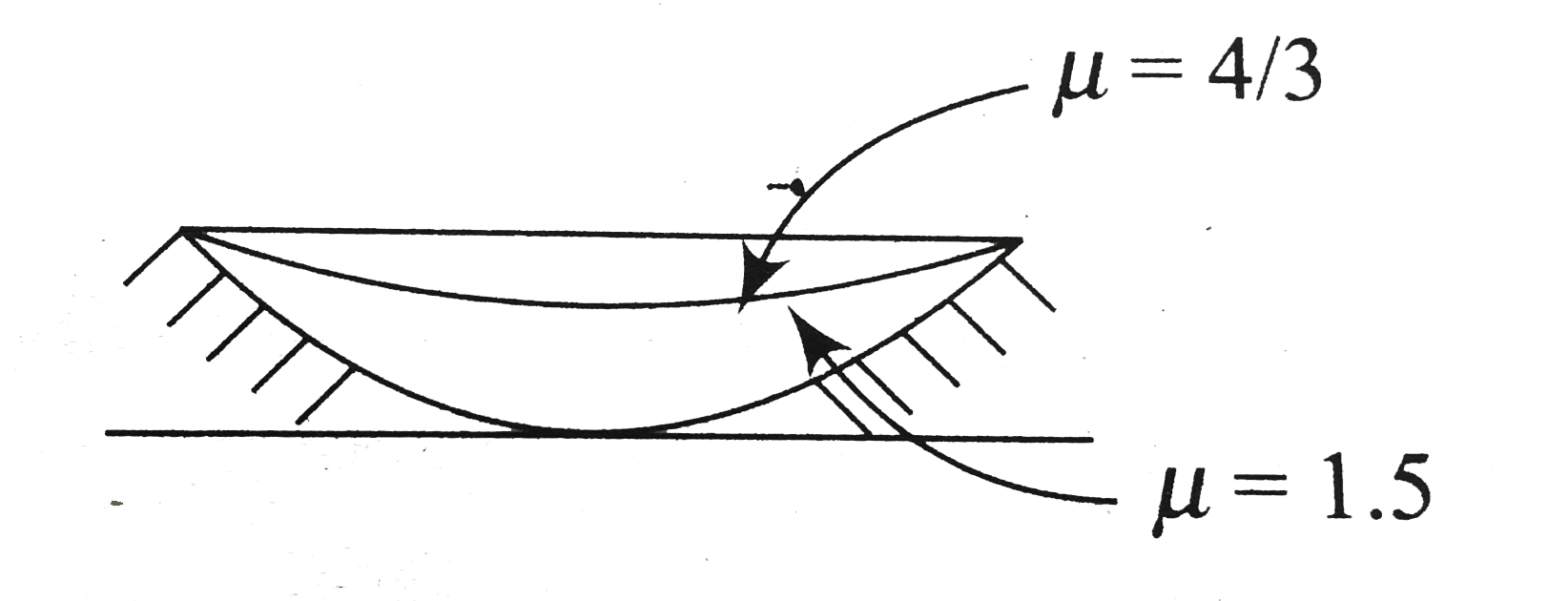
|
|
| 16. |
A long straight wire along the z-axis carries a current 'i' in the negative z direction. The magnetic vector field barB at a point having coordinates (x,y) in the z = 0 plane is |
|
Answer» `(mu_0 I ( y HATI- X hatj ))/( 2 pi( x^2+y^2))` |
|
| 17. |
Which of the following is correct for the beam which enters the medium? |
|
Answer» TRAVEL as a cylindrical beam |
|
| 18. |
The bob of simple pendulumof length L is released at time t = 0 from a position of small angular displacementtheta. Its linear displacement at time t is given by : |
|
Answer» `X=thetao sin 2pi SQRT((L)/(g))xxt` Now `""theta=(A)/(L)` (when `theta` is small) or `""A=L theta` Also `""omega=(2pi)/(T)=(2pi)/(2pi sqrt((L)/(g)))=sqrt((g)/(L))` `:.""x=L theta cos sqrt((g)/(L)).t.` Correct CHOICE is (d). |
|
| 19. |
A charge q is uniformly distributed throught the volume of a sphere R and permittvity k = 1. Let U_(1) and U_(2) be the electrostatic energy within and outside ths sphere. Then U_(1) : U_(2) is equal to 1/x where .x. is |
|
Answer» |
|
| 20. |
The total energy of H_(2) atom, when the electron is in the second quantum state is E_(2). The total energy of He^(+) ion in the third quantum state is : |
|
Answer» `(3)/(2)E_(2)` `E_(3)(He^(+))=(Z^(2)E_(1)(H))/(2^(2))` |
|
| 21. |
A point charge q moves from 'P' to 'S' along path PQRS in a uniform electric field E directed parallel to positive X-axis. The coordinates of the points P, Q, R and S are (a, b, 0), (2a, 0, 0), (0, -b, 0) and (0, 0, 0) respectively. The work done by field in the above process is given by |
|
Answer» `qEa` |
|
| 23. |
.......... obtained at angle of incidence equal to critical angle is called critical ray. |
|
Answer» REFRACTED RAY |
|
| 24. |
What is the reference circle for a particle performinglinear SHM? |
| Answer» SOLUTION :For a particle PERFORMING LINEAR SHM, the reference circle is a circle WHOSE radius is EQUAL to the amplitude of the SHM and whoseprojection along a diameter gives the linear SHM. | |
| 25. |
Radiation of frequency 10^(15) Hz is incident on two photosensitive surfaces P and Q. there is no photoemission from surface P. photoemission occurs from surface Q but photoelectrons have zero kinetic energy. Explain these observations and find the value of work function for surface Q. |
|
Answer» Solution :Since there is no photoemission from surface P when radiation of frequency `10^(15)` HZ is incident on it, it means that the threshold frequency for surface P is more than `10^(15) `Hz. Thus, `(v_(0))_(P)gt10^(15)`Hz. Again for samme radiation photoemission takes place from surface Q but photoelectrons have zero kinetic energy. so we CONCLUDE that threshold frequency for surface Q is `10^(15)Hz`. thus, `(v_(0))_(Q)=10^(15)` Hz. `therefore`Work FUNCTION for surface `Q=(phi_(0))_(Q)=h(v_(0))_(Q)J=(h(v_(0))_(Q))/(e)EV=(6.63xx10^(-34)xx10^(15))/(1.6xx10^(-19))=4.10eV` |
|
| 26. |
The electric potential at a point P due to two charges in fig (a) is V_(1) and in fig (b) is V_(2). Consider the given object to be a ring. What is the relation between V_(1) and V_(2)? Explain your answer. |
|
Answer» Solution :`V_(1)=(1)/(4pi epsilon_(0)) ((2q)/(R ))` (where r is RADIUS of rings) `V_(2)=(1)/(4pi epsilon_(0))((2q)/(r )) rArr V_(1)=V_(2)` As electric potential is a SCALAR quantity it DEPENDS only on the DISTANCE of the charge from point (P) and not on the direction of the location of the point. |
|
| 27. |
The relative permeability is represented by muand the susceptibility is denoted by x for a magentic subtancethen for paramagneticsubtance |
|
Answer» `mu_(r )LT1,xlt 0` |
|
| 28. |
A projectilie is throw horizontally from the top of a tower on the surface of earth. Identify the trajectory which is not possible assuming no air resistance |
|
Answer» STRAIGHT line |
|
| 29. |
Obtain the equivalent focal length of combination of thin lenses placed in contact, |
Answer» Solution : Consider two lenses A and B of focal length `f_1` and `f_2`, placed in contact with each other. Let the object be placed at a point 0 beyond the focus of the first lens A. The first lens produces an image at `I_1`,. Since image `I_1`, is real, it serves as a VIRTUAL object for the second lens B producing the final image at I. Formation of image by the first lens is presumed only to facilitate determination of the position of the final image. In fact, the direction of rays emerging from the first lens gets modified in accordance with the angle at which they strike the second lens. Since the lenses are thin, we assume the optical centres of the lenses to be coincident. Let this central point be DENOTED by P. For the image formed by the first lens A, `(1)/(v_1)-(1)/(u)=(1)/(f_1)` ... (1) For the image formed by the second lens B, `1/v-(1)/(v_1)=(1)/(f_2)` ... (2) Adding equation (1) and (2), `1/v-1/u=(1)/(f_1)+(1)/(f_2)` ... (3) If the two lens system is REGARDED as EQUIVALENT to a single lens of focal length f we have, `1/f=(1)/(f_1)+(1)/(f_2)` The derivation is valid for any NUMBER of thin lenses in contact. If several thin lenses of focal length `f_1, f_2, f_3, ...f_n` In are in contact, the effective focal length of their combination is given by, `1/f=(1)/(f_1)+(1)/(f_2)+(1)/(f_3)+...` |
|
| 30. |
The magnitude of linear momentum of a particle moving at a relativistic speed v is proportional to |
| Answer» Answer :D | |
| 31. |
Which of the following pairs correctly express potential and field of a point charge Q ? |
|
Answer» `(4piQ)/(epsilon_0r),(4piQ)/(epsilon_0r^2)` |
|
| 32. |
The phenomena involved in the reflection of radiowaves by ionosphere is similar to |
|
Answer» reflection of light by a plane mirror. |
|
| 33. |
Charge Q is uniformly distributed on a dielectric rod AB of length 21. The potential at P shown in the figure is equal to |
|
Answer» `(q)/( 4 PI in_02l)` |
|
| 34. |
A system has two charges q_(A)=2.5xx10^(-7) C, and q_(B)=-2.5xx10^(-7)C located at points A(0, 0, -15 cm) and B (0, 0, +15 cm). What are the total charge and electric dipole moment of the system? |
| Answer» SOLUTION :TOTAL charge is zero dipole moment `=7.5 xx10^(-8)` C m along z axis | |
| 35. |
A point charge q moves unifromlyand rectilnearly with arelativisticwith a relativisticvelocityof light(beta = v//c). Find theelectric fieldstrengthE produced by the charge at the pointwhose radius vectorrelatives to the charge is equal to rand formsan angle theta with itsvelocity vector. |
|
Answer» Solution :Suppose the charge `Q` moves in thepositivedirectionof the x-axis of the frame `K`. Let us GO over TOTHE moving frame `K'`, at whose origin the charge is at rest. We take the `x`and `x'` axes of the twoframesto becoincident,and the`y & y'` axes, to beparallel. In the `K'` frame, `vec(E) = (1)/(4pi epsilon_(0)) (q vec(r))/(r^(3))`, and this has the followingcomponents, `E'_(x) = (1)/(4pi epsilon_(0)) (q x')/(r'^(3)), E'_(y) = (1)/(4pi epsilon_(0)) (q y')/(r'^(3))` Now let us go BACK to the frame`K`. At the moment, whenthe originsof the two frames coincide, we take `t = 0`. Then, `x = r cos theta = x' sqrt(1 - (v^(2))/(c^(2))), y = r sin theta = y'` Also, `E'_(x) = E'_(x), E_(y) = E'_(y)//sqrt(1 - v^(2)//c^(2))` Form these equations, `r'^(2) = (r^(2)(1 - beta^(2) sin^(2) theta))/(1 - beta^(2))` `vec(E) = (q)/(4pi epsilon_(0)) (1)/(r^(3) (1 - beta^(2) sin^(2) theta)^(3//2)) [ (1 - beta^(2))^(3//2)(x' hat(i) + (y')/(sqrt(1 - beta^(2)))hat(j))]` `= (q vec(r) (1 - beta^(2)))/(4pi epsilon_(0) r^(3) (1 - beta^(2) sin^(2) theta)^(3//2))` |
|
| 36. |
The earth's surface has a negative surface charge density of 10^(-9)C m ^(-2). The potential difference of 400 kV between the top of the atmosphere and the surface results (due to the low conductivity of the lower atmosphere) in a current of only 1800 A over the entire globe. If there were no mechanism of sustaining atmospheric electricfield, how much time (roughly) would be required to neutralise the earth's surface? (This never happens in practice because there is a mechanism to replenish electric charges. namely tghe coontainual thunderstorms and lighting in different parts of the globe). (Radius of earth =6.37 xx 10 ^(6) m.) |
|
Answer» Solution :Amount of charge on the spherical surface of Earth, `Q = 4 pi R^(2) sigma` `( because " Surface charge density " sigma = (Q)/(A) = (Q)/(4 pi R^(2)) )` Constant CURRENT is, `I = (Q)/(t) ` `therefore = (Q)/(I) ` `therefore t = (4 pi R^(2) sigma)/(I)` `therefore t = ((4) (3.14) (6.37 xx 10^(6))^(2) (10^(-9)))/(1800)` `therefore t = 283.1 ` S |
|
| 37. |
In an experiment on photoelectric effect, the slope of the cut-off voltage versus frequency of incident light is found to be 4.12xx10^(-15)V s. Calculate the value of Planck's constant. |
|
Answer» SOLUTION :Slope `=4.12xx10^(-15)Vs` `(h)/( e)=4.12xx10^(-15)` `h=4.12xx10^(-15)xx1.6xx10^(-19)=6.6xx10^(-34)JS` |
|
| 38. |
A stoneis throw down the slopeas shown. Determingthe magnitdueu anddirectionof its initial velocityso that the sotne will rise 12 mand still have a rangeof 50m down the slope. |
| Answer» SOLUTION :`17.74 m//s , THETA = 59.8^(@)` | |
| 39. |
A body of mass m = 3.513 kg is moving along the x- axis with a speed of 500ms^(-1) . ,The magnitude of its momentum is recorded as |
|
Answer» `17.6kgms^(-1)` |
|
| 40. |
Unpredictable fluctuations in temperature voltage supply, mechanical vibrations of experimental set-ups, etc, lead to |
|
Answer» RANDOM ERRORS |
|
| 41. |
Which of the following phenomenon does not support the wave nature of light? |
|
Answer» Interference |
|
| 42. |
4 muF and 6 muF capacitors are joined in series and 500 V are applied between the outer plates of the system. What is the charge on each plate '? |
|
Answer» `1.2xx10^(-3) C ` ` C = (4xx6)/(4+6) ` `= (24)/(10)` `= 2.4 mu F ` Total CHARGE on CAPACITOR is Q= CV `= 2.4 xx10^(-6) xx500 ` `= 12 xx10^(-4) = 1.2 xx10^(-3) C ` `:.` Charge on each plate as series connection is `= 1.2 xx10^(-3) ` C |
|
| 43. |
If the wire of length 50cm elongater by 0.1 mm the strain is |
|
Answer» a)0.1 |
|
| 44. |
The SI unit of self inductance henry can be written as |
|
Answer» ohm-second |
|
| 45. |
Wheatstone bridge can be used |
|
Answer» to compare two UNKNOWN resistances. |
|
| 46. |
A hemisphere is uniformly charged positively. The electric field at a point on a diameter away from the centre is directed |
|
Answer» PERPENDICULAR to the diameter |
|
| 47. |
Two resistors of resistances 2 Omega and 6 Omega are connected in parallel. This combination is then connected to a battery of emf 2 V and internal resistance 0.5 Omega . What is thecurrent flowing through the battery ? |
|
Answer» Solution :`R_(P) = (R_(1)R_(2))/(R_(1) + R_(2))` `R_(p) = (2 XX 6)/((2+6)) = 1.5 Omega` `I = (E)/(R_(p) + r) = (2)/(1.5 + 0.5) = 1A` |
|
| 48. |
Cos(90^(@) +theta)sec(-theta)tan(180^(@) -theta) /sec(360^(@) -theta) sin(180^(@) +theta) cot(90^(@) -theta) |
| Answer» Answer :D | |
| 49. |
A siple pendulum rotates in a horizontal plane with an angular velocity of omega about a fixed point P I gravity-free space. There is a negative charge at P. The bob gradully emits photoelectrons (disregard the energy and momentum of the incident photons and emitted electrons). The total force acting on the bob is T. |
|
Answer» T will decreases,`omega` will DECREASE. |
|
| 50. |
Using Ampere's circuital law, obtain an expression for the magnetic field along the axis of a current carrying solenoid of length l and havingN number of turns. |
|
Answer» Solution :Magnetic field due to solenoid : Consider a rectangular amperianloop ABCD near the middle ofsolenoid as shown in flg. Where PQ=l. Let the mangetic field along the path ab be B and in zeroalong CD. As the paths bc and DA are perpendicular to the axis of solenoid, the magnetic field component along these path is zero. Therefore, the path bc and da will not contribute to the line integral of magnetic field B. Total number of turns in length l=Nl The line integral of magnetic field induction B over the closed path abcd is `underset(abcd)ointvec(B). vec(dl)=underset(a)overset(b)int vec(B).vec(dl)+underset(b)overset(c)int vec(B).vec(dl)+underset(c)overset(d) int vec(B).vec(dl)+underset(d) overset(a)int vec(B).vec(dl)` `:' underset(a)overset(b) int vec(B).vec(dl)=underset(a)overset(b)int B dl cos 0^(@) = Bl andunderset(b)overset(c) int vec(B).vec(dl) = underset(b)overset(c) B dl cos 90^(@) = 0 = underset(d) overset(a) vec(B).vec(dl)` Also, `underset(c) overset(d) vec(B).vec(dl) = 0 ` (`:'` Outside the solenoid, B=0) `:. underset(abcd)oint vec(B).vec(dl) = Bl + 0+ 0+0=Bl` ...(i) Using AMPERE's circuital law `underset(abcd) oint vec(B).vec(dl)=mu_(0) xx` total current in rectangle abcd `=mu_(0)xx`no. of turns in rectangle `xx` current `= mu_(0) xx Nl xx I = mu_(0) NlI "" ...(ii)` From (1) and (2), we have `Bl=mu_(0) Nl.I` `:. B=mu_(0)NI`. 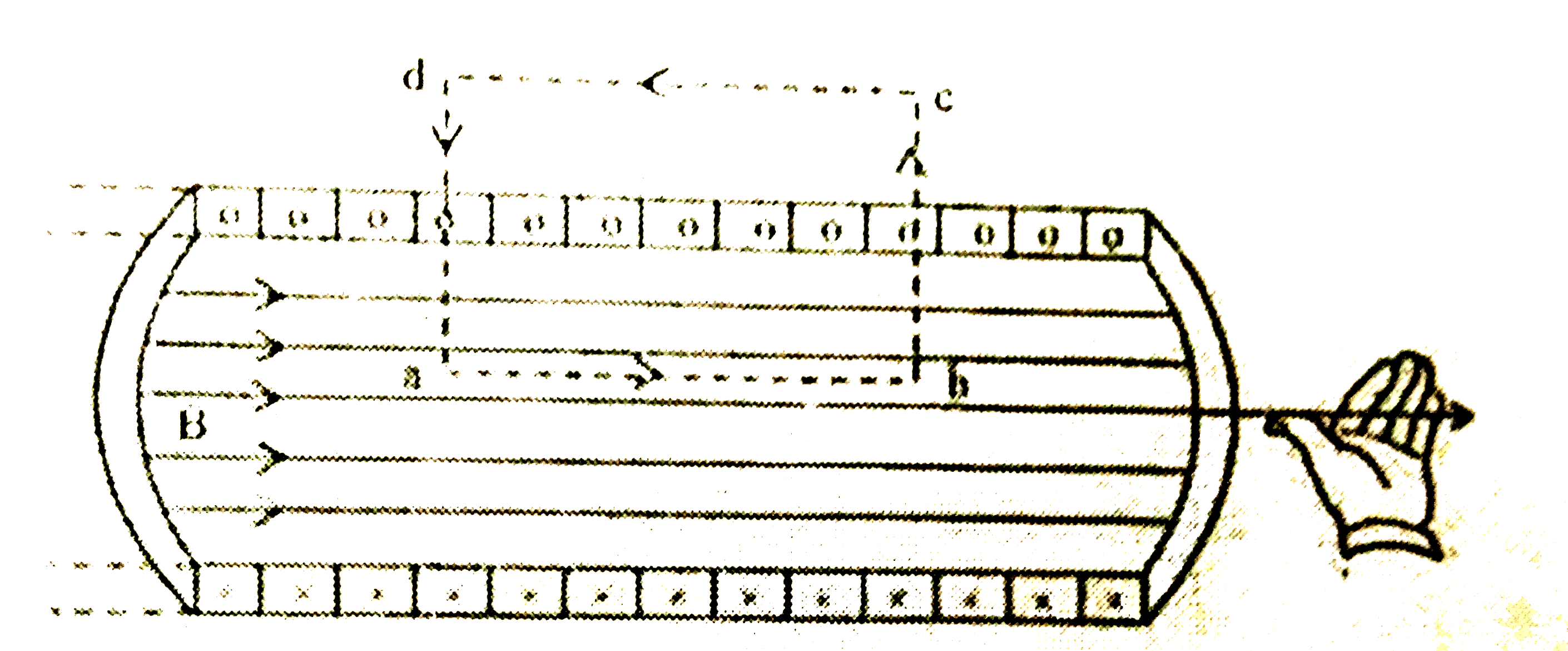
|
|