

Saved Bookmarks
This section includes 7 InterviewSolutions, each offering curated multiple-choice questions to sharpen your Current Affairs knowledge and support exam preparation. Choose a topic below to get started.
| 1. |
Determine the wavelength of spectral lines appearing on transition of exicted Li atoms from the state 3S down to the ground state 2S. The Rudberg corrections for the S and P terms are -0.41 and -0.04. |
|
Answer» Solution :The enrgy of the `3S` STATE is `E(3S)=-(ħR)/((3-0.41)^(2))=-2.03eV` The ENERGY of a `2S` state is `E(2S)= -(ħR)/((2-0.41)^(2))= -5.39eV` The energy of a `2P` state is `E(2P)=(ħR)/((2-.04)^(2))=-3.55eV` We see that `E(2S) lt E(2P) lt E(3S)` The transitions are `3S rarr2P` and `2Prarr2S`. Direct `3Srarr2S` transition is forbidden by selection rules. The wavelength are determined by `E_(2)-E_(1)= DeltaE=(2piħc)/(lambda)` Substitution gives `lambda= 0.816mu m(2Srarr2P)` and `lambda=0.67mu m(2Prarr2S)` |
|
| 2. |
Given fig. shows a coil bent with all edges of length Im and carrying a current of 1A. There exists in space a uniform magnetic field of 2T in the positive y-direction. Find the torque on the loop. |
| Answer» Solution :`vec TAU = F_(AH) L (hati)= Bi l xx l(hati)= 2xx 1xx 1^2 = 2 hatiN-m` | |
| 3. |
Coefficient of reflection ( Reflectance ). |
| Answer» SOLUTION :The COEFFICIENT of reflection ( reflectance ) of the SURFACE of a body is defined as the RATIO of the QUANTITY of radiant energy reflected by the surface to the quantity of radiant energyincident on the surface in the same time . | |
| 4. |
To supply maximum current, cells should be arrange in |
|
Answer» SERIES |
|
| 5. |
A beam of light converges at a point P. Nnw a lens is placed in the path of the convergent beam 12cm from P. At what point does the beam converge if the lens is (a) a convex lens of focal length 20 cm, and (b) a concave lens of focal length 16 cm ? |
|
Answer» SOLUTION :`(1)/(v) - (1)/(u)= (1)/(f)"" f = 20 ` cm , u = + 12 cm( OBJECT on the right) `(1)/(v) = (1)/(20) + (1)/((+12)) = (20 + 12)/(20 xx 12) = (32)/(240) = (2)/(15)"" therefore v = 7.5 ` cm A real image is formed 7.5 cm away from the lens. b. `(1)/(v) = (1)/(f) + (1)/(u)= (1)/(-16) + (1)/(12) =(-12 + 16)/(16 xx 12) = (4)/(16 xx 12)= (1)/(48)therefore v= 48` cm A real image is formed at 48 cm away from the lens |
|
| 6. |
In figure, assuming the diodes to be ideal, |
|
Answer» `D_(1)` is FORWARD biased and `D_(2)` is reversebiased and hence current flows from A to B For diode `D_(1), V_(A)= -10V and V_(K)=0 rArr V_(A) lt V_(R ) rArr D_(1) ` isreverse biased. Hence its resistance would be`R_(1) = oo(because D_(1)`is an ideal diode) For diode `D_(2), V_(A)=0 and V_(K) =-10V rArr V_(A) gt V_(K) rArr D_(2) `is forward biased. Hence its resistance would be `R_(2)=0. (because D_(2)` is an ideal diode) Here, `D_(1) and D_(2)` are CONNECTED in series and so itsequivalent resistance `R=R_(1)+R_(2)=oo +0=oo` and so current will not flow, neither from A to B nor from B to A. `rArr` Option (B) is correct. |
|
| 7. |
For a complex [Co(NH_(3))_(3)CI_(3)] pick up true statements ? |
|
Answer» The co-ordination number and oxidation number of coablt is 6 |
|
| 8. |
For an ideal inductor, connected across a sinusoidal a.c. voltage source, state which one of the following quantity is zero : (i) instantaneous power, (ii) average power over full cycle of the a.c. voltage source. |
| Answer» Solution : For an ideal inductor average POWER over FULL CYCLE of the a.c. voltage SOURCE is zero. | |
| 9. |
Explain the series of spectral lines for H-atom whose fixed inner orbit numbers are 3 and 4. |
|
Answer» Solution :According to Bohr's theory, electromagnetic radiation of a particular wavelength is emitted when there is a transition of the electron from a higher energy state to a lower energy state. Let the quantum number `n=n_(1)` REPRESENT a higher energy state and `n=n_(1)` represent a lower energy state `(n_(i)gtn_(f))`. For hydrogen, the wavelength `(lamda)` of the radiation arising due to transition from `n_(i)" to "n_(f)` is given by `(1)/(lamda)=R((1)/(n_(f)^(2)-(f)/(n_(i)^(2)))),` where R is the RYDBERG constant. The SPECTRAL SERIES arising due to the transitions to `n_(1)=3` from `n_(1)=4, 5,6,...,` etc. is called the Paschen series. The wavelengths in this series are given by `(1)/(lamda)=R((1)/(3^(2))-(1)/(n_(1)^(2)))(n_(1)=4,5,6,...,` etc.) The spectral series arising due to the transitions to `n_(1)=4" from "n_(1)=5,6,7,...,` etc. is called the Brackett series. The wavelengths in this series are given by `(1)/(lamda)=R((1)/(4^(2))-(1)/(n_(1)^(2)))(n_(1)=5,6,7,...,` etc.) |
|
| 10. |
Two concentric uniform shells of mass M_(1) and M_(2) are as shown in the figure. A particle of mass m is located just within the shell M_(2) on its inner surface. Gravitation force on 'm' due to M_(1) and M_(2)will be (##DSH_NTA_JEE_MN_PHY_C07_E02_020_Q01.png" width="80%"> |
|
Answer» ZERO |
|
| 11. |
A double convex lens made of glass refractive index 1.6 has its both surfaces of equal radii of curvature of 30 cm each. An object of 5 cm height is placed at a distance of 12.5 cm from the lens. Find the position, nature and size of the image. |
|
Answer» Solution :For double convex lens `R_(1) = +30 cm` and `R_(2) = -30 cm, n=1.6, u =-12.5 cm` Using relatino `1/f=(n-1)(1/R_(1)+1/R_(2))`, we have `1/f =(1.6-1) (1/30 + 1/30)= 0.6 xx 2/30 RARR f= 30/(0.6 xx 2) = 25 cm` Using lens formula `1/v -1/u = 1/f`, we have `1/v =1/f+1/u = 1/25 + 1/(-12.5) = (1-2)/(25) = -1/25 rArr v=-25 cm` Height of object h = 5 cm. If height IMAGE be `h.`, then `h^(.)/h = v/u` `therefore h. = v/u.h = (-25)/(-12.5) xx 5 = 10 cm` Thus, a virtual and erect image of 10 cm height is formed at 25 cm from the lens. |
|
| 12. |
Derivean expression forpotentialenergyof electric - di-poleplacedin a n uniformelectricfield . |
|
Answer» SOLUTION :We knowthe torfque on an electric dipoleplacedin an electric FIELD , ` t = pEsintheta ` Bydefinitionwork done by torque on thedipole ` dW = tdtheta ` ` dW = pEsintheta .dtheta ` Net workdoneto movefrom ` theta_(1) " to"theta_(2)`is givenby ` W = int dW = int_(theta_(1))^(theta_(2)) p E sin theta d theta ` `W = -pE ( cos theta)_(theta_(2))^(theta_(1))` ` W = -pE ( cos theta_(2) - cos theta_(1))` Taking ` theta_(1) = 90^(@)and theta_(2) = theta `we can write . ` W = - pE cos theta ` ` W = BARP. vecE` This work done willbe storedin the FORM of potentialenergy. `i.e,P.E = - VECP. vecE` |
|
| 13. |
Briefly discuss the observations of Hertz, Hallwachs and Lenard. Hertz observation: |
|
Answer» Solution :• In 1887, Heinrich Hertz first became successful in generating and detection electromagnetic wave with his high voltage induction coil to cause a spark discharge between two metallic spheres. • When a spark is formed, the charges will oscillate back and forth rapidly and the electromagnetic waves are produced. • The electromagnetic waves thus produced were detected by a detector that has a copper wire bent in the shape of a circle. Although the detection of waves is successful, there is a problem in observing the tiny spark produced in the detector. : 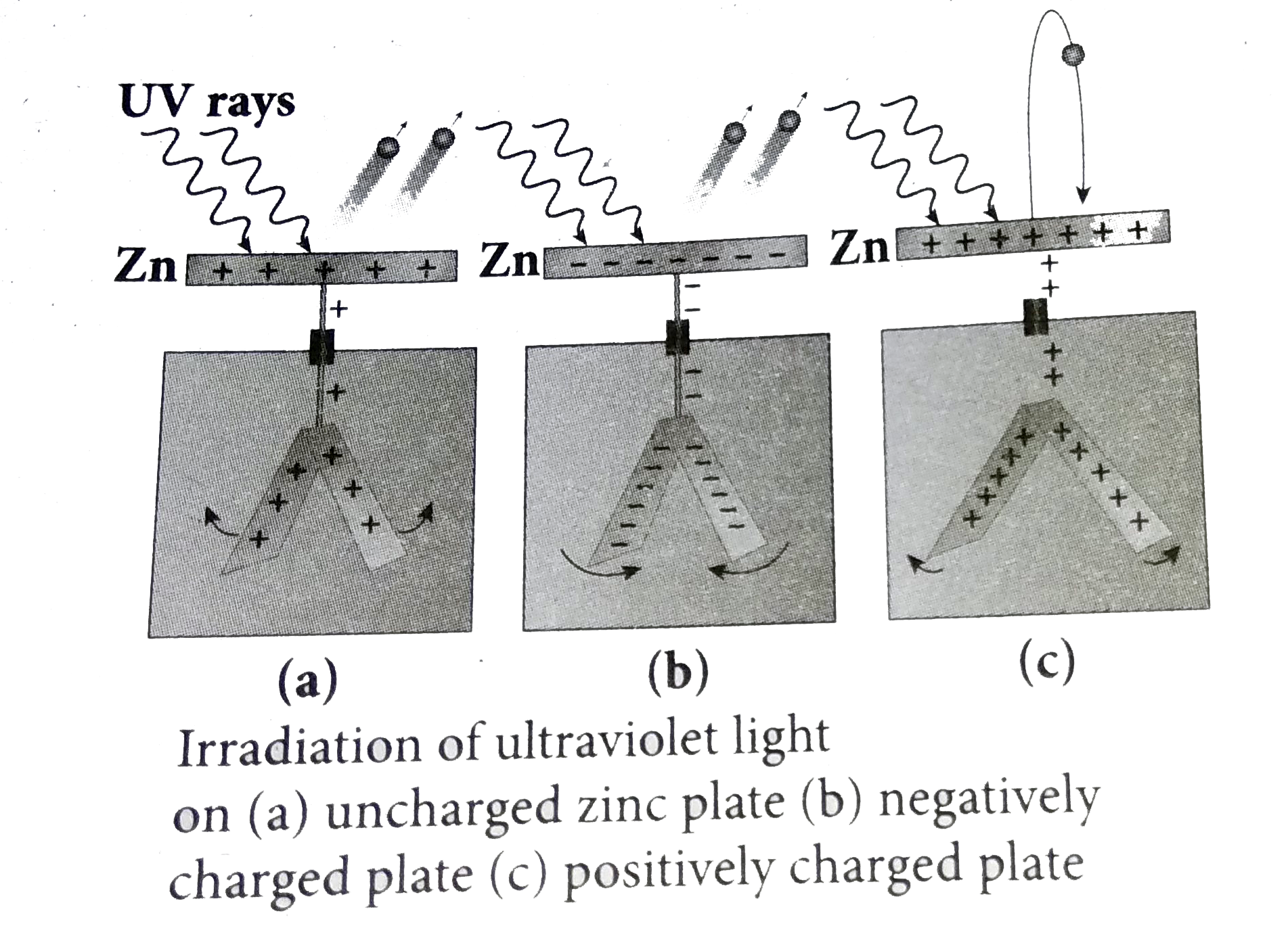 • In order to improve the visibility of the spark, Hertz made many attempts and finally noticed an important thing that small detector spark became more vigorous when it was exposed to ultraviolet light. • The reason for this behaviour of the spark was not known at that time. Later it was found that it is due to the photoelectric emission. • Whenever ultraviolet light is incident on the metallic sphere, the electrons on the outer surface are emitted which caused the spark to be more vigorous. Hallwachs Observation 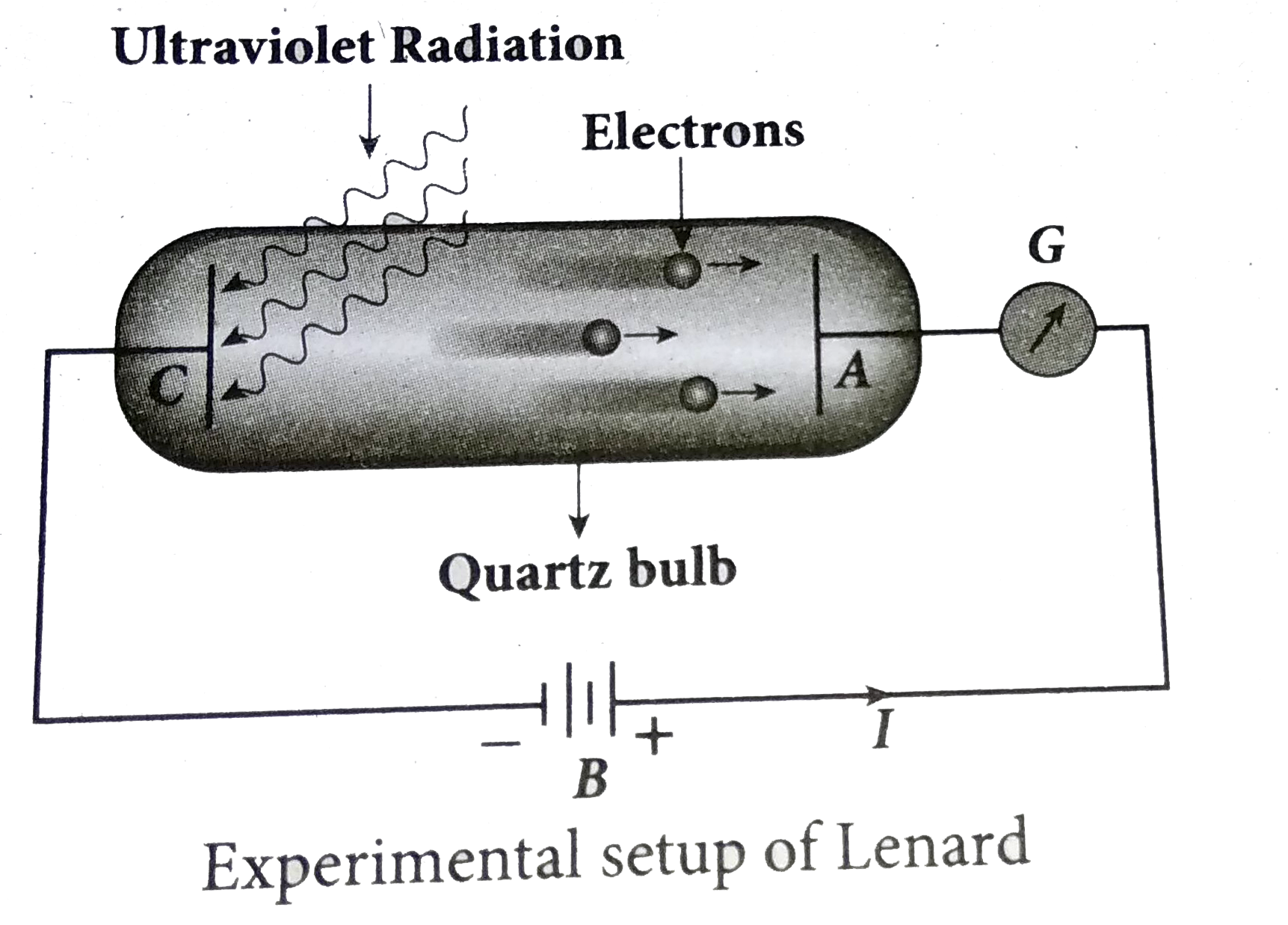 • In 1888, Wilhelm Hallwachs, a German physicist, confirmed that the strange behaviour of the spark is due to the ACTION of ultraviolet light with his simple experiment. • A clean circular plate of zinc is mounted on an insulating stand and is ATTACHED to a GOLD leaf electroscope by a wire. When the uncharged zinc plate is irradiated by ultraviolet light from an arc lamp, it becomes positively charged and the leaves will open. • Further, if the negatively charged zinc plate is exposed to ultraviolet light, the leaves will close as the charges leaked away quickly. If the plate is positively charged, it becomes more positive upon UV rays irradiation and the leaves will open further. • From these observations, it was concluded that negatively charged electrons were emitted from the zinc plate under the action of ultraviolet light. Lenard.s observation:• In 1902, Lenard studied this electron emission phenomenon in detail. The Ultraviolet Radiation apparatus consists of two metallic plates A Electrons and C placed in an evacuated quartz bulb. The galvanometer G and BATTERY B are connected in the circuit. • When ultraviolet light is incident on the negative plate C, an electric current Quartz bulb FLOWS in the circuit that is indicated by the deflection in the galvanometer. On other hand, if the positive plate is irradiated by Experimental setup of Lenard the ultraviolet light, no current is observed in the circuit • From these observations, it is concluded that when ultraviolet light falls on the negative plate, electrons are ejected from it which are attracted by the positive plate A. On reaching the positive plate through the evacuated bulb, the circuit is completed and the current flows in it. • Thus, the ultraviolet light falling on the negative plate causes the electron emission from the surface of the plate. |
|
| 14. |
Two wires of different mass densities are soldered together end to end and are then stretched undera tension F (the tension is same in both the wires). The way e speed in the second wire is three times that in the first wire. When a harmonic wave is travelling in the first wire, it is reflected at thejunction of the wires,the reflected wave has half the am plitude of the incident wave (a) If the amplitude of incident wave is A, what are the amplitudes of the reflected and transmitted waves ? (b) Assuming no loss in wire, what fiaction of the incident power is reflected at thejunction and what fraction is transmitted ?(c) Show that the displacement just to the left of the junction equals that just to the right ofthe junction. |
|
Answer» |
|
| 15. |
A radioactive substance decays to 1/16 th of the initial mass in 40 days. The half life of the substance is….. Day. |
|
Answer» 20 `THEREFORE 1/2^n=1/2^4 therefore n=4` Now `n=t/t_(1//2) IMPLIES t_(1//2)=t/n=40/4=10 DAYS` |
|
| 16. |
Focal length of convex lens having refractive index 1.5 is 2 cm. If this lens is dipped in a liquid having refractive index 1.25 its focal length will be ...... cm. |
|
Answer» 10 `(2)/(f_1)=(1.5-1.25)/(1.5-1.00)xx(1.00)/(1.25)` `thereforef_l=(2xx1.25xx0.5)/(1.0xx0.25)` `thereforef_l=(1.25)/(0.25)thereforef_l=5` CM |
|
| 17. |
Which frequency produces a sound that can be heard by a person? |
|
Answer» 100 kHz |
|
| 19. |
A plane sheet has a uniformly distributed charge. Origin is selected at the middle of the sheet (in yz plane). A charge +Q is moved from point A (10a, 2a,0) to point B (10a,0,2a) along a circle and then to point C(10a, 0, 0). If the initial electrostatic potential energy is U_0, what will be final electrostatic potential energy? |
|
Answer» zero 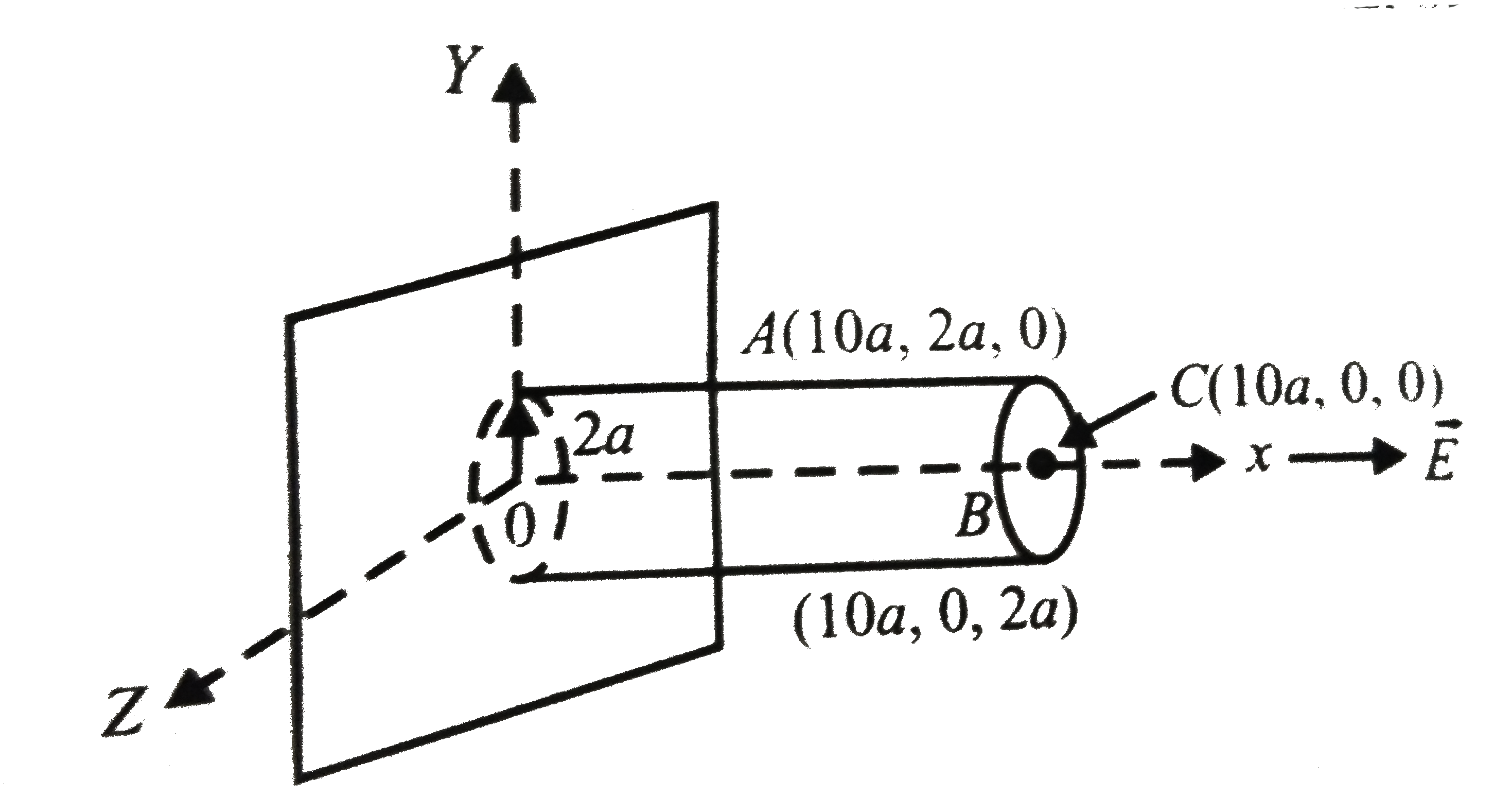 Points `A` and `B` are LOCATED on a circle forming flat surface of the cylinder. The electric field is perpendicular at all the points of this plane surface. THUS, there will be no-change in electrostic `PE` in moving the charge `+Q` on this plane surface. |
|
| 20. |
Two beams of light having intensities 9I and 4I interfere to produce fringe pattern on a screen P, Q and R are three points on the screen at which the phase differences between the interfering beams are 30^(@), 45^(@)" and "60^(@) and the intensities are I_(P), I_(Q)" and "I_(R ) respectivley. Arrange the diffrence between the intensities in ascending order |
|
Answer» <P>`(I_(P)-I_(Q)), (I_(P)-I_(R )), (I_(Q)-I_(R ))` |
|
| 21. |
If radiation possesses dual nature, what is the nature of matter? Justify. |
| Answer» SOLUTION :DUAL NATURE. Because nature LOVES SYMMETRY. | |
| 22. |
Two small circular coil having same number of turns have radii in the ratio of 1:2 the ratio of self-inductance: |
|
Answer» 0.084027777777778 |
|
| 23. |
9 ग्राम पानी में उपस्थित हाइड्रोजन के परमाणुओं के मोलो की संख्या |
|
Answer» 1 mol |
|
| 24. |
A variable frequency a.c source is conneced to a capacitor. How will the displacement current change with decrease in frequency? |
|
Answer» Increase |
|
| 25. |
Consider an evacuted cylindrical chamber of height h having rigid conducting plates at the end and an insulting curved surface as shown in the figure. A number of spherical balls made of a light weight and soft material and coated with a conducting material are placed on the bottom plated. The balls have a radius r |
|
Answer» The balls will stick to the TOP plate and remain there |
|
| 26. |
Suppose an isolated north pole is kept at the centre of a circular loop carrying a electric current i. The magnetic field due to the north pole at a point on the periphery of the wire is B. The radius of the loop is a . The force on the wire is |
|
Answer» Nearly `2 pi a I B` perpendicular to the PLANE of the wire |
|
| 27. |
A charged cork of mass m suspended by a light string is placed in uniform electric field filed of strength E = (hati+hatj) xx 10^(5)NC^(-1) as shown in the figure. If in equilibrium position tension in the string is 2mg//(1+sqrt3) the angle alpha with the vertical can be |
|
Answer» `60^@` `E_(X)=E_(y)=10^(5)NC^(-1)` `qE_(x)=T SIN a`, `qE_(y)=mg -T cos a` Dividing `(E_(x))/(E_(y))=(Tsin a)/(mg-T cos a)` or `mg-T cos a=T sin a` or `mg=(2mg)/(1+sqrt(3))(cosa+sin a)` or `OCS a+sin a=(sqrt(3)+1)/(2),rArra=30^(@)` or `60^(@)` 
|
|
| 28. |
Consider an evacuted cylindrical chamber of height h having rigid conducting plates at the end and an insulting curved surface as shown in the figure. A number of spherical balls made of a light weight and soft material and coated with a conducting material are placed on the bottom plated. The balls have a radius r |
|
Answer» zero |
|
| 29. |
The pressure exerted by an ideal gas at a particular temperature is directly proportional to |
|
Answer» the MEAN SPEED of the gas MOLECULES |
|
| 30. |
The refractive index of glass is 3/2. What is the polarising anglefor glass |
| Answer» Answer :A | |
| 31. |
A compound microscope has an objective of focal length 1 cm and an eye pice of focal length 2.5 cm. An object has to be placed at a distance of 1.2 cm away from the objective for normal adjustment. (a) Find the angular magnification. (b) Find the length of the microscope tube. |
|
Answer» |
|
| 32. |
The lengths of smooth & rough inclined planes of 45^@ inclination is same. Times of sliding of a body on two surfaces is t_1 , t_2 and mu= 0.75 , then t_1 : t_2 = |
| Answer» ANSWER :C | |
| 33. |
Heat is supplied to a gaseous system but it is found that no work is done by the gas. From this we conclude that the gas has undergone an |
|
Answer» ISOTHERMAL change |
|
| 34. |
A small town with a demand of 800 KW of electric power at 220V is situated 15km away from an electric plant generating power at 440 V. The resistance of the two wire line carrying power is 0.5Omega per km. The town gets power from the line through a 4000-220 V step down transformer at a substation in the town. The line power loss in the form of heat is |
| Answer» Answer :B | |
| 35. |
Two lamps of luminous intensity of 8 Cd and 32 Cd respectively are lying at a distance of 1.2 m from each other. Where should a screen be placed between two lamps such that its two faces are equally illuminated due to two sources |
|
Answer» 10 cm from 8 CD lamp |
|
| 36. |
The minimum angle of deviation of a prism of refractive index 1.732 is equal to its refracting angle. What is the angle of prism? |
| Answer» ANSWER :D | |
| 37. |
The main scale of a vernier calliper reads in mm and its vernier scale is divided into 8 divisions, which coincides with 7 divisions of the main scale. It was also observed that, when the two jaws are brought in contact, the zero of the vernier scale coincided with the zero of the main scale. The edge length of a cube is measured using this vernier calliper. The main scale reads 12 mm and 2^("nd") division of the vernier scale coincides with the main scale. The edge length (in mm) of the cube is |
|
Answer» |
|
| 38. |
May the continuity equation be used in the analysis of a pipeline? What about the equation of momenta and the Bernoulli equation? |
|
Answer» |
|
| 39. |
The horizontal component of the earth's magnetic field at a certain place is 4.0xx10^(-5)T and the direction of the field is from the geographic south to the geographic north. A very long straight conductor is carrying a steady current of 1A. What is the force per unit length on it when it is placed on a horizontal table and the direction of the current is east to west |
Answer» Solution :(a)  When I amount of current is passing through a straight conducting wire of length `vecl` (WHOSE direction is taken as the direction of current) placed in a uniform MAGNETIC field `VECB`, magnetic force `vecF` EXERTED on it is given by Ampere.s law as, `vecF=I(veclxxvecB)` `thereforeF=IlBsintheta` (where `theta` = angle between `veclandvecB`) Magnetic force per unit length, `F/l=IBsintheta""...(1)` = `IB_(h)sin90^(@)" "(because"Here "B=B_(h)andtheta=90^(@))` = `(1)(3xx10^(-5))(1)` = `3xx10^(-5)Nm^(-1)` (b) Now, in this case as per the statement, conducting wire is placed along `vecB_(h)` and current is passed from south to north and so in equation (1), we should take `theta=0^(@)`. Hence, in this case, `F/l=0" "(becausetheta=0^(@)rArrsintheta=0)` |
|
| 40. |
A bar magnet is 10 cmlonggiven the horizontalcomponent of earth field to be 0.4 gauss the polestrengthof the magnetis |
|
Answer» 9A-m `r=15xx10^(-2)m` `OP=sqrt(225-25)=sqrt(200)cm` SINCE at the neutral point magnetic field due to the magnet equal to `B_(H` 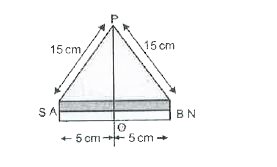 `B_(H)=(mu_(0))/(4pi).(M)/(OP^(2)+AO^(2))^(3//2)` `(0.4xx10^(-4))/(10^(-7))xx225xx10^(-4^(3//2))=M` `0.4xx10^(3)xx10^(-6)=M` `M=1.35 A-m` |
|
| 41. |
Calculate and compare the energy released by a) fusion of 1.0 kg of hydrogen deep within Sun and b) the fission of 1.0 kg of ""^(235)U in a fission reactor. |
|
Answer» Solution :(a) Note that in the INTERIOR of SUN, four ` ""_(1)^(1)H` nuclei COMBINE to form one `""(2)^(4)He` nucleus releasing about 26 MeV of energy per event. Energy released in fusion of 1kg of hydrogen `= 39 xx 10^(26) MeV` (b) Energy released in fission of 1kg of `""_(92)^(235) U= 5.1 xx 10^(26) MeV` The energy released in fusion of 1 kg of hydrogen is about 8 times that of the energy eleased in the fission of 1 kg of uranium. |
|
| 42. |
The light ray is incident at an angle of 60^@ on a prism of angle 45^@ When the light ray falls on theother surface at 90^@, the refractive index of the material of the prism mu and angle of deviation 'd' are given by |
|
Answer» `MU = sqrt2, d = 30^@` |
|
| 43. |
A series LCR circuit with R=20Omega,L=1.5H,andC=35muF is connected to a variable frequency 200 V ac supply. When the frequency of the supply equals the natural frequency of the circuit, what is the average power transferred to the circuit in one complete cycle? |
|
Answer» Solution :`Z = sqrt(R^(2) + (X_(L) - X_(C))^(2))` At RESONANCE `X_(L) - X_(C) = 0` `:. Z = R` `I = (V)/(Z) = 10` `P = VI = 200 W` |
|
| 44. |
A cylindrical rod with one end in steam and other end in ice results in melting of 0.1 g of ice per second. If the rod is replaced by another with half the length and double the radius and 1//4th the conductivity than that of the first, the rate at which the ice melts in g/sec will be : |
|
Answer» 3.2 This HEAT is used in melting ice `:.Q=mL`. `RARR""(mL)/(t)=(kA(T_(1)-T_(2)))/(d)` or `m/t=(kA(T_(1)-T_(2)))/(Ld)` `:.""(m_(1))/(t_(1))=(k_(1)pir_(1)^(2)(T_(1)-T_(2)))/(Ld_(1))` `(m_(2))/(t_(2))=(k_(2)pir_(2)^(2)(T_(1)-T_(2)))/(Ld_(2))` `:.(m_(1))/(t_(1))xx(t_(2))/(m_(2))=(k_(1))/(k_(2))((r_(1))/(r_(2)))^(2)*(d_(2))/(d_(1))=0.1xx(t_(2))/(m_(2))=(1)/(1//4)xx(1/2)^(2)xx(1//2)/(1)=1/2` `(m_(2))/(t_(2))=0.2" g/sec"` Thus correct CHOICE is (C ). |
|
| 45. |
Light ray is travelling from a medium of refractive index mu in to air. Angle of incidence at the interface is 53^(@). Light ray is found to suffer total internal reflection. Select possible values of mu from the following : |
|
Answer» 1.2 `sin^(-1)((1)/(mu))gt 53^(@)` `rArr""(1)/(mu) gt sin 53^(@)` `rArr""(1)/(mu gt (4)/(5)` `rArr""mu gt 1.25` Options (B), (c) and (d) satisfy above CONDITION and hence are correct options. |
|
| 46. |
A stopping potential of 0.82 volt is required to stop the photoelectrons emitted from a metallic surface by light of wavelength 4000 Å. The stopping potential for wavelength 3000 Å will be : |
|
Answer» Solution :`0.82eV=(12375)/(4000)-phi_(0)` `:. Phi_(0)=2*27eV` Also `eV_(S)=(12375)/(3000)-2.27` Then `V_(S)=1*85V`. |
|
| 47. |
Figure 11-16a shows a safe (mass M = 430 kg) hanging by a rope (negligible mass) from a boom (a = 1.9 m and b = 2.5 m) that consists of a uniform hinged beam (m=85 kg) and horizontal cable (negligible mass). What is the tension T_(c) in the cable? In other words, what is the magnitude of the force vecT_(c) on the beam from the cable? |
|
Answer» Solution :The system here is the beam alone, and the forces on it are shown in the free-body diagram. The force from the cable is `vecT_(c)`. The gravitational force on the beam acts at the bcam.s center of MASS (at the heam.s center) and is represented by its equivalent `mvecg`. The vertical component of the force on the beam from the hinge is `vecF_(v)` and the horizontal component of the force from the hinge is `vecF_(h)`. The force from the rope supporting the safe is `vecT_(r)`. Because beam, rope, and safe are stationary, the magnitude of `vecT_(r)` is equal to the weight of the safe: `T_(r) = Mg`. We place the origin O of an xy COORDINATE system at the hinge. Because the system is in static equilibrium, the balancing equations apply to it. calculation: let us start with Eq. 11-27(`tau_("net,z")= 0`) NOTE that we are asked for the magnitude of force `vecT_(c)` and not of forces `vecF_(h)` and `vecF_(v)`acting at the hinge, at point O. To eliminate `vecF_(h)` and `vecF_(v)` from the torque calculation, we should calculate torques about an axis that is perpendicular to the figure at point O. Then `vecF_(h)` and `vecF_(v)` will have moment arms of zero. The lines of action for `vecT_(c)vecT_(r)`, and `mvecg` are dashed. The corresponding moment arms are a, b, and `b//2`. Writing torques in the form of `r_(bot) F` and using our rule about SIGNS for torques, the balancing equation `tau_("net,z")= 0` becomes `(a)(T_(c))-(b)(T_(r))-((1)/(2)b)(mg)=0`(11-29) Substituting Mg for `T_(r)` and solving for `T_(c)` we find that `T_(c)= (gb(M+(1)/(2)m))/(a)` `((9.8 m//s^(2) )(2.5 m)(430 kg +85/2 kg))/(1.9m)` `= 6093 N ~~ 6100 N. ` 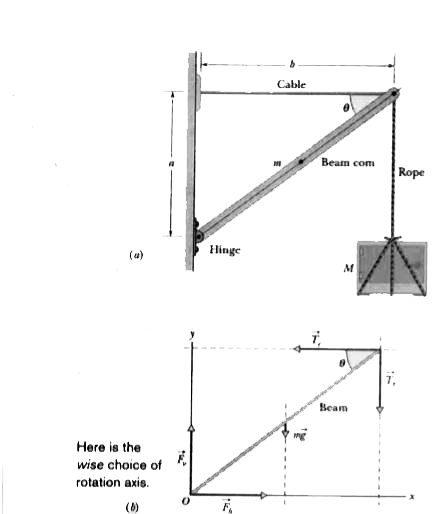
|
|
| 48. |
(A): Long distance transmission of A.C. is carried out at extremely high voltage. (R) : For large distance, voltage has to be large. |
|
Answer» Both 'A' and 'R' are TRUE and 'R' is the CORRECT EXPLANATION of 'A'. |
|
| 49. |
(a) Why is an intrinsic semiconductor deliberately converted into an extrinsic semiconductor by adding impurity atoms ? (b) Explain briefly the two processes that occur in p-n junction region to create a potential barrier. |
|
Answer» (b) During formation of a p-n junction .diffusion. and .drift. are two important processes taking place in it. Whenever a p-n junction is formed, holes diffuse from p-SIDE to n-side and electrons diffuse from n-side to p-side. Diffusion of an electron from n to p-side leaves BEHIND an immobile ionised donor (positive charge). Similarly, diffusion of a hole from p-to n-side leaves behind an immobile acceptor (negative charge). Thus, due to diffusion of electrons and holes a layer of positive charge (or positive space charge region) is developed on n-side of junction and a layer of negative charge (or negative space charge region) is developed on p-side of junction. Therefore, a. depletion layer. is formed on either side of junction consisting of immobile ion cores devoid of their electrons or holes. Due to positive space charge on n-side and negative space charge on p-side of the junction an electric field is developed at the junction which is directed from n-side to p-side. Due to this electric field electrons drift from p-side to n-side and holes drift from n-side to p-side thus giving rise to a drift current. The direction of drift current is opposite to that of diffusion current and in equilibrium state the two currents just balance each other. Hence, no net current flows in p-n junction. The loss of electrons from n-region and gain of electrons by p-region causes a potential difference across the junction. This potential opposes further FLOW of charge CARRIERS across the junction and is CALLED the potential barrier. |
|
| 50. |
1992 के पृथ्वी सम्मेलन में लगभग कितने देशों के राष्ट्राध्यक्ष शामिल |
|
Answer» 75 |
|