

Saved Bookmarks
This section includes 7 InterviewSolutions, each offering curated multiple-choice questions to sharpen your Current Affairs knowledge and support exam preparation. Choose a topic below to get started.
| 1. |
The two parallel plates of a condenser have been connected to a battery of 300 volts and the charge collected at each plate is 1muC. The energy supplied by the battery: |
|
Answer» `6xx10^-2J` |
|
| 2. |
A straight conductor carries a current along the z-axis. Consider the points A (a, 0, 0), B(0, -a, 0), C(-a, 0, 0) and D(a, a, 0): |
|
Answer» all four points have magnetic FIELDS of the same magnitude. |
|
| 3. |
A copper rod AB of length L, pivoted at one end A, rotates at constant angular velocity omega, at right angles to a uniform magnetic field of induction B. The e.m.f developed between the mid point C of the rod and B is |
|
Answer» `(Bomegal^(2))/4` `de=Bomegaxdx` 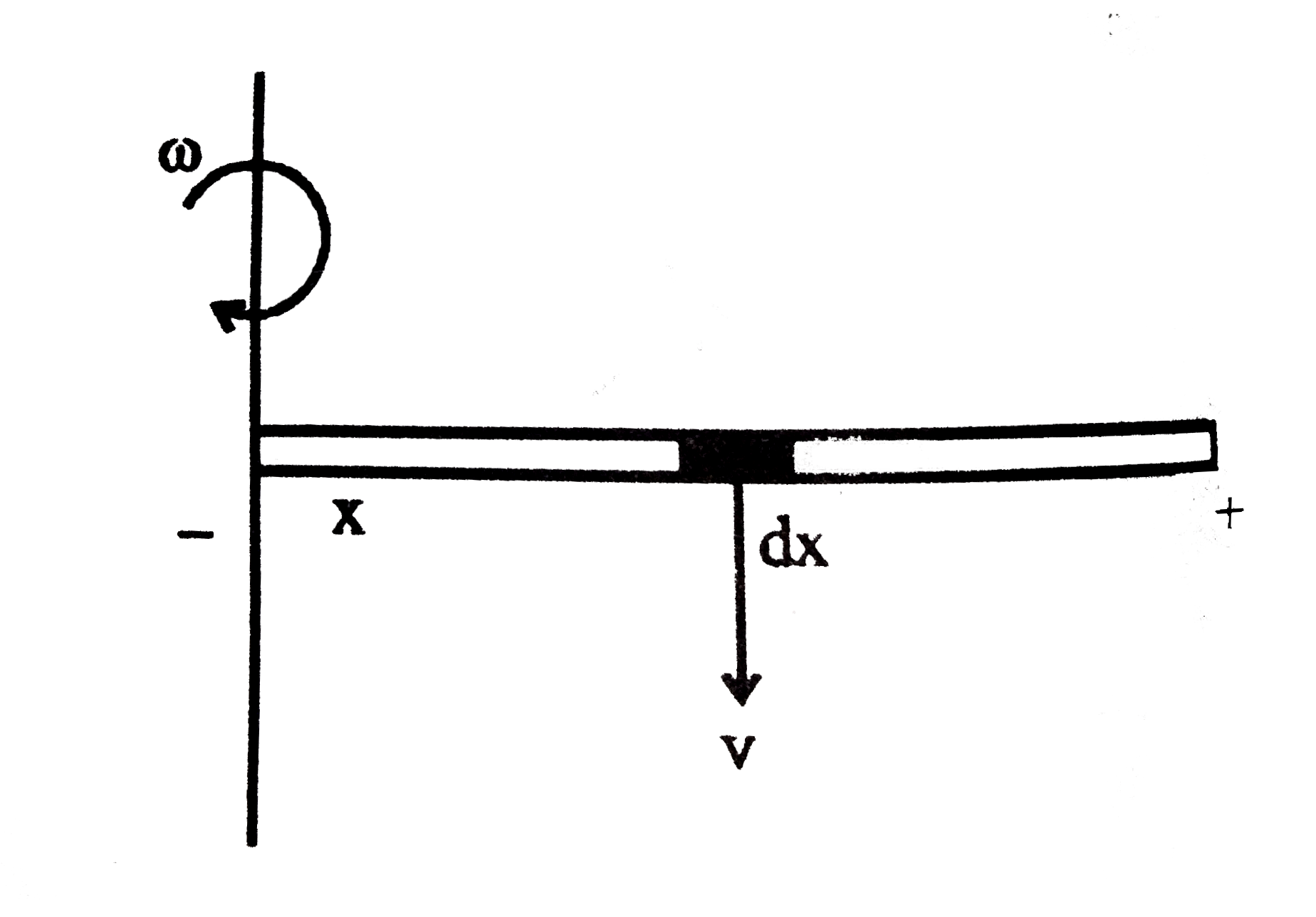 `e=Bomegaoverset(l)underset(l//2)intxdx = (Bomega)/2[X^(2)]_(l//2)^(l)` `=(Bomega)/2xx(3l^(2))/4impliese=(3Bomegal^(2))/8` |
|
| 4. |
In previous problem, if the cell had been connected in parallel (instead of in series) which of the above graphs would have shown the relationship between total current I and n? |
|
Answer»
|
|
| 5. |
Answer the question regarding earth's magnetism: In which direction would a compass free to move in the vertical plane point to, if located right on the geomagnetic north or south pole? |
|
Answer» Solution :(d) When a magnetic NEEDLE, free to rotate in vertical PLANE is PLACED at magnetic POLES of Earth, it remains vertical. North POLE of above needle remains vertically upward at magnetic north pole of Earth. |
|
| 6. |
The unit of inductance is equivalent to ….. |
|
Answer» `"Volt-Ampere"/"Second"` `therefore L=E/((dI)/(dt))` `therefore` UNIT of L=`"Volt"/"Ampere/Second"` `="Volt X Second"/"Ampere"` |
|
| 7. |
A coil having 100 turns and area 0.020m^(2) is placed normally in a magnetic field. The magnetic field changes from 0.20 Wb m^(-2) at a uniform rate over a period of 0.01 s. Calculate the induced emf in the coil. |
|
Answer» |
|
| 8. |
An equilateral triangle of conducting wire of side 'a' is kept in a time (t) varying magnetic field B=B_0t, where B_0 is constant in such a way that the centre of field coincides with the centroid of the triangle. Now, choose the correct statement. |
|
Answer» INDUCED emf in the TRIANGLE will be `B_0a^2sqrt3` |
|
| 9. |
A 12.75 eV electron beam is used to excitea gaseous hydrogen atom at room temperature.Determine the wavelengths and the corresponding series of the lines emitted. |
|
Answer» Solution :We know that energy in the n-th orbit of HYDROGEN atom, `E_n=(13.6)/(n^2)eV` Energy of anelectron in the excited state after absorbing energy 12.75 eV becomes -13.6 +12.75 =-0.85 eV Thus , `n^2=(13.6)/(E_n)=(-13.6)/(-0.85)=16` or, n=4 Therefore, the electron getsexcited to n=4 state. `therefore` Total number of wavelengths in the spectrum `=(n(n-1))/(2)=(4xx3)/(2)=6` `therefore` During transition from the fourth Bohr orbit to the ground state, the decrease in energy of the atom may occur in6 different ways. The POSSIBLE emission LINES are shown in  Emitted wavelength , for the jump from initial energy LEVEL `E_i` to final energy level `E_f`, `lambda_(if)=(hc)/(E_i-E_f)=(6.6xx10^(-34)xx3xx10^(8))/(E_i-E_f)` `=(19.8xx10^(-26))/(E_i-E_f)m` `=(19.8xx10^(-26))/((E_i-E_f)xx10^(-10))"Å"` Wavelength emitted for the transition from n=3 to n=2 , `lambda_(32) =6547.6 "Å"` Wavelength emitted for the transition from n=3 to n=1 , `lambda_(31) =1023.6 "Å"` Wavelength emitted for the transition from n=2 to n=1 `lambda_(21)=1213.2 "Å"` Wavelength emitted for thetransition fromn=4to n=3 , `lambda_(43)=19110 "Å"` Lyman series -`lambda_(21)(1213"Å") and lambda_(31)(1024"Å")` Balmer series `-lambda_(32)(6548"Å")` `"Paschen series" -lambda_(43)(19110"Å")` |
|
| 10. |
The ratio of resistance of forward bias and reverse bias in p-n connection is ……. |
|
Answer» `10^(2):1` RESISTANCE of forward bias `r_(FB)=50Omega" to "100Omega` Resistance of reverse bias `r_(RB)=10^(-6)Omega` `therefore` RATIO `=10^(-4)` |
|
| 11. |
State two characteristics of em waves. |
| Answer» SOLUTION :The orderly distribution of ELECTROMAGNETIC raditions of all types of according to their wavelength and FREQUENCY | |
| 12. |
A fuse wire with radius of 0.2mm blows off with a current of 5 Amp. The fuse wire of same material, but of radius 0.3 mm will blow off with a current of 1) 5xx(3)/(2)" Amp" 2) (5sqrt3)/(2)" Amp" 3) 5sqrt((27)/(8))" Amp" 4) 5 Amp |
| Answer» Solution :`i^(2)propr^(3), (i_(1))/(i_(2))=((r_(1))/(r_(2)))^(3//2)=((0.1)/(0.3))^(3//2)""I,=5sqrt((27)/(8))" AMP"` | |
| 13. |
How many significant figures are there in 8000 |
|
Answer» 2 |
|
| 14. |
The two surfaces of a biconvex lens hassame radii of curvatures. This lens is made of glass of refractive index 1.5 and has a focal length 10 cm in air. The lens is cut into two equal halves along a plane perpendicular to its principal axis to yield tow plano-convex lenses. The two pieces are glued such that the convex surfaces touch each other. If this combination lens is immersed in water of refractive index 4/3 its focal length (in cm) is |
|
Answer» 5 |
|
| 15. |
An automobile tire has a volume of 1.64 xx10^2 m^3 and contains air at a gauge pressure (pressure above atmospheric pressure) of 165 kPa when the temperature is 0.00°C. What is the gauge pressure of the air in the tires when its temperature rises to 37.0°C and its volume increases to 1.67 xx10^(-2)m^4 Assume atmospheric pressure is 1.01 xx10^5Pa. |
| Answer» SOLUTION :`196kPa` | |
| 16. |
Explain dielectrics in detail and how an electric field is induced inside a dielectric . |
Answer» Solution :Induced ELECTRIC field inside the dielectric : When an external electric field is applied on a CONDUCTOR the charges are aligned in such a way that an internal electric field is produced . The magnitude of the internal electric field is smaller than that of external electric field is SMALL than that of external electric field . Therefore the net electric field inside the dielectric is not zero but is parallel to an external electric field with magnitude less than that of the external electric field . For example let us consider a rectangular dielectric slab placed between two oppositely charged plates ( capacitor ) as shown in the figure .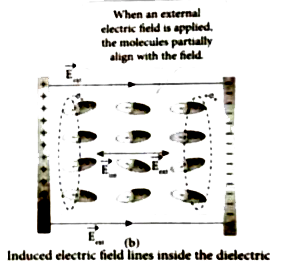 The uniform electric field between the plates acts as an external electric field `vecE_("ext") ` which polarizes the dielectric placed between plates . The positive charges are induced on one side SURFACE and negative charges are induced on the other side fo surface . But inside the dielectric the net charge is zero even in a small VOLUME . So the dielectric in the external field is equivalent to two oppositely charged sheets with the surface charge densities `+ sigma ` and `-sigma b`. These charges are called bound charges . They are not free to move like free electrons in conductors . This is shown in the figure . 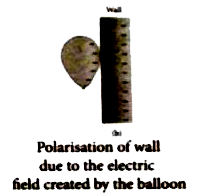 For example the charged balloon after rubbing sticks onto a wall . The reason is that the negatively charged balloon is brought near the wall it polarizes opposite charges on the surface of the wall which attracts the balloon. |
|
| 17. |
How are the magnitudes of the electric and magnetic fields related to the velocity of the EM wave? |
| Answer» SOLUTION :`(E_0)/(B_0) = C` | |
| 18. |
Given that current through CA = 1A, current through C'A' = 2A/ Now if A is connected to A' and B is connected B'. Find currents through CA and C'A', respectively. |
|
Answer» `1 A, 3A` 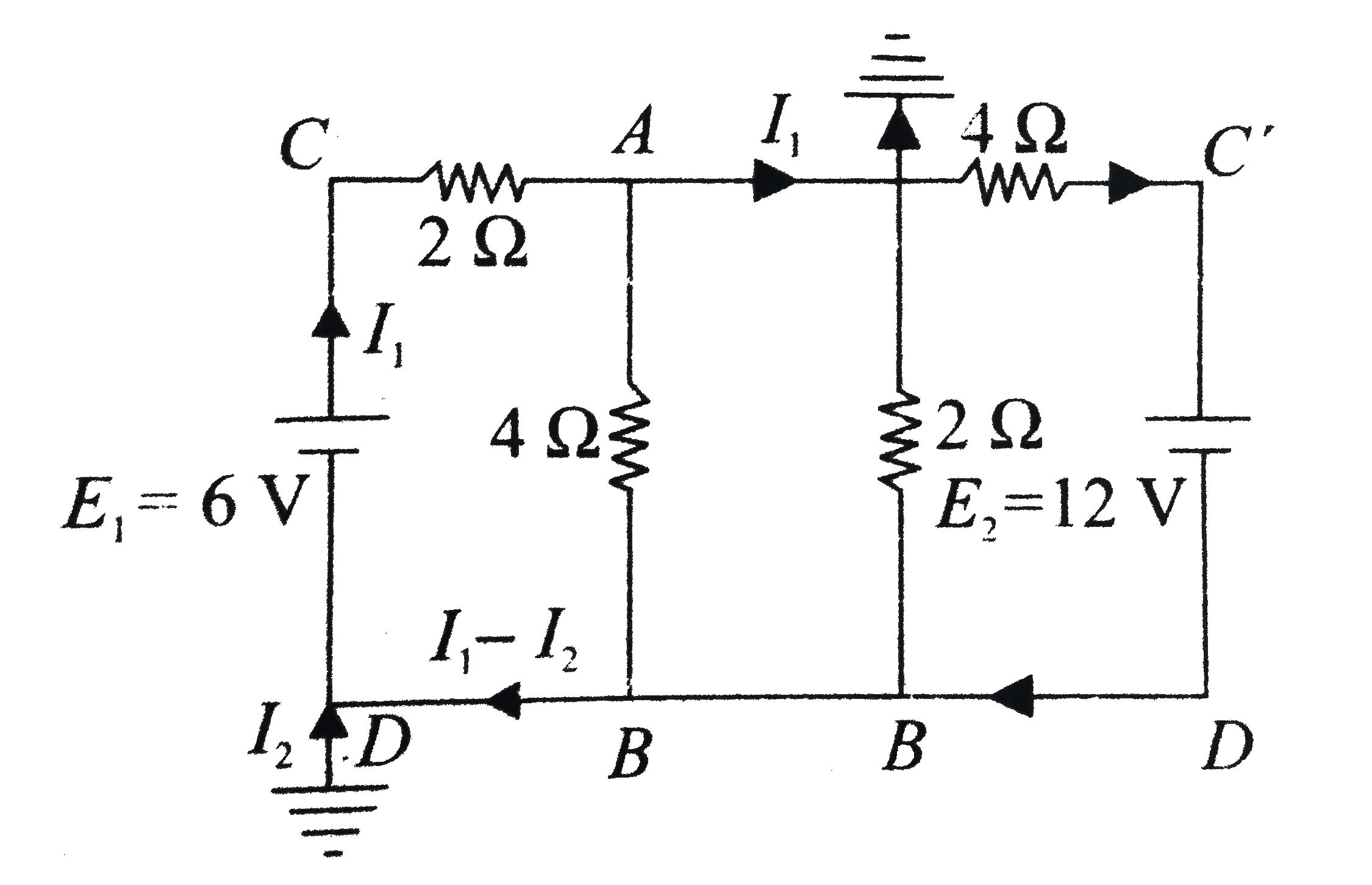 There will be no current in AB and A'B', because all these points are at the same potential. From D to A' : `V_(D) + 6 - 2I_(1) = V_(A), but V_(D) = V_(A') = 0 ` `IMPLIES I_1 = 3A` For outermost loop : `6-12 = 2I_1 + 4(I_1-I_2)or I_2 = 6A` Current through C'A' = `I_1-I_2 = 3-6 = -3A`. |
|
| 19. |
A horizontal jet of water coming out of a pipe of area of cross-section 20 cm^2 hits a vertical wall with a velocity of 10 ms^(-1) and rebounds with the same speed. The force exerted by water on the wall is, |
|
Answer» 0.2 N |
|
| 20. |
Calculate the amount of energy released when 1 kg of ""_(92)^(235)"U" undergoes fission reaction. |
|
Answer» Solution :235 g of` ""_(92)^(235)"U"` has `6.02 xx 10^(23)` atoms. In one gram of`""_(92)^(235 "U"`, the number of atoms is equal to `(6.02 xx 10^(23))/(235) = 2.56 xx 10^(21)` So the number of atoms in 1 kg of `""_(92)^(235)"U" = 2.56 xx 10^(21)xx 1000 = 2.56 xx 10^(24)` Each `""_(92)^(235)"U"` is `Q = 2.56 xx 10^(24) xx 200 MeV = 5.12 xx 10^(26)MeV` By CONVERTING in terms of joules, `Q = 5.12 xx 10^(26) xx 1.6 xx 10^(-13)`J = `8.192 xx 10^(13)`J. In terms of Kilowatt HOUR `Q = (8.192 xx 10^(13))/(3.6 xx 10^(6))= 2.27 xx 10^(7)` kWh |
|
| 21. |
A body of mass 2 kg is kept on a rough horizontal surface as shown in the figure. Find the work done by frictional force in the interval t=0 to t=5 sec |
|
Answer» ZERO `:.` Block does not start `rArr` WORK DONE by fricitional FORCE is zero |
|
| 22. |
Explain refractive index for light of different colours. |
|
Answer» Solution :Each colour is associated with wavelength of LIGHT. In the visible spectrum red light is at the LONG wavelength end (~ 700 nm) while the VIOLET light is at the short wavelength end (~ 400 nm). Dispersion takes place because the refractive index of MEDIUM for different wavelengths (colours) is different. For example, the bending of red component of white light is LEAST while it is most for the violet. Equivalently, red light travels faster than violet light in a glass prism. Table gives the refractive indices for different wavelength for crown glass and flint glass. 
|
|
| 23. |
When two tuning forks (fork 1 and fork 2 ) are sounded simultaneously, 4 beats second are heard. Now some tape is attached on the prong of the fork 2. When the tuning forks are sounded again, 6 beats per second are heard. If the frequency of fork 1 is 200 Hz, then what was the original frequency of fork 2 ? |
|
Answer» 204 Hz SINCE on loading the unknown FORK beat frequency INCREASES. `THEREFORE v_(2) = 196 ` Hz. so correct choice is (b) . |
|
| 24. |
एक व्यक्ति की तीन प्रारम्भिक और अन्तिम स्थितियाँ x-अक्ष के अनुदिश दी गई हैं (i) (-8m,7m) (ii) (7m,-3m)(iii)(-7m,3m) कौनसा युग्म ऋणात्मक विस्थापन को दर्शाता है |
| Answer» ANSWER :B | |
| 25. |
Give one use of polaroid. |
| Answer» Solution :To view 3-D pictures, in SUN glasses, to minimise HEAD light in automobiles ETC. | |
| 26. |
If radius of the earth is 6347 km, then what will be difference between acceleration of free falls and acceleration due to gravity near the earth's surface? |
|
Answer» A. 0.34 `g_("free FALL")=(GM)/(R^(2)-omega^(2)R=9.8-omega^(2)R` `g-g_("free falls")omega^(2)R=((2pi)/(T))^(2)R` `=(4pi^(2))/((24xx60xx60)^(2))xx6347xx10^(3)=0.03401` |
|
| 27. |
The time period of a satellite of earth is 5 hours. If the separation between the earth and the satellite is increased to 4 times the previous value, the new time period will become |
|
Answer» 10 hours `therefore T_(2) = T_(1) ((R_(2))/(R_(1)))^(3//2) = 5 xx [ (4R)/(R) ]^(3//2) = 40` hours |
|
| 28. |
A light stright fixed at one end to a wooden clamp on a ground passes over a fixed pulley and hangs at the other side. It makes an angle 30^(@) with the ground. A boy weighing 60 kg climbs up the rope. The wooden clamp can tolerate upto vertical force 360N. Find the maximum acceleration in the upward direction with which the boy can climb safely. The friction of pulley and wooden clamp may be ignored (g = 10 m//s^(2)) |
|
Answer» |
|
| 29. |
A copper wire of cross sectional area 0.01 mm^(2)? is used to prepare a resistance of 1KOmega. The resistivity of copper is 1.7xx10^(-8)Omegam. Calculate the length of the wire |
|
Answer» 58.82 m |
|
| 30. |
The value of coefficient of mutual induction in two coils can be increased by __ |
|
Answer» placing the COILS MUTUALLY perpendicular . |
|
| 31. |
To measure p.d between two points in a circuit, minimum current should pass through the voltmeter. Why? |
| Answer» Solution :Otherwise the expected potential drop (as CURRENT X resistance) MAY not be PRODUCED. | |
| 32. |
Whatare the majority carries in the N-type semiconductor ?How an N-type semiconductor conductor? |
|
Answer» SOLUTION :Electrons are the majority carries in the N-type semiconductor. When ELECTRIC field is applied,the free ELECTRON of the N-type semiconductor DRIFTS opposite to the field.Due to the flow,a current is GENERATED. |
|
| 33. |
Consider a metal ring kept (supported by a cardboard) on top of a fixed solenoid carrying a current I as per figure. The centre of the ring coincides with the axis of the solenoid. If the current in the solenoid is switched off, what will happen to the ring ? |
| Answer» Solution :When the current in the solenoid is switched off the MAGNETIC flux LINKED with METAL ring will decrease and clockwise current will be induced in it, so the solenoid and the metal ring attract each other, hence the ring remains on the cardboard. | |
| 34. |
The amplitude of polarised light transmitted through a polariser is A. The amplitude of unpolarised light incident on it is |
|
Answer» `(A)/(2)` |
|
| 35. |
Three equal charges q_1,q_2,q_3 are placed at the three corners ABC of a square ABCD. If the force between the charges at A and B (on q_1 and q_2) is F_12 and that between A and C is F_13 then the ratio of magnitudes F_12 and F_13 is |
|
Answer» `1//2` |
|
| 36. |
Angular velocity of an electron in nth Bohr orbit is proportional to (1)/(n^((p)/(2))).Find the value of p |
|
Answer» <P> |
|
| 37. |
A 2 kg abl collides with the floor at an angle theta and rebounds at the same3 angle and speed as shown below. Which of the following vectors represents the impulse exerted on the ball by the floor? |
|
Answer» <P>darr |
|
| 38. |
The quantity that cannot be measured by a potentiometer is .......... |
|
Answer» RESISTANCE |
|
| 39. |
An electric field givenvecE= 4.0hati -3.0(y^(2) + 2.0)j pierces a Gaussian cube of edge length 2.0 m and positioned as shown in the figure. (The magnitude E is in newtons per coulomb and the position z is in meters.) what is the electric flux through the (a) top face,(b) bottom face, (c) left face , (b) bottom facem (c) left face, and (d) back face ? (e) what is the net electric flux through the cube ? |
|
Answer» |
|
| 40. |
the magnetic field in a plane electromagnetic field is given by the expression for the electric field (in v/m) may be given by: |
|
Answer» `E_y=2xx10^(-7) SIN (6.5xx10^3 Z + 1.5xx10^11 t)` |
|
| 41. |
A rod of length l having uniformly distributed charge Q is rotated about one end with constant frequency 'f'. Its magnetic moment is (pi fQl^(2))/n Then the value of n is |
|
Answer» 7 `dq=Q/L.dx` Equivalent CURENT di = f dq `therefore` Magnetic moment of this element `DMU = (di)NA (N = 1)` `dpi = (pir^(2))fQ/l dx` `implies mu = (pifQ)/l int_(0)^(l) X^(2) dx implies mu = 1/3pifQl^(2)` 
|
|
| 42. |
When 100V DC is applied across a solenoid, a current of 1A flows in it. When 100V AC is applied across the same solenoid, the current drops to 0.5A. If the frequency of the AC source is 50 Hz, the impedance and inductance of the solenoid are : |
|
Answer» `200 OMEGA` and 0.551H |
|
| 43. |
The ground state energy of hydrogen atom is -13.6 eV. What is the potential energy of the electron in this state? |
| Answer» Answer :B | |
| 44. |
Which of the following is thecorrect order for increasing bond angle ? |
|
Answer» `NH_(3) LT PH_(3) lt AsH_(3) lt SbH_(3)` (here, bond angle depends on electronegativiy of central atom ) |
|
| 45. |
A small sphere of mass m suspended by a thread is first taken aside so that the thread forms the right angle with the vertical and then released. Find: (a) the total acceleration of the sphere and the thread tension as a function of theta, the angle of deflection of the thread from the vertical, (b) the thread tension at the moment when the vertical component of the sphere's velocity is maximum, (c) the angle theta between the thread and the vertical at the moment when the total acceleration vector of the sphere is directed horizontally. |
|
Answer» Solution :Let us depict the forces acting on the small sphere m, (at an arbitrary position when the thread makes an angle `theta` from the vertical) and write equation `vecF=mvecw` VIA projection on the unit vectors `hatu_t` and `hatu_n`. From `F_t=mw_t`, we have `mg sin theta=m(DV)/(dt)` `=m (vdv)/(ds)=m(vdv)/(l(-d theta))` (as vertical is reference line of ANGULAR position) or `vdv=gl sin theta d theta` Integrating both the sides: `UNDERSET(0)overset(v)INT v dv=-gl underset(x//2)overset(0)int sin theta d theta` or, `v^2/2=gl cos theta` Hence `v^2/l=2 g cos theta =w_n` .(1) (Eq. (1) can be easily obtained by the conservation of mechanical energy). From `F_n=mw_n` `T-mg cos theta=(mv^2)/(l)` Using (1) we have `T=3 mg cos theta` (2) Again from the Eq. `F_t=mw_t`: `mg sin theta=mw_1` or `w_t=g sin theta` (3) Hence `w=sqrt(w_t^2+w_n^2)=sqrt((gsin theta)^2+(2 g cos theta)^2)` (using 1 and 3) `=gsqrt(1+3cos^2theta)` (b) Vertical component of velocity `v_y=v sin theta` So, `v_y^2=v^2 sin^2 theta=2gl cos theta sin^2 theta` (using 1) For maximum `v_y` or `v_y^2`, `(d(cos theta sin^2 theta))/(d theta)=0` which yields `cos theta=1/sqrt3` Therefore from (2) `T=3mg1/sqrt3=sqrt3mg` (c) We have `vecw=w_thatu_t+w_nhatu_n` thus `w_y=w_(l(y))+w_(n(y))` But in accordance with the problem `w_y=0` So, `w_(t(y))+w_(n(y))=0` or, `g sin theta sin theta +2 g cos^2 theta(-cos theta)=0` or , `cos theta=1/sqrt3` or, `theta=54*7^@` 
|
|
| 46. |
Discuss the historical observation of frictional electrics. |
| Answer» Solution :The CREDIT of discovery of the fact that amber robbed with WOOL or silk cloth attracts LIGHT objects GOES to Thales of Miletus of Greece, around 600 BC. | |
| 47. |
Electromagnetic waves can be propagated throught conductor.Write the probable equation for the electric and magnetic fields for a wave propagated in the X-direction. |
| Answer» Solution :For a electromagnetic WAVE PROPAGATING in the X-direction, the field VARIATIONS are in a transverse PLANE in the Y-Z plane. The two fields can be written as `barE = E_y.hatj = E_0 sin(omegat-kx),BARB = B_zhatk = B_0 sin(omegat-kx)` | |
| 48. |
A beaker contains water up to a height h_(1) and kerosene of height h_(2) above water so that the total height of (water + kerosene) is (h_(1) + h_(2)) . Refractive index of water is mu_(1) and that of kerosene is mu_(2) . The apparent shift in the position of the bottom of the beaker when viewed from above is :- |
|
Answer» `(1-(1)/(mu_1))h_2+(1-(1)/(mu_2))h_1`  APPARENT DEPTH `=("Real depth")/("Refractive INDEX")` Shift of bottom `x=d_o-d_i` `=d_o-(d_o)/(MU)` `=(1-(1)/(mu))d_o` …. (1) For water `x_1=(1-(1)/(mu_1))h_1` and For kerosene `x_2=(1-(1)/(mu_2))h_2` `therefore` Total shift of bottom `=x_1+x_2` `=(1-(1)/(mu_1))h_1+(1-(1)/(mu_2))h_2` |
|
| 49. |
What will be the total flux through the face of the cube with side of length a if a charge q is placed at mid point of an edge of the cube. |
Answer» Solution :When q is placed at B, it is shared by CUBES, then total FLUX is `PHI=(q/4)/epsilon_@ =q/(4 epsilon_@)`
|
|
| 50. |
Select wrong statement from the following for EMW |
|
Answer» are TRANSVERSE |
|


