Saved Bookmarks
This section includes 7 InterviewSolutions, each offering curated multiple-choice questions to sharpen your Current Affairs knowledge and support exam preparation. Choose a topic below to get started.
| 1. |
Fig. shows variation of photocurrent with anode potential for photosensitive surface for three different radiations. Let I_(a), I_(b) and I_(c) be the intensities and f_(a),f_(b) and f_(c) the frequencies for curves a, b to c, then: |
|
Answer» `f_(a)=f_(b),I_(a)neI_(b)` |
|
| 2. |
A body is projected at 60^(@) with the horizontal with the velocity of 10ms^(-1). Findthe velocity of the projectile when it moves perpendicularto itsinitial direction. |
|
Answer» |
|
| 3. |
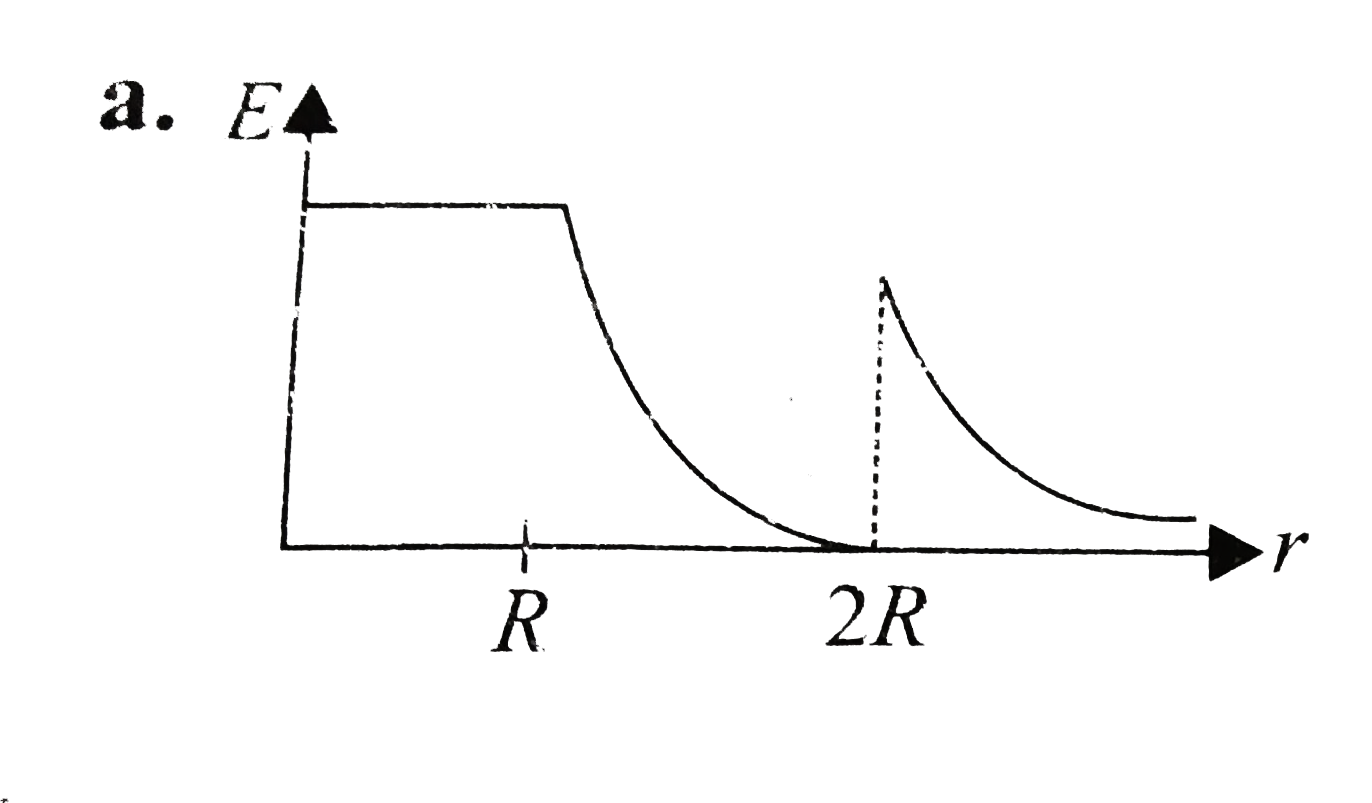
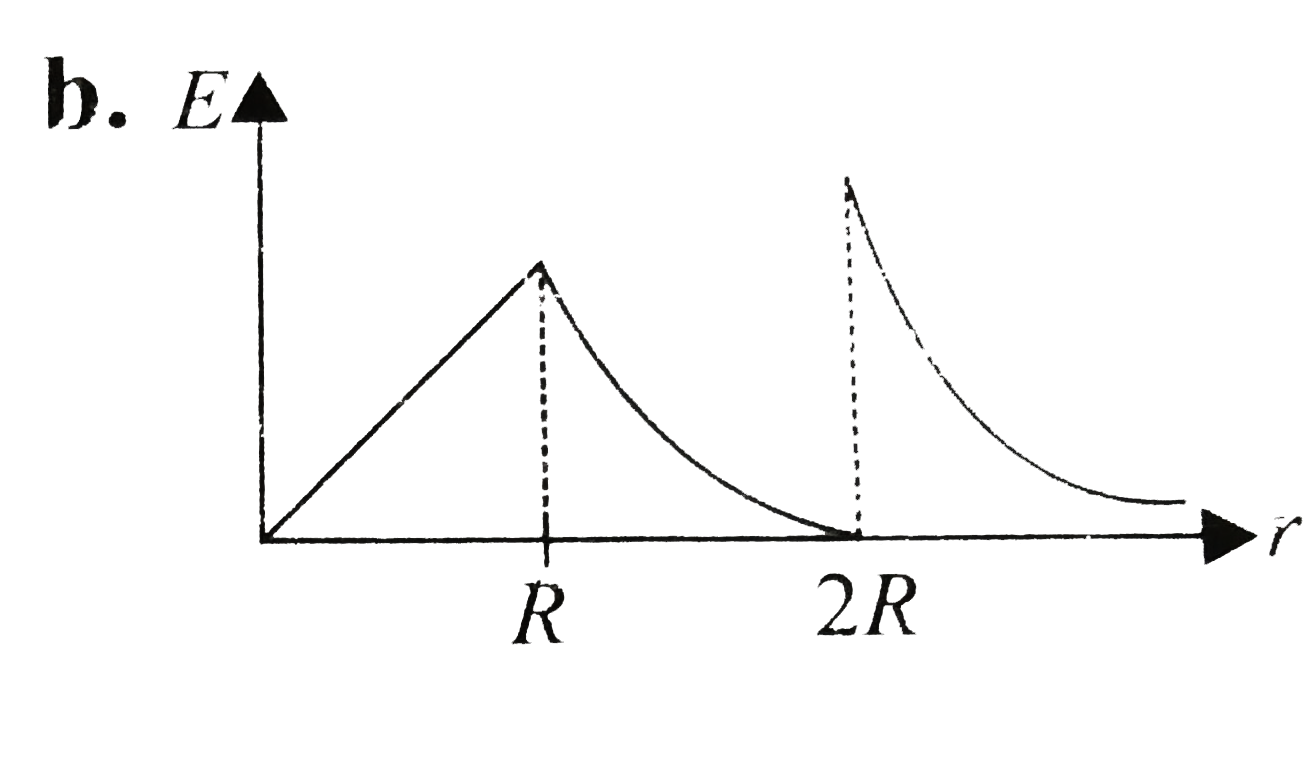
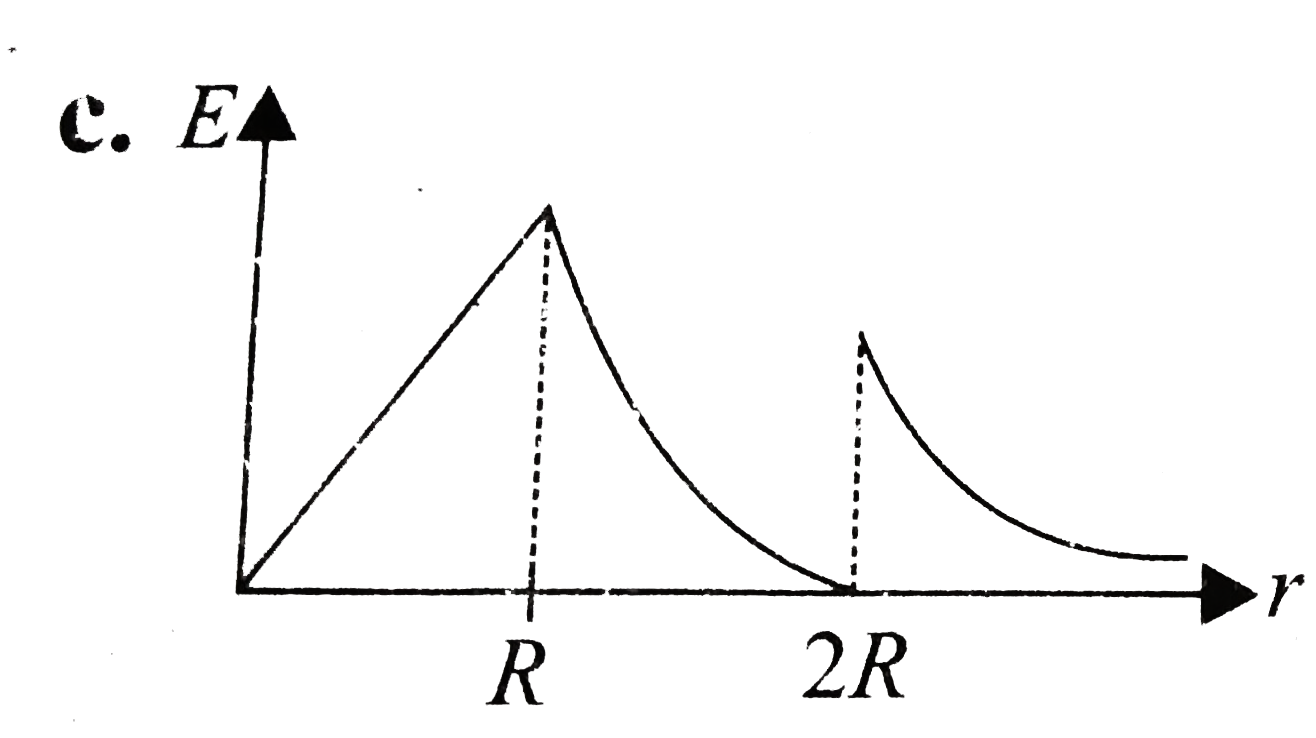
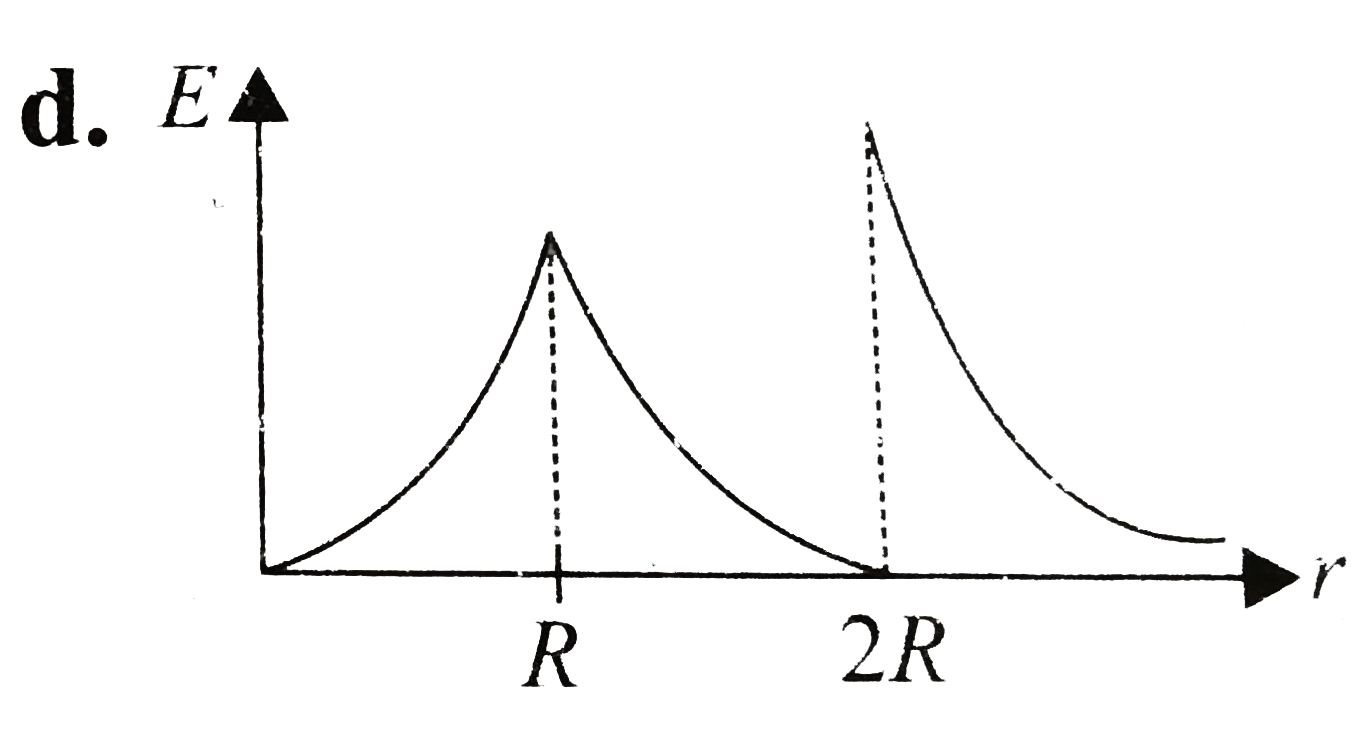
A charge Q is uniformly distributed in a dielectric sphere of radius R (having dielectric constant unity). This dielectric sphere is enclosed by a concentric spherical shell of radius 2R and having uniformly distributed charge 2Q. Which of the following graph correctly represents variation of electric field with distance r from the common centre? |
|
Answer»
Electric field inside uniformly DISTRIBUTED dielectric sphere `E=R`(For `0ltrleR`) Between the spheres `Eprop(Q)/(r^(2))`(For `Rltrle2R`) OUTSIDE the spheres `E=(3Q)/(r^(2))`(For `2Rltr`) |
|
| 4. |
Derive the relation vec(j)=sigmavec(E) with terms which has usual meaning. |
|
Answer» SOLUTION :We know from the Ohm.s law, I = KV where, I- electric CURRENT, K - CONDUCTANCE and V - potential difference Dividing I= KVby `.^^.` on both sides we get, `I/A=K/A V` by definition electric current density `j=I/A` Hence `j=(K/A)V` But electric field , `E=V/l` or V=EL hence `j=(K/A)(El)` where `SIGMA=(Kl)/A` is known as theelectricalconductivity . Hence `j=sigmaE`. In a vectorform , the relationis written as `vecj=sigmavecE` . |
|
| 5. |
A ray of light is incident on a plane mirror along the direction given by vector A = 2hati - 3hatj + 4hatk . Find the unit vector along reflected ray. Take normal to mirror along the direction of vector B = 3hati - 6hatj + 2hatk. |
|
Answer» `(-94hati + 237hatj+68hatk)/(49sqrt(29))` |
|
| 6. |
Using the necessary circuit diagram, show how the V-I characteristics of a p-n junction are obtained in (i) forward biasing (ii) Reverse biasing. How are these characteristics made use of in rectification? |
|
Answer» Solution :The circuit arrangement for STUDYING the V–l characteristics of a diode are shown in Fig. (a) and (b). For different values of voltages the value of CURRENT is noted. A graph between V andis obtained as in Figure (c). From the V-l characteristic of a junction diode it is clear that it allows current to pass only when it is forward biased. So if an alternating voltage is applied across a diode the current flows only in that part of the cycle when the diode is forward biased. This PROPERTY is used to RECTIFY alternating voltages. 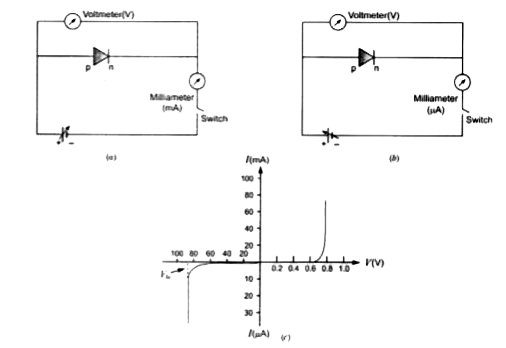
|
|
| 7. |
Consider the circuit arrangement shown in figure (1) for studying input and output characteristics of n-p-n transistor in CE configuration. Select the values of R_(B) and R_(C ) for a transistor whose V_(BE)=0.7V, so that the transistor is operating at point Q as shown in the characteristics shown in figure (2). Given that the input impedance of the transistor is very small and V_(C C)=V_(BB)=16V, also find the voltage gain and power gain of circuit making appropriate assumptions. |
|
Answer» Solution :Graph in FIGURE-2 is for `I_(B)=30muA`. For point Q on it, `I_(C )=4mA=4xx10^(-3)A and V_(CE)=8V` For output part of above figure, `V_(C C)=I_(C )R_(C )+V_(CE)` `therefore 16=(4xx10^(-3))R_(C )+8` `therefore R_(C )=(8)/(4xx10^(-3))=2xx10^(3)Omega=2kOmega` For INPUT part of above figure-1, `V_(B B)=I_(B)R_(B)+V_(BE)` `therefore 16=(30xx10^(-6))R_(B)+0.7` `therefore R_(B)=(15.3)/(30xx10^(-6))=5.1xx10^(5)Omega=510xx10^(3)Omega` `=510kOmega` Voltage gained, `A_(V)=beta(R_(C ))/(R_(B))=((I_(C ))/(I_(B)))((R_(C ))/(R_(B)))` `therefore A_(v)=((4xx10^(-3))/(30xx10^(-6)))((2xx10^(3))/(510xx10^(3)))` `therefore A_(V)=0.52` Power gained, `A_(P)=A_(V)A_(i)=A_(V)beta=A_(V)((I_(C ))/(I_(B)))` `therefore A_(P)=0.52xx(4xx10^(-3))/(30xx10^(-6))` `therefore A_(P)=69.33` |
|
| 8. |
Consider the situation shown in figure. The plates of the capacitor have plate area A and are clamped in the laboratory, the dielectric slab is released from rest with a length a inside the capacitor. Neglecting any effect of friction or gravity . Show that the slab will execute periodic motion and find its time period. |
|
Answer» `8sqrt(((l-a)LMD)/(epsilon_0Aepsilon^2(K-1)))` |
|
| 9. |
If thetais the polarising angle for two optical media whose critical angles are C_1 and C_2, then the correct relation is |
|
Answer» `SINTHETA=(sinC_2)/(sinC_1)` |
|
| 10. |
The optics deals with the transmission of light through transparent fibres is known as |
| Answer» SOLUTION :FIBRE OPTICS | |
| 11. |
A particle is projected from the ground so as to graze the four upper vertices of a regular hexagor, whose side is 2a and which is placed vertically with one side on the ground. What is the range on the ground. |
|
Answer» `3sqrt(7A)` 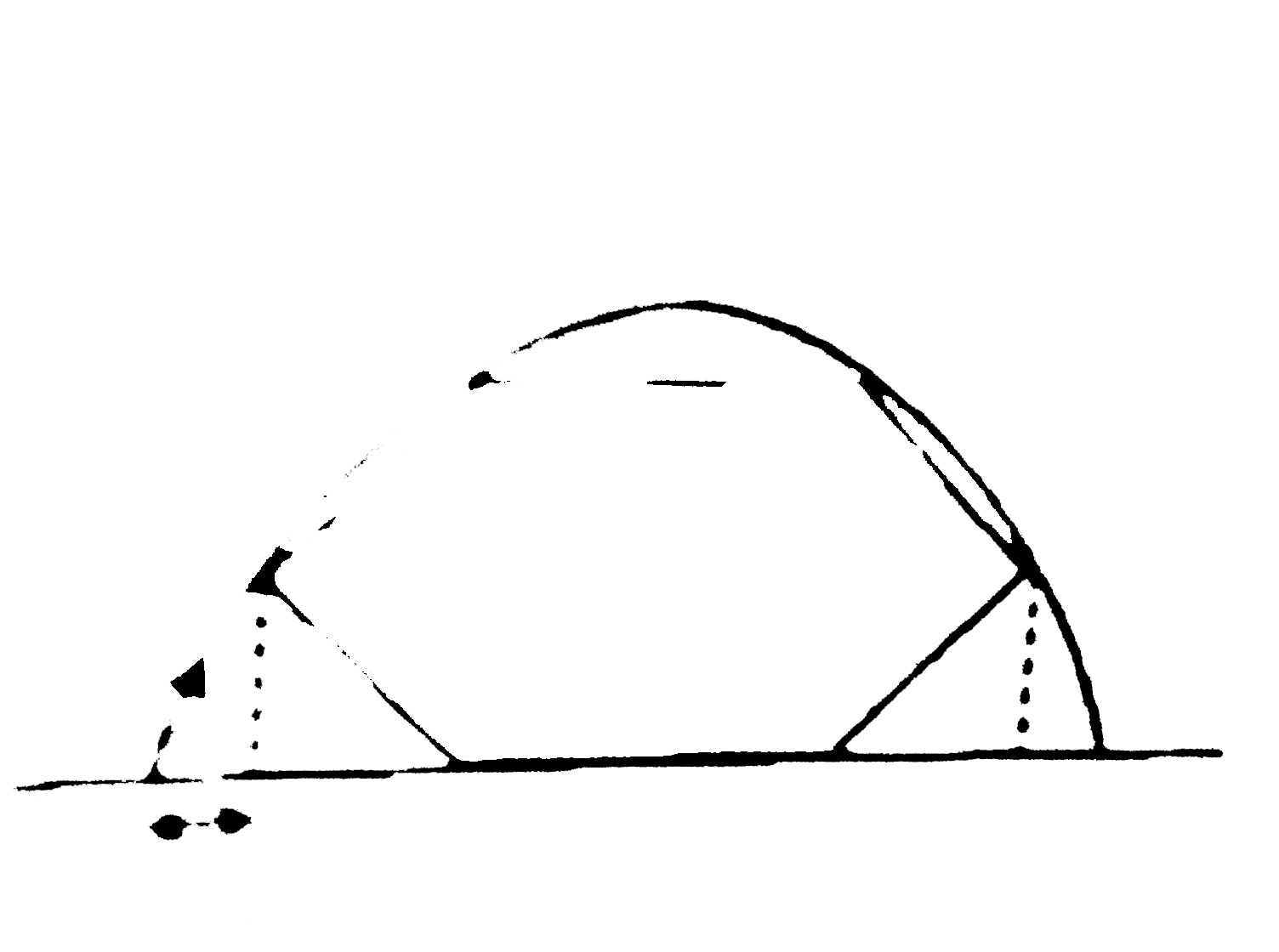 `x_(0)=(R(4a cos 60^(@)+2a))/(2)` `x_(0)=(R)/(2)-2a` `y=TAN thetax(1-(x)/(R))` `asqrt(3)=tantheta x[(1-((R)/(2)-2a))/(R)]` `2asqrt(3)=tan theta[((R)/(2)-2X)]+2a cos 60^(@)[1-((R)/(2)-2a+a)/(R)]` `(1)/(2)=((R-4a))/(R-2a)([R-(R)/(2)+2a])/([R-(R)/(2)a])=((R-4a))/(((P,-2a)))` `([R+4a])/((R+2a))` `(1)/(2)=(R^(2)-16a^(2))/(R^(2)-4a^(2))` `R^(2)-4a^(2)=4R^(2)-32a^(2)` `R=2a sqrt(7)` |
|
| 12. |
The focal lengths of the objective and the eyepiece of the telescope are 225 cm and 5 cm respectively. The magnifying power of the telescope will be |
|
Answer» a. 49 |
|
| 13. |
Arrange the following electromagnetic radiations in ascending order of their frequencis.(i) Mircrowavee(ii) Radiowave (iii) Xrays (iv) Gamma rays. |
| Answer» SOLUTION :The RADIATIONS in ascending order of frequencies are Radio waves `LT` MICROWAVES `lt` x-RAYS `lt` Gamma rays. | |
| 14. |
A soap bubble is given a negative charge, then its radius. |
|
Answer» Decreases |
|
| 15. |
A particle is projected from the ground so as to graze the four upper vertices of a regular hexagor, whose side is 2a and which is placed vertically with one side on the ground. What is the ratio of the velocity of the particle on reaching the ground to the least velocity? |
|
Answer» `SQRT((31)/(3))` Ratio `=sqrt(U_(x)^(2)+U_(y)^(2))/(U_(x))=sqrt(1+((U_(y))/(U_(x)))^(2))` `=sqrt(1+tan^(2)theta)` |
|
| 16. |
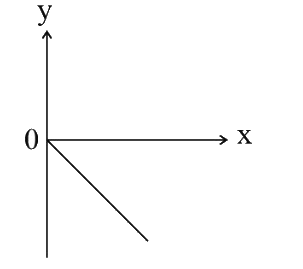
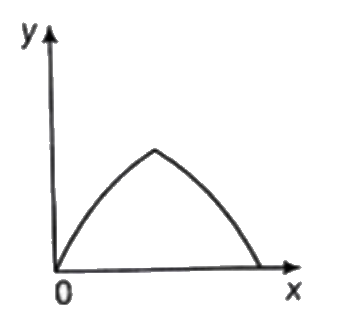
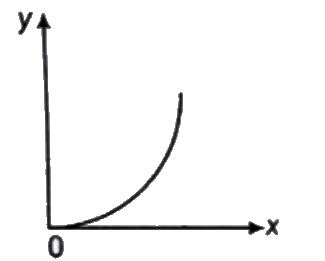
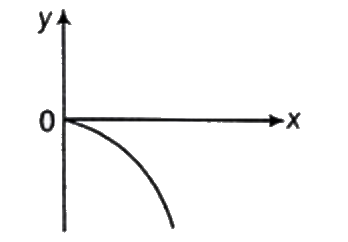
Two particles of mass m and 2m have their position vectors as a function of time as r_(1) (t) = hat I - t^(3) hat(j) +2t^(2)hat(k) and r_(1) (t) = t hat (i) -t^(3)hat(j) -t^(2) hatk respectively (where t is the time). Which one of the following graphs represents the path of the centre ofmass ? |
|
Answer»
|
|
| 17. |
Which of the following devices is half duplex ? |
|
Answer» Mobile phone |
|
| 18. |
A projectile is fired from a horizontal frictionless ground. Coefficient of restitution between the projectile and the ground is e. If T_(1), H_(1), R_(1), v_(1), T_(2), H_(2), R_(2), v_(2), are time flight, mmaximum height, range, horizontal velocities in first two collisions, then match the following. |
|
Answer» <P> SOLUTION :`(A)to Q, (B)to p, (C )to q, (D)to s` |
|
| 19. |
A convex mirror of focal length f produces an image (1)/(n) of the size of the object. The distance of the object from the mirror is: |
|
Answer» (n-1) F `THEREFORE v = (u)/(n)` `(1)/(f)=(1)/(v)+(1)/(u)=(n)/(u)+(1)/((-u))=(n-1)/(u)` `therefore f = (u)/(n-1), therefore u = (n-1) f`. |
|
| 20. |
Two wires A and B of same material and mass have their lengths in the ratio 1:2. On connecting them separately to the same source, the rate of heat dissipation in B is found to be 5W. The rate of heat dissipation in A is |
|
Answer» `10 W` |
|
| 21. |
We have obtained the expression for the potential of the field of a point charge using numerical methods. When you have learned to difierentiate, prove that formula (18.25) leads to the expression for the field intensity of a point charge known from the Coulomb law. |
|
Answer» Solution :In this case equipotential surfaces are SPHERES with a common CENTRE at the source, and radii normal to the surfaces. If the potential is `varphi=q..4PI epsi_(0)r,`the FIELD strength is `E=(dvarphi)/(dr)=-(d)/(dr)((q)/(4pi epsi_(0)r))=(q)/(4pi epsi_(0)r^(2))` and just this was to be proved. |
|
| 22. |
In the circuit shown in , capacitor A has capacitance C_(1)=2 muF when filled with a dielectric slab (k=2). Capacitors B and C are air capacitors and have capacitaces C_(2)=3 muF and C_(3)=6 muF, respectively. . A is charged by closing the switch S_(1) alone. i. Calculate the energy supplied by the battery during the process of charging. Switch S_(1)is now opened and is closed. ii. Calculate the charge on B and the energy stored in the system when an electrical equilinrium is atained. Now switch S_(2) is also opened, and the slab of A is removed. Another dielectric slab of K=2, which can just fill the space in B, is inserted into it and then switch S_2 alone is closed. iii. Calculate by how many time the electric field in B is increased. Calculate also the loss of energy during the redistribution of charge. |
|
Answer» Solution :When switch `S_(1)` alone is closed, capacitor `A` gets directly connected across the battery. Thus, charge on `A` in steady state is `q_(0) = C_1V =2xx180 =360mu C` This whole charge is supplied by the battery at emf `V = 180V`. Therefore, the energy suppliedby the battery during the charging of capacitor `A` is `W_("battery") = q_0V = 0.0648 J` But the energy stored in capacitor `A` is `U_1 = (1)/(2)q_0v = 0.0324 J` The remaining part of the energy supplied by the battery is converted into heat during the flow of CURRENT through the connecting wires. After `A` is charged switch `S_1` is opened, which disconnectsthebattery. When `S_2` is closed, some charge is transferred form capacitor `A`to CAPACITORS `B` and `C`. Let the charge transferred be `q`. In steady state, charges on the capacitors will be as shown in fig Applying Kirchhoff's loop law, (1) `(q)/(C_2) +(q)/(C_3) - ((q_0 - q))/(C ) = 0` or `q=180muC` Now energy stored in the SYSTEM of capacitors is `U_2 = U_A + I_B + U_C = ((q_0 - q)^2)/(2C_1) +(q^2)/(2C_2) +(q^2)/(2C_3) = 0.0162J` Electric field B is `E = q//epsilon_0A,` where A is the area of plates of capacitor B. Now after the opening of switch `S_2` the dielectric slab of A is removed, therefore, its capacitance becomes 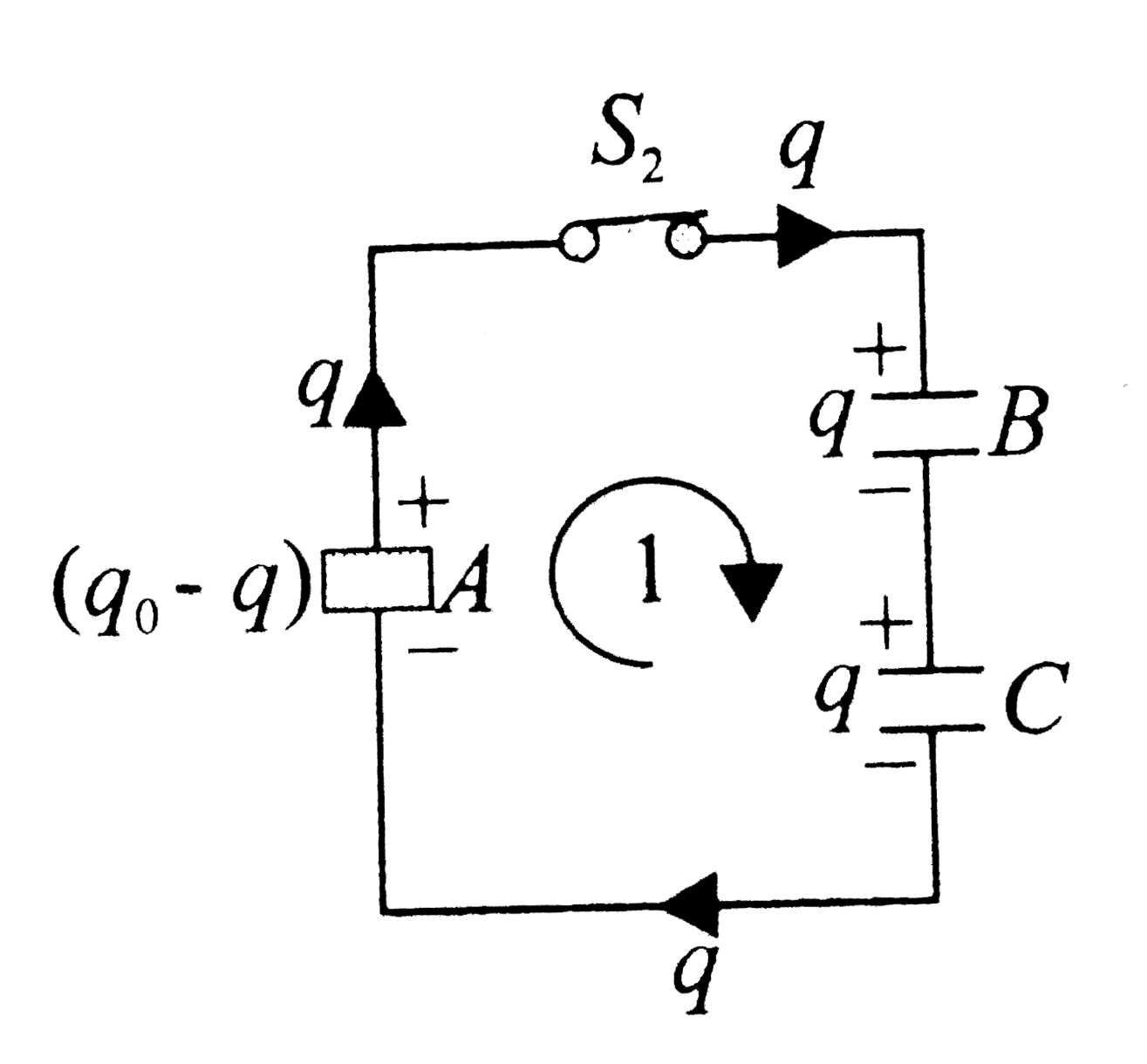 . . `C'_(1)=1 muF` Another plate of `K=2` is inserted in capacitor B. Therefore, its capacitance becomes `C'_(2)=KC_(2)` `=6 mu F`. Now switch `S_(2)` is closed and charge gets redistributed. charge `q'` be further transferred from A to capacitors B to C. In steady state, charges will be as shown in . Applying Kirchhoff's loop law, (2) `(q+q')/C'_(2)+(q+q')/C_(3)=(q_(0)-q-q')C'_(1)=0 q'=90 muC` Final charge on capacitor B is `q+q'=27 muC`. Hence, electric field inside it is `E'=(q+q')/(epsilonKA)` Factor, by which the electric field in capacitor B is increased is `(E')/E=((q_q'))/(qK)=0.75` During the redistribution of charge, energy is LOST in the form of heat froduced in the connecting and is equal to Hence, energy lost is `(-q')^(2)/(2C'_(1))=(q')^(2)/(2C'_(2))+(q')^(2)/(2C3) =5.4xx10^(-3)J`. 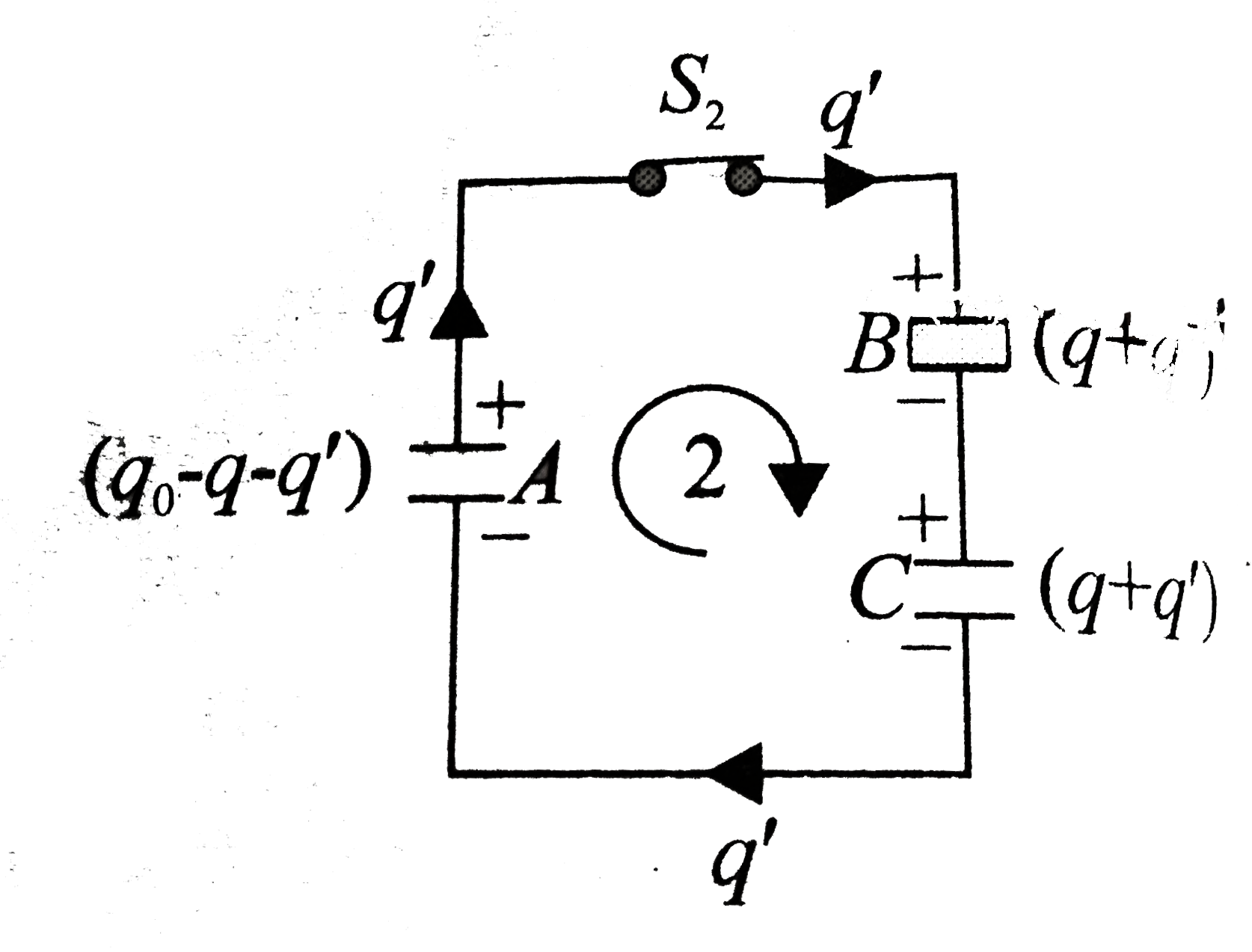
|
|
| 24. |
The velocity with which a ball of ice be thrown against a wall so that it melts completely is: |
| Answer» Answer :A | |
| 25. |
A plane monochromatic light wave of intensity I_(0)falls normally on a plane-parallel plate both of whose surfaces have a reflection coeffiecient rho. Taking into account multiple reflections, find the intensity of the transmitted light if (a) the plate is perfectly transparent, i.e the absorption is absent, (b) teh coefficient of linear absorption is equal to x, and the plate thickness is d. |
|
Answer» Solution :The multiple reflections are shown below. TRANSMISSION GIVEN a factor `(1- rho)` while reflections given factors of `rho`. Thus the TRANSMITTED intensity assuming inchoheren LIGHT is `(1 - rho)^(2) I_(0) + (1- rho)^(2)rho^(2)I_(0) + (1-rho)^(2)rho^(4)I_(0)+..` `= (1- rho)^(2)I_(0) (1+rho^(2) +rho^(4) + rho^(6)+...)` `= (1 - rho)^(2) I_(0) xx (1)/(1 - rho^(2)) = I_(0) (1-rho)/(1+ rho)`. (b) When there is ABSORPTION, we pick up a factor `sigma = e^(-chid d)` in each traversal of the plane. Thus we get `(1 - rho)^(2)sigmaI_(0) + (1- rho)^(2) sigma^(3) rho^(2)I_(0) + (1 - rho)^(2) sigma^(5) rho^(4)I_(0) +....` `= (1- rho)^(2) sigmaI_(0) (1 + sigma^(2) rho^(2) + sigma^(4) rho^(4) + ....)` `= I_(0) (sigma(1 - rho)^(2))/(1 - sigma^(2) rho^(2))` 
|
|
| 26. |
The variation of intensity of magnctization (I) with respect to the magnetising field (H) in a diamagnetic substance is described by the graph |
|
Answer» OD |
|
| 27. |
वायु में रखे दो धनावेशो के मध्य परावैद्युत पदार्थ रख देने पर इनके बीच प्रतिकर्षण बल का मान। |
|
Answer» बढ़ जायेगा |
|
| 28. |
White light is used in Young's double slit experiment. The separation between the slits is b and the screen is at a distance d ( dgtb) from the slits. At a point on the screen directly in fron of the slits certain wavelengths are missing. Some of these missing wavelengths are: |
|
Answer» `LAMBDA= (b^(2))/(d)` |
|
| 29. |
A optical fiber is made up of a core material with refractive index 1.68 and a cladding materialof refractive index 1.44. What is the acceptance angle of the fiber kept in air medium? What is the answer if there is no cladding? |
|
Answer» Solution :Give: `n_(1) = 1.68,n_(2) = 144,n_(1) = 1` Acceptance angle, `i_(a) = sin^(-1) (sqrt(n_(1)^(2)-n_(2)^(2)))` `i_(a) = sin^(-1) (sqrt((1.68)^(2)-(1.44)^(2)))=sin^(-1)(0.865)` If there is no CLADDING then, `n_(1)=1` Acceptance angle, `i_(a) = sin^(-1)(sqrt(n_(1)^(2)-1))` `i_(a)=sin^(-1)(sqrt((1.68)-1))=sin^(-1)(1.35)` `sin^(-1)` (more than 1) is not possible But, this includes the RANGE `0^(@) "to" 90^(@)`. Hence, all the rays entering the core from flat surface will undergo total internal reflection. NOTE: If there is no cladding then is a condition on therefractive index `(n_(1))` of the core, `i_(a)=sin^(-1)(sqrt(n_(1)^(2)-1))` Hence, as per mathematical rule, `(n_(1)^(2)-1)le1or(n_(1)^(2))le2orn_(1)lesqrt(2)` Hence, in air (no cladding) the refractive index `n_(1)` of the should be, `n_(1) le 1.414` |
|
| 30. |
A juggler maintain 10 balls in motion, making each of them to rise at a height of 80 m from his hands. To keep proper distance between them, the time interval maintained by juggler would be |
|
Answer» 0.6s |
|
| 31. |
If resistance resistance is increased gradually in LCR circuit. |
|
Answer» QUALITY FACTOR increases |
|
| 32. |
A simple pendulum is oscillating at (3)/(4)th of a second, where g = 980 cm sec^(2), the length of the pendulum is |
|
Answer» 55.85 cm |
|
| 33. |
Figure shows tracks of three charged particles in a uniform electrostatic field. Give the signs of the three charges. Which particles has the highest charge to mass ratio ? (a) Suppose two particles have identical curved trajectories true ? (i) they have same charge (ii), they have same charge mass (iii) the charges have the same sign. (iv) they have the same e//m ration. (b) you are given the initial velocity vof a beam particale and the lengthof the capacitor l. What other measurement would enable one to finde//m ? |
|
Answer» Solution :The charge on particles `1 and 2` , must be negativeand charge on particle `3` MUSTBE positive. We shallshow that chargeto mass ration `(e//m)` is highest in case of particale `3`. If we assume that the three charged particles haveeneteredthe electricfield with the same velocity, thenthe deflection is proportional to `(e//m)` of this particale must be the highest. (a) Whentwo particles have identicalcurvedtrajectories, theirchargesmust have the samesign and the particlesmust havethe same `e//m` ration. (b) if h is the vertical DISPLACEMENT of particle at the end of capacitorplatesas shownin Figure then, from 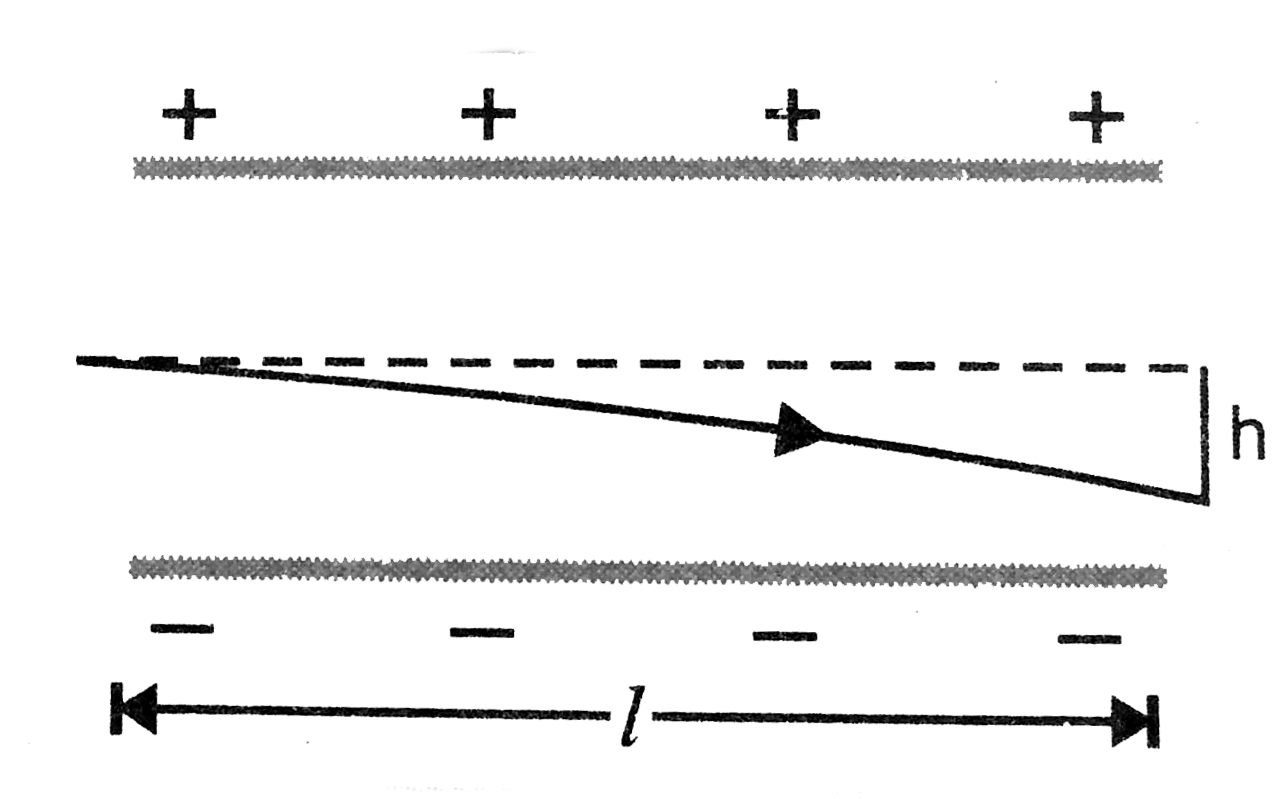 `s = ut + (1)/(2) at^(2)` `h = 0 + (1)/(2) ((eE)/(m)) ((l)/(v))^(2) = (1)/(2) ((e)/(m)) (El^(2))/(v^(2))` `e//m = (2V^(2)h)/(E l^(2))` As E, l and v are known, by MEASURING h, we cancalculate`(e//m)`. The relation shws that for given `E, l and v ,` deflection `(h) prop (e//m)`. This is what we have stated above. |
|
| 34. |
How does capacitive reactance vary with frequency ? |
| Answer» SOLUTION :INVERSELY PROPORTIONAL | |
| 35. |
A cycle tyre bursts suddenly. What is the type of this process ? |
|
Answer» Isothermal |
|
| 36. |
Oersted's experiment confirmed that current carrying conductor produces_______around it. |
| Answer» SOLUTION :MAGNETIC FIELD | |
| 37. |
Four resistance 10Omega, 5 Omega , 7 Omegaand 3 Omegaare connected so that. They form the sides of a rectangle AB, BC, CD and DA respectively. Another resistance of 10 Omegais connected across the diagonal AC. The equivalent resistance between A and B is |
|
Answer» `5 OMEGA ` |
|
| 38. |
A circular coil of 20 turns and radius 10 cm is placed in uniform magnetic field of 0.10 T normal to the plane of the coil. If the current in coil is 5 A, then the torque acting on the coil will be |
|
Answer» `31.4 NM` |
|
| 39. |
A rocket trevelling at the speed of 500m/s ejects it's product of combustion at the speed of 1500 metre/sec relative to the rocket. Then the speed of escaping vapours with respect of the person on the ground is |
|
Answer» `500 m/s` |
|
| 40. |
Given n resistors each of resistance R, how will you combine them to get the (i) maximum(ii) minimum effective resistance ? What is the ratio of the maximum to minimum resistance ? |
|
Answer» Solution :(i)To GET the MAXIMUM effective resistance `R_(MAX)`, the RESISTANCES have to be joined in series. Then `R_(max) = nR ` (ii) For minimum resistance, the resistances have to be joined in parallel. Then, `R_("MIN") = R/n` ` therefore (R_(max))/(R_("min")) = (nR)/((R//n)) = n^2` |
|
| 41. |
A plastic disc of radius 'R' has a charge 'q ' uniformly distributed over its surface. If the disc is rotated with a frequency 'f' about its axis, then the magnetic induction at the centre of the disc is given by |
|
Answer» Solution :`dB=(mu_(0)DI)/(2x),dq=q/(piR^(2))(2pix)dx` `di=(dq)F=(2qxdx)/(R^(2))f` `B=(mu_(0)qf)/(R^(2))(R)rArrB=(mu_(0)qf)/R` |
|
| 42. |
If a man weighs 90 kg on the surface of the earth, the height above the surface of the earth of radius, R where the weight is 30 kg is |
| Answer» ANSWER :A | |
| 43. |
The refractive indices of glass and water are 1.54 and 1.33 respectively. What is the polarising angle for a beam of light going from water to glass ? |
| Answer» Answer :C | |
| 44. |
Hydrogen atom from excited state comes to the ground state by emitting a photon of wavelength lambda. If R is the Rydberg cosntant, the principal quantum number n of the excited state is |
|
Answer» `sqrt((lambdaR)/(lambdaR-1))` `1/lambda =R (1/n_(f)^(2)-1/n_(i)^(2))` Here, `n_(f)=1, n_(i)=N` `1/lambda=R (1l^(2)-1/n^(2)) RARR 1/lambda =R (1-1/n^(2)) ........(i)` Multiplying equation (i) by `lambda` on both sides, `1=lambda R(1-1/n^(2)) rArr 1/(lambda R)=1-1/n^(2)` `rArr 1/n^(2)=1-(1)/(lambdaR) rArr 1/n^(2)=(lambdaR-1)/(lambdaR) rArr n= sqrt((lambdaR)/(lambdaR-1))` |
|
| 45. |
An alternating current by frequency v is flowing in a circuit containing a resistance R and inductance L in series. The impedance of this circuit is |
|
Answer» R = `2PI vL` |
|
| 46. |
A man throws a ball of mass m from a moving plank (A). The ball has a horizontal component of velocity u=3sqrt(34)ms^(-1)with respect to ground towards another man standing on stationary plank (B), as shown in the figure. The combined mass of plank A with man is 2m each. The x-y plane represents the horizontal plane which is frictionless. If initially, plank A was moving with speed uhati with respect to ground, then the relative velocity of plank B ("in m s"^(-1)) with respect to plank A (after the man on plank B catches the ball) minus 10ms^(-1) is |
|
Answer» |
|
| 47. |
(I) Transistor can be operated efficiently in an operating point (II) Variations of I_(C) and V_(CE) takes place in this point. (III) Q - points determine the working point of a transistor . (IV) Transistor is a semiconductor device used to amplify or switch electronic signals. |
|
Answer» I and II only |
|
| 48. |
What is a solar cell ? Draw its V-I characteristics. Explain the three processes involved in its working. |
|
Answer» Solution :Asolar cell is basically a p-n junction which generates emf when solar radiation falls on the p-n junction. Its I-V characteriestic is shown here. (open circuit voltage) The generation of emf by a solar cell, when light falls on it, is due to following three BASIC processes : (i) Generation of e-h pairs due to incident light (PHOTON energy `E =hv gt E_(g))` close to the junction. (ii) Separation of electrons and holes due to electric FIELD of the depletion REGION. As a result electrons are swept to n-side and holes to p-side of junction. (iii) Collection of electrons REACHING the n-side and holes reaching p-side by metal contacts provided at the two sides of solar cell. 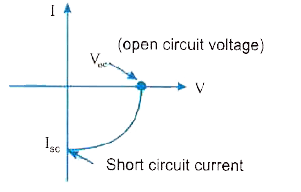
|
|
| 49. |
A ball is droped gently from the top of a tower and another rball is thrown horizontally at the same time. Which ball hit the ground earlier ? |
|
Answer» at the same time `therefore` time of FLIGHT of each ball is = `sqrt(2h/g)` |
|
| 50. |
A conducting rod of length L is carrying a constant current I. There exists a magnetic field B perpendicular to the rod. Due to the magnetic force the rod moved through a distance x in a direction perpendicular to the field (B) as well as its own length. The rod acquires a kinetic energy. A student says that a magnetic force ILB acted on the rod and it performed a work W = ILB x on the rod. But we know that magnetic force is always perpendicu- lar to the velocity of the charge and it cannot perform work on a moving charge. Which agency has actually spent energy to impart kinetic energy to the rod? |
|
Answer» |
|