Saved Bookmarks
This section includes InterviewSolutions, each offering curated multiple-choice questions to sharpen your knowledge and support exam preparation. Choose a topic below to get started.
| 5351. |
A complete transparent object is invisible ir free space, then what is its refractive index ? |
|
Answer» ONE |
|
| 5352. |
Which of the following combinations should be selected for better tuning of an L-C-R circuit used for communication? |
|
Answer» `R=15Omega,L = 3.5H,C = 30muF ` |
|
| 5353. |
The horizontal component of flux density of earth’s magnetic field is 1.7 × 10^(-5) tesla. The value of horizontal component of intensity of earth’s magnetic field will be ? |
|
Answer» 24.5 A/m |
|
| 5354. |
A non conducting ring of radius 0.5 m has charge of 1.11 xx 10^(-10) C distributed non-uniformly on its circumference. An electrical field is spread everywhere in space. The value of the potential at the center of the ring is (approximately) |
|
Answer» ZERO |
|
| 5355. |
Direction : The questions 64, 65 and 66 are based on the following paragraph: The work function of caesium metal is 2.14 eV. When light of frequency 6xx10^(14)Hz is incident, on the metal surface, the photoemission of electrons starts. Then stopping potential is |
|
Answer» Solution :STOPPING potential `(V_(S)):` `eV_(s)=1//2 mv^(2) rArr V_(s)=(K.E.)/(e)` `rArrV_(s)=(0.588xx10^(-19))/(1.6xx10^(-19))=0.349V` |
|
| 5356. |
Direction : The questions 64, 65 and 66 are based on the following paragraph: The work function of caesium metal is 2.14 eV. When light of frequency 6xx10^(14)Hz is incident, on the metal surface, the photoemission of electrons starts. Then max. speed of emitted electron is |
|
Answer» `12XX10^(4)m//s` then `v_("max")=350xx10^(3)m//"sec"` |
|
| 5357. |
Direction : The questions 64, 65 and 66 are based on the following paragraph: The work function of caesium metal is 2.14 eV. When light of frequency 6xx10^(14)Hz is incident, on the metal surface, the photoemission of electrons starts. Then max. K.E. of emitted electron is |
|
Answer» `0.92xx10^(-19)J` `K.E.=hv-phi_(0)` `=(6.63xx10^(-34)xx6xx10^(14)-3.42xx10^(-19))J` `=0.558xx10^(-19)J` |
|
| 5358. |
What is unit of a pole strength ? |
| Answer» Solution :The unit is `Am^Z`. HENCE the unit of pole strength is GIVEN by < BR>` [m]= [M]/[L] =Am^2/m= Am` | |
| 5359. |
(a) Define current sensitivity of a galvanometer. Write its expression. (b) A galvanometer has resistance and shows full scale deflection for currently I_(g). (i) How can it be converted into an ammeter to measure current up to I_(0) (I_(0) gt I_(g)) (ii) What is the effective resistance of this ammeter ? |
|
Answer» Solution :(a) Current sensitivity of a galvanometer is DEFINED as deflection per unit current flowing through it. Current sensitivity `=phi/I=(NAB)/(K)` (b) A galvanometer of resistance G and full SCALE deflection current `I_g` can be converted into an ammeter of range `l_(0)` by joining a shunt resistance `r_(s)` in parallel to galvanometer, where `r_(s)=(I_(g))/(I-I_(g)) .G` (ii) The EFFECTIVE resistance of the ammeter is `(G.r_(s))/(G+r_(s))` |
|
| 5360. |
At what values of the ratio of the kinetic energy to rest energy can the velocity of a particle be calculated from the classical formula with the relative error less than epsilon=0.010? |
|
Answer» Solution :Relativistically `(T)/(m_0c^2)=((1)/(sqrt(1-beta^2))-1)=1/2beta^2+3/8beta^4` So `beta_(rel)^2~~(2T)/(m_0c^2)-3/4(beta_(rel)^2)~~(2T)/(m_0c^2)-3/4((2T)/(m_0c^2))^2` Thus `-beta_(rel)=[(2T)/(m_0c^2)-3(T^2)/(m_0^2c^4)]^(1//2)=sqrt((2T)/(m_0c^2))(1-3/4(T)/(m_0c^2))` But CLASSICALLY, `beta_(CL)=sqrt((2T)/(m_0c^2))` so `(beta_(rel)-beta_(cl))/(beta_(cl))=3/4(T)/(m_0c^2)=epsilon` Hence if `(T)/(m_0c^2)lt4/3epsilon` the velocity `beta` is GIVEN by the classical formula with an error less than `epsilon`. |
|
| 5361. |
An N turn metallic ring of radius a, resistance R, and inductance L is held fixed with its axis along a spatially uniform magnetic field vecB whose magnitude is given by B_(0) sin (omegat). (a)Set up the emf equation for the current i in the ring. (b)Assuming that in the steady state i.oscillates with the same frequency omega as the magnetic field, obtain the expression for i. ( c)Obtain the force per unit length.Further obtain its oscillatory part and the time-averged compressional part. (d)Calculate the time-averaged compressional force per unit length given that B_(0)=1.00 tesla , N=10,a=10.0 cm, omega=1000.0 rad s^(-1),R=10.0 Omega,L=100.0 mH. (e)Answer the following two questions without providing rigourous justification : (i)For omega//2pi=60 Hz,the ring emits a humming sound.What is the frequency of this sound? (ii)A capacitor is included in the circuit.How does this affect the force on the ring? |
|
Answer» (b)`i=(Npi a^(2) B_(0)omega (R cos omegat +omegaL sin omegat))/(R^(2)+omega^(2)L^(2))` (c )`(dF)/(dl)=-(NB_(0)^(2))/(2(R^(2)+omega^(2)L^(2)))(Rsin omegat cos omegat+omega L sin^(2)omegat)` `(dF)/(dl)|_(av) =-(NB_(0)^(2) PIA^(2)omega^(2)L)/(2(R^(2)+omega^(2)L^(2)))=(dF)/(dl)|_(osc)=-(NB_(0)^(2) pia^(2)omega)/(2(R^(2)+omega^(2)L^(2)))(Rsin 2omegat cos omegat-omega L cos^(2)omegat)` (d)`(dF)/(dl)|_(av) =1.55 N m^(-1)` (e)`i`.The frequency of the sounds is `120 Hz`. |
|
| 5362. |
Of metals and alloys which has greater value of tempurature co.efficient ? |
| Answer» SOLUTION :The VALUE of `PROP` is more for METALS than that of ALLOYS. | |
| 5363. |
If two lenses of power + 1.5 and + 1.0 D are placed in contact, then the effective power of combination will be |
| Answer» Solution :`P = P_(1) + P_(2) = + 1.5 + 1.0 = + 2.5 D` | |
| 5364. |
Threshold wavelength for lithium metal is 6250 Å wavelength of incident radiation required for photoelectric emission will be…… |
|
Answer» more than 6250 Å `fgef_(0) therefore (c )/(lambda)GE (C )/(lambda_(0)) therefore lambda_(0) ge lambda` |
|
| 5365. |
Direction : Question Numbers. 150 and 151 are based on the following paragraph. Wave property of electrons implies that they will show diffraction effects. Davisson and Germer demonstrated this by diffracting electrons from crystals. The law governing the diffraction from a crystal is obtained by requiring that electron waves reflected from the planes of atoms in a crystal interfere constructively (See figure). Electrons accelerate by potential V are diffracted from a crystal. If d=1Å and i=30^(@), V should be about (h=6.6xx10^(-34)Js,m_(e)=9.1xx10^(-31)kg,e=1.6xx10^(-19)C) |
|
Answer» 1000 V `2d sin theta= nlambda` `:.` for first ORDER diffraction, `2d sin (90^(@)-30^(@))=lambda` `lambda=2xx1xx(sqrt(3))/(2)=sqrt(3)Å` Now `lambda=(h)/(sqrt(2meV)) rArr V=(h^(2))/(2melambda^(2))` `V=((6.6xx10^(-34))^(2))/(2xx9xx10^(-31)xx1.6xx10^(-19)xx3xx10^(-20))` `V=50 V` |
|
| 5366. |
A dip circle is so set that its needle move freeely in the magnetic merdian inthis position the angle of dip is 40^(@)with the magnetic meridianin th this positionthe needle will dip by an angle |
|
Answer» `40^(@)` |
|
| 5367. |
Direction : Question Numbers. 150 and 151 are based on the following paragraph. Wave property of electrons implies that they will show diffraction effects. Davisson and Germer demonstrated this by diffracting electrons from crystals. The law governing the diffraction from a crystal is obtained by requiring that electron waves reflected from the planes of atoms in a crystal interfere constructively (See figure). If a strong diffraction peak is observed when electrons are incident at an angle i from the normal to the crystal planes with distance d between them (see tigure), de-Broglie wavelength lamda_(dB) of electrons can be calculated by the relationship (n is an integer) |
|
Answer» `dcosi=nlamdadB` `2D SIN THETA= nlambda` `2d sin (90-i)=nlambda` `2d cos i=nlambda` |
|
| 5368. |
The fobbidden gap in an ntype semiconductor is 4 mev so that the electrons are just able to enter the coduction band |
| Answer» SOLUTION :`3.10 XX 10^(-4)m` | |
| 5369. |
Two charges 2muC and 1 muC are placed at a distance of 10 cm. The position of third charge from 2 mu C between them so that it does not experience any force |
| Answer» Answer :C | |
| 5370. |
Which of the following statement (s) is true I- Slpe of isotherm at critical point is maximum II - Larger is the value of T_(C) easier is the liquification of gas. III- Vander walls equation of state is applicable below critical temperature at all pressure. |
|
Answer» only 1 |
|
| 5371. |
A particle moves on a circle of radius r with centripetal acceleration as function of time as a_(e)=k^(2)rt^(2) where k is a positive constant. Find the resultant acceleration. |
|
Answer» `kt^(2)` |
|
| 5372. |
The objective of a microscope has a focal length of 1cm and diameter 0.5 cm. Using light of 600 dotA, is it possible to resolve the two point objects it they are separated by a distance of 10^(-6)m? |
|
Answer» SOLUTION :Suppose the TWO objects are a distance `triangle x` apart. Since these objects are almost at the focal length of the objective, the ANGLE subtended by `triangle x`, `i.e., triangle phi approx (triangle x)/(f_0)` For the two objects to be CLEARLY resolved, `triangle phi gt triangle theta` (or) `(triangle x)/(f_0) gt (1.22 lambda)/(a) (triangle theta= (1.22 lambda)/(a))" (or) "triangle x gt (1.22 f_(0) lambda)/(a)` (or) `triangle x gt ((1.22)(1xx 10^(-2)m)(6000xx 10^(-10)m))/((0.5xx 10^(-2)))= 1.46xx 10^(-6)m` Because `10^(-6)m` is smaller than `1.46xx 10^(-6)m`, the two objects will not be resolved. |
|
| 5373. |
A ray of light strikes a plane mirror M at an angle of 45^(@) as shown in the figure. After reflection, the ray passes through a prism of refractive index 1.5 whose apex angle is 4^(@). The total angle through which the ray is deviated is |
| Answer» Answer :c | |
| 5374. |
Consider a beam of electron (each electron with energy E_0) incident on a metal surface kept in an evacuated chamber then. |
|
Answer» no ELECTRON will be emitted as only PHOTONS can emit electrons |
|
| 5375. |
Two plane mirrors are inclined at angle 'theta' as shown in figure. If a ray parallel to OB strikes the other mirror at P and finally emerges parallel to OA after two reflections then theta is equal to |
|
Answer» `90^@` |
|
| 5376. |
If D represents the diameter,rho the density , v the speed and etathe coefficient of viscosity , then the quantity (Drhov)/(eta) has : |
|
Answer» dimensions of mass Putting the dimensions, we have quantity `=(L^(1)M^(1)L^(-3)L^(1)T^(-1))/(M^(1)L^(-1)T^(-1))` `=[M^(0)L^(0)T^(0)]` `:.(d)` is correct |
|
| 5377. |
Assertion (A) : When two coils of enamelled copper wire are wound on each other, the mutual inductance between the coils is maximum. Reason (R) : Mutual inductance does not depend on the orientation of the coils. |
|
Answer» If both assertion and REASON are true and the reason is the correct EXPLANATION of the assertion. |
|
| 5378. |
Assertion: Electric and gravitational fields are acting along same direction. When proton and alpha -particle are projected up vertically along that line, the time of flight is less for proton. Reason:In the given electric field acceleration of a charged particle is directly proportional to specific charge |
|
Answer» Both Assertion and REASON are true and Reason is the CORRECT explanation of Assertion |
|
| 5379. |
For an unknown element , the thickness of forbidden band is 4.97 eV and its resistivity is found to be of the order of 10^(-1) ohm metre . This element should be : |
|
Answer» CONDUCTOR |
|
| 5380. |
White coherent light (400 nm- 700 nm) is sent through the slits of a young.s double slit experiment. The separation between the slits is 0.5 mm and the screen is 50 cm away from the slits. There is a hole in the screen at a point 1 mm fromthe centre. In the above problem which wavelength have a strong intensity at the hole? |
|
Answer» Solution :`y=(xD)/(d) implies 10^(-3) = n LAMBDA(1)/(2)xx(10^3)/(0.5) implies lambda= (1000)/(n)nm` `n=1""lambda 1000nm, ."n=2""lambda= 500 nm` `n=3""333.3nm` `THEREFORE lambda= 500 nm` will have STRONG intensity. |
|
| 5381. |
White coherent light (400 nm- 700 nm) is sent through the slits of a young.s double slit experiment. The separation between the slits is 0.5 mm and the screen is 50 cm away from the slits. There is a hole in the screen at a point 1 mm fromthe centre. Which wavelength will be absent in the light coming from the hole? |
|
Answer» Solution :`y= (XD)/(d)= (2n-1) (lambdaD)/(2d)` `10^(-3)= (2n-1) (lambda)/(2)XX(1)/(2)xx(10^3)/(0.5)` `lambda= (2000)/(2n-1)nm` In the given WAVELENGTH range 400m and 667nm will the absent `n=1""lambda= 2000 nm""n=2"" lambda= (2000)/(3)= 667nm` `n=3""lambda= (2000)/(5)=400NM" "n=4""lambda=(2000)/(7)= 285.7nm`. 
|
|
| 5382. |
Yellow light is used in a single slit diffraction experiment with slit width of 0.6 mm. If yellow light is replaced by x-rays, how will the diffraction pattern be changed ? |
| Answer» Solution :As the wavelength of X-rays is MUCH smaller than that of yellow light. So, the diffraction PATTERN is lost when yellow light is REPLACED by x - rays . | |
| 5383. |
कोनसी अभिक्रिया में ऊष्मा अवशोषित होगी |
|
Answer» ऊष्माक्षेपी |
|
| 5384. |
a sphere rolling with velocity V collides a vertical wall. The friction cefficients mu_(1),mu_(2) are as shown. Mathc the column, analysing for just after the collision. |
| Answer» SOLUTION :Mechanical energy is lost in the form of SOUND. Think of the torque due to impulsive FORCES. | |
| 5385. |
The diameter of an eye lens is 2.5xx 10^(-3)m and the refractive index of the eye lid is 1.44. The resolving power of the eye for light of wavelength 5000 A^(0) will be (in "minute"^(-1)) |
|
Answer» `1.07` |
|
| 5386. |
Tell us about the susceptibility of diamagnetic substance. |
| Answer» SOLUTION :SMALL and NEGATIVE | |
| 5387. |
Three cells of emf 1 V and iternal resistance 1 Omega each are connected as shown. Effective emf of combination between the points P and Q is- |
|
Answer» Zero |
|
| 5388. |
A smallconducting ball carryinga charge q is located in a uniforman infiniteboundary planebetweenthe dielectrics and vacumm. Find the surfacedensity of the boundchagres on the boundary plane as a function ofdistance r from the ball. Analysse the obtained result for l rarr 0. |
|
Answer» Solution :`vec(E_(p)) = (q vec(r_(2)))/(4 pi epsilon_(0) r_(2)^(3)) + (q' vec(r_(1)))/(4pi epsilon_(0) r_(1)^(3)) , P` in 2 `vec(E_(p)) = (q" vec(r_(2)))/(4 pi epsilon_(0) r_(2)^(3)) , P` in 1 Using the boundary conditions, `E_(1n) = epsilon E_(2n), E_(1T) - E_(2T)` This implies `q - epsilon q' =q''` and `q + epsilon q' = epsilon q''` So,`q'' = (2q)/(epsilon + 1), q' = (epsilon - 1)/(epsilon +1) (q)/(epsilon)` Then, as earlier, `sigma' = (ql)/(2pi r^(3)) ((epsilon - 1)/(epsilon + 1)) . (1)/(epsilon)` 
|
|
| 5389. |
A convex mirror gives images which are |
|
Answer» REAL and INVERTED |
|
| 5390. |
What is an eV ? |
|
Answer» |
|
| 5391. |
Choose the correct alternative from the clues given at the end of the each statement : The positively charged part of the atom possesses most of the mass in ......... (Rutherford's model/both the models) |
| Answer» SOLUTION :both the MODELS. | |
| 5392. |
What is the de-Broglie wavelength associated with (a) Electron moving with velocity of 4.5xx10^(6) m//s and (b)30 g ball moving with speed of 15.0 m/s |
| Answer» SOLUTION :(a)`LAMBDA`=0.162 NM, (B)`lambda.=1.4733xx10^(-33)m` | |
| 5393. |
Sources Separated by 20 m vibrate according to equations y_(1) = 0.06 sin pi t metre and y_(2) = 0.02 sin pi t metre. They send out waves along a rod at speed 3 m/s. What is the equation of motion of a particle 12 m from the first source and 8 metre from the second ? |
|
Answer» |
|
| 5394. |
When current passing through a coil is made doubled, its self inductance ...... |
|
Answer» becomes doubled `L=Phi/I` Here `Phi PROP I` and so RATIO `Phi/I` remains constant through we change I. Hence `L=Phi/I` does not depend on current PASSING through the coil. |
|
| 5395. |
(i) A paper weight of refractive index n=3//2 in the from of a hemisphere of radius 3.0 cm is used to hold down a printed page. An observer looks at the page vertically through the paperweight. At what height above the page will the printed letters near the centre appear to the observer ? (ii) Solve the previous problem if the paperweight is inverted at its place so that the spherical surface touches the paper. |
|
Answer» `(1)/(v)=-(1)/(u) |v|=|u|` For spherical SURFACE `(n_(2))/(v)-(n_(1))/(u)=(n_(2)-n_(1))/(R)` `(1)/(v)-(3/2)/(-3)=(1-(3)/(2))/(-3)` ltb rgt `v=-3` So no shift 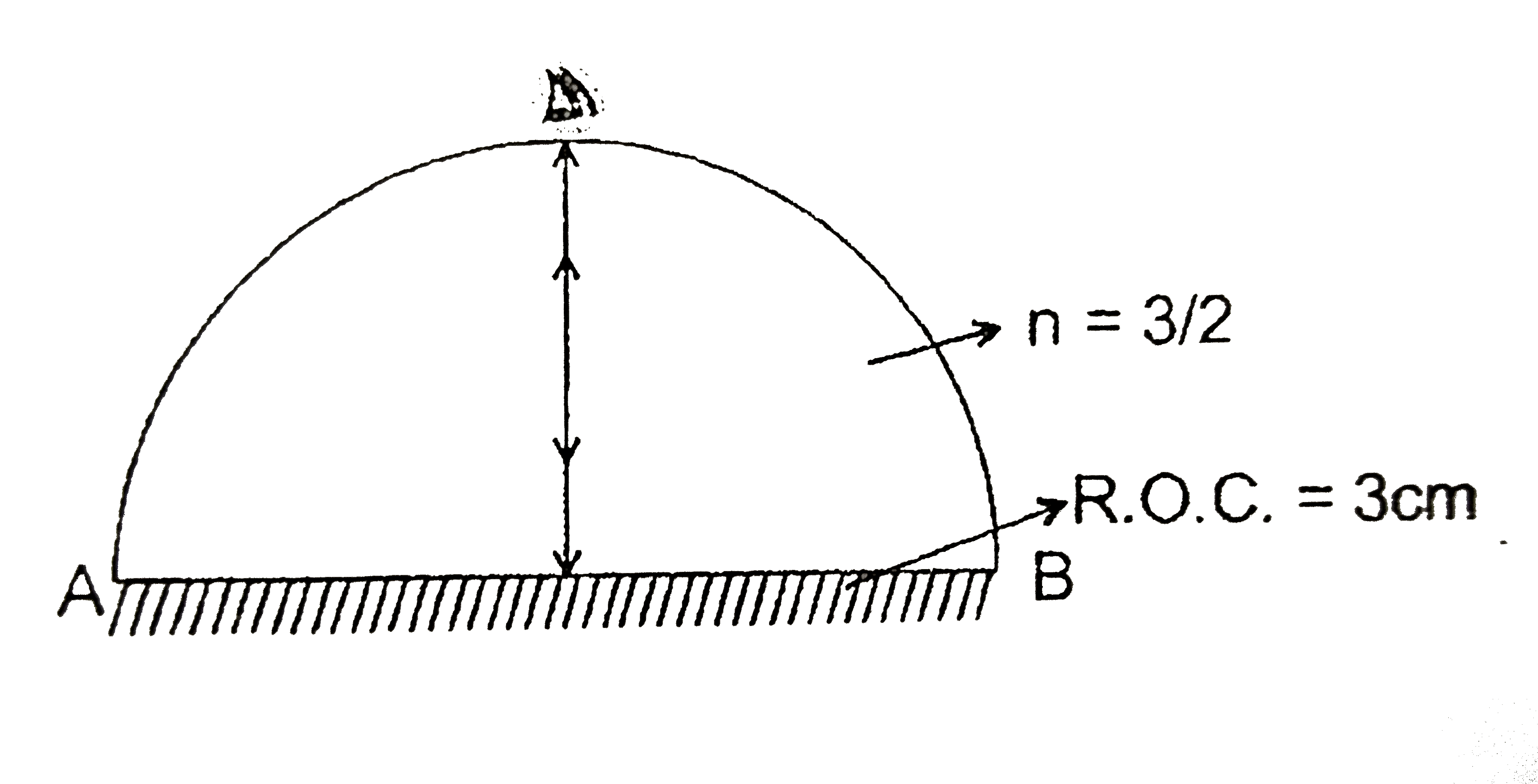 (ii) 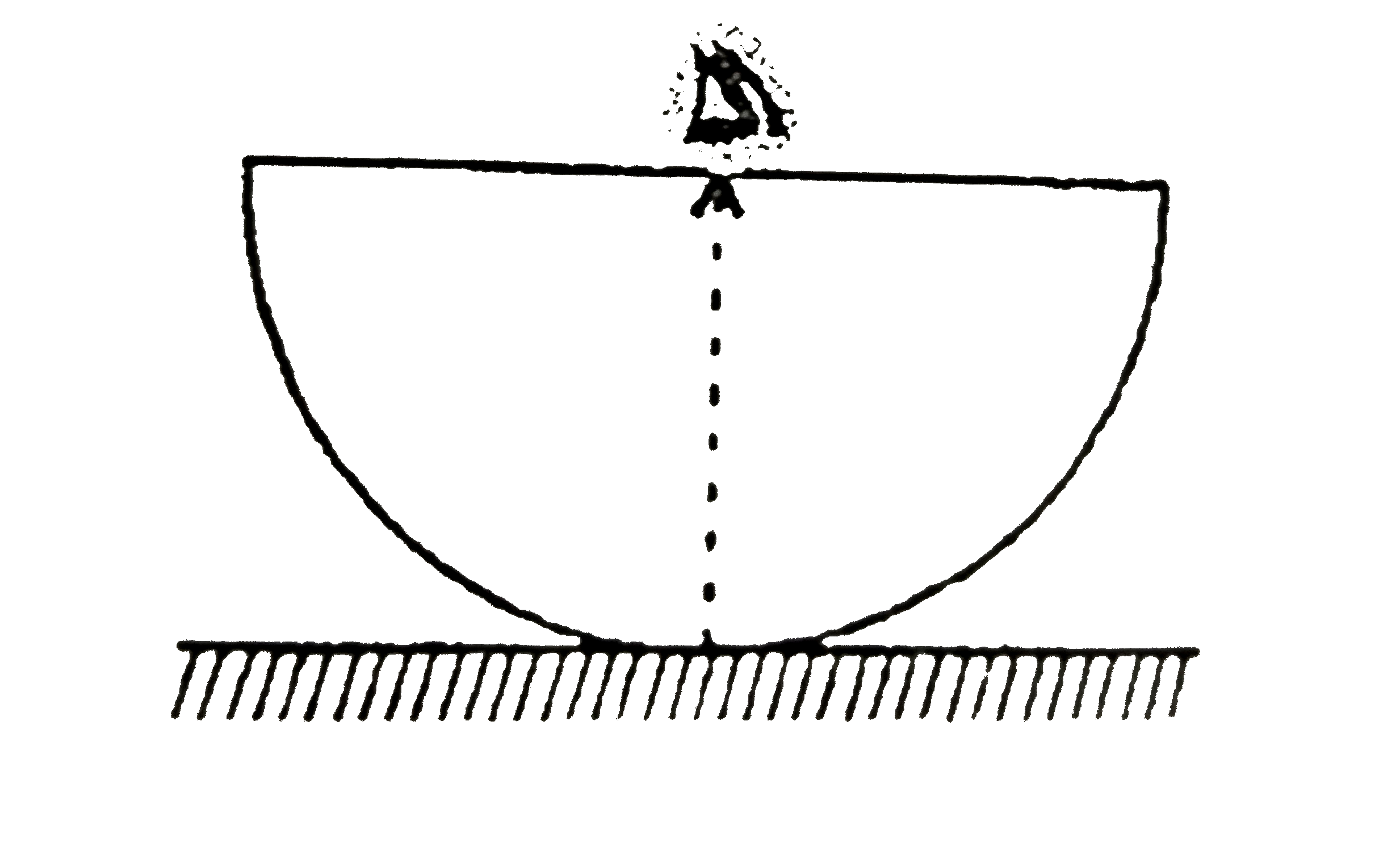 `D_(app)=d_(actual)//n_(relative)=(3)/(3//2)=2 CM` so shift `=3-2=1 cm` upward |
|
| 5396. |
The length of each side of a square coil of 10 turns is 10 cm. It rotates in a magnetic field of density 25 xx 10^(-3)T. If the maximum induced e.m.f. is 20 m V. then the angular velocity of the coil will be : |
|
Answer» `2 (rad)/sec` |
|
| 5397. |
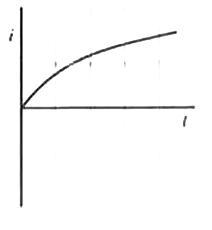
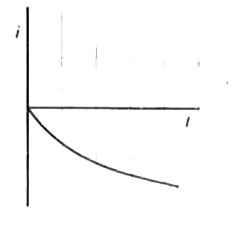
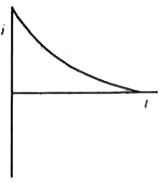
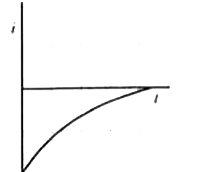
In the circuit shown in the following figure, the switch is moved to position 1 at t = 0. Which of the following most closely represents the current I as a function of time? |
|
Answer»
|
|
| 5398. |
In metre bridge experiment, the known and unknown resistances in the two gaps are interchanged. The error so removed is |
|
Answer» END CORRECTION |
|
| 5399. |
When the key K is pressed at time t = 0, then which of the following statement about the current I in the resistor AB of the given circuit is true ? |
|
Answer» I oscillates between 1 mA and 2 mA |
|
| 5400. |
Through two parallel wires A and B, 10 and 2 ampere of currents are passed respectively in opposite direction. If the wire A is infinitely long and the length of the wire Bis 2m, the force on the conductor B, which is situated at 10cm distance from A will be |
|
Answer» `8 xx 10^(-5) N` |
|