

Saved Bookmarks
This section includes InterviewSolutions, each offering curated multiple-choice questions to sharpen your knowledge and support exam preparation. Choose a topic below to get started.
| 37051. |
Friction can be |
|
Answer» COMPLETELY avoided |
|
| 37052. |
In a closed organ pipe , the frequency of fundamental note is 50Hz. The note of which frequencywill not be emitted by it ? |
|
Answer» 50Hz |
|
| 37053. |
A single slit Fraunhoffer diffraction pattern is formed with white light.For what wavelength of light the third secondary maximum in the diffraction pattern coincides with the second secondary maximum in the pattern of red light of wavelength 6500 Å? |
|
Answer» 4400 `Å` For red light, x= `((4 + 1)D)/(2a) xx 6500 dot A` For other light, `x = ((6 + 1)D)/(2a) xx lambda dot A` x is the same for each. `THEREFORE 5 xx 6500 = 7 xx lambda Rightarrow lambda = (5)/(7) xx 6500 = 4642.8 dot A`. |
|
| 37054. |
The emissive power of a surface depends upon |
|
Answer» area |
|
| 37055. |
A glass sphere of refractive index 1.5 has a diameter of 0.2m. A parallel beam is incident on the sphere. Where is it brought to focus by the sphere ? |
|
Answer» SOLUTION :Formula `: ( n_(1) ) /( u ) + ( N _(2))/( V) = ( n_(1) ~ n_(2))/( R)` For REFRACTION at `1^(st)` SURFACE, `u = oo, v = v.` `(1)/( oo) + ( 1.5)/( v ) = ( 1.5-1)/( 0.1)` `v. = ( 1.5)/( 5) = 0.3m` For refraction at `2^(nd)` surface, `( -1.5)/( 0.1) +( 1)/( v) = (1.5-1)/(0.1)` |
|
| 37056. |
(A) : UV rays are used for sterilizing surgical instruments in hospitals. (R) : IR rays are used for sterilizing surgical instruments in hospitals. |
|
Answer» Both 'A' and 'R' are TRUE and 'R' is the CORRECT explanation of 'A'. |
|
| 37057. |
The modulation index is 0.75. Then the useful power available in the side bands nearly |
| Answer» ANSWER :B | |
| 37058. |
Magnetic field lines ...... |
|
Answer» ALWAYS intersect. |
|
| 37059. |
When a negative charge is moved from surface of Earth to a certain height, its gravitational potential energy ...... . |
|
Answer» remains constant `U_(1) = -(GMm)/(R)` ( Where m = mass of given negative charge ) At HEIGHT h above surface of Earth `U_(2)=-(GMm)/(R+h)` `:. U_(2)-U_(1)=-(GMm)/(R+h)-((-GMm)/(R))` `:. U_(2)-U_(1)=GMm((1)/(R)-(1)/(R+h))` Here `R lt R +himplies (1)/(R) gt (1)/(R+h)` `:. U_(2)-U_(1)gt 0` `:. U_(2) gt U_(1)` Gravitational potential energy increases as we move away from surface of Earth. |
|
| 37060. |
The spectrum obtained from the chromosphere of the sun at the time of total solar eclipse is |
|
Answer» line emission spectrum |
|
| 37061. |
An alpha -particle of energy 5 MeV is scattered through 180^@ by a fixed uranium nuclous. The distance of closest approach is of the order: |
|
Answer» `10^(-10)m` `E=1/2 MV^(2)=((Ze)(2e))/(4PI epsi_(0) r_(0))` `r_(0)=((Ze)2e)/(4pi epsi_(0)+E)` `=(92 xx 1.6 xx 10^(-19) xx 2 xx 1.6 xx 10^(-19))/(5 xx 10^(6) xx 1.6 xx 10^(-19))` `=10^(-14)m` |
|
| 37062. |
Out of the following, which can be used as coherent sources required to produce interference pattern of light ? |
|
Answer» Two indentical and INDEPENDENT SODIUM lamps |
|
| 37063. |
How does Asimov describe the County Inspector? |
|
Answer» Round, little MAN, RED face |
|
| 37064. |
A capacitor of capacitance C fared is being charged from a.d.c supply of E volts through a resistance of R ohms, i) Show that most of the voltage across the capacitor builds up during the first time constant . Ii) Show that capacitor is almost fully charged after time equal to 5 time constants. |
|
Answer» SOLUTION :The voltage developed across the capacitor during charging is : `V=V_0 (1- e^(-1//RC))` i) During the first time constant i.e., at t = RC seconds, `V= V_0 (1- e^(-RC//RC))` `=V_0 =(1-e^(-1))= 0.632 V_0 ` VOLTS Hence, most of the voltage (i.e. ,63.2%) builds up across the capacitor during first time constant : ii) After time equal to 5 time constant i.e., at t = 5 RC, `V= V_0 (1- e^(-5RC//RC))` =`V_0 (1-e^(-5))= 0.993 V_0` |
|
| 37065. |
Cyclotron frequency does not depend on ______ |
|
Answer» mass `(MV^(2))/r=Bqv` `therefore(mv)/r=BQ` `therefore(m(ROMEGA))/r=Bq` `thereforeomega=(Bq)/m` `therefore2pif_(C)=(Bq)/m` `thereforef_(c)=(Bq)/(2pim)` `thereforef_(c)` is INDEPENDENT of momentum. |
|
| 37066. |
A system two fictitious poles separated by a certain distance is called as _____ |
| Answer» SOLUTION :MAGNETIC DIPOLE | |
| 37067. |
A clock with an iron pendulum keeps correct time at 15^@C . What will be the error, in seconds per day, if room temperature is 20^@C (The co-eff.of linear expansion of iron is 0.000012//^@C) |
|
Answer» 2.6 S |
|
| 37068. |
The magnetic energy stored in a long solenoid of area of cross-section A in a small region of length L is |
|
Answer» `(B^(2)AL)/(2mu_(0)^(2))` |
|
| 37069. |
The electric potential between a proton and an electron is given by V =V_0 In r/r_(0)" where "r_(0) is a constant. Asuming Bohr'a model to be applicable, write variation of, r_(n) with n, n being the principal quantum number: -- |
|
Answer» `r_(N) alpha n` But `F=-(d V)/(dr)=(e V_(0))/(r)` But `F=-(d V)/(dr)=(eV_(0))/(R)` `RARR (mv^(2))/(r)=(e V_(0))/(r) (therefore F=(mv^2)/(r))` `therefore v=sqrt((e V_(0))/(m))` But `mv r_(n) =(NH)/(2pi)` `rArr m^(2)v^(2)r_(n)^(2)=(n^(2)H^(2))/(4pi^(2))` `m^(2) (e V_(0))/(m) .r_(n)^(2)=(n^(2)h^(2))/(4pi)` `r_(n)^(2)=(n^(2)h^(2))/(4pi meV_(0)) rArr r_(n)^(2) alpha n^(2)` `r_(n) alpha n` |
|
| 37070. |
A batery, with potential V across it, is connected to a combination of two idential resistors and them has current I through it. What are the potential difference acros and the current through either resistor if the resistors are (a) in series and (b) in parallel? |
|
Answer» |
|
| 37071. |
A particle moves along the x' axis of frame S' with velocity 0.50c. Frame S' moves with velocity 0.80c with respect to frame S. What is the velocity of the particle with respect to frame S? |
|
Answer» |
|
| 37072. |
A wheel with 100 metallic spokes each 1 m long is rotated with a speed of 120 "rev"/"min" in a plane normal to the horizontal component of earth's magnetic field H_E at a place. If H_E = 0.4 G at the place, what is the induced emf between the axle and the rim of the wheel ? Note that 1G=10^(-4) T |
|
Answer» |
|
| 37073. |
What is the importance of Coulomb's law in vector from ? |
| Answer» Solution :The vector EQUATION TELLS us that the electrostatic forces are central forces and that force expected bhy two charges on each other are EQUAL and opposite in DIRECTION. | |
| 37074. |
1/(sqrt9-sqrt8) निम्न मे से किसके बराबर है - |
|
Answer» `3+2sqrt2` |
|
| 37075. |
A long straight wire carries a current of 35 A . What is the magnitude of the field B at a point 20 cm from the wire ? |
|
Answer» SOLUTION :` I = 35 A, r =20 cm = 20 xx 10^(-2)`m `B = (mu_0I)/(2 pi r) = (4 pi xx 10^(-7) xx 35)/(2 pi xx 20 xx 10) = 3.5 xx 10^(-5) T` |
|
| 37076. |
Four lenses of focal length + 10 cm, + 50 cm, + 100 cm and + 200 cm are available for making an astronomical telescole. To produce the largest magnification, the focal length of the eyepiece should be |
|
Answer» ` + 10 cm` |
|
| 37077. |
A black body at 227^(@)C radiates heat at the rate of 7" cal/cm"^(2)s. At a temperature of 7276^(@)C, the rate of heat radiated in the same units will be : |
|
Answer» 50 `(E_(2))/(E_(1))=((T_(2))/(T_(1)))^(4)=((1000)/(500))^(4)=16` GIVEN `T_(1)=500" K "T_(2)=1000K` `:.""E_(2)=16xx7=112" cal/cm"^(2)s` Correct choice is (a). |
|
| 37078. |
The direction of magnetic field can be found by which rule ? |
| Answer» SOLUTION :RIGHT HAND GRIP RULE | |
| 37079. |
The line integral or an electric field along the circumference of a circle of radius r, drawnwith a point charge Q at the centre will be......... |
|
Answer» `(1)/(4pi epsilon_(0)r)(Q)/(r)` `:. W = ointvecE.dvecl=0` |
|
| 37080. |
(A) : Working of a moving coil galvanometer is based on heating effect of current. (R) : On heating, the coil starts to rotate in moving coil galvanometer because fo torque. |
|
Answer» Both 'A' and 'R' are TRUE and 'R' is the CORRECT EXPLANATION of 'A'. |
|
| 37081. |
A short dipole produces B = 0.4 xx 10^(-7) Wb/m^2 at 10 cm along its axis. What will be he distance along its equator to produce the same magnetic induction ? |
|
Answer» `10 SQRT2 CM ` |
|
| 37082. |
Two particles are fixed on an x axis. Particle 1 of charge 50 mu C is located at x = - 20.0 cm, particle 2 of charge Q is located at x= 3.0 cm. Particle 3 of charge magnitude 20 mu C is released from rest on the y axis y = 2.0 cm. What is the value of Q if the initial acceleration of particle 3 is in the positive direction of (a) the x axis and (b) the y axis ? |
| Answer» SOLUTION :(a) `-104 MU C`, (B) `69.4 mu C` | |
| 37083. |
Which flame can be hidden but never extinguished? |
|
Answer» MAN's love |
|
| 37084. |
Bharat is my home is |
|
Answer» Speech |
|
| 37085. |
Two bodies of mass M and m are allowed to fall from the same height. If the air resistance for each be the same, then will both the bodies reach the earth simultaneously? |
|
Answer» Solution :No, The FORCES acting on the BODY of mass M are: It's weight Mg and resistance F. `therefore` net force = Mg- F Now acceleration `a = (Mg - F)/M = g - F/M` Thus, acceleration of the ody of LARGE mass will be greater and hence it will REACH earlier. |
|
| 37086. |
A resistance of 25 Omega is connected to 100 V,50 Hz a.c. source. What is the maximum instantaneous current in the resistor ? |
|
Answer» 6.66 A |
|
| 37087. |
Deutarium was discovered in 1931by Harold Urey by measuring the small change in wavelength for a particular transition in .^1H and .^2H. This is because, the wavelength of transition depends to a certain extent on the nuclear mass. If nuclear motion is taken into account, then the electrons and nucleus revolve around their common centre of mass. Such a system is equivalent to a single particle with a reduced mass mu, revolving around the nucleus at a distance equal to the electron-nucleus separation. Here mu=m_eM//(m_e+M) where M is the nuclear mass and m_e is the electronnic mass. Estimate the percentage difference in wavelength for the 1st line of the Lyman series in .^1H and .^2H. (Mass of ^1H nucleus is 1.6725xx10^(-27)kg, mass of .^2H nucleus is 3.3374xx10^(-27)kg, Mass of electron =9.109xx10^(-31)kg). |
|
Answer» Solution :If we take into account the nuclear MOTION, the stationary state energies will be GIVEN by `E_(n)=-(mu Z^2e^4)/(8in_(0)^(2)h^2) (1/(n^2))` Let `mu_(H)` be reduced MASS of hydrogen `(H^1)` and `mu_(D)` be reduced mass of deuterium `(H^2)`. The frequency of 1st of LYMAN series in hydrogen is given by `hv_(H)=(mu_(H)e^4)/(8pi in_0^2h^2)(1/(1^2)-1/(2^2))= (3//4 mu_(H)e^4) /(8in_0^2h^2)` The wave number of transition is `barlambda_(H)=(3//4 mu_(H)e^4) /(8in_0^2h^3 c)` Similarly, for deuterium, `barlambda_(D)=(3//4 mu_(D)e^4) /(8in_0^2h^3 c)` `Deltabar lambda=barlambda_(D)-barlambda_(H)` `:.` The percentage difference in wave number is`(Deltabar(lambda))/(bar(lambda)_(H)) xx 100 = ((bar(lambda)_(D)-bar(lambda)_(H)) xx100)/(bar(lambda)_(H)) = (mu_(D)-mu_(H))/(mu_(H)) xx 100` USING `mu_(H)=(m_(e)M_(H))/(m_(e)+M_(H))` and `mu_(D)=(m_(e)M_(D))/(m_(e)+M_(D))`, we g et `(bar(Delta lambda))/(barlambda_(H))xx100=((m_(e)M_(D))/(m_(e)+M_(D))-(m_(e)M_(H))/(m_(e)+M_(H)))/(m_(e)M_(H)//(m_(e)+M_(H)))xx100` As `m_(e)lt lt M_(H)lt ltM_(D)` `:. (barDeltalambda)/(barlambda_(H))=[(M_(D))/(M_(H))xx(M_(H))/(M_(D))((1+m_(e)//M_(H))/(1+m_(e)//M_(D)))-1]xx100=[(1+(m_(e))/(M_(H)))(1+(m_(e))/(M_(D)))^(-1)-1]xx100` `=[1+(m_(e))/(M_(H))-(m_(e))/(M_(D))-1]xx100=m_(e)[1/(M_(H))-1/(M_(D))]xx100` `(bar(Deltalambda))/(bar(lambda)_(H))xx100=9.1xx10^(-31)[1/(1.6725xx10^(-27))-1/(3.3374xx10^(-27))]xx100` `=9.1xx10^(-4)(0.5979-0.2996)xx100=2.714xx10^(-2)%` |
|
| 37088. |
What are the qualities of Postmaster? |
|
Answer» Amiable |
|
| 37089. |
In the given circuit when S_(1) & S_(2) are clossed, The potential of point A will be |
|
Answer» `(5)/(3)V` 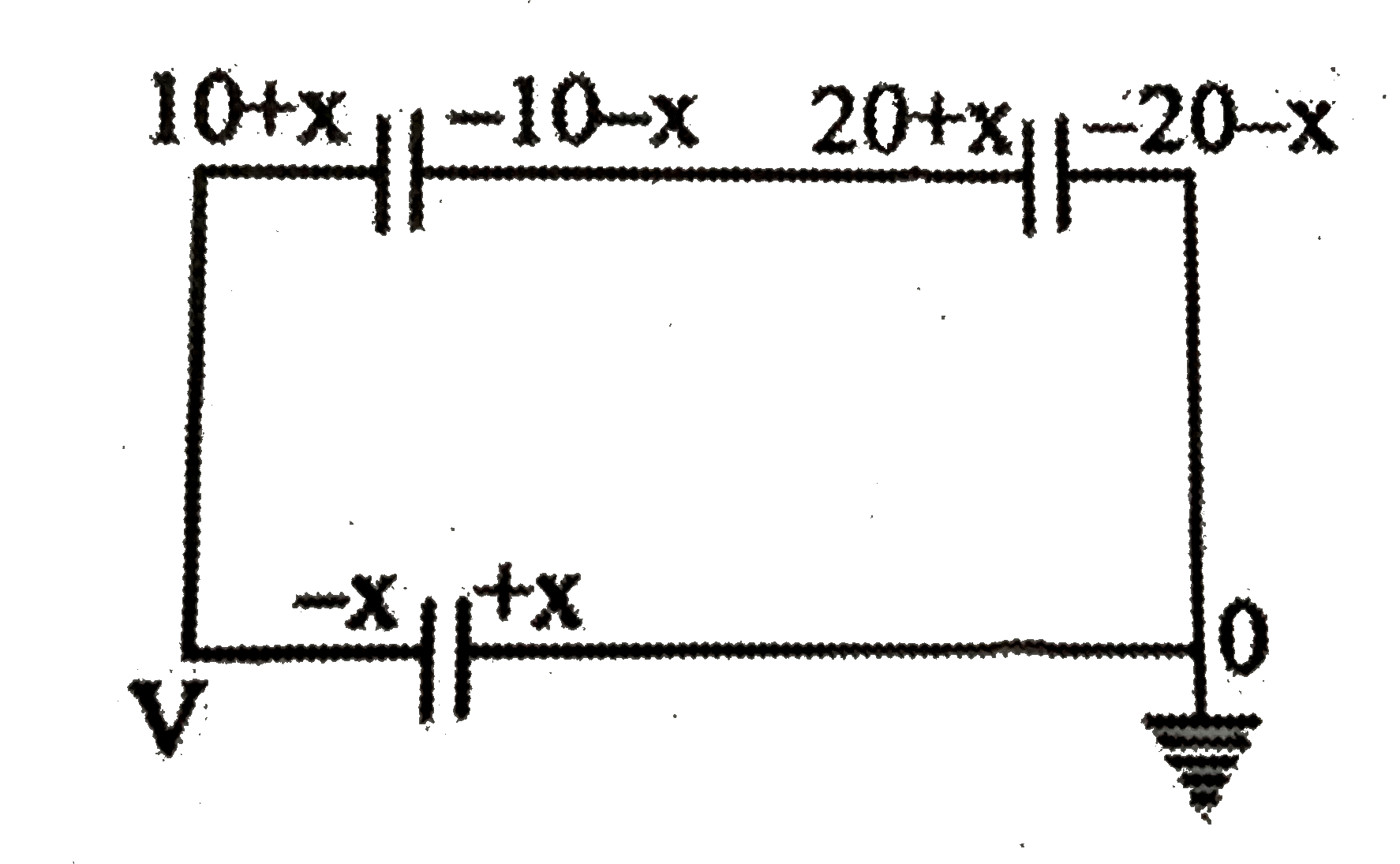 `(10+X)/(6)+(20+x)/(6)+x/6=0` x=-10 `V-0=-(x)/(C)` `V=-((-10))/(6)=(10)/(6)=5/3` VOLT |
|
| 37090. |
In an experiment, with the position of the object fixed, a student varies the position of a convex lens and for each position, the screen is adjusted to get a clear image of the object. A graph between the object distance u and the image distance v, from the lens, is plotted using the same scale for the two axes. A straight line passing through the origin and making an an angle of 45^@ with the x-axis meets the experimental curve at P. The coordinates of P will be: |
|
Answer» `(F/2, f/2)` |
|
| 37091. |
The average life period (tau) of a radioactive material and its disintegration constant (lambda) are correlated as |
|
Answer» `taulambda`=1 |
|
| 37092. |
In a plane electromagnetic wave, the electric field oscillates sinusoidally at a frequency of 2.0xx10^(10) Hz and amplitude 48 V m^(-1). |
|
Answer» SOLUTION :Here, v=`2.0xx10^(10) Hz, E_(0)=48 VM^(-1),C=3xx10^(8) m//s` For average energy density `U_(E)=1/2 epsi_(0)E_(0)^(2)………………. (1)` We KNOWN that `(E_(0))/(B_(0))=C` Putting in Eq (1) `U_(E)=(1)/(4)epsi_(0).C^(2)B_(0)^(2)..............(2)` Speed of ELECTRO magnetic waves, `C=(1)/(sqrt(mu_(0)E_(0)))` Putting in Eq (2) We get . `U_(E)=(1)/(4) epsi_(0) B_(0)^(2)* (1)/(mu_(0)epsi_(0))` `U_(E)=1/4 * (B_(o)^(2))/(mu_(0))=(Bo^(2))/(2mu_(0))=mu_(B)` Thus, the average energy density of E field equals the average energy density of B field. |
|
| 37093. |
A proton and an electron have equal speeds. Find the ratio of de-Broglie wavelengths associated with them. |
| Answer» SOLUTION :`(lambda_("PROTON"))/(lambda_("ELECTRON"))=(m_("electron"))/(m_("PHOTON"))` | |
| 37094. |
In anomalous expansion of water, at what temperature, the density of water is maximum ? |
|
Answer» `4^(@)C` So correct choice is (a). |
|
| 37095. |
A parallel plate capacitor with circular plates of radius 1 m has a capacitance of 1 nF. At t = 0, it is connected for charging in series with a resistor R = 1 M Onega across a 2V battery. Calculate the magnetic field at a point P, halfway between the centre and the periphery of the plates, after t=10^(-3)s. (The charge on the capacitor at time t is q (t) = CV [1 - exp (-t//tau)], where the time constant tau is equal to CR.) |
|
Answer» Solution :Here, during charging of a capacitor, CHARGE on its PLATE changes with time ACCORDING to formula `q=CV(1-e^(-t//RC))`. Hence surface charge density on the plate changes according to `sigma =(q)/(A)`. Hence electric field between the plates of a capacitor changes according to `E=(sigma)/(in_(0))`. Because of this electric flux, associated with area `A_(1)=pi r_(1)^(2)` between the plates changes according to `Phi_(E )=A_(1)E` which gives rise to displacement current `i_(d)=in_(0)(d Phi_(E ))/(dt)`. Because of this, we get induced magnetic field B whose magnitude can be obtained USING Ampere - MAXWELL law. During the charging of a capacitor, charge on the plate of a capacitor at time t is given by `q=q_(0)(1-e^(-t//tau))` (Where `q_(0)=CV=` maximum charge on the plate of a capacitor and `tau = RC =` time constant) `therefore q=CV(1-e^(-t//RC))` `therefore q=CV-CV e^(-t//RC)` `therefore (dq)/(dt)=0-CV e^(-t//RC)(-(1)/(RC))=(V)/(R )e^(-t//RC)`....(1) (Where R = external resistance in the circuit) At time t, displacement current enclosed by Amperean loop of radius r given by, `i_(d)=in_(0)(d Phi_(E ))/(dt)` `therefore i_(d)=in_(0)(d)/(dt){A.E}` (Where A. = area enclosed by considered circular Amperean loop `= pi r^(2)` and r = radius of this loop) `therefore i_(d)=in_(0)(d)/(dt){pi r^(2)xx(sigma)/(in_(0))}` (Where `sigma =` surface charge density on the plate of a capacitor) `therefore i_(d)=pi r^(2)(d)/(dt)(sigma)` `=pi r^(2)(d)/(dt)((q)/(pi R_(0)^(2)))` (Where `R_(0)=`radius of plate of a capacitor) `=((r )/(R_(0)))^(2)(dq)/(dt)` `therefore i_(d)=((r )/(R_(0)))^(2)(V)/(R )e^(-t//RC)` [From equ. (1)]....(2) Placing the respective values, `i_(d)=((0.5)/(1))^(2)((2)/(1xx10^(6)))(2.718)-((10^(-3))/(1xx10^(6)xx1xx10^(-9)))` `therefore i_(d)=(1)/(4)xx(2)/(10^(6)xx(2.718))` `therefore i_(d)=0.184xx10^(-6)A` 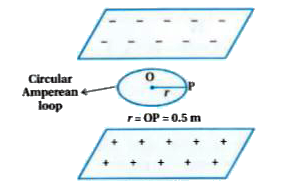 Now, as shown in the figure, because of above displacement current, magnitude of magnetic field at each point on the circumference of circular Amperean loop, considered between the plates of a capacitor, parallel to its plates will be same. If this magnitude is B then, according to Ampere - Maxwell, line integration of induced magnetic field, taken over loop will be, `oint vec(B).vec(d)l=mu_(0)(i_(c )+i_(d))` `therefore int B dl cos 0^(@)=mu_(0)(0+i_(d)) ""`(`because` In the region between the plates `i_(c )=0` and `vec(B)"||"vec(d)l`) `therefore B int dl=mu_(0)i_(d)` `therefore B(2pi r)=mu_(0)i_(d)` `therefore B=(mu_(0)i_(d))/(2pi r) ""`...(3) `=(4pi xx10^(-7)0.184xx10^(-6))/(2pi xx0.5)` `therefore B=0.736xx10^(-3)T` |
|
| 37096. |
Four capacitors are connected as shown . The equivalent capacitance between the points P and Q is |
|
Answer» `4MUF` |
|
| 37097. |
When a charged particle moves in a magnetic field its kinetic energy _______ . |
|
Answer» REMAINS constant |
|
| 37098. |
An AC voltage source has an output of V = 200 sin 2 pi ft. This source is connected to a 100 Omega resistor. RMS current in the resistance is |
|
Answer» 1.41 A |
|
| 37099. |
Hari asked Prof.Joy,"sir, Why are you using spectacles to read text books etc. " Prof Joy explained. What is the explanation given by Prof.Joy? |
| Answer» Solution :Prof. Joy is suffering from long sight and this defect is rectified by using convex LENS of suitable power . THUS he can see nearer OBJECTS. Clearly . | |
| 37100. |
A poing object moves along the principal axis of a convex lens of focal length f such that its real image, also formed on the principal axis at a distance (4f)/3 (at t=0) moves away from the lens with uniform velocity alpha. Find the velocity of the point object as a function of time t. |
|
Answer» `(F/(f+alphat))^(2)ALPHA` |
|