

Saved Bookmarks
This section includes InterviewSolutions, each offering curated multiple-choice questions to sharpen your knowledge and support exam preparation. Choose a topic below to get started.
| 38301. |
A ray of light passes normally through a slab (mu=1.5) of thickness t. If the speed of light in vacuum be C, then time taken by the ray to go across the slab will be |
| Answer» Answer :B | |
| 38302. |
If vecE and vecB represent electric and magnetic field vectors of the electromagnetic wave, the direction of propagation of electromagnetic wave is along |
|
Answer» `VECE` |
|
| 38303. |
A straight wire of mass 150 g and length 2 m carries a current of 1.5 A. It is suspended in mid-air by a uniform horizontal magnetic field B (figure). What is the magnitude of the magnetic field ? (g=10ms^(-2)) |
|
Answer» |
|
| 38304. |
A man move towards the plane mirror at 2 ms^(-1). The relative speed of his image with respect to him will be |
|
Answer» `2 ms^(-1)` |
|
| 38305. |
For a dipole q= 2 xx 10^(-6)C and d= 0.01m. Calculate the maximum torque for this dipole if E= 5 xx 10^(5)N//C. |
|
Answer» `1 XX 10^(-3) NM` |
|
| 38306. |
A magnetic field set up using Helmholtz coils (described in Exercise 4.16) is uniform in a small region and has a magnitude of 0.75 T. In the same region, a uniform electrostatic field is maintained in a direction normal to the common axis of the coils. A narrow beam of (single species) charged particles all accelerated through 15 kV enters this region in a direction perpendicular to both the axis of the coils and the electrostatic field. If the beam remains undeflected when the electrostatic field is 9.0 x× 10^(-5 )V m^(-1) , make a simple guess as to what the beam contains. Why is the answer not unique? |
| Answer» Solution :Deuterium ions or deuterons, the ANSWER is not UNIQUE because only the ratio ofcharge to mass is determined. Other possible ANSWERS are `He^(++) , Li^(+++) `, etc | |
| 38307. |
Four slabs of iron heated to different temperatures show different colours listed below. The temperature is highest for |
|
Answer» YELLOW slab |
|
| 38308. |
A low loss transformer has 250 V applied to primary and gives 4.6 V in secondary. The secondary is connected to a load which draws 5A current. The current flowing in primary is ……… |
|
Answer» Solution :`epsilon_1`=250 V, `epsilon_2`= 4.6 , `I_2`= 5A, `I_1` = ? `P_1=P_2` (For an ideal transformer ) `epsilon_1I_1=epsilon_2I_2` `therefore I_1=(epsilon_2I_2)/epsilon_1=(4.6xx5)/250` = 0.092 A `therefore I_1 approx` 0.1 A |
|
| 38309. |
An L-C-R series circuit with 100Omega resistance is connected to an AC source of 200V and angular frequency 300rad//s. When only the capacitance is removed, the current lags behind the voltage by 60^@. When only the inductance is removed the current leads the voltage by 60^@. Calculate the current and the power dissipated in the L-C-R circuit |
|
Answer» 50 W |
|
| 38310. |
Diode is used as an a |
|
Answer» OSCILLATOR |
|
| 38311. |
A bird descends vertically downwards in the direction of a pond during its flight. To a fish which is under water and directly below the bird, what will be the apparent position of the bird? |
|
Answer» |
|
| 38312. |
A bob of mass 0.1 kg hung from the ceiling of a room by a string 2m long is set into oscillation. The speed of the trajectory of the bob if the string is cut when the bob is (a) at one of its extreme positions,(b) at its mean position. |
|
Answer» Solution :(a) We know that at each EXTREME position, velocity of the bob is zero. If the STRING is cut at the extreme position, it is only under the ACTION of .G.. Hence the bob will fall vertically downwards. (b) At the mean position, velocity of the bob is 1 m/s. along the tangent to the arc, which is in the HORIZONTAL direction. If the string is ut at mean position, the bob will behave as a horizontal projectile. |
|
| 38313. |
A: Magnified image is obtained by microscope.R: Angular dispersion of image is more as compared to object of microscope. |
|
Answer» Both ASSERTION and REASON are TRUE and the reason is CORRECT EXPLANATION of the assertion. |
|
| 38314. |
Displacemtn vector vecA points due east and has a magnitude of 2.00km. Displacement vector vecB points due north and has a magnitude of 3.75Km. Displacement vector vecC points due west and has a magnitude of 2.50km. Displacement vector vecD points due south and has a magnitude of 3.00 km. Find the magnitude and direction (relative to due west) of the resultant vector vecA+ vecB+ vecC + vecD. |
|
Answer» `0.90km, 56^(@)` NORTH of west |
|
| 38315. |
What is power of lens of focal length 20 cm ? |
|
Answer» SOLUTION :f=20 cm=20/100m=1/5m p=1/f=`5m^-1` or P=5 DIOPTRE. |
|
| 38316. |
Find the strangeness S and the hypercharge Y of a neutral elementry particle whose isotopic spin projection is T_(z)= +1//2 and baryon charge B= +1. What particle is this. |
|
Answer» Solution :From the Gell-Mann Nishijama formula `Q=T_(Ƶ)+(Y)/(2)` we GET `O=(1)/(2)+(Y)/(2) or Y=-1` ALSO `Y=B+Simplies S-2`. THUS the PARTICLE is `=^(o)0` |
|
| 38317. |
In J.J. Thomson's experiment a potential difference of 600 V is applied and deflection of spot is obtained on fluorescent screen . The spot was brought to its original position by applying uniform magnetic induction . The velocity of the beam of electron was found to be 4 xx 10^(7) m/s . The value of magnetic induction if distance between the plates is 0.3 cmis |
|
Answer» `7 XX 10^(3) T` |
|
| 38318. |
A ray of light strikes a glass plate at an angle 60^@ . If the reflected and refracted rays are perpendicular to each other, the refractive index of the glass is, |
|
Answer» `sqrt3` sini = N X sin r `n=(sin 30^@)/(sin 60^@)=sqrt3` |
|
| 38319. |
Consider the following statement A and B and identify the correct answer A) Perpendicular to the direction of optical axis, O-ray and E-ray travel with same velocity. B) Along the optic axis O-ray and E-ray travel with same velocity |
|
Answer» A is FALSE but B is true |
|
| 38320. |
A bucket containing water is tied to one end of a rope of 8 m long and rotated about the other end in a verticle circle. What is the minimum number of r.p.m made in order that the water in the bucket may not spill |
|
Answer» 10.57 rps |
|
| 38321. |
Express the speed of an electromagnetic wave in terms of permittivity epsilon and permeability mu of the mediu. Also write the dimensional formula of mu epsilon . |
| Answer» SOLUTION :`nu=1/sqrt(MU EPSILON)`. DIMENSIONAL FORMULA of `mu epsilon` is `L^-2 T^2` | |
| 38322. |
Let us assume that the current voltage graph for photoelectric tube consists of two straight lines as shown. On such a photoelectric tube, light of wavelength 310 nm is incident. The work function of the emitter plate is 2eV. The tube effectively acts as a solar cell to supply current to an external resistor R. Saturation current is 2A. How does the current depend for R |
|
Answer»
`V=-iR` `V_("stop")=(hc)/(elamda)-(phi)/e=2v` `i=2+V` `I=2-iR` `i(1+R)=2` `i=2/(1+R)` `P=i^(2)R=(4R)/((1+R)^(2))` `(dP)/(DR)=0` `4(1+R)^(2)-4Rxx2(1+R)=0` `4+4R=8R` `R=1Omega` 
|
|
| 38323. |
Let us assume that the current voltage graph for photoelectric tube consists of two straight lines as shown. On such a photoelectric tube, light of wavelength 310 nm is incident. The work function of the emitter plate is 2eV. The tube effectively acts as a solar cell to supply current to an external resistor R. Saturation current is 2A. At the what value of R will be the power dissipated in R maximum |
|
Answer» `1Omega` `V=-iR` `V_("stop")=(hc)/(elamda)-(phi)/e=2v` `i=2+V` `I=2-iR` `i(1+R)=2` `i=2/(1+R)` `P=i^(2)R=(4R)/((1+R)^(2))` `(dP)/(DR)=0` `4(1+R)^(2)-4Rxx2(1+R)=0` `4+4R=8R` `R=1Omega` 
|
|
| 38324. |
A regular hexagon of side 10 cm has a charge 5 muC at each of its vertices. The potential at the centre of the hexagon is : |
|
Answer» `2.7xx10^(6)V` |
|
| 38325. |
If the range of a gun which fires a shell with muzzle speed ν is R, then the angle of elevation of the gun is :- |
|
Answer» `cos^(-1)(v^2/(Rg))` `therefore theta=1/2 sin^(-1) ((gR)/v^2)` |
|
| 38326. |
A converging lens of focal length f is placed in front of a fixed oject, at a distance f from it. The lens is then moved away from the object with a constant velocity. The velocity of the image will |
|
Answer» be constant |
|
| 38327. |
An impulse "I" given to a body changes its velocity from "v_1 to v_2". The increase in the kinetic energy of the body is given by |
|
Answer» `I (v_(1) + v_(2))` |
|
| 38328. |
How are electromagnetic waves emitted ? |
| Answer» SOLUTION :An oscillating or accelerated CHARGE emits electromagnetic WAVES. | |
| 38329. |
An 80 MHz carrier is modulated by 400 Hz since wave. The carrier voltage is 50 V and the frequency deviation is 20 KHz. Find modulatin index. |
|
Answer» 25 |
|
| 38330. |
When un known resistance and a resistance of 4Omega are used in the left and right gaps of a meter bridge, the balance point is 50cm. the shift in the balance point if a 4Omega resistance is now connected parallel to the resistor in right gap ______ |
| Answer» Answer :B | |
| 38331. |
In C.G.S system the magnitude of the force is 100dyne. In another system where fundamen- tal physical quantities are kg, m, min, the magnitude of the force is |
|
Answer» `0.036` |
|
| 38332. |
Is your school ready? Who asked this question? |
|
Answer» SAHEB's mother |
|
| 38333. |
What is the meaning of stunned? |
|
Answer» Astonished |
|
| 38334. |
Four charges of +q, +q +q and +q are placed at the corners A, B, C and D of s square. The resultant force on the charge at D |
|
Answer» `(q^(2))/(8pi in_(0)a^(2)) (1 + 2 SQRT2)` |
|
| 38335. |
A : Coloured spectrum is seen when we look through a muslin cloth. R : The coloured spectrum is due to diffraction of white light on passing through fine slits made by fine threads in the muslin cloth. |
|
Answer» Both A and R are TRUE and R is the correct explanation of A |
|
| 38336. |
(A) :The lectromagnetic waves of shorter wavelengths can travel longer distances wavelengths. (R) : Shorter the wavelength, the large is the speed of propagation of the wave. |
|
Answer» Both 'A' and 'R' are true and 'R' is the CORRECT EXPLANATION of 'A'. |
|
| 38337. |
In Fig. 5-26a, a constant horizontal force vec(F)_("app") of magnitude 20 N is applied to block A of mass m_(A)=4.0 kg, which pushes against block B of mass m_(B)=6.0 kg. The blocks slide over a frictionless surface, along an x axis. (a) What is the acceleration of the blocks ? |
|
Answer» Solution :We can relate not force on block B to the block.s ACCELERATION with Newton.s SECOND law. Calculation: Here we can write that law, still for COMPONENTS along the x axis, as `F_(BA)=M_(B)alpha`, which, with known VALUES, gives `F_(BA)=(6.0" kg")(2.0" m"//"s"^(2))=12" N"`. Thus, force `vec(F)_("BA")` is in the positive direction of the x axis and has a magnitude of 12 N. |
|
| 38338. |
The best method to increase the sensitivity of a moving coil galvanometer is to increase the |
|
Answer» radius of the coil |
|
| 38339. |
vector is not changed if |
|
Answer» it is ROTATED through an ARBITRARY angle |
|
| 38340. |
What is diffraction ? Discuss diffraction pattern obtainable from a single slit. |
|
Answer» Solution :Diffraction : The phenomenon of bending of light at the edges of an obstacle and light enters into the geometrical shadow is KNOWN as diffraction of light. Example : The silver lining surrounding the profile of a mountain just before sun rise. Diffraction of light at a single slit: (i) Consider a narrow slit AB of wvidth d. A parallel beam of light of wave length A falling normally on a single slit. (ii) Let the diffracted light be focussed by means of a convex lens on a SCREEN. (ii) The secondary wavelets travelling normally to the slit, ie., along the direction of `OP_(0)`. Thus P is a bright central image. (iv) The secondary wavelets travelling at an angle e with the normal are focussed at a point P, on the screen. (v) In order to find out intensity at P, draw a perpendicular AC on BR. (vi) The path difference between secondary wavelets = BC `=AB sin theta =a sin theta (therefore sin theta =theta)` Path difference `(lambda)=a theta .....(1)` (vii) Experimental observations shown in figure, that the intensity has a central maximum at `theta=0` and other secondary maxima at`theta=(n+1/2)lambda/a` and has minima at `theta=(nlambda)/(a)` (viii) From equation`(1), theta=(lambda)/(a)` Now we divide the slit into two equal halves, each of size `(a)/(2)` (ix) We can SHOW that the intensity is zero for `theta=(nlambda)/(2)` where n= 1, 2, 3 .... (x) It is also to see why there are maxima at 0 (xi) Consider `theta=(3lambda)/(2a)` which is midway between two of the dark fringes. (xii) If we take the first two THIRDS of the slit, the path difference between two ends is Intensity (xiii) The first two third of the slit can be DIVIDED into two halves which have a path difference. The contribution of two halves cancel and only remaining one third of the slit contributes to the intensity minima. 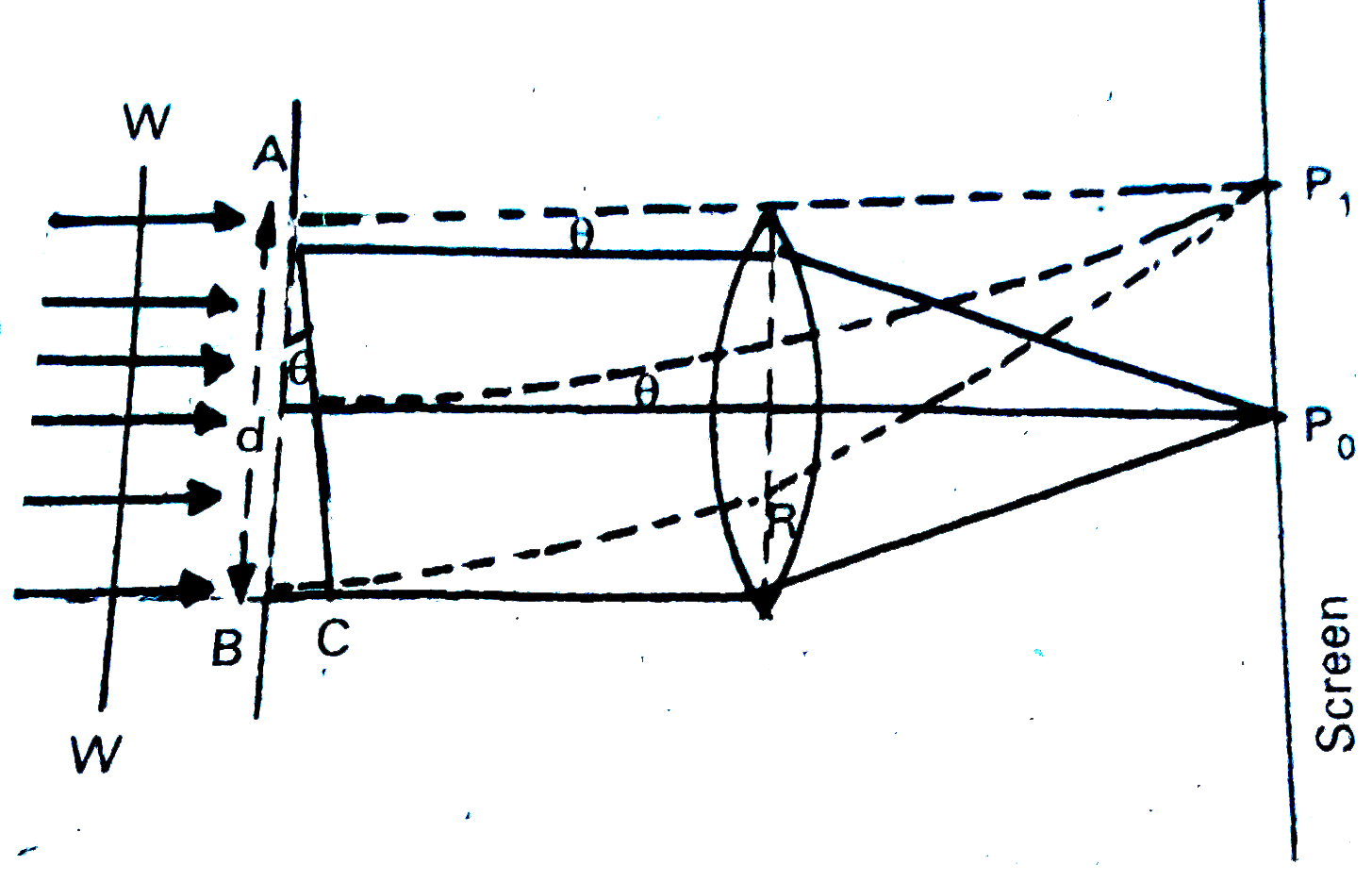 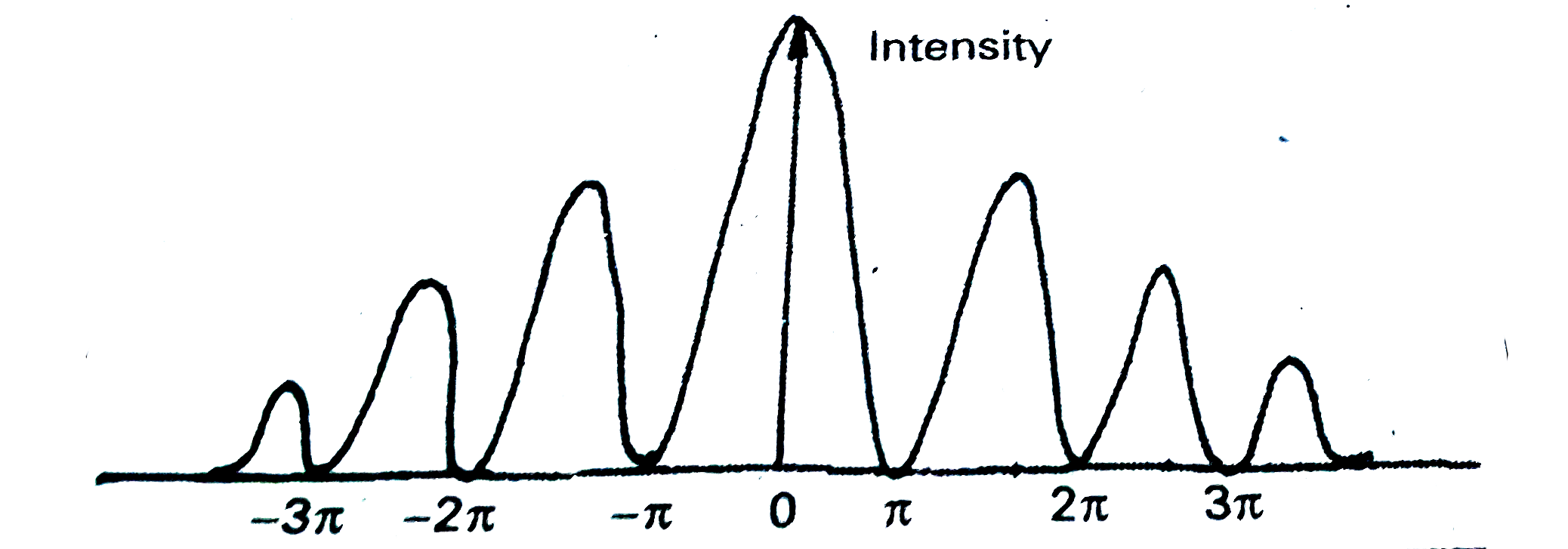
|
|
| 38341. |
Light passes successively through two polarimeter tubes each of length 0.29m. The first tube contains dextrorotatory solution of concentration 60 kg m^(-3) and specific rotation 0.01 rad m^(2)kg^(-1). The second tube contains laevo-rotatory solution of concentration 30 kg m^(-3) and specific rotation 0.2 rad m^(2) kg^(-1).The net rotation produced is : |
|
Answer» `15^(@)` |
|
| 38342. |
There charges , each of +1muC, are placed at the corners of an equilateral triangle. If the force between any two charges be f, then the net force on either charges will be : |
| Answer» Answer :B | |
| 38343. |
An n-p-n transistor can be considered to be equivalent to two diodes, connected Which of the following figures is the correct one ? |
|
Answer»
|
|
| 38344. |
There are different types of radioactive series that radioactivie decay follows. In the given table, Column I shows the end or stable nuclei which any one of theradioactive series produces, Column II shows the mass number ofdifferent tpes of ratioactive series and Column III shows different values of n different radioactive sereis. Determine the characteristics ofactinium. |
|
Answer» (III)(i)(K) |
|
| 38345. |
The face of a prism of refracting angle A is coated with silver. A light ray after first being incident at an angle of incidence 2A on the first face of the prism, is refracted and is then reflected from the second face, retracting its path. Calculate the value of the refractive index of the prism. |
|
Answer» Solution :LET PQR be a glass prism. The refracting surface PR of the prism is coated with mercury. In the figure, INCIDENT ray DB is refracted along BC and the light ray returns following the same path getting REFLECTED from the surface PR. `therefore "" anglePCB = 90^(@)` and `anglePBC = alpha = (90^(@) - A)` `["where" angleBPC = "refracting ANGLE of the prism = A"]` Again, from the figure, `alpha + r = 90^(@)` `alpha = (90^(@) - r)` Comparing equations (1) and (2), we may write A = r `"Here", "" mu = (sini)/(sinr) = (SIN2A)/(sinA) or, mu = (2sinAcosA)/(sinA)` `or, "" mu = 2cosA` Therefore, required refractive index is 2 cos A. 
|
|
| 38346. |
If you made a map of magnetic field lines at Melbourne in Australia, would the lines seem to go into the ground or come out of the ground ? |
| Answer» Solution :Field lines DUE to the earth.s MAGNETISM WOULD seem to come out of the ground at MELBOURNE because it is in SOUTHERN hemisphere, which behaves as the north pole of earth.s magnet. | |
| 38347. |
What is the excess charge on a conducting sphere of radius r = 0.35 m if the potential of the sphere is 1500 V and V = 0 at infinity ? |
| Answer» SOLUTION :`5.8 XX 10^(-8)` C | |
| 38348. |
The energy per unit area associated with a progressive sound wave will be doubled if |
|
Answer» the AMPLITUDE of the wave is doubled |
|
| 38349. |
What are the conditions when capacitor is in th series network? |
|
Answer» (III) (I) (L) |
|
| 38350. |
Derive an experession for the total energy of an electron in stationary state of hydrogen atom. Assuming the expression for the radius. |
|
Answer» Solution :Consider an electron of mass m and charge -e REVOLVING around the nucleus of an atom of atomic number Z in the `n^(th)` orbit of radius r. Let v be the velocity of the electron. The electron possesses potential energy, because, it is in the electrostatic field of the nucleus. The electron also possesses kinetic energy by virtue of its motion. Potential energy of the electron is given by, `E_p` = (potential at a distance r from the nucleus)(-e) `=1/(4piepsilon_0) ["Ze"/r](-e)` `E_P=-(Ze^2)/(4piepsilon_0r)` ...(1) Kinetic energy of the electron is given by, `E_k=1/2 mv^2` ...(2) From Bohr.s postulate , `(mv^2)/r=1/(4piepsilon_0) [(Ze^2)/r^2] ` `thereforemv^2 = (Ze^2)/(4piepsilon_0r)` Substituting this value of `mv^2`in equation(2) `E_k=1/2 ((Ze^2)/(4piepsilon_0 r))` ...(3) Total energy of the electronrevolving in the `n^(th)`orbit is given by ` E_n=E_p + E_k` `E_n=-(Ze^2)/(4piepsilon_0r) +1/2 ((Ze^2)/(4piepsilon_0r))` Using(1) and (2) `=(Ze^2)/(4piepsilon_0r) [(-1)/1 + 1/2]` `=(Ze^2)/(4piepsilon_0r) [-1/2]` `thereforeE_n=-(Ze^2)/(8piepsilon_0r)` . The radius of `n^(th)`permitted orbit of the electronis given by `r=(epsilon_0 n^2 h^2)/(pi m Ze^2) ` Substitutingthis value ofr in the equation , `E_n = -(Ze^2)/(8 pi epsilon_0 r)` we get ,`E_n =-(Ze^2)/(8pi epsilon_0) xx(pimZe^2)/(epsilon_0 n^2 h^2)` i.e.,`E_n=(-Z^2 me^4)/(8epsilon_0^2n^2h^2)`for hydrogenlike atoms. For HYDROGEN atom , put Z=1 `therefore` Total energy of the ELECTRONIN the `n^(th)`orbit of hydrogen atom is `E_n=(-me^4)/(8epsilon_0^2 n^2 h^2)` NOTE : The Total energy of the electron in the firstorbit is `E_1 = (-me^4)/(8epsilon_0^2 h^2)`=-13.6 eV |
|


