

Saved Bookmarks
This section includes InterviewSolutions, each offering curated multiple-choice questions to sharpen your knowledge and support exam preparation. Choose a topic below to get started.
| 39201. |
When straight conductor moves in external magnetic field (LHP rule):- |
|
Answer» |
|
| 39202. |
When straight conductor moves in external magnetic field (LHP rule):- |
|
Answer» |
|
| 39203. |
When straight conductor moves in external magnetic field (LHP rule):- |
|
Answer» |
|
| 39205. |
Two lights of wavelenght 560 nm and are used in Young's double slit experiment. Find the least distance from the centeral fringe where the bright fringe of the two wavelenght coindes. Give D = 1 m and d = 3 mm. |
|
Answer» SOLUTION :`lambda_(1) = 560 NM = 560 xx 10^(-9) m:` `lambda_(2) = 420 xx 10^(-9) m,` `D = 1m, d = 3 mm = 3 xx 10^(-3) m` For a GIVE y,n and `lambda`are inversely proportional Let `n^(th)` order bright fringe of `lambda_(1)` conicides with `(n + 1)^(th)` order bright fringe of `lambd_(2)`. EQUATION for `n^(th)` bright fringe is, `y_(n) = n (lambdaD)/(d)` `Here, n(lambda_(1)D)/(d)=(n+1)(lambda_(2)D)/(d)"" (aslambda_(1)gtlambda_(2))` `nlambda_(1)=(n+1)lambda_(2)(or)(lambda_(1))/(lambda_(2))=(n+1)/(n)` `1+(1)/(n)=(560xx10^(-9))/(420xx10^(-9))(or)1+(1)/(n)=(4)/(3)` `(1)/(n)=(1)/(3)(or)n=3` Thus the `3^(rd)` hright fringe of `lambda_(1) and 4^(th)` bright fringe of `lambda_(2)` coincide at the least distancy The least distance from the central fringe where the bright fringes of the TWO wavelenght coincides is, `y_(n)=n(lambdaD)/(d)` `y_(n)=3xx(560xx10^(-9)xx1)/(3xx10^(-3))=560xx10^(-6)m` `y_(n)=0.560xx10^(-3)m=0.560mm` |
|
| 39206. |
When straight conductor moves in external magnetic field (LHP rule):- |
|
Answer» |
|
| 39207. |
You can be aware of good scenes when: |
|
Answer» When you sleep |
|
| 39208. |
Two conducting rings P and Q of radius r and 3r move in opposite directions with velocities 2v and v respectively on a conducting surface S. There is a uniform magnetic field of magnitude B perpendicular to the plane of the rings. The potential difference between the highest points of the two rings a |
|
Answer» zero |
|
| 39209. |
In a double slit interference experiment, the separation between the slits is 1.0mm, the wavelength of light used is 5.0xx10^(-7) m and the distance of the screen from the slits is 1.0m. (a) Find the distance of the centre of the first minimum from the centre of the central maximum. (b) How many bright fringes are formed in one centimeter width on the screen? |
| Answer» SOLUTION :(a) 0.25mm, (B) 20 | |
| 39210. |
A partaicle of mass 1 kg and carrying 0.01 C is at rest on an inclined plane of angle of 30^(@) with horizontal when an electric field of (490)/(sqrt(3))NC^(-1) applied parallel to horizontal, the coefficient of friction is |
|
Answer» 0.5 |
|
| 39211. |
In a lift moving up with an acceleration of 5 m s^(-2), a ball is dropped from a height of 1.25 m. The time taken by the ball to reach the floor of the lift is ……(nearly) (g = 10 ms^(-2)) |
|
Answer» 0.3 second `:.` TIME of descnt is `T=sqrt((2h)/(g+a))=sqrt((2xx1.5)/(15))=0.4s` |
|
| 39212. |
Three coherent waves having amplitudes 12 mm 6 mm arrives at a given point with successive phase difference of pi//2. Then the amplitude of the resultant wave is |
| Answer» ANSWER :B | |
| 39213. |
Which of the following will radiate heat to a large extent? |
|
Answer» ROUGH surface |
|
| 39214. |
In a series resonant RLC circuit, the voltage across 100Omega resistor is 40 V. The resonant frequency omega" is "250//s. If the value of C is 4 muF, then the voltage across L is |
| Answer» Answer :C | |
| 39215. |
Both alternating current and direct current are measured in amperes. But how is the ampere defined for an alternating current ? |
|
Answer» Solution :For a direct CURRENT (DC) 1 ampere = `"1 Coloumb"/S` An AC current CHANGES direction with the source frequency and the attractive force would average to zero. Thus, the AC ampere must be defined in TERMS of some property that is independent of the direction of current. Joule.s heating EFFECT is such property and hence it is used to define rms value of AC. 1 ampere current in AC means, the amount of heat produce in resistance of 1 `Omega` by DC current as same amount produced in AC is KNOWN as 1 ampere of AC current. |
|
| 39216. |
The number of tubes of induction originating from a unit positive charge is |
| Answer» ANSWER :A | |
| 39217. |
A double convex lens is made of glass which has refractive inded 1.55 for voilet rays and 1.50 for red rays. If the focal length for violet rays is 20 cm, the focal length for red rays will be |
|
Answer» 9 cm |
|
| 39218. |
A 2.00 kg particle moves along an x axis in onedimensional motion while a conservative force along that axis acts on it. The potential energy U(x) associated with the force is plotted in Fig. 8-36a. That is, if the particle were placed at any position between x=0 and x=7.00m, it would have the plotted value of U. At x=6.5 m, the particle has velocity vec(v)_(0) = (-4.00 m//s)hat(i). (c) Evaluate the force acting on the particle when it is in the region 1.9 m lt x lt 4.0 m. |
|
Answer» Solution :KEY IDEA The force is given by Eq. 8-90 `(F(x)= - d U (x)//dx)`: The force is EQUAL to the negative of the slope on a graph of `U(x)`. Calculation: For the graph of Fig. 8-36b, we see that the RANGE `1.0 m LT x lt 4.0` m the force is `F= -(20J - 7.0 J)/(1.0 m - 4.0 m) = 4.3N`. Thus , the forcehas magnitude 4.3 N and is in the positive direction of the x axis . This result is consistent with the fact tha the initially leftward-moving PARTICLE is stopped by the force and then sent rightward. |
|
| 39219. |
IF E_p and E_k represent potential energy and kinetic energy respectively of an orbital electron, then according to Bohr's theory. |
|
Answer» `E_k=- E_p/2` `E=-K=U/2` `THEREFORE K=- U/2` `therefore E_k=- E_p/2` (`because` Here `K=E_k` and `U=E_p` ) |
|
| 39220. |
A charge q is placed at the Centre of the line joining two equal charges Q. The system of three charges will be in equilibrium if q is equal to |
| Answer» ANSWER :C | |
| 39221. |
The coordination number for a bcc crystal is |
|
Answer» 4 |
|
| 39222. |
A good lubricant would have |
|
Answer» HIGH viscosity |
|
| 39223. |
In the circuit drawn, current following through 25V cell is: |
|
Answer» 7.2 A |
|
| 39224. |
A hole is near the bottom of a tank. The volume of liquid emerging from the hole does not depend upon : |
|
Answer» HEIGHT of liquid level above hole = Velocity of efflux `xx` area of cross-section `=sqrt(2gh)xxpir^(2)` Clearly volume is INDEPENDENT of density of liquid. Hence the correct choice is (c). |
|
| 39225. |
A projectile is given an initial velocity of (hati + 2hatj) m/s, where hati is along the ground and hatj is along the vertical. If g = 10 m//s^(2) , the equation of its trajectory is: |
|
Answer» `y=2x-5x^(2)` `:.y=2t-5t^(2)` EQUATION of TRAJECTORY `y=2x-5x^(2)` |
|
| 39226. |
a. Are the equations of nuclear reactions such as ""_(7)^(14)N + ""_(2)^(4)He to ""_(8)^(16)O + ""_1^2H 'balanced' in the sense a chemical equation 2H_2 + O_2to 2H_2O is? If not, in what sense are they balanced on both sides? b. If the number of protons and number of neutrons are conserved in a nuclear reaction, in what way the mass is converted into energy (or vice versa) in a nuclear reaction? c. A general impression exists that mass energy inter-conversion takes place only in nuclear reaction and never in chemical reaction. Strictly speaking, this is incorrect Explain. |
|
Answer» SOLUTION :a. The total number of atoms remains the same in a CHEMICAL reaction. The number of ATOMSOF each element is not NECESSARILY conserved in a nuclear reaction. B. The binding energy (tota) of the elements before the nuclear reaction need not be equal to the total binding energy after the reaction. c. There is mass defect in chemical reaction but it is almost a million times smaller compared with nuclear reaction. |
|
| 39227. |
गोलाकार जीवाणु जब एक जंजीर (chain) में व्यवस्थित होते है, इन्हे कहते है : |
|
Answer» कोकस (COCCUS) |
|
| 39228. |
Find the effective capacity of the combination shown below : |
Answer» SOLUTION :a. 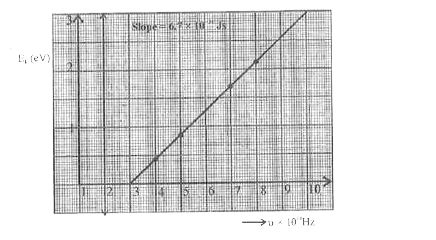 b. `1.2eV, 6.7xx10^(-34)JS` c. `hupsilon=phi_(0)+K_("max")=phi_(0)+eV_(0)` `UPSILON=(phi_(0))/(h)+(e )/(h)V_(0)` |
|
| 39229. |
Now the messages are sent in form of _____ signals and the person at receiving are sent in form of _____ signals and the person at receiving end picks the message with the help of _____. |
| Answer» SOLUTION :ELECTRIC, ELECTRONIC GADGET | |
| 39230. |
Assertion: Gauss's law can't be used to calculate electricl field near an electric dipole. Reason : Electric dipole don't have symmetric charge distribution . |
|
Answer» Both ASSERTION and Reason are TRUE and Reason is the correct explanation of Assertion |
|
| 39231. |
A car battery with a 12 V emf and an internal resistance of 0.030 Omega is being charged with a current of 40 A. What are (a) the potential difference V across the terminals, (b) the rate P_r. of energy dissipation inside the battery, and (c) the rate P_("emf") of energy conversion to chemical form? When the battery is used to supply 40 A to the starter motor, what are (d) V and (e) P? |
|
Answer» |
|
| 39232. |
A proton, neutron an electron and an alpha particle have same energy. Their de Broglie wavelengths compare as : |
|
Answer» ` lambda_p = lambda_n GT lambda_e gt lambda_alpha` |
|
| 39233. |
Two identical imperfect polarizers are placed in the way of a natural beam of light. When the polarizers' planes are parallel, the system transmits eta = 10.0 times more than in the case of crossed planes. Find the dergee of polarization of light produced (a) by each polarizer separately, (b) by the whole system when the planes of the polarizers are parallel. |
|
Answer» Solution :Let us represent the natural light as a sum of two mutually perpendicualr componets, both with intensity `I_(0)`. Suppose that each polarizer TRANSMITS a fraction `alpha_(1)` of the light with oscillation plane parallel to the principle direction of the polarizer and a fraction `alpha_(2)` with oscillation plane perpendicular to the principle direction of the polaizer. Then the intensity of light transmitted through the two polarizers is equal to `I_(||) = alpha_(1)^(2)I_(0) + alpha_(2)^(2)I_(0)` when their principle direction are parallel and `I_(_|_) = alpha_(1)alpha_(2)I_(0) + alpha_(2)alpha_(1)I_(0) = 2alpha_(1)alpha_(2)I_(0)` when they are crossed. But `(I_(_|_))/(I_(||)) = (2alpha_(1)alpha_(2))/(alpha_(1)^(2) + alpha_(2)^(2)) = (1)/(eta)` so `(alpha_(1) - alpha_(2))/(alpha_(1)+alpha_(2)) = sqrt((eta - 1)/(eta+ 1))` (b) Now the degee of polarization PRODUCED by either polarizer when used SINGLY is `P_(0) = (I_(max) - I_(min))/(I_(max) + I_(min)) = (alpha_(1) - alpha_(2))/(alpha_(1) + alpha_(2))` (ASSUMING, of course, `alpha_(1) gt alpha_(2)`) Thus `P_(0) = sqrt((eta - 1)/(eta + 1)) = sqrt((9)/(1)) = 0.905` (b) When both polarizer are used with theri principle directions parallel, the transmitted light, when analysed, has maximum intensity, `I_(max) = alpha_(1)^(2)I_(0)` and minimum intensity, `I_(min) = alpha_(2)^(2)I_(0)` so `P = (alpha_(1)^(2) - alpha_(2)^(2))/(alpha_(1)^(2) + alpha_(2)^(2)) = (alpha_(1) - alpha_(2))/(alpha_(1) + alpha_(2)).((alpha_(1) + alpha_(2))^(2))/(alpha_(1)^(2) + alpha_(2)^(2))` `= sqrt((eta - 1)/(eta + 1)) (1+ (2 alpha_(1) alpha_(2))/( alpha_(1)^(2) +alpha_(2)^(2)))` `= sqrt((eta - 1)/(eta + 1)) (1+(1)/(eta)) = (sqrt(eta^(2) - 1))/(eta) = sqrt(1-(1)/(eta^(2))) = 0.995`. |
|
| 39234. |
What phenomenon justify the brilliancy of diamonds ? |
| Answer» SOLUTION :TOTAL INTERNAL REFLECTION | |
| 39235. |
A narrow slit , illuminated by a monochromatic source of wavelength 5896 xx 10^(-10) m is placed at a distance of 5 cm from a biprism . The virtual images formed by the biprism are 1 mm apart . Find the fringe-width on a screen placed 95 cm in front of the biprism . |
|
Answer» |
|
| 39236. |
Two identical particles having the same mass m and charges +q and - q separated by a distance d enter a uniform magnetic field barB as shown in the figure. For what value of d the particles will not collide? |
| Answer» SOLUTION :`d GT (2M)/(BQ) (V_1 + V_2)` | |
| 39237. |
A particle performing S.H.M. starting from mean position has period 2 second and amplitude 5 cm. Then what is it's displacement at the end of half a second ? |
|
Answer» SOLUTION :`a=omega^2X=((2PI)/T)^2x=((2pi)/2)^2xx5` ` 5pi^2 cm/s^2` |
|
| 39238. |
A transverse sinusoidal wave is generated at one end of a long horizontal string by a bar is continuous and is repeated regularly 120 times per second. The string has linear density of 117g/m. the other end of the string is attached to a mass 4.68kg. the string passes over a smooth pulley and the mass attached to the other end of the string hangs freely under gravity. The maximum power transferred along the string is: |
|
Answer» 3.845 kW 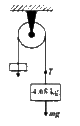 T = mg T = 46.8 N Speed of wave should be `v = sqrt((t)/(mu)) = sqrt((46.8)/(0.117)) = 20MS^(-1)` Power of wave on string is given as `P = (1)/(2)A^(2)omega^(2)MUV` = `(1)/(2) XX (1.12 xx 10^(-2))^(2) xx(2PI xx 120)^(2) xx 0.117 xx 10^(-3) xx20 ` 0.0834 W. |
|
| 39239. |
64 tuning forks are arranged such that each fork produces 4 beats per second with next one. If the frequency of the last fork is octave of the first, the frequency of 16th fork is |
| Answer» ANSWER :C | |
| 39240. |
The unit of expression mu_(0) epsilon_(0) are : |
|
Answer» `m // s` |
|
| 39241. |
Two long parallel wires carry equal current I in the same direction. The length of each wire is I and the distance between them is a. Force acting on cach wire is |
|
Answer» attract ONE another |
|
| 39242. |
Predict the direction of induced current in the situations described by the following figures (a) to (f). |
|
Answer» Solution :a. By Lenz.s LAW, the FACE of the oil towards the south pole of the magnet opposes the south pole. So this face should behave as south pole. Hence the current flows along qrpq. b. SIMILAR to the above reason the current flows along yzxy and along prqp. c. When the coil is energised. with a cell the incresaing current produces an INVERSE current in the nearby coil along yzxy. d. Similar to the above reason the current flows along zyxz. e. By Lenz.s law current is along xryx. F. Field lines being along the plane of the loop, there is no induced current. |
|
| 39243. |
A closely wound solenoid of 2000 turns and area of cross- section 1.6 xx 0^(-4)m^(2), carrying a current of 4.0 A, is suspended through its centre allowing it to turn in a horizontal plane. (a) What is the magnetic moment associated with the solenoid ? (b) What is the force and torque on the solenoid if a uniform horizontal magnetic field of 7 .5 xx 10^(-2)T is set up at an angle of 30° with the axis of the solenoid ? |
|
Answer» `1.28Am^(2), 0.042 NM` |
|
| 39244. |
A radioactive nucleus is being produced at a constant rate alpha per second. Its decay constant is lambda. If N_(0) are the number of nuclei at time t =0, then maximum number of nuclei possible are : |
|
Answer» `alpha/LAMBDA` i.e. `lambda N_("max")=alpha` `N_(max)=alpha/lambda` |
|
| 39245. |
A unit positive point charge of mass m is projected with a velocity V inside the tunnel as shown. The tunnel has been made inside a uniformly charged nonconducting sphere. The minimum velocity with which the point charge should be projected such that it can reach the opposite end of the tunnel is equal to |
|
Answer» `[ rho R^2// 4m epsilon_0]^(1//2)` `Delta K + Delta U = 0` or `(0 + (1)/(2) mv^2) + q (V_f - V_i) = 0` or `V_f = (V_s)/(2) (3 - (r^2)/(R^2)) = (rho R^2)/(6 epsilon_0)(3 - (r^2)/(R^2))` Hence `r = (R)/(2)` `V_f = (rho R^2)/(6 epsilon_0)(3 - (R^2)/(4 R^2)) = (11 rhoR^2)/(24 epsilon_0) , V_i = (rho R^2)/(3 epsilon_0)` `(1)/(2) m v^2 = 1[(11 rho ^2 R^2)/(24 epsilon_0) - (rho R^2)/(3 epsilon_0)]= (rho R^2)/(epsilon_0) [(11)/(24) - (1)/(3)] = (rho R^2)/(8 epsilon_0)` or `V = ((rho R^2)/(4 m epsilon_0))^(1//2)` Hence velocity should be SLIGHTLY greater than `V`. |
|
| 39246. |
Find the torque of a force vec(F)=-3hat(i) + hatj + 5hatk acting at a point vec(r ) = 7hati + 3hatj + hatk |
|
Answer» `14hati - 38hatj + 16hatk` `tau=(7hati+3hatj+hatk)xx(-3hati+hatj+5hatk)` `=-14hati-38hatj+16hatk` |
|
| 39248. |
Light of wavelength lambda_(0) in air enters medium of refractive index n. If two points A and B in this medium lie along the path of this light at a distance x, then phase difference phi_(0) between these two points is |
|
Answer» `phi_(0) = (1)/( μ)((2pi)/(lambda)) x` |
|
| 39249. |
(A) : For TV broadcasting and medium wave band, surface wave propagation is used. (R) :The surface travel directly between transmitting and receiving antennas through the atmosphere. |
|
Answer» Both 'A' and 'R' are TRUE and 'R' is the correct explanation of 'A'. |
|
| 39250. |
Is there any difference between coloured light obtained from prism and colours of soap bubble? |
| Answer» SOLUTION :Yes. There is a DIFFERENCE colored light obtained from the prism is the phenomenos of dispersion of light and colored light obtained from the SOAP bubble is the phenomenon of INTERFERENCE of light. | |