

Saved Bookmarks
This section includes 7 InterviewSolutions, each offering curated multiple-choice questions to sharpen your Current Affairs knowledge and support exam preparation. Choose a topic below to get started.
| 1. |
Arrange the following isoelectronic species (O^(2-) , F^(-) , Na^+, Mg^(2+)) in order of: increasing ionization energy |
| Answer» Solution :`O^2 lt F lt Na^+ lt MG^(2+)`. As dictated above, greater the POSITIVE charge, smaller the size of the cation and hence closer the valence electrons to the nucleus. Increased effective nuclear charge results in the valence electrons being tightly BOUND to the nucleus CAUSING the ionization ENERGY to increase | |
| 2. |
Arrange the following isoelectronic species (O^(2-) , F^(-) , Na^+, Mg^(2+)) in order of: increasing ionic radius and |
|
Answer» Solution :`MG^(2+) LT Na^(+) lt F^(-)lt O^(2-)` This ORDER can be justified on the basis of the fact that a negative anion is larger than its neutral atom due to a decrease in effective nuclear charge. As the VALENCE electrons now experience WEAKER attractions from the nucleus, its size must be largest. On the contrary,a cation will have smaller size than its neutral atom due to an increase in effective nuclear charge. Higher the positive charge, smaller the cation. |
|
| 3. |
Arrange the following ions in the order ofdecreasing X -O bond length where X is the central atom |
|
Answer» `ClO_(4)^(-_ , SO_(4)^(2-), PO_(4)^(3-), SiO_(4)^(4-)`  Greater the bond order , SHORTER is the bond length. Hence X-O bond lengths will be in the order : `SiO_(4)^(4-) gt PO_(4)^(3-)gtSO_(4)^(2-) gt ClO_(4)^(-)` |
|
| 4. |
Arrangethe followingionsin orderof theirincreasingionicradii : Li^(+)Mg^(2+) + , K^(+) , A1^(3+) |
|
Answer» Solution :(i) Theionicradiusof anycationincreasesas the numberof energyshellsincreasesand decreasesas themagnitudeof thepositivechargeincreases. (ii)`Mg^(2+) ( 1s^(2)2s^(2)2P^(6))` and `A1^(3+)(1s^(2) 2s^(2)2p^(6))` areisoelectronicions andeach ONEOF thesehas twoenergyshells.Since`K^(+) (1s^(2)2s^(2)2p^(6)3s^(2)3p^(6))` has threeshellsand `Mg^(2+) ` and `A1^(2+)` and `A1^(3+)` have twoshellseach, thereforeionicradiusof `K^(+)` is thelargestfollowedby `Mg^(2+) ` and then `A1^(3+)` (IV)Now `Li^(+)(1s^(2))` has oneshell and + 1 chargebut `A1^(3+)(1s^(2)2s^(2)2p^(6))` has twoshell sand + 3charge. Sincethe increasesin the ionicradiusof `A1^(3+)` due tothe PRESENCEOF twoshellsis morethancounterbalanced bythe decrease in itssize dut toan increases in chargefrom + 1 in `Li^(+)` to3 in `A1^(3+)` thereforethe ionicradiusof `A1^(3+)` is lowerthan thatof `Li^(+)` Thusthe ionicradii of thefourionsincreases in theorder : `A1^(3+) lt Li^(+)lt Mg^(2+)lt K^(+)` |
|
| 5. |
Arrange thefollowingions in order ofdecreasingionicradii: Li^(2+), He ^(+) , Be^(3+) |
| Answer» Solution :`He^(+) , LI^(2+)` and `Be^(3+)` are allisoelectronicions. Amongisoelectronicionsionicradiusdecreasesas the positivechargeincreases.Therefore theionicradiidecreasesin the order `: He^(+) GT Li^(2+) gt Be^(3+)` | |
| 6. |
Arrange the following ions in order of decreasing ionic radii He, Li^(2+),Be^(3+) |
|
Answer» `HegtLi^(2+)gtBe^(3+)` |
|
| 7. |
Arrange the following ions in increasing Na^+, Mg^(2+), Al^(3+) (i) extent of hydration (ii) size of the hydrated ions (iii) ionic mobility |
|
Answer» Solution :`AL^(3+) GT MG^(2+) gt Na^(+)` `Al_((AQ))^(3+) gt Mg_((Aq))^(2+) gt Na_((aq))^(+)` (III) `Na^(+) gt Mg^(2+) gt Al^(3+)` |
|
| 8. |
Arrange the followingin the orderof increasingionization enthalpy : (i) 1 s^(2)2s^(2)2p^(6) 3s^(2)(ii)1s^(2) 2s^(2)2p^(6)3s^(1)(iii)1s^(2)2s^(2)2p^(6)(iv)1s^(2)2s^(2)2p^(2)(v)1s^(2)2s^(2)2p^(3) |
|
Answer» Becauseof bigger size bothmg `1s^(2) 2s^(2) 2p^(6) 3s^(2)` (i) and Na `1s^(2) 2s^(2)2p^(6) 3s^(1)` (ii) havelower `Delta_(i)H_(1) ` than C, N, O. Out (i)and (ii), (i)has highest `Delta_(i)H_(1)` due tohighernuclearchargeadn completelyfilleds- ORBITAL. Thus, theoverallorderof increasing`Delta_(i)H_(1) ` is(iii) `lt(i) lt (iv) lt (v) lt (iii)` |
|
| 9. |
Arrange the following in the order of decreasing basic character : (a) (1) CH_3NH_2 (2) (CH_3)_2NH (3) C_6H_5NH_2 NH_3 (b) (1) CH_3NH_2 (2) (CH_3)_2NH (3) CH_3)_3N (4) C_6H_5NH_2 ( c) (1) NH_3 (2) CH_3NH_2 (3) C_6H_5NH_2 (4) (C_6H_5)_2NH (5) (C_6H_5)_3 N (d) (1) C_6H_5NH_2 (2) p-NO_2C_6H_4NH_2 (3) m-NO_2C_6H_4NH_2 (4) p-CH_3OC_6H_4NH_2 ( e) (1) p-Toluidine (2) N,N-Dimethy1-p-toluidine (3) p-Nitroaniline (4) Aniline (f) (1) Methulamine (2) Dimethylamine (3) Aniline (4) N-Methylaniline (g) (1) RCN (2) RNH_2 (3) RN=CHR (h) (1) C_2H_5NH_2 (2) (iso-C_3H_7)_3N (3) CH_3CONH_2 (4) CH_3 overset (Ө) N HN a^(oplus) (i) (1) overset(Ө) N H_2 (2) HC -= C^(Ө) (3) .^(Ө)OH (4) .^(Ө)OR (5) R^(Ө) (6) RCOO^(Ө) (j) (1) H^(Ө) (2) C1^(Ө) (3) NH_2^(Ө) (4) RCOO^(Ө) (5) RO^(Ө) . |
|
Answer» Solution :(a) `2 gt 1 gt 4 gt 3((2) 2^@ amine gt (1) 1^@ amine gt (4)` standard `NH_3 gt (3)` aromatic amine) (b) `2 gt 1 gt 3 gt 4 gt ((2) 2^@ amine gt (1) 1^@ amine gt (3) 3^@ amine gt (4)` aromatic amine) ( c) `2 gt 1 gt 3 gt 4 gt 5 ((2) 1^@ ` amine `gt(1)` Standard `NH_3 gt (3)` Aromatic (amine) `gt (4)` Dipheny1 amine, due to resonance of `L P overline e^, s` on `N` with two benzene rings, basicity decreases `gt (5)` Tripheny1 amine, due resonance of `L P overline e^, s` of `N` with three benzene rings, basicity further decreases, due to nonavailability of `L P overline e^, s` on `N` atom) (d) `4 gt 1 gt 3 gt 2 [(4) (-OMe)` at `p` (`-I` and `+R`, net `overline e` donating) `gt (1)` Standard, aniline ` gt (3) (-I)` effect of `(-NO_2)` at `m-position gt (1) - I and - R` effects of `(-NO_2)` at `p-position`] ( e) 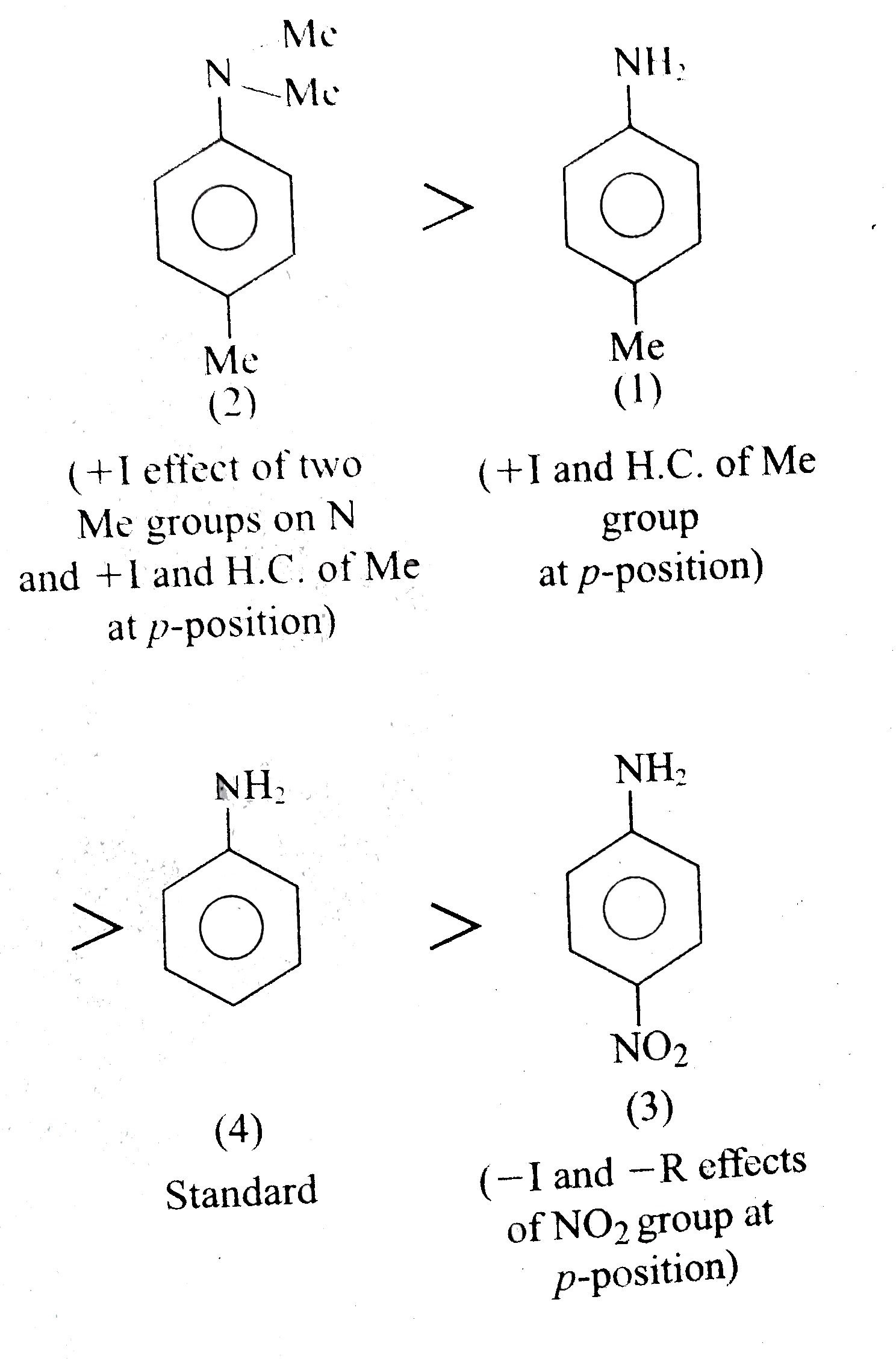 (f) `2 gt 1 gt 4 gt 3 gt [(2) 2^@` amine ` gt (1) 1^@` amine ` gt (4)` Aromatic amine (with `Me` group on `N, + I` effect of `Me` group) `gt (3)` Standard aniline] (G) `2 gt 3 gt 1 [(2) 1^@ R - NH_2(SP^3) gt (3) R-N = CH - R(sp^2) gt (1) R - C -= N(sp)` character] Basicity : `sp^3 gt sp^2` character. (h) `4 gt 1 gt 2 gt 3 (4)` Anion of `1^@` amine `CH_3 - overset Ӫunderset (ddot) N H, L P overline e^, s` density INCREASES `gt (1) 1^@` amine `gt (2) 3^@` amine `gt (3)` amide. 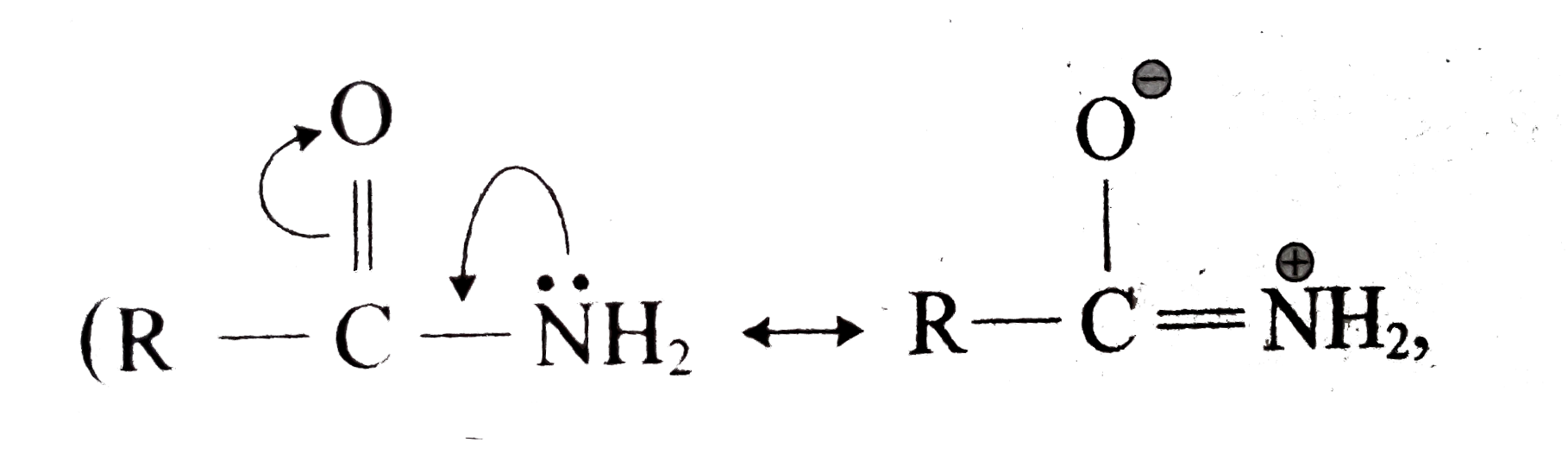 (i)`5 gt 1 gt 2 gt` Convert conjugate base into acid by adding `H^(oplus)`, find the acidic character and then reverse the order after removing `H^(oplus)` ions that would be the order for basic character. Acidity : `underset((6))(RCOOH) gt underset ((3))(H_2)O gt underset (4) ROH gt CH -= underset ((2)) CH gt underset ((1)) NH_3 gt underset ((5)) RH` Basicity : `RCOO^(Ө) lt overset (Ө) OH lt RO^(Ө) lt CH -= C^(Ө) lt overset (Ө) N H_2 lt R^(Ө) (6 lt 3lt 4 lt 2 lt 1 lt 5)`. (j) `(3 gt 1 gt 5 gt 4 gt 2)` Acidity : `underset ((2))HC1 gt underset ((4)) ROOCH gt underset ((5)) ROH gt underset ((1)) (H_2) gt underset ((3)) NH_3` Basicity : `C1^(Ө) lt RCOO^(Ө) lt RO^(Ө) lt H^(Ө) lt NH^(Ө) 2 lt 4 lt 5 lt 1 lt 3` (k) 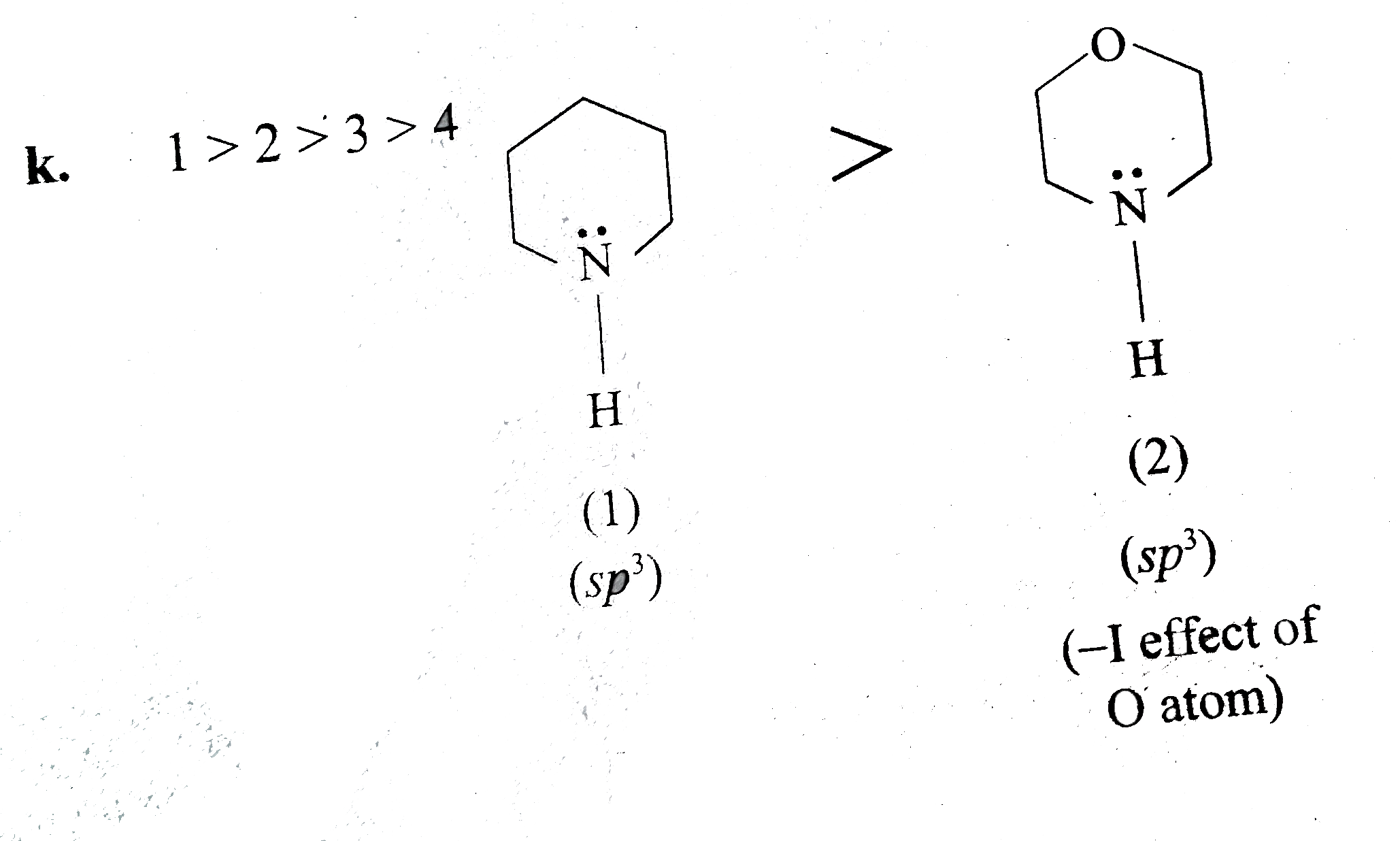 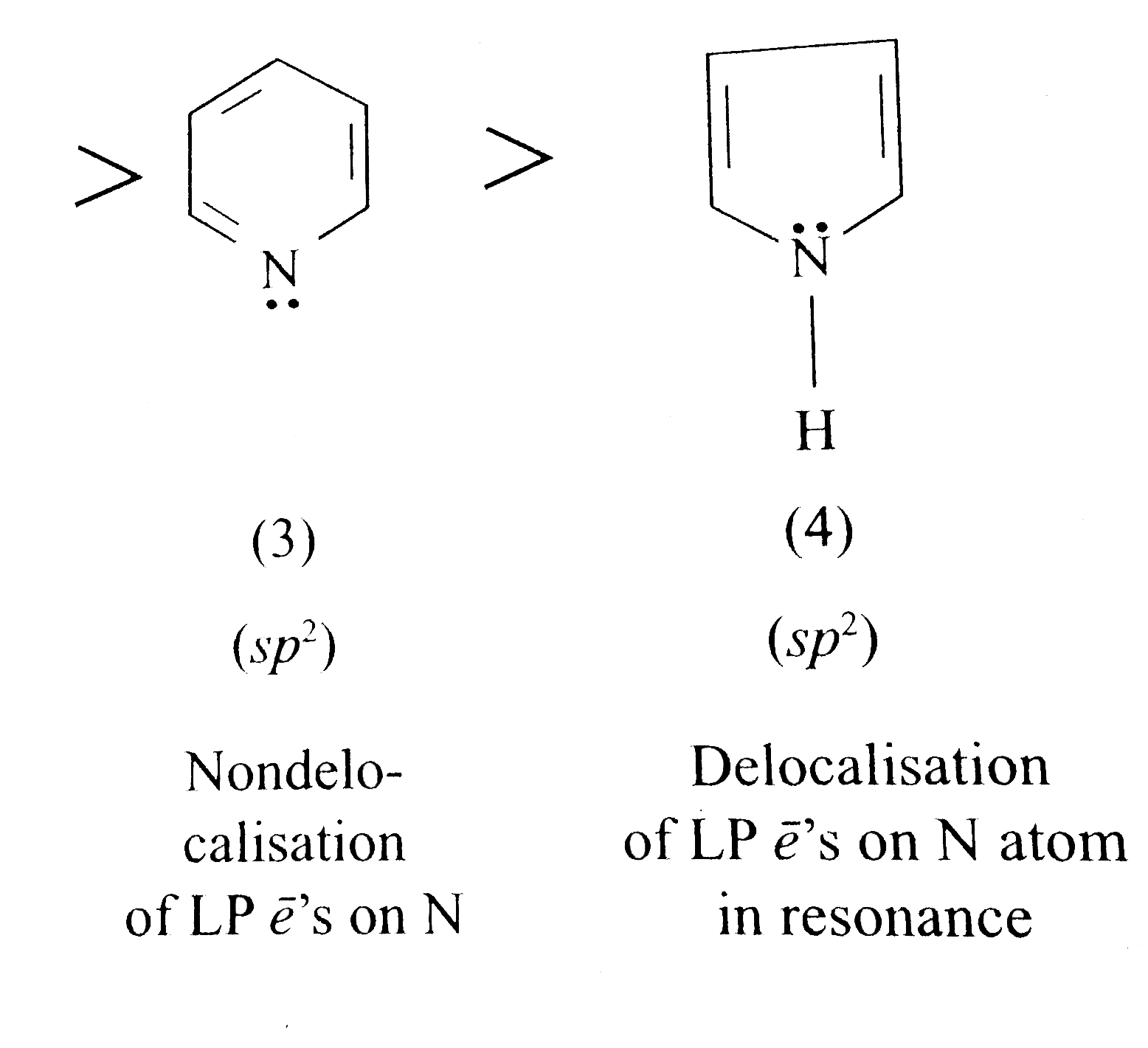 . .
|
|
| 10. |
Arrange the following in the order in which they displace each other from the solution of their salts. Al, Cu, Fe,Mg and Zn |
| Answer» Solution :The standard ELECTRODE potentials of these metals are -1.66V, +0.34V, -0.44V, -2.36V and -0.76V respectively.Hence the order will be Mg, Al, Zn, FE and Cu. (Mg can displace all the metals from their salt solutions, Al DISPLACES other metals expect Mg ETC) | |
| 11. |
Arrange the following in the increasing order of their CaCO_(3), BaCO_(3), MgCO_(3), BeCO_(3) ("Thermal stability") |
|
Answer» |
|
| 12. |
Arrange the following in the increasing order of C-C bond length : C_2H_6, C_2H_4, C_2H_2, C_6H_6 |
| Answer» SOLUTION :`C_2H_2 "(120 PM ) lt "C_2H_4 "(134 pm) lt " C_6H_6 "(139 pm) lt " C_2H_6` (154 pm) | |
| 13. |
Arrange the following in the increasing order of ionic character : KCl, MgCl_2 , CaCl_2, BeCl_2. |
| Answer» SOLUTION :`BeCl_2 LT MgCl_2 lt CaCl_2 lt KCL` | |
| 14. |
What are Iso-electronic species? Arrange the following in the increasing order of their ionic radius N^(-3),Mg^(+2),Na^(+) and O^(-2). |
|
Answer» |
|
| 15. |
Arrange the following in the decreasing order of Bond angle C_(2)H_(2), BF_(3), C Cl_(4) |
|
Answer» Solution :`C_(2)H_(2) , BF_(3), C Cl_(4)` : `C_(2)H_(2) = 180^(@) , BF_(3) = 120^(@), C Cl_(4) = 109.5^(@)` DECREASING order of bond angle ` C Cl_(4) lt BF_(3) lt C_(2)H_(2)` |
|
| 16. |
Arrange the following in the decreasing order of Bond angle CH_(4) , H_(2)O, NH_(3) |
|
Answer» Solution :`CH_(4) , H_(2)O, NH_(3)` : `NH_(3) = 107^(@) ", WATER " = 104.5^(@) , CH_(4) = 109.5^(@)` Decreasing order of bond ANGLE `H_(2)O lt NH_(3) lt CH_(4)` |
|
| 17. |
Arrange the following in the decreasing order of Bond angle (i) CH_(4),H_(2)O,NH_(3) (ii) C_(2)H_(2),BF_3,"CC"1_(4) |
|
Answer» SOLUTION : (i) `CH_(4),H_(2)O,NH_(3)` : `NH_(3)= 107^(@), "WATER" = 104.5^(@),CH_(4)=109.5^(@)` Decreasing order of bond angle : `H_(2)Olt NH_(3)lt CH_(4)` (ii)`C_(2)H_(2),BF_3,"CC"1_(4)` : `C_(2)H_(2)= 180^(@), BF_(3)= 120^(@),"CC"1_(4)=109.5^(@)` Decreasing order of bond angle : `"CC"1_(4)lt BF_(3)ltC_(2)H_(2)` |
|
| 18. |
Arrange the following in the decreasing order of basic strength i) pyrrole "" ii) pyridine "" iii) aniline |
|
Answer» `igt ii gt III` |
|
| 19. |
Arrange the following in the decreasing order of basic strength |
|
Answer» `II gt I gt III gt II` From the above data the order of strength of basicity is `IV gt III gt II gt I` |
|
| 20. |
Arrangethe followingin properorderof size |
|
Answer» MG` ltSi lt A1 lt P` |
|
| 21. |
Arrange the following in the decreasing order of acidity : (i) (1) n-Butanol (2) Methy1 alcohol (3) sec-Butanol (4) rert-Butanol (ii) (1) HCOOH (2) CH_3 COOH (3) C_2H_5COOH (4) C_6H_5 COOH (5) (CH_3)_2CHCOOH (6) CH_2 C1COOH (iii) (1) CH_3 CH_2CH_2COOH (2) CH_3 CH_2 CHC1COOH (3) CH_3 CHC1CH_2COOH (4) CH_2 C1CH_2 CH_2 COOH (iv) (1) CH_3COOH (2) CH_2C1COOH (3) CHC1_2 COOH (4) C C1_3 COOH (v) (1) CH_3BrCOOH (2) CH_2C1COOH (3) CH_2 FCOOH (4) CH_2 ICOOH (vi) (1) C_6H_5 COOH (2) p-OHC_6 H_4COOH (3) p-CH_3C_6H_4COOH (4) p-C1C_6H_4COOH (5) p-Br C_6H_4COOH (6) p-BO_2C_6 H_4 COOH (vii) (1) o-Hydroxybenzoic acid (2) p-Hydroxybenzoic acid (3) 2,6-Dihydroxybenzoic acid. (viii) (1) HCOOH (2) C_6 H_5 COOH (3) C_6H_5OH (4) HC1 (ix) RCOOH (2) ROH (3) RH (4) NH_3 (5) HOH (6) CH -= CH (x) (1) Phenol (2) p-Chlorophenol (3) p-Nitrophenol (4) m-Cresol (xi) (1) Phenol (2) m-Chlorophenol (3) m-Nitrophenol (4) m-Cresol (xii) (1) Phenol (2) Benzoic acid (3) p-Nitrophenol (4) Carbonic acid (xiii) (1) Phenol (2) Benzyl alcohol (3) Benzene sulphonic acid (4) Benzoic acid (xiv) (1) Phenol (2) p-Chlorophenol (3) 2,4,-Dichlorophenol (4) 2,4,6-Trichlorophenol (xv) (1) Nitroform HC(NO_2)_3 (2) Cyanoform HC(CN)_3 (3) CHC1_3 (xvi) (1) CH_3 SO_2CH_3 (2) CH_3NO_2 (xvii) (1) CH_3 BO - O^(Ө) (2) CH_3CHO (3) CH_3 COOR. |
Answer» Solution :(i)  (ii) `6 gt 1 gt 4 gt 2 gt 3 gt 5` (In `(6) -I` effect of `C1 gt (1)` (standard) `gt (4)+R gt -I` of `PH gt (2) + I`effect of `Me gt (3) + I` effect of `Et gt (5) + I` effect of two `Me` groups) . (iii) `2 gt 3 gt 4 gt1` (2) `- I` effect of `C1` at `alpha-C gt (3) - I` effect of `C1` at `beta - C gt (4) - I` effect of `C1` at `gamma-C gt (1) + I` effect of `CH_3 CH_2 CH_2`. (iv) `4 gt 3 gt 2 gt 1`(4) `-I` effect of `3 C1` at `alpha-C gt` (2) `-I` effect of `1 C1` at `alpha-C gt (1) + I` effect of `(CH_3 - )` group (v) `3 gt 2 gt 1 gt 4 ` (3) `- I` effect of `F = (2) - I` effect of `C1 gt (1) - I` effect of `Br gt (4) - I` effect of `I` (vi) `6 gt 4 gt 5 gt 1 gt 3 gt 2` (6) `-1` and `-R` effect of `(-NO_2)` group `gt (4) - I` effect of `C1 gt (5) - I` effect of `Br gt (1)` standard `gt (3) + I` and `H.C` effect of `CH_3- at p- gt` (2) `- I` and `-R` effect of `OH` group at `p-` However, the net effect is more `overline e-`donating than the net effect of `(3)`, since `+R gt + I` and `H.C` effects. (vii) `3 gt 1 gt 2` (3) Intramolecular H-bonding from two sides `gt (I)` Intramolecular H-bonding from one sides `gt (2) - I` and `+R` effects of `OH` group at `p-`position , net effect is `overline e-`donating. (viii) `4 gt 1 gt 2 gt 3` (4) Inorganic acid `gt (1)` FORMIC acid (standard) `gt (2)` Benzonic acid, `- I` and `+R` of `Ph` group, net `overline e-`donating `gt (3)` Phenol. (ix) `1 gt 5 gt 2 gt 6 gt 4 gt 3 gt ` (I) Acid `gt (5) H_2 O gt (2)` Alcohol `gt (6) HC -= CH` (sp character) `gt (4) nH_3 gt (3)` Alkane (`sp^3` character) (x) `3 gt 2 gt 1 gt 4` (3) `- NO_2(- I` and `-R` effects of `C1` at `p-) gt(2) - C1 - I` effects of `C1` at `p- gt (1)` Standard (phenol) `gt(4) CH_3 + I` effected of `CH_3` at `m-`position. (xi) `3 gt 2 gt 1 gt 4`(3) `(-NO_2)` (only `-I` effect of `(-NO_2)` at `m-) gt (2) - C1(-I` effected of `C1` at `m-) gt (1)` Standard (phenol) gt `(4) Ch_3` (only `+1` effect of `CH_3` at `m-`position. (xi) `2 gt 4 gt 3 gt 1` (2) Benzoic acid `gt (4)` Weak inorganic acid `gt (3)` Nitro phenol `(-NO_2) (-I` and `-R` effect of `(-NO_2)` at `p- ) gt (1)` phenol. (xiii) `3 gt 4 gt 1 gt 2` (3) Sulphonic acid, `-I` and `-R` effects of `(-SO_3 H)` group `gt (4)`, Benzoic acid, `- I` and `-R` effects of `(-COOH)` group, but `(-SO_3 H)` effect `gt (-COOH)` effect `gt (1) `Phenol `gt (2)` Alcohol) (xiv) `4 gt 3 gt 2 gt 1` (4) `- I` effect of `3 C1 gt (3) - I` effect of `2 C1 gt (2) - I` effect of `1 C1 gt (1)` Phenol, standard (xv) `1 gt 2 gt 3` (1) `-I` effect of three `NO_2` groups `gt (2) - I` effects of three `CN` groups `gt (3) - I` effect of three `C1` groups , ` - I` effect of : `-NO_2 gt - CN gt - C1`. (xvi) ` 2 gt 1 (2) -NO_2 (-I` effect of `NO_2 ) gt (1) - I` effect `SO_2` and `+ I` effect of two `CH_3` groups. (xvii) `1 gt 2 gt 3` (1) `-I` effect of `-NO_2 gt (2) -I` effect of `- CHO gt (3) - I` effect of `(- COOR)` group) , `-I` effect of : `- NO_2 gt -CHO gt -COOR`. |
|
| 22. |
Arrange the following in the decreasing order of acidic strength |
|
Answer» `II GT IV gt I gt III` |
|
| 23. |
Arrange the following in order of the increasing covalent character : MCl , MBr , MF , MI (where M = alkali metal ) . |
|
Answer» Solution :As the SIZE of the anion INCREASES , covalent character increases and HENCE the order is : `MF lt MCL lt MBr lt MI`. |
|
| 24. |
Arrange the followingin orderof increasingradii ? (i) I, I^(+) , I^(-) (ii) C, N, Si, P (iii) O^(2), N^(3-) , S^(2-) ,F^(-) |
|
Answer» (II) C andN lie in2ndperiodwhile Si and P liebelow them in the3rdperiod .Sinceelements in the 3th period havehigheratomicsizethanthosein the 2ndperiod therefore, atomicradii of Si and P arehigherthanthoseof C and N respectively .Sinceatomicradiidecrease fromleftto rightin a perioddut tohighernuclear charge therfore C hashigheratomicradius thanN andSi hashigheratomicradiusthan P. Thus the overall order of increasingatomic radii is : `N lt C lt P lt Si` (iii) Amongisoelectronic ionsthe SIZE ofanionsincrease as thenuclear chargedecreases. `F^(-) lt O^(2-) lt N^(3-).` SinceS belongto thirdperiodwhile `F, O, N` all belongto the secondperiodtherefore ionicradiusof `S^(2-) lt N^(3-) lt S^(2-)` |
|
| 25. |
Arrange the following in order of increasing acid strength: (a) NH_(3) ,CH_(4),HF,H_(2)O""(b) HCOOH, C_(6)H_(5)COOH. CH_(3)COOH. |
|
Answer» Solution :`(a) CH_(4) lt NH_(3) lt H_(2)O lt HF` `(b) CH_(3)COOHlt C_(6)H_(5)COOH lt HCOOH.` |
|
| 26. |
Arrange the following in order of (i) increasing N-O bond length (ii) increasing bond angles NO_(2)^(+) , NO_(2)^(-) , NO_(3)^(-) Give reasons . |
|
Answer» Solution :Applying rules for finding the TYPE of hybridisation of central atom, N atom in `NO_(2)^(+)` is `sp` hybridised while in `NO_(2)^(-) and NO_(3)^(-) ` , it is`sp^(2)`hybridised . Their structures are  `{:("BOND angle ":180^(@) ,132^(@), 120^(@)),("Bond order ":2, (2+1)/(2) = 1.5 , (2+1+1)/(3) = (4)/(3) = 1.33):}` Bond lengths :` NO_(2) ^(+) LT NO_(2)^(-) lt NO_(3)^(-)` |
|
| 27. |
The correct order of N-O bond length in No, NO_(2)^(-) and NO_(3)^(-) will be |
|
Answer» `NO_(3)^(-) GT NO_(2)^(+) gt NO_(2)^(-)` |
|
| 28. |
Arrange the following in order of decreasingbond angles (i)CH_(4), NH_(3), H_(2)O, BF_(3), C_(2) H_(2) ""(ii) NH_(3), NH_(2)^(-), NH_(4) ^(+) |
|
Answer» Solution : (i) `C_(2) H_(2) (180^(@)) gt CH_(4) (109^(@) 28') gtBF_(3) (120^(@)) gt nh_(3) (107^(@)) gt H_(2) O gt (104.5^(@))`. (ii) ` NH_(4)^(+) gt NH_(3) gt NH_(2)^(-)` This is because all of them involve `sp^(3)`hybridization . The NUMBER of lone pair of electrons presnt on N- atom are 0,1 and 2 resprectively. Greater the number of lone pairs, greater are the REPULSIONS on the bond pairs and HENCE smaller is the angle . |
|
| 29. |
Arrange the following in order of decreasing bond angle ,giving reason :NO_(2), NO_(2)^(+), NO _(2)^(-) |
|
Answer» Solution :`NO_(2)^(+)gt NO_(2)gtNO _(2)^(-)` . This is because ` NO_(2)^(+)` has no lone pair of elecrtons (i.e. has only BOND pairs on TWO Sides ) and hence it is linear . ` NO_(2)`has one unshared electon while` NO_(2)^(-)`has one unsharedelectron pair . There are greateron N-O bonds CASE of ` NO_(2)^(-)` than in case of ` NO_(2)`. 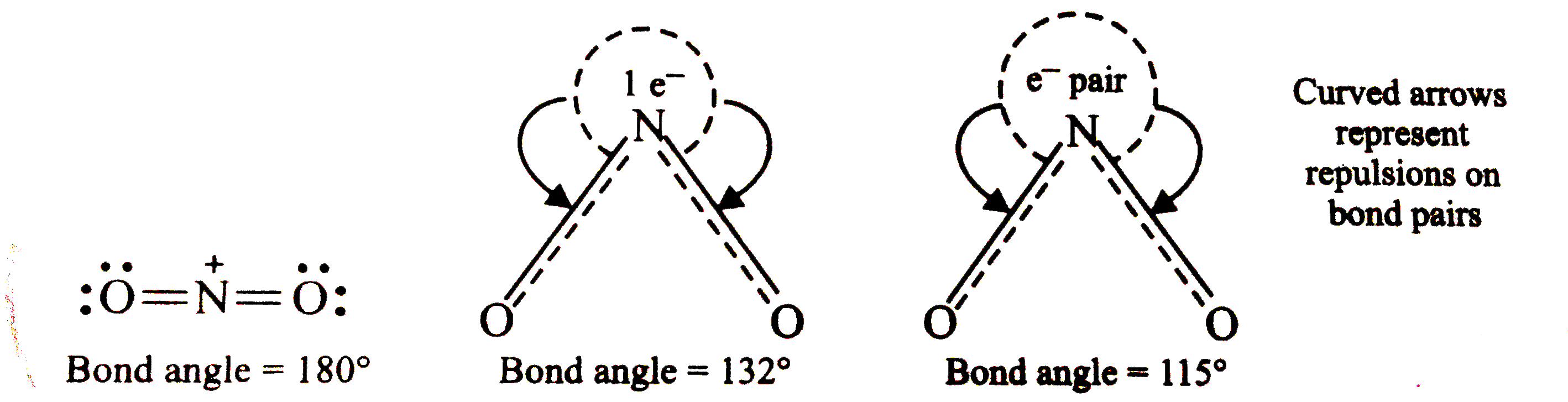
|
|
| 30. |
Arrange the following in increasing order of the property indicated. (i) F, Cl, Br and I (negative electron gain enthalpy) (ii) Mg^(2+), O^(2-), Na^(+), F^(-) and N^(3-)" (ionic size)" (iii) Mg, Al, Si and Na (ionization enthalpy) (iv) Br^(+) Br and Br^(-) (size) |
|
Answer» Solution :(i) `I lt Br lt F lt CL` II `Mg^(2+) lt Na^(+) lt F^(-) lt O^(2-) lt N^(2-)` (iii) `Na lt Al lt Mg lt Si` iv `Br^(+) lt Br lt Br^(-)` |
|
| 31. |
Arrange the following in increasing order of pH. KNO_(3(aq)) , CH_3COONa_((aq)), NH_4Cl_((aq)) , C_6H_5COONH_(4(aq)) |
|
Answer» Solution :(i)`KNO_3` is a salt of STRONG acid `(HNO_3)` strong base (KOH), thus its aqueous solution is neutral, pH = 7. (ii)`CH_3COONa` is a salt of weak acid `(CH_3COOH)` and strong base (NaOH), thus, its aqueous solution is basic, pH `gt` 7. (iii)`NH_4Cl` is a salt of strong acid (HCL) and weak base (`NH_4OH`) thus, its aqueous solution is ACIDIC, pH `lt` 7. (iv)`C_6H_5COONH_4` is a salt of weak acid, `C_6H_5COOH` and weak base, `NH_4OH`. But `NH_4OH` is slightly STRONGER than `C_6H_5COOH`. thus, pH is slightly `gt` 7. Therefore, increasing order of pH of the GIVEN salts is, `NH_4Cl lt C_6H_5COONH_4 gt KNO_3 lt CH_3COONa` |
|
| 32. |
Arrange the following in increasing order of pH. KNO_(3) (aq), CH_(3)COONa (aq), NH_(4)Cl (aq), C_(6)H_(5) CO ONH_(4) (aq) |
|
Answer» Solution :`KNO_(3)` (salt of strong acid-strong base), solution is neutral, pH = 7 . `CH_(3)CO ON a ` (salt of weak acid-strong base), solution is basic , `pH gt 7` `NH_(4)CL` (salt of strong acid-weak base), solution is acidic, `pH LT 7` `C_(6)H_(5)CO ONH_(4)` (both weak but `NH_(4)OH` is slightly STRONGER than `C_(6)H_(5)CO OH`), pH close to 7 but slightly `gt 7`. Hence, in order of pH , `NH_(4)Cl lt C_(6)H_(5) CO ONH_(4) gt KNO_(3) ltCH_(3)CO ON a`. |
|
| 33. |
Arrange the following in increasing order of dipole moment. |
Answer» SOLUTION :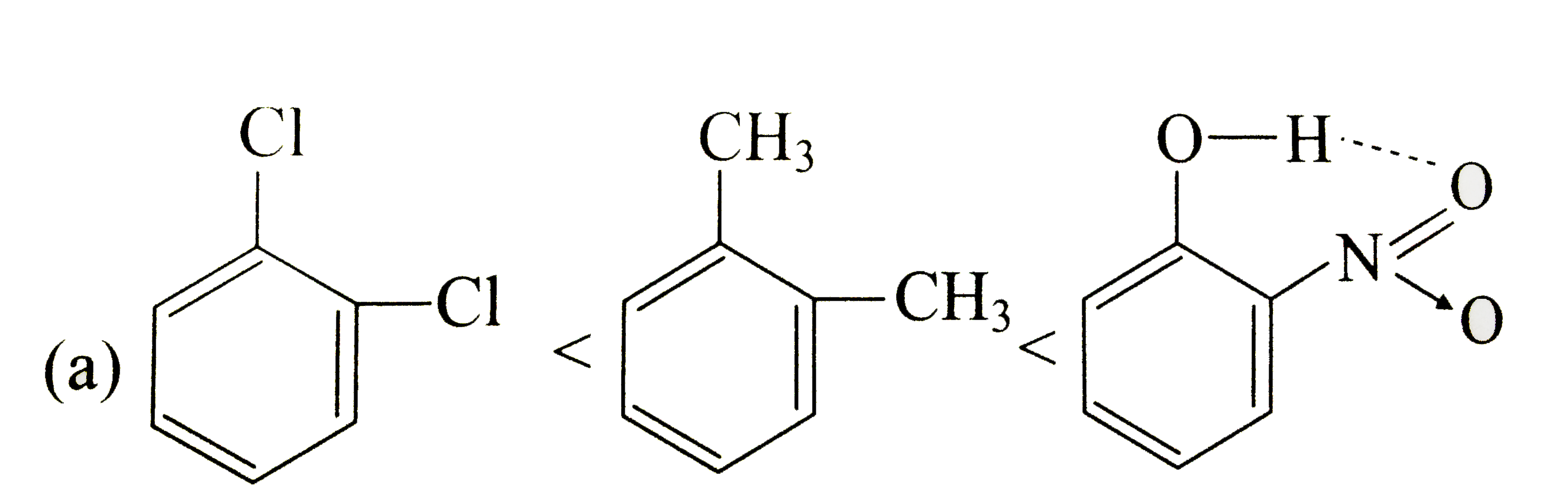 In ortho-dichlorobenzene, dipole-dipole repulsion of twohalohens increases the hond angle (more than 60%) and hence, dipole MOMENT is lowerd. In ortho-nitrophenol, intramolecular H-BOND decreases the bond angle and hence, dipole moment is increased. 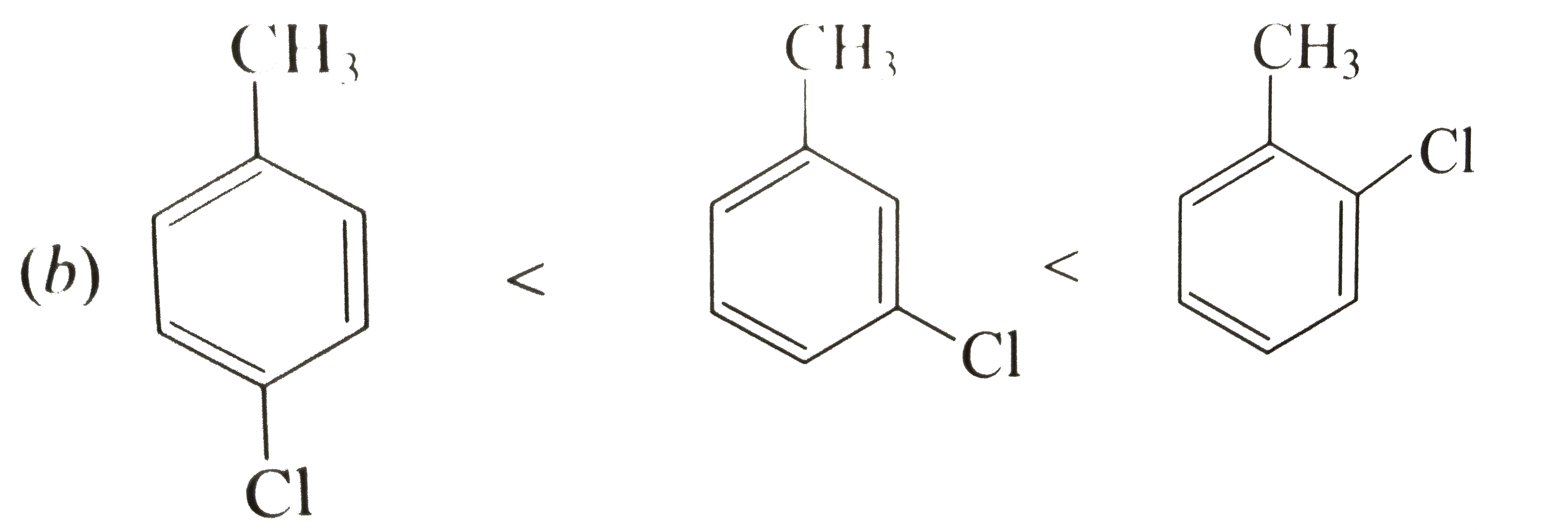
|
|
| 34. |
Arrange the following in increasing order of C-C bond length : C_(2)H_(6), C_(2)H_(4), C_(2)H_(2). |
| Answer» Solution :`C_(2)H_(2) ("120 pm") LT C_(2)H_(4) ("134 pm") lt C_(2)H_(6) ("154 pm")` | |
| 35. |
Arrange the following in increasing order of boiling point . Give reason . (CH_(3) CH_(2) CH_(2) Cl , CH_(3) CH_(2) Cl , CH_(3) Cl) |
|
Answer» Solution :The correct order of BOILING point of haloalkanes is : `CH_(3) CH_(2) CH_(2) Cl GT CH_(3) CH_(2) Cl gt CH_(3) Cl` . The boiling point of monoalkanes increase with the increase in the NUMBER of CARBON atoms. |
|
| 36. |
Arrange the following in increasing order of boiling point. (i) methane, butane, propane, pentane, ethane. (ii) n-pentane, neo-pentane, iso-pentane. (iii) ethane, 2-methyl propane, propane, n-butane. (iv) 2methyl pentane,2,2-dimethyl butane, 2,2-dimethyl propane. |
|
Answer» SOLUTION :(i) methane `lt` ethane `lt` propane `lt` butane `lt` pentane (II) neo-pentane `lt` iso-pentane `lt` n-pentane (iii) ethane `lt` propane `lt` 2-methyl propane `lt` n-butane (IV) 2,2-DIMETHYL propane `lt` 2,2 dimethyl butane `lt` 2-methyl pentane |
|
| 37. |
Arrange the following in increasing order of a dipole moment. (a) HF, HCI, HBr, HI (b) CH_(3)CI, CH_(3)Br, CH_(3)I, CH_(3)F (c) CHF_(3),CHI_(3), CHBr_(3),CHCI_(3) (d) CH_(4),CH_(3)CI, CH_(2)CI_(2),CHCI_(3) (e) NH_(3),SbH_(3),AsH_(3),PH_(3) (f) SO_(3),SiO_(2),P_(2)O_(5),CI_(2)O_(7) (g) o-chlorotoluene, m-chlorotoluene, p-chlorotoluene (h) o-nitrophenol, m-nitrophenol, p-nitrophenol (i) o-dichlorobenzen, m-dichlorobenzene, p-dichlorobenzene |
|
Answer» (b) `CH_(3)I lt CH_(3)Br lt CH_(3)F lt CH_(3)CI` (c) `CHI_(3) lt CHBr_(3) lt CHCI_(3) lt CHF_(3)` (d) `CH_(4) lt CH_(3)CI lt CH_(2)CI_(2) lt CHCI_(3)` (e) `SbH_(3) lt AsH_(3) lt PH_(3) lt NH_(3)` (f) `CI_(2)O_(7) lt SO_(3) lt P_(2)O_(5) lt SiO_(2)` (G) o-CHLOROTOLUENE `lt m`-chlorotoluene `ltp-`chlorotoluene (h) p-nitrophenol `lt m`-nitrophenol `lt o-`nitrophenol (i) p-DICHLOROBENZENE `lt m`-dichlorobenzene `lto`-dichlorobenzene |
|
| 38. |
Arrange the following in increasing order : a. First ionisation enthalpy : Mg , Al, Si, Na b. Extent of byrolysis : CCl_4 MgCl-2 , AICI_3, SiCI_4 c. Reducing power : GeCI_2_2, SnCI_2, PbCI_2 d. Oxididsing power : Gecl_4, SnCI_4, PbCi_4 e. pH of the soulution : NACl,Becl_2MgCl_2 , AlCl_3 . |
|
Answer» Solution :a. Increasing orbder of the first iobnitsation enthalypy `Na lt Al lt Mg lt Si` The valence electronic configureation of these elements are as follows : `{:[Na(Z =111 ) 3s^1],[Mg(Z= 12 ) 3s^2],[Al (Z=13) 3s^1],[Si (Z=14) 3p^2]:}` These elements belong to the same period . Aklong the period (rarr) effecitve nuclear charg increase . Hence . `IE_1` should increase as `Na lt Mg lt A llt Si` . But `Al` has lower `IE_1` value as compared to `MF` due to preneteration efect , Hence the ordr ereversea t `Al` and BECOMES : ` Na lt Al lt mg lt lSi` b. Increasing extent of hydrolysis : `C Cl_4lt MgCl_2 lt AlCl_3 lt SiCl_4` In covalent halicdes , hydroluysis occures as a reslult of corredination of a water molecule to the less eelctrongative element `C Cl_4` does not undrgo hydrolysis dut to the absiece to d-orbitals in its valence shell . So it can not expand its coordination nbumber vbeyond `4`. Thus, it cannot orrdinate with water molecules . c. Increasing reducing power : `PbCl_2 lt SnCl_2 lt GeCl_2` Amnong froup `14` elements the stability of lower oxidation states i.e `+2` increases doen the froup `(darr) ` doue to increase in INERT parie effect . d. Increasing oxidsing pwer : `GeCl_4 lt SnCl_3 lt PbCl_4` Among group `14` elements the stability of lower oxidation states i.e `+2` increases doen the group `(darr)` due to increase in inert pari effect . e. Incerasing `pH` of the solution `alCl_3 lt BeCl_2 lt mgCl_2lt NaCl` Whth increase in charge /radius ration of the central ion the tendcy to poarise eletron cloud in `H_2O` molecule and , hence dissorcattion of `O-H` bond in `H_2O` molecule increase i.e.m, more and more proton will be liberated and solution becames more actdic and `pH` DECREASES . In the compounds metioned charge /radius ration si in the order `Na^(otimes+) lt Mg^(2+) lt Al^(3+) lt Al^(3+)` and hence extent of hydrolysis follws the ordr : `NaCl lt MgCl lt BeCl_2 lt AlCl_3`Thisis why `NaCl` will be least acideic and ` AlCl_3` will be more ancidic . In other words , `pH` of `NaCl` will be least and that of `Alcl_3` will be maximum , hence the ordr : `AlCl_3 lt beCl_2 lt MgCl_2 lt NaCl`. |
|
| 39. |
Arrange the following in increasing Lewis base strange NH_(3), BiH_(3), PH_(3), AsH_(3), SbH_(3) |
| Answer» Solution :`BiH_(3) LT SbH_(3) lt ASH_(3) lt PH_(3)ltNH_(3)` | |
| 40. |
Arrange the following in increasing base strength CH_(3)^(-), NH_(2)^(+),OH^(-),F^(-) |
| Answer» SOLUTION :`F^(-) lt OH^(-) lt NH_(2), lt CH_(3)` | |
| 41. |
Arrange the following in increasing acidic strengthHCl, HBr, HF, HI |
| Answer» Solution :`HF lt HCl lt HBr lt HI ` | |
| 42. |
Arrange the following in decresing order of -I effect -C_(6)H_(5), -NO_(2), -COOH, -CN,-I, -F, -CH_(3), -C_(2)H_(5) |
| Answer» Solution :`-NO_(2) gt -CN gt -COOH gt -F gt -I gt - CH_(3) gt - C_(2)H_(5)`. | |
| 43. |
Arrangethe followingin decreasingorder oftheirvan derWaalsradii: C1, H , O, R |
|
Answer» Solution :The van derWaalsradii increaseas thenumber ofenergyshellsincreasesanddecreasesas thenuclear chargeincreases.SinceH has ONLYONE energyshell.And C1has threethereforethe van beWaalsradiusof H isthesmallestwhile that ofC1 is thelargest . Furtherboth N ANDO havetwo energyshellsbut thenuclearcharge onO (+ 8)is highestthan thatof N (+7)thereforethe van berWaalsradiusradius ofN isbiggerthan thatof O. Thusthe overalldecreasingorder is `C1 GT N gt O gt H` |
|
| 44. |
Arrange the following in decreasing order of their reactivity with an electrophile. |
|
Answer» |
|
| 45. |
Arrange the following in decreasing order of their boiling points: (I) n-Butane (II) 2-Methylbutane, (III) n-Pentane (IV) 2,2-Dimethylpropane |
|
Answer» IgtIIgtIIIgtIV Thus, the DECREASING order of their boiling points is: `underset(III)("n-Pentane") gt underset((II))("2-Methylbutane")gt underset((IV))("2,2-Dimethylpropane")gtunderset((I))("n-Butane")` |
|
| 46. |
Arrange the following in decreasing order of their boiling points (A) n-butane , (B)-2-methylbutane , (C ) n-pentane, (D)2,2-dimethylpropane |
|
Answer» A GT B gt C gt D |
|
| 47. |
Arrange the following in decreasing order of their boiling points. (A) n-butane (B) 2-methylbutane (C) n-pentane (D) 2,2-dimethylpropane |
|
Answer» `A gt B gt C gt D` |
|
| 48. |
Arrange the following in decreasing order of stability. (i) overset(.)(C )H_(3), (CH_(3))_(3) overset(.)C, (CH_(3))_(2) overset(.)(C )H and CH_(3) overset(.)(C )H_(2) (ii) CH_(3) overset(+)(C )H_(2), (CH_(3))_(3) overset(+)(C ), (CH_(3))_(2) overset(+)(C )H and overset(+)(C )H_(3) |
|
Answer» SOLUTION :(i) `(CH_(3))_(3) OVERSET(.)(C )gt (CH_(3))_(2) overset(.)(C )H gt CH_(3) overset(.)(C )H_(2) gt overset(.)(C )H_(3)` (ii) `(CH_(3))_(3) overset(+)(C )gt (CH_(3))_(2) overset(+)(C )H gt CH_(3) overset(+)(C )H_(2) gt overset(+)(C )H_(3)` |
|
| 49. |
Arrange the following in decreasing order of stability of their transition state during elimination by strong base |
| Answer» Answer :A | |