

Saved Bookmarks
This section includes 7 InterviewSolutions, each offering curated multiple-choice questions to sharpen your Current Affairs knowledge and support exam preparation. Choose a topic below to get started.
| 1. |
Find the co-ordination number of Lithium chloride in its crystalline state |
|
Answer» |
|
| 2. |
Find the charge on one gram ion of nitride ? |
|
Answer» SOLUTION :ONE gram ION of `N^(3-)` has 3F CHARG= `3 XX 96500 =289500 "coul"` |
|
| 3. |
Find the charge of 27 g of Al^(3+)ions in coulombs. |
|
Answer» Solution :One `AL^(3+)`ion has the charge of 3 protons, and a proton has the same magnitude of charge as that on an ELECTRON. No. Of moles of `Al^(3+)` ions `=("wt. In g")/(at. Wt")` `=27/27=1` No. Of `Al^(3+)` ions in 27 g = no. Of moles x Av. const `=1 xx 6.022 xx 10^(23)` Charge of 27 g of `Al^(3+)` ions =`3 xx` charge of a proton `xx` no. of `Al^(3+)` ions `=3 xx 1.602 xx 10^(-19) xx 6.022 xx 10^(23)` `=2.894 xx 10^(5)` coulombs. |
|
| 4. |
Find the changes in the hybridisation of B and N atoms as a result of the following reaction. BF_3 +NH_3toF_3 B - NH_3 |
| Answer» Solution :In `BF_(3)` the bybridisation of boron in `sp^(2)` and in `NH_(3)` the HYBRIDISATION of nitrogen is `sp^(3)`. After the reaction, the hybridisation of boron changes to `sp^(3)` but the hybridisationof N remains unchanged. | |
| 5. |
Find the change in pH when 0.01 mole CH_(3) COONa is added to one litre 0.01 M CH_(3) COOH solution (pK_(a) = 4.74) |
|
Answer» 3.27 |
|
| 6. |
Find the bond enthalpy of N - H bond in ammonia by using the change in enthalpy for the reaction given below. N_(2(g)) + 3H_(2(g)) to 2NH_(3(g)) ,DeltaH= -23 k.cal Bond energy N-=N= 226, H-H= 103 k.cal |
| Answer» SOLUTION :BOND energy N - H = 93 k.cal/mole | |
| 7. |
Find the average velocity, RMS velocity and most probable velocity of oxygen molecules at 30^@C |
|
Answer» |
|
| 8. |
Find the amound of iron pyrites (FeS_2) which is sufficient to produce enough SO_2 on roasting (heating in excess of O_2) such that is (SO_2) completely decolourise a 1 L solution of KMnO_4 containing 15.8 g L^(-1) of it. The equation are FeS_2+O_2toFe_2O_3+SO_2 KMnO_4+SO_2toMnSO_4+H_2SO_4+KHSO_4 |
|
Answer» SOLUTION :First calculate the amount of `SO_2` REQUIRED to decolourise `15.8gL^(-1)` of `KMnO_4` solution. For this, balance the following chemical reaction. The balanced equation is as: `KMnO_4+SO_2toMnSO_4+H_2SO_4+KHSO_4` `2KMnO_4+5SO_2+2H_2Oto2MnSO_4+H_2SO_4+2KHSO_4` `2" MOL of "KMnO_4-=5 " mol of "SO_2` Calculate moles in `15.8g L^(-1) of KMnO_4` Using strength `(GL^(-1))=(M)/(Mw)` `implies1.0L of KMnO_4` contains 0.1 mol Hence, moles of `SO_4` required `=(5)/(2)(0.1)=0.25` To calculate the amount of pyrites, we have to balance the following reaction. `FeS_2+O_2toFe_2O_3+SO_2` Balancing the reaction, we have `4FeS_2+11O_2to2Fe_2O_3+8SO_2` From stoichiometry of roasting, we have: `8 " mol of "SO_2-=4" mol of "FeS_2` `0.25 " mol of "SO_2-=(4)/(8)(0.25)" mol of "FeS_2` `=0.125 " mol of "FeS_2` Mass of `FeS_2=0.125xx120=15gL^(-1)` |
|
| 9. |
Find pH of solution prepared by mixing 100 ml. 0.1 M Na_3PO_4 and 200 ml , 0. 1M HCl ( P^(kal) , P^(ka2 )& P^(ka 3)" of " H_3PO_4 " are "3,7 & 1 0 respectively) |
|
Answer» `{:( HPO_4^(_2) +, H^(+) to, H_2PO_4^(-) ),( 10 , 10 , 0),( -,-, 10 m " MOLES" ) :}` `pH =(P^(K_a_1)+P^(Ka_2) )/( 2) = 5` |
|
| 10. |
Find pH of 0.1 M NaHCO_(3), (P^(kal) & p^(kal) "of" H_(2),CO_(3) are 7 & 11) |
|
Answer» <P> ` NaHCO_3 ,pH =(P^(Ka_1) +P^(Ka_2))/( 2)=( 7+11)/(2) = 9` |
|
| 11. |
Find out true (T) and false (F) for the following statements. (i) Propane ,2-diol is obtained as a oxidized product in bayer's test of propene. (ii) Ethanal is obtained as reduced product in ozonolysis of propene. (iii) Tertairy butyl alcohol is obtained on oxidaiton of 2-methyl propane by KMnO_(4). (iv) Oxidation is not possible for alkane like 2-methyl propane. |
|
Answer» |
|
| 12. |
Find out total number of structure of X. |
Answer» 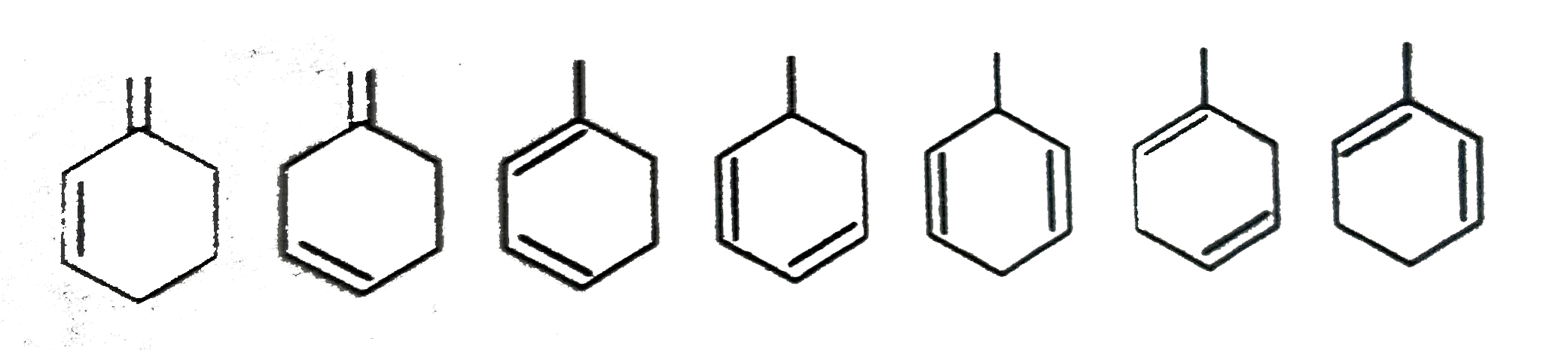
|
|
| 13. |
Find out the wavelength of a track star running a 100 metre dash I 10.1 sec, if its weight is 75 kg. |
|
Answer» |
|
| 14. |
Findout the volume of oxygen gas liberated at S.T.P. on complete decomposition of 6.8 g of H_(2)O_(2). |
|
Answer» |
|
| 15. |
Find out the volume of o gas liberated at S.T.P. on complete decomposition of 100ml of perhydrol. |
|
Answer» Solution :Commercially 100V `H_2O_2` solution is CALLED perhydrol. 1ML of perhydrol on COMPLETE decomposition liberates 100ml of `O_2` gas at S.T.P. Volume of `O_2`gas liberated at S.T.P. on complete decomposition of 100ml of perhydrol = 100 x 100 = 10,000 ML |
|
| 16. |
Find out the value of K_c for each of the following equilibria from the value of K_p : (i)2NOCl_((g)) hArr 2NO_((g)) + Cl_(2(g)) , K_p=1.8xx10^(-2) , 500 K (ii)CaCO_(3(s)) hArr CaO_((s)) + CO_(2(g)), K_p=167 , 1073 K |
|
Answer» Solution :(i)`{:("Reaction equilibrium:",2NOCl_((g)) hArr, 2NO_((g))+, Cl_(2(g))),("Stoichiometric multiply:", 2,2,1):}` All are gaseous , So, `Deltan_((g))` = (Difference of coefficient of products and reactant gas compount) `therefore Deltan_((g))`=(2+1)-(2)=+1 T=500 K, `K_p=1.8xx10^(-2)` R=0.0831 L bar `"mol"^(-1) K^(-1)` `K_p=K_c(RT)^(DELTAN)_((g))` `therefore K_c=K_p/(RT)^(Deltan_((g)))=(1.8xx10^(-2))/{{(0.0831)(500)}}^1` `=(1.8xx10^(-2))/(0.0831xx5xx10^2)` `=4.3321xx10^(-4) "mol L"^(-1)` (If R=0.0821 L atm `"mol"^(-1) K^(-1)` So, answer `4.384xx10^(-4) "mol L"^(-1)` ) (ii)`CaCO_(3(s)) hArr CaO_((s)) + CO_(2(g))` In equilibrium SOLID is ignore, `Deltan_((g))`=(Coefficient of gaseous product )-(Coefficientof gaseous reactants ) =+1-0=+1 `K_p`=167 T=1073 K R=0.0831 L bar `"mol"^(-1) K^(-1)` |
|
| 17. |
Find out the volume (in ml) of perhydrol to be decomposed to get oxygen gas which is sufficient for combustion of 2.8 g of ethylene gas |
| Answer» SOLUTION :6.72 LT | |
| 18. |
Find out the value ofn in: MnO_(4)^(-)+ 8H^(+) + "ne" rarr Mn^(2+) + 4H_(2)O |
|
Answer» |
|
| 19. |
Find out the value of K_c for each of the following equilibria from the value of K_p : (i)2NOCl(g) hArr 2NO(g) + Cl_2(g) , K_p=1.8xx10^(-2) at 500 K (ii)CaCO_3(s) hArr CaO(s) +CO_2(g) , K_p = 167 at 1073 K |
|
Answer» SOLUTION :`2NOCl hArr 2NO(G) + Cl_2(g)` `K_p = 1.8xx10^(-2)` at 500 K `Deltan` =3-2=1 `K_c=K_p(RT)^(-Deltan_g)` `=1.8xx10^(-2) (0.0831xx500)^(-1) =4.33xx10^(-4)` (II)`Deltan`=1-0=1 `K_c=K_p(RT)^(-Deltan_g)` `=167xx(0.0831xx1073)^(-1)` =1.87 |
|
| 20. |
Find out the value of K_(c) for each of the following equilibria from the value of K_(p) (a) 2 NOCl (g) hArr 2 NO(g) + Cl_(2) (g), K_(p) = 1*8 xx 10^(-2) " at 500 K " (b)CaCO_(3) (s) hArr CaO (s) hArr CaO(s) + CO_(2) (g), K_(p) = 167 "at" 1073 K. |
|
Answer» Solution :(a) ` Delta n_(g) = 3-2 =1 K_(p) = K_(c) (RT) or K_(c) =(K_(p))/(RT) = (1*8 xx 10^(-2))/(0*0831 xx 500) " " (R = 0*0831 "BAR litre MOL"^(-1) K^(-1))` ` = 4* 33 xx 10^(-4) ` (b) ` Delta n_(g) = 1 - 0 = 1 , K_(c) = (K_(p))/ (RT)= (167)/(6*3 xx 10^(14))= 1*87 .` |
|
| 21. |
Find out the value of K_c for each of the following equilibria from the value of K_p CaCO_3(s)iff CaO(s)+CO_2(g),K_p=167 at 1073 K |
|
Answer» SOLUTION :`Deltan(G)=1-0=1` `THEREFORE K_c=K_p/(RT)=167/(0.0821xx1073)=1.895` |
|
| 22. |
Find out the value of equilibrium constant for the following reaction at 298K 2NH_(3)(g) + CO_(2)(g) hArr NH_(2)CONH_(2)(aq)+H_(2)O(l) Standard Gibbs energy change, Delta_(f)G^(@)at the given temperature is -13.6kJmol^(-1) |
|
Answer» or log K `= 2.38:. K = ` antilog ` 2.38xx 2.4 xx 10^(2)` |
|
| 23. |
Find out the value of K_c for each of the following equilibria from the value of K_p 2NOCl(g)iff2NO(g)+Cl_2(g),K_p=1.8xx10^-2 at 500 K |
|
Answer» SOLUTION :`DELTAN(G)=(2+1)-2=1`, `THEREFORE K_p=K_cRT` or `K_c=K_p/(RT)=(1.8xx10^-2)/(0.0821xx500)=4.38xx10^-4` |
|
| 24. |
Find out the value of equilibrium constant for the following reaction at 298K, 2NH_(3(g)) +CO_(2(g)) hArr NH_2CONH_(2(aq))+H_2O_((l)) Standard Gibbs energy change, DeltaG_r^0 at the given temperature is "-13.6 kJ mol"^(-1) . |
|
Answer» Solution :Given : T=298 K `DeltaG_r^0=-13.6 "kJ mol"^(-1)` `=-13600 "J mol"^(-1)` `DeltaG^0=-2.303 RT log K_(eq)` `log K_(eq)=(-DeltaG^0)/(2.303RT)` `log K_(eq)=("13.6 kJ mol"^(-1))/(2.303xx8.314xx10^(-3) JK^(-1) mol^(-1)xx298K)` `logK_(eq)=2.38` `K_(eq)`=antilog(2.38) `K_(eq)`=239.88 |
|
| 25. |
Find out the value of equilibrium constant for the following reaction at 298 K. 2NH_(3(g)) + CO_(2(g)) hArr NH_(2) CONH_(2(aq) ) + H_(2) O_((l)) Standard Gibbs energy change, Delta_(r) G^( Theta ) at the given temperature is -13.6 "kJ mol"^(-1). |
|
Answer» Solution :We know, `LOG K= (- Delta_(r) G^( Theta ) )/( 2.303 "RT" ) ` `= ((13.6 xx 10^(3) "J MOL"^(-1) ) )/( 2.303 (8.314 "JK"^(-1)"mol"^(-1) ) (298) )=2.38` Hence, `K=` antilog `2.38 = 2.4 xx 10^(2)` |
|
| 26. |
Find out the value of equilibrium constant for the following reaction at 298 K. 2NH_(3(g)) + CO_(2(g)) |
|
Answer» SOLUTION :We know, LOG `K = (- Delta G ^(@))/(2.303RT) =2.38` `K = ` ANTILOG `2.38 = 2.4 xx 10 ^(2).` |
|
| 27. |
Find out the value of equilibrium constant for the following reaction at 298 K. 2NH3(g)+CO_2(g)harrNH_2CONH_2(aq)+H(O)(I) Standards Gibbs energy change Delta G^@ at the given temperature is-13.6 kJ mol^(-1). |
|
Answer» SOLUTION :`LOGK=(-DeltaG^(@))/(2.303RT)` `=-(13.6xx10^(3))/(2.303xx8.314xx298)=2.38` `:.K=` ANTILOG `2.38=2.4xx10^(2)` |
|
| 28. |
Find out the total number of reagents(s) which gives white turbidity with H_(2)S//Na_(2)S: FeCI_(3),HNO_(3),H_(2)SO_(3),HCI,Ca(OH)_(2),(KMnO_(4)+H_(2)SO_(4)),H_(2)O_(2) |
|
Answer» |
|
| 29. |
Find out the total number of reagents(s) which converts chromium (III) ion to chromate ion. {:(H_(2)O_(2)"solution",,(NaBO_(3).4H_(2)O+H_(2)O_(2)),),(NaOBr,,FeSO_(4),),(NaOH,,K_(2)S_(2)O_(8)):} |
|
Answer» |
|
| 30. |
Find out the total number of isomers of possible for C_(2)H_(2)F_(2) |
|
Answer» 2 
|
|
| 31. |
Find out the total number of compounds, which can be dissolved by both dil. HNO_(3) and NaOH PbSO_(3), [PbCO_(3).Pb(OH)_(2)], PbCrO_(4), AgCI, Ag_(3)S, Ag_(2)O |
|
Answer» |
|
| 32. |
Find out the percentage of oxalate in a given sample of an oxalate salt of which when 0.3 g were dissolved in 100 mL of water required 90 mL of N//20 KMnO_(4) solution for complete oxidation. |
|
Answer» |
|
| 33. |
Find out the oxidation states of two types of Fe atoms in Fe_(4)[Fe(CN)_(6)]_(3) and reqrite the formula in stock notation form |
|
Answer» SOLUTION :From our knowledge of COORDINATE complex we know that the species `Fe_(4)` which lies outside the complex ion I.e `[Fe(CN)_(6)]_(3)` is the +ve PART while the complex ion itself is the -ve part in other words the +ve charge on 4 fe atoms ouside the ocordination spher is balanced by the -ve charge on the complex ion since fe has two oxidationstates i.e +2 and +3 and oxidation number of `CN^(-)=-1 THEREFORE` Fe in the complex ions has an O.N of +2 while the fe atoms outside the coordination spere have an O.N of +3 thus the stock notation for `Fe_(4)[Fe(CN)_(6)]_(3)` is `Fe_(4)[Fe^(II)(CN)_(6)]_(3)` |
|
| 34. |
Find out the oxidation state of sodium in Na_(2)O_(2). |
|
Answer» Solution :Let x be the OXIDATION state of Na in `Na_(2)O_(2) ` . SINCE `Na_(2)O_(2)` contains a peroxide linkage in which O has an oxidation state of -1 , therefore , `overset(x)(N)a_(2) overset(-1)(O_(2)) or 2x + 2 (-1) = 0` or x = + 1 . Thus , the oxidation state of sodium in ` Na_(2)O_(2)` is +1. |
|
| 35. |
Find out the oxidation state of titanium in pertitanic acid (H_2TiO_4). |
|
Answer» +2 |
|
| 36. |
Find out the oxidation number of suphur in the following species H_(2)SO_(4),S_(2)O_(4)^(2-),S_(2)O_(7)^(2-),HSO_(3)^(-) and HSO_(4)^(-) |
| Answer» SOLUTION :O.N of S =+6 in `H_(2)SO_(4) and HSO_(4)^(-) "and" S_(2)O_(7)^(2-) +4 in HSO_(3)^(-) "and" +3 in S_(2)O_(4)^(2-)` | |
| 37. |
Find out theoxidation numbers of (i) S atoms in Na_(2)S_(2)O_(3) and CI atoms in bleaching powder CaOCI_(2) |
|
Answer» Solution :(i) oxidation number of S ATOMS in `Na_(2)S_(2)O_(3)` (a) By conventional method `overset(+1)Na_(2) overset(X)S_(2) overset(-2)O_(3)` or ` 2xx(+1)+2x+3xx(-2)=0` or x=+2 (wrong) but this is wrong because both the sulphur atoms cannot be in the same oxidation state as is evident from the fact that when `Na_(2)S_(2)O_(3)` is TREATED with dil `H_(2)SO_(4)` one Satom gets preciptated while the other gets converted in to `SO_(2)` the oxdation number of these two S atoms however be determined by the chemical bonding method by chemical method the structure of `Na_(2)S_(2)O_(3)` is `Na^(+)O-overset(S)overset(uparrow)underset(O)underset(||)S-O^(-)-Na^(+) "or" Na^(+)O-overset(S)overset(||)underset(O)underset(||)S-O^(-)Na^(+)` since there is a coordinate bond between the two S atoms therefore the acceptors S atom has an O.N of -2 the O.N of the other S atom can be calculated as follows (ii) oxidation number of chlorine in bleaching powder `CaOCI_(2)` average O.N of CI in `CaOCI_(2)` is `overset(+2)Ca overset(-2)Ooverset(x)CI_(2)` or 2x+2-2=0 or x=0 (a) by stoichiometry the composition of bleaching powder is `Ca^(2+)(OCI)^(-)CI^(-)` here O.N of CI in `OCI^(-)` is +1 while that in `CI^(-)` is -1 and the average of two oxidation number =`1XX(+1)xx(-1)=0` |
|
| 38. |
Find out the oxidation state of sodium in Na_(2)O_(2) |
|
Answer» Solution :LET the oxidation state of sodium in `Na_2O_2` be x. `Na_2O_2`is a PEROXIDE and CONTAINS a peroxy -O-O- LINKAGE in which the oxidation state of oxygen is -1. Thus, for `Na_2O_2` , we have `(2 xx x) + (-1 xx 2 ) = 0` or `x = + 1`. S |
|
| 39. |
Find out the oxidation number of chlorine in the following compounds and arrange them in increasing order of oxidation number of chlorine. NaClO_(4),NaClO_(3),NaClO,KClO_(2),Cl_(2)O_(7),ClO_(3),Cl_(2)O,NaCl,Cl_(2),ClO_(2). Which oxidation state is not present in any of the above compounds ? |
|
Answer» Solution :`NaClO_(4):+1+Cl+4(-2)=0` `Cl=+7` `NaClO_(3):+1+Cl+3(-2)=0` `Cl=+5` `NaClO:+1+Cl-2=0` `Cl=+1` `KClO_(2):+1+Cl+2(-2)=0` `Cl=+3` `Cl_(2)O_(7):2Cl+7(-2)=0` `Cl=+7` `ClO_(3):Cl+3(-2)=0` `Cl=+6` `Cl_(2)O:2Cl-2=0` `Cl=+1` `NaCl:Cl=-1` `Cl_(2)` : Cl = 0 `ClO_(2)` : Cl + 2(-2) = 0 Cl = +4 Increasing order of oxidation number of Cl : `NaClltCl_(2)ltNaClOltKClO_(2)ltClO_(2)ltNaClO_(3)ltClO_(3)ltCl_(2)O_(7)` None of them possess (+2) oxidation STATE. |
|
| 40. |
Find out the oxidation number of CI in HCI , HCIO, CIO_(4)^(-) and CIO_(2) |
| Answer» Solution :O.N of CI=-1 in HCI+1 in HCIO,+7 in `CIO_(4)^(-)"and" +4 in CIO_(2)` | |
| 41. |
Find out the oxidation number of sulphur in the following species : HSO_4^-. |
| Answer» SOLUTION :OXIDATION NUMBER of S=+6 in `HSO_4^-` | |
| 42. |
Find out the number of waves made by a Bohr electron in its 3rd orbit. |
|
Answer» Solution :No. of waves in any ORBIT `= ("CIRCUMFERENCE of that orbit")/("Wavelength") = (2pi r)/(lamda) = (2pi r)/((h//mv)) = (2pi)/(h) (m v r) = (2pi)/(h) (NH)/(2pi) = n` Thus, the number of waved in 3RD orbit = 3 |
|
| 43. |
Find out the number of reactions that are electrophilic aromatic substitution aromatic substitution in nature. |
|
Answer» |
|
| 44. |
Find out the most favourable conditon for electrovalent bonding . |
|
Answer» Low ionization POTENTIAL of ONE atom and high electron affinity of the other atom . |
|
| 45. |
Find out the internal energy change for the reaction A (l) rarr A (g) at 373 K . Heat of vaporisation is 40.66 kJ // mol and R = 8.3J mol^(-1) K^(-1) |
|
Answer» SOLUTION :`A (l) rarr A(G),Delta n_(g) = n_(p) - n_(r) = 1 -0 = 1` `Delta H = Delta U + Delta n_(g) RT` or `Delta U = Delta H - Delta n_(g) RT = 40660 J - 1 mol XX 8.314 J K^(-1) mol^(-1) xx 373 K ` `= 40660J - 3101 J = 37559 J mol^(-1) = 37.56 k J mol^(-1)` |
|
| 46. |
What is the equivalent weight of potassium dichromate in acidic medium ? |
|
Answer» SOLUTION :In acidic solution DICHROMATE gives chromic salts `Cr_(2)O_(7)^(2-)to2Cr^(3+)` `(2)xx (+6) to (2) xx (+3)` The change in oxidantion number of potassium dichromate in acid medium is 6 Theformula weight =294 Equivalent weight ` = (294)/(6) =49` |
|
| 47. |
Find out the number of angular nodes in the orbital to which the last electron of Cr enter |
|
Answer» number of radial nodes = 3 -2 -1 =0 number of angular nodes = 2, Difference = 2 |
|
| 48. |
Find out the Deltang values and write the K_(c) and K_(p) relation for the equilibrium reactions Formation of NO |
|
Answer» Solution :`N_(2)+O_(2)hArr2NO` `Deltang=2-2=0` `K_(P)=K_(c)(RT)^(Deltang)` `K_(P)=K_(c)(RT)^(0),K_(P)=K_(c)` |
|
| 49. |
Find out the Deltang values and write the K_(c) and K_(p) relation for the equilibrium reactions Decomposition of ammonia |
|
Answer» <P> Solution :`2NH_(3)(g)hArrN_(2)(g)+3H_(2)(g)``Deltang=4-2=2` `K_(P)=K_(c)(RT)^(Deltang)` `K_(P)=K_(c)(RT)^(2),K_(P)gtK_(c)` |
|