

Saved Bookmarks
This section includes 7 InterviewSolutions, each offering curated multiple-choice questions to sharpen your Current Affairs knowledge and support exam preparation. Choose a topic below to get started.
| 1. |
For a reversible process at equilibrium, the change in entropy may be expressed as: |
|
Answer» `DeltaS = Tq_(REV)` |
|
| 2. |
For a real gas 'X'the Boyle point is 240^@C. If the van der Waals constant 'b'is 0.08 dm^3 mol^(-1), calculate the value of constant 'a'for 'X'. |
|
Answer» Solution :The BOYLE POINT, `T_(b)` is given as `T_(b) = (a)/(Rb)` van der WAALS. CONSTANT .a. for the gas .X. ` = T_(b) xx R xx b = 513 xx 0.0821 xx 0.08 = 3.37` atm `L^(2)MOL^(-2)`. |
|
| 3. |
For a real gas , the compressibility factor Z has different values at different temperatures and pressures . Which of the following is not correct under the given conditions ? |
|
Answer» Z lt 1 at very low PRESSURE . |
|
| 4. |
For a real gas, following equation (P+(a)/(TV_(m)^(2)))(V_(m)-beta)=RT, where alpha and beta are positive constants. Select the correct option(s): |
|
Answer» `T_(C)=(8alpha)/(27Rbeta)` |
|
| 5. |
For a reaction value of K_c is 7.105 xx 10^(-5), what will be the change in free energy ? |
|
Answer» `Delta G GT 0` |
|
| 6. |
For a reaction whose standrad enthalpy change is -100 kJ, what final temperature is needed to double the equilibrium constant from its value at 298 K? |
|
Answer» Solution :`"log"K_(2)/K_(1)=(DeltaH^(@))/(2.303R)[(T_(2)-T_(1))/(T_(1)*T_(2))]` `LOG2=(-100000)/(2.3xx8.3)[(T_(2)-298)/(298T_(2))]` `0.301=(-100000)/(19.09)((T_(2)-298))/((298T_(2)))` Solving for `T_(2)`, we get `T_(2)~~293K` |
|
| 7. |
Which of the following reaction is spontaneous at room temperature |
|
Answer» `DELTA H and Delta G` should be negative |
|
| 8. |
For a reaction the Delta S value is -20 J mol^(-1) k^(-1) . If the temperature is increased from 0^(@) C at 25^(@)C , the increases in the value of Delta Gis (in J mol^(-1)) |
| Answer» ANSWER :A | |
| 9. |
For a reaction taking place in a container in equilibriumwith its surroundings, the effect of temperature on its equilibrium constant K in terms of entropy is described by |
|
Answer» With increase in temperature, the VALUE of K for endothermic reaction increase because unfavourable changein entropy of the surroundings DECREASES For endothermica reaction , if`T_(surr)` increases, `DeltaS _(surr)`will increase `(:'DeltaH = +ve)` For exothermicreactions K increases with increase of temperature `(K= K_(f) //K_(b))` and in endothermicreaction, `k_(f)` increases with increase of temperature) WHEREAS for exothermic reaction,K decreases with increase of temperature ( because in these reactions, `k_(b)` increases with increase oftemperature) . |
|
| 10. |
For a reaction, SO_(2) (g) + 1//2O_(2)(g) to SO_(3)(g) if K_(p)=1.7 xx10^(12) at 20^(@)C and 1 atm pressure , then value of K_(c) is |
|
Answer» <P>`1.7xx10^(12)` or `K_(c)=(K_(p))/((RT)^(Deltan))=(1.7xx10^(12))/((0.082xx293)^(-1//2))` `=1.7xx10^(12)xxsqrt(0.082xx293)` `=1.7xx10^(12)xx4.9=8.33xx10^(12)` |
|
| 11. |
For a reaction R_(1), Delta G = x KJ mol^(-1). For a reaction R_(2), Delta G = y KJ mol^(-1). Reaction R_(1) is non-spontaneous but along with R_(2) it is spontaneous. This means that |
|
Answer» X is -ve, y is +ve but in magnitude `x GT y` |
|
| 12. |
For a reaction N_(2)(g)+3H_(2)(g)to2NH_(3)(g),DeltaH=-24 kcal at 700 K and 10 atm pressure, calculate magnitude of change in internal energy if 1.68 kg of N_(2)(g) and 0.3 kg of H_(2) are mixed and reaction undergoes 60% completion: |
|
Answer» 21.2 kcal |
|
| 13. |
For a reaction Delta H= 3 KJ and Delta S = 10 J/Kelvin at what temperature the reaction will be spontaneous ? |
| Answer» Answer :D | |
| 14. |
For a reaction AX_(5)hArr AX_(2), 1% of AX_(5) is dissociated at a total pressure of 1 atm, the equilibrium constant K_(P) is approximately equal to |
|
Answer» `10^(-3)` |
|
| 15. |
For a reaction at equilibriumH_(2)(g) + Cl_(2)(g) hArr 2HCl(g) K = 4, " the calue of " (K_(b)[HCl]^(2))/(K_(f)[H_(2)][Cl_(2)])is 1. |
|
Answer» |
|
| 16. |
For a reaction at 25^(circ)C,DeltaG=12.7kJ when the reaction quotient Q=10.0. What is the value of DeltaG^(circ) for this reaction? |
|
Answer» `-12.1kJ` |
|
| 18. |
For a reaction A (g)hArrB(g)at equilibrium, the partical pressure of B is found to be one fourth of the paritcal pressure of A. The value of DeltaG^(circ) of the reaction AhArrB is : |
|
Answer» RT In 4 |
|
| 19. |
For a reaction , A (g) to A(l) , Delta H = -3RT . The correct statement for the reaction is |
|
Answer» `DELTAH = Delta U ne O` |
|
| 20. |
For a reaction A+BhArr2C the equilibrium concentration of (A) and (B) are 20 mole//Lwhen volume is doubled the new equilibrium concentration of (A) was found to be 15 mol//L then |
|
Answer» Ratio of CONCENTRATION of `A "and" B` at new EQUILIBRIUM is 3//4 at new equilibrium `((20)/(2)+(X)/(2))((20)/(2)+x)((a)/(2)-x)` given that `(A)_(new)=15=((20)/(2)+(x)/(2)rArrx=(15-10)xxL` `x=101` for IST equilibrium `K_(C)=((a)/(2))^(2)/(((20)/(2)(20)/(2))^(2))=((a)/(2))^(2)/(10+100)=(((a)/(2))^(2)/(1000))` for IInd equilibrium `K_(C)=((a)/(2)-10)^(2)/((20/(2)+(x)/(2))((20)/(2)-x)^(2))=((a)/(2)-10)^(2)/(15xx25)=((a)/(2)-10)^(2)/(275)` `(K_(C) "for" I=K_(C) "for II")` `((a)/(2))^(2)/(1000)=((a)/(2)-10)^(2)/(375)` `((a)/(2))/(31.62)=((a)/(2)-10)/(19.365)` `19.365xx(a)/(2)=31.62xx(a)/(2)-31.62xx10` `9.6825xx0=15.81xx0-316.2` `6.1275xxa=316.2` `a=51.60M` `K_(C)=(C)^(2)/((20)(20)^(2))=(51.6xx51.6)/(20xx20xx20)=332.82xx10^(-3)` `K_(C)=0.333` approxly. |
|
| 21. |
For a reaction A + B rarr C + D, the entropy change is +68.4 JK^(-1) and the enthalpy change is -124.6 kJ. Calculate the Gibb's energy change at 298 K. |
|
Answer» Solution :`Delta G = Delta H - T Delta S` Given, `Delta H = -1246000 J, T = 298 K` and `Delta S = +68.4 JK^(-1)` Substituting in the formula, we get `Delta G = -124600 - 298 xx 68.4` `= -144983 J = -144.983 KJ`. |
|
| 22. |
Fora reaction:2A(g) toB(g), DeltaH =-40 Kcal. Ifrate constantfor disapperance of A is 10^(-2) M^(-1) sec^(-1) then identify the opationswhich will be correct [Assumegases to behaveideallyand reactionto be occuring at 300 K][Take : R=2 cal/mole K] |
|
Answer» THEREACTION must be ELEMENTARY reaction. |
|
| 23. |
For a reaction 2A(g) hArr B (g) Q_(c) gt K " if "'A' is added maintainingQ_(c) gt K,the reaction will move in backward direction. |
|
Answer» |
|
| 24. |
For a reaction 2 Cl_((g))rarrCl_(2)What are the signs of DeltaH and DeltaS ? |
|
Answer» Solution :The GIVEN reaction represents the formation of bonds. Hence energy is released , ie., `DELTAH` is - ve Further two moles of atom will have GREATER randomness than ONE mole of molecules. Hence randomness increases so `DeltaS=+ve` |
|
| 25. |
For a process change in enthalpy is 36 kJ.mol and change in entropy is 120 J "mole "^(-1) K ^(-1). The temperature at which the sywstem attains eequibrium is |
|
Answer» `50 ^(@)C` |
|
| 26. |
For a polyprotic acid, H_(3)PO_(4) its three dissociation constanst K_(1),K_(2) and K_(3) are in the order |
|
Answer» `K_(1) = K_(2) gt K_(3)` |
|
| 27. |
For a physical equilibrium, H_(2) O (Ice) hArr H_(2) O (Water ) which of the following is the true statement: |
|
Answer» The pressure CHANGE do not affect the equilibrium |
|
| 28. |
For a perfectly cyrstalline solid C_(p,m)= a T^(3) + bT, where a and b are constants. If C_(p,m) is 0.40 J/K mol at 10K and 0.92 J/K mol at 20K, then molar entropy at 20K is 0.2x xx R joules. Then the value of x is |
|
Answer» 0.92 J/K mol `=[(aT^(3))/(3) + bT]_(0)^(20)` `S_(20) = (a)/(3) (20)^(3) + b(20)` `C_(10) = a(10)^(3) + b(10) =0.4` `C_(20) = a(20)^(3) + b(20) = 0.92` `rArr a = 2 xx 10^(-5) , b= 0.038` `rArr S_(20) = (2)/(3) xx 10^(-5) xx (20)^(3) + 0.038 xx 20` = 0.813 J/mol -K |
|
| 29. |
For a perfectly crystalline solid C_(p.m) = aT^(3), where a is constant. If C_(p.m) is 0.42 J/K - mol at 10K, molar entropy at 10K is |
|
Answer» <P>0.42J/K -mol `C_(P) = 0.42 = a xx 10^(3) rArr a= (0.42)/(10^(3))` `rArr S_(10) - S_(0) = (0.42)/(1000) xx (1000)/(3) = (0.42)/(3)` `S_(10) = 0.14` J/mol-K |
|
| 30. |
For a particular value of azimuthal quantum number (l), the total number of magnetic quantum number values (m) is given by |
|
Answer» `L = (m+1)/(2)` |
|
| 31. |
For a particular reversible reaction at temperature T, DeltaH and DeltaS were found to be both +ve. If T_(e) is the temperature at equilibrium, the reaction would be spontaneous when |
|
Answer» At EQUILIBRIUM, `DeltaG =0` ` 0 = DeltaH -TDeltaS` or `T_(e)DeltaS = DeltaH` `T_(e) = (DeltaH)/(DeltaS)` SINCE it is an endothermic reaction, it is favoured by high temperature so that `T gt T_(e)`. |
|
| 32. |
For a particular reverisble reaction at temperature T,DeltaH and DeltaSwere found to be both =ve. If T_(e) is the temperature at equilibrium, the reaction would be spontaneous when |
|
Answer» `T_(e)` is 5times T |
|
| 33. |
For a of orbital, the values of m are |
|
Answer» `-1, 0, +1` |
|
| 34. |
For a non-ideal gas, the compressibility factor (Z) is defined as Z=(PV_(m))/(RT),V_(m)= molar volume Compressibility of an unknown gas at 600 K and 1.0 atm was found to be 1.2 Also, this gas was found to effuse 1.58 times slower than the pure methane gas under identical conditions Take R=0.0821 L-atm-mol^(-1)k^(-1) Molar volume of the gas in the given experimental condition is: |
|
Answer» `41.0` L |
|
| 35. |
For a non-ideal gas, the compressibility factor (Z) is defined as Z=(PV_(m))/(RT),V_(m)= molar volume Compressibility of an unknown gas at 600 K and 1.0 atm was found to be 1.2 Also, this gas was found to effuse 1.58 times slower than the pure methane gas under identical conditions Take R=0.0821 L-atm-mol^(-1)k^(-1) Density of the gas in the above mentioned experimental condition is: |
|
Answer» `0.98 GL^(-1)` |
|
| 36. |
For a non-electrolytic solution |
|
Answer» ` i=+ve` |
|
| 37. |
For a molecule to be stable |
|
Answer» `N_(B) LT N_(a)` |
|
| 38. |
For a mutielectron atom, the maximum of 2p-orbital in radial probability distribution graph is nearer the nucleus than that of 2s-orbital . Therefore, 2p-orbital should be closer to the nucleus and lower in energy than 2s-orbital. But 2s-orbital has lower energy than 2p-orbital. Explain. |
Answer» Solution :The radial probability DISTRIBUTION graphs for 2s - and 2p- orbitals are shown below:  It is clear from the figure that in case of 2s - orbital, there is a small additional PEAK or lamp. This indicates that a 2s-electron spends some of its time NEAR the nucleus. In other words, 2s-electron penetrates the `1s^2` - core (or K-shell, shown shaded in the figure). Due to penetration, a 2s- electron gets less shielding from other electrons and therefore, feels more nuclear charge. As a result, a 2s-electron is ATTRACTED more strongly by the nucleus than a 2p - electron. THUS, 2s has lower energy than a 2p - electron. |
|
| 39. |
For a molecule given select the correct statement (s). CH_(3)-CH=CH-CH=C=C=CH-CH=C=CH-CH_(3) |
|
Answer» It has only one optically inactive from, is its trans geometrical isomer. 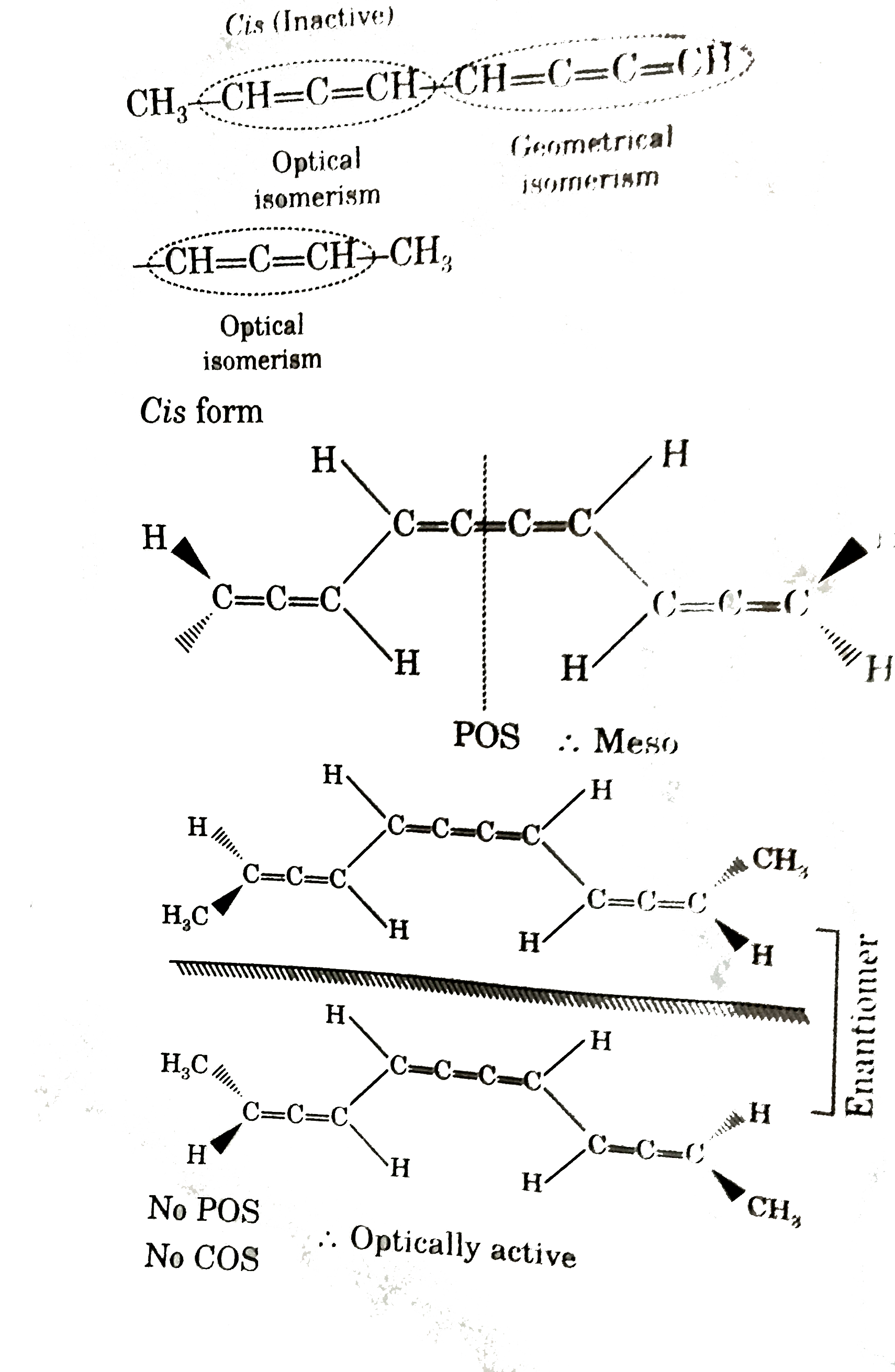 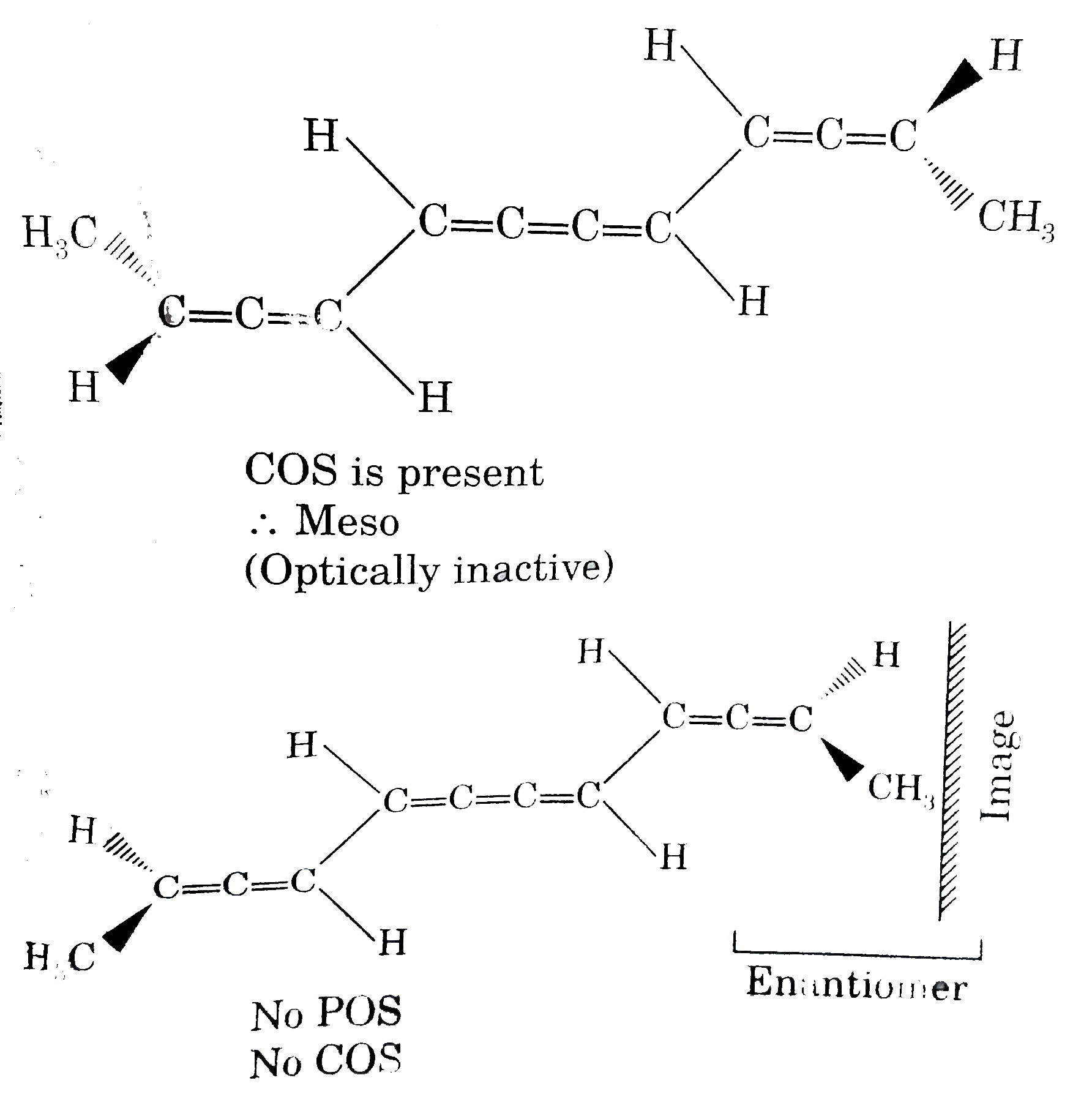
|
|
| 40. |
For a mixture of I mole He and 1 mole Ne, select the correct statements(s) |
|
Answer» Molecules of the two gases strike the wall of the container with same frequency Same moles `IMPLIES` P same `implies` same frequency . |
|
| 41. |
For a liquid the vapour pressure is given by log_(10) P = (-400)/(T) + 10 Vapour pressure of the liquid is 10^(x) mm Hg at 400K. The value of x will be _______ |
|
Answer» <P> at 400K, log `P = (-400)/(400) + 10 = - 9 RARR P = 10^(-9)` |
|
| 42. |
For a liquid, enthalpy of fusion is 1.435 xx 10^(3) cal mol^(-1) and molar entropy change is 5.26 cal mol^(-1). Calculate the melting point of the liquid. |
|
Answer» `Delta S= (Delta H)/(T_(MP))` `rArr M.P. = (1.435 xx 10^(3))/(5.26) = 273 = 0^(@)C` |
|
| 43. |
For a liquid, enthalpy of fusion is 1.435 kCal mol^(-1) and molar entropy change is 5.26 cal mol^(-1) K^(-1). The freezing point of liquid in celcius will be ________ |
|
Answer» `= 0^(@)C` |
|
| 44. |
For a hypothetical reaction , X rarr Y , the enthalpy and entropy changes are 46.3 kJ mol^(-1) and 108.80 JK^(-1) mol^(-1) respectively. Find the temperature. Find the temperature above which this reaction is spontaneous |
|
Answer» |
|
| 45. |
For a hypothetical reaction, the following kinetic data suggested that the overall order of this reaction is {:("[A]",[B],[C]),(mol" "dm^(-3),mol" "dm^(-3),mol" " dm^(-3) s^(-1)),(2.0,1.0,1.0),(2.0,4.0,2.0),(1.0,4.0,1.0):} |
|
Answer» 3 `1=(2)^(a)(1)^(b)""…(i)` `2=(2)^(a)(1)^(b)""…(ii)` `1=(1)^(a)(4)^(b)""…(iii)` Dividing (ii) by (i) `((2)^(a)(4)^(b))/((2)^(a)(1)^(b))=(2)/(1)` `4=2 to b=1//2` Dividing (ii) by (iii) `((2)^(a)(4)^(b))/((1)^(a)(4)^(b))=(2)/(1)` `2^(a) = 2 IMPLIES a=1` `therefore` Rate law EXPRESSION is , `r=[A][B]^(1//2)` Order of reaction `=1+(1)/(2)=(3)/(2)=1.5` |
|
| 46. |
For a hypothetical reactionP(g) + Q(g) hArr R(g) + S(g) , " a graph between log K and " T^(-1)" is a straight line as hsown in the fig. in which "theta = tan^(-1) 0*5 and OA = 10. " Assuming "Delta H^(@) " is independent of temperature , calculate the equilibrium constant of the reaction at 298 K and 798 K respectively. |
|
Answer» Solution :Effect of temperature on equilibrium constant K is given by van't Hoff equation, viz. ` log K = -(DeltaH^(@))/(2* 303 RT) +C`where C = constant of integration THUS , a plot of log or `1/T`, i.e., `T^(-1) ` is a straight LINE with SLOPE = `(Delta H^(@))/(2* 303 R)` and intercept = C `:. C = 10 and " slope " = tan theta= 0*5 = (DeltaH^(@))/(2*303 xx 8*314) or DeltaH^(@)= 9* 574 " Jmol"^(-1)` `:. log K= 10 -(9*574)/(2*303 xx 8* 314 xx 298 ) =9* 9827` or K= Antlog `(9 *9827)= 9* 96 xx 10^(9)` As `DeltaH^(@)` is independent of temperature , K will also be independent of temperature . Hence , K wil be same at 298 K and 798 K. 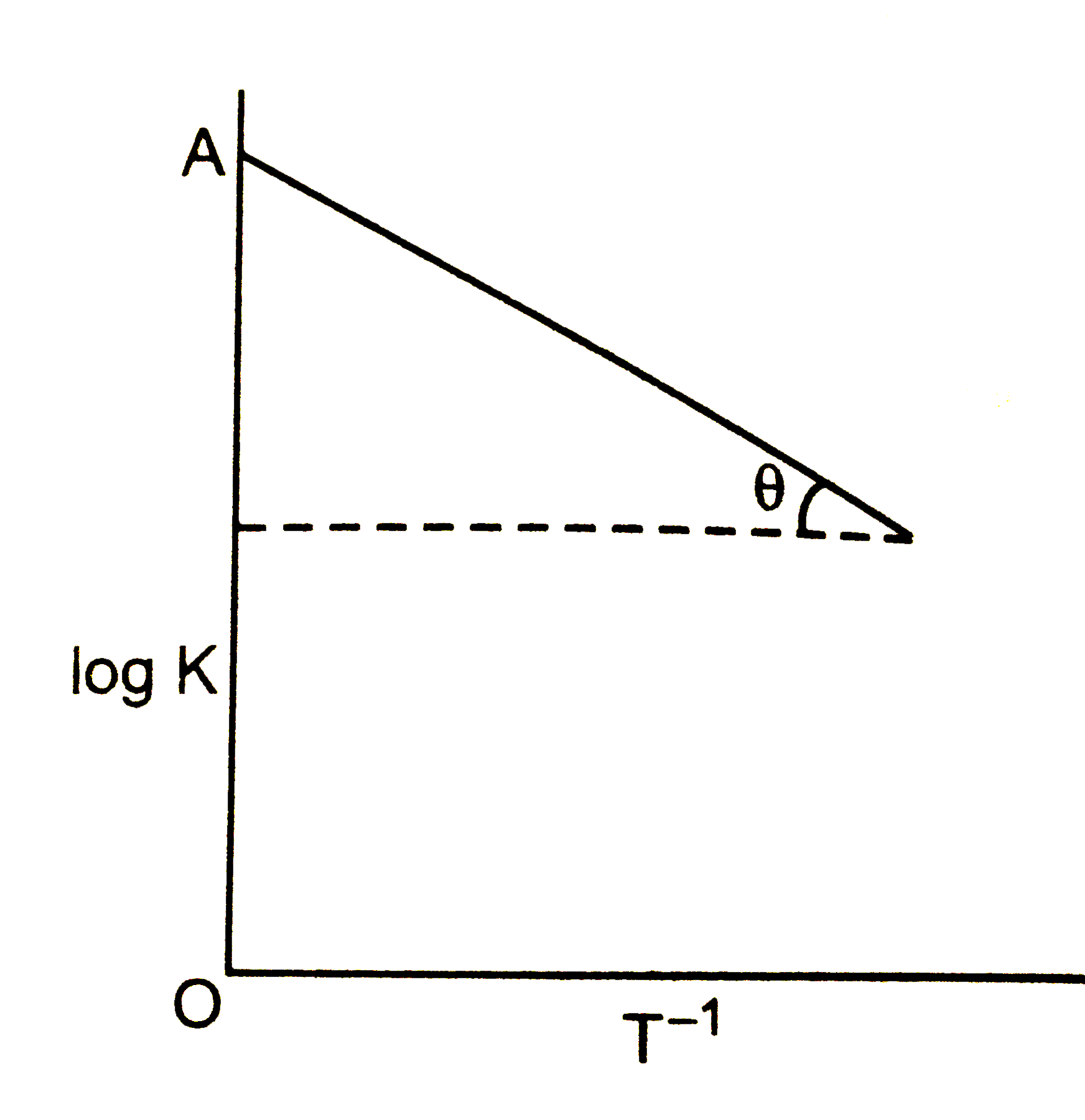
|
|
| 47. |
For a hypothetical hydrogen like atom, the potential energy of the system is given by U(r) = (-Ke^2)/(r^3) ,where r is the distance between the two particles, If Bohr.s model of quantization of angular momentum is applicable then velocity of particle is given by: |
|
Answer» `v= (n^2 h^3)/(Ke^2 8 pi^3 m^2)` `therefore (3Ke^2)/(r^4) = (mv^2)/(r)` and we KNOW mvr `=(nh)/(2PI) ` or `r= (nh)/(2pin.v)`, `3Ke^2 XX(8pi^3m^3 v^3)/(n^3 h^3) = mv^2 , v=(n^3 h^3)/(24ke^2 pi^3 m^2)` |
|
| 48. |
For a hydrogen -like particle, derive the expression : v_(n) = ((Ze^(2))/(mr_(n)))^(1//2) where v_(n) is the velocity of the electron at distance r_(n) from the nucleus, Z is the atomic number of the H-like particles, m and e are the charge and mass of the electron. |
| Answer» Solution :For H-like particle, FORCE of ATTRACTION between the electron and the nucleus = centrifugal force i.e., `(Ze^(2))/(r_(n)^(2)) = (mv_(n)^(2))/(r_(n)) or v_(n)^(2) = (Ze^(2))/(mr_(n)) or v_(n) = ((Ze^(2))/(mr_(n)))^(1//2)` | |
| 49. |
For a homogeneous gaseous reaction, 2A(g)+3B(g)hArr4C(g)+D(g),K_(eq)=(8)/(1.5)^(3) If in a 2 litre rigid container starting with 4 moles of A and 6 moles of B equilibrium was established then identify the options which is/are correct. |
|
Answer» CONCENTRATION of B at equilibrium is 1.5M. |
|