

Saved Bookmarks
This section includes 7 InterviewSolutions, each offering curated multiple-choice questions to sharpen your Current Affairs knowledge and support exam preparation. Choose a topic below to get started.
| 1. |
Giving suitable reasons, predict the sign of entropy change ( DeltaS)for the following: (i) sublimation of ammonium chloride(ii) NH_(4)NO_(3)(s) overset(Delta)(rarr) N_(2)O(g) + 2H_(2)O(g) |
|
Answer» |
|
| 2. |
Glacial Acetic acid is |
|
Answer» Pure acetic acid at `100^(@)C` |
|
| 3. |
Giving proper justification categorise the following molecules/ions as nucleophile or electrophile : HS^(-), BF_(3), C_(2)H_(5)O^(-), (CH_(3))_(3)N, Cl^(+), CH_(3)overset(+)(C) = O, H_(2)N:^(-), overset(+)(N)O_(2). |
|
Answer» SOLUTION :(i) Nucleophiles : `Hunderset(..)overset(..)(S):^(-), C_(2)H_(5)UNDERSET(..)overset(..)(O):^(-), (CH_(3))_(3)N:, H_(2)overset(..)(N):^(-)` All these species have one or more lone pairs of electrons which it can easily donate to an ELECTROPHILE and hence behave as nucleophiles. (ii) Electrophiles : `BF_(3), Cl^(+), CH_(3)overset(+)(C) = O, overset(+)(N)O_(2)` All the POSITIVELY charged species have a sextet of electrons around the positively charged atom and hence can accept a pair of electrons and them behave as electrophiles. Similarly, B has only a sextet of electrons in the valence shell and hence `BF_(3)`, though neutral, also ACTS as an electrophile. |
|
| 4. |
Giving justification, catogories the following species as Nuclophile or Electrophile . (i) SO_(3) (ii) C_(2)H_(5)O |
|
Answer» SOLUTION :(i) `SO_(3)`- Electoplite, because it is an electron deficient and accepts a pair of electrons. (II) `C_(2)H_(5)O`- Nucleophile because it is electron rich and donates electrons. |
|
| 5. |
Giving justification categories the following molecules/ions as nucleophile or electrophile: HS^(-), BF_(3), C_(2)H_(5)O^(-), (CH_(3))_(3)N, C overset(+)(1), CH_(3) overset(+)(C )= O, H_(2)N^(-), overset(+)(N) O_(2) |
|
Answer» Solution :NUCLEOPHILES: `H ul(S)^(-), C_(2)H_(5) ul(O)^(-), (CH_(3))_(3) ul(N), and H_(2) ul(N)^(-)`: These speciees have unshared PAIR of electrons, which can be donated and shared with an electrophile. Electrophiles: `ul(B)F_(3), ul(C ) overset(+)(1), H_(bar(3)) ul(C )^(+)= O,ul(overset(+)(N))O_(2)` Reactive sites have only six valence electrons, can accept electron pair from a nucleophile. |
|
| 7. |
Given,H_(s)(g)=2H(g)Delta_(H-H)=103kcalmol^(-1) CH_(4)(g)=CH_(3)(g)+H(g)Delta_(CH_(3)-H)=103kcalmol^(-1) The heat of reaction of CH_(4)(g) = CH_(3)(g)+ H(g) |
|
Answer» `103Kcalmol^(-1)` `D_(CH_(3-H))=103"KCALMOL"^(-1)` `H(g)+H(g)=H_(2)(g)` `(D_(H-H)=-103Kcalmol^(-1))/(Ch_(4)(g)+H(g)=CH_(4)(g)+H_(2)(g))` `DeltaH=103-103=0` |
|
| 8. |
Given: Which of the given compounds can exhibit tautomerism? |
|
Answer» II and III (I) ln keto-enol tautomerism, `alpha- H` PARTICIPATES 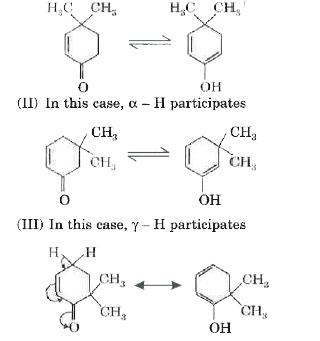
|
|
| 9. |
Given van der Waals' constant for NH_3, H_2, O_2 " and " CO_2 " are respectively " 4.17, 0.244, 1.36 " and " 3.59, which one of the following gases is most easily liquefied? |
|
Answer» `NH_3` |
|
| 10. |
Given van der Waals constant for NH_3, H_2, O_2and CO_2are respectively 4.17, 0.244, 1.36 and 3.59, which one of the following gases is most easily liquefied ? |
|
Answer» `CO_2` |
|
| 11. |
Given two unfair assumptions of Kinetic theory of gas. Justify them. |
|
Answer» Solution :We find that two assumptions of the kinetic theory do not hold good. There is no force of attraction between the molecules of a GAS : If assumption is CORRECT, the gas will NEVER liquify. However, we know that GASES do liquify when cooled and compressed. Also, liquids formed are very difficult to compress. This means that forces of repulsdion are powerful enough ad prevent squashing of molecules in tiny volume. `therefore` There must be attraction force present between molecules of gases. Volume of the molecules of a gas is negligibly small in comparison to the space occupied by the gas : If assumption is correct, the presure vs volume graph of experimental DATA (real gas) and that theoretically calculated from Boyle.s law (ideal gas) should coincide But such thing is not possible so Assumptions are unfair. |
|
| 12. |
Given two mixtures: (I) NaOH and Na_(2)CO_(3) and (II) NaHCO_(3) and Na_(2)CO_(3). 100 mlof mixture I required w and x ml of 1 M HCl is separate titrations using phenophthalein and methyl orange indicators while 100 ml of mixture II required y and z ml of same HCl solutioni in separate titrations using the same indicators. |
|
Answer» `Na_(2)CO_(3)` = b m. moles and mixture II has `NaHCO_(3)` = C m.moles `Na_(2)CO_(3)` = d m.moles Mixture-I titration : Phenolphthalein : EQ HCl = eq. `NaOH+(1)/(2)` eq.`Na_(2)CO_(3)` `W=a+b` Methyl orange : eq. HCl = eq. NaOH + eq. `Na_(2)CO_(3)` `x=a+2b` `impliesa=2w-ximplies[NaOH]=(2w-x)/(100)M` `b=x-wimplies[Na_(2)CO_(3)]=(x-w)/(100)M` Mixture II Titration : Phenolphthalein : eq. `HCl=(1)/(2)` eq. `Na_(2)CO_(3)` `y=d` Methyl orange : eq. HCl = eq. `NaHCO_(3)+` eq. `Na_(2)CO_(3)` `z=c+2d` `IMPLIES d=yimplies[Na_(2)CO_(3)]=(y)/(100)M` `c=z-2dimplies[NaHCO_(3)]=(z-2y)/(100)M` |
|
| 13. |
Given three acids The order of ease of acid catalysed esterification is |
|
Answer» `I gt III gt II` |
|
| 14. |
Given the standard electrode potentials L^(+)//K =-2.93V,Ag^(+)//Ag=0.80 V ,Hg^(2+)//Hg=0.79V,Mg^(2+)//Mg=-2.37V Cr^(3+)//Cr=-0.74 V Arrange these metals in increasing order of their reducing power |
| Answer» Solution :Lower the electrode potentialbetter is thereducing agent since the electrode POTENTIAL increase in the order `K^(+)//K(-2.93 V)MG^(2+)//Mg(-2.37 V),Cr^(3+)//Cr(-074 V),F^(2+)//Hg(0.79V ),Ag^(+)//Ag(0.80 V)`therefore oreducing power of METALS decrases in the same order i.e k, Mg , Cr Hg ,Ag | |
| 15. |
Given the standard electrode potentials , K^(+)//K = - 2.93 V , Ag^(+) // Ag = 0.80 V , Hg^(2+) // Hg = 0.79 V Mg^(2+)//Mg = -2.37 V. Cr^(3+)//Cr = - 0.74 V arrange these metals in their increasing order of the reducing power . |
| Answer» SOLUTION :`AgltHgltCrltMgltK` | |
| 16. |
Given the standard electrode potentials, K^(+)//K=-2.93V,Ag^(+)//Ag=0.80V Hg^(2+)//Hg=0.79V Mg^(2+)//Mg=-2.37V,Cr^(3+)//Cr=-0.74V arrange these metals in their increasing order of reducing power. |
|
Answer» SOLUTION :As reduction potential is more POSITIVE, then it is STRONG reducing agent. Increasing reduction potential series is : `K^(+)//K(-293V),Mg^(+2)//Mg(-2.37V),Cr^(3+)//Cr(-0.74V),Hg^(+2)//Hg(0.79V),Ag^(+)//Ag(0.80V)` Increasing order of reducing power is as under : Ag, Hg, Cr, Mg, k |
|
| 17. |
Given the standard electrode potentials , K^(+)|K=-2.93V, Ag^(+) |Ag=0.80V, Hg^(2+)|Hg=0.79V Mg^(2+)|Mg=-2.37V, Cr^(3+) |Cr=-0.74V arrange these metals is their increasing order of reducing power . |
| Answer» Solution :`Ag^(+)|,Ag,Hg^(2+)|HA, CR^(3+)|Cr, Mg^(2+)|Mg, K^(+)|K` | |
| 18. |
Given the standard electrode potentials K^+//K= -2.93V, Ag^+//Ag = +0.8V, Hg^(2+)//Hg= 0.79 V, Mg^(2+)//Mg = -2.36V Cr^(3+)//Cr = 0.74 V Arrange them in increasing order of reducing power. |
| Answer» SOLUTION :Lower the electrode POTENTIAL, BETTER is the reducing POWER. Hence the reducing power decreases in the order `KgtMg gtCrgtHg GTAG` | |
| 19. |
Given the relationship between the molar volume of a gas and its molar mass. |
|
Answer» <P> Solution :According to charles LAW ` Vprop(t+273)` at constant P and N. |
|
| 20. |
Given the relation between enthalpy (H) and internal energy (U). |
|
Answer» Solution :H = U + PV Considering the initial and FINAL STATES of H U and V as `H_(1) , U_(1) and V_(1) and H_(2) , U_(2) and V_(2) ` CHANGE in ENTHALPY is `(H_(2)-H_(1)) = (U_(2)-U_(1)) +P(V_(2)-V_(1)) ` `Deltah = DeltaU+PDeltaV` |
|
| 21. |
Given the relation between Bohr radius (r) and the de Broglie wavelength (lamda) |
|
Answer» Solution :Quantisation of angular momentum and de - Broglie concept: the According to the de - Broglie concept , the election that revolves around the nucleus exhibits both particle and wave character, in order for the electionwave to exist in phase, the circumference of the ORBIT should be an integral multiple of the WAVELENGTH of the electron wave. Otherwise,. The electron wave is out of phase. Circumference of the orbit ` =nlamda` `2pir=nlamda ""...(1)` `2pir=nh//mv""...(2)` Rearranging,`mvr =nh//2pi` Angular momentum `=nh//2pi` The above equation was ALREADY predicted by Bohr, Hence, de - Broglie and Bohr'sconcepts are in agreement with each other. |
|
| 22. |
Given the reaction of sodium ethyne. |
| Answer» SOLUTION :`H-C-=C-Hoverset(NA)rarrH-C-=C-Naoverset(Na)rarrNa-C-=Na` | |
| 23. |
Given the numbers : 786, 0.786 and 0.0786 cm. The number of significant figures for the three numbers is : |
| Answer» Answer :B | |
| 24. |
Give thenumber of electron in thespeciesH_(2)^(+)H_(2) andO_(2 )^(+) |
|
Answer» SOLUTION :The numberof ELECTRONS in `H_(2)^(+) = (2-1) =1` The numberof electronsin` H_(2)=2` the numberof electrons in `O_(2)^(+)= (8+8 -1)=15` |
|
| 25. |
Given the number : 161 cm, 0.161 cm and 0.0161 cm. The no. of significant figures for the three numbers are |
|
Answer» 3,4,5 |
|
| 26. |
Given : The mass of electron is 9.11 xx 10^(-31) kg, Planck constant is 6.626 xx 10^(-34) J, the uncertainty involved in the measurement of velocity within a distance of 0.1 Å is |
|
Answer» `5.79 xx 10^(8) ms^(-1)` |
|
| 27. |
Given the mathematical expression that relates gas volume and moles. Describe in words what the mathematical expression means. |
|
Answer» Solution :(i) The mathematical relationship between the VOLUME of a gas and the number of moles is `V prop n` (ii) `(V_(1))/(n_(1)) = (V_(2))/(n_(2))` = constant, where `V_(1) and n_(1)` are the volume and number of moles of a gas and `V_(2) and n_(2)` are the value of volume and number of moles of same gas at a DIFFERENT set of conditions. (III) If the volume of the gas increase then the number of moles of the gas also INCREASES. (iv) At a certain temperature and PRESSURE, the volume of a gas is directly proportional to the number of the moles of the gas. |
|
| 28. |
Given the following thermochemical equations : (i) S( rhombic ) + O_(2)(g) rarr SO_(2)(g) , Delta H = - 297.5 kJ mol^(-1) (ii) S ( monoclinic) + O_(2) rarrSO_(2)(g) , Delta H = - 300.0 kJ mol^(-1) Calculate Delta Hfor the transformation of one gram atomof rhombicsulphur into monochlinic sulphur. |
|
Answer» Solution :We aim at`:`S ( RHOMBIC ) `rarr ` S ( MONOCLINIC) , `Delta H = ?` EQUATION (i) - Equation(II) gives S ( rhombic ) - S ( monoclinic ) ` rarr 0 , Delta= 297.5 - ( - 300.0) = 2.5 kJ mol^(-1)` or S( rhombic ) `rarr ` S ( monoclinic ) , `Delta H = + 2.5 kJ mol^(-1)` Thus, for the transformation of one gram atom of rhombic sulphur into monoclinicsulphur, `2.5 kJ mol^(-1)` of heat is ABSORBED. |
|
| 29. |
Given: The heat of sublimation of K(s) is 89 kJ mol^(-1). K(g) rarrK^(o+)(g)+e^(-), DeltaH^(Theta) = 419 kJ F_(2)(g) rarr 2F(g),DeltaH^(Theta) = 155 kJ The lattice enegry of KF(s) is -813kJ mol^(-1), the heat of formation of KF(s) is -563 kJ mol^(-1). the E_(A) of F(g) is |
|
Answer» `-413` Heat of sulmiation of `K(s)` `K(s) rarr K(v),Delta_("sub")H^(Theta) = 89 kJ mol^(-1)` Heat of ionisation `K(g) rarr K^(o+) (g) +e^(-),Delta_(i)H^(Theta) = 419 kJ mol^(-1)` Heat of atomisation of `F_(2)` `F_(2)(g) rarr 2F(g),Delta_(a)H^(Theta) = 155 kJ mol^(-1)` LATTICE enegry `Delta_(U)H^(Theta) =- 813 kJ mol^(-1)` Heat of formation `Delta_(f)H^(Theta) =- 563 kJ mol^(-1)` [Heat of electron affinify of `F(g) = ?]` `:. Delta_(f)H = Delta_("sub")H^(Theta) +Delta_(lie)H^(Theta) +(1)/(2)Delta_(a)H^(Theta) +Delta_(E_(A))H^(Theta) +Delta_(i)H^(Theta)` or `Delta_(E_(A))H^(Theta) = Delta_(f)H - Delta_("sub")H^(Theta) - Delta_(i)H^(Theta) - (1)/(2)Delta_(a)H^(Theta) - Delta_(i)H^(Theta)` Substituting all the VALUES: `Delta_(E_(A))H^(Theta) =- 563 - 89 - 419 - (155)/(2)+813.0` `~~-336 kJ mol^(-1)` |
|
| 30. |
Given the following infonnation of magnesium oxygen, and magneisurn oxide calculate the second electron gain enthalpy for oxygen {i .e. for O- (g)+c^(-) rarr O^(2-)(g)] for Mg(s)DeltaH_(sab)= +148 kJ//mol "" bond dissociation energy for O_(2) = +499kj/mol 1^(st) ionization energy for Mg = +738 kJ/mol"" 1^(st) electron gain enthalpy for O = - 141 kJ/mol 2^(nd) ionization energy for Mg = +1450 kJ/mol"" for MgO (s), lattice energy = +3890kJ/mol for MgO(s), enthalpy of formation =-602kJ/mol |
| Answer» SOLUTION :+844 kJ/mol | |
| 31. |
Given the following empirical formula and molecular weight, compute the true molecular formulae : {:(,,"Empirical formula","Molecular weight"),((a),,""CH_(2),""84),((b),,""CH_(2)O,""150),((c),,""HO,""34),((d),,""HgCl,""472),((e),,""HF,""80):} |
|
Answer» |
|
| 32. |
Given, the enthalpy of formation of MgCl_((s)) is -125 kJ mol^(-1) and the entahpy of formation of MgCl_(2(s)) is-642kJ mol^(-1). Predict whether MgCl will undergodisproportionnation or not? If yes, calculate the enthalpy of disproportion. |
|
Answer» Solution : Given, (a). `Mg_((s))+(1)/(2)Cl_(2(g))rarrMgCl_((s)) ,DeltaH_(1)^(Θ)=-125 KJ mol^(-1)` (b). `Mg_((s))+Cl_(2(g))rarrMgCl_(2(s)),DeltaH_(2)^(Θ)=-642 kJ mol^(-1)` (C ). Disproportionation of `MgCl` is `OVERSET((1+))(2MgCl_((s)))rarroverset((2+))(MgCl_(2(s)))+overset((0))(Mg),DeltaH_(3)^(Θ)=?` `:.DeltaH_(3)^(Θ)=DeltaH_(2)^(Θ)-2DeltaH_(1)^(Θ)` `=[-642-2(-125)]kJ mol^(-1)` `=-392 kJ mol^(-1)` Since the enthalpy of dispropotionation is exothermic and much higher compared to the formation of `MgCl_((s))`, therefore, `MgCl_((s))` will redily undergo disproportionation reaction. Enthalpy of disproportionationof `MgCl_((s))=392 kJ mol^(-1)`. STATEMENT: Alkani nearth metals do not exhibit an oxidation state of `+3` in their compounds or `MX_(3)` type of compounds are not known. Explanation: For the formation of `M^(3+)` ION, the third electron has to be removed from an INERT gas core, which ishighly stable. `underset(["Noble gas"]ns^(2))(M_((g)))overset(IE_(1))underset(-e^(Theta))rarr underset(["Noble gas"]ns^(1))(M^(o+))overset(IE_(2))rarr underset(["Noble gas"]ns^(0))(M^(2+))` Third third ionisation energy of therse elements is too high to allow the formation of `M^(3+)`. Hence, `MX_(3)` type of compounds are not known. |
|
| 33. |
Given the enthalpy changes: A+BtoC DeltaH=-35KJxxmol^(-1) A+DtoE+FDeltaH=+20KJxxmol^(-1)Fto C+EDeltaH=+15KJxxmol^(-1) What is DeltaHfor the reaction 2A+B+Dto2F ? |
|
Answer» `0KJ.mol^(-1)` |
|
| 34. |
Given the end product of the following reaction sepuence : |
|
Answer»

|
|
| 35. |
Given the electronic configurations of the ions : (i) H^(-1) (ii) Na^(+) (iii) N^(-1) (iv) N^(2+) |
| Answer» Solution :(i) `1S^(2)` (ii) `1s^(2) 2s^(2) 2p^(6)` (iii) `1s^(2) 2s^(2) 2p^(4)` (iv) `1s^(2) 2s^(2) 2p^(1)` | |
| 36. |
Given The decreasing order of their acidic character is |
|
Answer» `I GT II gt III` |
|
| 37. |
Given that van der Waals constant for NH_(3), H_(2),O_(2) and CO_(2) are respectively 4.17, 0.244, 1.36 and 3.59. Which one of the following gases is most easily liquefied ? |
|
Answer» `NH_(3)` |
|
| 38. |
Giventhat the solubility product of BaSO_(4) is 1xx10^(-10). Will a precipitate form when (i) Equal volumes of 2xx10^(-3)M BaCl_(2) solution and 2xx10^(-4) M Na_(2)SO_(4) solution are mixed ? (ii) Equal volumes of 2xx10^(-8) MBaCl_(2) solution and 2xx10^(-3)M Na_(2)SO_(4) solution are mixed ? |
|
Answer» Solution : (i) `BaCl_(2)` ionizes completely in the solution as : `BaCl_(2) rarr Ba^(2) + 2 Cl^(-) :. [Ba^(2+)]=[BaCl_(2)]=2xx10^(-3)M` (Given) `Na_(2)SO_(4)` ionizes completely in the solution as : `Na_(2)SO_(4) rarr 2Na^(+)+SO_(4)^(2-) :. [SO^(4)^(2-) :. [SO_(4)^(2-)] = [ Na_(2)SO_(4)]=2xx10^(-4)M` (Given) Since equal volumes of the two solutions are mixed together, therefore, the concentrations of `Ba^(2+)` ions and `SO_(4)^(2-)` ions after mixing will be `[Ba^(2+)]=(2xx10^(-3))/(2) = 10^(-3) M and [SO_(4)^(2-)]=(2xx10^(-4))/(2) = 10^(-4)M` `:. ` Ionic PRODUCT of `BaSO_(4) = [ Ba^(2+)][SO_(4)^(2-)]=10^(-3)xx10^(-4)=10^(-7)` which is greater than the solubility product `(1xx10^(-10))` of `BaSO_(4)` . Hence, a precipitate of `BaSO_(4)` will be FORMED. (ii) Here, the concentrations before mixing are : `[Ba^(2+)]=[BaCl_(2)]=2xx10^(-8) M ` (Given), `[SO_(4)^(2-)]=[Na_(2)SO_(4)]=2xx10^(-3)M ` (Given) `:.` Concentrations after mixing equal volumes willbe : `[Ba^(2+)]= (2xx10^(-8))/(2) = 10^(-8)M and [SO_(4)^(2-)] = (2xx10^(-3))/(2) = 10^(-3) M` `:.` Ionic product of `BaSO_(4) = [ Ba^(2+)][SO_(4)^(2-)]=10^(-8) xx 10^(-3)=10^(-11)` which is less than the solubility product `(1xx10^(-10))`. Hence, no ppt. will be formed in this case. |
|
| 39. |
Given that the solubility product of radium sulphate (RaSO_(4)) is 4xx10^(-11). Calculate the solubility in (a) pure water (b) 0.10 M Na_(2)SO_(4). |
|
Answer» |
|
| 40. |
Given that the data for neutralization of a weak acid (HA) and strong acid with a strong base is: HA +OH^(-) rArr A^(-) + H_(2)O: DeltaH = -41.80kJ , H^(+) + OH^(-) rArr H_(2)O, Delta H= -55.90kJ The enthalpy of dissociation of weak acid would be |
|
Answer» `-97.20kJ` GIVEN reactions are `HA + OH^(-) rarr A^(-) + H_(2)O` …(2) `H^(+) + OH^(-) rarr H_(2)O` …(3) (eq. (1) = Eq. (2) - Eq(3) `Delta H = - 41.80 - (-55.90) = 14.10` |
|
| 41. |
Given that the co-volume of O_(2) gas is 0.318 L mol^(-1). Calculate the radius of O_(2) molecule. |
|
Answer» Solution :26 K or `52.85^(@)C` `V=5dm^(3)` `P=10.0` BAR `b=0.0564Lmol^(-1)` `a=6.7` bar `L^(2)mol^(-2)` is `n=(w)/(M)=(128)/(64)` `triangleT=((P+(an^(2))/(V))(V-nb))/(RN)` |
|
| 42. |
Given that the bond energies of H - H and CI - CI are 430 kJ"mol"^(-1) and 240 kJ"mol"^(-1) respectively and Delta_(f)H for HCI is -90 kJ"mol"^(-1), bond enthalpy of HCI is |
|
Answer» `254 kJ"mol"^(-1)` `DeltaH = 1/2 B.E.(H-H) + 1/2B.E(CI - CI) - B.E.(H- ci)` `-90 = 1/2(430) + 1/2(240) - B.E (H - CI)` `therefore B.E.(H - CI) = 215 + 120+ 90 = 425 kJ"mol"^(-1)` |
|
| 43. |
Given that the abundance of isotopes ""^(54)Fe,""^(56)Fe and ""^(57)Fe are 5%, 90% and 5% respectively, the atomic mass of Fe is |
|
Answer» `55.85` |
|
| 44. |
Given that S_((s)) + 3/2 O_(2(g)) rarr SO_(3(g)) + 2xK.cal SO_(2(g)) + ½ O_(2(g)) rarr SO_(3(g)) + y K.Cal. Which would be the enthalpy of formation SO_2 ? |
|
Answer» `(2X-y)` |
|
| 45. |
Given that ""^(r)Ca^(2+) = 114pm and""^(r)CO_(3)^(2-) = 185pm , calculate the lattice energy ofCa CO_(3). |
|
Answer» Solution :ApplyingKapustinskii equation `U_(L) = 120250 ((v*|z_(+)|*|z_(-) |)/(d)) (1 - (34.5)/(d))` Where v = No. of ions per formula UNIT ` Z_(+), Z_(-) = `CHARGE on the cation and anion respectively `d = r_(+) + r_(-)`, i.e., SUM of ionic radii in pm `U_(L)` = LATTICE ENERGY in kJ `mol^(-1)` Here,` v = 2 , z_(+) = + 2, z_(-) = - 2, z_(-) = 2 , i.e., |z_(+)| = 2 , |z_(-)| = 2 ` ` d = r_(+) + r_(-) = 144 + 185 = 299 pm` `U_(L) = 120250 ((2xx2xx2)/(299))(1 - (34.5)/(299)) = 2846 " kJ mol "^(-1)`. |
|
| 46. |
Given N_(2)(g)+3H_(2)(g)to2NH_(3)(g),Delta_(r)H^(theta)=-92.4 kJ mol^(-1) What is the standard enthalpy of formation of NH_(3) gas ? |
| Answer» ANSWER :D | |
| 47. |
Given that N_2(g)+3H_2(g)rarr2NH_3 Delta_rHtheta=-92.4 What is the sandard enthalpy of formation of NH_3 gas? |
|
Answer» SOLUTION :`DeltaH^0` for the FORMATION of 2 moles of `NH_3` from its ELEMENTS=-92.4 KJ`therefore` `DeltaH^0` for the formation of 1 mole of `NH_3` from its elements (i.e. standard enthalpy of fromation of `NH_3`=92.4/2=-46.2 kJ mol^-1` |
|
| 48. |
Given that (i) C( graphite) + O_(2)(g) rarr CO_(2)(g) , Delta H = - 393 .7 kJ mol^(-1) (ii) C ( diamond) rarrC ( graphite ) , Delta H= - 2.1 kJ mol^(-1) (a) Calculate Delta Hfor burning of diamond toCO_(2) (b) Calculate the quantityof graphite that must be burnt to evolve 5000 kJ of heat |
|
Answer» (b) 393.7 KJ of HEATIS producedfrom graphite `= 12G` `:.` 5000kJ of heat will be producedfrom graphite `=(12)/( 393.7) xx5000g = 152.4g` |
|
| 49. |
Given that (i)O(g) + e^(-) rarr O^(-)(g) ,DeltaH= -142kJ mol^(-1) (ii) O(g) + 2e^(-)rarr O^(-2) (g), DeltaH = + 712 kJ mol^(-1) Calculate DeltaH for the reaction O^(-)(g) +e^(-) rarr O^(-2) (g). |
| Answer» Solution :Eqn. (II) - Eqn. (i) gives `O^(-)(g) + e^(-) rarr O^(2-) (g), Delta H =712-( - 142) kJ mol^(-1) = 854 kJ mol^(-1)` | |
| 50. |
Given that for He^(+) ion, the difference between the longest wavelength line of Balmer series and Lymen series is 133.8 nm, calculate the value of Rydberg constant. |
|
Answer» Solution :For H-like PARTICLE. `bar(v) = (1)/(lamda) = RZ^(2) ((1)/(n_(1)^(2)) - (1)/(n_(2)^(2)))` where R is Rydberg constant For `He^(+), Z = 2` and for LONGEST wavelength line of Balmer series, `n_(1) = 2, n_(2) =3`. Hence, `(1)/(lamda_("Balmer")) = R (2)^(2) ((1)/(2^(2)) - (1)/(3^(2))) = 4R ((1)/(4) - (1)/(9)) = 4R xx (5)/(36) = (5R)/(9) or lamda_("Balmer") = (9)/(5R)` For longest wavelength in Lyman series, `n_(1) =1, n_(2) = 3=2`. Hence, `lamda_("Lyman") = R (2)^(2) ((1)/(1^(2)) - (1)/(2^(2))) = 4R (1 - (1)/(4)) = 4R xx (3)/(4) = 3R or lamda_("Lyman") = (1)/(3R)` Given `lamda_("Balmer") - lamda_("Lyman") = 133.8 xx 10^(-9)m` `:. (9)/(5R) - (1)/(3R) = 133.8 xx 10^(-9) or (1)/(R) ((9)/(5) - (1)/(3)) = 133.8 xx 10^(-9)` or `(1)/(R) xx (22)/(15) = 133.8 xx 10^(-9) or R = (22)/(15) xx (1)/(133.8 xx 10^(-9)) = 1.0961 xx 10^(9) m^(-1)` |
|


